- Product Description Description
- Table of Contents TOC
- List of Table & Figure LOT
- Get Free Sample PDF Sample PDF
Market Size, 2025
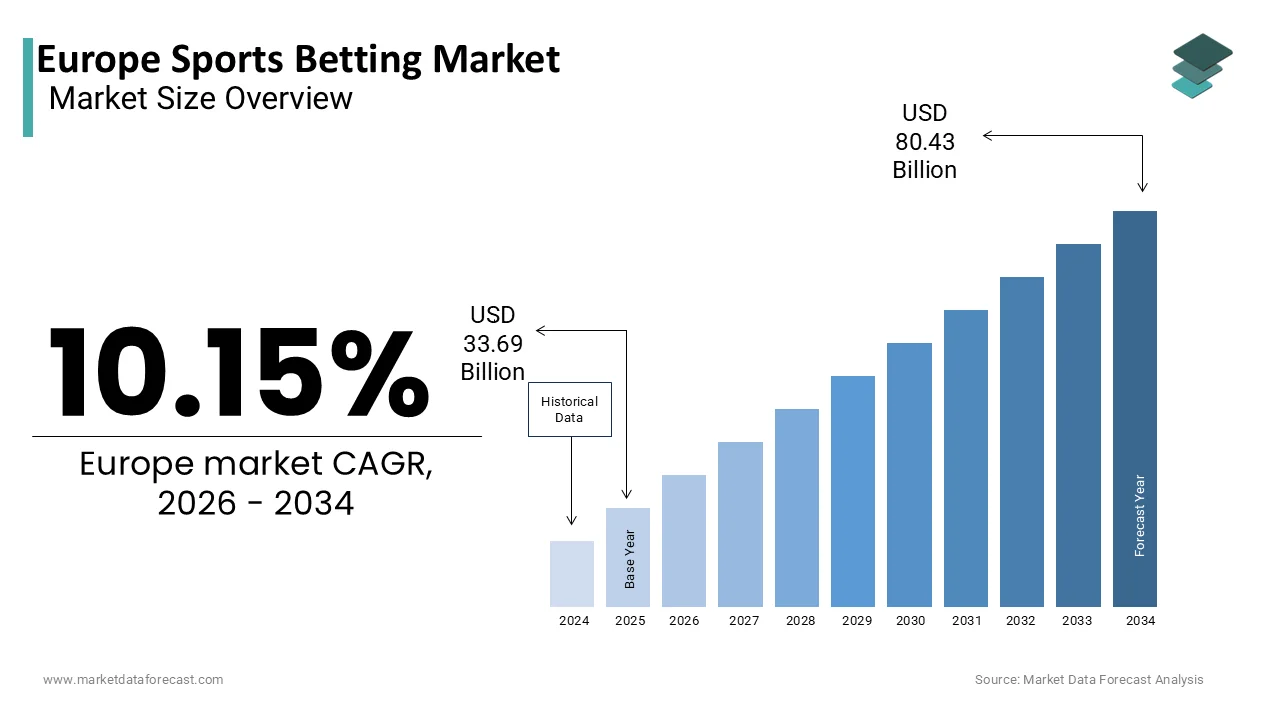
$33.69 BnMarket Estimate, 2026
$37.11 BnMarket Forecast, 2034
$80.43 BnCAGR, 2026–2034
10.15%Europe Sports Betting Market Size
The europe sports betting market was valued at USD 33.69 billion in 2025, is estimated to reach USD 37.11 billion in 2026, and is projected to reach USD 80.43 billion by 2034, growing at a CAGR of 10.15% from 2026 to 2034.
Sports betting is legally sanctioned and digitally enabled wagering activities on athletic contests, ranging from football and tennis to esports, conducted through licensed operators under national regulatory frameworks. The sector has evolved from traditional retail bookmaking to a predominantly online model, driven by smartphone penetration and real-time data analytics. According to the European Commission, 24 out of 27 EU member states maintain specific licensing regimes for remote sports betting, reflecting widespread institutional recognition of its economic and social dimensions. Furthermore, the Council of Europe’s 2023 report on match fixing indicates that 19 European countries now mandate betting operators to share suspicious transaction data with national sports integrity units. This regulatory maturity, combined with deep cultural engagement in sports, as evidenced by UEFA’s 2023 finding that 63% of Europeans follow football weekly, positions the continent as a global benchmark for balanced, innovation-led sports betting governance.
MARKET DRIVERS
Deep Cultural Integration of Football and Mass Spectator Sports
Football’s unparalleled cultural resonance is escalating the growth of Europe's sports betting market. The sport commands weekly viewership from over 300 million Europeans, with domestic leagues and continental tournaments like the UEFA Champions League generating consistent engagement cycles that fuel betting activity. National team tournaments amplify this effect. During the 2024 UEFA European Championship qualifiers, betting handle in Germany alone increased by 41% compared to non-tournament months, as per the German Gambling Authority. In the UK, the Premier League’s global broadcast reach translates into localized betting spikes, with over 12 million unique betting accounts placing football wagers in 2023, according to the UK Gambling Commission. This cultural embeddedness ensures a steady base of informed, emotionally invested consumers who view betting not merely as gambling but as an interactive extension of fandom. Operators capitalize on this by offering micro markets, such as next goal scorer or corner counts, that align with real-time viewing behavior, thereby deepening engagement and transaction frequency.
Proliferation of Mobile Internet and Real-Time Data Infrastructure
The near-universal availability of high-speed mobile internet has fundamentally transformed sports betting from an occasional retail activity into an on-demand digital experience, which is additionally propelling the growth of the European sports betting market. As per the European Electronic Communications Observatory, 92% of Europeans aged 16 to 74 used a mobile device to access the internet in 2024, with average 5G coverage exceeding 85% in urban areas of Western Europe. This connectivity enables instantaneous access to live odds, in-play betting, and personalized promotions during matches. The integration of real-time sports data feeds provided by entities like Sportradar and Genius Sports allows operators to offer dynamic markets that update within milliseconds of on-field events. According to the International Telecommunication Union, latency on European 5G networks averages under 15 milliseconds, making live betting technically seamless. In Spain, mobile sports betting accounted for 76% of total online wagering volume in 2023, as per the Dirección General de Ordenación del Juego. This infrastructure not only enhances user experience but also supports responsible gambling tools such as session timers and loss limits that function in real time.
MARKET RESTRAINTS
Stringent and Fragmented National Regulatory Frameworks
The absence of a unified regulatory regime, resulting in 27 distinct licensing, taxation, and operational requirements that impede scalability and compliance efficiencyy,y is majorly degrading the growth of the European sports betting market. While the European Court of Justice has affirmed the right of operators to seek cross-border market access, national regulators retain broad discretion to impose local conditions. According to the European Gaming and Betting Association, operators must navigate an average of 14 separate compliance obligations per country, including mandatory server localization, advertising bans, and player fund segregation rules. In Germany, the State Treaty on Gambling imposes a 5.3% turnover tax on all bets, while simultaneously restricting live betting to pre-approved events, resulting in a dual burden that reduced operator margins by an estimated 18% in 2023, as per the survey. Similarly, Italy’s AAMS requires all betting interfaces to be in Italian and blocks access to unlicensed offshore sites through ISP filtering, increasing customer acquisition costs. This regulatory patchwork discourages innovation, inflates operational overhead, and creates legal uncertainty for smaller operators lacking multinational compliance teams, thereby stifling market fluidity and competition.
Rising Incidence of Problem Gambling and Associated Public Health Concerns
The growing awareness of gambling-related harm is prompting European governments to impose restrictive measures that are also declining the growth of the European sports betting market. According to the European Monitoring Centre for Drugs and Drug Addiction’s 2024 behavioral addictions report, an estimated 0.8% of the adult population in Western Europe, approximately 2.1 million individuals, exhibit signs of problem gambling, with sports betting accounting for 34% of high-intensity cases. In response, countries are enacting aggressive harm minimization policies. France banned all sports betting advertising during live broadcasts in 2022, and the Netherlands requires mandatory self-exclusion registration for new accounts. These interventions, while socially necessary, reduce customer lifetime value, limit marketing reach, and increase operational friction by creating a structural headwind for revenue growth even in mature markets.
MARKET OPPORTUNITIES
Legalization of Online Sports Betting in Previously Closed Jurisdictions
The progressive opening of regulated online sports betting in historically restrictive countries is substantially prompting new opportunities for the growth of the European sports betting market. Nations such as Portugal and Greece have recently transitioned from monopolistic or prohibitionist models to competitive licensing systems, unlocking new consumer bases and investment flows. Similarly, Greece launched its first competitive online betting tender in 2024, attracting bids from major European operators and projected to increase state gambling revenue by 40%, according to the reports. These reforms are often accompanied by robust consumer protection frameworks that build public trust and encourage migration from unlicensed offshore sites estimated to handle 35% of Greek betting volume prior to regulation, as per a study.
Integration of Artificial Intelligence for Personalized and Safer Betting Experiences
The deployment of artificial intelligence to enhance both user engagement and responsible gambling protocols is also to promote new opportunities for the growth of the European sports betting market. Operators are leveraging machine learning models to analyze betting patterns, predict user preferences, and deliver hyper-contextual offers, such as dynamic odds boosts on a user’s favorite team, while simultaneously detecting early signs of problematic behavior. According to the European AI Office’s 2024 sectoral review, 68%of licensed betting operators in the EU now employ AI-driven player protection systems that flag anomalies like rapid stake escalation or extended session duration. In Denmark, the Danish Gambling Authority mandates that all licensees use certified AI tools to conduct real-time risk assessments, a policy credited with reducing high-risk accounts by 29% between 2022 and 2024. Furthermore, AI enables micro segmentation for marketing, improving conversion while adhering to strict advertising rules. As per the survey, AI adoption in betting has increased customer retention by up to 18% without increasing gambling intensity. This dual use of AI, as both a commercial and protective instrument, aligns with Europe’s emphasis on ethical technology and positions operators to thrive within tightening regulatory boundaries.
MARKET CHALLENGES
Persistent Threat of Match Fixing and Sports Integrity Breaches
The vulnerability to integrity threats stemming from match manipulation in lower-tier competitions with limited oversight is additionally hindering the growth of the European sports betting market. According to the Council of Europe’s 2024 Corruption in Sport Report, over 120 suspicious betting patterns were detected across European football leagues in 2023, with 63% linked to matches in the third division or below, where player salaries are low and external scrutiny is minimal. These incidents erode public trust and trigger regulatory backlash; following a 2023 match-fixing scandal in Romanian football, the government suspended all live betting on domestic leagues for six months, as per the study. The proliferation of micro betting markets, such as next corner or throw-in, creates additional vectors for manipulation, as these outcomes are easier to influence than match results. Although operators share data with bodies like the European Sports Security Association, legal barriers prevent real-time cross-border information exchange in some jurisdictions. This integrity gap not only risks reputational damage but also invites stricter state intervention, including market suspensions or technology bans, thereby undermining long-term market stability and investor confidence.
Intensifying Advertising Restrictions and Digital Platform Limitations
The sweeping advertising bans that severely curtail customer acquisition and brand visibility are also expected to degrade the growth of the European sports betting market in the coming years. Driven by public health concerns, countries are enacting near-total prohibitions on promotional activities. Spain’s 2023 Royal Decree bans all sports betting advertising across television, radio, social media, and sports venues, allowing only generic brand awareness campaigns during non-sports programming. According to the Spanish Association of Betting Operators, this reduced new customer registrations by 37% in the first six months of enforcement. Similarly, Italy prohibits bonuses and free bets, while Belgium requires all advertising to carry a mandatory harm warning occupying 20% of screen space. The European Commission’s 2024 Digital Services Act further empowers national regulators to delist betting apps from app stores if deemed harmful to minors. These restrictions disproportionately impact digital native operators that rely on performance marketing, forcing them to shift toward costlier and less measurable channels like sponsorships, now also under scrutiny. As per the European Advertising Standards Alliance, 14 EU countries have introduced new betting ad limitations since 2022 by creating a hostile environment for growth and innovation despite legal market status.
REPORT COVERAGE
| REPORT METRIC | DETAILS |
| Market Size Available | 2025 to 2034 |
| Base Year | 2025 |
| Forecast Period | 2026 to 2034 |
| Segments Covered | By Platform, Betting Type, and Region. |
| Various Analyses Covered | Global, Regional, and Country-Level Analysis, Segment-Level Analysis, Drivers, Restraints, Opportunities, Challenges; PESTLE Analysis; Porter’s Five Forces Analysis, Competitive Landscape, Analyst Overview of Investment Opportunities |
| Countries Covered | UK, France, Spain, Germany, Italy, Russia, Sweden, Denmark, Switzerland, Netherlands, Turkey, Czech Republic, Rest of Europe |
| Market Leaders Profiled | Flutter Entertainment plc, Entain plc, Bet365 Group Ltd., Kindred Group plc, 888 Holdings plc, William Hill (Caesars Entertainment), Betsson AB, LeoVegas AB (MGM Resorts), DraftKings Inc., PointsBet Holdings Ltd., Unibet (Kindred Group), Betway Group, Paddy Power (Flutter Entertainment), Ladbrokes (Entain plc), Bwin (Entain plc) |
SEGMENTAL ANALYSIS
By Platform Insights
The online platform dominated the Europe sports betting market in 2025 with a significant share. The growth of the segment is propelled by the emergence of digital infrastructure, consumer behavior shifts, and regulatory modernization that favors remote access over physical outlets. The proliferation of smartphones and high-speed mobile networks has enabled seamless, real-time wagering from any location, aligning with the on-demand expectations of modern consumers. As per the European Electronic Communications Observatory, 89% of Europeans aged 18 to 55 owned a smartphone in 2024, and average monthly mobile data consumption exceeded 18 gigabytes, facilitating continuous engagement with betting apps. The online model also supports advanced responsible gambling tools such as session limits and self-exclusion, which are more difficult to enforce in retail settings. This regulatory and technological alignment has rendered online betting not just convenient but institutionally preferred.
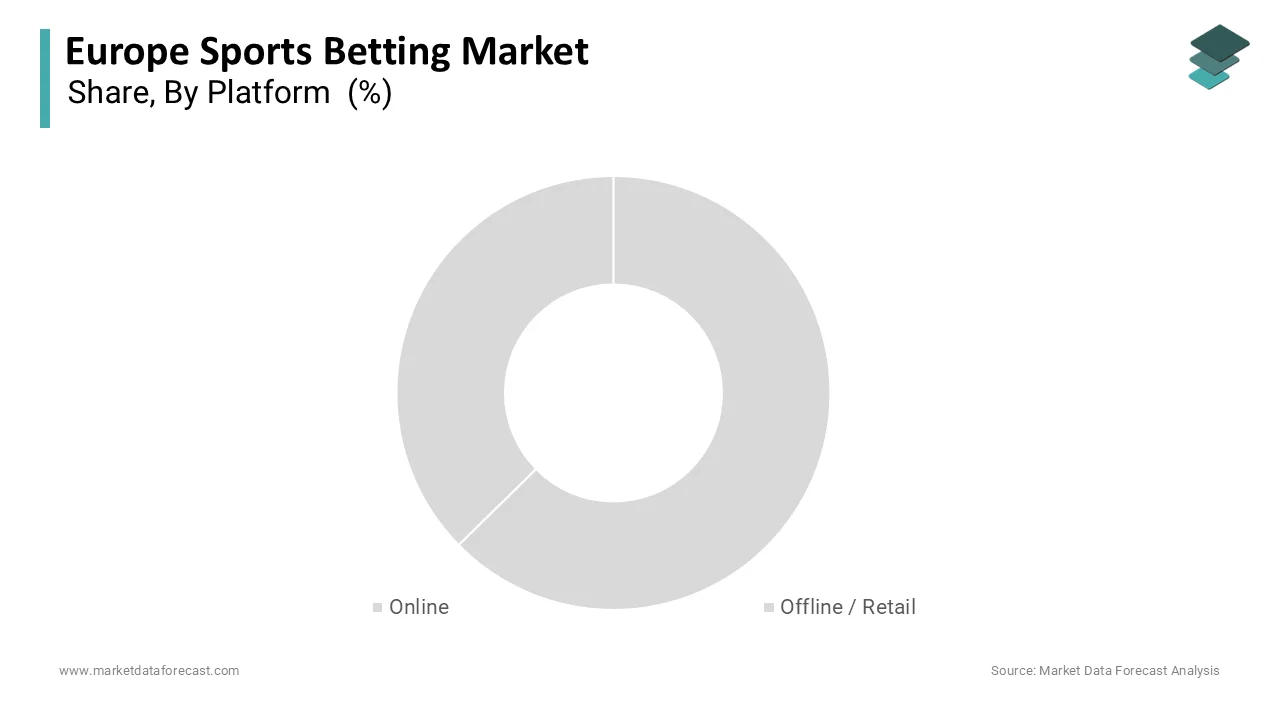
The online segment is projected to expand at a CAGR of 9.7% from 2026 to 2034, with the continuous innovation in user experience and the integration of live data ecosystems that transform passive viewers into active participants. Operators now offer hyper contextual in-play markets, such as next corner kick or player fouls that update in real time using feeds from certified data providers like Sportradar. According to the International Telecommunication Union, 5G network latency in Western Europe averages under 12 milliseconds by enabling near instantaneous bet placement during fast-paced matches. In Sweden, mobile sports betting transactions grew by 24% year on year in 2023 as per the Swedish Gambling Authority, driven by one-click betting features and personalized push notifications.
By Betting Type Insights
The fixed odds wagering segment was the largest by holding 53.2% of the European sports betting market in 2025 due to its simplicity, regulatory familiarity, and deep integration into mainstream sports culture across the continent. Fixed odds, where the payout is determined at the time of bet placement, offer transparency and predictability that appeal to both casual and seasoned bettors. National regulators widely recognize this model as low risk from an integrity standpoint, facilitating licensing and taxation. In the UK, the Gambling Commission reported that fixed odds bets constituted 68% of all football wagers in 2023, particularly on match outcomes and over under totals. The model also aligns with traditional retail betting shops, which remain culturally embedded in countries like Ireland and Portugal. As per UEFA’s Fan Engagement Survey, 57% of European football followers place bets primarily on pre-match outcomes, with a behavior naturally served by fixed odds, by ensuring its continued centrality in the betting ecosystem.
The eSports betting segment is solely growing at a fastest CAGR of 21.3% from 2026 to 2034. The growth of the segment is likely to expand with the surging popularity of competitive video gaming among younger demographics and the formal recognition of eSports as a legitimate sporting discipline. Titles such as League of Legends, Counter-Strike, and Dota 2 now attract millions of European viewers; the 2023 League of Legends World Championship drew over 12 million concurrent European viewers as per Riot Games’ official analytics. National regulators have responded by updating licensing frameworks; Germany’s 2023 amendment to the State Treaty explicitly included eSports under the definition of “sporting events,” enabling regulated wagering. In France, the Autorité Nationale des Jeux reported a 140% year on year increase in eSports betting handle in 2023, driven by tournaments like the BLAST Premier. Operators are investing heavily in specialized trading desks and integrity partnerships with organizations like the Esports Integrity Commission to ensure fair markets.
COUNTRY LEVEL ANALYSIS
United Kingdom Sports Betting Market Analysis
The United Kingdom was the top performer of the European sports betting market by occupying 24.3% of the market share in 2025. The growth of the market in this country is driven by the well-regulated framework that balances consumer protection with commercial innovation. The Gambling Act 2005 established a licensing system that has evolved to include stringent affordability checks, advertising codes, and mandatory contributions to research and treatment. Despite recent tightening, including the reduction of maximum stake on online slots, sports betting remains robust, with over 13 million active betting accounts in 2023. The UK’s deep football culture, anchored by the globally followed Premier League, drives consistent engagement; match-day betting volumes spike by up to 300% during derby fixtures as per industry data. The Gambling Commission’s real-time monitoring system, coupled with mandatory data sharing with the National Fraud Intelligence Bureau, ensures high integrity standards.
Germany Sports Betting Market Analysis
Germany was ranked second by capturing 19.2% of the European sports betting market share in 2025. The country’s market growth is driven by its large population, high disposable income, and the 2021 nationwide legalization of online sports betting under a unified federal treaty. Before this, the country operated in a legal gray zone, but the new regime has attracted over 40 licensed operators, including Bet365 and Tipico, who collectively processed more than 18 billion euros in bets in 2023. The system imposes a 5.3% turnover tax and restricts live betting to pre-approved events, creating a controlled yet viable environment.
Spain Sports Betting Market Analysis
Spain's sports betting market growth is likely to grow at the fastest CAGR in the coming years, with the high mobile penetration and aggressive regulatory enforcement that has successfully migrated users from offshore sites to licensed platforms. Spain was among the first EU nations to implement real-time transaction monitoring and ISP blocking of unlicensed operators, resulting in a compliance rate among bettors by 2023, as per the Spanish Gambling Authority. The regulatory framework includes a 20% tax on gross gaming revenue and strict advertising bans during live sports broadcasts, yet operators maintain profitability through high user engagement and low acquisition costs in a consolidated market.
Italy Sports Betting Market Analysis
Italy's sports betting market growth is likely to be driven by the tightly controlled licensing regime that prioritizes fiscal yield and integrity over market liberalization. Italy imposes one of Europe’s highest tax rates at 22% on gross gaming revenue and prohibits bonuses, free bets, and credit-based wagering, which measures credited with reducing problem gambling incidence by 19% between 2020 and 2023 as per the survey. The regulator mandates that all betting interfaces be in Italian and display clear odds and return rates, enhancing transparency. In 2023, licensed operators processed over 120 million bets on the UEFA Nations League alone. Italy’s approach demonstrates that even in a highly regulated environment, deep-rooted sports engagement can sustain a vibrant and compliant betting ecosystem.
France Sports Betting Market Analysis
France's sports betting market growth is expected to have significant opportunities in the foreseeable years with the state-supervised monopoly model, where private operators compete under strict public oversight. The regulatory framework emphasizes social responsibility, including a complete ban on sports betting advertising since 2019 and mandatory self-exclusion via the Ariane platform, which had over 250000 registrants by early 2024. The football and tennis drives consistent demand; the 2023 French Open generated a 44% year on year increase in tennis betting handle. In 2023, licensed operators returned many stakes to players as winnings, one of the highest payout ratios in Europe, as per official data. France’s model proves that public health priorities and commercial viability can coexist through transparent rules, high payout standards, and robust monitoring, making it distinctive.
COMPETITIVE LANDSCAPE
Competition in the European sports betting market is defined by a dynamic interplay between global operators, local incumbents, and regulatory constraints that vary significantly by country. Unlike markets with uniform rules, Europe’s fragmented legal landscape forces companies to balance scale with localization, resulting in a hybrid competitive model. Major players like Flutter and Entain leverage their multinational infrastructure to absorb compliance costs, while regional specialists thrive through cultural nuance and community trust. The race for technological differentiation centers on live betting speed, streaming quality, and AI-driven personalization, all within tight responsible gambling boundaries. Advertising bans have shifted competition toward product experience and brand loyalty rather than mass marketing. Simultaneously, the migration from unlicensed to licensed operators continues, intensifying pressure on customer acquisition efficiency.
KEY MARKET PLAYERS
Some of the companies that are playing a dominating role in the global European sports betting market include
- Flutter Entertainment plc
- Entain plc
- Bet365 Group Ltd.
- Kindred Group plc
- 888 Holdings plc
- William Hill (Caesars Entertainment)
- Betsson AB
- LeoVegas AB (MGM Resorts)
- DraftKings Inc.
- PointsBet Holdings Ltd.
- Unibet (Kindred Group)
- Betway Group
- Paddy Power (Flutter Entertainment)
- Ladbrokes (Entain plc)
- Bwin (Entain plc)
TOP LEADING PLAYERS IN THE MARKET
- Flutter Entertainment, headquartered in Dublin, is a global leader in sports betting with a commanding presence across Europe through its flagship brand Paddy Power and its integration with FanDuel’s technology stack. The company operates licensed betting platforms in the UK, Italy, Spain, and Germany, offering a full suite of pre-match and in-play markets. In 2024, Flutter enhanced its European compliance infrastructure by deploying AI-driven affordability checks across all EU jurisdictions ahead of regulatory deadlines. It also launched localized eSports betting hubs in partnership with ESL Gaming, targeting younger demographics in France and the Netherlands. Through its ownership of Sportradar data rights in select territories, Flutter ensures low-latency odds pricing.
- Bet365, based in Stoke on Trent in the United Kingdom, remains one of Europe’s most influential sports betting operators due to its proprietary technology, extensive live streaming capabilities, and deep liquidity across markets. The company holds licenses in over 15 European countries and is particularly strong in Germany, Spain, and Italy, where it offers real-time in-play wagering on thousands of weekly events. In early 2024, Bet365 upgraded its mobile platform with predictive bet suggestions powered by machine learning, improving user retention by 18% in pilot markets. It also expanded its integrity monitoring partnership with the International Centre for Sport Security to cover lower-tier European football leagues.
- Entain, formerly GVC Holdings, operates a diversified portfolio of sports betting brands including Ladbrokes, Coral, and bwin, with extensive reach across the UK, Germany, Belgium, and Eastern Europe. The company has positioned itself as a leader in responsible gambling, investing over 100 million euros since 2020 in player protection tools and research. In 2024, Entain rolled out its proprietary “Advanced Responsibility and Care” system across all European platforms, using real-time behavioral analytics to intervene with at-risk customers. It also secured a long-term data partnership with Genius Sports to enhance in-play betting accuracy for niche sports like handball and volleyball. Entain’s commitment to regulatory collaboration, evident in its active role in the European Gaming and Betting Association,n has strengthened its credibility with policymakers. Its global footprint, spanning over 30 countries, allows it to export European compliance best practices to emerging markets in Latin America and Asia.
TOP STRATEGIES USED BY THE KEY MARKET PARTICIPANTS
Key players in the European sports betting market prioritize regulatory compliance by embedding jurisdiction-specific controls, such as affordability checks, advertising restrictions, and mandatory self-exclusion, directly into their platforms. They invest heavily in proprietary data and trading technology to ensure competitive odds and low latency in play markets. Companies form strategic partnerships with official sports leagues and data providers to secure integrity and enhance product authenticity. They deploy artificial intelligence for both personalized engagement andrreal-timeharm detection, aligning commercial and social responsibility objectives. Operators localize content and payment methods to match regional preferences while maintaining centralized risk management. Additionally, they expand into adjacent verticals like eSports and virtual sports to capture younger audiences.
MARKET SEGMENTATION
This research report on the europe sports betting market is segmented and sub-segmented into the following categories.
By Platform
- Online
- Offline / Retail
By Betting Type
- Fixed Odds Betting
- Live / In-Play Betting
- Exchange Betting
- eSports Betting
- Others
By Country
- United Kingdom
- Germany
- Spain
- Italy
- France
- Netherlands
- Sweden
- Rest of Europe