- Product Description Description
- Table of Contents TOC
- List of Table & Figure LOT
- Get Free Sample PDF Sample PDF
Market Size, 2025
$10.79 BnMarket Estimate, 2026
$11.61 BnMarket Forecast, 2034
$20.84 BnCAGR, 2026–2034
7.59%Europe Ethnic Food Market Report Summary
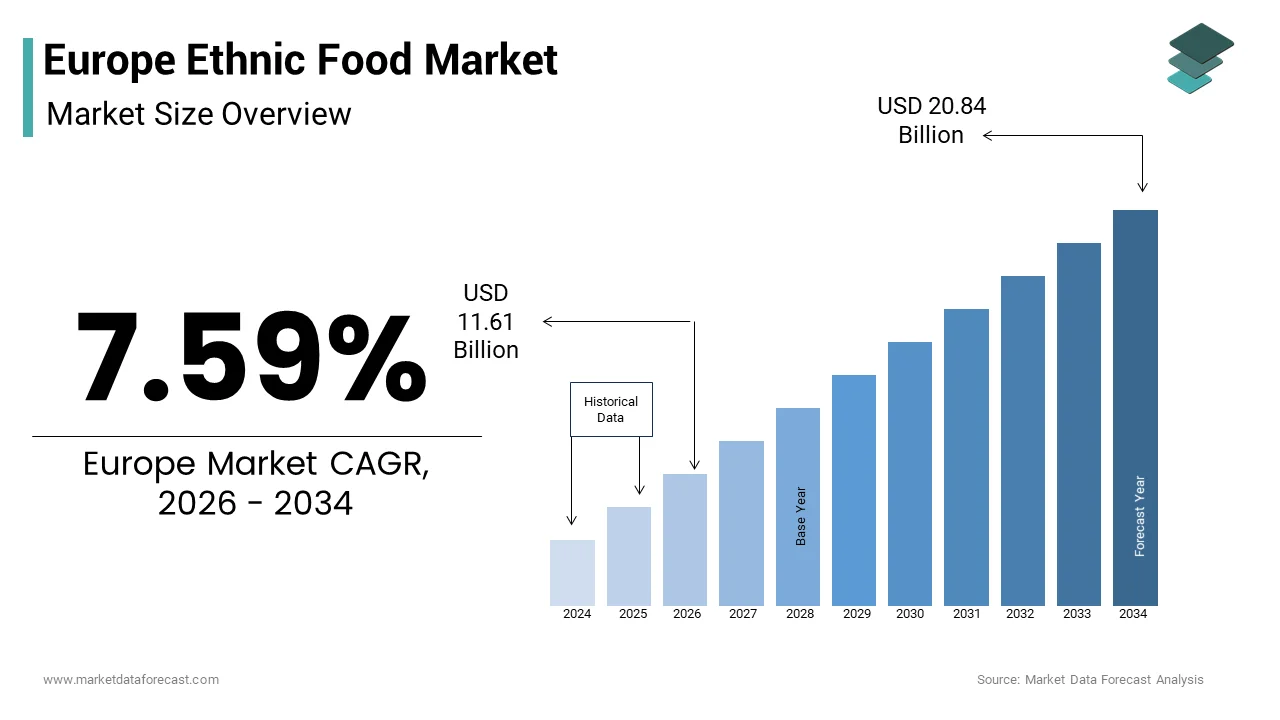
The Europe ethnic food market was valued at USD 10.79 billion in 2025, is estimated to reach USD 11.61 billion in 2026, and is projected to grow to USD 20.84 billion by 2034, registering a CAGR of 7.59% during the forecast period from 2026 to 2034. The growth of the Europe ethnic food market is driven by rising multicultural populations, increasing consumer exposure to global cuisines, and a strong shift toward vegetarian, vegan, and plant-based diets. Expanding international travel, urbanization, and the growing influence of global food media are further accelerating demand for authentic ethnic flavors across European countries.
Key Market Trends
The rising popularity of Indian, Asian, Middle Eastern, and African cuisines among mainstream European consumers. Strong growth in vegetarian and vegan ethnic foods aligned with Europe’s health, sustainability, and ethical consumption trends. Increasing availability of ethnic food products through supermarkets, hypermarkets, and online retail platforms. Growing demand for ready-to-cook and ready-to-eat ethnic meals ssupportsconvenience-driven consumption. Product innovation focused on authentic flavors adapted to local taste preferences.
Segmental Insights
- By cuisine, the Indian cuisine segment dominated the Europe ethnic food market by holding 28.4% of the market share in 2025, supported by widespread acceptance of Indian flavors, spices, and ready meals.
- By food type, the vegetarian and vegan segment led the market with a 56.7% share in 2025, driven by Europe’s strong plant-based food adoption and ethical consumption patterns.
- By distribution channel, supermarkets and hypermarkets accounted for 63.2% of the market share in 2025, reflecting their role in improving accessibility, affordability, and product visibility of ethnic foods.
Country Insights
- The United Kingdom was the largest contributor to the Europe ethnic food market in 2025, accounting for 22.6% of the regional share, supported by its highly multicultural population and strong demand for Indian and Asian cuisines.
- Germany ranked second with a 19.3% share, driven by large immigrant communities and expanding ethnic food retail networks.
- France is expected to register the fastest CAGR in the coming years, supported by strong North and West African culinary influence.
- The Netherlands continues to grow steadily due to its multicultural urban centers and progressive retail ecosystem.
- Italy is witnessing the rising adoption of ethnic foods beyond traditional Italian cuisine.
Competitive Landscape
The Europe ethnic food market is moderately fragmented, with global food manufacturers and regional specialty brands focusing on product innovation, authenticity, and retail expansion. Leading companies are investing in plant-based ethnic offerings, premium ingredients, and convenient meal formats to strengthen market presence. Prominent players operating in the market include Ajinomoto Co., Inc., McCormick & Company, Inc., General Mills, Inc., Orkla ASA, Associated British Foods plc (Patak’s, Blue Dragon), ARYZTA AG, Paulig Ltd., Conagra Brands, Inc., Goya Foods, Inc., and McCain Foods Limited.
Europe Ethnic Food Market Size
The Europe ethnic food market size was valued at USD 10.79 billion in 2025 and is anticipated to reach a valuation of USD 11.61 billion in 2026 and USD 20.84 billion by 2034, growing at a CAGR of 7.59% during the forecast period from 2026 to 2034.
Introduction of the Europe Ethnic Food Market
The ethnic food is culinary products and ingredients rooted in non-European cultural traditions from Asia, Latin America, the Middle East and Africa that are commercially produced distributed or consumed within the European Union. These include ready meals sauces condiments frozen dishes and pantry staples that replicate authentic flavors while adapting to local safety and labeling norms. According to Eurostat, over 28 million foreign born residents live in the EU, where few of the total population with significant communities from Turkey, Morocco, and India, concentrated in Germany, France, and the UK. The European Commission’s Urban Agenda notes that Europeans now live in cities, where multicultural neighborhoods act as incubators for culinary fusion and retail innovation. Additionally, the rise of digital food delivery platforms has normalized access to ethnic cuisine beyond restaurant confines.
MARKET DRIVERS
Growing Urban Multiculturalism Fuels Mainstream Adoption
The increasing diverse urban populations are normalizing ethnic cuisines through community centered retail entrepreneurship and intercultural culinary exchange is fuelling the growth of Europe ethnic food market. According to Eurostat, over 15.4 million people with non-EU citizenship resided in European cities in 2024 with concentrations exceeding 20% in districts like Berlin, Neuköln London Tower Hamlets, and Paris Seine Saint Denis. These communities establish specialty grocers halal butchers and spice importers that initially serve diaspora needs but gradually attract local consumers seeking authenticity and novelty. A 2024 study by the European Consumer Organisation found that urban Europeans, now regularly purchase at least one ethnic food item per month with Mexican harissa and gochujang showing the highest trial rates among non-immigrant households. Supermarkets like Carrefour and Edeka have responded by dedicating entire aisles to global cuisines with clear origin labeling and recipe cards.
Expansion of E Commerce and Meal Kit Platforms Democratizes Access
Digital platforms have dismantled geographic and knowledge barriers that once limited ethnic food consumption to urban enclaves or specialty stores. The expansion of e-commerce and meal kit platforms democratizes access is additionally escalating the growth of Europe ethnic food market. According to the European Commission, many Europeans now use online grocery or food delivery services with ethnic ready meals and ingredient boxes, among the fastest growing categories. Companies like Marley Spoon, and Gousto, offer weekly rotating menus featuring Thai curries Lebanese tabbouleh or Nigerian jollof rice with pre-measured spices and step by step instructions. Similarly, Amazon Pantry and Picnic have expanded their ethnic SKUs by 200%, since 2023 with algorithm driven recommendations introducing consumers to complementary ingredients like tamarind paste or berbere spice. This digital democratization enables consistent exposure and reduces the intimidation factor of unfamiliar cooking techniques thereby embedding global flavors into routine home meal preparation across rural and suburban Europe.
MARKET RESTRAINTS
Stringent EU Food Safety and Origin Labeling Requirements Increase Compliance Costs
European regulations impose rigorous standards on imported ethnic ingredients particularly those containing spices herbs and traditional additives is hampering the growth of the Europe ethnic food market. According to the European Food Safety Authority, spice consignments from South Asia and North Africa were rejected at EU borders in 2024 due to excessive levels of aflatoxins ethylene oxide or unauthorized colorants. The EU’s Regulation (EU) No 1169 2011 mandates clear labeling of allergens country of origin and processing methods, which is challenging for traditional blends like garam masala or ras el hanout that contain ten or more components. Small importers often lack the laboratory infrastructure to certify each batch leading to product recalls or delisting by retailers. In 2023, German customs authorities destroyed uncertified chili powder due to pesticide residues exceeding Maximum Residue Levels. These compliance burdens disproportionately affect authentic but unindustrialized producers forcing retailers to source from large certified processors that may compromise on regional specificity or flavor fidelity.
Fragmented Consumer Perceptions of Authenticity and Health
The consumers hold inconsistent and often stereotyped views about ethnic cuisines, which can limit sustained adoption is another attribute declining the growth of Europe ethnic food market. According to the European Food Information Council, respondents associate Asian foods with “high sodium” Middle Eastern dishes with “excessive oil” and Latin American meals with “refined carbohydrates” perceptions that deter health conscious buyers regardless of actual nutritional profiles. Additionally, the demand for “authenticity” is subjective and frequently misaligned with diaspora realities many consumers expect rigid adherence to textbook recipes, while immigrant chefs adapt dishes to local ingredients and palates.
MARKET OPPORTUNITIES
Integration of Ethnic Flavors into Plant Based and Clean Label Innovation
Food manufacturers are increasingly leveraging ethnic culinary traditions as natural sources of umami richness and functional ingredients that align with clean label and plant based trends, which is creating new opportunities for the growth of Europe ethnic food market. According to the European Plant Based Foods Association, new meat alternative launches in 2024 incorporated globally inspired seasonings, such as Korean gochujang Moroccan harissa or Thai lemongrass to enhance flavor complexity without artificial additives. Companies like Oatly and Quorn use miso paste and shiitake extracts to replicate savory depth in vegan cheeses and ready meals. Similarly, the clean label movement favors traditional fermentation methods found in kimchi tempeh and injera as natural preservatives and probiotic enhancers. The European Commission’s Farm to Fork Strategy supports this convergence by promoting diverse protein sources and reducing reliance on synthetic flavor enhancers.
Rise of Gastrodiplomacy and Cultural Food Festivals as Demand Catalysts
National governments and cultural institutions are actively promoting ethnic cuisines through official gastrodiplomacy initiatives that boost awareness and legitimacy among European consumers. The rise of gastrodiplomacy and cultural food festivals is also gearing up the growth of Europe ethnic food market. According to the European External Action Service, many non-EU countries including Thailand, Mexico, and Lebanon maintain formal culinary diplomacy programs that fund restaurant certifications food festivals and chef exchanges across Europe. The European Institute of Food History reports that such events increase long term retail purchases of featured ingredients as attendees seek to recreate experiences at home. Additionally, UNESCO’s intangible cultural heritage listings, such as for Turkish coffee or French baguette create halo effects that legitimize entire culinary traditions.
MARKET CHALLENGES
Supply Chain Volatility for Climate Sensitive Specialty Ingredients
Many core ethnic ingredients including spices chilies coffee and tropical fruits are highly vulnerable to climate change and geopolitical instability in their countries of origin, which disrupts consistent European supply. The supply chain volatility for climate sensitive specialty ingredients is certainly a major challenge for the growth of Europe ethnic food market. According to the European Environment Agency, droughts in India reduced turmeric yields in 2024 pushing wholesale prices up across EU importers. Similarly, civil unrest in Ethiopia disrupted berbere spice exports while floods in Thailand delayed jasmine rice shipments by over ten weeks. Unlike standardized commodities these ingredients often lack futures markets or substitute sources making price hedging impossible for small food businesses. This fragility undermines product consistency and brand reliability for building consumer trust in unfamiliar cuisines, thereby slowing mainstream integration despite strong demand signals.
Shortage of Trained Culinary Talent for Authentic Large Scale Production
The commercial scaling often suffers from a lack of chefs and food technologists, who possess both authentic cultural knowledge and industrial production expertise. The shortage of trained culinary talent for authentic large scale production is also hindering the growth of Europe ethnic food market. According to Cedefop, the European Centre for the Development of Vocational Training fewer than five EU member states offer formal training in non-European culinary arts with most vocational programs focused on French Italian or German traditions. As a result, large food manufacturers frequently rely on trial and error or outsourced consultants to replicate flavors leading to inconsistent results. A blind taste test conducted by the University of Gastronomic Sciences in 2024 found that seventy% of supermarket “Thai green curry” products contained no galangal or kaffir lime key botanicals that define regional authenticity. This knowledge gap forces brands into a trade off between scalability and fidelity often resulting in homogenized “pan Asian” or “Mediterranean fusion” profiles that dilute cultural specificity.
REPORT COVERAGE
| REPORT METRIC | DETAILS |
| Market Size Available | 2025 to 2034 |
| Base Year | 2025 |
| Forecast Period | 2026 to 2034 |
| CAGR | 7.59% |
| Segments Covered | By Cuisine, Food, Distribution Channel, And By Country |
| Various Analyses Covered | Global, Regional & Country Level Analysis; Segment-Level Analysis, DROC, PESTLE Analysis, Porter’s Five Forces Analysis, Competitive Landscape, Analyst Overview of Investment Opportunities |
| Regions Covered | UK, France, Spain, Germany, Italy, Russia, Sweden, Denmark, Switzerland, Netherlands, Turkey, Czech Republic, & Rest of Europe |
| Market Leaders Profiled | Ajinomoto Co., Inc., McCormick & Company, Inc., General Mills, Inc., Orkla ASA, Associated British Foods plc (Patak's, Blue Dragon), ARYZTA AG, Capital Foods Ltd., Paulig Ltd., Conagra Brands, Inc., Huy Fong Foods, Inc., Goya Foods, Inc., Charlie Bigham, Tai Pei Foods, Quality Ethnic Foods Inc., The Spice Tailor, Yeo's Group, Halwani Bros., Tata Consumer Products (Tata Sampann), B&G Foods, Inc., McCain Foods Limited |
SEGMENTAL ANALYSIS
By Cuisine Insights
The Indian cuisine segment was the largest by holding 28.4% of the Europe ethnic food market share in 2025 from decades of diaspora-driven culinary integration, widespread familiarity with core ingredients like curry powder and basmati rice, and the cuisine’s natural alignment with Europe’s growing plant based dietary trends. The European Food Information Council notes that “curry” is the most recognized ethnic dish across all age groups with Europeans reporting consumption in the past year. Retailers like Tesco, and Carrefour dedicate entire shelf sections to Indian sauces pastes and ready meals with private label lines accounting for nearly half of category sales. Additionally, Indian cuisine’s heavy reliance on lentils legumes and vegetables dovetails with EU clean label and sustainability messaging making it a culturally accessible gateway to ethnic eating for health-conscious consumers.
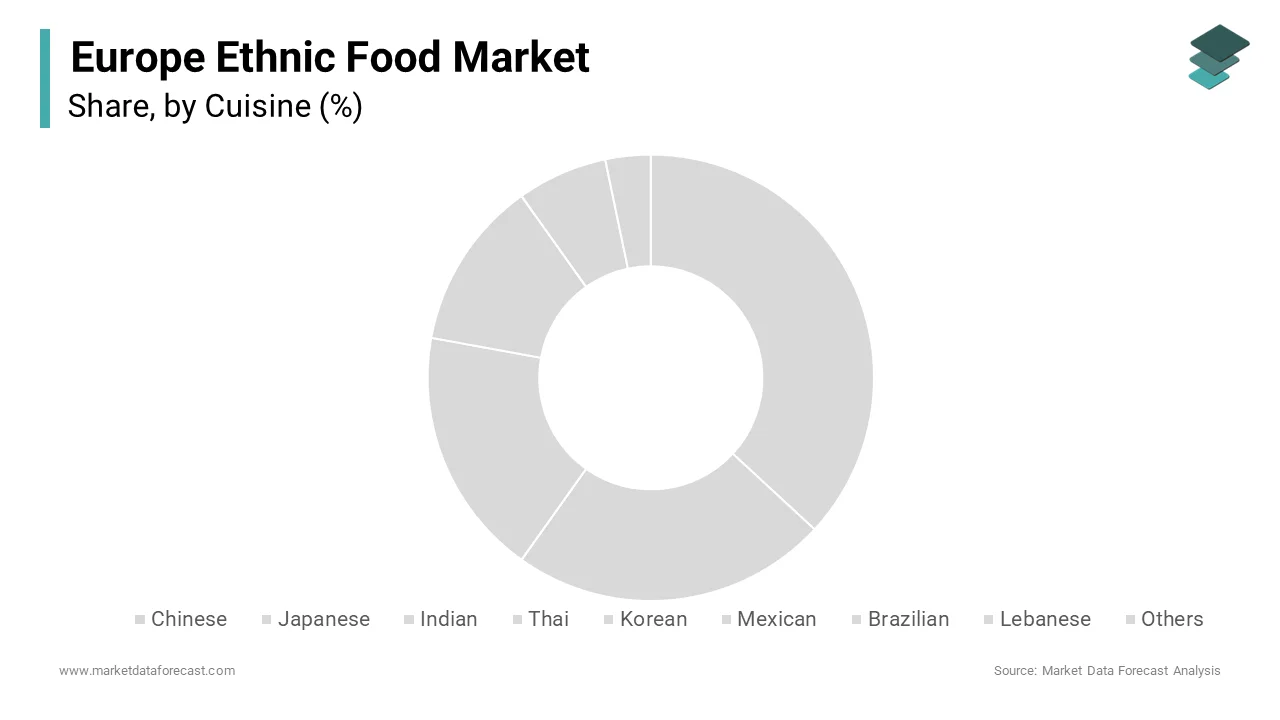
The korean cuisine segment is projected to grow at a fastest CAGR of 14.2% throughout the forecast period owing to the global influence of Korean pop culture with Europeans aged 18 to 34 reporting exposure to K drama K pop or Korean beauty content. This cultural affinity translates into culinary curiosity with gochujang kimchi and bibimbap emerging as mainstream pantry staples. The European Commission’s Novel Food Catalogue fast tracked approval for traditional Korean fermentation strains in 2025, enabling local production of authentic kimchi without import delays. Additionally, the cuisine’s emphasis on fermented vegetables aligns with Europe’s gut health trend of health conscious consumers actively seeking probiotic foods. These cultural nutritional and regulatory forces position Korean food as the vanguard of next generation ethnic adoption.
By Food Insights
The vegetarian and vegan segment was the largest by accounting for 56.7% of the Europe ethnic food market in 2025 with the structural compatibility between many ethnic culinary traditions and Europe’s rapidly expanding plant based dietary landscape. Cuisines, such as Indian Thai and Ethiopian inherently feature lentil legume and vegetable centric dishes that require minimal adaptation for vegan or vegetarian consumers. According to the European Plant Based Foods Association, new ethnic food launches in 2025 carried a plant-based claim with Indian dals, Thai green curries, and Korean bibimbap leading in retail innovation. The European Commission’s Farm to Fork Strategy further incentivizes meat reduction indirectly boosting demand for culturally diverse plant proteins. Major retailers like Edeka and Sainsbury’s now use “vegan ethnic” as a dedicated merchandising category with shelf tags and recipe QR codes.
The vegetarian and vegan segment is expected to witness a fastest CAGR of 12.8% from 2025 to 2033 with the emergence of ethical flexitarianism clean label demand and ethnic culinary discovery. Unlike Western, plant-based alternatives that rely on processed substitutes many ethnic cuisines offer whole food plant protein sources, such as chickpeas in Middle Eastern hummus or tofu in East Asian stir fries that resonate with consumers seeking minimally processed options. Food delivery platforms like Deliveroo and Just Eat report that “vegan Indian” and “plant based Thai” are among the top five fastest growing search terms in urban centers. Additionally, the EU’s upcoming mandatory sustainability labeling will likely favor ethnic plant dishes with lower carbon footprints. These synergies position vegetarian ethnic food as the primary engine of both volume and velocity in the market.
By Distribution Channel Insights
The supermarkets and hypermarkets segment was the largest by holding 63.2% of the Europe ethnic food market share in 2025 from their unparalleled reach convenience and strategic merchandising of ethnic categories as mainstream rather than niche. Chains like Carrefour Tesco and Edeka have moved ethnic foods from isolated “world food” aisles into integrated placements alongside fresh produce ready meals and plant based alternatives. In 2024, Carrefeur’s “Ethnic Moments” campaign in France, increased sales of Indian and Thai sauces through in store tastings and QR linked recipe videos. The scale of these retailers also ensures consistent cold chain logistics for fresh ethnic produce like curry leaves and galangal, which were previously limited to specialty stores.
The online retail segment is anticipated to witness a fastest CAGR of 15.3% throughout the forecast period with the algorithm driven discovery personalized subscription boxes and the ability to access rare authentic ingredients not available in physical stores. Platforms like Amazon Pantry Picnic and Ocado feature dedicated “Global Pantry” sections with AI recommendations that introduce consumers to complementary items, such as suggesting tamarind paste after a purchase of Thai curry paste. In 2025, Berlin based startup Saffron & Herbs reported triple digit growth by offering curated Indian and Middle Eastern ingredient kits with chef designed recipe cards. Additionally, post pandemic consumer comfort with home delivery ensures sustained demand for specialty items like gochujang or berbere spice that require minimal storage space and infrequent repurchasing. This digital accessibility democratizes ethnic cooking beyond urban enclaves into suburban and rural households.
COUNTRY ANALYSIS
United Kingdom Ethnic Food Market Analysis
The United Kingdom was the largest contributor of the Europe ethnic food market with a 22.6% share in 2025. Its position is rooted in deep historical ties to South Asia the Caribbean and Africa, which have normalized ethnic cuisines as part of national culinary identity. Additionally, the UK’s post Brexit regulatory autonomy allows faster novel food approvals for traditional fermentation methods such as kimchi.
Germany Ethnic Food Market Analysis
Germany was ranked second by capturing 19.3% of the Europe ethnic food market with its large immigrant communities and rising openness to global flavors. Over 23 million residents have a migration background with significant populations from Turkey, India, and Vietnam operating restaurants and specialty stores that serve as cultural anchors. Retailers like Edeka and REWE have responded by launching “Asia World” and “Spice Journey” lines with transparent sourcing and organic certification. The Federal Ministry of Food and Agriculture also funds multicultural food festivals in major cities to promote integration through cuisine.
France Ethnic Food Market Analysis
France ethnic food market growth is likely to register a fastest CAGR in coming years with its North and West African diaspora and evolving culinary openness. Supermarkets like Carrefour and Monoprix feature “Saveurs du Monde” sections that regional authenticity with origin stories and chef collaborations. The government’s National Food Strategy now includes support for immigrant led food entrepreneurship through microgrants and market access programs. Additionally, French consumers’ emphasis on terroir and craftsmanship extends to ethnic ingredients with premium pricing accepted for artisanal products like hand rolled couscous or small batch ras el hanout.
Netherlands Ethnic Food Market Analysis
The Netherlands ethnic food market growth is propelled with its multicultural urban centers and progressive food retail ecosystem. Amsterdam Rotterdam and The Hague host communities from Suriname Indonesia Turkey and Morocco, whose culinary traditions are deeply integrated into Dutch food culture evident in national dishes like nasi goreng and kapsalon. According to Statistics Netherlands, Amsterdam residents are of non-Western origin creating high baseline demand for authentic ingredients. Retailers like Albert Heijn prioritize inclusion by offering halal certified ethnic ranges and multilingual packaging.
Italy Ethnic Food Market Analysis
Italy ethnic food market growth is likely to grow with the adoption beyond traditional Italian fare. While historically conservative in dietary habits Italy’s urban centers are increasingly embracing ethnic cuisines due to tourism exposure and younger consumer openness. According to ISTAT, many foreign born residents live in Italy with strong communities from China Bangladesh and Nigeria operating restaurants and grocery stores. Italian consumers show particular affinity for Japanese and Indian cuisines valued for their perceived lightness and health benefits compared to heavy meat based local dishes.
COMPETITIVE LANDSCAPE
Competition in the Europe ethnic food market is defined by a dynamic interplay between diaspora authenticity mainstream adaptability and retail integration. The landscape includes multinational food corporations ethnic specialty brands and private label developers all vying for shelf space in an increasingly crowded category. Differentiation hinges on the ability to deliver genuine flavor profiles using clean label ingredients while meeting EU safety and labeling standards. Large players leverage scale and distribution while niche brands compete on regional specificity such as Punjabi versus South Indian or Lebanese versus Turkish. Retailers exert significant influence through category curation and private label development often favoring suppliers with localized production and sustainability credentials. Innovation focuses on convenience formats like ready meals and cooking sauces that lower the barrier to home preparation.
KEY MARKET PLAYERS
An important market players in the Europe ethnic food market are
- Ajinomoto Co., Inc.
- MTR Foods GmbH
- Al Wadi Al Akhdar
- Kikkoman Europe GmbH
- McCormick & Company, Inc.
- General Mills, Inc.
- Orkla ASA
- Associated British Foods plc (Patak's, Blue Dragon)
- ARYZTA AG
- Capital Foods Ltd.
- Paulig Ltd.
- Conagra Brands, Inc.
- Huy Fong Foods, Inc.
- Goya Foods, Inc.
- Charlie Bigham
- Tai Pei Foods
- Quality Ethnic Foods Inc.
- The Spice Tailor
- Yeo's Group
- Halwani Bros.
- Tata Consumer Products (Tata Sampann)
- B&G Foods, Inc.
- McCain Foods Limited
Top Players in the Market
- MTR Foods GmbH is a European subsidiary of India’s leading ethnic food brand with a strong presence across Germany the UK and the Netherlands. The company specializes in ready to eat Indian meals frozen parathas and spice blends that cater to both diaspora communities and mainstream European consumers seeking authentic South Asian cuisine. MTR leverages traditional recipes adapted to EU food safety standards and clean label expectations. This localization strategy strengthens its position as a trusted bridge between heritage authenticity and European retail requirements.
- Kikkoman Europe GmbH is the European arm of Japan’s iconic soy sauce and umami ingredient manufacturer with distribution across over thirty countries. The company supplies authentic Japanese condiments including soy sauce mirin and ponzu to supermarkets restaurants and foodservice operators throughout the continent. Kikkoman’s products are essential in both traditional Japanese cuisine and fusion applications such as teriyaki burgers and umami dressings. This regional production enhances freshness supply chain resilience and regulatory alignment while supporting the rising demand for Asian flavors in European kitchens.
- Al Wadi Al Akhdar is a leading Middle Eastern food brand with deep penetration in France the UK and Germany through its extensive range of Lebanese and Levantine products. The company offers tahini hummus pickles and ready to cook falafel mixes that combine traditional preparation methods with modern food safety protocols. Al Wadi Al Akhdar caters to Europe’s growing interest in Mediterranean and Middle Eastern plant based cuisine which aligns with regional health and sustainability trends. The brand introduced a certified organic halal range across Carrefour stores in France featuring BPA free packaging and QR coded origin stories to enhance transparency. These initiatives reinforce its role as a cultural ambassador while meeting European consumer demands for ethical traceable and flavorful ethnic foods.
Top Strategies Used by the Key Market Participants
Key players in the Europe ethnic food market focus on authentic yet adaptable product formulation that respects traditional recipes while complying with EU clean label and allergen regulations. They invest in localized production or co packing to ensure freshness reduce import dependencies and meet traceability requirements. Companies leverage cultural storytelling through packaging digital content and in store activations to build consumer trust and educate on culinary context. Strategic partnerships with major retailers enable prominent shelf placement recipe integration and private label collaborations. Additionally brands tailor spice levels texture and format, such as refrigerated versus shelf stable to align with European palates and consumption habits. These approaches balance cultural fidelity with market accessibility to drive mainstream adoption without compromising authenticity.
MARKET SEGMENTATION
This research report on the Europe ethnic food market is segmented and sub-segmented into the following categories.
By Cuisine Type
- Chinese
- Japanese
- Indian
- Thai
- Korean
- Mexican
- Brazilian
- Lebanese
- Others
By Food Type
- Vegetarian/Vegan Ethnic Foods
- Non-Vegetarian Ethnic Foods
By Packaging Type
- Shelf-stable
- Frozen
- Refrigerated/Chilled
- Others
By Distribution Channel
- Supermarkets/Hypermarkets
- Convenience/Grocery Stores
- Specialty Stores
- Online Retail
- Other Retail Channels
By Country
- UK
- France
- Spain
- Germany
- Italy
- Russia
- Sweden
- Denmark
- Switzerland
- Netherlands
- Turkey
- Czech Republic
- Rest of Europe