- Product Description Description
- Table of Contents TOC
- List of Table & Figure LOT
- Get Free Sample PDF Sample PDF
Market Size, 2025
$211.12 BnMarket Estimate, 2026
$218.49 BnMarket Forecast, 2034
$287.48 BnCAGR, 2026–2034
3.49%Executive Summary: Europe Home Decor Market
- Market Scope: Regional analysis of Europe's home decor sector, detailing non-structural interior products, textiles, lighting fixtures, wall art, distribution channels, and country-level profiles.
- Market Valuation: Valued at USD 211.12 billion in 2025, reaching USD 218.49 billion in 2026, and projected to expand to USD 287.48 billion by 2034, growing at a robust CAGR of 3.49% from 2026 to 2034.
- Primary Growth Drivers: Rising emphasis on the home as a multifunctional lifestyle hub and strong cultural identity coupled with regional design heritage.
Key Market Segment Metrics
| Category | Leading Segment (Base Position) | Fastest-Growing / High-Growth Segment |
|---|---|---|
| By Product Type | Home Textiles (held a 28.3% share in 2025, driven by dual roles as functional essentials and expressive design elements) | Lighting (anticipated at a 9.3% CAGR, fueled by wellness technology, circadian rhythm systems, and smart design) |
| By Distribution Channel | Home Decor Stores (held a 36.2% share in 2025, anchored by tactile in-store shopping experiences and localized curations) | Online Stores (expected to register an 11.7% CAGR, driven by enhanced AR tools, logistics, and social commerce) |
| By Country | Germany (market leader with a 19.3% share in 2024/2025, backed by a strong middle class, quality craftsmanship, and sustainability) | United Kingdom & France (key high-growth regions driven by rental decor trends, vintage revivals, and artisanal heritage) |
Major Market Players & Industry Landscape
Market Structure: Highly dynamic ecosystem characterized by multinational mass retailers, regional specialists, and independent artisans competing on emotional resonance, material integrity, and experiential differentiation.
Key Companies: IKEA, Maisons du Monde, H&M Home, Zara Home, Westwing Group SE, Habitat, BoConcept, Ferm Living, Bloomingville, Kartell, Anthropologie, Urban Outfitters, Crate & Barrel, Pottery Barn, La Redoute, Conforama, CB2, and The White Company.
 Download Free Sample Report
Europe Home Decor Market Size
The europe home decor market was valued at USD 211.12 billion in 2025, is estimated to reach USD 218.49 billion in 2026, and is projected to reach USD 287.48 billion by 2034, growing at a CAGR of 3.49% from 2026 to 2034.
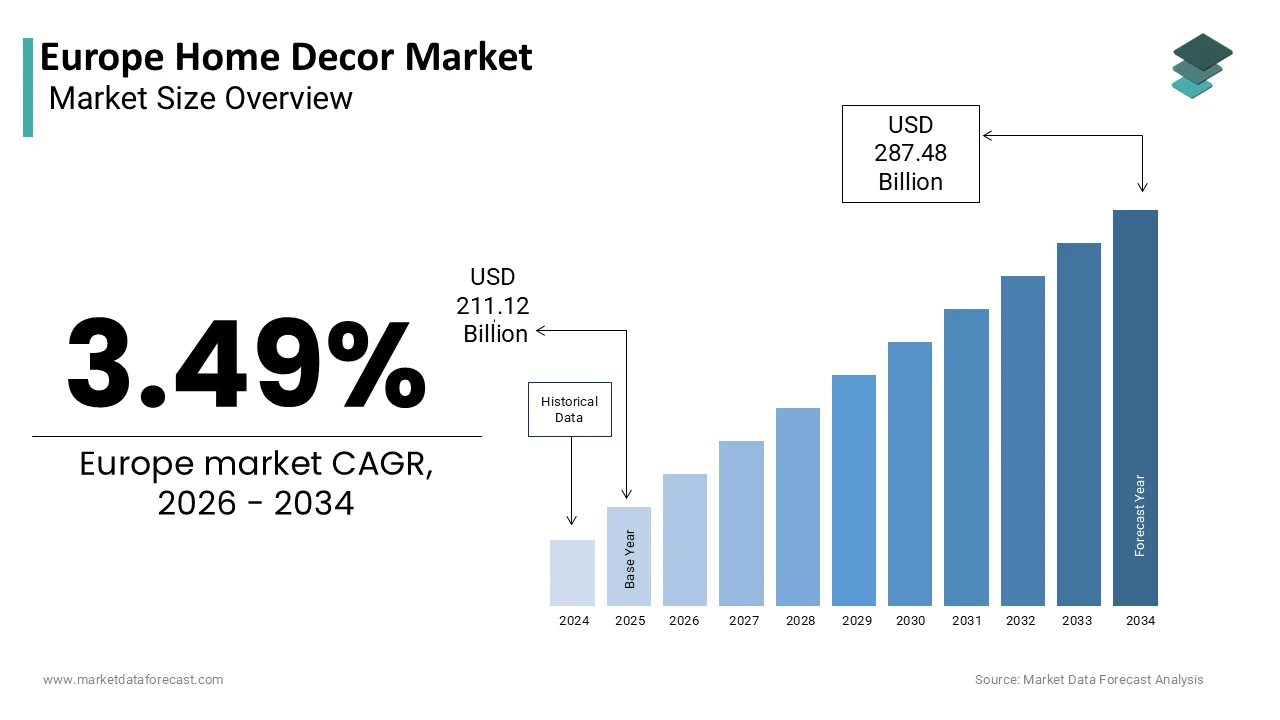
The home decor is a non-structural interior product, including wall art, lighting fixtures, textiles, decorative accessories, furniture accents, and seasonal ornaments designed to enhance aesthetic appeal, express personal identity, and improve residential well-being. Unlike functional home furnishings, home decor items are primarily driven by design trends, cultural preferences, and emotional resonance. According to Eurostat, 68% of EU households undertook home improvement or redecoration activities in 2024, reflecting a post-pandemic emphasis on domestic comfort. As per the European Commission’s Circular Economy Action Plan, over 12 million tonnes of household textiles and decorative items reach end-of-life annually, prompting regulatory scrutiny on material sustainability. Furthermore, the European Environment Agency notes that indoor air quality regulations now influence choices in paints, adhesives, and fabric treatments. This interplay of aesthetics, regulation, and lifestyle redefinition positions home decor as a dynamic reflection of Europe’s evolving relationship with domestic space.
MARKET DRIVERS
Rising Emphasis on Home as a Multifunctional Lifestyle Hub
The transformation of the home into a primary space for work wellness and social interaction for expressive and functional décor is majorly accelerating the growth of Europe home décor market. According to the European Foundation for the Improvement of Living and Working Conditions, 42% of employed Europeans now follow hybrid work models, necessitating dedicated home office zones that blend productivity with personal style. This shift has spurred demand for curated décor, such as acoustic wall panels, ergonomic desk accessories, and mood-enhancing lighting, all positioned as both aesthetic and functional upgrades. Retailers like Zara Home and Maisons du Monde have responded with collections that merge utility and design, such as modular shelving with integrated planters or sound-absorbing tapestries. As homes evolve beyond shelter into holistic lifestyle ecosystems, decor becomes a strategic tool for self-expression and spatial optimization.
Strong Cultural Identity and Regional Design Heritage
The deep-rooted regional design identities serve as a powerful driver of home decor consumption, fostering loyalty to locally inspired aesthetics and artisanal craftsmanship, which is additionally escalating the growth of Europe home decor market. In Scandinavia, the enduring popularity of hygge and lagom principles sustains demand for light wood tones, neutral textiles, and ceramic tableware that evoke calm and balance. According to Statistics Sweden, 63% of Swedish households purchased at least one locally designed decor item in 2024, often from certified craft cooperatives. Similarly, in Italy and Spain, traditional motifs, such as Sicilian maiolica tiles or Andalusian wrought iron, inform mo, dern in,terpretations in mirrors, vases, and lighting. The European Commission’s Creative Europe programme has funded over 200 artisan collectives since 2022 to preserve decorative crafts like Portuguese azulejos and Polish paper cuttings, integrating them into contemporary interiors. This cultural anchoring ensures consistent demand for regionally resonant products, insulating local makers from global homogenization and fueling premiumization in authentic design narratives.
MARKET RESTRAINTS
Stringent Environmental Regulations on Materials and Chemicals
The growing rigorous chemical and material restrictions under REACH, the EU Ecolabel, and the upcoming Ecodesign for Sustainable Products Regulation are restraining the growth of Europe home décor market. These frameworks limit the use of volatile organic compounds, phthalates, and certain dyes in textiles, paints, and decorative finish materials historically common in affordable decor. According to the European Chemicals Agency, over 200 substances used in home textiles and surface coatings were added to the Candidate List of Substances of Very High Concern between 2020 and 2024, forcing suppliers to reformulate or discontinue products. Small designers and importers face disproportionate compliance costs, where a 2025report by the European Confederation of Artisans noted that 44% of micro enterprises delayed new collections due to testing expenses exceeding 15 000 euros per product line. Moreover, the lack of harmonized biodegradability standards for bio-based plastics creates confusion in labeling claims.
Vulnerability to Economic Volatility and Discretionary Spending Cuts
The home decor market faces significant headwinds from macroeconomic instability that directly impacts non-essential consumer expenditure. As a discretionary category, decor is often among the first purchases deferred during periods of inflation or uncertainty. According to the European Central Bank, real disposable income in the euro area declined by 2.1% in 2023, the sharpest drop in over a decade. In response, consumers shifted toward value-oriented options or extended product lifespans, where a GfK survey across six EU markets revealed that respondents postponed decor upgrades in 2025by opting instead for repairs or second-hand alternatives. This sensitivity is most acute in mid-tier segments where brands lack the pricing power of luxury labels or the cost base of fast decor retailers.
MARKET OPPORTUNITIES
Integration of Smart and Wellness-Oriented Decor Solutions
The emergence of interior design with health setting technology is ascribed to setting up new opportunities for the growth of Europe home decor market. Europe's home decor market. Consumers increasingly seek decor that actively enhances well-being through circadian lighting, air-purifying textiles, and biophilic elements. According to the European Wellness Institute, 48% of urban Europeans now consider indoor air quality and light quality when purchasing home products. Brands like Philips Hue and IKEA have responded with smart lighting systems that mimic natural daylight cycles to support sleep and focus, while startups such as BioMason offer wall tiles made from living mycelium that absorb VOCs. The EU’s Green Public Procurement criteria now include wellness parameters for public housing, creating B2B demand for certified healthy materials. Additionally, the rise of “slow interiors” encourages investment in durable, therapeutic pieces, such as Himalayan salt lamps or wool rugs with natural antimicrobial properties that align with holistic living.
Expansion of Circular and Rental-Based Consumption Models
The emergence of circular economy models, including resale, rent,l and take-back programs, is reshaping how Europeans acquire and dispose of home decor. The expansion circularlat and rental-based consumption models is greatly influencing the growth of Europe home decor market. The sustainability mandates and shifting attitudes toward ownership mean that these models reduce waste while offering access to premium design. Companies like Vinterior and Kaiyo operate pan-European online marketplaces for pre-owned designer decor, reporting 35% year-on-year growth in 2024. Meanwhile, startups, such as Casa Mica in Spain, offer monthly subscriptions for rotating art and accessories, targeting urban renters seeking flexibility. IKEA’s “Buy Back & Resell” program now includes decorative items in 15 European markets, recovering over 200,000 pieces in 2025alone.
MARKET CHALLENGES
Fragmented Sustainability Standards and Greenwashing Risks
The absence of unified criteria for environmental claims, leading to consumer confusion and regulatory risk, is additionally hindering the growth of Europe home decor market. While the EU Ecolabel exists, it covers only a narrow subset of decor categories, leaving brands to rely on private certifications like OEKO-TEX, Cradle to Cradle, or FSC, each with differing scopes and verification rigor. According to the European Commission’s 2025sweep of green claims, 52% of home decor products labeled “eco-friendly” or “sustainable” lacked sufficient evidence, triggering enforcement actions in Germany and the Netherlands. This inconsistency erodes trust; a Eurobarometer survey found that 61% of consumers doubt the authenticity of sustainability claims in home goods. Moreover, small designers struggle to afford third-party verification, placing them at a disadvantage against larger firms that can absorb certification costs.
Overreliance on Fast Decor and Short Product Lifecycles
The proliferation of low-cost, trend-driven “fast decor” from mass retailers poses a structural challenge to long-term sustainability and brand differentiation. This factor is also expected to inhibit the growth of Europe home decor market. Chains like H&M Home, Zara Home, and Amazon Basics release weekly collections mimicking high-end designs at a fraction of the price by encouraging disposability. According to the European Federation of Textile and Furnishing Industries, the average lifespan of decorative cushions and throws has declined from 5.2 years in 2015 to 2.1 years in 2025due to poor material quality and rapid style obsolescence. Furthermore, fast decor dilutes the perceived value of design, making it harder for artisanal and sustainable brands to justify premium pricing.
REPORT COVERAGE
| REPORT METRIC | DETAILS |
| Market Size Available | 2025 to 2034 |
| Base Year | 2025 |
| Forecast Period | 2026 to 2034 |
| Segments Covered | By Product Type, Distribution Channel, and Region. |
| Various Analyses Covered | Global, Regional, and Country-Level Analysis, Segment-Level Analysis, Drivers, Restraints, Opportunities, Challenges; PESTLE Analysis; Porter’s Five Forces Analysis, Competitive Landscape, Analyst Overview of Investment Opportunities |
| Countries Covered | UK, France, Spain, Germany, Italy, Russia, Sweden, Denmark, Switzerland, Netherlands, Turkey, Czech Republic, Rest of Europe |
| Market Leaders Profiled | IKEA, Maisons du Monde, H&M Home, Zara Home, Westwing Group SE, Habitat, BoConcept, Ferm Living, Bloomingville, Kartell, Anthropologie, Urban Outfitters (home decor segment), Crate & Barrel, Pottery Barn, La Redoute, Conforama, Anthropologie Home, CB2, The White Company |
SEGMENTAL ANALYSIS
By Product Type Insights
The home textiles segment was the laEuropeanby holding 28.3% of the Europe h,ome decor market share in 2025 from their dual role as both functional essentials and expressive design elements in everyday living. Bed linens, curtains, cushions, and throws are frequently refreshed to align with seasonal trends, lifestyle changes, or emotional well-being goals by making them high-turnover categories. According to Eurostat, 74% of EU households purchased new home textiles in 2024, with sustainability and comfort cited as top purchase drivers. The rise of “slow interiors” has further amplified demand for natural fibers, where the European Textile Federation reports that sales of organic cotton and linen home textiles grew in 2024, driven by consumer awareness of skin health and indoor air quality. National preferen; es also reinforce this segment, Scandinavian markets favor wool and cotton blends for thermal comfort, while Southern Europe prioritizes lightweight, breathable fabrics for warm climates.

The lighting segment is likely to grow with an anticipated CAGR of 9.3% from 2025 to 2033, owing to the emergence of wellness technology and aesthetic design, transforming lighting from utility to mood-enhancing decor. Consumers increasingly seek circadian rhythm-aligned systems that adjust color temperature throughout the day to support sleep and focus. According to the European Wellness Institute, 51% of urban Europeans now consider lighting quality a key factor in home well-being decisions. Smart lighting brands like Philips Hue and IKEA’s TRADFRI have capitalized on this trend, with integrated apps allowing users to create ambiance for relaxation, work, or social gatherings. The EU Ecodesign Regulation has also phased out inefficient halogen bulbs, acceleratingthe adoption of LED-based decorative fixtures. Furthermore, artisanal lighting, such as hand-blown glass pendants from Murano or ceramic lamps from Portugal, has gained traction as statement pieces.
By Distribution Channel Insights
The home decor segment held 36.2% of the Europe h,ome decor market share in 2025, with its ability to offer immersive, tactile shopping experiences that align with Europe’s strong culture of design appreciation and sensory engagement. Chains like Maisons du Monde in France, Habitat in the UK, and Casa in Italy curate regionally tailored assortments that blend global trends with local aesthetics, fostering emotional connection and brand loyalty. According to the European Retail Association, many consumers prefer to touch and visualize decor items in person before purchasing, particularly for higher-value or style-defining pieces like lighting and wall art. These stores also serve as discovery hubs for emerging designers and sustainable collections, often featuring in-store workshops and styling consultations. Municipal policies in cities like Berlin and Barcelona further support physical retail by restricting large e-commerce warehouses in historic districts, preserving the centrality of neighborhood boutiques.
The online stores theegment is expected to grow at the fastest CAGR of 11.7% throughout the forecast period with an enhanced digital shopping tool, expanded logistics networks, and shifting consumer expectations for convenience and personalization. Augmented reality (AR) try-on features now allow users to visualize how a rug or wall art wil.l appear in their actual space. Zalando Living and Wayfair report 89% user satisfaction with their AR integrations in 2024. Same-day delivery in major cities like Paris, Amsterdam, and Stockholm has reduced friction, while AI-driven recommendation engines suggest coordinated looks based on past purchases. Social commerce also accelerates discovery; TikTok Shop and Instagram Checkout generated 38% year-on-year growth in home decor sales across Southern Europe in 2024, according to the survey. Moreover, online platforms enable access to niche designers and circular marketplaces like Vinterior, which saw 42% growth in cross-border sales.
COUNTRY LEVEL ANALYSIS
Germany Home Decor Market Analysis
GermanyEuropeanhe top performer of the European home decthe market, or market by holding 19.3% of the market share in 2024, with its strong middle-class consumer base, emphasis on quality craftsmanship, and sustainability consciousness. According to the German Federal Statistical Office, 71% of households undertook home redecoration in 2024, with a preference for durable, functional pieces made from certified materials. The country’s strict Blue Angel eco-label influences purchasing, with 63% of consumers actively seeking it on textiles and furniture. Retailers like XXXLutz and Mobelhaus dominate with large-format stores offering full-room solutions, while online platforms such as Home24 have scaled rapidly with next-day delivery. The government’s Circular Economy Strategy mandates extended producer responsibility for home goods, pushing brands toward take-back programs. With high disposable income, environmental awareness, and a culture of “Wohnkultur” (living culture), Germany remains the most value-driven and volume-rich market in Europe.
UK Home Decor Market Analysis
The United Kingdom was positioned as European by holding 17.2% of the European home decor market shar,e in 2025with its dynamic mix of heritage style and contemporary innovation. London serves as a design capital where global trends intersect with British eccentricity, fueling demand for eclectic, personality-driven decor. According to the Office for National Statistics, 65% of UK households redecorated in 2024, with renters driving demand for non-permanent solutions like peel-and-stick wallpaper and modular lighting. Brands like John Lewis and Made.com blend traditional craftsmanship with digital convenience, while resale platforms like Vinterior thrive in the vintage revival. The UK’s post-Brexit Product Safety and Metrology Regulations align closely with EU standards, ensuring continuity in material compliance.
France Home Decor Market Analysis
France home decor market is likely to grow with the deep-rooted “art de vivre” philosophy that elevates everyday objects to artistic expressions. Parisian chic, Provençal rusticity, and Alpine minimalism inform regional preferences, sustaining demand for artisanal ceramics, linen textiles, and wrought iron accents. The government’s An bans unsold goods destruction, compelling brands like Maison Sarah Lavoine to adopt circular models. Maisons du Monde leads with 300+ stores offering affordable yet stylish collections inspired by French design history. With strong protections for craft industries and a cultural aversion to disposability, France maintains a premium, authenticity-driven market that values narrative and heritage as much as function.
Italy's Decor Market Analysis.
Italy's home decor market has a global reputation for design excellence and artisanal manufacturing. Regions like Tuscany, Lombardy, and Veneto produce handcrafted Murano glass, Carrara marble accents, and ceramic tableware that define luxury decor worldwide. According to the Italian National Institute of Statistics, 61% of households view home decor as an extension of personal identity, driving demand for bespoke and limited-edition pieces. Milan’s Salone del Mobile remains the industry’s premier showcase, influencing global trends and attracting buyers from across Europe. Companies like Frette and Alessi blend heritage techniques with contemporary aesthetics, while e-commerce platforms like YOOX promote Italian design internationally. With strong export orientation, design education, and cultural pride in “Made in Italy,” Italy sustains a high-value market centered on craftsmanship, material integrity, and timeless style.
Sweden Home Decor Market Analysis
Sweden's home decor market growth is likely to be driven by the sustainable, minimalist, and human-centered design. The concept of “lagom,” meaning “just enough,h” shapes consumer preferences for functional, uncluttered, and eco-conscious products. According to Statistics Sweden, 78% of households prioritize sustainability in decor purchases, with 52% willing to pay a premium for certified organic or recycled materials. IKEA, H&M Home, and smaller brands like Ferm Living champion democratic design that merges affordability with environmental responsibility. The government’s Green Public Procurement policy mandates sustainable criteria for public housing interiors, setting industry benchmarks.
COMPETITIVE LANDSCAPE
The competition in the European home decor market is highly dynamic, characterized by a mix of multinational retailers, regional specialists, a nd independentdesignerss. Dominant play, ers like IKEA, Maisons du Monde,nde and H&M Home leverage scale, omnichannel reach, and trend agility to capture mass and mid-tier segments. At the same time,ime niche brands differentiate through artisanal craft, craftsmanship, heritage techniques, or hyperlocal sustainability narratives. The market is fragmented by country specific aesthetics regulatory environmenpan-Europeanan European standardizatis ion difficult. Competition centers on emotional resonance, material integrity, and experiential differentiation rather than price alone. Regulatory pressures under the EU Green Claims Directive and Ecodesign Regulation are raising compliance barriers, rs favoring established players with robust sustainability frameworks. Meanwhile, digital platforms enable small designers to access broader audiences through curated marketplaces.
KEY MARKET PLAYERS
Some of the companies that are playing a dominating role in the global europe home decor market include
- IKEA
- Maisons du Monde
- H&M Home
- Zara Home
- Westwing Group SE
- Habitat
- BoConcept
- Ferm Living
- Bloomingville
- Kartell
- Anthropologie
- Urban Outfitters (home decor segment)
- Crate & Barrel
- Pottery Barn
- La Redoute
- Conforama
- Anthropologie Home
- CB2
- The White Company
TOP LEADING PLAYERS IN THE MARKET
- IKEA Group is a defining force in the European home decor market through its democratic design philosophy,hy that combi,nes affordability, functionality, and sustainability. The company operates over 260 stores across Europe, offering a wide range of textiles, lighting wadecoreco,r and seasonal accessories that align with Scandinavian minimalism and circular economy principles. IKEA has strengthened its position by launching its “Buy Back & Resell” program for home decor items in 15 European markets and introducing collections made from recycled textiles and renewable materials. The company expanded its smart lighting range with circadian rhythm features and partnered with local artisans in Portugal and Romania to develop regionally inspired limited editions. Its integrated supply chain and omnichannel presence ensure consistent accessibility, while reinforcing its role as a lifestyle enabler across diverse European households.
- Maisons du Monde is a leading European home decor retailer headquartered in France with a strong presence in Western and Southern Europe. The company trend-driven itself through trend-driven yet affordable collections that blend global inspirations with French aesthetic sensibilities. Maisons du Monde has reinforced its market position by accelerating its sustainability transformations, sustainability transformationsingle-use the elimination of single-use packaging, eco-designedch of a certified product line, and representing over 30% of its assortment. The company also enhanced its digital experience with augmented reality visualization and same-day delivery in major cities. Its deep understanding of European interior trends and agile supply chain allows it to refresh collections every six weeks, ensuring continuous relevance in a fast-moving market.
- H&M Home conEuropeanes significantly to the Europe fashion-forwardet by offerifashion-forwardard textiles and accessories at accessible price points thre-commercephysical stores and e comm,erce. As part of the H&M Group, the brand leverages fast fashion agility to translate runway and social media trends into seasonal home collections, featuring organic cotton, linen, and recycled polyester. In 20,24 H&M Home expanded its “Conscious Choice” Standard-certified organic Textile Standard certified take-backnd launchedcircular take-back binss. Its integration with Ian nstagram-driven program and Instagram-driven marketing resonates strongly with younger urban consumers seeking stylish yet sustainable decor. This synergy between fashion and home enables rapid trend adoption across its pan-European footprint.
TOP STRATEGIES USED BY THE KEY MARKET PARTICIPANTS
Key players in the European home decor market pursue several strategic priorities to address evolving consumer values and competitive pressures. Sustainability integration is central with companies adoptingcertified materialss, circular business models, and transparent labeling to meet EU environmental regulations. Digital transformation enhances customer experience through augmented reality-driven virtual room planning and AI-driven personalization. Agile product development enables rapid response to social media and seasonal trends, particularly among younger demographics. Regional customization ensures collections reflect local design identities from Nordic minimalism to Mediterranean warmth. Brands aexpanding experientialale retail with stores,w workshops, styling consultations, and resale sections to differentiate from pure play e-commerce and foster emotional experience-orientedcreasingly experience oriented marketplace.
MARKET SEGMENTATION
This research report on the europe home decor market is segmented and sub-segmented into the following categories.
By Product Type
- Home Textiles
- Bed Linen
- Curtains & Drapes
- Cushions & Throws
- Rugs & Carpets
- Lighting
- Decorative Lighting
- Smart Lighting
- Ambient & Wellness Lighting
- Wall Décor
- Paintings & Art Prints
- Mirrors
- Wallpapers
- Furniture Décor & Accents
- Decorative Accessories
- Vases
- Candles
- Sculptures
- Flooring Décor
By Distribution Channel
- Home Décor Stores
- Specialty Boutiques
- Hypermarkets & Supermarkets
- Online Stores
- Direct-to-Consumer (DTC)
By Country
- Germany
- United Kingdom
- France
- Italy
- Sweden
- Spain
- Netherlands
- Rest of Europe