- Product Description Description
- Table of Contents TOC
- List of Table & Figure LOT
- Get Free Sample PDF Sample PDF
Market Size, 2025
$6.70 BnMarket Estimate, 2026
$7.51 BnMarket Forecast, 2034
$18.65 BnCAGR, 2026–2034
12.05%Europe Identity and Access Management (IAM) Market Report Summary
The Europe identity and access management (IAM) market was valued at USD 6.70 billion in 2025 and is projected to reach USD 18.65 billion by 2034 from USD 7.51 billion in 2026, growing at a CAGR of 12.05% from 2026 to 2034. Market growth is driven by rising cybersecurity threats, increasing adoption of cloud services, and stringent data protection regulations such as GDPR. Organizations across Europe are implementing IAM solutions to strengthen digital identity verification, prevent unauthorized access, and enable secure remote work environments. The growing demand for zero-trust security frameworks, multi-factor authentication, and identity governance platforms is further accelerating market expansion.
Key Market Trends
- Rising adoption of zero-trust security architectures to enhance enterprise-wide access control.
- Increasing deployment of multi-factor authentication (MFA) and biometric security systems.
- Strong shift toward cloud-based IAM platforms for scalability and centralized identity management.
- Growing integration of IAM with AI-driven threat detection and behavioral analytics.
- Expanding demand for identity governance and compliance solutions in regulated industries.
Segmental Insights
- Based on component, the single sign-on (SSO) segment dominated the Europe IAM market in 2025 by accounting for 23.2% market share. The segment’s dominance is attributed to its ability to simplify user authentication, improve productivity, and reduce password-related security risks.
- Based on deployment, the cloud deployment segment led the market by capturing 57.4% share in 2025, driven by rising cloud adoption, remote workforce expansion, and demand for flexible security infrastructure.
- Based on end use, the BFSI segment dominated the market by occupying 25.5% share in 2025, supported by strict regulatory requirements, high cybersecurity investments, and the need for secure digital banking platforms.
Regional Insights
The Europe IAM market is witnessing strong growth across major economies, supported by increasing digital transformation initiatives, rising cybercrime incidents, and stringent data security regulations.
- Germany led the regional market in 2025 with 24.1% share, driven by strong industrial digitization, enterprise cybersecurity investments, and advanced IT infrastructure.
- The United Kingdom held 17.4% market share in 2025, supported by high cloud adoption and widespread implementation of identity security solutions.
- France is anticipated to command a prominent share over the forecast period, driven by government-led digital security initiatives and growing enterprise modernization efforts.
Competitive Landscape
The Europe identity and access management market is characterized by intense competition among global technology providers and specialized cybersecurity firms offering comprehensive identity security platforms. Market players are focusing on enhancing AI-powered authentication, expanding passwordless security solutions, and strengthening identity governance frameworks. Strategic partnerships, acquisitions, and continuous platform upgrades are shaping competitive dynamics across the region.
Prominent companies operating in the Europe IAM market include Amazon Web Services, Inc., Broadcom, One Identity LLC, ForgeRock, HID Global Corp., IBM, McAfee, LLC, Microsoft Corporation, Okta Inc., OneLogin, Oracle, Ping Identity, SecureAuth, Evidian, and SailPoint Technologies Holdings Inc.
 Download Free Sample Report
Europe Identity and Access Management (IAM) Market Size
The Europe identity and access management (IAM) market was worth USD 6.70 billion in 2025. The European market is projected to reach USD 18.65 billion by 2034 from USD 7.51 billion in 2026, growing at a CAGR of 12.05% from 2026 to 2034.
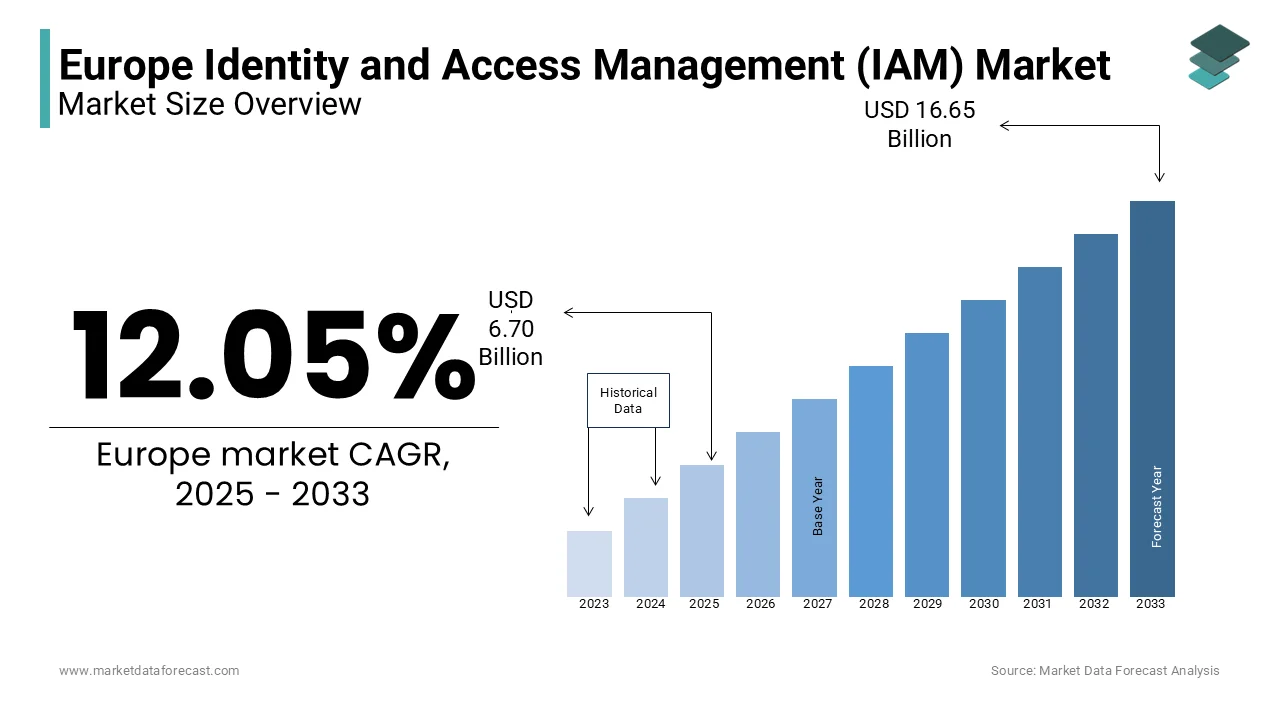
Identity and access management (IAM) is the integrated suite of policies, technologies, and processes that govern digital identity, verification, authentication, and authorization across enterprise and public sector systems. The market is shaped by a confluence of regulatory stringency, technological modernization, and escalating cyber threats. As per the European Union Agency for Cybersecurity, a large number of cyber incidents were reported by EU critical infrastructure operators in 2024, which indicates the urgency for robust identity controls. The EU’s Digital Identity Framework Regulation, adopted in 2024, mandates that all member states issue European Digital Identities by 2026, enabling citizens to access public and private services with a secure, verifiable credential. Concurrently, as per the estimations of the European Commission, most European enterprises now operate hybrid or multi-cloud environments, fragmenting identity perimeters and amplifying demand for centralized access governance. With remote work persisting, a significant share of EU employees worked remotely at least two days per week in 2024, according to Eurostat. The traditional network boundary has dissolved, making identity the new security perimeter. These dynamics position IAM as a foundational layer of Europe’s digital sovereignty and economic resilience.
MARKET DRIVERS
Mandatory Compliance with NIS2 and DORA Driving Enterprise IAM Adoption
The enforcement of the revised Network and Information Security Directive and the Digital Operational Resilience Act has become a primary catalyst for identity and access management investments across European critical sectors. NIS2 expands cybersecurity obligations to thousands of entities in energy, transport, health, and digital infrastructure, requiring strict access controls based on least privilege and multi-factor authentication as per the European Commission’s implementing guidelines. Similarly, DORA compels all EU financial institutions to implement real-time access monitoring and privileged session recording by January 2025. According to the European Banking Authority, thousands of banks and investment firms are now conducting mandatory identity risk assessments, with many reporting IAM system upgrades as their top remediation action. The German Federal Financial Supervisory Authority has already issued non-compliance fines in 2024 for inadequate access governance. These regulations transform IAM into a legal necessity, compelling organizations to deploy identity governance and administration platforms that support automated user provisioning, access certification, and just-in-time privilege elevation to meet audit readiness and avoid penalties.
Proliferation of Cloud and SaaS Applications Fragmenting Identity Silos
The rapid adoption of cloud-based software as a service applications across European enterprises has created a sprawling identity landscape that demands centralized management, which is further boosting the expansion of the European identity and access management market. As per Eurostat, a majority of EU businesses with more than 250 employees used multiple SaaS platforms in 2024, which is ranging from Microsoft 365 and Salesforce to Workday and ServiceNow. Each application maintains its own user directory, leading to credential sprawl, orphaned accounts, and inconsistent policy enforcement. As per a survey by the European Cloud Partnership, large European enterprises manage extensive volumes of digital identities across on-premises and cloud systems, with a significant share of access requests requiring manual intervention due to a lack of integration. This fragmentation increases breach risk; the European Data Protection Supervisor reported that many unauthorized data accesses in 2024 originated from stale SaaS permissions. Consequently, organizations are deploying cloud native IAM solutions featuring single sign-on, federated identity, and automated deprovisioning to enforce consistent access policies across heterogeneous environments.
MARKET RESTRAINTS
Complexity of Integrating Legacy Systems with Modern IAM Frameworks
Many European enterprises, particularly in public utilities, banking, and manufacturing, operate mission-critical applications on legacy systems that lack native support for modern authentication protocols like SAML or OAuth 2.0, which is impeding the expansion of the European identity and access management market. According to the European Investment Bank, a large share of industrial control systems in the EU still run on older platforms that cannot integrate directly with cloud IAM platforms. Retrofitting these systems requires costly custom middleware or agent-based proxies that introduce performance latency and maintenance overhead. According to the projections of the German Association of Information Technology, Telecommunications and New Media, integration costs for IAM in brownfield environments are significantly higher than greenfield deployments. Additionally, legacy applications often rely on shared service accounts with static passwords, a practice explicitly prohibited under NIS2 but difficult to eliminate without application re-engineering. According to the European Central Bank’s 2024 operational resilience review, many financial institutions delayed DORA compliance deadlines due to legacy IAM integration challenges.
Ambiguity in Cross-Border Data Localization and Consent Management
The Europe identity and access management market faces significant friction from divergent national interpretations of GDPR and the ePrivacy Directive regarding biometric data and consent logging. While the European Data Protection Board classifies facial recognition and behavioral biometrics as special category data requiring explicit consent, countries like France and Sweden permit their use in corporate access control under national security exemptions. This regulatory fragmentation forces multinational IAM vendors to deploy country specific identity stores, increasing architecture complexity and compliance costs. According to the European Data Protection Supervisor, enterprises operating in three or more EU countries spend considerably more on IAM governance to manage jurisdictional variations. Furthermore, GDPR mandates that consent records be stored separately from identity profiles and made instantly revocable, a requirement that many legacy IAM platforms cannot fulfill without customization. The Dutch Data Protection Authority fined a multinational logistics firm in 2024 for storing biometric access logs in a centralized cloud directory without local encryption keys.
MARKET OPPORTUNITIES
Integration of European Digital Identity Wallets with Enterprise IAM Systems
The EU rollout of the European Digital Identity Wallet (EUDI Wallet) presents a transformative opportunity for enterprise identity and access management by enabling citizens to authenticate to private sector services using government-verified credentials. Starting in 2026, all 27 member states will issue EUDI Wallets supporting qualified electronic signatures and attribute sharing under eIDAS 2.0. According to the European Commission, the wallets will be available to all citizens and residents by the end of 2026, creating a standardized identity layer for onboarding employees, customers, and partners. Early adopters like Siemens and AXA are already piloting EUDI integration to streamline KYC and workforce identity verification, reducing onboarding time significantly in internal trials. The wallets support selective disclosure, allowing users to share only necessary attributes such as age or professional license without revealing full identity details, aligning with privacy by design principles. IAM vendors are developing eIDAS 2.0-compliant connectors that enable seamless federation between national identity schemes and enterprise access policies. This public-private identity bridge reduces reliance on passwords and social logins while enhancing trust and compliance across the European digital economy.
Expansion of Identity Governance in Healthcare for Cross-Border Patient Data Access
The European Health Data Space Regulation, set to take effect in 2025, creates a major opportunity for advanced identity and access management in the healthcare sector by mandating secure cross-border access to electronic health records. The regulation requires all EU healthcare providers to implement attribute-based access control that dynamically grants permissions based on clinician role, patient consent, and treatment context. According to the European Commission, millions of cross-border medical consultations occur annually within the EU, necessitating real-time identity validation across national systems. Germany’s Gematik and France’s ANS are already deploying national IAM backbones that support federated clinician identities compliant with the regulation’s audit and non-repudiation requirements. IAM solutions with policy decision points and XACML engines are being integrated into hospital information systems to enforce granular consent management, ensuring a French specialist can view only relevant sections of a German patient’s record during teleconsultation. As per the European Commission, cloud-based health information exchanges are increasingly being adopted across Europe, driving demand for interoperable identity governance and positioning IAM as the trust enabler of Europe’s integrated digital health vision.
MARKET CHALLENGES
Shortage of Skilled IAM Professionals Capable of Managing Zero Trust Architectures
Despite rising demand, the Europe identity and access management market contends with a critical talent gap in professionals who can design and operate modern zero trust IAM systems. According to the European Union Agency for Cybersecurity, there is a shortfall of over 200,000 cybersecurity specialists across the EU, with IAM expertise among the most-scarce subdomains. Zero trust implementations require deep knowledge of identity federation, conditional access policies, and privileged access management, skills absent in traditional network security teams. As per ENISA surveys, many European enterprises report delays in IAM deployment due to a lack of qualified staff with hands-on experience in platforms like Microsoft Entra ID or SailPoint. The problem is acute in Southern and Eastern Europe, where vocational training programs have not yet incorporated cloud identity curricula. As a result, organizations increasingly rely on managed security service providers, but this introduces third-party risk and reduces control over sensitive identity data. Without rapid upskilling through EU-funded digital academies, the talent deficit will constrain the scalability and effectiveness of Europe’s identity security posture.
Inconsistent Implementation of Multi-Factor Authentication Across Critical Sectors
The Europe identity and access management market faces a persistent challenge in achieving uniform multi-factor authentication adoption across regulated industries due to legacy workflows and user resistance. Although NIS2 mandates MFA for all privileged and remote access, according to the European Banking Authority, only about half of EU financial institutions had fully implemented phishing-resistant MFA, such as FIDO2 security keys, by the end of 2024. In healthcare, as per ENISA, many hospitals still rely on SMS based onetime passwords, a method deprecated under ENISA’s 2023 security baseline due to SIM swap vulnerabilities. User experience remains a key barrier, according to the European Consumer Organization. Employees in manufacturing often bypass MFA by sharing static codes due to perceived workflow disruption. This patchwork adoption creates exploitable gaps, as per Europol cybercrime assessments, weak or absent MFA in supply chain partners has been linked to business email compromise incidents. Until regulatory enforcement is paired with user-centric authentication design, Europe’s IAM maturity will remain uneven across sectors and geographies.
REPORT COVERAGE
| REPORT METRIC | DETAILS |
| Market Size Available | 2025 to 2034 |
| Base Year | 2025 |
| Forecast Period | 2026 to 2034 |
| Segments Covered | By Category, Application, and Country. |
| Various Analyses Covered | Global, Regional, and Country-Level Analysis, Segment-Level Analysis, Drivers, Restraints, Opportunities, Challenges; PESTLE Analysis; Porter’s Five Forces Analysis, Competitive Landscape, Analyst Overview of Investment Opportunities |
| Countries Covered | UK, France, Spain, Germany, Italy, Russia, Sweden, Denmark, Switzerland, Netherlands, Turkey, Czech Republic, and the Rest of Europe. |
| Market Leaders Profiled | Amazon Web Services, Inc., Broadcom, One Identity LLC, ForgeRock, HID Global Corp., IBM, McAfee, LLC, Microsoft Corporation, Okta Inc., OneLogin, Oracle, Ping Identity, SecureAuth, Evidian, SailPoint Technologies Holdings Inc., and Others. |
SEGMENTAL ANALYSIS
By Component Insights
The single sign-on commands segment dominated the market by accounting for 23.2% of the regional market share in 2025. The dominance of the single sign-on segment in this regional market is driven by the exponential growth of cloud applications and the need to streamline user experience without compromising security. European enterprises now use a large number of SaaS applications per organization, creating significant password fatigue and helpdesk burden. Single sign-on eliminates redundant logins by federating identity across platforms using standards like SAML and OpenID Connect, reducing password reset tickets significantly, as per industry associations. The European Commission’s Cloud Rulebook for public sector procurement explicitly recommends SSO as a baseline security control, accelerating adoption in government agencies. Moreover, SSO serves as the foundational layer for advanced capabilities like conditional access and user behavior analytics, features mandated under NIS2 for critical infrastructure operators. As per European CIO surveys, enterprises report improved productivity post SSO deployment, making the component indispensable for balancing security, usability, and operational efficiency across hybrid digital environments.
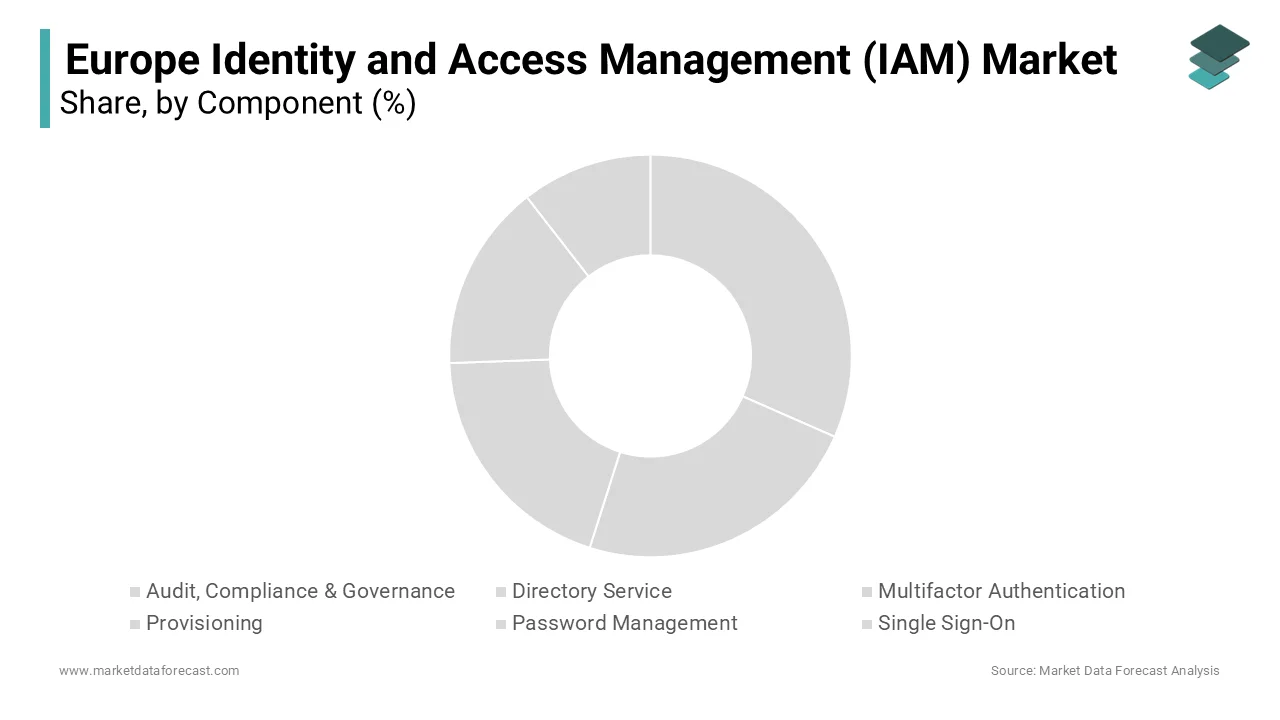
The multifactor authentication segment is the fastest-growing component in the Europe identity and access management market and is estimated to witness a CAGR of 15.5% over the forecast period, owing to the regulatory mandates under NIS2 and DORA that require phishing-resistant authentication for all remote and privileged access by 2025. According to the European Banking Authority, most EU financial institutions are replacing SMS based one-time passwords with FIDO2 security keys or biometric authenticators to comply with DORA’s operational resilience requirements. Similarly, the European Health Data Space Regulation mandates MFA for clinicians accessing cross-border patient records, driving adoption in hospitals across Germany and France. As per the European Union Agency for Cybersecurity, credential theft remains a leading cause of ransomware incidents, galvanizing enterprises to deploy adaptive MFA that evaluates device posture, location, and behavior before granting access. Microsoft’s European security reports confirm that accounts protected by phishing-resistant MFA are far less likely to be compromised.
By Deployment Insights
The cloud deployment segment led the market by capturing 57.4% of the regional market share in 2025. The growth of the cloud deployment segment in the European market is attributed to the continent’s rapid migration to SaaS enterprise platforms and the inherent scalability of cloud native IAM solutions. As per Eurostat, a majority of EU enterprises with more than 250 employees now operate in multi-cloud environments, which is demanding IAM systems that can dynamically synchronize identities across Microsoft Entra, Google Workspace, and Salesforce. Cloud IAM eliminates the capital expenditure and maintenance overhead of on-premise directories while enabling real-time policy updates and threat detection powered by global telemetry. The European Commission’s GAIA-X initiative further incentivizes cloud adoption by certifying IAM providers that adhere to European data sovereignty and interoperability standards. According to the European Cloud Partnership, hundreds of public sector agencies migrated to cloud IAM platforms in 2024 to support pan-European digital service delivery under the Once Only Principle. Additionally, cloud IAM vendors offer automatic compliance templates for GDPR, NIS2, and DORA, which reduces audit preparation time significantly, as per the European Data Protection Supervisor.
The hybrid deployment segment is the fastest-growing segment in the Europe identity and access management market and is estimated to register a CAGR of 13.3% over the forecast period, owing to the reality that most European enterprises operate a mix of legacy on-premises applications and modern cloud services requiring a unified identity fabric that spans both domains. Critical sectors like energy, banking, and manufacturing maintain core systems such as SAP ECC mainframes and industrial control platforms that cannot be migrated to the cloud due to regulatory or operational constraints. According to the European Investment Bank, many industrial firms still rely on on-premises ERP systems yet must integrate with cloud-based HR and collaboration tools. Hybrid IAM solutions bridge this gap by synchronizing on-premises Active Directory with cloud identity providers using secure connectors and identity firewalls. As per Germany’s Federal Office for Information Security, a majority of DORA-compliant banks adopted hybrid IAM in 2024 to maintain control over privileged access to legacy trading systems while enabling secure cloud collaboration.
By End-use Insights
The BFSI segment dominated the market by occupying 25.5% of the regional market share in 2025. The growth of the BFSI segment in the European market is driven by stringent regulatory obligations and the high value of financial data targeted by cybercriminals. The Digital Operational Resilience Act requires all EU banks, insurers, and investment firms to implement real-time access monitoring, privileged session recording, and just-in-time provisioning by January 2025. According to the European Banking Authority, thousands of financial institutions are conducting quarterly access certifications with automated remediation workflows to satisfy DORA’s audit trail requirements. Additionally, open banking under PSD2 mandates strong customer authentication using multi-factor methods for all third-party payment initiations, increasing identity verification volume significantly as per the European Central Bank. The sector’s adoption of cloud core banking and digital wallets further fragments identity perimeters, necessitating centralized governance. Europol reports link a large share of financial cyber incidents to compromised employee credentials, underscoring the urgency for advanced IAM. With average breach costs in BFSI exceeding millions of euros according to the European Insurance Federation, the sector prioritizes identity security as both a compliance imperative and business enabler.
The healthcare segment is growing exponentially and is estimated to expand at a CAGR of 17.3% over the forecast period, owing to the European Health Data Space Regulation that mandates secure cross-border access to electronic health records by 2025, requiring attribute-based access control and dynamic consent management. According to the European Commission, millions of cross-border patient consultations occur annually, necessitating real-time identity validation across national health information systems. Germany’s Gematik and France’s ANS are deploying national IAM backbones that federate clinician identities using eIDAS 2.0 standards, enabling specialists to securely access relevant sections of patient records during teleconsultation. Additionally, hospitals are digitizing operations with cloud-based EHRs and IoT medical devices, creating thousands of new access points that must be governed under GDPR’s special category data rules. As per the European Federation of Medical Informatics, a majority of European hospitals plan to adopt zero trust IAM in the coming years to protect sensitive health data.
COUNTRY LEVEL ANALYSIS
Germany Identity and Access Management (IAM) Market Analysis
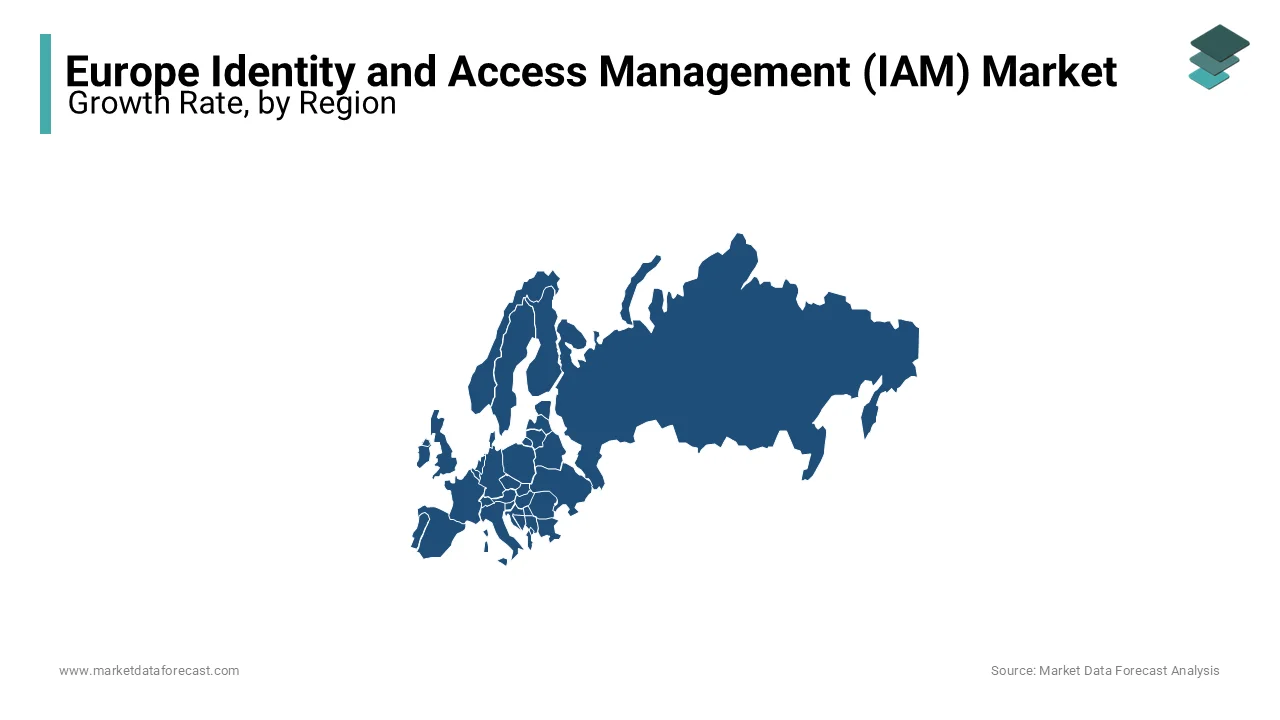
Germany led the identity and access management market in Europe in 2025 by holding 24.1% of the regional market share. The dominance of Germany in the European market is attributed to its dense concentration of critical infrastructure operators and rigorous data protection enforcement. The country’s Federal Office for Information Security administers some of the EU’s strictest cybersecurity audits under the IT Security Act 2.0, which aligns closely with NIS2 requirements. According to the German Banking Industry Committee, many financial institutions have implemented advanced IAM platforms featuring just-in-time access and behavioral analytics to comply with BaFin’s operational resilience guidelines. Germany’s manufacturing sector, home to automotive giants like BMW and Siemens, also drives demand as factories adopt cloud-based MES and IIoT platforms requiring secure machine and user identities. As per the Fraunhofer Institute, a majority of German industrial firms now use hybrid IAM to bridge legacy OT systems with cloud analytics. With the highest density of GDPR fines in Europe as per the European Data Protection Board, German organizations treat IAM not as optional but as an existential infrastructure for legal and operational continuity.
United Kingdom Identity and Access Management (IAM) Market Analysis
The United Kingdom occupied 17.4% of the regional market share in 2025. The growth of the UK in the European market can be credited to its globally integrated financial sector and early adoption of cloud native security architectures. Despite Brexit, the UK’s Financial Conduct Authority enforces IAM standards equivalent to DORA, requiring banks to log and review all privileged sessions in real time. According to the Bank of England, most UK financial institutions have migrated to cloud IAM platforms like Microsoft Entra ID to support hybrid work and SaaS proliferation. The UK’s National Cyber Security Centre lists identity as the primary attack vector in its 2024 threat report, prompting public and private sector collaboration on phishing-resistant MFA deployment. Additionally, the UK’s digital identity trust framework enables certified private sector verifiers to integrate with government services, creating a seamless identity ecosystem. As per Ofcom, a large share of UK enterprises operates multi cloud environments, driving demand for scalable SSO and access governance.
France Identity and Access Management (IAM) Market Analysis
France is anticipated to command a prominent share of the European identity and access management market over the forecast period. France stands out for its strategic investment in sovereign cloud infrastructure and centralized public sector IAM. The French Agency for Digital Transformation (ANCT) mandates that all government agencies adopt the France Connect Plus identity system, which federates citizen and employee access across thousands of public services using eIDAS 2.0 standards. According to the French National Cybersecurity Agency, millions of citizens now use France Connect for tax, healthcare, and education services, reducing reliance on passwords. In parallel, the French defense and energy sectors enforce sovereign IAM requirements prohibiting the use of non-European cloud providers for identity data, a policy that has boosted local vendors like Thales and Orange Cyberdefense. The Banque de France’s directive requires all payment service providers to implement hardware-backed MFA by 2025, accelerating adoption in fintech. With the state acting as both regulator and anchor customer, France creates a unique IAM ecosystem where public policy directly shapes private sector security architecture.
Netherlands Identity and Access Management (IAM) Market Analysis
The Netherlands is estimated to grow at a healthy CAGR in the Europe identity and access management market during the forecast period. The Netherlands serves as a critical data logistics hub due to its concentration of hyperscalers, internet exchanges, and multinational headquarters. Amsterdam hosts major European data centers for AWS, Microsoft, and Google, making it a focal point for cloud IAM deployment. According to the Dutch Data Protection Authority, hundreds of multinational corporations use the Netherlands as their EU data processing base, necessitating robust cross-border identity governance compliant with GDPR. The Dutch government’s DigID system, used by most citizens, integrates with private sector services under the eIDAS framework, enabling seamless authentication for banking and healthcare. The Dutch Central Bank’s operational resilience guidelines require financial institutions to implement real-time access anomaly detection, a driver for advanced IAM analytics. With English as a business lingua franca and a highly digitized economy, the Netherlands offers an ideal testbed for scalable identity solutions serving pan-European operations.
Sweden Identity and Access Management (IAM) Market Analysis
Sweden is expected to account for a notable share of the European identity and access management market over the forecast period. Sweden exemplifies Europe’s most advanced digital society with identity and access management embedded in everyday civic life. According to the Swedish Civil Contingencies Agency, most Swedish citizens use BankID, a government-certified mobile authentication system, for everything from tax filing to healthcare appointments. This cultural normalization of secure digital identity creates low-friction adoption of enterprise IAM solutions that align with national standards. Sweden’s implementation of NIS2 includes stricter requirements for critical infrastructure operators, mandating continuous access reviews and MFA for all third-party vendors. As per the Swedish Financial Supervisory Authority, all banks must log identity transactions in immutable ledgers to satisfy audit requirements. Additionally, Sweden’s strong privacy ethos influences IAM design, with vendors prioritizing consent granularity and data minimization features that resonate with GDPR’s spirit. With one of the highest English proficiency rates in Europe and a tech-fluent workforce, Sweden serves as a launchpad for privacy-centric IAM innovation that balances security, usability, and fundamental rights.
COMPETITIVE LANDSCAPE
Competition in the Europe identity and access management market is defined by a triad of global cloud giants, specialized governance vendors, and emerging European players, each competing on regulatory compliance, technical depth, and data sovereignty. Microsoft leverages its ecosystem dominance to offer integrated identity within Microsoft 365 and Azure, while Okta excels in workforce and customer identity unification with strong API extensibility. SailPoint and One Identity focus on granular access governance for highly regulated sectors requiring audit-ready controls. The market is further intensified by European startups like Cryptomathic and Keyless that offer privacy-preserving authentication aligned with EU digital ethics. Regulatory pressure from NIS2 DORA and the European Health Data Space creates a high barrier to entry, favoring vendors with proven compliance frameworks. At the same time, the shift toward zero trust and the rollout of the European Digital Identity Wallet are reshaping buyer priorities toward interoperability and citizen-centric design. This dynamic environment rewards both global scale and regional adaptability.
KEY MARKET PLAYERS
The leading companies operating in the Europe identity and access management (IAM) market include:
- Amazon Web Services, Inc.
- Broadcom
- One Identity LLC.
- ForgeRock
- HID Global Corp.
- IBM, McAfee, LLC
- Microsoft Corporation
- Okta Inc
- OneLogin
- Oracle
- Ping Identity
- SecureAuth
- Evidian
- SailPoint Technologies Holdings Inc
TOP PLAYERS IN THE MARKET
- Microsoft Corporation is a dominant force in the Europe identity and access management market through its Microsoft Entra ID platform, formerly Azure Active Directory. The company contributes globally by setting industry standards for cloud identity with protocols like SCIM and FIDO2 and by embedding zero-trust principles into enterprise workflows. In Europe, Microsoft has strengthened its position by achieving compliance with EU data sovereignty requirements through localized cloud regions in Germany, France, and Switzerland. The company recently enhanced Entra ID with AI-powered identity threat detection and integrated it with the European Digital Identity Wallet framework to support eIDAS 2.0 interoperability. These initiatives align with NIS2 and DORA mandates while enabling seamless cross-border authentication for both public and private sector customers across the continent.
- Okta Inc is a leading identity cloud provider with a significant footprint in the Europe identity and access management market, serving enterprises across finance, healthcare, and public sectors. Globally, Okta drives innovation through its extensible platform that unifies workforce and customer identity management. In Europe, the company has deepened its presence by establishing GDPR compliant data centers in Ireland and the Netherlands and achieving certification under the EU Cloud Code of Conduct. Okta recently launched advanced lifecycle management features that automate access reviews and deprovisioning to meet NIS2 audit requirements. The company also partners with European system integrators like Capgemini and Tietoevry to deliver tailored IAM solutions that address sector-specific regulatory and operational needs across diverse member states.
- SailPoint Technologies Holdings Inc is a specialized leader in identity governance and administration with strong adoption in regulated European industries. The company contributes globally by pioneering AI-driven identity analytics and automated access certification that support zero-trust architectures. In Europe, SailPoint has reinforced its market position by aligning its Identity Security Cloud with DORA and the European Health Data Space Regulation through pre-built compliance templates and policy packs. The company recently opened a dedicated European data residency option hosted on AWS Frankfurt to ensure full GDPR adherence. Additionally, SailPoint collaborates with national cybersecurity agencies to develop identity risk scoring models that reflect regional threat landscapes. These efforts position SailPoint as a strategic partner for enterprises seeking granular control over access governance in complex hybrid environments.
TOP STRATEGIES USED BY THE KEY MARKET PARTICIPANTS
Key players in the Europe identity and access management market prioritize regulatory alignment by embedding NIS2 DORA and GDPR compliance controls directly into their platforms through automated policy enforcement and audit logging. They invest in European data residency by deploying localized cloud infrastructure in Germany, France, and Ireland to meet data sovereignty requirements. Companies enhance interoperability by supporting eIDAS 2.0 and integrating with national digital identity schemes like BankID and France Connect. Strategic partnerships with regional system integrators and managed service providers accelerate deployment in complex legacy environments. Additionally, they advance phishing-resistant authentication by promoting FIDO2 security keys and passkeys while retiring legacy protocols like SMS based onetime passwords to meet evolving ENISA security baselines.
COMPETITIVE LANDSCAPE
KEY MARKET PLAYERS
Some of the companies that are playing a dominating role in the Europe identity and access management (IAM) market include
- Amazon Web Services, Inc.
- Broadcom
- One Identity LLC.
- ForgeRock
- HID Global Corp.
- IBM, McAfee, LLC
- Microsoft
- Okta
- OneLogin
- Oracle
- Ping Identity
- SecureAuth
- Evidian
MARKET SEGMENTATION
This research report on the Europe identity and access management (IAM) market is segmented and sub-segmented into the following categories.
By Component
- Audit, Compliance & Governance
- Directory Service
- Multifactor Authentication
- Provisioning
- Password Management
- Single Sign-On
By Deployment
- Cloud
- Hybrid
- On-premise
By End-use
- BFSI
- Energy, Oil & Gas
- Telecom & IT
- Education
- Healthcare
- Public Sector & Utilities
- Manufacturing
- Others
By Country
- UK
- France
- Spain
- Germany
- Italy
- Russia
- Sweden
- Denmark
- Switzerland
- Netherlands
- Turkey
- Czech Republic
- Rest of Europe