- Product Description Description
- Table of Contents TOC
- List of Table & Figure LOT
- Get Free Sample PDF Sample PDF
Market Size, 2025
$286.44 BnMarket Estimate, 2026
$303.88 BnMarket Forecast, 2034
$487.64 BnCAGR, 2026–2034
6.09%Europe Insurtech Market Report Summary
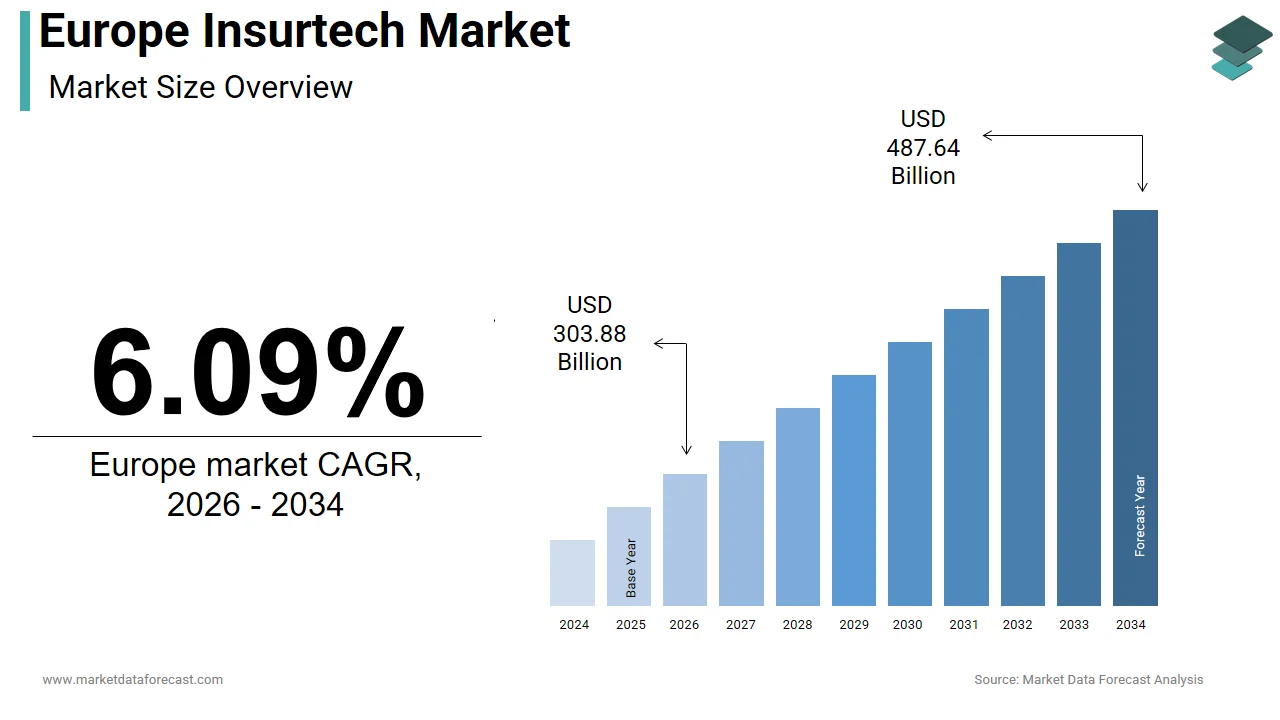
The Europe insurtech market was valued at USD 286.44 billion in 2025, is estimated to reach USD 303.88 billion in 2026, and is projected to reach USD 487.64 billion by 2034, growing at a CAGR of 6.09% from 2026 to 2034. The market is being transformed by the widespread adoption of AI, IoT, blockchain, telematics, and mobile-first platforms that enable dynamic pricing, real-time underwriting, and automated claims. Regulatory sandboxes, high digital readiness, and generational demand for on-demand, personalized products are key enablers. Insurtechs are driving new distribution models (embedded, D2C, marketplaces), redefining risk assessment with alternative data, and partnering with incumbents to scale solutions, all of which are accelerating digital insurance adoption across Europe.
Key Market Trends
- Regulatory sandboxes and adaptive authorisation frameworks are accelerating product validation and market entry for innovative insurance models.
- Rising consumer demand for hyper-personalized, on-demand coverage (usage-based motor, pay-as-you-live health, short-term travel) is reshaping product design.
- AI-driven underwriting and claims automation are improving speed, accuracy, and cost efficiency, using alternative data (telematics, wearables, satellite).
- Embedded insurance in e-commerce, mobility, and travel platforms is opening low-friction distribution channels and improving conversion economics.
- Growing focus on privacy, explainability, and cybersecurity as algorithmic fairness and data protection scrutiny intensify.
Segmental Insights
- Based on product line, the property & casualty (P&C) segment led the Europe insurtech market in 2024 with 41.7% share, supported by rapid digitization in motor, home, and travel insurance, strong adoption of telematics and parametric solutions, and high consumer demand for usage-based and rapid-payout products.
- Based on distribution channel, aggregators and digital marketplaces segment dominated in 2024 with a 48.45% share, reflecting consumer preference for transparent multi-carrier comparisons and API-driven instant quoting, while the Direct-to-Consumer (D2C) digital channel is forecast to grow fastest (CAGR 25.2%) as brands seek first-party customer data and subscription / service-style relationships.
- Based on end user, the retail & individual segment was the largest in 2024 at 63.5%, led by high digital literacy, app-first purchasing behavior among younger adults, and modular, on-demand product designs. The SME & commercial segment is expected to expand fastest (CAGR 28.7%) as insurtechs address underserved small business needs (cyber, logistics, e-commerce risks) with automated underwriting and API integrations.
Regional Insights
The Europe insurtech market is expanding unevenly across countries, shaped by regulatory approaches, digital infrastructure, fintech ecosystems, and public sector digital initiatives.
- United Kingdom outperformed peers with a 22.4% share in 2024, driven by London’s fintech hub, agile FCA sandbox, investor capital, and dense startup activity.
- Germany held 18.7% share in 2024, supported by a deep insurance market, strong incumbent digital transformation efforts, and an active Berlin startup scene.
- France is a major player, with strong public digital infrastructure supporting pan-European health and embedded models and a favorable funding environment for scaleups.
- Netherlands is notable for advanced digital identity, open finance adoption, and SME-focused insurtech innovation, making it a disproportionate contributor to API-driven solutions.
- Sweden is expected to grow rapidly from 2025–2033 due to world-leading digital public services, high institutional trust, and early uptake of preventive and wearable-based insurance models.
Competitive Landscape
The Europe insurtech market is highly competitive and fragmented, featuring digital natives, white-label solution providers, and innovation units of legacy insurers. Firms differentiate on UX, data moats, regulatory compliance, and embedded distribution capabilities. Incumbents respond by partnering, acquiring, or launching spin-offs to retain relevance. Investors favor companies with defensible unit economics, data advantages, and clear paths to cross-border scale, but fragmentation across national regulations and data regimes requires localization strategies and operational discipline. Key market players include: Wefox, Alan, Zego, Lemonade, Getsafe, and Others.
Europe Insurtech Market Size
The size of the Europe insurtech market was worth USD 286.44 billion in 2025. The regional market is anticipated to grow at a CAGR of 6.09% from 2026 to 2034 and be worth USD 487.64 billion by 2034 from USD 303.88 billion in 2026.
Insurtech refers to the use of digital tech like AI, IoT, blockchain, and mobile apps to revolutionize insurance, which makes it more efficient, personalized, and customer-focused. It achieves this by streamlining processes like underwriting and claims, creating new models such as P2P and on-demand, and enhancing the overall customer experience with seamless, data-driven services that lower costs and increase transparency. These solutions leverage artificial intelligence, telematics, blockchain, Internet of Things devices, and advanced data analytics to enhance efficiency, personalization, and risk assessment accuracy. Unlike traditional insurance models constrained by legacy infrastructure, insurtech enables dynamic pricing, real-time policy adjustments, and automated customer journeys. The market’s evolution is deeply intertwined with Europe’s regulatory maturity and digital readiness. As per sources, a large majority of households possess the foundational connectivity necessary for adopting digital insurance services. Furthermore, regulatory environments across various states are actively encouraging the testing and development of innovative insurance offerings. Consumer behavior also reflects this shift. Also, consumer preferences show a clear inclination among younger adults towards using digital platforms that provide instant purchasing options. These contextual enablers, digital access, regulatory experimentation, and generational preference, form the bedrock of Europe’s insurtech transformation.
MARKET DRIVERS
Regulatory Sandboxes Foster Controlled Innovation and Market Entry
European regulators have deliberately created adaptive frameworks to incubate insurance technology solutions without compromising consumer protection, which drives the growth of the Europe Insurtech market. This significantly accelerates product validation and commercial deployment. A particular jurisdiction led the way in developing a specific regulatory innovation approach. Numerous other jurisdictions across a major region have since established similar operational frameworks. A significant number of companies in a specific sector have engaged in trials within these frameworks. Most of the participating companies successfully moved from trials to offering full-scale services in the market. The trial programs have demonstrated a reduction in the time it takes for firms to bring their products to market, compared to traditional licensing procedures. These controlled environments allow startups to test usage-based auto insurance models, parametric climate coverage, and AI-driven underwriting engines using real customer data under supervisory oversight. Crucially, sandboxes also build trust with incumbent insurers seeking innovation partnerships. This institutionalized experimentation lowers systemic risk while nurturing a pipeline of compliant, scalable solutions, which makes regulatory sandboxes a critical catalyst for insurtech maturation across Europe.
Consumer Demand for Hyper Personalized and On-Demand Coverage Drives Product Innovation
Modern European consumers increasingly reject one-size-fits-all insurance policies in favor of dynamic and context-aware protection aligned with their lifestyle and risk exposure, which also boosts the expansion of the Europe Insurtech market. This behavioral shift is particularly pronounced among younger demographics who view insurance as a service rather than a static contract. As per a study, many individuals in younger consumer groups show an interest in exchanging personal data, such as details about driving habits or home sensor data, for personalized insurance premiums. In response, insurtech firms have launched usage-based motor insurance, pay-as-you-live health policies, and on-demand travel coverage triggered via smartphone geolocation. One insurer's collaboration with a startup has enabled the sale of short-term, usage-based car insurance policies. Another insurance provider offers specific home insurance add-ons that integrate with rental calendars, providing coverage exclusively for the duration of short-term rentals. Regulatory bodies have indicated that these types of insurance models generally comply with data protection principles when they rely on clear consumer consent and minimize the amount of data collected. This convergence of consumer expectations, mobile technology, and privacy-compliant data use is redefining insurance from a passive safeguard to an active, responsive utility.
MARKET RESTRAINTS
Fragmented Data Protection and Insurance Regulations Across Member States Impede Scalability
There are significant disparities in national insurance supervision and data governance frameworks that create operational friction for pan-European insurtech expansion, despite the European Union’s efforts toward harmonization, and thereby restrain the growth of the Europe Insurtech market. The General Data Protection Regulation establishes a baseline for handling personal data, but different jurisdictions interpret its rules differently, especially concerning automated decision-making and the use of biometric data in underwriting. Insurtech firms operating across multiple EU countries allocate a notable portion of their compliance budget toward managing varied national requirements. Compliance efforts frequently involve reconciling different regulatory approaches to data use, as the permissibility of real-time data analysis for insurance purposes differs significantly between member states. One jurisdiction may allow real-time telematics scoring for motor premiums, while another may limit data use strictly to post-accident analysis. Similarly, solvency and capital adequacy rules under Solvency II are applied differently by national regulators, affecting how startups structure risk transfer partnerships with incumbents. Costly and complex scaling of European AI innovation persists due to a lack of converged rules on ethics, licensing, and data portability.
Legacy IT Infrastructure in Traditional Insurers Hinders Integration and Collaboration
Many established European insurers continue to rely on decades-old core systems that lack APIs, cloud compatibility, and real-time processing capabilities, which obstructs the expansion of the Europe insurtech market. This creates a formidable barrier for insurtech integration. These monolithic architectures, often written in COBOL or proprietary mainframe languages, cannot easily interface with modern data analytics engines or customer-facing digital platforms. According to a study, many financial institutions across the Eurozone grapple with the operational challenges and inefficiencies inherent in maintaining older technology platforms. This technological debt forces insurtechs to build costly middleware or limit partnerships to greenfield ventures, slowing innovation diffusion. Integrating innovative technologies, such as telematics-based products, frequently presents high cost and time challenges for individual insurers due to a lack of compatibility between new systems and existing infrastructure. Besides, legacy systems often store data in siloed formats, preventing holistic risk profiling needed for personalized pricing. The full value of insurtech collaboration hinges on incumbents accelerating their core system transformation, an effort that needs regulatory incentives to succeed.
MARKET OPPORTUNITIES
Integration of Embedded Insurance into E Commerce and Mobility Platforms Unlocks New Distribution Channels
Insurance technology in the region is increasingly leveraging non-traditional touchpoints to deliver insurance at the precise moment of need by bypassing conventional sales funnels, which creates new opportunities for the Europe insurtech market. Embedded insurance, where coverage is seamlessly offered within third-party digital experiences, has gained rapid traction in sectors like online retail, ride-hailing, and home sharing. Embedded insurance transactions in Europe have seen significant growth in recent years, with millions of policies distributed via partner platforms. In the e-commerce sector, some insurtechs are collaborating with retailers to provide seamless return protection options for fashion purchases. Travel insurance models have emerged where coverage is automatically activated through partnerships with ride-sharing services when users book airport transfers. These distribution models are recognized as compliant with existing insurance distribution rules, provided that principles of transparency and user consent are upheld. This shift transforms insurance from a standalone purchase to a contextual feature, dramatically improving conversion while reducing customer acquisition costs. The increasing depth of digital ecosystems across Europe creates a significant structural chance for embedded insurance to achieve widespread market relevance without relying on traditional branding strategies or agent infrastructures.
Adoption of AI-Driven Underwriting and Claims Automation Enhances Operational Precision
Artificial intelligence is revolutionizing core insurance functions in the region by enabling faster, fairer, and more accurate risk assessment and settlement processes, which provides fresh prospects for the expansion of the Europe insurtech market. Insurtech firms are deploying machine learning models that analyze alternative data, such as satellite imagery for property risk or wearable device metrics for health, to refine pricing beyond traditional actuarial tables. Tractable's artificial intelligence platform is widely used by major European insurers, including Covéa in France and Generali in Italy, to assess vehicle damage from photos. The technology significantly increases the speed of claims processing compared to traditional manual methods. UK-based company Cytora provides commercial property underwriting platforms that integrate various data sources, including geospatial and climate information. This allows insurers to enhance their risk assessment and pricing accuracy in response to evolving environmental risks, such as flood or wildfire events. Automation and enhanced accuracy from AI are the bedrock of next-generation European insurance, which reduces costs and significantly upgrades the customer experience.
MARKET CHALLENGES
Algorithmic Bias and Lack of Explainability Undermine Trust and Regulatory Compliance
Insurance technology firms in the region face mounting scrutiny over opaque decision engines that may perpetuate discrimination or violate the right to explanation enshrined in the General Data Protection Regulation, despite the promise of AI, which challenges the growth of the Europe insurtech market. Machine learning models trained on historical insurance data can inadvertently reinforce biases related to postal code, occupation, or credit history, factors that correlate with protected characteristics like ethnicity or socioeconomic status. European data protection authorities and financial regulators are increasingly scrutinizing insurtech algorithms for potential bias and disparities in outcomes based on sensitive demographic data. There have been instances where national consumer and market authorities have intervened in cases where AI-driven models in the insurance sector raised concerns about unfair or potentially discriminatory practices across different geographic areas. Regulators now demand model interpretability. Algorithmic opacity will continue to pose significant reputational and legal risks until organizations adopt standard practices like fairness by design and real-time bias monitoring.
Cybersecurity Vulnerabilities in Digital Insurance Platforms Expose Sensitive Consumer Data
The digitization of insurance processes has expanded the attack surface for cyber threats, which places vast volumes of highly sensitive personal and financial data at risk across the region’s insurance technology ecosystem, and thereby inhibits the expansion of the Europe insurtech market. Unlike traditional paper-based models, digital platforms continuously collect, store, and transmit health records, biometric data, banking details, and behavioral telemetry, making them prime targets for ransomware and data exfiltration. The insurance sector has observed a rise in reported cyber incidents. Smaller and medium-sized insurance technology firms seem more vulnerable, potentially due to resource limitations for security. A data breach affecting customer information at a health insurtech led to an official investigation, prompting mandatory cybersecurity guidance for relevant entities. These guidelines include requirements for data protection, identity verification, and regular security assessments. However, enforcement remains fragmented. The sector's digital trust depends on uniform security protocols for all players, given the increasing sophistication of cyber threats.
REPORT COVERAGE
| REPORT METRIC | DETAILS |
| Market Size Available | 2025 to 2034 |
| Base Year | 2025 |
| Forecast Period | 2026 to 2034 |
| Segments Covered | By Product Line, Distribution Channel, End User, and County. |
| Various Analyses Covered | Global, Regional, and Country-Level Analysis, Segment-Level Analysis, Drivers, Restraints, Opportunities, Challenges; PESTLE Analysis; Porter’s Five Forces Analysis, Competitive Landscape, Analyst Overview of Investment Opportunities |
| Countries Covered | UK, France, Spain, Germany, Italy, Russia, Sweden, Denmark, Switzerland, Netherlands, Turkey, Czech Republic, and the Rest of Europe. |
| Market Leaders Profiled | Wefox, Alan, Zego, Lemonade, Getsafe, and Others. |
SEGMENTAL ANALYSIS
By Product Line Insights
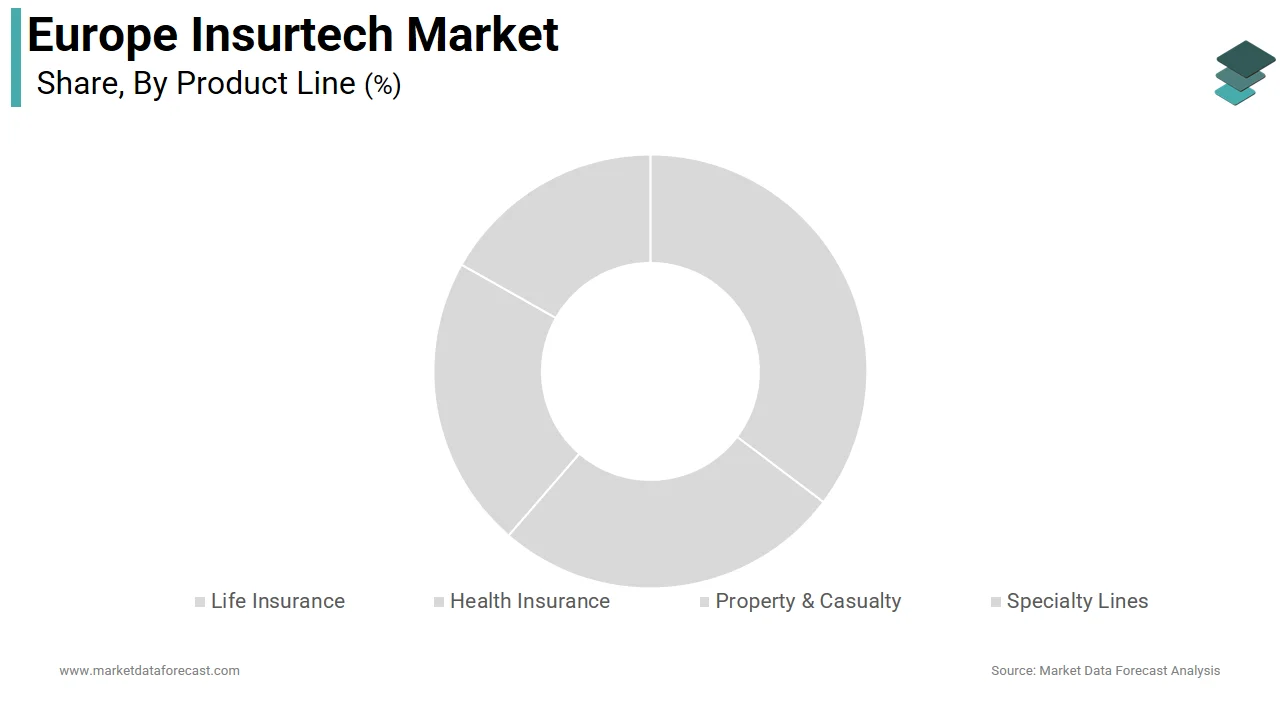
The property and casualty segment led the Europe insurtech market and captured a 41.7% share in 2024. The leading position of the property and casualty segment is driven by high consumer demand for real-time, usage-based, and parametric coverage models in motor, home, and travel domains. The property and casualty (P&C) sector is a prominent area for insurtech developments, particularly in aligning with digital distribution methods and enhanced risk assessment practices. The integration of telematics into motor insurance has revolutionized underwriting by enabling behavior-based premiums rather than demographic proxies. European consumers are increasingly receptive to sharing driving data for fairer pricing. Drivers are receptive to using driving monitoring applications when those apps are linked to potential discounts on their insurance premiums. Insurtech firms like By Miles in the UK and Coya in Germany offer pay-as-you-drive models that adjust premiums monthly based on actual kilometers traveled and driving quality. Incentivizing safer driving behaviors, such as smooth acceleration and braking, can lead to a reduction in the frequency of insurance claims. Furthermore, initiatives to standardize vehicle data access support secure integration for third-party services. This regulatory and behavioral synergy has made motor insurance the fastest digitizing P&C sub-segment, which anchors the broader category’s dominance. Parametric insurance, where payouts are triggered automatically by predefined external events such as flight delays or flood levels, has gained rapid traction in Europe’s P&C segment due to its speed and transparency. In an era of increasing climate volatility, consumers demand immediate relief without claims bureaucracy. This convergence of climate urgency, sensor technology, and consumer impatience with traditional claims processes solidifies P&C’s market leadership.
The health insurance segment is expected to exhibit a noteworthy CAGR of 21.4% from 2025 to 2033 due to the rising chronic disease burdens, digital health adoption, and regulatory support for preventive care. European insurers are increasingly leveraging data from wearables and health apps to shift from reactive treatment to proactive prevention. Insurtechs like Alan in France and Feather in Germany offer premium discounts for meeting daily activity goals tracked via Apple Watch or Fitbit. The legal framework enables personalized health plans that reward healthy behavior, transforming insurance into a wellness partner rather than a claims payer. Mental health has emerged as a critical frontier in European health insurtech, spurred by rising public awareness and workforce pressures. Insurtechs are responding with on-demand therapy, AI-driven screening, and employer-sponsored mental wellness plans. UK-based Sanctus embeds licensed therapists into corporate benefits platforms, while Germany’s Feather offers instant access to psychologists via video within its app. The annual growth of digital mental health platforms across Europe is redefining health insurance, transforming it into a holistic, continuous care ecosystem.
By Distribution Channel Insights
The aggregators and digital marketplaces segment dominated the Europe insurtech market and accounted for a 48.45% share in 2024. The dominance of the aggregators and digital marketplaces segment is propelled by consumer preference for transparent and multi-carrier comparisons that drive platform loyalty, and by API-driven real-time quoting that enhances conversion and carrier access. These platforms empower consumers to compare multiple offerings in real time, fostering price transparency and competition. European consumers increasingly distrust single-brand sales and seek objective comparisons before purchasing insurance. Platforms like Compare the Market in the UK and Verivox in Germany provide side-by-side policy analysis, including coverage nuances and claim satisfaction scores. This transparency builds trust. Moreover, regulatory requirements under the Insurance Distribution Directive mandate clear disclosure of product features, which aggregators operationalize more effectively than individual insurer sites. This alignment with consumer sovereignty and regulatory compliance cements marketplaces as the primary gateway to digital insurance in Europe. Modern aggregators leverage open APIs to connect directly to insurer pricing engines, enabling instant, binding quotes rather than estimates. This technical interoperability dramatically reduces friction in the purchase journey. For insurers, aggregators provide cost-efficient customer acquisition without heavy marketing spend. This symbiotic ecosystem, combining consumer choice, technical efficiency, and mutual commercial benefit, sustains the segment’s commanding position.
The Direct to Consumer Digital segment is predicted to witness the highest CAGR of 25.2% from 2025 to 2033, owing to a strategic shift toward brand-owned, data-rich customer relationships. Insurtechs are bypassing comparison sites by embedding insurance directly into lifestyle and transactional apps where risk naturally arises. French insurtech integrates travel insurance into airline and hotel booking flows, while UK-based Sherpa offers rental damage protection at the point of car reservation on Turo. These contextual placements achieve conversion rates up to five times higher than traditional funnels. Crucially, D2C models retain full customer data ownership, enabling hyper-personalization and cross-selling. This shift from passive comparison to proactive, in-the-moment coverage is redefining distribution economics. Leading D2C insurtechs are adopting recurring subscription structures, akin to streaming services, to build long-term customer loyalty. Alan in France charges a monthly fee for comprehensive health coverage, including therapy and preventive care, reducing the transactional nature of insurance. D2C platforms thrive by making insurance an ongoing service, fostering consistent engagement and reliable revenue streams, core enablers for their rapid expansion.
By End User Insights
The retail and individual segment was the largest in the Europe insurtech market by occupying a share of 63.5% in 2024. The supremacy of the retail and individual segment is attributed to high digital literacy, regulatory empowerment, and personalized product innovation.
Younger Europeans are inherently comfortable managing financial services through apps, rejecting traditional broker models. According to the source, most adults aged 18 to 34 in the EU used mobile banking weekly, creating a natural on-ramp for digital insurance. Insurtechs cater to this cohort with intuitive interfaces, instant issuance, and social proof features. Furthermore, the EU’s Digital Markets Act has mandated interoperability and data portability, enabling seamless switching between providers. This generational and regulatory environment makes retail consumers the most agile and receptive segment for insurtech innovation. Unlike corporate policies, individual consumers seek flexible, bite-sized cover that adapts to life changes. Insurtechs respond with modular products, such as adding pet coverage to home insurance or extending travel insurance mid-trip. The granularity aligns with modern lifestyle volatility, where gig work, cohabitation, and digital nomadism redefine risk exposure. Retail’s dominance is thus rooted in its alignment with individualized, on-demand risk protection in a fluid economic landscape.
The SME and commercial segment is estimated to register the fastest CAGR of 28.7% during the forecast period. The rapid expansion of the SME and commercial segment is fuelled by unmet coverage needs and digital transformation among small businesses. Traditional insurers often deem SMEs too complex or risky to underwrite profitably, leaving a portion of European small businesses underinsured. Insurtechs are closing this gap with automated data ingestion from accounting software, e-commerce platforms, and logistics APIs. The speed and relevance are critical for SMEs operating on thin margins with limited administrative capacity. As European SMEs adopt cloud services and digital payments, cyber risk has become acute. According to research, a portion of cyberattacks targeted businesses with fewer than 250 employees. In response, insurtechs like Germany’s Element Insurance offer instant cyber policies with breach response services. The regulatory and threat-driven urgency is propelling the SME segment into the fastest growth trajectory in the insurtech market.
COUNTRY-LEVEL ANALYSIS
United Kingdom Insurtech Market Analysis
The United Kingdom outperformed other regions in the Europe insurtech market and accounted for a 22.4% share in 2024. London’s status as a global fintech hub, coupled with an agile regulatory sandbox, has nurtured a dense ecosystem of insurtech innovators. The FCA's regulatory sandbox has consistently supported a variety of innovative financial and insurance-related trials, fostering new approaches such as parametric and on-demand coverage. British consumers are increasingly using digital channels for financial services, with a growing trend in the use of online platforms for various insurance needs. Companies like Alan, although French, launched UK operations through sandbox testing, leveraging London’s capital access and talent pool. Moreover, the UK’s post-Brexit regulatory autonomy has enabled faster adoption of AI-driven underwriting guidelines than EU peers. Driven by a high number of active insurtech companies and substantial venture funding, the UK benefits from foundational strengths in talent, investment capital, and an adaptable regulatory environment, which helps maintain its prominent market position.
Germany Insurtech Market Analysis
Germany was the second-largest in the Europe insurtech market by capturing an 18.7% percent share in 2024. The growth of the German market is due to its dense network of mutual insurers seeking digital transformation and a tech-savvy population. Berlin has emerged as a startup magnet, hosting firms like Coya and Clark that integrate AI with traditional advisory models. With Europe’s largest insurance premium volume and a regulatory environment that balances innovation with consumer protection, Germany’s market depth ensures its sustained prominence.
France Insurtech Market Analysis
France occupies a noteworthy position in the Europe insurtech market. Paris serves as a launchpad for pan-European health and embedded insurance models, driven by strong public digital infrastructure and startup incentives. Initiatives such as a specialized visa program and substantial funding have successfully encouraged many foreign insurtech companies to establish a presence in France. The French populace generally exhibits high confidence in technology-supported health solutions, with a majority of consumers regularly engaging with digital health applications. Insurtechs pioneered subscription-based health and home insurance, now emulated across Europe. France’s blend of regulatory support, digital public services, and consumer openness to health innovation underpins its robust market standing.
Netherlands Insurtech Market Analysis
The Netherlands is growing moderately in the Europe insurtech market, with its advanced digital identity system, open finance adoption, and SME focused innovation. Amsterdam has become a hub for commercial insurtech, with startups like Brolly and Buckaroo offering API driven coverage for e-commerce and logistics SMEs. Furthermore, the Netherlands’ progressive stance on AI ethics has made it a testing ground for compliant AI underwriting. This combination of digital trust infrastructure, SME digitization, and responsible innovation cements the Netherlands as a disproportionate force in European insurtech.
Sweden Insurtech Market Analysis
Sweden is predicted to grow in the Europe insurtech market from 2026 to 2034, owing to its world-leading digital public services, high trust in institutions, and early adoption of preventive insurance models. Sweden’s BankID system is used in most online insurance applications, enabling frictionless onboarding. Stockholm-based insurers like Hedvig and Min Doktor have redefined customer experience with chat-based claims and integrated telehealth. Crucially, Swedes exhibit a strong willingness to share health data. A notable share consented to wearable-based premiums. The Swedish Pensions Agency also pioneered public-private data sharing for longevity risk modeling, fostering actuarial innovation. Sweden's leading cashless transaction rate and its emphasis on transparency and efficiency create a natural alignment with insurtech's principles, affording it significant influence despite a smaller population.
COMPETITIVE LANDSCAPE
The Europe insurtech market features intense competition among digitally native startups and innovation units of legacy insurers striving to differentiate through user experience, data intelligence, and regulatory agility. Unlike markets dominated by a few giants, Europe’s landscape is fragmented by national regulations, language preferences, and consumer trust models, creating opportunities for local specialists. Startups compete not just on price but on prevention embeddedness and emotional engagement, offering services like mental health support, cyber hygiene coaching, and real-time risk feedback. Incumbents respond by launching spin-offs offs acquiring technology firms, or building open API platforms to host third-party insurtech solutions. Regulatory scrutiny around algorithmic fairness and data usage raises entry barriers but also rewards compliant innovators. Venture capital remains active yet selective, favoring businesses with clear unit economics and defensible data moats. This environment fosters rapid iteration but demands deep localization, operational discipline, and strategic patience to achieve sustainable scale across Europe’s diverse insurance cultures.
KEY MARKET PLAYERS
The leading companies operating in the Europe insurtech market include:
- Wefox
- Alan
- Zego
- Lemonade
- Getsafe
TOP PLAYERS IN THE MARKET
- Alan is a Paris-based digital health insurer transforming the European health insurance landscape through technology-driven user experience and preventive care integration. The company has expanded its model beyond France into Spain and Germany, offering real-time access to doctors, mental health professionals, and personalized wellness plans via a mobile application. The company also partnered with European hospital networks to enable cashless treatment and integrated its services into corporate HR platforms. These initiatives position Alan as a global benchmark for human-centered, tech-enabled health insurance and demonstrate its commitment to redefining insurance as a continuous health companion rather than a claims payer.
- Lemonade operates as a digital insurer leveraging behavioral economics and artificial intelligence to deliver home, renters, and pet insurance across multiple European markets, including Germany, the Netherlands, and France. The company contributes to the global insurtech ecosystem by pioneering AI-powered claims handling and transparent fee structures. It also introduced climate resilience scoring for home policies, adjusting premiums based on flood and fire mitigation measures. Through its Giveback program, surplus premiums fund local nonprofits, reinforcing trust. Lemonade’s agile, data-centric model challenges legacy norms and sets new standards for speed, fairness, and social impact in digital insurance worldwide.
- Wefox is a Berlin-based insurtech that combines a digital insurance platform with a network of independent advisors to serve retail and SME customers across multiple European countries. The company distinguishes itself by enabling traditional brokers to digitize their operations through its white label operating system. It also deepened integration with European banking apps to embed property and liability coverage at the point of financial transactions. Wefox chooses to equip intermediaries with advanced technology, seamlessly connecting traditional distribution methods with digital innovation, and this approach is shaping global strategies for delivering hybrid insurance.
TOP STRATEGIES USED BY THE KEY MARKET PARTICIPANTS
Key players in the Europe insurtech market employ strategies centered on embedded insurance partnerships, AI-driven underwriting automation, and preventive risk management ecosystems. Companies actively integrate their offerings into banking e-commerce and mobility platforms to reach customers at moments of need. Advanced analytics and Internet of Things data enable dynamic pricing and real-time risk mitigation rather than passive indemnification. Strategic collaborations with traditional insurers and brokers facilitate scaling while maintaining regulatory compliance and distribution reach. Additionally, firms prioritize regulatory alignment by participating in national sandboxes and adopting explainable AI frameworks to ensure transparency. Sustainability is also emerging as a core strategy, with parametric climate coverage and carbon footprint-based pricing gaining traction. These approaches collectively enhance customer retention, reduce claims frequency, and position insurtechs as enablers of resilient and responsive protection in modern European economies.
MARKET SEGMENTATION
This research report on the Europe insurtech market has been segmented and sub-segmented into the following categories.
By Product Line (Insurance Type)
- Life Insurance
- Health Insurance
- Property & Casualty
- Motor
- Home
- Commercial
- Liability
- Specialty Lines
- Cyber
- Pet
- Marine
- Travel
By Distribution Channel
- Direct-to-Consumer (Digital)
- Aggregators / Marketplaces
- Digital Brokers / MGAs
- Embedded Insurance Platforms
- Traditional Agents / Brokers (digitally enabled)
- Bancassurance (digitally enabled)
- Other Channels
By End User
- Retail / Individual
- SME / Commercial
- Large Enterprise / Corporate
- Government / Public Sector
By Country
- United Kingdom
- France
- Spain
- Germany
- Italy
- Russia
- Sweden
- Denmark
- Switzerland
- Netherlands
- Rest of Europe