- Product Description Description
- Table of Contents TOC
- List of Table & Figure LOT
- Get Free Sample PDF Sample PDF
Market Size, 2025
$16.65 BnMarket Estimate, 2026
$17.44 BnMarket Forecast, 2034
$24.70 BnCAGR, 2026–2034
4.75%Europe Labels Market Report Summary
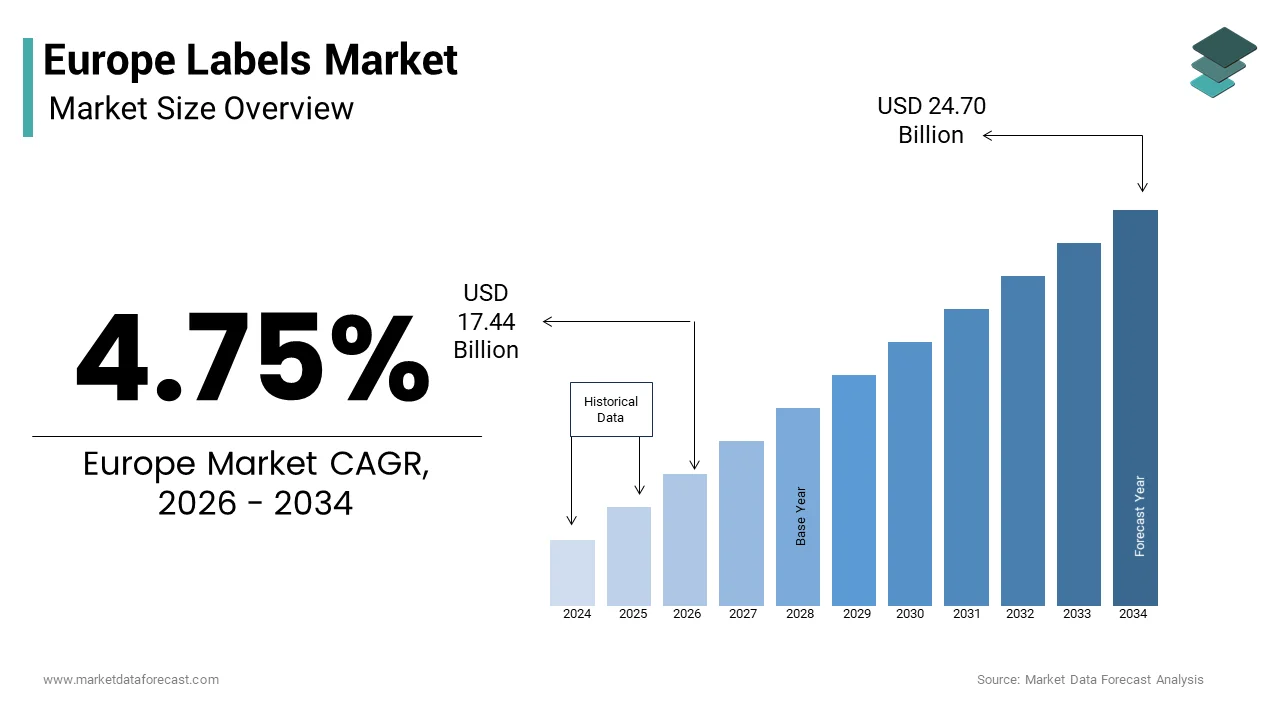
The Europe labels market was valued at USD 16.65 billion in 2025, is estimated to reach USD 17.44 billion in 2026, and is projected to grow to USD 24.70 billion by 2034, expanding at a CAGR of 4.75% during the forecast period from 2026 to 2034.
The growth of the European labels market is driven by rising demand from the food and beverage, pharmaceutical, and retail sectors, along with the rapid expansion of e-commerce and organized retail. Increasing emphasis on product traceability, regulatory compliance, and brand differentiation is further fueling market growth. Moreover, advancements in digital printing technologies, smart labels, and sustainable labeling materials are reshaping label design, functionality, and adoption across Europe.
Key Market Trends
- Strong demand for pressure-sensitive labels due to ease of application, versatility, and cost efficiency.
- Rising adoption of sustainable and recyclable label materials is driven by EU environmental regulations.
- Growth of smart and digital labels supporting traceability, anti-counterfeiting, and consumer engagement.
- Increasing use of high-quality labels to enhance shelf appeal and brand visibility in competitive retail environments.
- Expansion of private-label brands across European supermarkets is boosting label consumption.
Segmental Insights
- Based on label type, the pressure-sensitive labels segment dominated the European labels market in 2025, accounting for 62.5% of the total market share. The segment’s leadership is attributed to its wide application across food packaging, logistics, personal care, and pharmaceuticals.
- Based on material, the paper segment held the majority share of 55.1% of the European labels market in 2025. Paper labels remain preferred due to their cost-effectiveness, print quality, recyclability, and suitability for food and beverage packaging.
- Based on application, the food and beverage segment was the largest, occupying 40.2% of the market share in 2025. High demand for packaged foods, beverages, and regulatory labeling requirements continue to drive this segment’s dominance.
Regional Insights
The European labels market shows steady growth across major economies, supported by strong manufacturing, retail, and export activity. Germany led the market with a 22.3% share in 2025, driven by its robust industrial base and advanced packaging sector. France followed with 15.4%, supported by strong demand from food, cosmetics, and pharmaceuticals. The United Kingdom remains a key market due to its highly developed retail and e-commerce ecosystem. Italy continues to grow steadily, supported by global exports of food and beverages such as wine, olive oil, and pasta, while the Netherlands is expected to expand further due to its strategic role in European logistics and packaging distribution.
Competitive Landscape
TheEuropeane labels market is moderately consolidated, characterized by the presence of global label manufacturers and regional specialists focusing on innovation, sustainability, and digital printing capabilities. Companies are investing in recyclable materials, smart labeling solutions, and advanced printing technologies to strengthen their market position.
Prominent players in the European labels market include:
Avery Dennison Corporation, CCL Industries Inc., Multi-Color Corporation, UPM Raflatac, 3M Company, Constantia Flexibles Group GmbH, Torraspapel Adestor, Lintec Corporation, Tekni-Plex, Inc., and Schott AG.
Europe Labels Market Size
The Europe label market size was valued at USD 16.65 billion in 2025 and is anticipated to reach USD 17.44 billion in 2026 and USD 24.70 billion by 2034, growing at a CAGR of 4.75% during the forecast period from 2026 to 2034.
Current Introduction of theEuropeane Labels Market
A label serves as the primary interface between a product and its end user, conveying essential information on origin, composition, safety, usage, and regulatory compliance. The market’s structure is fundamentally shaped by the European Union’s stringent and harmonized legislative framework, which mandates detailed disclosures across sectors from food and pharmaceuticals to chemicals and electronics. This regulatory environment ensures a high baseline of consumer protection and product traceability. According to Eurostat, the European Union's business economy is primarily driven by a vast population of small and medium-sized enterprises (SMEs), which heavily depend on adhering to product labeling regulations to operate across the single market. Furthermore, as per the European Commission, the European Union manages an enormous volume of imported goods, requiring stringent, compliant, and accurate labeling on countless consignments to ensure food safety and regulatory compliance.
MARKET DRIVERS
Stringent EU Regulatory Mandates for Product Transparency
The continent’s comprehensive and ever-evolving body of regulations mandates detailed product information for consumer safety and transparency, which drives the growth of the European labels market. Legislation such as the EU Food Information for Consumers Regulation requires extensive nutritional data, allergen declarations, and country-of-origin labeling on all packaged foodstuffs. Similarly, the Classification, Labelling and Packaging Regulation enforces a standardized system of hazard pictograms and safety statements for chemicals. These legal requirements create a non-discretionary, constant demand for high-quality, compliant labeling solutions across virtually every manufacturing and retail sector. As per sources, driven by tightening EU safety and environmental regulations, the European Chemicals Agency is mandating that chemical importers and manufacturers provide increasingly detailed, standardized, and up-to-date labeling for a growing inventory of registered substances. This regulatory pressure ensures that investment in labeling is not a marketing choice but a fundamental cost of doing business, providing a stable and inelastic foundation for the entire market.
Growth of E-Commerce and the Demand for Advanced Logistics Labeling
The explosive growth of e-commerce has fundamentally transformed the role of the label from a static product descriptor to a dynamic logistics and tracking tool, which acts as an accelerator of the European labels market. Every online order requires a complex suite of labels, including shipping manifests, barcodes for warehouse management, tamper-evident seals, and return instructions. This shift has dramatically increased the volume and technical sophistication required of labeling systems. The need for high-speed, high-accuracy printing of variable data like unique serial numbers and QR codes has become paramount for efficient fulfillment. Eurostat emphasizes that e-commerce in the EU continues to expand, with a rising percentage of internet users purchasing non-food products online, particularly in the clothing and cosmetics sectors. This relentless expansion of digital commerce directly fuels demand for advanced digital printing technologies and intelligent label solutions that can integrate seamlessly with automated supply chain management systems.
MARKET RESTRAINTS
Volatile Costs of Raw Materials and Energy Inputs
Its exposure to the volatile pricing of key raw materials and energy, which are fundamental to production, hampers the growth of the European labels market. The industry relies heavily on petrochemical-derived substrates like polypropylene and polyester films, as well as paper pulp, all of which are subject to global commodity price swings. Simultaneously, the energy-intensive nature of converting these materials into finished labels, through processes like printing, coating, and die-cutting, makes the sector highly sensitive to Europe’s fluctuating energy costs. European packaging raw material markets, specifically for paper and plastic, have experienced sustained, significant price volatility over the past two years, influenced by fluctuating demand, energy costs, and logistical factors. This volatility compresses profit margins for converters and forces them to either absorb costs or pass them on to customers, creating uncertainty and potentially dampening investment in new, more sustainable materials that may carry a higher initial price premium.
Fragmented National Implementation of EU-Wide Directives
A persistent operational challenge due to the fragmented implementation of overarching EU directives at the national level hinders the expansion of the Europe labels market. Individual EU member states often supplement broad, EU-level directives with their own specific rules, language mandates, and enforcement schedules. For a multinational brand operating across Europe, this means a single product may require multiple label variants to comply with the rules in Germany, France, Italy, and Spain. This complexity increases design, printing, and inventory management costs significantly. European packaging industry associations report that divergent national rules regarding packaging labeling and waste management continue to pose a significant barrier to the completion of a fully integrated single market. This administrative burden stifles efficiency and innovation, as resources are diverted to managing compliance rather than developing new, value-added labeling solutions.
MARKET OPPORTUNITIES
Integration of Smart and Interactive Labeling Technologies
The integration of smart and interactive technologies transforms a passive label into an active communication channel, which is a major opportunity for the European labels market. Solutions like Near Field Communication tags, QR codes, and augmented reality markers can be embedded into labels to provide consumers with a wealth of dynamic information beyond the static print. Scanning a code can reveal a product’s full supply chain journey, detailed sustainability credentials, recipe suggestions, or even authentication to combat counterfeiting. This trend is being accelerated by the EU’s Digital Product Passport initiative, which will soon require a digital record for many products. Pilot projects supported by European innovation initiatives in the food and luxury sectors indicate that incorporating smart labels significantly boosts consumer interaction, providing deeper engagement and increased transparency. This shift opens a high-value market for labels that are not just compliant but are intelligent gateways to enhanced brand experiences and trust.
Expansion of Sustainable and Circular Labeling Solutions
The development and adoption of fully sustainable and circular labeling solutions opens new potential for the European labels market. Driven by the EU’s Green Deal and the Packaging and Packaging Waste Directive, there is a powerful push to eliminate problematic materials and ensure all packaging, including labels, is reusable or recyclable by 2030. This creates demand for innovative products like wash-off adhesives that allow labels to be cleanly removed during bottle recycling, or labels made entirely from mono-materials that do not contaminate recycling streams. The Ellen MacArthur Foundation promotes circular design, driving increased business adoption of labeling components compatible with recycling streams. This movement aims to eliminate problematic packaging materials and ensure all components can be effectively reprocessed, aligned with broader European and global efforts to transition toward a circular economy. Companies that can provide certified, high-performance, sustainable alternatives are positioned to capture a substantial share of this rapidly expanding green segment.
MARKET CHALLENGES
Rising Cybersecurity Threats to Digital Labeling Systems
The increasing risk of cybersecurity breaches targeting digital printing and supply chain management systems is a growing challenge for theEuropeane labels market. As labels become smarter and more integrated with enterprise software for track-and-trace and serialization, they also become potential entry points for malicious actors. A compromised system could lead to the printing of counterfeit labels, the theft of sensitive product data, or the disruption of critical logistics operations. The threat is particularly acute in regulated industries like pharmaceuticals, where a single fake label can have severe public health consequences. According to the European Union Agency for Cybersecurity, the threat landscape targeting industrial control systems and operational technology has experienced a significant surge, with manufacturing and critical infrastructure facing elevated, frequent, and increasingly sophisticated attacks. This necessitates significant investment in secure infrastructure, creating a new layer of cost and complexity for label producers and their clients.
Shortage of Skilled Labor in Advanced Printing and Converting
A critical shortage of skilled technicians and engineers proficient in operating and maintaining advanced digital and hybrid printing presses remains a barrier to the European labels market. The modern label production facility requires a workforce that can manage complex software, troubleshoot high-speed machinery, and understand the nuances of various substrates and inks. However, vocational training programs have not kept pace with the rapid technological evolution of the industry. Printing and converting companies in Western Europe are facing a significant, growing, and pervasive challenge in recruiting and retaining qualified personnel, resulting in a widespread shortage of skilled labor. This labor deficit leads to production barriers, increased downtime, and a reliance on expensive external service providers, ultimately hindering the industry’s ability to fully capitalize on new technological opportunities and meet the growing demand for sophisticated, short-run label jobs.
REPORT COVERAGE
| REPORT METRIC | DETAILS |
| Market Size Available | 2025 to 2034 |
| Base Year | 2025 |
| Forecast Period | 2026 to 2034 |
| CAGR | 4.75% |
| Segments Covered | By label Type, Material, Printing Technology, Application, and Region |
| Various Analyses Covered | Global, Regional & Country Level Analysis, Segment-Level Analysis, DROC, PESTLE Analysis, Porter’s Five Forces Analysis, Competitive Landscape, Analyst Overview on Investment Opportunities |
| Regions Covered | UK, France, Spain, Germany, Italy, Russia, Sweden, Denmark, Switzerland, Netherlands, Turkey, Czech Republic, & Rest of Europe |
| Market Leaders Profiled | Avery Dennison Corporation, CCL Industries Inc., Multi-Color Corporation, UPM Raflatac, 3M Company, Constantia Flexibles Group GmbH, Torraspapel Adestor, Lintec Corporation, Tekni-Plex, Inc., Schott AG |
SEGMENTAL ANALYSIS
By Label Insights
The pressure-sensitive labels segment dominated the European labels market by accounting for a 62.5% share in 2025. The dominance of the pressure-sensitive labels segment is driven by their unparalleled versatility, ease of application, and cost-effectiveness across a vast array of industries. These labels require no water, heat, or solvent to adhere, making them ideal for high-speed automated labeling lines that are standard in food, beverage, and personal care manufacturing. Their ability to be printed with high-resolution graphics and variable data also makes them perfect for modern retail environments where brand appeal and traceability are paramount. According to sources, the rapid adoption of digital printing technologies is strengthening their market position, as self-adhesive materials remain the preferred substrate for short-run, customized label production. This shift addresses the increasing demand for personalized, limited-edition products across the region.
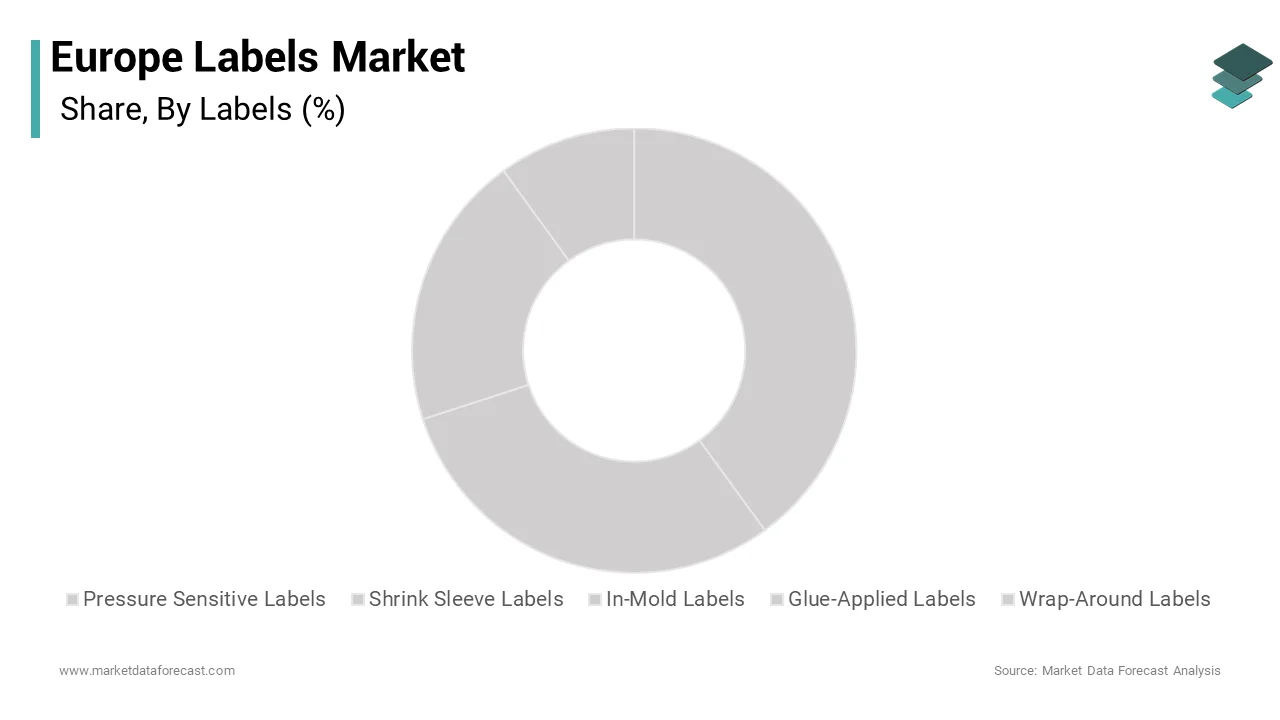
The shrink sleeve labels segment is likely to experience the fastest CAGR of 8.9% over the forecast period due to its unique ability to provide a full 360-degree branding canvas on complex container shapes, which is highly sought after in competitive sectors like beverages, personal care, and household chemicals. The seamless, tamper-evident seal they create also offers a significant functional advantage over traditional labels. A key driver is the premium aesthetic they deliver, allowing brands to create striking, shelf-impacting designs that stand out in crowded retail spaces. The rising popularity of individual-sized and portable product formats has significantly increased the use of shrink-wrapped labels, as these full-body designs provide the essential 360-degree branding surface needed to capture consumer attention and drive purchases for smaller containers.
By Material Insights
The paper segment held the majority share of 55.1% of the European labels market in 2025. The supremacy of the paper segment is attributed to its long-standing reputation for being cost-effective, printable, and, crucially, its alignment with the continent’s strong environmental ethos. Paper labels, especially those made from certified sustainable sources like FSC or PEFC, are perceived by consumers and regulators as the most eco-friendly option due to their biodegradability and high recycling rates. The European paper industry has a well-established and efficient collection and recycling infrastructure, with a recycling rate for paper and board packaging consistently above eighty-five percent. The European paper industry, as represented by CEPI, is positioning fiber-based packaging as a key driver of the circular economy, offering a sustainable alternative that aligns with strict European regulatory requirements and consumer demands for responsibly sourced materials.
The plastic or polymer materials segment is on the rise and is expected to be the fastest-growing segment in the market by witnessing a CAGR of 7.5% over the forecast period, owing to the need for high-performance labels in demanding applications where paper falls short. Polymer films like polypropylene and polyester offer superior resistance to moisture, oils, chemicals, and extreme temperatures, making them indispensable for products in the pharmaceutical, automotive, and industrial chemical sectors. Furthermore, their excellent clarity and durability make them the preferred choice for premium beverage and cosmetic brands seeking a “no-label” look. The European plastics converting industry is heavily focused on innovating through the development of mono-material structures and the adoption of recycled content. These efforts are addressing historical environmental concerns by improving recyclability and enabling alignment with the European Union's circular economy goals and regulations.
By Application Insights
The food and beverage application segment was the largest segment in the European labels market by occupying a 40.2% share in 2025. The prominence of the food and beverages segment is credited to the sector’s immense size and the absolute necessity of compliant, informative, and attractive labeling. EU regulations mandate extensive information on every food package, including a full ingredients list, nutritional table, allergen warnings, and country of origin, creating a constant, non-discretionary need for labels. Beyond compliance, the label is a critical marketing tool in a highly competitive retail environment, where it must convey brand identity, quality, and product benefits at a glance. The food and beverage industry continues to drive European label consumption, fueled by the demand for high SKU counts and frequent promotional activities, rather than by EFSA, as sometimes incorrectly cited. Increasing regulatory requirements for sustainability and product information are forcing producers to update their packaging and adopt more flexible, digital printing solutions to meet market demands.
The pharmaceutical and healthcare segment is expected to exhibit a noteworthy CAGR of 9.3% between 2026 and 2034. The rapid expansion of the pharmaceutical and healthcare segment is propelled by an aging population and the corresponding increase in demand for medications and medical devices, all of which are subject to some of the most stringent labeling regulations in the world. The EU’s Falsified Medicines Directive mandates the use of unique serial numbers and tamper-evident features on every medicine pack, driving the adoption of advanced security printing and track-and-trace technologies. The European Medicines Agency has experienced a significant upward trend in the authorization of innovative therapies for EU patients, resulting in a rising demand for comprehensive, multi-lingual, and highly secure, tamper-evident product information and labeling. This regulatory intensity, coupled with the critical need for patient safety, makes this segment a high-value, high-growth engine for the entire labels market.
COUNTRY-LEVEL ANALYSIS
Germany Labels Market Analysis
Germany outperformed other countries in the European labels market by holding a 22.3% share in 2025. The leading position of the German market is driven by a powerful industrial base that includes world-leading manufacturers in the automotive, chemical, and pharmaceutical sectors, all of which demand high-precision, compliant, and often security-enhanced labeling solutions. The German market is characterized by a strong emphasis on engineering excellence, automation, and sustainability. As part of Germany's National Circular Economy Strategy, the government is incentivizing industry to adopt, design, and produce packaging components, such as adhesives and labels, that align with enhanced recycling and material efficiency standards. This combination of industrial demand, technological sophistication, and environmental responsibility makes Germany the definitive hub for innovation and quality in the European labels industry.
France Labels Market Analysis
France was the next prominent country in the European labels market by capturing a 15.4% share in 2025. The growth of the French market is fuelled by its world-renowned luxury goods, cosmetics, and wine industries. These sectors place an extraordinary premium on label aesthetics, craftsmanship, and storytelling, driving demand for high-end printing techniques like embossing, foil stamping, and specialty substrates. The French market is a key destination for innovative and artistic label design, where the label is not just an information carrier but an integral part of the product’s luxury experience. Export-driven industries are increasingly required to adopt intricate, multilingual labeling and specialized, regulatory-compliant markings to satisfy strict, newly implemented environmental and consumer protection standards in the French market. This focus on premium quality and brand narrative ensures that France remains a vital and influential market for high-value label production.
United Kingdom Labels Market Analysis
The United Kingdom is another key player in the European labels market due to a highly developed retail sector, a large pharmaceutical industry, and a vibrant craft beverage scene, all of which generate substantial and diverse labeling demand. The UK’s departure from the EU has introduced a layer of complexity, as businesses now must manage dual labeling requirements for the UK and EU markets, driving demand for flexible and agile printing solutions. As per sources, the growth of e-commerce and direct-to-consumer models has further fueled the need for variable data printing for logistics and personalization. This unique post-Brexit regulatory landscape, combined with strong domestic consumption, makes the UK a complex but crucial market for label converters.
Italy Labels Market Analysis
Italy experienced a steady growth in the European labels market owing to its globally celebrated food and beverage exports, particularly wine, olive oil, and pasta. Italian labeling is renowned for its emphasis on design, heritage, and geographical indication, with labels serving as a primary vehicle for communicating the story and authenticity of “Made in Italy” products. The market demands a blend of traditional craftsmanship and modern compliance, as these products must meet both EU and international import regulations. According to research, the country’s vast network of small and medium-sized food producers creates a steady demand for short-run, high-quality label printing. This focus on artisanal quality and brand provenance ensures that Italy remains a major and distinctive force in the European labeling landscape.
Netherlands Labels Market Analysis
The Netherlands is likely to expand in the European labels market from 2026 to 2034 due to its role as a major European logistics and distribution hub, home to the Port of Rotterdam and numerous multinational headquarters. This logistical centrality drives immense demand for logistics labels, shipping manifests, and warehouse management barcodes. Furthermore, the Dutch market is a leader in sustainable innovation, with a strong national push towards circular economy principles in packaging. As per a study, the country has one of the highest rates of e-commerce penetration in Europe, which directly fuels the need for advanced, variable-data labeling for fulfillment and returns. This unique combination of being a trade gateway and a sustainability pioneer makes the Netherlands a critical and forward-looking market for the labels industry.
COMPETITIVE LANDSCAPE
The competitive landscape of the European labels market is characterized by a multi-tiered structure featuring a few global giants, numerous strong regional players, and a long tail of specialized local converters. The primary arena of competition has shifted from price to value, with a heavy emphasis on sustainability credentials, technological innovation, and service agility. Global leaders compete on their R&D prowess and ability to offer integrated, pan-European solutions, while regional players often win on responsiveness and deep local market knowledge. The market is under intense pressure from evolving EU regulations, which act as both a barrier to entry for smaller players and a catalyst for innovation among the established ones. Success requires a delicate balance of mastering complex regulatory compliance, investing in advanced digital and sustainable technologies, and building resilient, collaborative relationships across the entire packaging value chain.
KEY MARKET PLAYERS
A few of the market players in the European labels market are
- Avery Dennison Corporation
- CCL Industries Inc.
- Multi-Color Corporation
- UPM Raflatac
- 3M Company
- Constantia Flexibles Group GmbH
- Torraspapel Adestor
- Lintec Corporation
- Tekni-Plex, Inc.
- Schott AG
Top Players In The Market
- Avery Dennison is a global leader in materials science and a cornerstone of the European labels market, renowned for its innovative pressure-sensitive materials and branding solutions. Its contribution to the global market is defined by setting industry standards for sustainable labeling, including its pioneering work in wash-off adhesives and recycled content facestocks. To strengthen its position in Europe, Avery Dennison has recently expanded its digital printing capabilities by launching new material grades specifically engineered for HP Indigo and other leading digital presses. The company has also deepened its commitment to circularity by scaling up its AD Circular program, which provides a closed-loop solution for label waste from converters, directly addressing the EU’s stringent packaging sustainability mandates.
- CCL Industries is a world leader in specialty packaging and labeling with a vast and integrated European footprint spanning multiple countries and end-use sectors. Its global impact stems from its ability to deliver complex, high-value labeling solutions for the pharmaceutical, beverage, and personal care industries. CCL has reinforced its European presence through strategic investments in smart labeling technologies, including Near Field Communication and tamper-evident security features that comply with EU regulations like the Falsified Medicines Directive. The company has also focused on operational excellence by upgrading its manufacturing facilities with state of the art digital and hybrid printing lines to meet the growing demand for short-run, highly customized label jobs across the continent.
- UPM Raflatac is a major global supplier of labeling materials and a key driver of sustainable innovation in the European market. As part of the UPM Group, it leverages its strong forestry heritage to offer a wide range of labeling solutions based on renewable and recycled materials. Its contribution to the global market is centered on its leadership in eco design, particularly its Forest Film product line made from wood-based naphtha. To solidify its position, UPM Raflatac has recently intensified its collaboration with brand owners and recycling operators to develop and validate truly recyclable label systems. The company has also expanded its digital service platform, offering customers advanced tools for material selection and carbon footprint calculation, aligning perfectly with the EU’s Green Deal objectives.
Top Strategies Used By The Key Market Participants
Key players in the European labels market are pursuing a strategic agenda focused on three core pillars. First, they are making substantial investments in sustainable material science, developing label constructions that are fully compatible with existing recycling streams and incorporating high levels of post-consumer recycled content. Second, they are aggressively expanding their digital printing capabilities to offer agile, cost-effective solutions for short-run and personalized label production. Third, they are integrating smart technologies like QR codes and NFC tags into their offerings to provide brands with powerful tools for consumer engagement, product authentication, and supply chain traceability, thereby transforming the label from a static information carrier into a dynamic digital gateway.
MARKET SEGMENTATION
This research report on the European labels market is segmented and sub-segmented into the following categories.
By Label Type
- Pressure Sensitive Labels
- Shrink Sleeve Labels
- In-Mold Labels
- Glue-Applied Labels
- Wrap-Around Labels
By Material
- Paper
- Plastic/Polymer
- Metal
- Fabric
By Printing Technology
- Flexographic
- Digital
- Lithographic
- Screen Printing
By Application
- Food & Beverage
- Pharmaceutical & Healthcare
- Personal Care & Cosmetics
- Retail & Consumer Goods
- Industrial & Chemical
- Automotive
By Country
- UK
- France
- Spain
- Germany
- Italy
- Russia
- Sweden
- Denmark
- Switzerland
- Netherlands
- Turkey
- Czech Republic
- Rest of Europe