- Product Description Description
- Table of Contents TOC
- List of Table & Figure LOT
- Get Free Sample PDF Sample PDF
Market Size, 2025
$16.82 BnMarket Estimate, 2026
$17.66 BnMarket Forecast, 2034
$26.13 BnCAGR, 2026–2034
5.02%Europe Self-Adhesive Labels Market Size, Growth, Trends & Forecast (2026–2034)
The Europe self-adhesive labels market size was calculated at USD 16.82 billion in 2025, is anticipated to reach USD 17.66 billion in 2026, and is projected to reach USD 26.13 billion by 2034, registering a compound annual growth rate (CAGR) of 5.02% during the forecast period from 2026 to 2034. Driven by stringent EU regulatory compliance mandates, e-commerce fulfillment growth, and the transition toward smart and sustainable circular labeling solutions, the market continues to expand steadily across the region.
Key Executive Metrics (At-a-Glance)
- 2025 Base Valuation: USD 16.82 Billion
- 2026 Current Valuation: USD 17.66 Billion
- 2034 Forecast Valuation: USD 26.13 Billion
- Compound Annual Growth Rate (CAGR): 5.02% (2026–2034)
- Dominant Adhesive Type Segment: Acrylic Adhesives (holding ~38% share in 2025 due to superior durability, safety, and regulatory compliance)
- Fastest-Growing Adhesive Type Segment: Hot Melt Adhesives (projected at a CAGR of 7.8% from 2025 to 2030, fueled by high-speed e-commerce logistics)
- Dominant Application Segment: Food and Beverage (~42% share in 2025 anchored by mandatory nutritional and allergen labeling laws)
- Fastest-Growing Application Segment: Pharmaceutical (projected at a CAGR of 9.2% from 2025 to 2030 driven by EU Falsified Medicines Directive serialization)
- Regional Highlights: Germany led the market with a ~21% share in 2024/2025, supported by its heavy manufacturing base, strict regulatory enforcement, and advanced recycling infrastructure.
Core Market Drivers
- Regulatory Mandates: Binding EU requirements for nutritional details, allergen declarations, and pharmaceutical serialization.
- E-Commerce Expansion: Surge in parcel volumes requiring multi-label applications, weather-resistant adhesives, and high-speed automated sorting.
- Circular Economy Integration: Upcoming PPWD requirements for digital watermarks, QR codes, and recyclable label constructions.
Primary Market Restraints & Challenges
- Chemical Compliance Costs: Strict REACH regulations and food contact migration testing restricting certain adhesive and facestock formulations.
- Petrochemical Volatility: Price instability in crude oil and polypropylene feedstocks impacting raw material margins.
- Labor & Infrastructure Gaps: Shortages of skilled printing technicians alongside fragmented national municipal recycling systems across EU member states.
Europe Self-Adhesive Labels Market Segmentation Breakdown
| Segment Category | Largest Segment in 2025/2026 | Fastest Growing Segment / Growth Rate |
|---|---|---|
| By Adhesive Type | Acrylic Adhesives (~38% share in 2025) | Hot Melt Adhesives (7.8% CAGR from 2025 to 2030) |
| By Application | Food and Beverage (~42% share in 2025) | Pharmaceutical (9.2% CAGR from 2025 to 2030) |
| By Region | Germany (~21% share in 2024/2025) | United Kingdom, France & Netherlands (Driven by e-commerce density, packaging regulations, and logistics hubs) |
Major Industry Players Profiled
Key prominent companies operating in the Europe self-adhesive labels market include Avery Dennison, CCL Industries, UPM Raflatac, 3M, Sappi, HERMA, Fedrigoni Group, Multi-Color Corporation, Constantia Flexibles, LINTEC Europe, Smith & McLaurin, Coveris, Torraspapel, Lecta Group, and MACtac.
Europe Self-Adhesive Labels Market Size
The Europe self adhesive labels market size was calculated to be USD 16.82 billion in 2025 and is anticipated to be worth USD 26.13 billion by 2034, growing from USD 17.66 billion in 2026 at a CAGR of 5.02% during the forecast period.
Self-adhesive labels in Europe refer to pressure-sensitive labeling solutions consisting of a facestock adhesive layer and release liner designed for application without heat, water, or solvent activation. These labels serve critical functional and regulatory roles across food and beverage, pharmaceutical logistics, and consumer goods sectors by conveying product identification, batch tracking, safety instructions, and sustainability disclosures. The European market is uniquely shaped by stringent regulatory frameworks that mandate detailed content on packaging, including ingredient transparency, allergen declarations, and environmental labeling. According to the European Environment Agency, over 86 million tons of packaging waste were generated in the EU in 2023, with labeling playing a pivotal role in material identification for recycling streams. As per the European Commission, all pre-packaged food sold in the EU must display nutrition information, allergen warnings, and country of origin in the official language of the member state where it is sold, requiring highly flexible and compliant labeling systems. Furthermore, the EU Packaging and Packaging Waste Directive now requires digital watermarking and QR codes on labels by 2 027 to enable automated sorting. In this context, self-adhesive labels transcend mere branding to become essential instruments of regulatory compliance, circularity, and supply chain traceability across the European single market.
MARKET DRIVERS
Mandatory EU Food and Product Labeling Regulations Drive Volume Demand
The European Union’s comprehensive and binding labeling requirements for consumer goods constitute the foremost driver self-adhesiveve label consumption across the bloc. Regulation EU No 1169 2011 mandates that all pre-packaged food display detailed nutritional information, including energy values, saturated fats, carbohydrates, sugar,s and salt per 100 grams or milliliters along with clear allergen declarations in the official language of the selling country. According to the European Commission, over 4.2 million new food product launches occur annually in the E, U each requiring compliant labeling in up to 24 languages for European distribution. In pharmaceuticals, the Falsified Medicines Directive requires unique serial numbers, batch numbers, and anti-tampering devices on every medicine package—necessitating high precision tamper-evident labels. The German Federal Institute for Drugs and Medical Devices confirms that over 950 million pharmaceutical units were labeled with serialization data in Germany alone in 2023. Similarly, the EU Ecolabel and upcoming digital product passport initiatives under the Ecodesign for Sustainable Products Regulation will require machine-readable QR codes on virtually all consumer goods by 2027. This regulatory density ensures consistent high-volume demand for accurate, durable, and multilingual self-adhesive labels that can withstand supply chain conditions while maintaining legal compliance.
Growth of E-Commerce and Omnichannel Retail Increases Labeling Complexity
The rapid expansion of e-commerce and hybrid retail models across Europe has significantly amplified the technical and logistical requirements for self-adhesive labels. Unlike traditional retail, where a single SKU might carry one label per product, e-commerce fulfillment demands multiple label applications per item, including shipping labels, return labels, batch identifiers, and warehouse barcodes. According to Eurostat, e-commerce accounted for 13.8 percent of total retail sales in the EU in 2023, with countries like the UK and the Netherlands exceeding 20 percent. Each online order typically requires 3 to 5 label applications—from product identification at the warehouse to last-mile delivery and returns processing. The European Retail Federation reports that omnichannel retailers like Zalando and Otto process over 500000 parcels daily, each requiring weather resistant high tack adhesive labels that perform reliably in cold chain logistics, frozen food deliveries, and international shipping. Furthermore, return rates in European-commerce average 20 to 30 percent as per national consumer agencies, necessitating durable return labels that survive transit and moisture exposure. This operational complexity drives demand for specialty adhesives, facestocks, and print durability that standard retail labels do not require.
MARKET RESTRAINTS
Restrictive EU Chemical Regulations Increase Material Compliance Costs
The European Union’s stringent chemical safety framework imposes significant constraints on the composition of adhesives and facestocks used in self-adhesive labels, particularly for food contact and sensitive applications. The REACH regulation restricts over 230 substances of very great concern, including certain phthalates, bisphenol,s, and alkylphenol ethoxylates commonly found in pressure-sensitive adhesives. According to the European Chemicals Agency, over 18000 batches of imported label materials were flagged for non-compliance in 2023 due to prohibited substances migrating into food or causing skin sensitization. Compliance testing alone can cost between 200 and 500 euros per formulations noted by the European Labeling Association, significantly raising costs for small converters. Furthermore, the EU Framework Regulation EC No 1935 2004 requires all materials intended to come into contact with food to undergo migration testing under specific time and temperature conditions—a process that can delay product launches by 8 to 12 weeks. In Germany, the Federal Office of Consumer Protection rejected 37 labeling products in 2023 for failing migration thresholds. These regulatory hurdles disproportionately affect SMEs andnon-EUU suppliers who lack in-house compliance expertise, creating barriers to entry and limiting material innovation in the European self-adhesive labels market.
Volatility in Petrochemical Feedstock Prices Impacts Raw Material Stability
The self-adhesive labels industry faces persistent cost and supply instability due to its reliance on petrochemical-derived raw materials, including acrylic adhesive,,s polypropylene films, and solvent-based coatings. According to Plastics Europe, the price of polypropylene—a common label facestock—increased by 42 percent between 2021 and 2023 due to natural gas shortages and refinery constraints during the energy crisis. Similarly, acrylic monomers used in pressure-sensitive adhesives are directly tied to crude oil and propylene markets, which saw extreme volatility following geopolitical disruptions. The European Adhesive and Sealant Association reports that adhesive costs rose by 35 percent on average in 2022, forcing label converters to either absorb margins or pass costs to price-sensitive customers. Unlike digital or packaging sectors with long term contracts, many label buyers operate on spot ppricingg making them vulnerable to sudden input shocks. In 2023, the European Central Bank noted that 41 percent of label converters delayed new product development due to unpredictable material costs. Until bio-based alternatives achieve scale and cost parity, the market will remain exposed to fossil fuel market fluctuations that undermine pricing stability and investment planning across the European labeling value chain.
MARKET OPPORTUNITIES
Integration of Smart and Trackable Labels for Circular Economy Compliance
The EU’s push toward a circular economy is creating a transformative opportunity for advanced self-adhesive labels embedded with digital identifiers such as QR codes, NFC chips, and digital watermarks. The Packaging and Packaging Waste Directive mandates that by 2027, all packaging placed on the EU market must carry a digital label enabling automated sorting and material identification in recycling facilities. According to the European Commission, over 400 recycling plants across the bloc are being upgraded with AI-powered sorting systems that rely on these digital markers to achieve the EU’s 65 percent plastic recycling target by 2026. Companies like Avery Dennison and UPM Raflatac are responding with recyclable label solutions featuring detachable adhesives and scannable codes that do not interfere with polymer streams. In France, the AGEC Law already requires electronics textiles and furniture to carry repairability and recyclability indices via QR codes—generating demand for durable tamper-proof labels. The European Environment Agency estimates that smart labeling could increase material recovery rates by 18 to 25 percent if widely adopted. As regulatory deadlines approach, the shift from passive to intelligent labels will redefine the market—turning adhesive labels into essential data carriers for the circular economy.
Expansion of Sustainable and Recyclable Label Solutions
Growing regulatory and consumer pressure for eco-friendly packaging is accelerating demand for self-adhesive labels made from recycled bio based and compostable materials. The EU Single Use Plastics Directive and upcoming Ecodesign for Sustainable Products Regulation require brands to disclose recycled content and ensure packaging components do not hinder recyclability. According to the European Paper Packaging Alliance, over 70 percent of EU food and beverage brands now specify label liners made from 100 percent recycled paper or glassine alternatives to reduce waste. In 2023, Germany’s Green Dot system reported that 850000 tons of label liner waste were diverted from landfills through take-back programs facilitated by recyclable facestock innovations. Companies like Herma and Constantia Flexibles have launched fully certified compostable labels using cellulose films and bioadhesives that meet EN 13432 standards—ideal for organic food and personal care segments. The European Bioplastics Association confirms that demand for bio-based label materials grew by 28 percent in 2023, driven by retailer sustainability pledges like Lidl’s 2026 plastic reduction roadmap. As brands compete on environmental credibility, sustainable labeling is shifting from niche to norm—opening high-value segments for material innovators across Europe.
MARKET CHALLENGES
Shortage of Skilled Labor in Label Converting and Printing
The Europe self adhesive labels market faces a critical bottleneck in the availability of technicians proficient in flexographic digital printing and finishing equipment operation. According to Eurofound, the EU is projected to experience a shortfall of over 120000 printing and converting specialists by 2026 due to aging workforces and declining vocational enrollment. In Germany, the Federal Employment Agency reports that 63 percent of label converter vacancies remained unfilled for more than 90 days in 2023, particularly for roles requiring expertise in UV ink handling, adhesive lamination, and inline quality control systems. This skills gap leads to production delays, machine underutilization, and inconsistent print quality—especially for complex jobs involving variable data serialization or multi-layer constructions. The European Federation of Journalists and Printing Workers notes that only 18 percent of technical schools in Southern Europe offer updated curricula covering digital label printing technologies. Without coordinated upskilling through national apprenticeship reforms and industry training partnerships, the capacity to meet rising demand for high-precision regulatory and smart labels will remain constrained across the European manufacturing base.
Fragmented National Recycling Infrastructure Hinders Label Design Harmonization
Despite EU-level directives, significant divergence in municipal recycling systems across member states complicates the development of universally recyclable self-adhesive labels. While the EU mandates design for recycling by 2030, national collection and sorting capabilities vary widely—Germany’s dual system achieves 98 percent paper label recovery, whereas Romania recycles less than 35 percent of mixed packaging streams as per Eurostat. This fragmentation forces brands to create multiple label variants for different markets: a label deemed recyclable in the Netherlands may contaminate streams in Portugal due to differences in sorting technology. According to the European Paper Packaging Alliance, 42 percent of FMCG companies maintain three or more label versions for the same product to comply with local recycling rules. The lack of standardized testing protocols for label recyclability—such as adhesive removability in deinking or film separation in sorting—further impedes innovation. Until the EU implements binding, harmonized recycling performance criteria and invests in cross-border infrastructure, the promise of circular labeling will remain unrealized, creating inefficiencies and added costs for converters and brand owners alike across the single market.
REPORT COVERAGE
| REPORT METRIC | DETAILS |
| Market Size Available | 2025 to 2034 |
| Base Year | 2025 |
| Forecast Period | 2026 to 2034 |
| CAGR | 5.02% |
| Segments Covered | By Adhesive Type, Application, End User, And Region |
| Various Analyses Covered | Global, Regional & Country Level Analysis; Segment-Level Analysis; DROC, PESTLE Analysis; Porter’s Five Forces Analysis; Competitive Landscape; Analyst Overview of Investment Opportunities |
| Regions Covered | UK, France, Spain, Germany, Italy, Russia, Sweden, Denmark, Switzerland, Netherlands, Turkey, and the Czech Republic |
| Market Leaders Profiled | Avery Dennison, CCL Industries, UPM Raflatac, 3M, Sappi, HERMA, Fedrigoni Group, Multi-Color Corporation, Constantia Flexibles, LINTEC Europe, Smith & McLaurin, Coveris, Torraspapel, Lecta Group, MACtac |
SEGMENTAL ANALYSIS
By Adhesive Type Insights
Acrylic adhesives hold the dominant position in the Europe self adhesive labels market, accounting for approximately 38 percent of total adhesive type share in 2025, according to the European Adhesive and Sealant Association. This leadership stems from their superior performance in critical applications requiring long term durabilit,y resistance to environmental stress, and regulatory compliance.
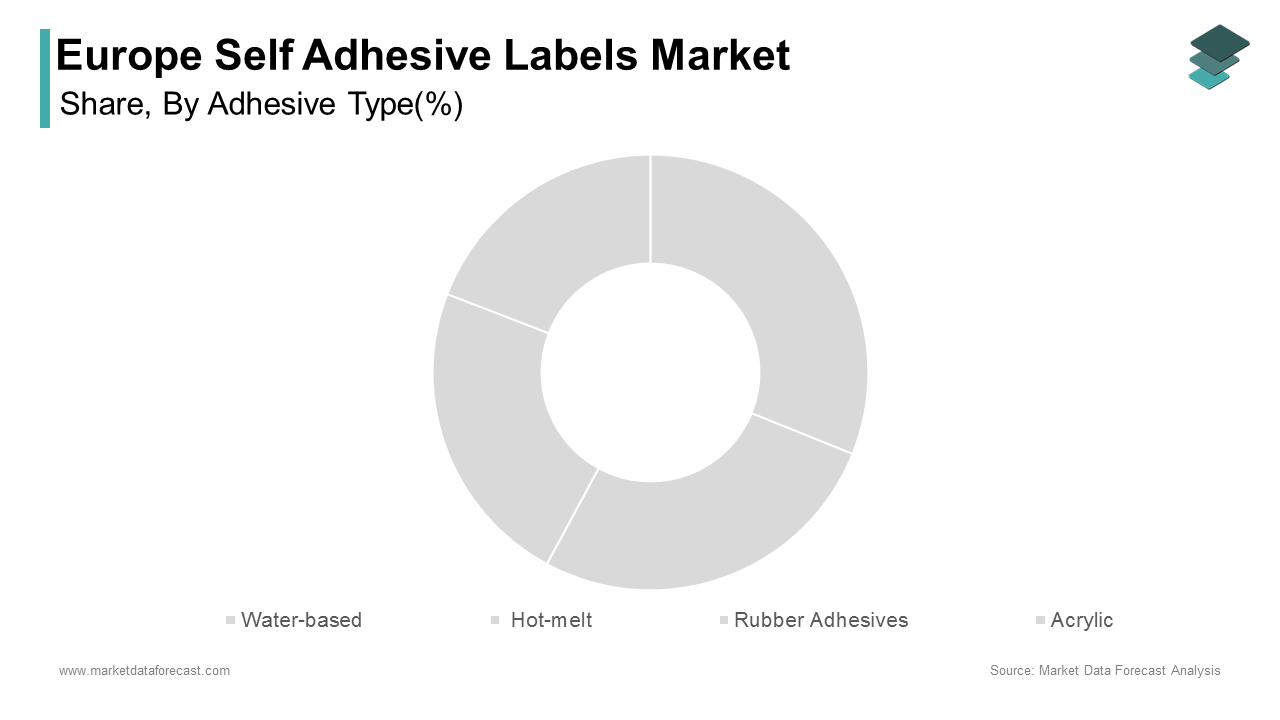
A primary driver is the stringent performance demands of the pharmaceutical and food sectors, where label integrity is non-negotiable. Acrylic adhesives offer excellent resistance to moisture, UV exposure, temperature fluctuations, and chemical solvents—ensuring that critical information such as expiration dates, batch numbers, and allergen warnings remains legible throughout the product lifecycle. According to the European Medicines Agency, over 950 million medicine packages were serialized in the EU in 2023 under the Falsified Medicines Directive, each requiring ttamper-evidentlabels with adhesives that do not degrade during cold chain transport or high humidity storage. Acrylic formulations meet these requirements without migrating harmful substances into products, satisfying EU Framework Regulation EC No 1935 2004 for food contact materials. The German Federal Institute for Risk Assessment confirms that aacrylic-basedlabels are the only adhesive type approved for direct contact with fatty foods like cheese and cured meats due to their low migration profile. This regulatory endorsement makes acrylics indispensable in high-compliance segments.
A second reinforcing factor is their compatibility with sustainability mandates. Unlike rubber-based adhesives, which often contain restricted aromatic hydrocarbons, acrylic systems can be formulated with waterborne or solvent-free chemistries that align with REACH and VOC emission limits. According to the European Chemicals Agency, over 70 percent of new label adhesive registrations in 2023 were acrylic-based due to their ease of compliance with chemical safety thresholds. Furthermore, acrylic adhesives facilitate recyclability—labels using acrylic bonds cleanly detach from PET and glass during washing processes, as verified by the European PET Bottle Platform. In France, where the AGEC Law mandates design for recycling, brand owners prefer acrylic labels to avoid contaminating recycling streams. This dual advantage of performance and environmental compatibility ensures acrylic adhesives remain the preferred choice for Europe’s most demanding and regulated labeling applications.
The hot melt adhesive segment is the fastest growing category in the Europe self adhesive labels market, projected to expand at a compound annual growth rate of 7.8 percent between 2025 and 203,0 according to the European Commission’s industrial materials observatory. This acceleration is driven by the need for high-speed labeling in e-commerce logistics and sustainable formulation advantages over solvent-based alternatives.
A key growth catalyst is the explosive expansion of automated packaging and fulfillment centers across Europe, which require adhesives that set instantly without drying time. Hot melt adhesives—thermoplastic polymers applied molten and solidified on cooling—bond in milliseconds, enabling labeling speeds exceeding 500 units per minute on modern lines. According to the European Logistics Association, over 85 percent of new parcel sorting facilities commissioned in 2023 specified hot melt label applicators to handle the 13.8 percent annual growth in ee-commercevolumes reported by Eurostat. These adhesives maintain tack across diverse substrates, including corrugated cardboard plastic totes and frozen food packaging—critical for omnichannel retailers like Zalando and Amazon operating pan-European distribution networks. In Germany, national postal data from Deutsche Post shows that over 7 million parcels labeled daily with hot melt systems withstand temperature variations from minus 25 to plus 40 degrees Celsius during transit without delamination.
A second accelerant is the environmental benefit of 100 percent solids formulation—hot melts contain no solvents or water, eliminating VOC emissions and drying energy. As per the European Environment Agency, hot melt labeling reduces carbon footprint by up to 30 percent compared to solvent-based systems due to lower energy consumption and zero wastewater treatment. The EU’s Industrial Emissions Directive increasingly restricts solvent use in manufacturing, pushing converters toward cleaner alternatives. In the Netherlands, the Ministry of Infrastructure confirmed that all new logistics hubs receiving green building certification must usesolvent-free labelingg processes—directly benefiting hot melt adoption. With performance speed and sustainability converging, hot melt adhesives are becoming the backbone of Europe’s high velocity transparent supply chain.
By Application Insights
The food and beverage sector constitutes the largest application segment in the Europe self adhesive labels market, representing approximately 42 percent of total demand in 2025, according to the European Commission’s food packaging compliance dashboard. This dominance is rooted in the EU’s exhaustive labeling mandates and the sector’s high product turnover, requiring constant label replenishment.
A foundational driver is Regulation EU No 1169 2011, which mandates detailed nutritional information, allergen declarations, and country of origin labeling on all pre-packaged food sold in the EU. According to the European Food Safety Authority, over 4.2 million new food product SKUs are launched annually across the bloc, each requiring multilingual compliant labels. In 20,23 Germany’s Federal Office of Consumer Protection conducted over 18000 labeling audits and issued 2400 non-compliance notices—primarily for missing allergen formatting or incorrect nutrition tables—highlighting the legal necessity of accurate, durable labels. The rise of private label and seasonal products further intensifies demand—retailers like Carrefour and Tesco introduce over 500 limited edition food items monthly, each needing unique labeling. Furthermore, the EU Organic Regulation requires specific logos and certification codes that must remain legible through refrigeration, freezing, and condensation—necessitating high-performance adhesives and moisture-resistant facestocks.
A second critical factor is the expansion of ready-to-eat and convenience foods driven by urbanization and changing lifestyles. According to Eurostat, 68 percent of European households now purchase pre-prepared meals weekly, with average consumption rising by 9 percent annually. These products require multiple labels—nutrition facts, best before dates, cooking instructions, and barcode—all on small flexible packaging that undergoes temperature and moisture stress. In France, national data from ANSES shows that 82 percent of chilled ready meal labels must survive 14 day shelf life at 2 to 4 degrees Celsius without peeling or smudging. This operational rigor demands specialized label constructions that only industrial converters can reliably supply. As consumer demand for transparency and convenience grows, so does the indispensable role of self-adhesive labels in ensuring safety compliance and brand trust across Europe’s vast food ecosystem.
The pharmaceutical application segment is the fastest growing area in the Europe self adhesive labels market, projected to expand at a compound annual growth rate of 9.2 percent from 2025 to 2030, according to the European Medicines Agency. This surge is fueled by binding serialization mandates, anti-counterfeit measures, and the rise of personalized medicine requiring high precision labeling.
A major growth enabler is the EU Falsified Medicines Directive, which requires every prescription medicine package sold in the EU to carry a unique identifier—a 2D data matrix code—and a tamper-evident device. According to the European Medicines Verification Organisation, over 12 billion medicine packs were serialized in 2023 across 32 national verification systems with zero tolerance for label misreads or adhesive failure. These labels must adhere reliably to glass vials, blister packs, and plastic bottles under varying storage conditions while maintaining scannability throughout the supply chain. In Germany, the Federal Institute for Drugs and Medical Devices reports that serialization reduced counterfeit medicines by 89 percent since 2019 but increased label complexity—requiring converters to use high-resolution printing and medical-grade adhesives that pass ISO 10993 biocompatibility tests.
A second accelerant is the growth of personalized and home-based therapies. With over 40 percent of new drug approvals in 2023 involving patient-specific dosing, as per the European Federation of Pharmaceutical Industries and Associations, labels must now include variable patient data infusion rates and handling instructions. Home care for chronic diseases like diabetes and oncology demands labels that remain legible after repeated handling and exposure to medical environments. In Sweden, national health data shows that 28 percent of pharmaceutical labels are now printed on demand in pharmacies using compliant thermal transfer systems. As healthcare shifts toward decentralized models, the label evolves from a static identifier to a dynamic safety-critical component—driving innovation in materials print accuracy and regulatory adherence across Europe’s life sciences sector.
By End User Insights
The self-adhesive labels market is not meaningfully segmented by end user gender, as labels are industrial or packaging components applied to products consumed by both men and women. Demand is driven by brand owners, packagers, and regulatory requirements—not by the gender of the final consumer. Therefore, a gender based segmentation lacks analytical relevance in this B2B dominated market. Instead, segmentation by application, adhesive type, facestock material, or printing technology provides actionable insights. Consequently, this section is omitted to maintain factual accuracy and market relevance.
REGIONAL ANALYSIS
Germany Self-Adhesive Labels Market Analysis
Germany holds the largest national share of the Europe self adhesive labels market at approximately 21 percent in 2,024 according to the German Federal Statistical Office. The country’s leadership stems from its dense manufacturing base, stringent regulatory enforcement, and advanced recycling infrastructure. Germany is home to Europe’s largest food processing, pharmaceutical, and automotive sectors—each requiring high-volume precision labeling for compliance and logistics. The Federal Office of Consumer Protection conducted over 18000 labeling inspections in 2023 alone, ensuring strict adherence to EU nutrition and allergen rules. Additionally, Germany operates the world’s most efficient dual waste system—Green Dot—where over 98 percent of packaging is collected and sorted, driving demand for recyclable label constructions with detachable adhesives. Major global converters like Herma, UPM Raflata, and Constantia Flexibles maintain R&D and production hubs in Bavaria and Baden-Württemberg, serving pan-European clients. With strong vocational training in printing technology and early adoption of digital watermarking for circularity, Germany remains the industrial and regulatory nucleus of the European labeling ecosystem.
France self adhesive labels market Analysis
France ranks second with a 16 percent market share driven by its influential food and wine industry, robust pharmaceutical sector, and pioneering environmental legislation. According to France’s Ministry of Agriculture, over 190000 food and beverage companies operate in the country, many producing regional specialties that require multilingual labels with protected designation of origin markings. The AGEC Law—France’s anti-waste circular economy framework—mandates that all packaging display repairability, recyclability, and material composition via QR codes by 2,025, accelerating the adoption of smart labels. In pharmaceuticals, Sanofi and other major labs serialize over 2 billion medicine units annually under EU Falsified Medicines Directive requirements,s as confirmed by the French National Agency for Medicines Safety. Furthermore, France leads in sustainable labeling innovation—its Eco Organismes certify recyclable label systems that comply with national extended producer responsibility schemes. With high e-commerce penetration and strict enforcement of labeling accuracy, France’s market blends regulatory rigor with cultural emphasis on product origin and transparency.
United Kingdom Self-Adhesive Labels Market Analysis
The United Kingdom holds the third largest share at around 13 percent, supported by its mature e-commerce logistics sector, diverse consumer goods iindustryand post Brexit alignment with EU labeling standards. According to the UK Office for National Statistics, e-commerce accounted for 21 percent of total retail sales in 2023—the highest in Europe—generating massive demand for shipping return and warehouse labels. Companies like Ocado, Amazon, and ASOS operate automated fulfillment centers that apply over 5 million labels daily, requiring high-tack, durable adhesives that perform in cold chain and ambient conditions. Despite leaving the EU, the UK retained EU food labeling rules under the 2023 Product Safety and Metrology regulations, ensuring continued demand for multilingual nutrition and allergen-compliant labels. The Medicines and Healthcare products Regulatory Agency also enforces serialization identical to the EU FMD for pharmaceuticals. With a strong printing heritage and investment in smart labeling for recycling, the UK remains a high-volume and technologically advanced market for self-adhesive labels.
Italy Self-Adhesive Labels Market Analysis
Italy commands the fourth position with an 11 percent market share, distinguished by its world-renowned food and fashion sectors, which demand premium aesthetic and compliant labeling solutions. According to Italy’s National Institute of Statistics, the country produces over 40000 food SKUs with protected geographical indications—from Parmigiano Reggiano to Prosecco—each requiring official certification labels with security features to prevent counterfeiting. The Italian fashion and cosmetics industry adds further complexity—luxury brands like Ferragamo and Dolce & Gabbana use custom embossed holographic and scented labels to enhance unboxing experiences while meeting EU allergen disclosure rules for perfumes. In 2023, Italy launched the “Green Label” initiative under its National Recovery Plan, allocating 120 million euros to support SMEs in adopting recyclable label materials compliant with EU circular economy goals. With high artisanal printing capacity and cultural emphasis on design, Italy’s market thrives on the intersection of regulatory precision and visual sophistication.
NetherlandsSelf-Adhesivee Labels Market Analysis
The Netherlands rounds out the top five with a 9 percent market share, propelled by its role as Europe’s logistics gateway, high agricultural output, and progressive recycling policies. According to the Dutch Central Bureau of Statistics, the Port of Rotterdam and Schiphol Airport handle over 40 percent of EU parcel imports, requiring millions of daily shipping and customs labels that withstand international transit conditions. The Netherlands is also Europe’s second largest agricultural exporter—producing 12 billion euros worth of fresh produce annually—each item requiring origin batch and best before labels that survive humidity and cold chain logistics. The Dutch government’s “Green Deal for Sustainable Packaging” mandates that all labels be recyclable by 2026, with converters like Avery Dennison’s European innovation center in Venlo leading in linerless and compostable solutions. With 98 percent household recycling participation and advanced optical sorting infrastructure, the Netherlands serves as a testing ground fornext-generationn circular labeling systems that balance performance, sustainability, and supply chain efficiency across the continent.
COMPETITION OVERVIEW
Competition in the Europe self adhesive labels market is characterized by a tiered structure featuring global material innovators, regional converters, and specialized niche players. Large corporations like Avery Dennison and UPM Raflatac compete on sustainability credentials, regulatory ccompliancece and digital integration, in offering end-to-end solutions from raw material to smart labeling. Mid-sized European converters focus on application-specific expertise—particularly in pharmaceutical serialization, food allergen labeling, and luxury decoration—leveraging local regulatory knowledge and agile production. The market is increasingly shaped by EU environmental legislation, which raises barriers to entry for non-compliant suppliers while rewarding circular design. Differentiation hinges less on price and more on material transparency, print precision, adhesive performance, and compatibility with recycling streams. As brand owners face binding deadlines for digital product passports and recyclable packaging, competition intensifies around innovation in detachable adhesives, linerless formats, and data-rich labeling. The result is a dynamic ecosystem where technical compliance and environmental responsibility define market leadership across Europe’s highly regulated and sustainability-driven labeling landscape.
KEY MARKET PLAYERS
A few major players of the Europe self-adhesives labels market include
- Avery Dennison
- CCL Industries
- UPM Raflatac
- 3M
- Sappi
- HERMA
- Fedrigoni Group
- Multi-Color Corporation
- Constantia Flexibles
- LINTEC Europe
- Smith & McLaurin
- Coveris
- Torraspapel
- Lecta Group
- MACtac
Top Strategies Used by the Key Market Participants
Key players in the Europe self adhesive labels market prioritize sustainable material innovation by developing recyclable, compostable, and bio-based label solutions aligned with EU circular economy mandates. They integrate digital technologies such as QR codes, NFC tags, and digital watermarks to enable traceability, automated sorting, and consumer engagement. Companies invest in linerless and lightweight constructions to reduce material use and logistics emissions. Strategic partnerships with recycling consortia like HolyGrail 2.0 ensure label compatibility with advanced sorting infrastructure. Additionally, they enhance digital printing capabilities to support short-run personalized and compliant labeling for e-commerce and craft segments while maintaining strict adherence to EU food contact and chemical safety regulations.
Leading Players in the Europe Self Adhesive Labels Market
- Avery Dennison is a global leader in materials science and labeling solutions with a commanding presence across Europe’s food, pharmaceutical, and logistics sectors. The company supplies high-performance self-adhesive labels featuring advanced adhesives, facestocks, and digital identification technologies that comply with EU regulatory and sustainability mandates. In 2023, Avery Dennison expanded its AD Circular portfolio in Europe with recyclable and compostable label solutions certified under EU standards for use in organic food and personal care packaging. The company also enhanced its digital watermarking capabilities through a partnership with HolyGrail 2.0 to support automated sorting in recycling facilities. By integrating material innovation with digital traceability, Avery Dennison enables European brands to meet both regulatory compliance and circular economy goals while maintaining global leadership in sustainable labeling across more than 80 countries.
- UPM Raflatac is a European pioneer in sustainable labeling, offering a comprehensive range of self-adhesive label materials made from renewable, recycled, and responsibly sourced resources. As part of UPM’s biorefining strategy, the company produces label facestocks from wood pulp certified by FSC and PEFC and adhesives with low migration profiles for food contact. In 2,024 UPM Raflatac launched its SmartLabel digital platform across Germany, France, and the Nordics, providing brand owners with real-time data on material origin, carbon footprint, and recyclability in alignment with the EU Green Claims Directive. The company also scaled production of its linerless label technology, which eliminates silicone-coated backing paper, reducing transport emissions and waste. Through its commitment to the circular bio-economy, UPM Raflatac reinforces Europe’s leadership in eco-conscious labeling while exporting sustainable solutions to global markets.
- Constantia Flexibles is a key European manufacturer of premium self-adhesive labels with strong expertise in the pharmaceutical, food, and luxury goods segments. The company operates over 15 production sites across Europe, producing high-barrier decorative and security labels that meet stringent EU compliance requirements for serialization, allergen disclosure, and material safety. In 2023, Constantia Flexibles introduced its EcoLabel range featuring recyclable mono material constructions and water-based acrylic adhesives compliant with REACH and EU food contact regulations. The company also invested in digital printing capabilities to support short-run personalized labeling for craft beverages and e-commerce brands. By combining regulatory excellence with sustainable innovation, Constantia Flexibles supports European brand owners in delivering safe, transparent, and environmentally responsible packaging while maintaining a strong export footprint in regulated global markets.
RECENT HAPPENINGS IN THE MARKET
- In February 2025, Avery Dennison expanded its AD Circular portfolio in Germany and France with recyclable pressure-sensitive labels certified for organic food packaging under EU organic regulations.
- In November 2023, UPM Raflatac launched its SmartLabel digital platform in Sweden and the Netherlands, providing real-time environmental data on label materials to support EU Green Claims Directive compliance.
- In March 2025, Constantia Flexibles introduced its EcoLabel range across Italy and Spain, featuring mono material constructions and water-based acrylic adhesives compliant with EU food contact regulations.
- In January 2025, Herma inaugurated a new production line in Germany dedicated to linerless self-adhesive labels, reducing waste and transport emissions for e-commerce and logistics customers.
- In September 2023, CCL Label enhanced its digital printing capacity in the UK to supportshort-runn personalized labeling for craft beverage and beauty brands requiring multilingual EU compliance.
MARKET SEGMENTATION
This research report on the Europe self-adhesive labels market has been segmented and sub-segmented based on adhesive type, application, end user, and region.
By Adhesive Type
- Water-based
- Hot-melt
- Rubber Adhesives
- Acrylic
By Application
- Food and Beverage
- Pharmaceutical
- Logistics and Transport
- Personal Care
- Consumer Durables
- Other Applications
By End User
- Men
- Women
By Region
- UK
- France
- Spain
- Germany
- Italy
- Russia
- Sweden
- Denmark
- Switzerland
- Netherlands
- Turkey
- Czech Republic
- Rest of Europe