- Product Description Description
- Table of Contents TOC
- List of Table & Figure LOT
- Get Free Sample PDF Sample PDF
Market Size, 2025
$39.01 BnMarket Estimate, 2026
$40.09 BnMarket Forecast, 2034
$49.80 BnCAGR, 2026–2034
2.75%Executive Summary: Europe Metal Packaging Market
- Market Scope: Comprehensive European metal packaging industry analysis covering material types (aluminum and steel), product configurations (cans, closures, drums), end-use sectors, country leadership frameworks, strategic corporate developments, and competitive landscapes.
- Market Valuation: Valued at USD 39.01 billion (2025), estimated at USD 40.09 billion (2026), and projected to reach USD 49.80 billion by 2034, registering a steady CAGR of 2.75% (2026–2034).
- Primary Growth Drivers: High recyclability and circular economy mandates (such as the EU Packaging and Packaging Waste Regulation - PPWR), indispensable barrier properties protecting food, beverages, and industrial products, and strong consumer preference for sustainable, lightweight containers. Restraints include raw material cost volatility and stringent compliance frameworks phasing out specific chemical coatings.
Key Market Segment Metrics (2026–2034)
| Category | Leading Segment / Country (Position) | Fastest-Growing Segment |
|---|---|---|
| By Material Type | Aluminum (dominates due to lightweight, corrosion-resistant, and infinite recyclability properties) | Steel packaging (experiencing rapid adoption driven by high magnetic filling accuracy and robust durability) |
| By Product Type | Cans and containers (lead market share across food, beverage, and industrial sectors) | Specialized metal closures and smart-feature caps (growing on premium wine and beverage preservation demands) |
| By End-User Industry | Food and beverage (secured largest consumption share across Europe) | Pharmaceuticals and specialty chemicals (expanding due to tamper-resistant and safety-compliant needs) |
| By Region / Country | Germany & Spain (leading industrial hubs backed by high sustainability awareness and horticultural packaging demand) | Western and Southern European markets adopting advanced circular recycling infrastructure |
Major Market Players & Market Structure
Market Structure: Highly consolidated yet competitive European packaging ecosystem driven by major international packaging leaders focusing on design-for-recycling compliance, lightweighting innovations, and reduced carbon footprint production facilities.
Key Companies: Ardagh Group, Ball Corporation, Crown Holdings, Amcor plc, Guala Closures Group, Silgan Holdings, Envases Group, and Sonoco Products Company.
Europe Metal Packaging Market Size
The Europe Metal Packaging Market is projected to grow from USD 39.01 billion in 2025 to USD 40.09 billion in 2026 and reach USD 49.80 billion by 2034, registering a CAGR of 2.75% from 2026 to 2034.
Metal packaging refers to the containers and enclosures fabricated primarily from steel and aluminum used for food, beverage, pharmaceuticals, and industrial products. These packages include cans, aerosol, closures, and trays valued for their barrier properties, durability, and infinite recyclability. Within Europe, metal packaging plays a critical role in advancing circular economy objectives due to its high recovery and reuse rates. According to Eurostat, overall EU packaging waste decreased slightly (8.7 kg/person from 2022), and metal packaging, at 4.9% of total waste, remains a smaller volume material compared to paper/cardboard, plastic, and glass. As per sources, metal packaging accounts for a relatively small proportion of the total volume of packaging waste generated in the EU, but it consistently achieves some of the highest recycling rates among all packaging materials. The European Union is moving towards a circular economy for packaging, with the Packaging and Packaging Waste Regulation establishing a key objective to ensure all packaging on the EU market is designed to be reusable or easily recyclable by the end of the decade. Furthermore, the EU’s Green Public Procurement criteria prioritize packaging with verified recycled content, reinforcing demand for certified metal solutions. These regulatory and environmental parameters define the strategic relevance of metal packaging beyond mere containment.
MARKET DRIVERS
Regulatory Push for Circular and Recyclable Packaging Formats
Stringent EU legislation mandates a high recycling rate, and material circularity propels the growth of the European metal packaging market. These rules inherently favor metal over less recoverable alternatives. According to sources, the European Union's new Packaging and Packaging Waste Regulation (PPWR) establishes an upward trend for mandatory metal packaging recycling targets that Member States must achieve by specified deadlines. Metal packaging uniquely meets these benchmarks as it retains full material integrity during recycling without downcycling. As per sources, Metal packaging in countries like Germany and Belgium demonstrates high collection rates within established official recovery systems. The EU’s Extended Producer Responsibility framework further requires brand owners to financially support collection and sorting infrastructure, which metal producers have long co-funded through organizations like PRO Europe. Additionally, recycled steel and aluminum are recognized within the industry as permanent materials that can be recycled repeatedly into new products, including new packaging, without a loss of inherent quality. This scientific validation, combined with legal mandate, creates a structural advantage for metal packaging across the food and beverage sectors. The convergence of policy ambition, technical feasibility, and regulatory compliance ensures sustained demand for metal formats in Europe’s sustainability-driven packaging transition.
Consumer Preference for Premium and Protective Food Packaging
Growing consumer demand for product safety, shelf-life extension, and premium presentation is boosting the expansion of the European metal packaging market. This is driving increased adoption of metal packaging across European food and beverage categories. Consumers across Europe increasingly regard the type of packaging material as an important element in evaluating product quality and freshness. Consumers show growing concern about potential chemical migration from certain packaging types into food and appreciate materials, like metal, that are seen as effective at preserving contents and are highly recyclable. Aluminum beverage cans and steel food tins provide complete barriers against light, oxygen, and moisture, enabling products like olive oil, coffee, tea, and ready meals to maintain quality for months without preservatives. Sales of premium and specialty food products, including items like gourmet canned goods and organic soups, are on the rise. This growth is partly driven by a demand from urban consumers for high-quality, convenient food options that fit a busy lifestyle without sacrificing quality or nutritional value. The rise e-commerce has further amplified demand as metal containers withstand shipping stresses better than glass or flexible plastics. Retailers feature dedicated “long life pantry” sections emphasizing metal packaged goods as sustainable and resilient. This alignment of functional performance, consumer trust, and retail strategy solidifies metal’s role in Europe’s evolving food consumption patterns.
MARKET RESTRAINTS
Volatility in Raw Material Costs and Supply Chain Constraints
The pronounced volatility in aluminum and steel prices is a restraint affecting the European metal packaging market. This is driven by global commodity markets, energy costs, and geopolitical disruptions. According to studies, hot-rolled coil prices within the EU market experienced considerable fluctuation over a recent two-year period. Europe's primary aluminum production saw a notable reduction, as smelters decreased operations largely due to elevated electricity expenses. These cost surges directly impact packaging converters who operate on thin margins and struggle to pass price increases to brand owners locked into annual contracts. The regional disparity complicates pan-European sourcing strategies and increases working capital requirements. Financial predictability is limited, hindering widespread adoption, due to the absence of long-term risk management and consistent recycled material sources.
Competition from Lightweight and Flexible Alternative Packaging
The rise of lightweight, flexible, and mono-material plastic solutions, offering lower transport emissions and design versatility, intensifies competitive pressure and thereby hinders the expansion of the European metal packaging market. Flexible packaging use in the EU is showing growth. The use of stand-up pouches is increasing across various product categories, including snacks, beverages, and pet food. This type of packaging offers a material weight reduction benefit compared to some traditional container formats. Retailers are increasingly favoring these formats for shelf space efficiency, with Lidl and Aldi expanding private label offerings in recyclable mono PP pouches certified under RecyClass. Many brands prioritize upstream carbon metrics for their net-zero pledges, even though metal has a superior end-of-life recycling rate. Besides, innovations in barrier-coated paper provide fish packaging alternatives that mimic metal’s protection while aligning with fiber-based sustainability narratives. This shift in brand and retailer preference toward perceived lightweight sustainability challenges metal’s traditional dominance in several high-growth categories.
MARKET OPPORTUNITIES
Expansion of Recycled Content Mandates and Industrial Symbiosis
The tightening EU requirements for recycled content in packaging offer a major opportunity for metal producers to leverage their circular infrastructure and deepen integration with brand sustainability goals, which is predicted to expand the European metal packaging market. Metal packaging is increasingly incorporating recycled materials to align with environmental goals. Both aluminum and steel are well-suited to accommodate high levels of recycled content. Current practices demonstrate that much of this packaging already utilizes significant amounts of recycled material. Certain manufacturers are even achieving very high percentages of recycled aluminum in their products. Industrial symbiosis initiatives further enhance this advantage. The EU’s Circular Economy Action Plan actively supports such closed-loop ecosystems through funding under the Innovation Fund. Major brands, including Nestlé and AB InBev, have signed supply agreements guaranteeing premium pricing for high-recycled-content metal packaging. This alignment of regulation, industrial capability, ty and corporate procurement creates a self-reinforcing cycle that strengthens Metal’s competitive position in Europe’s decarbonizing supply chains.
Growth in Sustainable Beverage Canning Across Non-Traditional Categories
The diversification of beverage canning beyond beer and soft drinks into premium wine, ready-to-drink cocktails, and functional waters is opening new prospects for the European metal packaging market. According to sources, Canned wine sales are experiencing growth in the region. Aluminum cans offer critical advantages for these segments, including UV protection, precise portion control, and portability for outdoor consumption. As per research, the market for ready-to-drink cocktails in cans is a notable area for new product launches. The format also supports sustainability narratives as cans are lighter than glass and fully recyclable with no cap or label waste. Beverage giants have invested in canning lines for premium spirits while start-ups leverage metal to signal modernity eco-consciousness. Retailers dedicate chilled can sections to these innovations. This category expansion transforms metal from a commodity container into a brand enabler across Europe’s dynamic beverage landscape.
MARKET CHALLENGES
Fragmented Collection and Sorting Infrastructure Across Member States
The uneven development of waste collection and sorting systems across member states is a serious issue for the European metal packaging market. According to studies, there are notable differences in steel packaging recycling performance across different nations. Some countries exhibit particularly high rates of recovery, while others currently show lower levels. This disparity complicates compliance with the EU’s harmonized Packaging and Packaging Waste Regulation, which mandates uniform performance across the single market. As per sources, A portion of aluminum packaging is estimated to be mixed with general waste in parts of Southern Europe. Furthermore, sorting facilities in Eastern Europe often lack eddy current separators needed to recover aluminum from mixed streams, reducing feedstock availability for local remelters. The performance gap in recycling will persist without standardized collection infrastructure and public awareness campaigns funded at the EU level. This absence of support will inhibit the scalability of high-recycled-content packaging and undermine the environmental benefits of using metal in regions with lower performance.
Energy Intensity of Primary Metal Production and Carbon Compliance Costs
The high carbon footprint of primary aluminum and steel production, which increasingly translates into financial and reputational risk under the EU’s climate regulations, is ultimately obstructing the expansion of the European metal packaging market. According to research, Primary aluminum production processes typically involve significantly higher carbon dioxide emissions compared to steel produced in an electric arc furnace from recycled scrap material. However, reliance on scrap remains constrained by collection gaps and alloy compatibility. As per sources, imported aluminum products entering the EU market are now subject to specific carbon pricing mechanisms designed to level the playing field with domestically produced goods. These costs are projected to rise as the cap tightens annually. Packaging converters without access to low-carbon metal face margin erosion and exclusion from green procurement tenders. Although recycled content mitigates this exposure, supply limitations persist. The transition towards lower-carbon metal production within the European Union requires substantial financial investment over the next several years. Metal packaging will remain susceptible to carbon pricing pressures and sustainability audits requiring verifiable low-carbon credentials until green hydrogen-based smelting and electrified steelmaking technologies achieve scale.
REPORT COVERAGE
| REPORT METRIC | DETAILS |
| Market Size Available | 2025 to 2034 |
| Base Year | 2025 |
| Forecast Period | 2026 to 2034 |
| Segments Covered | By Material Type, Product Type, End User Industry, and Region. |
| Various Analyses Covered | Global, Regional, and Country-Level Analysis, Segment-Level Analysis, Drivers, Restraints, Opportunities, Challenges; PESTLE Analysis; Porter’s Five Forces Analysis, Competitive Landscape, Analyst Overview of Investment Opportunities |
| Countries Covered | UK, France, Spain, Germany, Italy, Russia, Sweden, Denmark, Switzerland, Netherlands, Turkey, Czech Republic, Rest of Europe |
| Market Leaders Profiled | Ball Corporation, Crown Holdings, Inc., Ardagh Group S.A., Silgan Holdings Inc., Technocap S.p.A., Tata Steel Europe, Thyssenkrupp Rasselstein GmbH, DS Containers, Can-Pack S.A., Novelis Europe, Nampak Ltd., Metal Packaging Europe (Association Members), Constellium SE, Greif, Inc., Trivium Packaging, Lantern Packaging Group, HUBER Packaging Group GmbH, Eviosys Packaging (formerly Crown Food Europe), Mauser Packaging Solutions, Toyochem Europe |
SEGMENTAL ANALYSIS
By Material Type Insights
The steel segment maintained the largest share of 58.7% of the European metal packaging market and captured a 58.5% share in 2025. The leading position of the steel segment is driven by its extensive use in food packaging, bulk containers, and industrial applications where strength and magnetic recyclability are critical. A well-established infrastructure facilitates the widespread collection of steel packaging for recycling across the region. Steel is frequently chosen as a material due to its inherent ability to be recycled repeatedly without experiencing a loss in quality. This material is a common choice for containers used for items such as canned vegetables, fish, and various ready-to-eat meals. Standard steel food contact materials are considered safe for direct contact with food products, including those that undergo high-temperature processing. The use of steel packaging supports regional industrial strategies by contributing significantly to the supply of recycled material processed in electric arc furnaces. Major producers operate integrated recycling loops that feed remelted steel directly back into packaging production, minimizing transport emissions and reinforcing circularity. This combination of regulatory acceptance, food safety validation, and industrial integration ensures steel’s continued dominance across high-volume essential packaging categories.
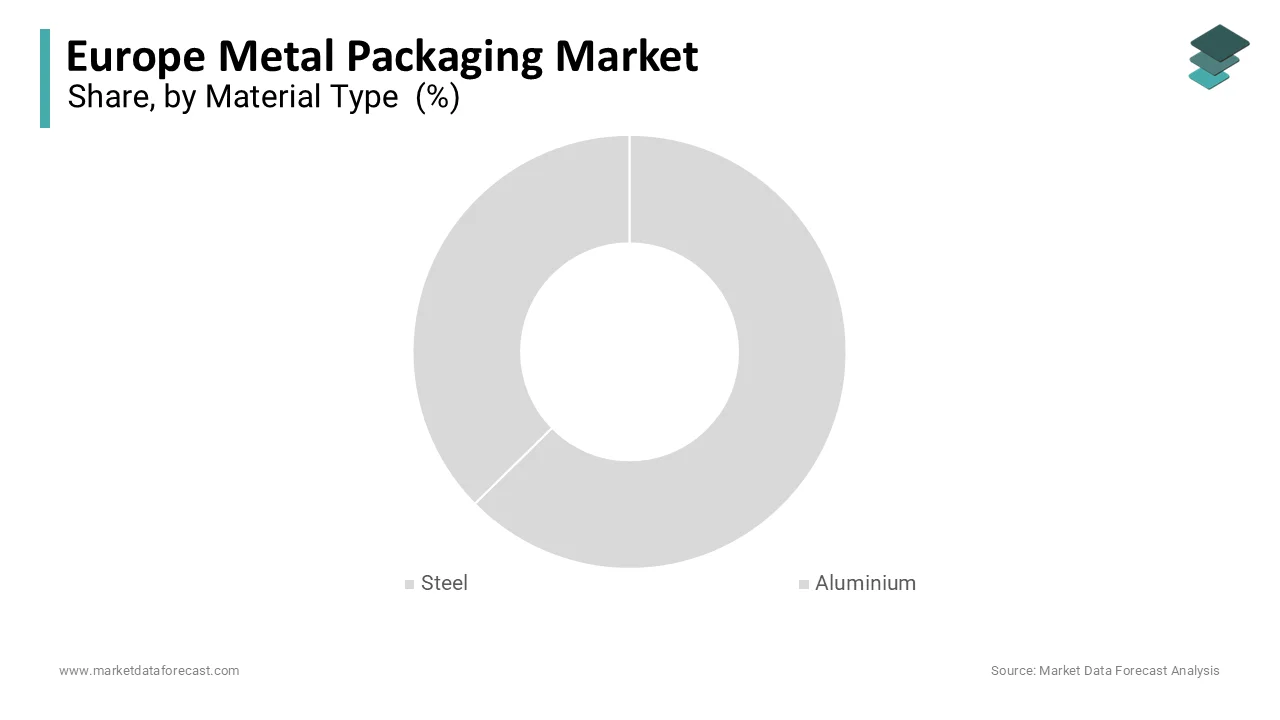
The aluminium segment is likely to experience the fastest CAGR of 6.8% from 2025 to 2033, owing to beverage can expansion and premiumization across non-traditional categories. Aluminium beverage can production is substantial across Europe. The market for canned wine has seen significant growth in sales. Aluminium packaging offers advantages in reducing logistics emissions due to its light weight compared to heavier materials like glass. Furthermore, the material’s compatibility with digital printing enables high-resolution branding that enhances shelf appeal for craft and premium products. Brands have launched limited edition aluminium cans using water-based inks and matte finishes to signal eco luxury. Upcoming regulatory goals concerning recycled content in metal packaging align well with aluminium's high capacity for incorporating recycled material without losing quality. These converging trends of category diversification, design flexibility, and circular compliance position aluminium as the highest growth material in Europe’s metal packaging landscape.
By Product Type Insights
The cans segment led the European metal packaging market and occupied a substantial share in 2025. The prominence of the cans segment is mainly because of its irreplaceable role in beverage and food preservation across mass consumption channels. Billions of food and drink cans are utilized annually in Europe. Beverage cans constitute the majority of these units used each year. Metal cans are a predominant packaging choice for beer consumed in Germany and the Netherlands, indicating significant consumer preference and supply chain reliance. Cans provide a hermetic barrier against light, oxygen, and microorganisms, enabling products like tomatoes, sardines, and carbonated drinks to achieve shelf lives exceeding two years without refrigeration. The format is also central to Europe’s emergency and military food reserves. Metal cans are a common choice for several components of operational rations. Their selection often relates to practical benefits, specifically their robust nature and ease of storage. Durability helps ensure food integrity in challenging logistical environments, and stackability aids efficient packing and distribution. Retailers favor cans for high turnover efficiency as they occupy less shelf space than bottles and generate no secondary packaging waste. These functional, economic, and systemic advantages ensure cans remain the structural cornerstone of Europe’s metal packaging ecosystem.
The caps and closures segment is on the rise and is expected to be the fastest growing segment in the market by witnessing a CAGR of 7.2% from 2025 to 2033 due to premium beverage demand and regulatory shifts toward tamper-evident evident sustainable sealing. Metal screw caps and crown corks are widely utilized for a premium feel and to assure product authenticity. Current packaging safety practices increasingly favor metal closures for pharmaceutical products and high-alcohol content beverages. Metal closures are generally seen as offering superior tamper resistance when compared to certain plastic alternatives. Innovations in aluminum easy-open ends and child-resistant closures have further expanded applications in household chemicals and nutraceuticals. Major producers have invested in low-carbon aluminum stamping lines in Spain and Poland to meet rising demand while complying with CBAM carbon costs. This convergence of regulatory compliance, brand premiumization, and material substitution establishes caps and closures as the highest growth product category in Europe’s evolving packaging landscape.
By End User Industry Insights
The beverage segment dominated the European metal packaging market and captured a 42.7% share in 2025. The dominance of the beverage segment is credited to beer, soft drinks, and the rapid expansion of alternative canned beverages. Beverage cans are widely utilized across the EU for packaging various drinks. A significant portion of the total volume of canned beverages is dedicated to beer. Beer remains highly popular in Germany, with packaged options making up a large majority of the volume consumed. Metal cans are a preferred packaging format for beer in this market, reflecting an established consumer and retail preference. The format’s dominance stems from its ability to preserve carbonati, on block UV light, and enable rapid chilling, critical attributes for Europe’s outdoor and festival culture. Additionally, the rise of craft breweries has revitalized can demand with a notable number of microbreweries in Europe using aluminum cans for branding and distribution efficiency. The beverage sector’s scale, infrastructure integration, and recycling performance solidify its leadership in metal packaging consumption.
The cosmetics and personal care segment is expected to exhibit a noteworthy CAGR of 8.1% from 2025 to 2033. The swift expansion of the cosmetics and personal care segment is propelled by luxury branding, aerosol innovation, and plastic reduction mandates. An increasing number of new premium skincare and fragrance products are being launched with metal tubes or aerosol cans, which is seen as supporting themes of sustainability and quality. Metal aerosols are generally considered to be a highly recyclable packaging format, and are exempt from certain restrictions related to single-use plastics due to their functional necessity in specific product types. Some brands are actively working to remove plastic components from their product dispensers, opting to use metal alternatives for items such as caps and collars. The use of personal care aerosol products appears to be growing, and systems for dispensing with a lighter weight and improved design are gaining market share. Furthermore, metal’s compatibility with refillable systems aligns with the EU’s Right to Repair proposals, now extending to beauty packaging. This fusion of regulatory tailwinds, luxury aesthetics, and circular design cements cosmetics and personal care as the highest growth end-user segment.
COMPETITIVE LANDSCAPE
The European metal packaging market exhibits an oligopolistic structure dominated by three multinational corporations—Ball, Crown, and Ardagh—that collectively control the majority of production capacity and technological innovation. Competition is characterized less by price and more by sustainability, ty performa, material efficiency, and service responsiveness. These leaders leverage integrated recycling loops, access to low-carbon energy, and close collaboration with brand owners to maintain an advantage. Regional players such as Silgan and Groupe Pochet focus on niche segments like specialty closures or pharmaceutical packaging but lack scale for mass beverage applications. The EU’s stringent Packaging and Packaging Waste Regulation creates high compliance barriers that favor incumbents with established collection partnerships and certified recycled content supply chains. Innovation in can desi,gn lightweight, ing and digital printing further consolidates leadership as smaller firms struggle with capital intensity. Despite material rivalry between aluminum and steel, the top players typically produce both, enabling portfolio flexibility. Overall, the market rewards scale circular integration and regulatory foresight.
KEY MARKET PLAYERS
Some of the companies that are playing a dominating role in the global European metal packaging market include
- Ball Corporation
- Crown Holdings, Inc.
- Ardagh Group S.A.
- Silgan Holdings Inc.
- Technocap S.p.A.
- Tata Steel Europe
- Thyssenkrupp Rasselstein GmbH
- DS Containers
- Can-Pack S.A.
- Novelis Europe
- Nampak Ltd.
- Metal Packaging Europe (Association Members)
- Constellium SE
- Greif, Inc.
- Trivium Packaging
- Lantern Packaging Group
- HUBER Packaging Group GmbH
- Eviosys Packaging (formerly Crown Food Europe)
- Mauser Packaging Solutions
- Toyochem Europe
TOP LEADING PLAYERS IN THE MARKET
- Ball Corporation is a global leader in metal packaging with a significant footprint in Europe, specializing in aluminum beverage cans and recyclable solutions for food and aerosol products. The company supplies major beverage brands across the continent and operates state-of-the-art canning facilities in Germany, France, and Spain. It also partnered with major brewers to introduce recycled aluminum cans under the ReAl program. These initiatives reinforce Ball’s commitment to circularity and deepen its integration with European sustainability mandates and consumer trends.
- Crown Holdings Inc maintains a strong presence in the European metal packaging market through its extensive portfolio of steel and aluminum containers for food, beverage, and aerosol applications. The company operates over 30 manufacturing sites across the continent, serving both multinational and regional brand owners. It also invested in digital print capabilities at its Italian plant to enable short-run customized branding for craft producers. These moves demonstrate the Crown’s focus on innovation, premiumization, and agile production to meet evolving brand demands in Europe.
- Ardagh Group is a key European metal packaging producer specializing in sustainable steel and aluminum solutions for food and beverage clients. Headquartered in Luxembourg, the company operates a dense network of plants across Germany, the UK, and the Netherlands, ensuring localized supply and reduced logistics emissions. It also launched a lightweight steel can for tomatoes and legumes that reduces material use by 8 percent without compromising performance. These actions highlight Ardagh’s alignment with EU packaging regulations and its commitment to resource efficiency and carbon reduction.
TOP STRATEGIES USED BY THE KEY MARKET PARTICIPANTS
Key players in the European metal packaging market prioritize increasing recycled content to comply with EU regulatory mandates and meet brand sustainability targets. They invest in lightweighting technologies to reduce material usage and transportation emissions while maintaining structural integrity. Companies expand digital printing capabilities to support short-run customized packaging for premium and craft segments. Strategic partnerships with beverage and food brands on circular initiatives such as deposit schemes and take-back programs enhance end-of-life recovery. Additionally, firms localize production to shorten supply chains and align with national recycling infrastructure, enhancing both cost efficiency and environmental credentials.
MARKET SEGMENTATION
This research report on the europe metal packaging market is segmented and sub-segmented into the following cacategoriess
By Material Type
- Steel
- Aluminium
By Product Type
- Cans
- Caps & Closures
By End User Industry
- Beverage
- Cosmetics & Personal Care
- Others
By Country
- Germany
- United Kingdom
- France
- Italy
- Spain
- Rest of Europe