- Product Description Description
- Table of Contents TOC
- List of Table & Figure LOT
- Get Free Sample PDF Sample PDF
Market Size, 2025
$3.63 BnMarket Estimate, 2026
$5.44 BnMarket Forecast, 2034
$137.39 BnCAGR, 2026–2034
49.74%Europe Mixed Reality Market Report Summary
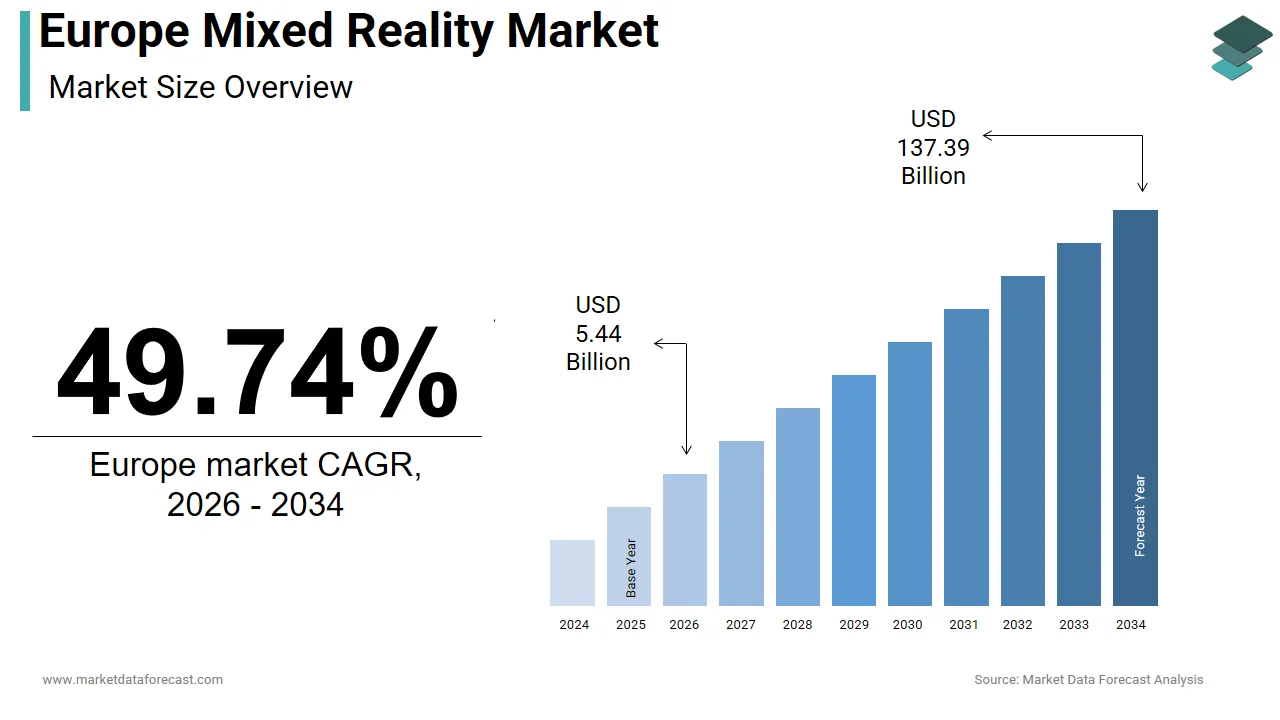
The Europe mixed reality market was valued at USD 3.63 billion in 2025 and is projected to grow from USD 5.44 billion in 2026 to USD 137.39 billion by 2034, expanding at a robust CAGR of 49.74% from 2026 to 2034. This exceptional growth trajectory is driven by accelerating adoption across industrial automation, healthcare training, defense simulation, smart manufacturing, digital twins, and immersive collaboration platforms. The integration of artificial intelligence, spatial computing, 5G connectivity, and cloud rendering is transforming mixed reality into a core enterprise productivity and visualization tool across Europe.
Key Market Trends
- Rapid adoption of digital twins and immersive simulation systems
- Expansion of XR-enabled industrial training and remote maintenance
- Growing use of mixed reality in surgical planning and medical education
- Integration of AI-powered spatial analytics and gesture recognition
- Rising deployment of the metaverse and enterprise collaboration platforms
- Increasing investments in defense and aerospace simulation technologies
Segmental Insights
-
Based on component:
-
The hardware segment dominated the market in 2025, driven by high capital investments in head-mounted displays, depth sensors, motion trackers, and spatial computing processors deployed across industrial, healthcare, and defense applications.
-
Enterprises prioritized hardware acquisition to establish foundational immersive infrastructure.
-
-
Based on device type:
-
The wired mixed reality devices segment held the leading market share in 2025 due to superior processing power, low-latency performance, and high-resolution visualization, which are critical for aerospace engineering, defense simulation, and industrial design workflows.
-
Wired devices remain preferred for mission-critical and studio-based environments.
-
-
Based on application:
-
Industrial and manufacturing applications accounted for approximately 34% of market share in 2025, supported by strong adoption in factory planning, predictive maintenance, equipment visualization, and workforce training.
-
Mixed reality enhances productivity by enabling real-time overlay of digital instructions and operational data.
-
Regional Insights
The European mixed reality market exhibits strong concentration in technologically advanced economies.
- Germany holds the largest market share, supported by its advanced manufacturing sector, Industry 4.0 initiatives, and strong public funding for digital technologies.
- The United Kingdom demonstrates high growth driven by its healthcare innovation ecosystem, gaming heritage, and creative industries.
- France shows strong momentum due to aggressive public-sector investments, defense modernization programs, and smart infrastructure development.
Competitive Landscape
The Europe mixed reality market is highly dynamic and innovation-driven, characterized by intense competition among global technology firms, specialized XR developers, and enterprise solution providers. Competition is centered on display resolution, field of view, ergonomics, software ecosystems, and enterprise integration capabilities. Leading companies are investing heavily in cloud-based rendering, AI-enhanced spatial mapping, and cross-platform interoperability. Strategic partnerships with industrial firms, healthcare providers, and defense agencies play a critical role in market expansion. Vendors are also developing customized enterprise-grade solutions to meet sector-specific regulatory and performance requirements.
Key players include Microsoft, Google, Canon, Samsung, Meta, HTC, Dell, PTC, Varjo, Hewlett Packard Enterprise, and Niantic.
Europe Mixed Reality Market Size
The Europe mixed reality market was valued at USD 3.63 billion in 2025, is estimated to reach USD 5.44 billion in 2026, and is projected to reach USD 137.39 billion by 2034, growing at a CAGR of 49.74% from 2026 to 2034.
Mixed reality refers to immersive computing environments that seamlessly integrate digital holograms and spatially aware virtual objects into the user’s physical surroundings through advanced head-mounted displays, depth sensors, and real-time spatial mapping. Unlike virtual reality, which replaces the physical world, or augmented reality, which overlays simplistic 2D graphics, mixed reality enables persistent interactive 3D content that responds to real-world geometry and lighting. This technology is increasingly deployed across industrial design, healthcare training, and smart infrastructure applications where contextual awareness and user collaboration are paramount. According to Eurostat, over 42% of large manufacturing enterprises in the EU conducted pilot programs involving spatial computing in 2024, as part of digital transformation mandates. Concurrently, the European Space Agency launched the Digital Twin Earth initiative using mixed reality interfaces to visualize climate modeling data across national research centers. As per the European Commission’s Digital Decade, all member states are required to establish at least one public sector mixed reality innovation hub by 2026 to accelerate skills development and cross-sector adoption.
MARKET DRIVERS
Industrial Digitalization Mandates Drive Enterprise Mixed Reality Adoption
The European Union’s push for industrial digitalization under the Digital Europe Programme and Industry 5.0 framework for mixed reality deployment in manufacturing logistics and energy sectors is greatly influencing the growth of the Europe medical reality market. Similarly, the European Aviation Safety Agency certified mixed reality guided maintenance procedures for Airbus A350 components, allowing technicians to visualize torque specifications and wiring paths without physical manuals. The German Federal Ministry for Economic Affairs allocated 210 million euros in 2023 to subsidize mixed reality adoption among Mittelstand suppliers to enhance supply chain resilience. These regulatory and economic incentives position mixed reality not as a novelty but as a core productivity layer in Europe’s sovereign industrial technology stack.
Expansion of Public Sector Digital Twins Fuels Spatial Computing Infrastructure
Governments are increasingly investing in national digital twin initiatives that rely on mixed reality for data interaction and scenario modelling, which is accelerating the growth of Europe medical reality market. According to the European Environment Agency, 19 EU member states launched city-scale digital twins in 2024, integrating real-time IoT sensor data traffic flows and energy consumption into spatially accurate 3D models accessible via mixed reality headsets. The City of Amsterdam’s Digital Twin platform enables urban planners to simulate flood resilience measures by visualizing water levels superimposed on actual streets and buildings during collaborative sessions. Similarly, the UK’s National Health Service deployed mixed reality interfaces at 12 major hospitals to overlay patient-specific anatomical models during surgical planning, reducing preoperative review time by 28% as per NHS Digital. In 2024, the European Space Agency awarded 45 million euros to the Destination Earth consortium to build a continental climate simulation engine with mixed reality visualization endpoints across research universities. These sovereign digital infrastructure projects create sustained demand for enterprise-grade spatial computing hardware, software, and content development, embedding mixed reality into Europe’s public sector innovation fabric.
MARKET RESTRAINTS
High Hardware Costs and Limited Enterprise Device Availability Restrict Scalability
The widespread deployment by the premium pricing and constrained supply of enterprise-grade headsets is significantly restraining the growth of Europe medical reality market. In 2024, only three vendors offered CE-marked mixed reality devices certified for industrial use across the EU, creating dependency on a narrow hardware ecosystem. The German Engineering Federation reported that of surveyed manufacturers delayed mixed reality pilots due to the inability to secure sufficient headsets amid global component shortages. Furthermore, unlike consumer VR devices, enterprise mixed reality units require specialized optical calibration, cybersecurity certifications, and integration with legacy enterprise resource planning systems, adding months to deployment timelines.
Absence of Unified Standards for Interoperability and Data Exchange
The lack of harmonized technical standards governing 3D asset formats, spatial anchoring protocols, and cross-platform data exchange, fragmenting development efforts and increases integration costs, is inhibiting the growth of the Europe mixed reality market. According to the European Telecommunications Standards Institute, over 14 distinct spatial computing frameworks are in active use across EU pilot projects, including OpenXR, Unity MARS, and proprietary vendor SDKs with limited compatibility. This fragmentation forces developers to rebuild applications for each hardware platform, eroding return on investment. In 2024, some of the mixed reality projects in European automotive supply chains required custom middleware to connect digital twin data from Siemens Teamcenter with HoloLens visualization engines. Although the European Committee for Standardization launched the CEN CENELEC JTC 21 working group on immersive technologies in 2023, formal specifications remain in draft phase.
MARKET OPPORTUNITIES
Integration with 5G and Edge Computing Unlocks Real-Time Collaborative Workflows
The emergence of mixed reality with ultra-low latency 5G networks and distributed edge computing infrastructure is creating new opportunities for the growth of the Europe mixed reality market. According to the European 5G Observatory, over 310 industrial 5G private networks were operational in the EU by the end of 2024, with 63% supporting mixed reality use cases in manufacturing and energy. In Sweden, Ericsson and Volvo Cars demonstrated a cross-site design review where engineers in Gothenburg and Brussels simultaneously manipulated a full-scale holographic vehicle model with sub-10 millisecond latency, impossible over conventional Wi-Fi. Similarly, the Port of Rotterdam deployed a 5G-enabled mixed reality system allowing crane operators and logistics planners to visualize real-time container stacking data overlaid on physical yards through HoloLens headsets. The European High Performance Computing Joint Undertaking further allocated 80 million euros in 2024 to develop edge AI inference nodes that preprocess spatial data locally, reducing cloud dependency. This synergy between connectivity, compute, and visualization is enabling scalable, secure, and responsive mixed reality applications that transcend single-user limitations and unlock true industrial metaverse potential.
Growth in Medical Simulation and Surgical Planning Expands Clinical Utility
The growing adoption of a tool for surgical planning, medical education, and patient communication, driving demand beyond industrial sectors, is expected to accelerate the growth of Europe mixed reality market. In 2024, the University Hospital of Heidelberg reported that neurosurgeons using mixed reality for glioma resection achieved 22% greater tumor removal accuracy compared to traditional navigation systems. Similarly, the UK’s Royal College of Surgeons integrated mixed reality modules into its core curriculum, allowing trainees to practice complex laparoscopic procedures on virtual patients anchored in real operating rooms. The European Commission’s Horizon Europe program funded the XR4Health initiative with 32 million euros to validate clinical outcomes and develop CE-marked software modules for orthopedic and cardiovascular applications. As regulatory pathways mature and evidence of improved outcomes accumulates, mixed reality is transitioning from experimental tool to standard clinical infrastructure in Europe’s high-value healthcare ecosystem.
MARKET CHALLENGES
Persistent Concerns Over Data Privacy and Biometric Surveillance
The use of mixed reality headsets equipped with inward-facing eye tracking, outward-facing depth sensors, and spatial mapping cameras raises significant data privacy and biometric surveillance concerns under Europe’s stringent regulatory regime. The persistent concerns over data privacy and biometric surveillance are a challenge for the growth of the Europe mixed reality market. According to the European Data Protection Board, mixed reality devices collect a novel category of personal data, including gaze patterns, spatial behavior, biometric identifiers, and environmental reconstructions that may fall under the scope of the General Data Protection Regulation as sensitive information. In 2024, France’s National Commission on Informatics and Liberty issued guidance requiring explicit consent for any mixed reality application capturing room geometry in private or semi-private spaces. Similarly, the German Federal Commissioner for Data Protection blocked a warehouse pilot at a major logistics firm after it was revealed that headsets recorded co-worker movements without anonymization. These regulatory uncertainties increase compliance risk and deter organizations from deploying mixed reality in human-centric environments.
Shortage of Skilled Developers and Spatial Design Talent Limits Content Creation
The shortage of professionals skilled in 3D-modeling, real-time rendering, spatial UX design, and mixed reality software development constrains the creation of high-value enterprise applications, which additionally inhibits the growth of the Europe mixed reality market. According to the European Centre for the Development of Vocational Training, fewer than 8 000 developers across the EU possess certified proficiency in OpenXR or Unity’s mixed reality toolkit as of 2024. This scarcity drives average developer day rates above 900 euros in Western Europe, making custom application development prohibitively expensive for all but the largest organizations. Although the European Commission launched the Digital Europe Academy in 2023, offering mixed reality development courses, enrollment remains below 5,000 annually, far short of projected demand.
REPORT COVERAGE
| REPORT METRIC | DETAILS |
| Market Size Available | 2025 to 2034 |
| Base Year | 2025 |
| Forecast Period | 2026 to 2034 |
| Segments Covered | By Component, Device Type, Application, and Country. |
| Various Analyses Covered | Global, Regional, and Country-Level Analysis, Segment-Level Analysis, Drivers, Restraints, Opportunities, Challenges; PESTLE Analysis; Porter’s Five Forces Analysis, Competitive Landscape, Analyst Overview of Investment Opportunities |
| Countries Covered | UK, France, Spain, Germany, Italy, Russia, Sweden, Denmark, Switzerland, Netherlands, Turkey, Czech Republic, and the Rest of Europe. |
| Market Leaders Profiled | Microsoft Corporation, Google LLC (Alphabet Inc.), Canon, Inc., Samsung Electronics Co., Ltd. (Samsung Group), Meta Platforms, Inc., HTC Corporation, Dell Technologies, Inc., PTC Inc., Varjo, Hewlett Packard Enterprise Company, Niantic, Inc., and Others. |
SEGMENTAL ANALYSIS
By Component Insights
The hardware segment was the largest by holding 62.3% of the Europe mixed reality market share in 2024, from high upfront investments in head mounted displays sensors and spatial computing devices deployed across industrial, healthcare, and defense sectors. Companies like Microsoft, with its HoloLens 2 and Meta, through its enterprise-focused Quest Pro, have intensified adoption in manufacturing and training environments. The hardware segment benefits from ongoing miniaturization of optical components and advancements in battery life and field of view, which directly enhance user immersion and operational efficiency. In Germany alone, over 40% of automotive manufacturers reported using mixed reality headsets for assembly line visualization in a 2024 survey by Bitkom, the German digital association. Additionally, public funding such as Horizon Europe grants has spurred procurement of mixed reality hardware for R&D labs and universities. These investments reflect a strategic shift toward digital twin integration and Industry 4.0 transformation, where physical and digital workflows converge through immersive hardware interfaces.
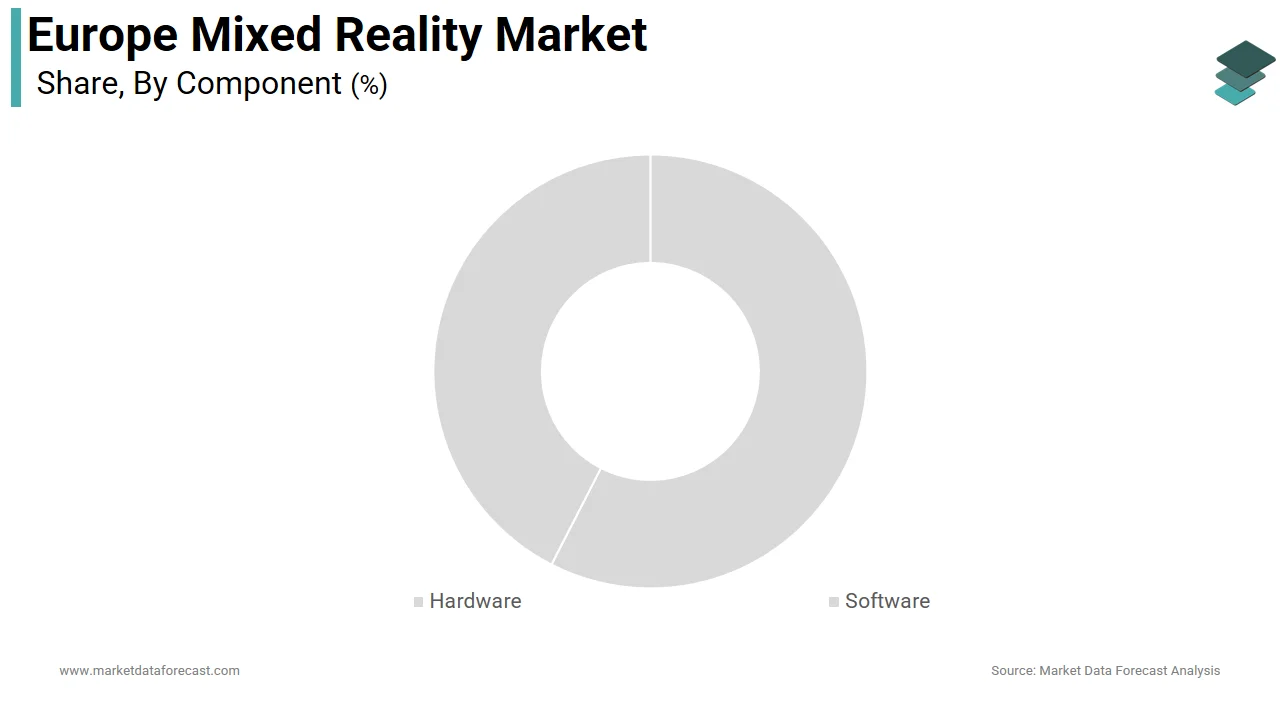
The software segment is projected to grow at a compound annual growth rate of 38.2% from 2026 to 2034, owing to the rising demand for customizable mixed reality applications that support remote collaboration, training simulations, and real-time data overlay. Enterprise software platforms, such as Microsoft Mesh and Unity’s MARS, are enabling developers to create scenario-specific environments without extensive coding. In healthcare, for instance, Osso VR reported a 270% increase in European hospital partnerships in 2024 for surgical training modules built on mixed reality software. Moreover, the European Commission’s Digital Europe Programme allocated 1.2 billion euros in 2024 to support immersive software development for public services, education, and SME digitization. Cloud-based deployment models are also reducing barriers to entry, allowing even small manufacturers to adopt mixed reality solutions via subscription-based licensing.
By Device Type Insights
The wired mixed reality devices segment held a dominant share of the Europe mixed reality market in 2025, with the superior processing power, stable latency, and high resolution output for professional applications in aerospace, defense, and industrial design. Companies, such as Varjo and Magic Leap, prioritize tethered architectures to support complex simulations requiring real-time rendering of large datasets. For example, Airbus uses wired Varjo XR-4 headsets at its Hamburg facility to visualize aircraft wiring harnesses, reducing engineering rework by 30% as reported in the company’s 2024 sustainability and innovation review. Moreover, wired devices benefit from direct integration with high-performance workstations and CAD software ecosystems common in German and French engineering firms. The reliability of wired connections also aligns with stringent safety protocols in regulated sectors like nuclear energy and medical device manufacturing, where wireless interference is unacceptable. These technical and compliance advantages ensure continued enterprise preference for tethered solutions despite growing consumer interest in mobility.
The wireless segment is likely to witness the fastest CAGR of 41.7% from 2025 to 2033. The growth of the segment is driven by the rapid improvements in standalone headset capabilities, including Qualcomm’s Snapdragon XR2 Gen 2 chip, which delivers desktop-level performance in a mobile form factor. Meta’s Quest 3 shipped over 1.2 million units in Europe during Q4 2024, alone, as per Counterpoint Research, highlighting strong enterprise and educational uptake. In Sweden, IKEA leverages wireless headsets for in-store design consultations, allowing customers to visualize furniture in real time without cables restricting movement. Additionally, workforce mobility demands in field service and logistics are accelerating adoption, with Deutsche Post DHL testing wireless MR glasses for warehouse navigation across its Benelux hubs.
By Application Insights
The Industrial and manufacturing applications account for 34% of the Europe mixed reality market in 2025, according to the European XR Association’s annual industry adoption survey. This segment leads due to widespread deployment in assembly line guidance, predictive maintenance, and worker training. BMW uses Microsoft HoloLens to overlay digital work instructions on physical vehicles, reducing training time by 50% as confirmed in its 2024 production efficiency report. Similarly, Siemens employs mixed reality in its digital twin factories across Germany, enabling engineers to troubleshoot machinery remotely with real-time holographic annotations. The European Union’s Green Deal and Digital Twin initiative have allocated over 800 million euros since 2023 to integrate immersive technologies into sustainable manufacturing practices. Furthermore, labor shortages in skilled trades are pushing companies to adopt mixed reality for knowledge transfer, with France’s Ministry of Industry reporting a 45% increase in XR-based apprenticeship programs in 2024. These operational efficiencies, cost savings, and policy tailwinds solidify industrial manufacturing as the cornerstone application driving Europe’s mixed reality economy.
Healthcare is the fastest-growing application segment in the Europe mixed reality market, projected to expand at a compound annual growth rate of 44.3% through 2030, according to a 2025 Frost & Sullivan analysis. This explosive growth stems from rising clinical adoption of mixed reality for surgical planning, medical education, and patient rehabilitation. In the United Kingdom, Imperial College Healthcare NHS Trust implemented HoloAnatomy in 2024, allowing surgeons to interact with 3D patient-specific organ models before complex procedures, reducing operative time by up to 22%. France’s Assistance Publique – Hôpitaux de Paris launched a mixed reality telemedicine pilot connecting rural clinics with urban specialists using spatial avatars and real-time imaging. Additionally, the European Medicines Agency approved three mixed reality-based therapeutic devices in 2024 for cognitive rehabilitation in stroke patients, accelerating reimbursement pathways. Investment is also surging with European health tech venture funding for XR startups reaching 320 million euros in 2024, per Dealroom data. Aging populations and strained healthcare systems are further driving demand for scalable immersive solutions that enhance precision and accessibility across the care continuum.
COUNTRY-LEVEL ANALYSIS
Germany Mixed Reality Market Analysis
Germany holds the largest share of the Europe mixed reality market at 24% according to data from the Federal Ministry for Economic Affairs and Climate Action in its 2025 Digital Technologies Outlook. The country’s leadership stems from its advanced industrial base, with over 60% of DAX 30 companies actively deploying mixed reality in production and R&D. Bosch uses HoloLens across 12 German facilities for remote equipment diagnostics, while Siemens maintains a dedicated XR lab in Munich focused on factory digitalization. Government initiatives like the 2 billion euro Industrial Metaverse funding program launched in 2024 have catalyzed public-private partnerships in immersive engineering. Additionally, Germany hosts leading hardware developers such as Ultraleap and Nreal’s European R&D center in Berlin. Academic institutions like RWTH Aachen University offer specialized courses in spatial computing, feeding a skilled talent pipeline. With over 45000 mixed reality professionals employed nationwide, as per Statista’s 2025 labor report, Germany remains the undisputed engine of Europe’s immersive technology adoption.
United Kingdom Mixed Reality Market Analysis
The United Kingdom mixed reality market growth is driven by its strong healthcare innovation ecosystem and gaming heritage. London alone is home to over 120 mixed reality startups, including FundamentalVR, which partners with NHS hospitals for surgical simulation. The UK’s Medicines and Healthcare products Regulatory Agency fast-tracked approval for five mixed reality medical devices in 2024, accelerating clinical integration. In entertainment, the BBC and Sky have invested in mixed reality storytelling with projects like “Our World in Mixed Reality”, reaching 2.3 million viewers in Q1 2025. The Department for Science Innovation and Technology allocated 300 million pounds in 2024 through the Immersive Tech Fund, supporting SMEs in defense education and retail. Moreover, the UK’s departure from the EU has prompted strategic autonomy in digital sovereignty initiatives, with immersive platforms seen as critical for future skills and export diversification. This multi-sectoral momentum solidifies the UK’s position as Europe’s second most influential mixed reality hub.
France Mixed Reality Market Analysis
France mixed reality market growth is attributed to a boost with the aggressive public investment and defense sector adoption. The French Ministry of Armed Forces deployed over 2000 mixed reality headsets in 2024 for pilot training and battlefield simulation under its SCORPION modernization program. The French Tech Next initiative injected 250 million euros in 2024, specifically for immersive startups, with Paris and Lyon emerging as key clusters. Education plays a pivotal role, with the Ministry of National Education rolling out mixed reality history and science modules across 1500 secondary schools. Companies like 3D Vision and Dassault Systèmes are exporting French-developed XR platforms globally, enhancing soft power and tech exports.
Italy Mixed Reality Market Analysis
Italy mixed reality market growth is propelled by luxury retail, automotive, and cultural heritage applications, according to Confindustria’s 2025 Digital Innovation Barometer. Ferrari integrates HoloLens into its Maranello design studio, enabling engineers to evaluate aerodynamics on full-scale holographic models. The Ministry of Culture allocated 50 million euros in 2024 to digitize historical sites, with Pompeii offering mixed reality tours that attracted 400000 visitors in the first six months. Furthermore, Italy’s National Recovery and Resilience Plan includes immersive technology as a pillar of its 49 billion euro digital transformation budget. Universities like Politecnico di Milano run XR incubators fostering startups in tourism and design. This blend of traditional industries and digital reinvention positions Italy as a unique and culturally driven contributor to Europe’s immersive economy.
Sweden Mixed Reality Market Analysis
Sweden mixed reality market growth is expected to have significant growth opportunities in the coming years, with the sustainable innovation and human-centered design. IKEA’s mixed reality kitchen planner, used by 1.8 million European customers in 2024, exemplifies retail integration, while Volvo employs XR for ergonomic vehicle testing, reducing physical prototype waste by 40%. Ericsson’s 5G and edge computing infrastructure further enables low-latency mixed reality applications across healthcare and logistics.
COMPETITIVE LANDSCAPE
Competition in the Europe mixed reality market is intense and multifaceted, characterized by a blend of global technology giants and specialized regional innovators. Microsoft Meta and Apple dominate the high-end enterprise and consumer segments while European firms like Varjo and Ultraleap carve niches through precision engineering and industry-specific solutions. The market features rapid technological iteration with frequent hardware refreshes and software platform updates. Regulatory alignment with GDPR and EU digital sovereignty frameworks adds complexity, influencing data handling and cloud architecture choices. Collaboration is as critical as competition, with players forming consortia under Horizon Europe and national innovation funds to co-develop standards and pilot projects.
KEY MARKET PLAYERS
The leading companies operating in the Europe mixed reality market include:
- Microsoft Corporation
- Google LLC (Alphabet Inc.)
- Canon, Inc.
- Samsung Electronics Co., Ltd. (Samsung Group)
- Meta Platforms, Inc.
- HTC Corporation
- Dell Technologies, Inc.
- PTC Inc.
- Varjo
- Hewlett-Packard Enterprise Company
- Niantic, Inc.
TOP PLAYERS IN THE MARKET
- Microsoft is a pivotal force in the Europe mixed reality market through its HoloLens platform, which integrates seamlessly with Azure cloud services and Dynamics 365. The company actively collaborates with European industrial leaders such as Airbus and ThyssenKrupp to deploy mixed reality solutions for remote assistance and digital twins. Microsoft expanded its mixed reality partnerships with NHS hospitals in the United Kingdom for surgical planning and medical training. It also launched the HoloLens 2 Development Edition tailored for European academic institutions to accelerate XR research and talent development across the region.
- Meta Platforms drives consumer and enterprise mixed reality adoption in Europe through its Quest series of standalone headsets. The company has intensified its enterprise outreach by introducing Meta Quest for Business, which offers enhanced security and device management features tailored for European corporations. In 2024, Meta established an immersive technology hub in Paris to support local developers and co-create industry-specific applications with European logistics and retail firms. It also partnered with leading universities in Germany and the Netherlands to advance research in spatial computing and human-computer interaction.
- Varjo is a Finland-based innovator specializing in high-fidelity mixed reality headsets used in aerospace, automotive, and defense sectors across Europe. The company’s XR 4 and Aero devices are known for human eye resolution and photorealistic passthrough capabilities. Varjo deepened integration with NVIDIA Omniverse and Siemens Teamcenter, enabling real-time collaborative engineering across European manufacturing sites. It also launched a dedicated enterprise support program in Sweden and the Netherlands to accelerate deployment in regulated industries requiring precision visualization and compliance with European data sovereignty standards.
TOP STRATEGIES USED BY THE KEY MARKET PARTICIPANTS
Key players in the Europe mixed reality market prioritize strategic partnerships with local enterprises and public institutions to tailor solutions for regional needs. They invest heavily in research and development to enhance hardware performance and software interoperability with existing enterprise systems. Companies frequently launch region-specific developer programs to cultivate local talent and expand application ecosystems. Cloud integration and edge computing capabilities are emphasized to support low latency and data security requirements under European regulations. Additionally, firms engage in targeted acquisitions of software startups to bolster their platform offerings and accelerate time to market for vertical-specific use cases across healthcare, manufacturing, and education sectors.
MARKET SEGMENTATION
This research report on the Europe mixed reality market has been segmented and sub-segmented into the following categories.
By Component
- Hardware
- Software
By Devices Type
- Wireless
- Wired
By Application
- Gaming & Entertainment
- Automotive
- Industrial & Manufacturing
- Healthcare
- Aerospace & defense
- Education
- E-Commerce & Retail
- Other Application
By Country
- United Kingdom
- France
- Spain
- Germany
- Italy
- Russia
- Sweden
- Denmark
- Switzerland
- Netherlands
- Rest of Europe