- Product Description Description
- Table of Contents TOC
- List of Table & Figure LOT
- Get Free Sample PDF Sample PDF
Market Size, 2025
$96.11 MnMarket Estimate, 2026
$99.32 MnMarket Forecast, 2034
$129 MnCAGR, 2026–2034
3.34%Europe Molybdenum Market Report Summary
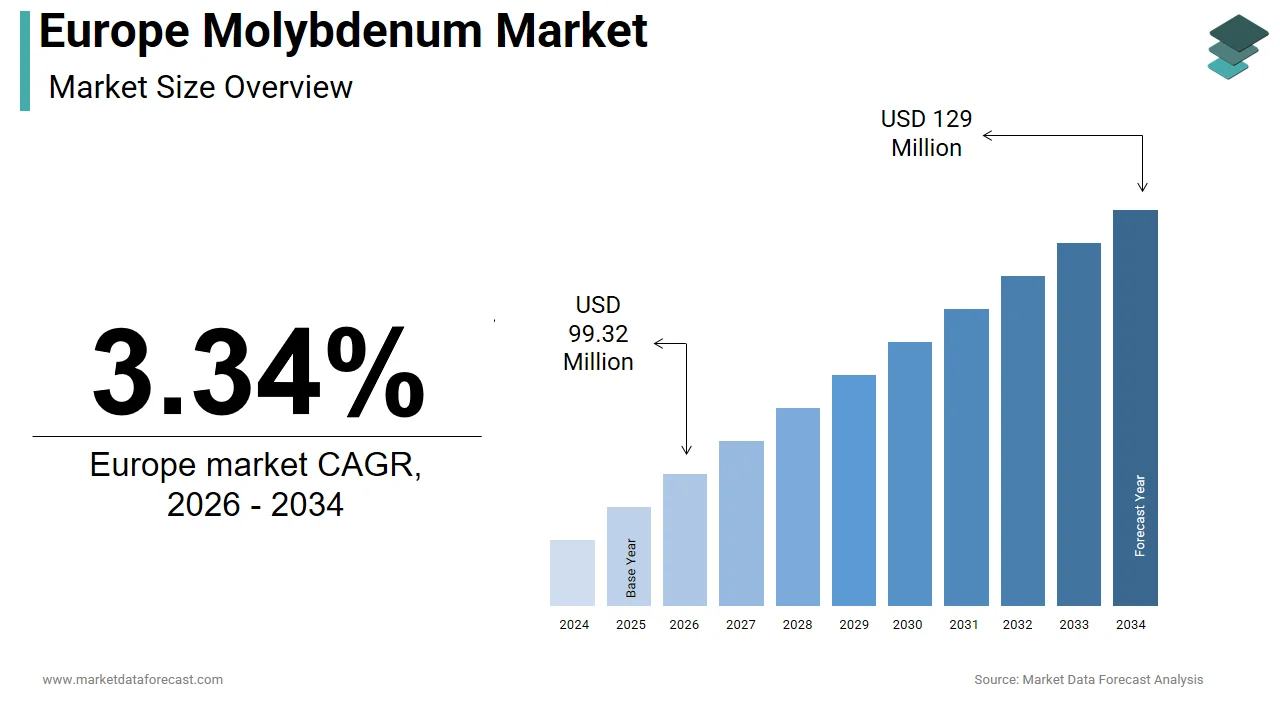
The Europe molybdenum market was valued at USD 96.11 million in 2025, is anticipated to reach USD 99.32 million in 2026, and is projected to reach USD 129 million by 2034, growing at a CAGR of 3.34% from 2026 to 2034. Market growth is driven by increasing demand for high-strength alloys, expanding industrial manufacturing, and rising use of molybdenum in steel production. Molybdenum is a critical alloying element that enhances strength, corrosion resistance, and heat tolerance in steel and other metals, making it essential for industrial machinery, automotive, aerospace, and energy applications. Additionally, growing investments in infrastructure development, industrial automation, and advanced manufacturing technologies are supporting steady demand across Europe.
Key Market Trends
- Rising demand for high-performance alloy steels in industrial applications.
- Increasing adoption of molybdenum in the automotive, aerospace, and energy sectors.
- Growing investments in industrial machinery and infrastructure development.
- Expansion of advanced manufacturing and heavy engineering industries.
- Strong focus on durable, corrosion-resistant, and heat-resistant materials.
Segmental Insights
- Based on end product, the steel segment dominated the Europe molybdenum market by accounting for 71.2% share in 2025, driven by widespread use of molybdenum as an alloying element to improve steel strength, durability, and resistance to corrosion and high temperatures.
- Based on product form, the ferromolybdenum segment held the largest share of 61.5% in 2025, supported by its extensive use in steel manufacturing due to its efficiency in enhancing alloy properties and production performance.
- Based on end-use industry, the industrial machinery and equipment segment led the market by capturing 30.6% share in 2025, driven by increasing demand for high-strength materials in heavy machinery, manufacturing equipment, and industrial tools.
Regional Insights
The Europe molybdenum market is witnessing steady growth across key industrial economies, supported by strong manufacturing activity, advanced metallurgy capabilities, and infrastructure development.
- Germany led the market by accounting for 25.5% share in 2025, driven by its strong automotive industry, advanced engineering sector, and extensive use of high-performance steel in manufacturing.
- Sweden held the second-largest share, supported by its well-established mining sector, metallurgical expertise, and strong presence in specialty steel production.
- Italy is expected to register a promising CAGR during the forecast period, driven by expanding industrial manufacturing, machinery production, and increasing demand for high-quality alloy materials.
Competitive Landscape
The Europe molybdenum market is characterized by the presence of global mining companies and metal producers focusing on supply stability, production efficiency, and expansion of alloy material applications. Market participants are investing in mining operations, refining technologies, and strategic partnerships to strengthen supply chains and meet growing industrial demand. Increasing focus on sustainable mining practices and advanced metallurgical processes is shaping the competitive landscape.
Leading companies operating in the Europe molybdenum market include Antofagasta plc, CMOC Group Limited, Codelco, Boliden, Freeport-McMoRan, and Grupo México.
Europe Molybdenum Market Size
The size of the Europe molybdenum market was worth USD 96.11 million in 2025. The regional market is anticipated to grow at a CAGR of 3.34% from 2026 to 2034 and be worth USD 129 million by 2034 from USD 99.32 million in 2026.
Molybdenum is a refractory metal valued for its exceptional strength at high temperatures, corrosion resistance, and catalytic properties. Primarily used as an alloying agent in stainless and high-strength low-alloy steels, molybdenum enhances hardness, weldability, and performance in extreme environments. In Europe, it is indispensable to aerospace, energy, automotive, and chemical processing sectors. The region does not possess significant primary molybdenum mines; instead, it relies heavily on imports of molybdenite concentrate and ferromolybdenum from the Americas and Asia. According to the European Commission’s Raw Materials Information System, the EU imports molybdenum content in various forms, with Germany, Italy, and Sweden serving as key processing and consumption hubs. As per Eurostat data, Europe also recovers molybdenum through scrap recycling, with secondary production contributing to apparent consumption. This import dependency, coupled with strategic recycling, defines the structural dynamics of Europe’s molybdenum landscape.
MARKET DRIVERS
Expansion of High-Performance Alloy Demand in Aerospace and Defense
The aerospace and defense industries are pivotal drivers of molybdenum consumption in Europe due to the metal’s critical role in nickel-based superalloys used in jet engines and gas turbines, which is significantly driving the growth of the European molybdenum market. These alloys require molybdenum to maintain structural integrity at high temperatures. According to the European Defence Agency, defense spending across EU member states has been increasing, which accelerates procurement of advanced aircraft and propulsion systems. As per Airbus, the company continues to deliver large volumes of commercial aircraft, each containing molybdenum-enhanced components. Furthermore, the European Space Agency’s Ariane 6 launch program utilizes molybdenum-containing alloys in combustion chambers and nozzles. As Europe seeks strategic autonomy in defense and space technologies, domestic demand for high-purity molybdenum continues to rise, reinforcing its status as a critical raw material under the EU’s Critical Raw Materials Act.
Growth in Renewable Energy Infrastructure Requiring Corrosion-Resistant Alloys
The European Green Deal’s push for decarbonization has intensified demand for molybdenum in renewable energy systems, particularly offshore wind and hydrogen production, which is further boosting the expansion of the regional market. Stainless steels alloyed with molybdenum are essential for seawater-exposed components like turbine shafts, subsea cables, and electrolyzer plates due to their superior resistance to pitting and crevice corrosion. According to WindEurope, the EU continues to expand wind capacity, with offshore projects representing a significant share of investments. Each offshore wind turbine requires molybdenum-containing stainless steel. Similarly, as per the European Hydrogen Backbone initiative, plans to repurpose natural gas pipelines for hydrogen transport will necessitate molybdenum-enhanced steels to withstand hydrogen embrittlement. This clean energy transition anchors long-term structural demand for molybdenum beyond cyclical industrial fluctuations.
MARKET RESTRAINTS
High Import Dependency and Geopolitical Supply Concentration
Europe’s molybdenum market is severely constrained by its near-total reliance on external sources. As per the European Commission’s Joint Research Centre, the majority of primary supply originates from Chile, the United States, and China. This concentration creates vulnerability to trade restrictions, logistical disruptions, and export policy shifts. According to industry reports, Chile has tightened environmental permitting for mining operations, which has contributed to global supply tightness and price volatility. Additionally, geopolitical tensions between major producers can indirectly affect European access, as U.S. export controls on strategic minerals may prioritize domestic or allied needs over EU buyers. Unlike copper or aluminum, molybdenum lacks diversified alternative sources within Europe, and stockpiling remains limited. This supply chain fragility undermines industrial planning and exposes key sectors like steel and energy to external shocks.
Stringent Environmental Regulations on Metal Processing and Emissions
Molybdenum processing, including roasting of molybdenite and ferroalloy production, is subject to increasingly rigorous EU environmental standards that raise operational costs and limit capacity expansion, which is further hindering the growth of the European molybdenum market. The Industrial Emissions Directive Mandates Best Available Techniques for facilities handling heavy metals, requiring advanced scrubbing systems to control sulfur dioxide and particulate emissions. According to the European Environment Agency, compliance investments for molybdenum oxide plants can be substantial. Moreover, the EU’s Carbon Border Adjustment Mechanism indirectly pressures downstream users by increasing the carbon cost of imported ferromolybdenum produced in high-emission regions. Recycling operations also face scrutiny under the Waste Framework Directive, as molybdenum-bearing scrap must be classified and handled as potentially hazardous waste. These regulatory layers disincentivize new processing investments within Europe, reinforcing reliance on third countries with less stringent environmental oversight.
MARKET OPPORTUNITIES
Advancement of Circular Economy Through Enhanced Scrap Recycling
Europe’s commitment to circularity offers a significant opportunity to reduce primary import dependence by scaling high-efficiency molybdenum recovery from end-of-life alloys and industrial scrap. Currently, around 35 percent of molybdenum consumed in the EU is sourced from recycled materials, but technological advances could raise this substantially. According to the International Molybdenum Association, modern hydrometallurgical processes can recover over 95 percent of molybdenum from stainless steel and superalloy scrap with minimal environmental impact. Companies like Outokumpu in Finland and Acerinox in Spain are investing in closed-loop recycling systems that reintegrate recovered molybdenum directly into new steel batches. The EU’s Circular Economy Action Plan provides funding for such innovations through Horizon Europe, recognizing molybdenum as a candidate for urban mining. By formalizing collection streams and standardizing scrap grading, Europe can transform waste into a secure secondary supply, enhancing resource resilience while meeting climate objectives.
Integration into Next Generation Nuclear and Fusion Technologies
Emerging nuclear energy initiatives offer a high-value niche for molybdenum in Europe’s future energy mix, which is another prominent opportunity in the European molybdenum market. In Generation IV nuclear reactors and experimental fusion projects like ITER in France, molybdenum and its alloys are being evaluated for plasma-facing components and heat exchangers due to their high melting point, low neutron activation, and thermal conductivity. According to the European Joint Undertaking for ITER, molybdenum-based materials are critical for divertor plates that manage extreme heat fluxes in tokamak reactors. Although still in R&D phases, these applications could create sustained demand as Europe advances its nuclear roadmap under the Strategic Energy Technology Plan. With the EU classifying nuclear as a green investment under certain conditions, public and private funding for advanced materials is increasing. Early engagement by European molybdenum processors in these programs positions them to supply ultra-high purity grades required for next-generation energy systems.
MARKET CHALLENGES
Price Volatility Due to Speculative Trading and Byproduct Supply Dynamics
Molybdenum prices in Europe experience significant volatility because the metal is primarily produced as a byproduct of copper mining, making its supply inelastic to demand shifts, which is challenging the growth of the European molybdenum market. When copper prices fall, mines reduce output, inadvertently tightening molybdenum availability regardless of its standalone market conditions. According to the London Metal Exchange, molybdenum oxide prices fluctuated by over 40 percent between 2022 and 2024 due to copper market corrections and speculative activity. European steelmakers, which account for over 70 percent of molybdenum consumption, struggle to hedge against these swings due to limited futures contracts and opaque spot markets. This unpredictability complicates budgeting and long-term material planning, especially for small and medium enterprises without procurement scale. Without transparent pricing mechanisms or strategic reserves, European industries remain exposed to financial risk stemming from upstream mining economics beyond their control.
Limited Domestic Processing Capacity and Technological Gaps
Europe faces a critical bottleneck in its ability to convert imported molybdenite concentrate into high-purity oxides or ferromolybdenum due to aging infrastructure and a lack of specialized smelting facilities. Most raw material is shipped to China or the U.S. for processing before being reimported as value-added products, adding cost and supply chain complexity. According to the European Raw Materials Alliance, only two facilities in Sweden and Germany possess partial molybdenum refining capabilities, and neither operates at full capacity due to environmental and economic constraints. This processing gap prevents Europe from capturing higher margins and ensures continued technological dependence on non-EU suppliers. Developing new hydrometallurgical or electrochemical refining plants would require billions in investment and years of permitting, deterring private capital. Until this capability gap is addressed, Europe’s molybdenum sovereignty will remain fundamentally incomplete despite growing strategic recognition of the metal’s importance.
REPORT COVERAGE
| REPORT METRIC | DETAILS |
| Market Size Available | 2025 to 2034 |
| Base Year | 2025 |
| Forecast Period | 2026 to 2034 |
| Segments Covered | By End Product, Product Form, End-user Industry, and Country. |
| Various Analyses Covered | Global, Regional, and Country-Level Analysis, Segment-Level Analysis, Drivers, Restraints, Opportunities, Challenges; PESTLE Analysis; Porter’s Five Forces Analysis, Competitive Landscape, Analyst Overview of Investment Opportunities |
| Countries Covered | UK, France, Spain, Germany, Italy, Russia, Sweden, Denmark, Switzerland, Netherlands, Turkey, Czech Republic, and the Rest of Europe. |
| Market Leaders Profiled | Antofagasta plc, China Molybdenum Co. Ltd., Codelco, CMOC Group Limited, Boliden, Freeport-McMoRan, Grupo México, and Others. |
SEGMENTAL ANALYSIS
By End Product Insights
The steel segment dominated the Europe molybdenum market by capturing 71.2% of the regional market share in 2025. The growth of the steel segment in the European market is driven by the irreplaceable role as an alloying element in high-performance stainless and structural steels. Adding 0.2 to 5% molybdenum significantly enhances corrosion resistance, high-temperature strength, and weldability, which are critical for infrastructure, energy, and automotive applications. According to the World Steel Association, Europe continues to produce large volumes of crude steel, with molybdenum-containing grades representing a notable share of specialty output. Major producers in Europe rely on ferromolybdenum to manufacture duplex and super austenitic stainless steels used in offshore platforms, chemical plants, and desalination facilities. The EU’s Green Deal further amplifies demand, as renewable energy projects require molybdenum-enhanced steels for durability in harsh environments. This deep integration into Europe’s industrial backbone ensures steel remains the primary consumption channel for molybdenum.
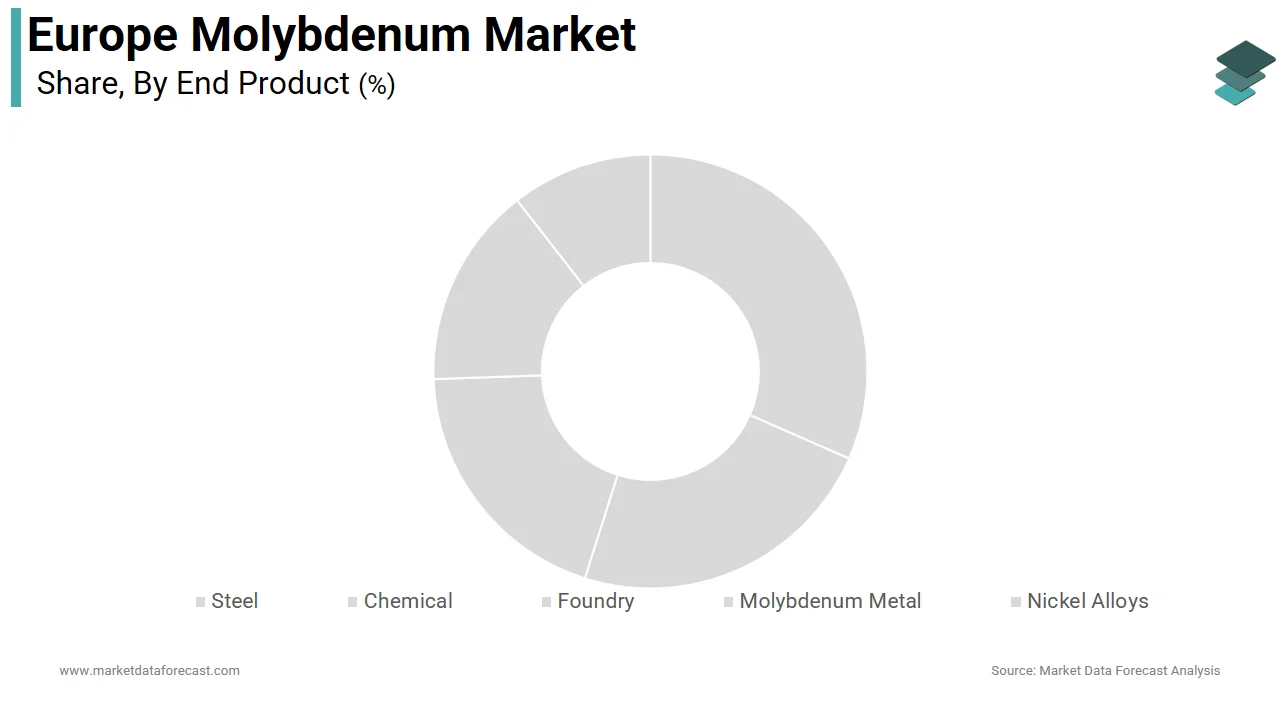
The chemical segment is the fastest-growing end product category in the Europe molybdenum market and is expected to exhibit a CAGR of 7.14% over the forecast period. The use as a catalyst in petroleum refining and green chemistry applications is majorly driving the growth of the chemical segment in this regional market. According to the International Energy Agency, European refineries continue to process large volumes of crude oil, each requiring catalysts containing molybdenum. Additionally, emerging applications in hydrogen production, such as molybdenum sulfide-based electrocatalysts for water splitting, are gaining traction under the European Hydrogen Strategy. Research institutions in Europe are developing molybdenum-based photocatalysts for CO₂ conversion, aligning with circular carbon goals. As Europe transitions toward cleaner fuels and sustainable chemical synthesis, demand for molybdenum-based catalytic compounds continues to rise beyond traditional refining roles.
By Product Form Insights
The ferromolybdenum segment had the leading share of 61.5% of the regional market in 2025. The dominance of the ferromolybdenum segment in the European market is driven by its direct compatibility with electric arc furnace steelmaking, the primary method used in European steel production. Ferromolybdenum, typically containing 60 to 75% molybdenum, allows precise alloying control while minimizing oxidation losses during melting. According to Eurofer, a significant portion of EU steel is produced via EAF routes, creating consistent demand for ferroalloy formats. Major steelmakers maintain long-term contracts with global ferromolybdenum suppliers to ensure supply stability. Additionally, ferromolybdenum’s lower transportation and handling costs compared to pure metal make it economically favorable for bulk industrial use. This operational synergy with Europe’s steel infrastructure solidifies its position as the preferred molybdenum delivery form.
The roasted molybdenum segment is promising and is estimated to register the fastest CAGR of 8.15% over the forecast period. The dual role of roasted molybdenum as a precursor for high-purity molybdenum metal and as a direct input in chemical catalysts and pigments is propelling the expansion of the roasted molybdenum segment in the European market. According to the European Chemical Industry Council, specialty chemical output in the EU has been expanding, driving upstream demand for refined intermediates. Moreover, the push for domestic processing under the EU Critical Raw Materials Act has spurred interest in local roasting capacity to reduce reliance on Chinese-sourced oxides. Companies are also exploring direct use of roasted molybdenum in powder metallurgy for aerospace components, bypassing ferroalloy routes. As Europe seeks greater control over strategic material flows, roasted molybdenum emerges as a pivotal node in value chain localization.
By End-Use Industry Insights
The industrial machinery and equipment segment commanded the highest share of 30.6% of the regional market in 2025. The growth of the industrial machinery and equipment segment in the European market is driven by the widespread use of molybdenum-alloyed steels in manufacturing equipment, power generation turbines, heat exchangers, and heavy-duty tools that operate under extreme stress and temperature. Companies in Europe specify molybdenum-containing stainless steels for components exposed to corrosive fluids or high-pressure steam. According to the European Commission’s PRODCOM database, production of industrial boilers and pressure vessels in the EU continues to be significant, with many requiring molybdenum-enhanced alloys for safety and longevity. The sector’s resilience during economic downturns, due to maintenance and replacement cycles, ensures steady molybdenum demand. Furthermore, the digitalization of factories under Industry 4.0 increases reliance on durable, high-performance materials, reinforcing molybdenum’s role in Europe’s industrial core.
The renewable energy infrastructure segment is the fastest-growing end-use segment in the Europe molybdenum market and is estimated to witness a CAGR of 9.15% over the forecast period, owing to the directly tied to the EU’s ambitious climate targets, which mandate 45% renewable energy by 2030. Offshore wind farms rely heavily on molybdenum-alloyed stainless steels for turbine shafts, subsea foundations, and cable protection systems due to their resistance to chloride-induced corrosion. According to WindEurope, Europe continues to expand offshore wind capacity, each project consuming large volumes of molybdenum-containing steel. Similarly, green hydrogen electrolyzers use molybdenum-doped nickel anodes to improve efficiency and durability. As per the European Hydrogen Backbone initiative, plans to deploy hydrogen pipelines by 2030 will require molybdenum-enhanced steels to prevent hydrogen embrittlement. As clean energy becomes central to Europe’s industrial strategy, molybdenum transitions from a niche alloying element to a strategic enabler of decarbonization.
COUNTRY-LEVEL ANALYSIS
Germany Molybdenum Market Analysis
Germany led the molybdenum market in Europe in 2025 by accounting for 25.5% of the regional market share. The dominance of Germany in the European market is driven by its world-leading industrial base in machinery, automotive, and chemical engineering. The country’s manufacturing sector consumes vast quantities of molybdenum-alloyed steels for precision tools, turbines, and chemical reactors. According to Germany’s Federal Statistical Office, the mechanical engineering industry continues to generate significant revenue, underpinning consistent raw material demand. Companies like BASF and ThyssenKrupp rely on molybdenum for catalysts and high-strength components in energy transition projects. Germany’s strong recycling infrastructure also recovers molybdenum from scrap, supported by the Circular Economy Act. As the EU’s largest economy and a hub for advanced manufacturing, Germany’s demand patterns set benchmarks for molybdenum quality and application innovation across the continent.
Sweden Molybdenum Market Analysis
Sweden occupied the second-largest share of the European molybdenum market in 2025. The growth of Sweden in the European market can be credited to its integration of molybdenum into fossil-free steel production and domestic mineral processing. Although Sweden does not mine molybdenum, it hosts Europe’s most advanced ferroalloy and stainless-steel facilities, including SSAB and Boliden’s smelters. SSAB’s HYBRIT initiative, the world’s first pilot plant for hydrogen-reduced steel, uses molybdenum-enhanced grades for demanding applications. According to the Swedish Energy Agency, a majority of the nation’s electricity comes from renewables, enabling low-carbon molybdenum processing. The government’s Raw Materials Strategy prioritizes securing critical metals through recycling and international partnerships. This fusion of green metallurgy, technological leadership, and policy support positions Sweden as a model for sustainable molybdenum utilization in Europe.
Italy Molybdenum Market Analysis
Italy is expected to record a promising CAGR in the European molybdenum market during the forecast period. The robust specialty steel and petrochemical sectors in Italy are contributing to the Italian molybdenum market growth. Companies like Marcegaglia and Danieli produce molybdenum-containing stainless tubes for oil refineries and desalination plants, while Eni uses molybdenum catalysts in fuel upgrading. According to Italy’s National Institute of Statistics, the metal products industry employs a large workforce, reflecting deep industrial entrenchment. Southern Italy’s proximity to North African energy markets drives demand for corrosion-resistant alloys in pipeline and storage infrastructure. Additionally, Italy’s shipbuilding revival, led by Fincantieri, requires high-performance steels for naval and cruise vessels. The government’s National Recovery Plan allocates funding for industrial decarbonization, indirectly supporting molybdenum demand in next-generation equipment. This blend of energy processing and advanced manufacturing sustains Italy’s strategic role in the regional molybdenum ecosystem.
France Molybdenum Market Analysis
France is predicted to account for a notable share of the European molybdenum market during the forecast period. The reliance of France on molybdenum in nuclear energy and aerospace propulsion systems is driving the French market growth. EDF’s fleet of nuclear reactors uses molybdenum-alloyed components in steam generators and coolant systems for high-temperature stability. Meanwhile, Safran and ArianeGroup incorporate molybdenum superalloys in jet engines and rocket nozzles. According to the French Alternative Energies and Atomic Energy Commission, France plans to build new EPR2 reactors by 2035, each requiring specialized alloys. The nation’s defense modernization program further boosts demand for high-performance materials. France also hosts ITER, the world’s largest fusion experiment, which tests molybdenum plasma-facing components. This concentration of high-tech energy and aerospace activity creates a unique, high-value demand profile that prioritizes purity and performance over volume.
Spain Molybdenum Market Analysis
Spain is projected to grow at a healthy CAGR in the European molybdenum market over the forecast period, owing to its rapid expansion in renewable energy and industrial modernization. The country leads Europe in solar and wind capacity additions, with Iberdrola and Acciona deploying molybdenum-enhanced steels in offshore wind foundations and green hydrogen electrolyzers. According to Red Eléctrica de España, renewables supply a significant portion of national electricity, driving infrastructure investment. Spain’s steel sector, led by Acerinox, is Europe’s second-largest stainless steel producer and a major consumer of ferromolybdenum. The government’s PERTE program allocates funding to green hydrogen and battery value chains, indirectly boosting molybdenum demand in electrolyzers and storage systems. As Spain transitions from traditional industry to clean tech manufacturing, molybdenum becomes increasingly embedded in its new industrial identity.
COMPETITIVE LANDSCAPE
The Europe molybdenum market features a dual competitive structure comprising global miners supplying primary material and regional processors handling recycling and alloying. Large international producers like Freeport-McMoRan and CMOC dominate raw material supply but face increasing scrutiny over environmental credentials. Meanwhile, European players such as Boliden and specialty alloy makers compete on proximity, sustainability, and technical support rather than volume. Competition is intensifying around carbon transparency, material efficiency, and circularity as EU regulations penalize high-emission imports. The market remains highly concentrated due to technical barriers in refining and limited domestic mining. However, emerging opportunities in green tech are attracting new entrants focused on recovered molybdenum and advanced applications. Strategic differentiation now hinges on verified sustainability data processing innovation and alignment with Europe’s industrial sovereignty goals rather than price alone.
KEY MARKET PLAYERS
The leading companies operating in the Europe molybdenum market include:
- Antofagasta plc
- China Molybdenum Co. Ltd.
- Codelco
- CMOC Group Limited
- Boliden
- Freeport-McMoRan
- GRUPO MÉXICO
TOP PLAYERS IN THE MARKET
- Freeport-McMoRan is a leading global producer of molybdenum with significant influence in the European market through its long-term supply agreements and technical support services. Although headquartered in the United States, the company supplies high-purity ferromolybdenum and molybdenum oxide to European steelmakers and chemical manufacturers. Freeport-McMoRan ensures consistent quality and traceability aligned with EU sustainability standards. Recently, the company enhanced its digital logistics platform to provide real-time shipment tracking and carbon footprint data for European customers. It also expanded its technical collaboration with German and Swedish steel producers to optimize molybdenum dosing in low-carbon steelmaking processes, supporting Europe’s green metallurgy transition.
- Boliden is a prominent Nordic mining and smelting group with strategic relevance to the Europe molybdenum market through its integrated non-ferrous metal operations in Sweden and Finland. While primarily focused on copper and zinc, Boliden recovers molybdenum as a byproduct from its Aitik and Kevitsa mines and processes it into intermediate products for European alloy producers. The company emphasizes circularity and low-emission production, leveraging Sweden’s renewable energy grid. In recent years, Boliden invested in advanced hydrometallurgical refining to increase molybdenum recovery rates and purity. It also partnered with EU research initiatives to develop closed-loop recycling protocols for molybdenum-containing industrial scrap, reinforcing regional supply resilience.
- CMOC Group Limited is a major global molybdenum supplier with growing engagement in the European market through its high-grade concentrates and ferromolybdenum exports. The company sources material from its large-scale operations in China and Brazil and tailors product specifications to meet European steel and chemical industry requirements. CMOC has strengthened its European presence by establishing a technical service hub in the Netherlands to support customer trials and compliance documentation. Recently, the company obtained ISO 14064 certification for its molybdenum products, enabling European buyers to accurately account for upstream emissions under the EU Carbon Border Adjustment Mechanism. This move enhances CMOC’s competitiveness in sustainability-conscious procurement processes.
TOP STRATEGIES USED BY THE KEY MARKET PARTICIPANTS
Key players in the Europe molybdenum market focus on securing long-term offtake agreements with steel and chemical producers to ensure demand stability. They invest in low-carbon processing technologies and renewable energy integration to align with EU climate regulations and reduce embedded emissions. Companies enhance traceability by providing digital product passports that detail the origin, carbon footprint, and recycling content. Strategic partnerships with research institutions support the development of high-performance molybdenum alloys for green hydrogen, nuclear, and aerospace applications. Additionally, they expand technical service capabilities across Europe to assist customers in optimizing molybdenum usage efficiency and meeting regulatory compliance under the Critical Raw Materials Act and Circular Economy Action Plan.
MARKET SEGMENTATION
This research report on the Europe molybdenum market has been segmented and sub-segmented into the following categories.
By End Product
- Steel
- Chemical
- Foundry
- Molybdenum Metal
- Nickel Alloys
By Product Form
- Molybdenum Concentrates
- Roasted Molybdenum (Technical Oxide)
- Ferromolybdenum
- Molybdenum Metal Powder
- Molybdenum Chemicals
By End-user Industry
- Oil and Gas
- Chemical and Petrochemical
- Automotive
- Industrial
- Building and Construction
- Aerospace and Defense
- Other Industries (Energy Generation and Storage, Electronics and Semiconductors, etc.)
By Country
- United Kingdom
- France
- Spain
- Germany
- Italy
- Russia
- Sweden
- Denmark
- Switzerland
- Netherlands
- Rest of Europe