Europe Mulberry Market Size, Share, Trends & Growth Forecast Report By Product Type, Nature, Form, End-Use, And Country UK, France, Spain, Germany, Italy, Russia, Sweden, Denmark, Switzerland, Netherlands, Turkey, Czech Republic & Rest of Europe) - Industry Analysis on Size, Share, Trends & Growth Forecast (2026 to 2034)
Market Size, 2025
$9.70 BnMarket Estimate, 2026
$10.09 BnMarket Forecast, 2034
$13.88 BnCAGR, 2026–2034
4.07%Europe Mulberry Market Size
The mulberry market size in Europe was valued at USD 9.70 billion in 2025 and is anticipated to reach USD 13.88 billion by 2034 from USD 10.09 billion in 2026, growing at a CAGR of 4.07% from 2026 to 2034.

The mulberry is the cultivation, processing, and commercial utilization of mulberry fruit leaves and derived products primarily for food, nutraceutical, cosmetic, and traditional herbal applications. While not a mainstream agricultural commodity in the region, mulberry holds niche significance due to its historical use in sericulture and growing recognition for its high antioxidant content and functional health properties. The resurgence of interest in plant-based functional ingredients under the EU’s Farm to Fork Strategy has created a favorable policy backdrop for underutilized crops like mulberry.
MARKET DRIVERS
Rising Demand for Plant-Based Functional Ingredients in Nutraceuticals
The growing consumer preference for natural plant-derived bioactives in dietary supplements and functional foods is a primary driver for the growth of the Europe mulberry market. Mulberry fruit and leaf extracts are rich in anthocyanins 1 1-deoxynojirimycin, and flavonoids, which exhibit anti diabetic anti anti-inflammatory, and cholesterol-modulating properties validated in multiple clinical studies. This trend is amplified by the rising prevalence of metabolic disorders, with the International Diabetes Federation estimating that 61 million adults in Europe had diabetes in 2023. In response, nutraceutical manufacturers in Germany and France have incorporated standardized mulberry leaf extract into blood sugar support formulations following positive assessments by the European Food Safety Authority on its safety as a novel food. The European Herbal and Traditional Use Register also recognizes white mulberry leaf for traditional use in maintaining normal blood glucose levels.
Revival of Agro Biodiversity Initiatives Supports Cultivation
European Union policies promoting agricultural diversification and conservation of underutilized crops are also prompting the growth of the Europe mulberry market. The Common Agricultural Policy’s Eco Schemes allocate funding for farmers who cultivate traditional climate-resilient species that enhance biodiversity. According to the European Environment Agency, over 300000 hectares of EU farmland are now managed under agro biodiversity commitment, which includes planting fruit trees like mulberry as part of hedgerows or silvopastoral systems. Similarly, in Romania, the National Agency for Agricultural Intervention lists mulberry among priority species for orchard restoration under its 2021 2027 rural strategy. These programs provide subsidies for sapling acquisition and technical assistance, reducing entry barriers for farmers.
MARKET RESTRAINTS
Limited Commercial Cultivation and Supply Chain Fragmentation
The absence of organized large-scale cultivation and a fragmented supply chain dominated by wild harvesting and small orchards is restricting the growth of the Europe mulberry market. According to Eurostat, fewer than 50 commercial farms in the entire European Union maintain dedicated mulberry plantations exceeding one hectare, with the majority of fruit sourced from backyard trees or uncultivated groves. This informality results in inconsistent quality, seasonal shortages, and logistical inefficiencies that deter industrial buyers. The lack of cold chain infrastructure for this highly perishable fruit, mulberries, has a shelf life of less than 48 hours post-harvest, st that further limits the market expansion. Processors often rely on imported dried fruit or extracts from Asia to ensure a year-round supply, undermining local value addition.
Regulatory Ambiguity Surrounding Health Claims
The strict regulations on health-related messaging under the European Union Nutrition and Health Claims Regulation are limiting the growth of the Europe mulberry market. While mulberry leaf is authorized as a novel food ingredient, its specific therapeutic benefits cannot be explicitly marketed without an approved health claim from the European Food Safety Authority. According to the European Commission, over 200 health claim applications for botanicals remain pending due to insufficient clinical evidence or methodological concerns. This regulatory limbo forces manufacturers to use vague terms like “supports wellness” or “traditional use,” which weakens consumer appeal in a competitive functional food market. Cosmetic brands face similar constraints under the EU Cosmetics Regulation, which prohibits implying medical effects.
MARKET OPPORTUNITIES
Integration into Premium Natural Cosmetics and Skincare
The gaining traction in the natural cosmetics sector due to the fruit’s high concentration of skin brightening and antioxidant compounds such as arbutin and resveratrol analogs is solely prompting the growth of the Europe mulberry market. Mulberry extract is now featured in formulations by niche brands in France, Italy, and Sweden for its tyrosinase-inhibiting properties, which help reduce hyperpigmentation without the safety concerns associated with hydroquinone. The European Cosmetics Regulation permits the use of mulberry extract as a cosmetic ingredient provided it meets purity standards set by the Scientific Committee on Consumer Safety. In 2023, the French cosmetics cluster Cosmetic Valley launched a research initiative to standardize mulberry cultivation for cosmetic use, ensuring consistent active compound levels.
Development of Value-Added Functional Food Products
Innovative food manufacturers in Europe are exploring mulberry as a key ingredient in premium functional products such as sugar-free jams, plant-based yogurts, antioxidant beverages, and gluten-free baked goods. The fruit’s naturally high sweetness and vibrant color reduce the need for added sugars and artificial dyes, aligning with the EU’s Sugar Reduction Framework and clean label trends. According to FoodDrinkEurope, over 55% of new product launches in the European health food segment in 2023 emphasized natural color and sweetness sources. Italian startups have introduced mulberry-based probiotic drinks, leveraging the fruit’s prebiotic fiber content, while Spanish companies produce freeze-dried mulberry powder for smoothie blends and breakfast cereals. The European Union’s authorization of mulberry leaf as a novel food in 2021 opened doors for its use in teas and supplements targeting metabolic health. Furthermore, the EU’s Sustainable Food Systems Framework encourages the valorization of underutilized crops, reducing food waste and supporting rural economies.
MARKET CHALLENGES
High Perishability and Post-Harvest Losses
Mulberry fruit’s extreme perishability presents a persistent logistical and economic challenge that limits its commercial viability in Europe. The berries have a very soft texture, high moisture content, and thin skin, making them highly susceptible to bruising, microbial decay, and rapid deterioration. According to research published by the University of Bologna, post-harvest losses for fresh mulberries can exceed 40% within 72 hours under ambient conditions, even with careful handling. Unlike strawberries or blueberries, which benefit from decades of cold chain optimization, mulberry lacks dedicated harvesting protocols, refrigerated transport networks, or processing facilities in most European countries. In Romania, where wild mulberry is abundant, the farmers often lose entire harvests due to the absence of nearby processing units, as reported by the Romanian Academy of Agricultural and Forestry Sciences. While freezing or drying can extend shelf life, these methods require capital investment and energy inputs that smallholders cannot afford. The fruit remains largely confined to immediate local consumption or artisanal preserve, restricting its entry into mainstream retail or export channels.
Lack of Consumer Awareness and Market Recognition
The low consumer recognition in many countries specifically inhibits the growth of the Europe mulberry market. According to a 2023 pan-European consumer survey conducted by the European Consumer Organization, less than 18% of respondents in Germany, France, and the Netherlands could identify mulberry or associate it with any health benefit. This awareness gap stems from the fruit’s absence in mainstream supermarkets, limited media coverage, and minimal presence in culinary education. In contrast, berries like blueberries and raspberries benefit from decades of marketing and inclusion in dietary guidelines. The lack of familiarity discourages retailers from stocking fresh mulberries due to perceived low turnover and increases marketing costs for processors launching mulberry-based products. This invisibility perpetuates a cycle of low demand, low investment, and minimal innovation, hindering the crop’s transition from a heritage curiosity to a recognized functional food in the European consumer consciousness.
REPORT COVERAGE
| REPORT METRIC | DETAILS |
| Market Size Available | 2025 to 2034 |
| Base Year | 2025 |
| Forecast Period | 2026 to 2034 |
| CAGR | 4.07% |
| Segments Covered | By Product Type, Nature, Form, and Region |
| Various Analyses Covered | Global, Regional, & Country Level Analysis; Segment-Level Analysis; DROC; PESTLE Analysis; Porter’s Five Forces Analysis; Competitive Landscape; Analyst Overview of Investment Opportunities |
| Regions Covered | UK, France, Spain, Germany, Italy, Russia, Sweden, Denmark, Switzerland, Netherlands, Turkey, Czech Republic, Rest of Europe |
| Market Leaders Profiled | BioSpectrum, Natural Factors, Specialty Natural Products Co., Pure Ingredients Ltd, Geneham Pharmaceutical, and Zhejiang Wecan Bio. |
SEGMENTAL ANALYSIS
By Product Type Insights
The black mulberry segment was accounted for in holding 52% of the Europe mulberry market in 2025, with the superior sensory and phytochemical attributes that align with consumer and industrial preferences. Black mulberries contain the highest concentration of anthocyanins among all varieties, up to 350 milligrams per 100 grams of fresh weight, as measured by the University of Mila, giving them intense color and potent antioxidant capacity. The European Food Safety Authority recognizes anthocyanins from black mulberry as safe for use in food applications, reinforcing its industrial relevance.
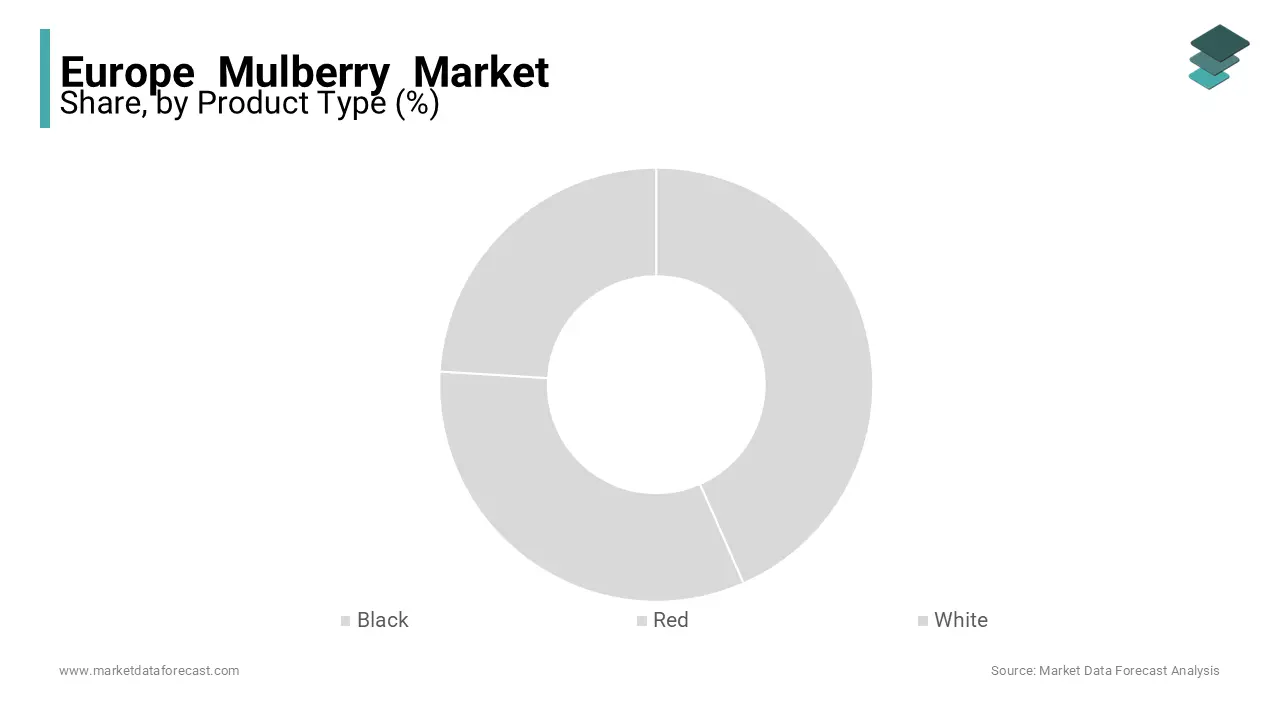
The white mulberry segment is likely to grow with an anticipated CAGR of 13.6% from 2026 to 2034, with its leaves in nutraceutical and herbal tea applications due to the presence of 1-deoxynojirimycin, a compound shown to modulate postprandial glucose levels. The European Commission authorized white mulberry leaf as a novel food in 2021, enabling its use in dietary supplements and functional beverages. Additionally, the leaf’s historical use in European sericulture is being revived in sustainable textile initiatives in Romania and Bulgaria, where mulberry plantations support ethical silk production.
By Nature Insights
The conventional segment was the largest and held a dominant share of the Europe mulberry market in 2025, with the most mulberry cultivation occurring in non-certified settings, including wild groves, backyard trees, and small orchards that do not pursue organic certification due to cost complexity or lack of awareness. The European organic regulation requires a two-year conversion period and rigorous documentation, which is impractical for low-volume producers. Furthermore, the majority of mulberries used in food processing for jams and liqueurs rely on conventionally sourced raw material due to consistent availability and lower price points.
The organic mulberry segment is expected to witness a CAGR of 15.2% in the coming years, with the surging consumer demand for certified organic ingredients in premium health food, cosmetics, and herbal products. In Switzerland and Denmark, over 65% of new natural supplement launches in 2023 featured organic botanicals, including mulberry leaf, as reported by the European Natural Products Association. Additionally, the Common Agricultural Policy’s Eco Schemes provide up to 300 euros per hectare in additional subsidies for certified organic fruit growers, incentivizing conversion. In Greece, organic mulberry orchards have doubled since 2021, supported by the Hellenic Organic Farming Network.
By Form Insights
The leaf extract segment was the largest and held 41.2% of the Europe mulberry market share in 202,4, with its central role in the nutraceutical and herbal medicine sectors, where standardized extracts deliver consistent concentrations of bioactive compounds such as 1-deoxynojirimycin. The European Directorate for the Quality of Medicines lists white mulberry leaf as a recognized herbal substance for traditional use in maintaining normal blood glucose levels, providing regulatory legitimacy. The extract’s solubility, stability, and compatibility with capsule tablets and liquid formulations make it ideal for mass production.
The dehydrated segment is projected to grow at a CAGR of 16.8% throughout the forecast period, with its versatility in clean-label food manufacturing and direct consumer use. Dehydration preserves the fruit’s anthocyanins and natural sweetness while extending shelf life to over 12 months without refrigeration, making it ideal for inclusion in muesli bars, breakfast cereals, plant-based snacks, and baking mixes. The process also aligns with EU food waste reduction goals by utilizing imperfect or surplus harvests that would otherwise spoil.
REGIONAL ANALYSIS
Italy Market Analysis
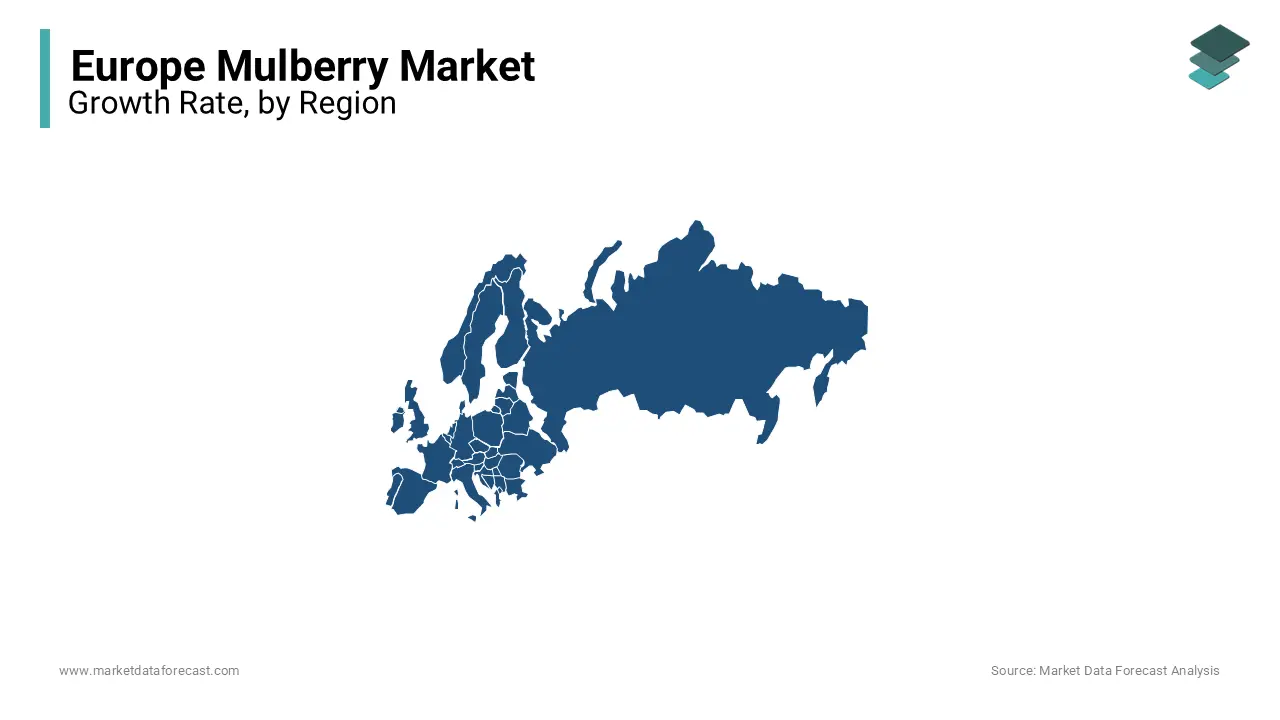
Italy was the largest contributor to the Europe mulberry market with a 24.5% share in 2025, with the old cultivation traditions particularly in Emilia Romagna, Apulia, and Sicily, where mulberry trees were historically planted for sericulture and remain integral to rural landscapes. Over 600 hectares of dedicated mulberry orchards are registered under the National Agricultural Register, with black mulberry being the primary variety for artisanal food production. Italy produces more than 1200 tons of fresh mulberries annually, most of which are processed into protected designation jams, liqueur, and syrups. The Ministry of Agricultural Food and Forestry Policies supports mulberry through its Quality Agricultural Production Program, which funds genetic conservation and value chain development.
Spain Market Analysis
Spain was positioned second by occupying 18.7% in 2025, owing to the favorable Mediterranean climatic conditions that support high-yielding mulberry cultivation, particularly in Andalusia, Extremadura, and Murcia.
France Market Analysis
The French mulberry market is likely to grow with prominent opportunities in next coming years. The country’s influence lies not in volume but in high-value applications in herbal medicine, natural cosmetics, and premium organic foods. The French Agency for Food, Environment, and Occupational Health and Safety has approved mulberry leaf for use in traditional herbal teas under strict quality controls.
COMPETITION OVERVIEW
The Europe mulberry market features a fragmented competitive landscape dominated by specialized botanical extract manufacturers, rs small-scale artisanal producers, and regional agro processors rather than large multinational food corporations. Competition is not based on price but on purity, standardization, organic certification, and scientific backing of health benefits. Leading companies differentiate through proprietary extraction methods, clinical data, and integration into high-value applications such as metabolic health supplements and natural cosmetics. The absence of mass cultivation means raw material sourcing is often localized and seasonal, prompting players to secure long-term contracts with farmers or invest in their own orchards. Regulatory navigation is critical as companies must comply with the EU novel food regulation, traditional herbal registration, and organic labeling rules simultaneously. New entrants face high barriers due to the need for analytical capabilities, agronomic knowledge, and established distribution in niche channels.
KEY MARKET PLAYERS
A few of the dominating players in the europe mulberry market include
- BioSpectrum
- Natural Factors
- Specialty Natural Products Co
- Pure Ingredients Ltd
- Geneham Pharmaceutical
- Zhejiang Wecan Bio.
Top Strategies Used by the Key Market Participants
Key players in the Europe mulberry market focus on scientific validation of bioactive compounds to support health claims and regulatory compliance. They prioritize organic certification and traceable supply chains to meet stringent EU consumer and retailer expectations. Companies invest in advanced extraction and drying technologies to preserve phytochemical integrity and extend shelf life. Strategic collaborations with research institutions and supplement brands enable the co-development of evidence-based products. Additionally, they diversify applications across nutraceuticals, natural cosmetics, and clean-label foods to mitigate dependence on a single sector. These approaches collectively enhance product differentiation, secure a premium position in, and build resilience in a niche yet growing botanical market shaped by health consciousness and sustainability mandates.
LEADING PLAYERS IN THE MARKET
Frutarom Industries Ltd (now part of International Flavors & Fragrances Inc)
Frutarom Industries has established a strong presence in the Europe mulberry market through its natural extracts and botanical ingredients division. The company sources mulberry fruit and leaf concentrates for use in functional food beverages and dietary supplements across European markets. It leverages its global supply chain to ensure consistent quality and traceability of raw materials while complying with EU novel food and botanical regulations. In recent years, Frutarom has invested in green extraction technologies to preserve anthocyanins and 1-deoxynojirimycin during processing. The company also collaborates with European research institutions to validate the health benefits of mulberry compounds, supporting science-based product development for its clients in the nutraceutical and natural food sectors throughout the region.
Indena S.p.A.
Indena S.p.A. is a leading Italian phytochemical company that plays a pivotal role in the Europe mulberry market by producing high-purity standardized extracts from white mulberry leaves. The company specializes in isolating and characterizing bioactive molecules such as 1-deoxynojirimycin for use in metabolic health supplements. Indena’s proprietary Phytosome technology enhances the bioavailability of mulberry compounds, making them more effective in clinical applications. Recently, the company expanded its analytical capabilities to meet the European Pharmacopeia standards for herbal substances and strengthened partnerships with German and French supplement brands.
Aromata Group
Aromata Group is a prominent European producer of natural plant extracts, including those derived from mulberry fruit and leaves. Headquartered in Italy, the company supplies dehydrated powder, liquid extract, and essential oil fractions to the food, cosmetic, and herbal medicine industries. The company recently upgraded its drying and extraction facilities in Tuscany to preserve thermolabile antioxidants in mulberry using low-temperature vacuum techniques.
RECENT HAPPENINGS IN THE MARKET
- In July 2023, Aromata Group inaugurated a dedicated organic mulberry processing line in its Tuscany facility, enabling production of dehydrated powder and liquid extracts compliant with EU organic standards for export to Germany and Scandinavia.
MARKET SEGMENTATION
This research report on the European mulberry market has been segmented and sub-segmented into the following categories.
By Product Type
- Black
- Red
- White
By Nature
- Organic
- Conventional
By Form
- Fruit
- Raw/Fresh
- Processed
- Frozen/Chilled
- Canned
- Dehydrated
- Pulp
- Leaves
- Leaf Extract
By End-Use
- Households
- Food Service
- Food Industry
- Bakery & Confectionary
- Convenience food
- Jams, jellies, and pickles
- Dressings, dips, and condiments
- Others (Frozen desserts, Snacks & Cereals)
- Infant formula
- Sports Nutrition
- Beverage Industry
- Dietary supplements
- Animal feed
- Pharmaceutical Industry
- Personal Care & Cosmetics
By Country
- UK
- France
- Spain
- Germany
- Italy
- Russia
- Sweden
- Denmark
- Switzerland
- Netherlands
- Turkey
- Czech Republic
- Rest of Europe
Access the study in MULTIPLE FORMATS
Purchase options starting from
$ 2000
Didn’t find what you’re looking for?
TALK TO OUR ANALYST TEAM
Need something within your budget?
NO WORRIES! WE GOT YOU COVERED!
Call us on: +1 888 702 9696 (U.S Toll Free)
Write to us: sales@marketdataforecast.com