- Product Description Description
- Table of Contents TOC
- List of Table & Figure LOT
- Get Free Sample PDF Sample PDF
Market Size, 2025
$12.77 BnMarket Estimate, 2026
$17.54 BnMarket Forecast, 2034
$222.01 BnCAGR, 2026–2034
37.34%Europe Natural Language Processing Market Report Summary
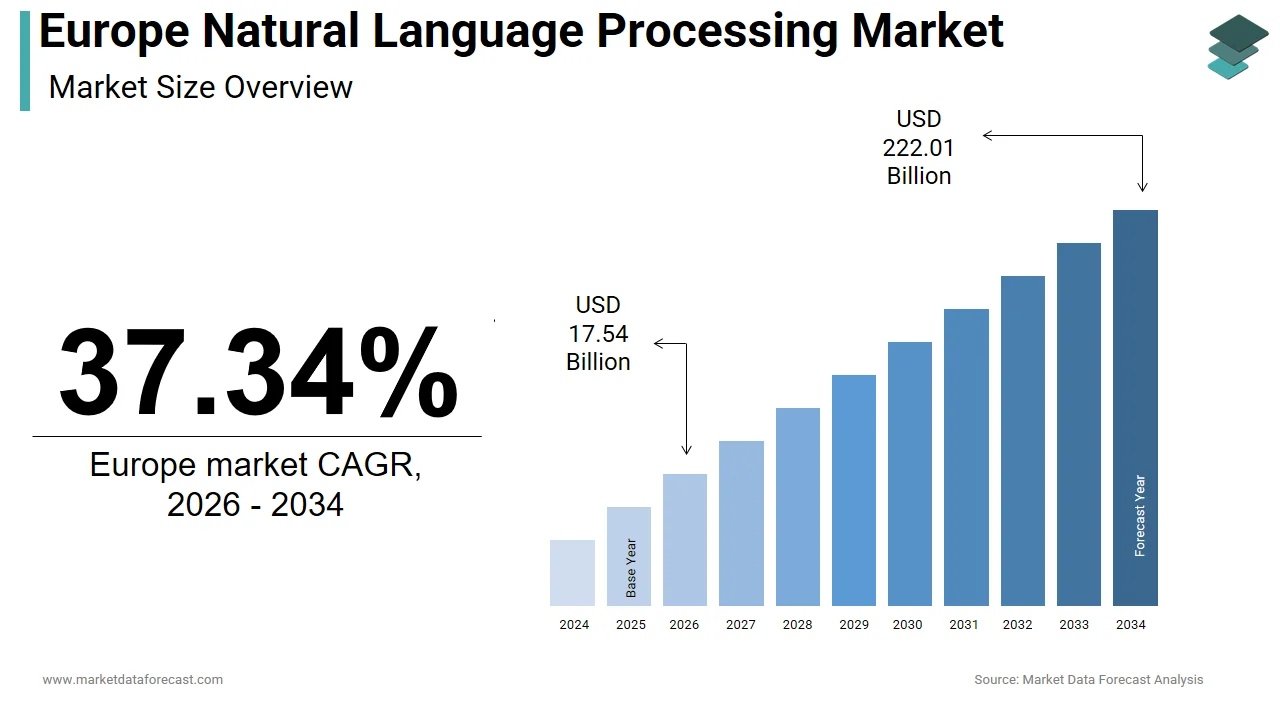
The Europe natural language processing (NLP) market was valued at USD 12.77 billion in 2025, is estimated to reach USD 17.54 billion in 2026, and is projected to reach USD 222.01 billion by 2034, growing at a CAGR of 37.34% during the forecast period from 2026 to 2034.
The growth of the European NLP market is driven by rising adoption of AI-powered automation, growing digitization of business processes, and increased demand for real-time data interpretation and language understanding solutions. Expanding use of NLP across BFSI, healthcare, retail, and government sectors, along with rapid innovation in speech recognition, text analytics, and generative AI, is further accelerating market expansion across the region.
Key Market Trends
- Rising adoption of AI-driven conversational interfaces such as chatbots and virtual assistants across enterprises.
- Increasing demand for multilingual NLP tools supporting Europe’s diverse linguistic landscape.
- Growing use of text analytics and sentiment analysis in marketing, compliance, and customer engagement.
- Integration of transformer-based language models (LLMs) and cloud NLP APIs to improve scalability and accuracy.
- Expanding healthcare and government AI initiatives leveraging NLP for document processing and voice data analysis.
Segmental Insights
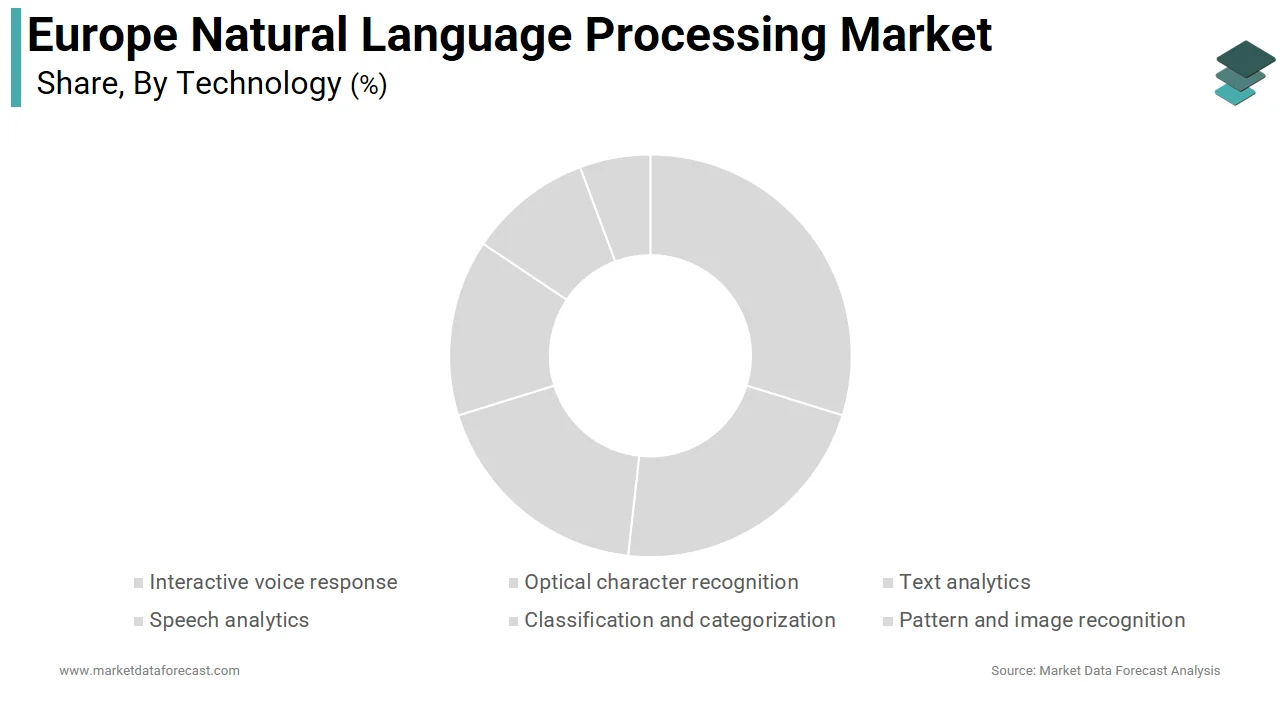
- Based on technology, the text analytics segment held the largest share of 32.4% of the Europe natural language processing market in 2024, driven by the growing need to extract actionable insights from unstructured textual data across sectors such as finance, healthcare, and e-commerce.
- Based on industry vertical, the BFSI segment led the Europe NLP market and captured a 28.1% share in 2024, owing to increasing adoption of AI for fraud detection, customer service automation, and regulatory compliance management.
- Based on enterprise size, the large enterprises segment was the largest in 2024, supported by higher investments in AI-driven analytics platforms, cloud infrastructure, and digital transformation strategies.
- Based on application, the sentiment analysis segment dominated the Europe NLP market, accounting for 29.8% of the market share in 2024, fueled by the rising need to analyze consumer opinions, brand perception, and customer feedback across social and digital platforms.
Regional Insights
The European natural language processing market is witnessing robust growth across major economies, driven by AI innovation, government-backed digitalization, and strong research capabilities.
- Germany stood as the top performer, accounting for a 22.3% share of the market in 2024, driven by its industrial AI adoption, enterprise automation, and R&D leadership in machine learning applications.
- The United Kingdom followed with an 18.7% share in 2024, supported by a thriving AI startup ecosystem, strong academic collaboration, and enterprise-led language AI deployment.
- France is another key market, supported by state-led digital sovereignty initiatives, EU AI framework participation, and leadership in voice and speech technology research.
Competitive Landscape
The European natural language processing market is highly competitive, with major players focusing on AI model advancement, multilingual capability, and strategic partnerships. Companies are investing in LLM-based applications, conversational AI, and cloud-based NLP platforms to strengthen their presence across key industries. Prominent players in the market include Spark Cognition, Inc., Conversica, Linguamatics, Narrative Science, SAP SE, Veritone Inc., SAS Institute Inc., Inbenta, Intel Corporation, IBM Corporation, Hewlett Packard Enterprise Development LP, Microsoft Corporation, Baidu, Inc., Amazon Web Services, Inc., Facebook, Inc., Apple, Inc., Bitext, Health Fidelity, Automated Insights, AI, Niki, Mihup, Al, Hyro, Just AI, and RaGaVeRa.
Europe Natural Language Processing Market Size
The size of the Europe natural language processing market was worth USD 12.77 billion in 2025. The regional market is anticipated to grow at a CAGR of 37.34% from 2026 to 2034 and be worth USD 222.01 billion by 2034 from USD 17.54 billion in 2026.
Natural language processing refers to the interdisciplinary domain where computational linguistics, machine learning, and artificial intelligence converge to enable machines to understand, generate, and respond to human language in a contextually meaningful manner. The European Union’s strong emphasis on digital sovereignty, multilingualism, and ethical AI has positioned the region as a unique ecosystem for NLP innovation. Unlike markets driven solely by commercial scale, Europe’s NLP landscape is shaped by regulatory frameworks such as the AI Act and the General Data Protection Regulation, which enforce stringent data usage and algorithmic transparency standards. According to the European Union, there are 24 official and working languages used across its institutions, which makes linguistic diversity a foundational challenge and opportunity for NLP systems. According to a 2024 Eurobarometer survey, 76% of Europeans think that improving language skills should be a policy priority, and 72% agree everyone should be able to speak more than one language in addition to their mother tongue, which fuels demand for multilingual NLP solutions. Apart from these, as per sources, the share of digital public services requiring natural language interaction rose in 2024, which emphasizes the operational necessity of robust language technologies across governmental and private sectors. This linguistic and regulatory complexity defines the Europe natural language processing market not merely as a commercial segment but as a sociotechnical infrastructure vital to digital inclusion and democratic engagement.
MARKET DRIVERS
Rising Demand for Multilingual AI Solutions in Public and Private Services
The necessity for multilingual natural language processing capabilities is intensifying in the region, which drives the growth of the Europe natural language processing market. This is due to the region’s inherent linguistic plurality and its policy commitments to inclusive digital access. The European Union recognizes 24 official languages and supports numerous regional and minority languages, which creates a structural imperative for language technologies that transcend monolingual English models. According to sources, there is a strong demand among the European populace for digital public services to be accessible in their native languages. This expectation has translated into concrete implementation mandates. The European Union is actively investing significant resources in the development of multilingual artificial intelligence (AI) infrastructure. In the private sector, customer experience demands are equally pressing. As per studies, consumers across the EU exhibit a clear preference for engaging in e-commerce using their primary language, which draws attention to the commercial benefits of removing language barriers in online transactions. Banking, healthcare, and e-government platforms increasingly integrate multilingual chatbots and voice assistants, where NLP models must handle code-switching, dialectal variation, and low-resource languages. Consequently, the technical requirement for high accuracy across diverse languages, particularly for morphologically complex ones like Finnish or Hungarian, compels sustained investment in Europe-specific NLP research and development, thereby driving market expansion through functional necessity rather than optional enhancement.
Accelerated Integration of NLP in Regulated Sectors such as Healthcare and Finance
The integration of NLP in the region's highly regulated sectors, notably healthcare and financial services, advances rapidly and propels the expansion of the Europe natural language processing market. This is because of both operational pressures and compliance imperatives. In healthcare, the European Health Data Space initiative promotes secondary use of clinical notes for research and policy making, which necessitates NLP for structured data extraction from unstructured physician narratives. Moreover, national health systems in Germany, France, and the Netherlands have piloted NLP tools to automate coding of diagnoses, monitor adverse drug reactions, and support clinical decision making. In parallel, the European Banking Authority has emphasized the need for enhanced transaction monitoring and customer communication analysis. NLP systems are now deployed to parse narrative field data in payment messages, identify typographical obfuscation, and classify customer inquiries in real time. Importantly, these applications must comply with strict interpretability standards under the EU AI Act, which classifies many NLP uses in these sectors as high risk. This regulatory alignment paradoxically fuels adoption as institutions seek certified NLP solutions that satisfy both efficiency and auditability requirements, thereby creating a demand vector distinct from markets with lighter oversight.
MARKET RESTRAINTS
Persistent Shortage of High-Quality European Language Training Data
The chronic scarcity of large-scale annotated datasets in non-English European languages, particularly for specialized domains, is one of the key restraints to the Europe natural language processing market. English enjoys abundant open-source linguistic data, whereas languages like Estonian, Maltese, and Slovenian lack the necessary comparable resources for training effective, context-aware models. This deficit is exacerbated in sectors like legal and biomedical domains, where even major languages like German or Italian have limited publicly available labeled datasets due to privacy and copyright constraints. Moreover, many European NLP developers resort to cross-lingual transfer learning, which often underperforms for morphologically rich or low-resource languages. This data bottleneck not only impedes model accuracy but also delays deployment timelines and increases costs as organizations must commission expensive custom annotation efforts. The absence of a unified European data space for language resources, despite initiatives like the European Open Science Cloud, further fragments efforts and prevents economies of scale. The region's NLP capabilities will be unequally distributed, which favours English and a handful of dominant languages and sidelining others, unless public-private investment in multilingual data infrastructure is coordinated.
Fragmented Regulatory Landscape Across Member States
A fragmented regulatory environment varies significantly across member states, particularly concerning data usage, algorithmic accountability, and sector-specific AI deployment, constraining the expansion of the Europe natural language processing market. A key challenge for the EU AI Act's harmonised framework is that its implementation relies on national authorities whose interpretation of the rules and capacity for enforcement are inconsistent across the Union. The regulatory ambiguity increases compliance costs for NLP vendors, who must navigate divergent national interpretations of lawful data processing, purpose limitation, and human oversight. In Germany, for instance, the Federal Data Protection Act imposes stricter consent requirements for voice data than the GDPR baseline, while France’s data watchdog has issued specific guidance on the use of generative AI in public services that other states do not replicate. Moreover, sectoral regulators, such as health data agencies or financial supervisors, often issue overlapping or conflicting technical standards. Such fragmentation not only stifles cross-border scalability but also discourages startups from entering the market due to unpredictable legal risk, and thereby constraining innovation and competition in Europe’s NLP ecosystem.
MARKET OPPORTUNITIES
Expansion of Sovereign AI Infrastructure Under the EuroHPC Initiative
The emergence of Europe’s sovereign AI infrastructure, spearheaded by the EuroHPC Joint Undertaking, creates an opportunity for the Europe natural language processing market. This is driven by enabling localized, secure, and ethically aligned model development. Unlike reliance on foreign cloud platforms, European institutions and enterprises can now access high-performance computing systems such as LUMI in Finland and MareNostrum in Spain, which are optimized for training large language models on European data under European governance. This infrastructure supports the European Language Grid and the upcoming European AI Factory, which aim to provide open yet compliant environments for training multilingual NLP models. Importantly, these systems operate under strict data residency and algorithmic transparency protocols, ensuring adherence to the General Data Protection Regulation and the AI Act. Europe can reduce its vulnerability to geopolitical risks by training models within its own borders. This approach would also create a self-sustaining cycle of natural language processing (NLP) innovation within Europe. This shift toward computational sovereignty thus creates a fertile ground for next-generation NLP applications that are both technically advanced and institutionally trusted.
Growing Adoption of AI Literacy Programs in Public Education Systems
The region's systematic investment in AI and digital literacy across national education curricula is cultivating a new generation of users, developers, and regulators who understand the capabilities and limitations of NLP, which is setting up fresh prospects for the expansion of the European natural language processing market. This foundational shift is creating long-term demand for transparent, interpretable, and pedagogically integrated NLP tools in schools, universities, and vocational training centers. These programs not only normalize human-language AI interaction from an early age but also generate valuable usage data that can inform the design of education-specific NLP models. The institutional embedding ensures sustained demand for NLP solutions that align with pedagogical goals, accessibility standards, and child data protection norms. Moreover, it builds public trust by demystifying AI and fostering critical engagement with language models, and thereby creating a social license for broader NLP adoption in civic and commercial contexts.
MARKET CHALLENGES
High Computational Costs of Training Multilingual Language Models
The exorbitant computational expense associated with training large multilingual language models that meet the region’s linguistic and regulatory standards is one of the major challenges in the Europe natural language processing market. Unlike English-centric models that benefit from economies of scale, European NLP systems must accommodate dozens of languages with varying syntactic complexity, data availability, and domain specificity, which multiplies training time and energy consumption. This energy intensity conflicts with the European Green Deal’s objective of climate neutrality by 2050 and triggers scrutiny under the Energy Efficiency Directive. Moreover, the cost barrier is prohibitive for small and medium enterprises. European firms are hesitant to use US-hosted cloud platforms offering high-performance GPU resources because of strict data sovereignty concerns. This forces them to rely on less-efficient domestic infrastructure, ultimately increasing costs and prolonging AI training durations. The lack of standardized model compression or distillation frameworks for low-resource European languages exacerbates inefficiencies. The financial and environmental costs of multilingual NLP development, currently only affordable for a few well-funded organizations due to a lack of shared resources, will impede the EU’s goal of inclusive AI innovation.
Bias and Fairness Gaps in Language Models Trained on Non-Representative Data
The systemic biases embedded in language models fail to reflect the continent’s demographic and linguistic diversity, which leads to discriminatory outcomes in high-stakes applications and obstructs the expansion of the Europe natural language processing market. Most publicly available NLP models are trained on web-crawled data that overrepresents dominant languages and urban populations while underrepresenting rural communities, migrants, and speakers of minority languages. In judicial settings, where NLP is used to summarize case files or transcribe hearings, the risk is even more acute. These gaps persist because benchmark datasets like XNLI or MLSum are skewed toward news and Wikipedia content, which poorly capture colloquial speech, legal jargon, or healthcare dialogues in multilingual contexts. The EU AI Act requires high-risk systems to undergo bias testing, yet a common European standard for multilingual fairness evaluation remains undefined. Consequently, developers often deploy models that perform adequately in lab settings but fail in real-world multicultural environments, which affects public trust and exposes organizations to legal liability under the EU’s non-discrimination directives.
REPORT COVERAGE
| REPORT METRIC | DETAILS |
| Market Size Available | 2025 to 2034 |
| Base Year | 2025 |
| Forecast Period | 2026 to 2034 |
| Segments Covered | By Technology, Industry Vertical, Enterprise Size, Type, Deployment, Component, Application, and Country. |
| Various Analyses Covered | Global, Regional and Country-Level Analysis, Segment-Level Analysis, Drivers, Restraints, Opportunities, Challenges; PESTLE Analysis; Porter’s Five Forces Analysis, Competitive Landscape, Analyst Overview of Investment Opportunities |
| Countries Covered | UK, France, Spain, Germany, Italy, Russia, Sweden, Denmark, Switzerland, Netherlands, Turkey, Czech Republic, and the Rest of Europe. |
| Market Leaders Profiled | Spark Cognition, Inc., Conversica, Linguamatics, Narrative Science, SAP SE, Veritone Inc., SAS Institute Inc., Inbenta, Intel Corporation, IBM Corporation, Hewlett Packard Enterprise Development LP, Microsoft Corporation, Baidu, Inc., Amazon Web Services, Inc., Facebook, Inc., Apple, Inc., Bitext, Health Fidelity, Automated Insights, AI, Niki, Mihup, Al, Hyro, Just AI, and RaGaVeRa. |
SEGMENTAL ANALYSIS
By Technology Insights
The text analytics segment held the largest share of 32.4% of the Europe natural language processing market in 2024. Factors such as the exponential growth in enterprise-generated textual data and its foundational role in extracting actionable insights from unstructured written content across sectors have significantly contributed to the supremacy of the text analytics segment. According to studies, European businesses are producing a rapidly increasing volume of digital data, with a significant proportion consisting of unstructured formats such as emails, reports, and social media posts. This volume necessitates automated semantic analysis for compliance, customer intelligence, and operational efficiency. Apart from these, regulatory alignment also adds to the growth of this segment. Similarly, in healthcare, the European Medicines Agency mandates pharmacovigilance systems to analyze adverse event narratives from clinical trials and patient forums, tasks impossible without robust text analytics engines. The technology’s maturity, interoperability with legacy enterprise systems, and adaptability to multilingual contexts further cement its dominance. Unlike speech or image-based technologies, text analytics requires less specialized hardware and integrates seamlessly with existing digital infrastructures, enabling rapid adoption even among public sector bodies bound by procurement constraints.
The speech analytics segment is predicted to witness the highest CAGR of 21.7% from 2025 to 2033 due to surging demand for voice-enabled customer service and voice-driven public interfaces. A further core growth factor is the region’s aging population. According to Eurostat projections, approximately 23 percent of the EU population (EU-27) will be aged 65 or older by 2030 (up from around 21% in 2023). The drive for efficiency and the promise of AI are leading national helplines in the EU to explore and adopt automated solutions, including automated transcription and intent classification, for managing their heavy call volumes. The EU’s push for inclusive digital public services is another accelerator of this segment. As per the European Commission’s Digital Decade Policy Programme, all member states must ensure 100 percent online accessibility of critical public services by 2030, in compliance with the Web Accessibility Directive and the European Accessibility Act, which promote various accessible formats for persons with disabilities. This has triggered widespread deployment of speech analytics in tax offices, immigration departments, and healthcare appointment systems. Importantly, recent advances in transformer-based acoustic models have reduced word error rates in low-resource European languages, which makes real-time voice analysis viable even for Catalan or Latvian. These technical and demographic tailwinds position speech analytics not merely as a customer service enhancement but as a societal infrastructure imperative.
By Industry Vertical Insights
The BFSI segment led the Europe natural language processing market and captured a 28.1% share in 2024. Stringent regulatory mandates and high volumes of customer interaction requiring linguistic interpretation are among the key reasons behind the growth of the BFSI segment. In addition, the escalating complexity of financial compliance also contributes to the growth of this segment in the regional market. NLP-powered text and speech analytics automate this labour-intensive task while ensuring audit trails. A different factor driving the expansion of this segment is Customer experience transformation. As per sources, a notable share of EU retail banks use NLP-driven chatbots for mortgage inquiries, fraud alerts, and investment advice, which reduces call center costs. Importantly, the EU AI Act classifies many BFSI NLP applications as high risk, which paradoxically accelerates adoption as firms seek certified, explainable systems to avoid penalties. Unlike other sectors, BFSI possesses the data maturity, governance frameworks, and capital to deploy enterprise-grade NLP at scale, which makes it the natural vanguard of market penetration.
The healthcare segment is estimated to register the fastest CAGR of 23.4% during the forecast period due to systemic pressures to digitize clinical workflows and personalize patient engagement. The implementation of the European Health Data Space (EHDS) Regulation is driving the need for advanced Natural Language Processing (NLP) solutions to effectively extract and standardize insights from the vast amount of unstructured narrative text in electronic health records for secondary uses like research and policy-making, as per research. NLP tools that extract diagnoses, medications, and symptoms from physician notes are thus essential for data interoperability. Moreover, telemedicine expansion further propels the growth of this segment. According to sources, the significant increase in the adoption of virtual consultations across the EU is accelerating the demand for sophisticated NLP technologies, such as speech recognition and multilingual language models, to facilitate efficient communication, streamline clinical documentation, and analyze patient sentiment from audio and textual data. National health services in the Netherlands and Sweden integrate NLP into triage systems that analyze patient descriptions of symptoms to prioritize care pathways. NLP’s role in alleviating cognitive burden and improving diagnostic accuracy ensures its accelerated adoption.
By Enterprise Size Insights
The large enterprises segment was the largest in the Europe natural language processing market in 2025. The prominence of the large enterprises segment is attributed to their capacity to absorb high implementation costs, manage regulatory complexity, and deploy integrated AI stacks. A further driver of this segment is their obligation under EU law to conduct algorithmic impact assessments for high-risk AI systems, as stipulated by the AI Act, requiring sophisticated NLP governance frameworks that only large organizations can sustain. According to studies, only a portion of small firms possess the internal compliance expertise to navigate such requirements, whereas nearly all Fortune 500 European subsidiaries have established AI ethics boards. A different aspect contributing to the expansion of this segment is data scale. Global banks, automakers, and telecom operators operate multilingual contact centers processing millions of interactions daily, which necessitates NLP for real-time sentiment tracking, compliance logging, and workflow automation. Their centralized IT procurement also enables long-term licensing agreements with major NLP vendors, unlike fragmented SME buying behavior. Thus, market dominance is not due to preference but because of structural capability.
The small enterprises segment is anticipated to witness the fastest CAGR of 25.1% from 2025 to 2033, owing to the proliferation of affordable cloud-based NLP APIs and sector-specific no-code platforms. An important enabler is the European Commission’s strategy for a sustainable and digital Europe, which allocated funds to subsidize AI adoption among businesses with fewer than 50 employees. The rise of AI-powered administrative assistants also drives the growth of this segment. According to a study, a percentage of small professional services firms in Spain and Italy use NLP to automate invoice processing, contract clause review, and GDPR consent management. These tools eliminate the need for dedicated data scientists.
By Application Insights
The sentiment analysis segment dominated the Europe natural language processing market and occupied a share of 29.8% in 2024. The dominance of the sentiment analysis segment is propelled by its pivotal role in brand governance, regulatory monitoring, and public opinion tracking. A different factor driving the growth of this segment is the EU’s Digital Services Act, which obligates online platforms to detect and mitigate systemic disinformation and hate speech. The competitive intensity in retail and financial services also contributes to the expansion of this segment. National statistical institutes incorporate social media sentiment indices into official economic sentiment indicators by formalizing their macroeconomic relevance. Unlike niche applications such as language scoring, sentiment analysis offers immediate ROI through churn prediction, campaign tuning, and crisis detection, which makes it the default entry point for NLP adoption across industries.
The risk and threat detection segment is likely to experience the fastest CAGR of 24.6% from 2025 to 2033 due to factors such as converging pressures from cybersecurity regulation, financial crime enforcement, and geopolitical instability. As per the European Union Agency for Cybersecurity, there has been a substantial increase in the sharing of cyber threat indicators across the EU's CSIRTs network, with the vast majority of these indicators requiring natural language processing (NLP) for effective contextual analysis. Simultaneously, the European Public Prosecutor's Office (EPPO) observes a growing prevalence of cross-border fraud cases involving complex deceptive communications and forged documents, indicating an increasing need for advanced text analysis tools like NLP to manage the rising caseload and associated data. Another key reason behind the growth of this segment is internal corporate governance. According to sources, there is a clear shift toward widespread adoption of NLP by large EU firms to monitor internal communications, which aids in the detection of potential instances of insider trading or harassment signals as part of their corporate governance and compliance efforts. Thus, NLP’s capacity to detect coordinated inauthentic behavior in multiple languages has elevated this application from an operational tool to a strategic asset.
COUNTRY LEVEL ANALYSIS
Germany Natural Language Processing Market Analysis
Germany stood as the top performer in the Europe natural language processing market and accounted for a 22.3% share in 2024. The domination of the German market is primarily driven by its industrial base, digital public services, and robust AI research ecosystem. The country’s supremacy is also because of its dual focus on Industry 4.0 integration and multilingual public administration. According to research, manufacturing firms in Germany's Mittelstand segment are actively integrating NLP solutions, particularly for analyzing maintenance logs and improving supply chain communication. Government agencies, such as the Federal Employment Agency, leverage NLP systems to efficiently process large volumes of diverse-language documentation, including job applications. Germany leads the regional landscape in Natural Language Processing (NLP) by merging foundational research from institutions with innovative ethical design practices shaped by its strict adherence to GDPR. This combination of scale, compliance, and innovation allows Germany to dominate the field.
United Kingdom Natural Language Processing Market Analysis
The United Kingdom maintains a strong position after Germany in the Europe natural language processing market and held an 18.7% share in 2024. Its world-class fintech sector, academic excellence, and agile regulatory sandbox are fuelling the demand for NPL in the UK. Furthermore, the Alan Turing Institute leads cross-institutional efforts to build open multilingual benchmarks for low-resource British regional languages. The UK's principle-based AI governance, though distinct from the binding EU AI Act, utilizes existing high standards like the retained GDPR framework to foster rapid innovation and commercialization compared to its continental counterparts.
France Natural Language Processing Market Analysis
France is another key player in the Europe natural language processing market, with strong state-led digital sovereignty initiatives and leadership in voice and speech technologies. The French government is prioritizing and significantly investing in the development of sovereign language artificial intelligence as a strategic goal. France is increasingly making advanced computing resources and large language models for French and regional languages available to public and private entities to foster trusted AI solutions. France’s dominance in speech analytics is further supported by companies like Speechmatics and VocalZoom critical for global telcos and banks. This fusion of national strategy, linguistic outreach, and public sector demand solidifies France’s technological and market influence.
Netherlands Natural Language Processing Market Analysis
The Netherlands saw steady growth in the Europe natural language processing market owing to its advanced digital government infrastructure, multilingual logistics networks, and progressive data governance. As per sources, most Dutch citizens interact with public services online, with NLP systems handling queries in Dutch, English, German, and Turkish across tax, immigration, and healthcare portals. Dutch universities like the University of Amsterdam lead the European Language Grid’s annotation efforts for low-resource languages, while the country’s strict yet pragmatic interpretation of the GDPR has made it a testing ground for compliant NLP solutions. According to research, a share of US and Asian AI firms establishing EU operations choose the Netherlands as their base due to its English proficiency, data connectivity, and regulatory clarity, which further accelerates NLP ecosystem growth.
Sweden Natural Language Processing Market Analysis
Sweden is predicted to grow in the Europe natural language processing market from 2025 to 2033 due to its innovation-driven welfare state, climate tech integration, and early adoption of ethical AI frameworks. The country’s prominence in green tech also extends to NLP, with firms like Einride and Northvolt deploying language models to parse sustainability reports and compliance documents under the EU Taxonomy Regulation. This blend of social purpose and technical rigor ensures Sweden’s outsized influence relative to its population size.
COMPETITIVE LANDSCAPE
Competition in the Europe natural language processing market is characterized by a dynamic interplay between global technology giants, European enterprise software leaders, and specialized AI startups. Unlike other regions where scale and data access dominate the landscape, Europe’s competitive differentiator is adherence to regulatory and ethical standards. Companies must navigate the EU AI Act’s risk-based requirement, General Data Protection Regulation constraints, and multilingual complexity, which elevates the importance of localization over raw algorithmic performance. This environment fosters collaboration between public research bodies and private firms to build trusted language infrastructures. While US-based hyperscalers lead in foundational model innovation, European players excel in domain integration and compliance-ready deployment. The market rewards solutions that balance technical accuracy with transparency, linguistic inclusivity, and data sovereignty, resulting in a fragmented yet highly specialized competitive ecosystem that prioritizes societal alignment over pure commercial velocity.
KEY MARKET PLAYERS
Some of the companies that are playing a dominating role in the Europe natural language processing market include
- Spark Cognition, Inc
- Conversica
- Linguamatics
- Narrative science
- SAP SE
- Veritone Inc.
- SAS Institute Inc.
- Inbenta
- Intel Corporation
- IBM Corporation
- Hewlett Packard Enterprise Development LP
- Microsoft Corporation
- Biadu, Inc
- Amazon Web Services, Inc
- Facebook, Inc
- Apple, Inc
- Bitext
- Health Fidelity
- Linguamatics
- Automated Insights
- Gnani.ai
- Niki
- Mihup
- Observe.Al
- Hyro
- Just Al
- RaGaVeRa
TOP PLAYERS IN THE MARKET
- Natural language processing market maintains a pivotal role in the Europe natural language processing market through its advanced language models and cloud-based AI services. The company’s Natural Language API and Dialogflow platform are widely adopted across European public and private sectors for sentiment analysis, multilingual chatbots, and document processing. In recent years Natural language processing market has invested heavily in EU-based AI research hubs, including the Natural Language Processing Market AI Zurich lab, which focuses on multilingual and low-resource language modeling. The company also collaborates with European universities and adheres to the EU AI Act framework by enhancing model explainability and data provenance features. These initiatives reinforce its commitment to ethical, compliant, and localized NLP solutions tailored to Europe’s regulatory and linguistic landscape.
- Microsoft significantly influences the Europe natural language processing market via Azure Cognitive Services and its integration of large language models into enterprise workflows. Its Azure AI platform supports multilingual text analytics and speech recognition across all 24 EU official languages. Microsoft has deepened its European footprint by establishing sovereign cloud regions in Germany, France, and Sweden, ensuring data residency and regulatory compliance. Recently, the company launched the Azure AI Studio with built-in bias detection and GDPR aligned data handling to meet stringent EU requirements. Partnerships with national health services and financial regulators further demonstrate its proactive alignment with Europe’s public sector digital transformation and secure AI deployment priorities.
- SAP plays a distinctive role in Europe’s natural language processing market by embedding NLP capabilities directly into its enterprise resource planning and customer experience suites. Its Joule Copilot leverages generative AI to enable natural language querying of business data across finance, supply chain, and HR modules. Tailored for European multilingual environments, SAP supports real-time translation and intent recognition in languages like Dutch, Finnish, and Polish. The company recently enhanced its Responsible AI framework with language-specific fairness metrics and on-premises deployment options to address data sovereignty concerns. Collaborations with the European Language Grid and participation in Horizon Europe-funded projects underscore SAP’s commitment to building linguistically inclusive and regulatorily compliant NLP solutions for European enterprises.
TOP STRATEGIES USED BY THE KEY MARKET PARTICIPANTS
Key players in the Europe natural language processing market primarily adopt strategies centered on regulatory alignment, multilingual model development, strategic partnerships, and localized infrastructure investment. Firms prioritize compliance with the EU AI Act and General Data Protection Regulation by embedding transparency, auditability, and data minimization into their NLP architectures. They invest in training language models on region-specific corpora to support low-resource and morphologically complex European languages. Cloud hyperscalers establish sovereign AI zones within EU member states to ensure data residency while enterprise software vendors integrate NLP into core business applications to drive embedded adoption. Additionally, companies collaborate with academic institutions and public agencies to co-develop ethical benchmarks and domain-specific annotation standards that reflect European societal values and linguistic diversity.
MARKET SEGMENTATION
This research report on the Europe natural language processing market has been segmented and sub-segmented into the following categories.
By Technology
- Interactive voice response
- Optical character recognition
- Text analytics
- Speech analytics
- Classification and categorization
- Pattern and image recognition
- Ohers (Coding, Professional services, etc)
By Industry Vertical
- Manufacturing
- Advertising and media
- Automotive and transportation
- Banking, financial services, and insurance (BFSI)
- High tech and telecom
- Energy utilities
- Government and public sector
- Education
- Transport and logistics
- Retail and e-commerce
- Healthcare
By Enterprise size
- Small Enterprises
- Medium-sized enterprises
- Large enterprises
By Type
- Rule-based
- Statistical
- Hybrid
By Deployment
- On premises
- Cloud (Public cloud and private cloud)
- Hybrid
By Component
- Solutions
- Platform
- Software tools
- Services
- Professional Services
- Consulting
- System integration and implementation
- Support and maintenance
- Managed Services
- Professional Services
By Application
- Language scoring
- Content management
- Automatic summarization
- Risk and threat detection
- Data extraction
- Sentiment analysis
- Others (HR and Recruiting branding, advertising, portfolio monitoring)
By Country
- United Kingdom
- France
- Spain
- Germany
- Italy
- Russia
- Sweden
- Denmark
- Switzerland
- Netherlands
- Rest of Europe