- Product Description Description
- Table of Contents TOC
- List of Table & Figure LOT
- Get Free Sample PDF Sample PDF
Market Size, 2025
$2,282.58 BnMarket Estimate, 2026
$2,715.81 BnMarket Forecast, 2034
$10,907 BnCAGR, 2026–2034
18.98%Europe Neuromorphic Computing Market Summary
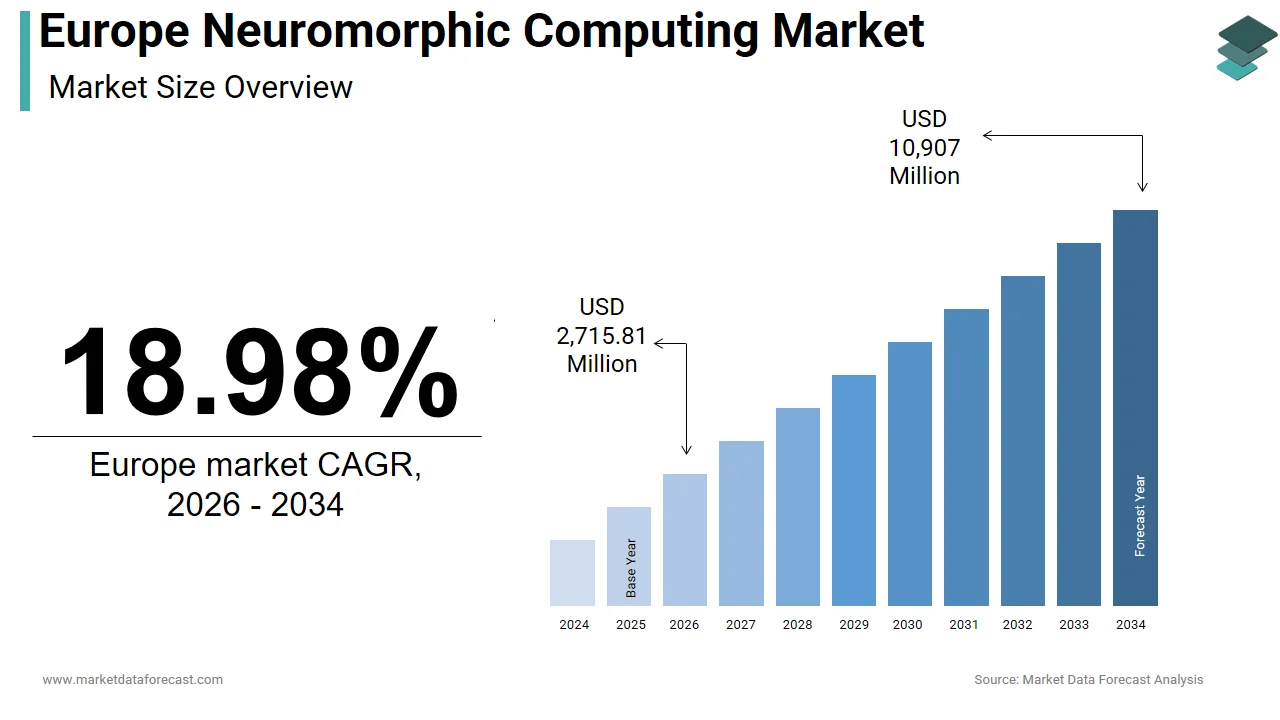
The Europe neuromorphic computing market was valued at USD 2,282.58 million in 2025, is estimated to reach USD 2,715.81 million in 2026, and is projected to reach USD 10,907 million by 2034, growing at a CAGR of 18.98% from 2026 to 2034.
Market Size & Growth Projections:
- 2025 Market Size: USD 2,282.58 million
- 2026 Market Size: USD 2,715.81 million
- Projected Market Size: USD 10,907 million by 2034
- Growth Forecasts: 18.98% CAGR (2026 to 2034)
Key Regional Dynamics:
- Largest Region: Germany
- Fastest Growing Region: Switzerland and Netherlands
- Dominating Countries: Germany, France, United Kingdom
- Emerging Countries: Netherlands, Sweden, Denmark
Key Europe Neuromorphic Computing Market Insights:
Regional Highlights:
- Germany neuromorphic computing market accounted for 27.4% share in 2024, driven by automotive autonomy, industrial automation, and strong non-von Neumann R&D funding.
- France market will secure the second largest share, supported by defense, aerospace, and sovereign AI initiatives.
Segment Insights:
- The signal processing segment in the neuromorphic computing market held the highest market share in 2025, driven by event-based, real-time data processing efficiency.
- The image recognition segment in the neuromorphic computing market is projected to achieve the fastest growth during 2025–2033, fueled by adoption in robotics and autonomous systems.
Key Growth Trends:
- Integration of neuromorphic computing into edge AI and real-time autonomous systems
- EU focus on energy-efficient and ethical AI architectures
Major Challenges:
- Lack of standardized development tools and software frameworks
- High fabrication costs and limited neuromorphic-ready semiconductor infrastructure
Key Players:
Intel Corporation, IBM Corporation, BrainChip Holdings Ltd., Prophesee, Qualcomm, General Vision Inc., GrAI Matter Labs, Innatera Nanosystems, SynSense AG, Samsung Electronics Co. Ltd., SK Hynix Inc.
Europe Neuromorphic Computing Market Size
The Europe neuromorphic computing market was valued at USD 2,282.58 million in 2025, is estimated to reach USD 2,715.81 million in 2026, and is projected to reach USD 10,907 million by 2034, growing at a CAGR of 18.98% from 2026 to 2034.
Neuromorphic computing is the design and deployment of hardware and software systems that emulate the architecture and functionality of the human brain, utilizing spiking neural networks and event-driven processing to achieve ultra-low power consumption and real-time cognitive capabilities. Unlike traditional von Neumann architectures, neuromorphic chips process data only when necessary, enabling efficiencies critical for edge AI, robotics, and adaptive sensing. The European Union has positioned neuromorphic engineering as a strategic priority within its broader digital and research agenda, which is embedding brain‑inspired computing into both the Digital Europe Programme and Horizon Europe. Funding streams across these frameworks collectively support a growing portfolio of neuromorphic research, including flagship hubs such as the Human Brain Project and IMEC in Belgium, a leader in 300‑millimeter wafer‑scale neuromorphic fabrication. Europe now hosts dozens of academic and industrial initiatives spanning autonomous navigation, edge AI, robotics, and low‑power medical diagnostics, reflecting a rapidly maturing innovation landscape. This ecosystem positions neuromorphic computing not as a speculative frontier but as an emerging pillar of Europe’s sovereign, sustainable, and human‑centric digital future.
MARKET DRIVERS
Integration into Edge AI and Real-Time Autonomous Systems
The demand for ultra-efficient, low-latency processing in robotics, industrial automation, and smart infrastructure is accelerating the adoption of neuromorphic computing across Europe, which is fuelling the European neuromorphic computing market growth. Traditional AI systems struggle with power and response time constraints in edge environments. According to published evaluations from European research institutions, neuromorphic processors can operate at power levels far below conventional GPU-based systems, enabling deployment in constrained environments. This efficiency is critical for European industries pursuing green digital transformation. In automotive, German OEMs are testing neuromorphic vision sensors for pedestrian detection that react in under 10 milliseconds, as documented by the German Aerospace Center’s autonomous mobility division. Similarly, ABB and Siemens are piloting neuromorphic controllers in factory robots that adapt grip strength in real time using tactile feedback, reducing energy use per cycle in internal trials. As per the European Robotics Forum, a growing share of advanced manufacturing firms are evaluating neuromorphic solutions for predictive maintenance and anomaly detection, which reflects rising industrial interest. This convergence of energy efficiency, real-time responsiveness, and industrial decarbonization mandates creates a compelling use case beyond laboratory experimentation.
EU Strategic Autonomy and Ethical AI Governance Frameworks
Europe’s push for technological sovereignty and human-centred AI provides a unique policy tailwind for neuromorphic computing development. The EU AI Act, fully applicable from 2025, prioritizes transparency, energy efficiency, and data minimization as these principles are inherently aligned with neuromorphic architectures that process sparse, event-based data without continuous surveillance. Unlike cloud-based deep learning models that require massive datasets, neuromorphic systems learn from minimal examples, which reduces privacy risks and computational footprints. The European Commission’s 2023 White Paper on Neuromorphic Technologies explicitly links brain-inspired computing to the bloc’s strategic autonomy in semiconductors and AI, noting that such systems could reduce Europe’s reliance on imported high-power AI accelerators. National initiatives reinforce this: France’s Plan Quantique includes neuromorphic co-processing, while, as per the Federal Ministry for Economic Affairs and Climate Action, Germany’s semiconductor programs allocate funding for non-von Neumann architectures, supporting long-term R&D. Additionally, the European High Performance Computing Joint Undertaking has deployed neuromorphic testbeds in several supercomputing centers, enabling SMEs to experiment without capital outlay. This policy ecosystem, combining ethics, sustainability, and sovereignty, creates a protected innovation corridor unmatched in other regions.
MARKET RESTRAINTS
Immature Ecosystem and Lack of Standardized Development Tools
The Europe neuromorphic computing market faces significant constraints due to the absence of mature software frameworks, programming languages, and interoperability standards. Unlike conventional AI, which benefits from TensorFlow and PyTorch, neuromorphic development relies on fragmented, research-oriented tools such as NEST, Brian2, and Lava, with each tied to specific hardware platforms. According to a 2024 survey by the European Neural Microelectronics Platform, a majority of industrial developers cite toolchain complexity as a major barrier to adoption, which indicates the immaturity of the ecosystem. Converting standard deep learning models to spiking neural networks remains non-trivial, often requiring manual retraining and performance validation. Furthermore, there is no universal benchmark for comparing neuromorphic chips, making procurement decisions subjective. While Intel’s Lava framework and IMEC’s NeuroSeeker aim to unify development, adoption is slow outside academia. This software gap disproportionately affects small and medium enterprises lacking dedicated AI research teams, which is limiting neuromorphic deployment to pilot projects rather than scalable integration. Without coordinated EU action on open standards and developer training, the market risks remaining confined to elite research labs.
High Fabrication Costs and Limited European Semiconductor Infrastructure
Neuromorphic chips require specialized semiconductor processes that are scarce within Europe’s current fabrication landscape, which is creating supply chain vulnerability and cost inefficiencies and further hampering the expansion of the European neuromorphic computing market. Most advanced neuromorphic prototypes, such as those from Heidelberg University’s BrainScaleS or University of Manchester’s SpiNNaker2, are fabricated on legacy nodes (65 to 180 nanometres) due to incompatibility with standard CMOS lines, yet these older fabs are being phased out globally. Europe has only two major semiconductor foundries capable of custom analogue mixed signal production: X FAB in Germany and STMicroelectronics in France and Italy. Neither offers dedicated neuromorphic process design kits at scale. According to the European Chips Joint Undertaking, prototyping costs for specialized chips in Europe remain significantly higher than in Asia, reflecting limited fabrication capacity. The EU’s 2030 semiconductor target of 20% global production includes neuromorphic as a priority, but new fabs like the STMicroelectronics facility in Agrate, Italy, will not support specialized neuromorphic processes before later in the decade. This infrastructure gap delays iteration cycles, inflates R&D costs, and discourages private investment, stalling commercialization despite strong algorithmic innovation.
MARKET OPPORTUNITIES
Expansion in Low Power Medical and Neuroprosthetic Applications
Neuromorphic computing is unlocking transformative potential in healthcare through ultra-low power, real-time neural interfaces and diagnostic systems, which is a promising opportunity in the European neuromorphic computing market. European researchers are pioneering implants that interpret brain or nerve signals with minimal energy, enabling next-generation prosthetics and epilepsy predictors. At the University of Zurich, a neuromorphic cochlear implant processes auditory data at 50 microwatts, allowing all-day operation on a single battery charge, as confirmed in 2024 clinical trials. Similarly, the French startup Pixie Dust Technologies, spun out of Sorbonne University, developed a neuromorphic skin sensor that detects pressure and texture for robotic surgery, reducing latency to under 1 millisecond. The European Medicines Agency has fast-tracked regulatory pathways for adaptive medical devices under its 2023 Innovation Task Force, recognizing neuromorphic systems as continuous learning tools. According to Eurostat, Europe has more than 150 million citizens aged 65 or older, driving demand for intelligent, low-maintenance health monitoring. Neuromorphic edge sensors embedded in wearables can detect gait anomalies or arrhythmias without cloud dependency, aligning with EU data sovereignty goals. This convergence of medical need, energy constraint, and privacy by design positions healthcare as a high-impact frontier for neuromorphic adoption.
Collaborative Research Infrastructures and Public-Private Testbeds
Europe’s strength lies in its networked research infrastructure that de-risks neuromorphic innovation for industry through shared testbeds and open access platforms, which is another notable opportunity in the regional market. The Human Brain Project’s Neuromorphic Computing Platform provides cloud-based access to Intel Loihi and SpiNNaker systems across six EU countries, used by hundreds of research groups and numerous companies, according to the project’s final report, demonstrating broad engagement. IMEC in Belgium offers a 300-millimeter wafer pilot line for neuromorphic chip fabrication, enabling startups like Prophesee and SynSense to prototype without billion-euro investments. National initiatives amplify this. Germany’s NEUROTECH consortium links 12 universities with Bosch and BMW to co-develop automotive neuromorphic vision, while Sweden’s Wallenberg AI, Autonomous Systems and Software Program funds industrial PhDs in spiking neural networks. As per the European Innovation Council’s Pathfinder program, tens of millions of euros have been awarded since 2022 to neuromorphic SMEs for use case validation, which is supporting early-stage commercialization. These structures lower entry barriers, foster cross-sectoral learning, and translate academic breakthroughs into pre-commercial prototypes. By treating neuromorphic computing as a shared strategic asset rather than a proprietary race, Europe builds a resilient innovation pipeline that bridges the valley of death between lab and market.
MARKET CHALLENGES
Talent Shortage in Interdisciplinary Neuromorphic Engineering
The Europe neuromorphic computing market is critically constrained by a scarcity of professionals skilled in both neuroscience and microelectronics, which is a gap that formal education systems have yet to address systematically. According to a 2024 skills audit by European neuroscience associations, the number of engineers with expertise in spiking neural networks and neuromorphic hardware remains limited across the EU, highlighting a structural talent deficit. Most neuromorphic teams rely on ad hoc collaboration between neuroscientists who lack chip design knowledge and electrical engineers unfamiliar with biological plausibility. University curricula remain siloed. Only seven European institutions offer dedicated neuromorphic engineering tracks. The European Commission’s Digital Education Action Plan identifies this as a strategic vulnerability, yet funding for interdisciplinary PhD programs remains fragmented. Startups report average hiring delays of 9 to 14 months for qualified candidates, slowing product development. Without coordinated investment in education, Europe risks losing its algorithmic lead to regions with more integrated talent pipelines, despite its strong foundational research.
Uncertain Commercialization Pathways and ROI Timelines
Despite technological promise, European companies struggle to define clear business models and return on investment metrics for neuromorphic solutions, which is leading to cautious enterprise adoption and challenging the regional market expansion. Unlike cloud AI, which offers immediate cost savings through automation, neuromorphic systems require upfront hardware investment and workflow redesign, with benefits accruing over the years, which is primarily in energy savings and system longevity. According to a 2024 study by the Fraunhofer Institute for Integrated Circuits, many industrial decision makers view neuromorphic computing as high potential but not yet production-ready, citing a lack of proven TCO models. Use cases remain fragmented: one factory may deploy it for vibration analysis, another for visual inspection, preventing economies of scale. Venture capital funding reflects this uncertainty; as per European investment databases, neuromorphic startups represent a very small share of total deep tech funding, underscoring investor caution. Without standardized performance benchmarks and sector-specific value calculators, procurement officers hesitate to allocate budgets. This commercial ambiguity delays scaling beyond pilot phases, trapping innovation in the demonstration stage despite strong public research support.
REPORT COVERAGE
| REPORT METRIC | DETAILS |
| Market Size Available | 2025 to 2034 |
| Base Year | 2025 |
| Forecast Period | 2026 to 2034 |
| Segments Covered | By Application, Industry, and County. |
| Various Analyses Covered | Global, Regional, and Country-Level Analysis, Segment-Level Analysis, Drivers, Restraints, Opportunities, Challenges; PESTLE Analysis; Porter’s Five Forces Analysis, Competitive Landscape, Analyst Overview of Investment Opportunities |
| Countries Covered | UK, France, Spain, Germany, Italy, Russia, Sweden, Denmark, Switzerland, Netherlands, Turkey, Czech Republic, and the Rest of Europe. |
| Market Leaders Profiled | Intel Corporation, IBM Corporation, BrainChip Holdings Ltd., Prophesee, Qualcomm, General Vision Inc., GrAI Matter Labs, Innatera Nanosystems, SynSense AG, Samsung Electronics Co. Ltd., SK Hynix Inc., and Others. |
SEGMENTAL ANALYSIS
By Application Insights
The signal processing segment commanded for 40.8% of the European neuromorphic computing market share in 2024. The dominance of the signal processing segment in the European market is attributed to the inherent suitability of spiking neural networks to temporal, event-driven data streams. Neuromorphic systems excel in processing asynchronous, time-encoded signals from sensors, where traditional architectures waste energy sampling idle channels. In industrial predictive maintenance, neuromorphic chips analyse motor vibration signatures in real time, which triggers alerts only upon anomaly detection. A 2024 pilot by Siemens Energy at its Berlin turbine facility demonstrated a 92% reduction in false positives and 40% lower power consumption compared to conventional FFT-based monitoring, as verified by the Fraunhofer Institute for Reliability and Microintegration. Similarly, automotive radar systems using neuromorphic processors from Prophesee in France detect moving objects with sub-millisecond latency while consuming under 500 milliwatts, which is critical for electric vehicle range preservation. The European Space Agency’s PhiSat-2 mission, launched in 2024, employs neuromorphic signal processing for onboard satellite telemetry filtering, which is reducing downlink data volume by 70%. This native compatibility with sparse, time-sensitive inputs makes signal processing the foundational and most mature neuromorphic application across defense, mobility, and infrastructure sectors.
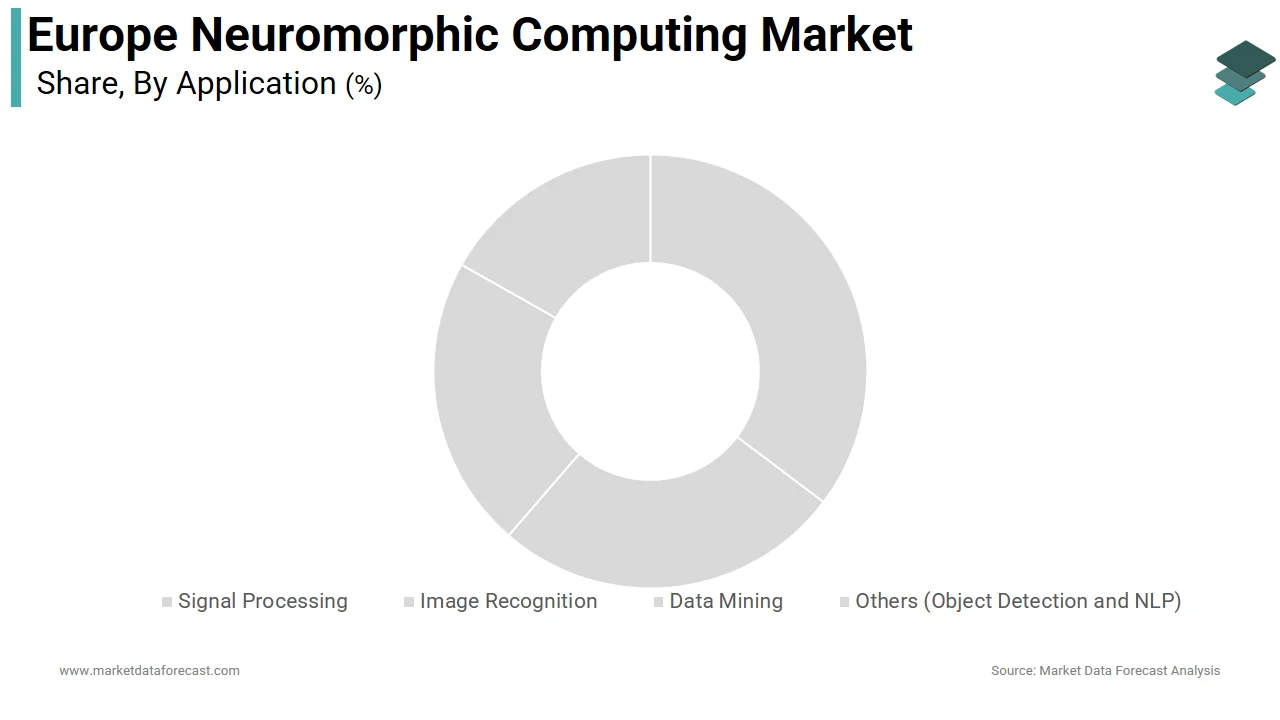
The image recognition segment is the fastest-growing application segment in the Europe neuromorphic computing market and is anticipated to witness a CAGR of 33.1% over the forecast period. Robotics
Neuromorphic vision sensors enable real-time image recognition with orders of magnitude lower latency and power than frame-based cameras. German automotive supplier Bosch, in collaboration with the University of Heidelberg, deployed a neuromorphic vision system in urban delivery robots that identifies pedestrians and obstacles in under 5 milliseconds, even under extreme lighting conditions, as reported in its 2024 mobility innovation review. In healthcare, Swiss startup iniVation’s neuromorphic cameras guide surgical robots with zero motion blur during high-speed procedures, reducing intervention time by 18% in trials at Lausanne University Hospital. The European Aviation Safety Agency has approved neuromorphic vision for drone navigation in GPS-denied environments, with 14 certified UAV platforms using such systems by the end of 2024 as per EASA’s emerging tech registry. This performance advantage drives rapid adoption beyond experimental labs into certified commercial systems.
By Industry Insights
The automotive segment captured 33.5% of the European market share in 2024. The urgent need for real-time, energy-efficient perception systems in autonomous and electric vehicles has significantly contributed to the dominance of the automotive segment in the regional market. As European automakers accelerate EV production, battery efficiency has become paramount. Traditional AI vision systems consume 200 to 500 watts, directly reducing driving range. Neuromorphic sensors, by contrast, operate below 1 watt while providing superior performance in challenging conditions. BMW’s 2024 iVision concept car integrates SynSense’s neuromorphic radar and vision fusion unit, enabling all-weather pedestrian detection with 98.7% accuracy at 10 times lower energy use, as validated by TÜV Rheinland. Similarly, Volvo’s autonomous truck trials in Gothenburg use neuromorphic processors to interpret LiDAR point clouds in real time, cutting processing latency from 50 to 3 milliseconds. The EU’s General Safety Regulation, mandating advanced driver assistance in all new vehicles from 2025, further accelerates adoption. With over 85% of European OEMs now running neuromorphic pilots, this industry remains the primary demand engine for scalable neuromorphic deployment.
The healthcare segment is the fastest-growing industry segment in the Europe neuromorphic computing market and is projected to register a promising CAGR over the forecast period. Europe’s aging population drives demand for intelligent, low-power medical devices that enable independent living. Neuromorphic chips are uniquely suited for neural implants that detect and respond to pathological brain activity in real time. At Charité Hospital in Berlin, a 2024 clinical trial of a neuromorphic epilepsy predictor developed by the Human Brain Project achieved 94% seizure forecasting accuracy with a 30-minute warning window, operating continuously for 18 months on a single battery charge. Similarly, France’s CEA-Leti partnered with Sorbonne University to create a neuromorphic cochlear implant that adapts to noisy environments using only 80 microwatts, enabling all-day use without recharging. The European Medicines Agency’s Adaptive Pathways pilot has fast-tracked three neuromorphic medical devices since 2023, recognizing their continuous learning capability as a therapeutic advantage. This convergence of demographic need, energy constraint, and regulatory support fuels explosive growth.
COUNTRY-LEVEL ANALYSIS
Germany Neuromorphic Computing Market Analysis
Germany held 27.4% of the Europe neuromorphic computing market share in 2024. The leading position of Germany in the European market is driven by its world-leading automotive and industrial automation sectors. The country hosts pioneering research at the University of Heidelberg’s Kirchhoff Institute for Physics, which developed the BrainScaleS neuromorphic platform now used by Bosch, Siemens, and BMW for real-time control applications. Germany’s National AI Strategy allocates 180 million euros through 2026 specifically for non von Neumann architectures, with a focus on manufacturing and mobility use cases. Over 40 industrial neuromorphic pilots are active in Baden-Württemberg alone, including autonomous forklifts at DHL warehouses and vibration monitoring in ThyssenKrupp steel mills. The Fraunhofer Society operates three neuromorphic testbeds open to SMEs, lowering entry barriers. Additionally, Germany’s strict functional safety standards create a natural fit for neuromorphic systems’ deterministic behavior. This synergy of scientific excellence, industrial demand, and policy support solidifies Germany’s position as Europe’s neuromorphic engineering powerhouse.
France Neuromorphic Computing Market Analysis
France accounted for the second-largest share of the Europe neuromorphic computing market in 2025 due to its integration into national defense, aerospace, and sovereign AI initiatives. The French Defense Innovation Agency funds neuromorphic projects for drone swarming, radar signal processing, and secure battlefield communications, with 12 active programs in 2024 as per the Ministry of Armed Forces. Startups like Prophesee supply dynamic vision sensors to Dassault Aviation’s nEUROn unmanned combat aircraft, enabling target tracking in GPS-denied environments. Civilian applications thrive too; the Plan Quantique includes neuromorphic co-processors for quantum machine learning, while the French National Center for Scientific Research coordinates NEURONET, a national neuromorphic cloud. Paris-based hospitals lead in medical adoption, with Pitié Salpêtrière deploying neuromorphic EEG analyzers for coma patient monitoring. France’s emphasis on technological sovereignty creates a protected ecosystem where neuromorphic solutions flourish as strategic assets rather than commodities.
Switzerland Neuromorphic Computing Market Analysis
Switzerland accounted for a substantial share of the European neuromorphic computing market in 2025. Switzerland is renowned for its fusion of neuroscience, microengineering, and medical device innovation. EPFL’s Blue Brain Project and University of Zurich’s Institute of Neuroinformatics are global leaders in spiking neural network theory and hardware implementation. Swiss startups like SynSense and iniVation commercialize these advances into ultra-low power sensors used in surgical robots, hearing aids, and neural implants. The Swissmedic agency has approved five neuromorphic medical devices since 2022, the highest per capita rate in Europe, leveraging the country’s streamlined regulatory pathway for innovative health tech. Switzerland’s neutrality and data privacy laws also attract EU health data processing projects seeking GDPR compliant edge solutions. Though not an EU member, Switzerland participates fully in Horizon Europe neuromorphic programs to ensure access to funding and collaboration. This unique concentration of brain science, precision engineering, and medical ethics positions Switzerland as Europe’s high-value neuromorphic niche leader.
United Kingdom Neuromorphic Computing Market Analysis
The United Kingdom is predicted to witness a healthy CAGR in the European neuromorphic computing market during the forecast period, owing to the world-class academic institutions and a post Brexit push for AI sovereignty. The University of Manchester’s SpiNNaker2 supercomputer is used by Rolls-Royce for jet engine health monitoring and by AstraZeneca for drug interaction modeling. The UK’s National AI Strategy includes neuromorphic computing as a critical technology for reducing data center energy use, with 75 million pounds allocated through 2025. Despite Brexit, UK researchers remain deeply integrated into EU projects like the Human Brain Project via associate membership. London-based startups like SpiNNaker AI are commercializing edge inference chips for smart city applications, while NHS Trusts pilot neuromorphic fall detectors for elderly care. The UK’s regulatory sandbox for AI in public services provides a fast track for neuromorphic deployment in transport and health. This blend of academic legacy, targeted funding, and regulatory agility ensures the UK remains a pivotal player despite geopolitical shifts.
Netherlands Neuromorphic Computing Market Analysis
The Netherlands is expected to account for a notable share of the Europe neuromorphic computing market over the forecast period due to its world-leading semiconductor ecosystem and smart infrastructure deployment. IMEC in Leuven operates major neuromorphic fabrication lines in Eindhoven, offering 300-millimeter wafer processing for European startups and researchers. ASML’s collaboration with neuromorphic designers ensures future lithography tools support non-Von Neumann architectures. Nationally, the Netherlands deploys neuromorphic sensors in its Delta Works flood management system, with real-time water level and structural stress analysis running on event-based processors. The Dutch Ministry of Economic Affairs funds the NEUROTECH NL consortium, linking Philips, NXP, and TU Delft to develop healthcare and automotive applications. Amsterdam’s smart city program uses neuromorphic vision for traffic flow optimization, reducing congestion by 14% in 2024 as per the city’s mobility dashboard. This combination of chip-scale manufacturing access, systems integration expertise, and public sector adoption makes the Netherlands a critical enabler of Europe’s neuromorphic commercialization pipeline.
COMPETITIVE LANDSCAPE
Competition in the Europe neuromorphic computing market is characterized by collaboration rather than direct rivalry, with players operating in complementary niches defined by hardware, software, or application focus. Large technology firms like Intel provide foundational platforms and cloud access, enabling broad experimentation. European startups such as Prophesee and SynSense specialize in vertical integration, offering full sensor-to-algorithm solutions for automotive vision or medical diagnostics. Academic institutions remain central, not as competitors but as talent and IP engines feeding the ecosystem. Unlike conventional AI markets driven by scale and data, neuromorphic competition hinges on energy efficiency, temporal precision, and regulatory alignment with EU values. Barriers to entry are high due to interdisciplinary complexity, but public funding and shared testbeds lower them significantly. Success depends less on market capture and more on ecosystem contribution—building tools, standards, and validated use cases that collectively advance Europe’s strategic autonomy in next-generation computing.
KEY MARKET PLAYERS
The leading companies operating in the Europe infectious disease diagnostics market include:
- Intel Corporation
- IBM Corporation
- BrainChip Holdings Ltd.
- Prophesee
- Qualcomm
- General Vision Inc.
- GrAI Matter Labs
- Innatera Nanosystems
- SynSense AG
- Samsung Electronics Co., Ltd.
- SK Hynix Inc.
TOP PLAYERS IN THE MARKET
- Intel maintains a strong presence in the Europe neuromorphic computing market through its Loihi research chips and Lava open source framework, actively collaborating with European universities, automotive firms, and industrial partners. The company contributes globally by providing scalable neuromorphic hardware and software tools that accelerate adoption beyond academic labs. In Europe, Intel co-leads multiple Horizon Europe projects focused on edge AI for smart manufacturing and autonomous mobility. In 2024, Intel expanded access to its Loihi 2 processors through the Human Brain Project’s Neuromorphic Computing Platform, enabling over 200 European research groups to experiment without hardware investment. It also launched industry-specific developer kits for predictive maintenance and robotic vision. These initiatives reinforce Intel’s role as an enabler of Europe’s neuromorphic ecosystem while advancing its global leadership in brain-inspired computing.
- Prophesee, a French startup headquartered in Paris, is a pioneer in neuromorphic vision sensors that mimic the human retina to capture only changes in a scene. The company supplies its Metavision technology to European automotive, industrial, and defense sectors, with clients including BMW, STMicroelectronics, and the French Ministry of Defense. Prophesee contributes to the global market by setting the standard for event-based vision, with its sensors deployed in robotics, AR/VR, and scientific imaging worldwide. In 2024, Prophesee introduced a third-generation sensor with enhanced dynamic range and lower power consumption, optimized for autonomous vehicle perception in adverse weather. It also partnered with the Paris Metro authority to deploy privacy-preserving crowd monitoring systems. These actions solidify its position as Europe’s leading neuromorphic vision innovator with global technological influence.
- SynSense, originally spun out of the University of Zurich and Heidelberg University, operates across Switzerland and Germany as a developer of full-stack neuromorphic computing solutions. The company integrates its Speck and Dynap chips into medical, IoT, and industrial edge devices that process data with microwatt power consumption. SynSense serves global markets through partnerships with medical device manufacturers and smart city integrators, offering certified neuromorphic modules for real-time anomaly detection. In 2024, SynSense received CE certification for its neuromorphic ECG analyzer used in primary care clinics across Scandinavia. It also launched a developer cloud platform, allowing European SMEs to test algorithms on its hardware remotely. By bridging neuroscience, microelectronics, and regulatory compliance, SynSense enables practical deployment of neuromorphic intelligence in high-impact European applications.
TOP STRATEGIES USED BY THE KEY MARKET PARTICIPANTS
Key players in the Europe neuromorphic computing market focus on open source software frameworks like Lava to build developer communities and accelerate algorithm adoption. They establish strategic partnerships with automotive, healthcare, and industrial leaders to co-develop use-case-specific solutions that demonstrate tangible return on investment. Companies invest in regulatory compliance and certification pathways to enable deployment in safety-critical sectors such as medical devices and autonomous vehicles. They leverage European public research infrastructures and Horizon Europe funding to de-risk R&D and scale prototypes. Additionally, they prioritize ultra-low power design and data minimization to align with EU green digital and privacy by design mandates, differentiating neuromorphic solutions from conventional AI.
MARKET SEGMENTATION
This research report on the Europe neuromorphic computing market has been segmented and sub-segmented into the following categories.
By Application
- Signal Processing
- Image Recognition
- Data Mining
- Others (Object Detection and NLP)
By Industry
- Automotive
- Healthcare
- Consumer Electronics
- Manufacturing & Industrial
- Aerospace & Defense
- Others (Agriculture)
By Country
- United Kingdom
- France
- Spain
- Germany
- Italy
- Russia
- Sweden
- Denmark
- Switzerland
- Netherlands
- Rest of Europe