- Product Description Description
- Table of Contents TOC
- List of Table & Figure LOT
- Get Free Sample PDF Sample PDF
Market Size, 2025
$9,539.83 MnMarket Estimate, 2026
$12,726.14 MnMarket Forecast, 2034
$127,627.22 MnCAGR, 2026–2034
33.4%Executive Summary: Europe Non-Fungible Token (NFT) Market
- Market Scope: Comprehensive analysis of the European non-fungible token (NFT) ecosystem, tracking unique cryptographic assets certifying ownership and authenticity of digital/physical art, music, intellectual property, real-world assets, and utility-driven tokens (forecast period: 2026-2034).
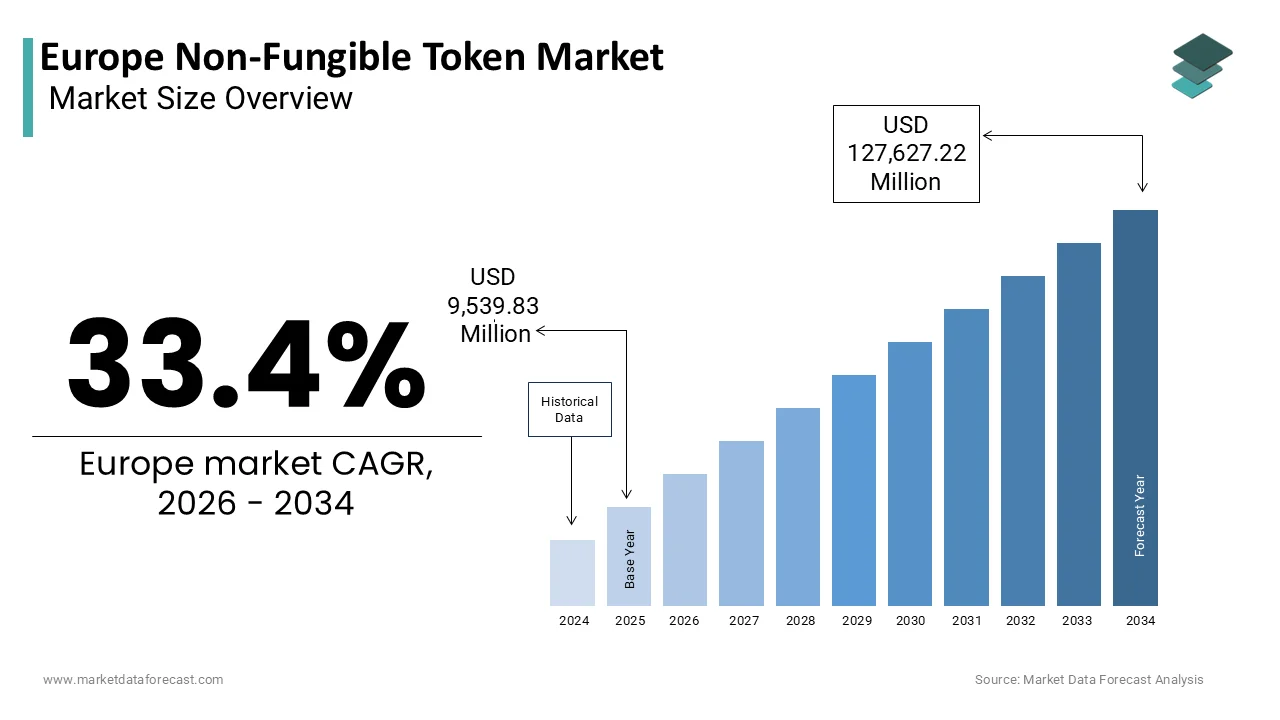
- Market Valuation: Valued at USD 9,539.83 million in 2025, estimated to reach USD 12,726.14 million in 2026, and projected to expand to USD 127,627.22 million by 2034, growing at a robust CAGR of 33.4% from 2026 to 2034.
- Primary Growth Drivers: Strategic integration of NFTs into cultural heritage and public art institutions for provenance and restoration funding, alongside strong legal frameworks protecting digital creator rights and royalty enforcement.
Key Market Segment Metrics
| Category | Leading Segment (Base Position) | Fastest-Growing / High-Growth Segment |
|---|---|---|
| By Type | Digital-Asset NFTs (held 64.2% share in 2025 anchored by foundational roles in digital art, music collectibles, and creator economy adoption) | Dynamic NFTs (projected fastest 38.7% CAGR driven by real-time data oracles, sports stats integration, and MiCA utility token compliance) |
| By Application | Art (largest share at 39.2% in 2025 powered by museum digitization, state patronage, provenance preservation, and cultural policy alignment) | Utilities (projected fastest 41.2% CAGR fueled by sports membership passes, digital university diplomas, and tamper-proof event ticketing) |
| By End User | Personal / Individual Users (held 52.3% share in 2025 driven by grassroots adoption among artists, musicians, collectors, and tech enthusiasts) | Commercial / Enterprise (projected fastest 36.5% CAGR fueled by luxury brand authentication, supply chain transparency, and CSRD reporting) |
| By Country / Region | United Kingdom (top performer with 21.3% share in 2025 anchored by fintech innovation hubs, FCA sandboxes, and flexible common law) | Germany, France, Netherlands, & Sweden (high-growth hubs leveraging industrial Industry 4.0 NFTs, state cultural programs, and green blockchain solutions) |
Major Market Players & Industry Landscape
Market Structure: Highly regulated and innovation-driven landscape shifting away from pure speculation toward enterprise-grade utility, GDPR compliance, and cultural integration under the EU MiCA framework.
Key Companies & Leaders: Rarible, OpenSea, Mintable, Immutable X, Sorare, SuperRare, Foundation, Magic Eden, LooksRare, and Tezos.
 Download Free Sample Report
Europe Non-Fungible Token Market Size
The Europe non-fungible token market was valued at USD 9,539.83 million in 2025, is estimated to reach USD 12,726.14 million in 2026, and is projected to reach USD 127,627.22 million by 2034, growing at a CAGR of 33.4% from 2026 to 2034
A non-fungible token is a unique cryptographic asset recorded on a blockchain that certifies ownership and authenticity of digital or physical items, such as art collectibles, music, intellectual property, or real-world assets. The European NFT ecosystem is characterized by its emphasis on legal compliance, cultural heritage digitization, and creator rights rather than speculative trading. According to the European Union Intellectual Property Office, over 120 000 European artists and designers registered digital works linked to NFTs between 2022 and 2025, reflecting growing adoption among creative professionals. As per the European Central Bank, blockchain-based digital asset activity in the EU remains largely experimental, with only 7% of adults reporting NFT ownership in 2025, underscoring its niche yet evolving status. The European Commission’s proposed Markets in Crypto Assets regulation mandates strict disclosure and environmental impact assessments for NFT issuers, signaling a shift toward responsible innovation. National initiatives such as France’s Digital Cultural Heritage Program and Germany’s Creative Europe NFT Pilot further embed NFTs within public cultural policy rather than pure financial markets, distinguishing Europe’s approach from other global regions.
MARKET DRIVERS
Integration of NFTs into Cultural Heritage and Public Art Institutions
European museums, galleries, and national archives are increasingly leveraging NFTs to democratize access, preserve provenance, and generate sustainable revenue streams. The integration of NFTs into cultural heritage and public art institutions is escalating the growth of theEuropeane non-fungible token market. According to the European Museum Association, major cultural institutions, including the Louvree,e the Rijksmuseum,, um and the Uffizi Gallery,lery launched authenticated NFT collections between 2022 and 2025. In 2023, Italy’s Ministry of Culture authorized the digitization of 150 Renaissance masterpieces as limited-edition NFTs with proceeds funding restoration projects, a model now replicated in Spain and Greece. These initiatives are not driven by speculation bumission-orientedented goals such as combating illicit trafficking through immutable provenance records and engaging younger audiences via interactive digital ownership. This institutional anchoring provides legitimacy, scale, and regulatory alignment that commercial platforms alone cannot achieve, reinforcing NFTs as tools of cultural stewardship rather than mere commodities.
Strong Legal Frameworks Protecting Digital Creator Rights
The robust intellectual property regime offers creators unprecedented control over distribution,n monetization, and attribution through NFTs, which is additionally prompting the growth of the Europe non-fungicide token market. In 2025, Germany’s Federal Court of Justice ruled that NFT smart contracts must embed royalty mechanisms compliant with national droit de suite laws granting artists resale rights. Similarly, the Nordic Copyright Bureau confirmed that over 8 000 Scandinavian musicians embedded automatic royalty splits into NFT releases in 2025 using EU-compliant smart contracts. As per the European Federation of Journalists, 12,000 photojournalists across the EU now tokenize exclusive content with geofenced licensing, ng ensuring regional usage rights are respected. This legal certainty encourages professional creators to adopt NFTs not as speculative gambits but as enforceable digital contracts.
MARKET RESTRAINTS
Stringent Regulatory Ambiguity Under the Markets in Crypto Assets Framework
The European Union’s Markets in Crypto Assets regulation creates significant uncertainty for NFT developers due to its exclusionary, yet inconsistently applied, criteria. The factor is majorly impeding the growth of Europe's non-fungible token market. According to the European Securities and Markets Authority, offer profit sharing governance rights or fractional ownership may be reclassified as security tokens, triggering full MiCA compliance, where a process requiring a capital reserve,s legal audits, and prospectus filings. The Dutch Authority for the Financial Markets halted three NFT projects involving music royalties after determining they constituted unlicensed investment instruments. As per the European Blockchain Observatory, over 40% of European NFT startups delayed product launches in 2025 due to legal ambiguity around utility versus financial classification. The lack of a unified supervisory body means interpretations vary, where Germany’s BaFin takes a stricter stance than Portugal’s CMVM, leading to fragmented compliance strategies. This regulatory fog discourages institutional participation and deters venture funding as investors fear retroactive reclassification.
High Energy Consumption Concerns Despite Shift to Proof of Stake
The environmental awareness continues to hinder mainstream NFT adoption in Europe,e even after Ethereum’s transition to proof of stake is limiting the growth of the European non-fungible market. According to the European Environment Agency, while Ethereum’s energy use dropped by over 99% post merge in 2022, public perception lags, with 61% of EU consumers still associating NFTs with high carbon footprints as per a 2025 Eurobarometer survey. National policies amplify this stigma, where Sweden’s Green Digital Charter excludes NFT projects from public innovation grants unless they use renewable-powered blockchains verified by third parties. In France, the High Climate Council recommended in 2023 that all publicly funded NFT initiatives undergo lifecycle emissions audits, where a requirement that adds cost and complexity. Although alternative low-energy blockchains like Polygon and Tezos are widely available, many legacy collections remain on older network,s, creating reputational spillover.
MARKET OPPORTUNITIES
Tokenization of Real World Assets Through EU Digital Ledger Technology Pilots
The European Union’s Digital Ledger Technology pilot regime to expand NFT use beyond digital art into tangible asset representation is creating new opportunities for the growth of Europe non fungible token market. According to the European Commission, the DLT Pilot Regime, which became operational in 2023, allows regulated entities to issue tokenized securities and asset certificates on blockchain with legal equivalence to traditional instruments. In 2025, Luxembourg’s financial regulator approved the first NFT-backed real estate fractional ownership structure covering a commercial property in Esch-sur-Alzette. Similarly, the European Investment Bank issued green bond certificates as NFTs on a permissioned blockchain, enabling granular investor tracking. As per the study, over 15 national central banks are exploring NFT-style tokens for collateral registry modernization. This institutional validation shifts NFTs from speculative collectibles to verifiable ownership layers for car,,s luxury goods, patents, ents and carbon credits.
Expansion of NFT-Based Fan Engagement in European Sports and Entertainment
The sports clubs and entertainment entities are pioneering utility-driven NFT models that foster loyalty rather than speculation. The expansion of NFT-based fan engagement in sports and entertainment is bolstering the growth of Europe's non-fungible token market. According to UEFA, over 40 top-tier football clubs,including FC Barcelona,na Manchester City and Paris Saint-Germain,, launched membership NFTs in 2025, granting voting rights,s merchandise discounts, ts and stadium access. The German Football League reported that 1.2 million fans held club-specific NFTs by early 2025, enabling dynamic ticketing and anti-scalping measures. In music, the European Live Events Association noted that 68% of major festivals, including Roskilde and Sziget integrated NFT wristbands for entry and exclusive content unlocking. As per the European Broadcasting Union, several public broadcasters like RAI and SVT piloted NFT collectibles tied to archival programming, ng driving intergenerational engagement. These applications emphasize recurring util,ity community identity,tity and experiential value aligning with European consumer preferences for meaningful digital interaction over pure financialization.
MARKET CHALLENGES
Fragmented Consumer Protection Standards Across Member States
The consumer redress mechanisms for NFT purchases remain inconsistent,istent creating trust deficits among buyers, which is one of the major challenges for the growth of Europe's non-fungible token market. According to the European Consumer Organisation, BEUC cross-border NFT disputes face jurisdictional ambiguity because digital goods fall between e-commerce directives and emerging crypto rules. In 2025, Spain’s National Markets and Competition Commission received over 1,200 complaints about undelivered or misrepresented NF, Ts, yet lacked the authority to compel refunds from platforms hosted in Estonia or Malta. As per the European Judicial Network, only 31% of national courts have issued rulings on NFT-related contract breaches, leading to legal uncertainty. The absence standardized cooling-off-offf period mandatory for physical goods under the Consumer Rights Directive leaves buyers vulnerable to scams or platform failures.
Scalability Limitations Privacy-Compliant Blockchain Infrastructure
The commitment to data privacy under the General Data Protection Regulation conflicts with the transparent, immutable nature of public blockchain,s crtechnicalenges l challenges for NFT scalability is additionahampersmper the growth of Europe's non-fungible token market. According to the European Data Protection Board, storing personal identifiers or transaction metadata on public ledgers may violate GDPR’s right to erasure and data minimization principles. In 2025, Germany’s data commissioner fined a Berlin-based NFT marketplace for permanently recording buyer wallet addresses without anonymization. As per the European Blockchain Partnership, most EU-aligned NFT projects now operate on hybrid or private chains, which sacrifice decentralization and interoperability. The resulting fragmentation limits network effects, where an NFT minted on a French cultural blockchain cannot easily interact with a German music platform. Furthermore, zero-knowledge proof solutions that reconcile privacy with verification remain computationally expensive and immature for mass deployment. This tension between regulatory integrity and technical fluidity constrains the development of open, composable NFT ecosystems comparable to those in less regulated regions.
REPORT COVERAGE
| REPORT METRIC | DETAILS |
| Market Size Available | 2025 to 2034 |
| Base Year | 2025 |
| Forecast Period | 2026 to 2034 |
| Segments Covered | By Type, Application, End User, and Region. |
| Various Analyses Covered | Global, Regional, and Country-Level Analysis, Segment-Level Analysis, Drivers, Restraints, Opportunities, Challenges; PESTLE Analysis; Porter’s Five Forces Analysis, Competitive Landscape, Analyst Overview of Investment Opportunities |
| Countries Covered | UK, France, Spain, Germany, Italy, Russia, Sweden, Denmark, Switzerland, Netherlands, Turkey, Czech Republic, Rest of Europe |
| Market Leaders Profiled | |
SEGMENTAL ANALYSIS
By Type Insights
The digital-asset NFTs segment accounted in holding 64.2% of theEuropeane non-fungible token market share in 2025. This dominance stems from their foundational role in digital art music collectibles and virtual identity domains, where European creators have been early adopters. According to the European Union Intellectual Property Office, over 180 000 digital artworks were registered with NFT-linked metadata by EU-based creators between 2022 and 2025. The segment thrives on cultural policy support, where France’s Ministry of Culture allocated 25 million euros in 2023 to digitize contemporary art through NFTs while Germany’s Creative Europe program funded 47 digital artist residencies focused on blockchain expression. As per the European Music Council, 12,000 independent musicians across the EU released NFT albums or exclusive tracks in 2025, embedding royalty automation directly into smart contracts. Their simplicit,,y accessibil,ity and alignment with Europe’s strong creative economy ensure continued leadership despite market volatility.
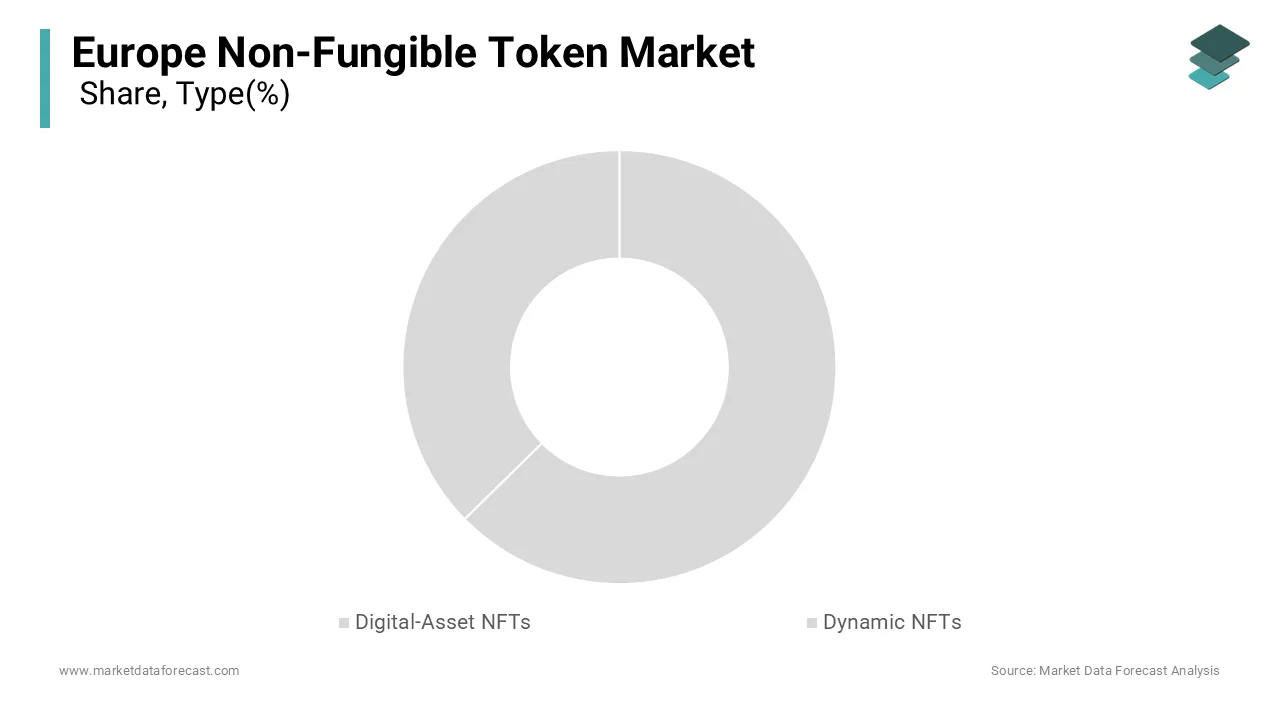
The dynamic NFTs segment is projected to grow at a fastest CAGR of 38.7% from 2025 to ,2033 with tevolvingevolve based on real-world data inputs via oracles, enabling use cases far beyond static ownership. According to the European Blockchain Observatory, dynamic NFT pilots in sports and sustainability surged in 2025 with UEFA integrating live match statistics into fan collectibles that update in real time. In Sweden, the Royal Institute of Technology launcheclimate-responsiveve NFTs that change visual properties based on verified carbon offset data, a model now adopted by three national environmental agencies. As per the European Commission’s Digital Innovation Hubs, over 60 startups received funding under Horizon Europe in 2025 to develop dynamic NFTs for academic credentialing, where degrees automatically update with continuing education credits. The technology’s ability to bridge on-chain assets with off-chain reality aligns with Europe’s emphasis on utility over speculation. Furthermore, dynamic NFTs comply more easily with MiCA’s utility token exemptions because they function as interactive certificates rather than investment vehicle,s accelerating institutional adoption across education logistics and green finance.
By Application Insights
The art application segment was the largest by holding 39.2% of the Europe non fungible token market share in 2025 owing to the deep institutional integration and cultural policy alignment. European museums and public galleries have embraced NFTs not as speculative instruments but as tools for provenance preservat,ion audience engagement, and revenue diversification. Italy’s Ministry of Culture reported that NFT sales from digitized Renaissance works generated 8.3 million euros in 2025 alon,e earmarked for fresco restoration. As per UNESCO’s European Office for Culture, 58% of publicly funded art schools now include NFT creation in their digital arts curricul,um fostering a new generation blockchain-literateate creators. Unlike gaming or collectibles, which rely on consumer trend,s art NFTs benefit from state patrona,ge legal clarity around moral rig,hts and alignment with Europe’s intangible cultural heritage g,oals ensuring sustained institutional demand independent of crypto market cycles.
The utilities application segmenexpectedeemed to witness the fastest CAGR of 41.2% throughout the forecast period. Utility NFTs serve as access keys, membership passes, or verifiable credentials rather than collectibles. According to UEFA, over 1.4 million football fans heldclub-specificc utility NFTs by early 2025,, granting stadium entry voting rights and exclusive content with a model replicated by 35 top-tier clubs across Europe. In higher education, the European University Association confirmed that 28 universities piloted NFT-based digital diplomas in 2025,, compliant with the European Qualifications Framework, enabling instant verification by employers. As per the European Live Events Association, major festiva,ls including Roskilde and Primavera So,und replaced paper tickets with utility NFTs, reducing fraud and enabling secondary market royalties. The segment’s growth is further accelerated by the EU’s Digital Identity Wallet initiative,e which will allow citizens to store and verify NFT credentials across borders.
By End-User Insights
The personal or individual users segment held 52.3% of Europeanrope non-fungible token market share in 2025, with the grassroots adoption among artist,s musicia,ns collectors,, and tech enthusiasts, who view NFTs as tools for creative expression and community building. The segment is fueled by accessible minting platforms like OpenSea and Rarible, which support EUR payments and local language interfaces,, lowering entry barriers. As per the European Youth Forum, 28% of creative students in EU universities used NFTs to monetize their portfolio, bypassing traditional gatekeepers. This decentralized user base provides market resilience even during bear cycles as activity remains rooted in utility and self-expression rather than speculation.
The commercial or enterprise end-user segment is projected to expand athe a fastest CAGR of 36.5% from 2025 to 2033. Businesses are deploying NFTs for brand engagement, supply chain transparenc,,y and customer loyalty. According to the European Brand Association, over 220 European luxury fashion and automotive brands launched utility NFTs in 202,4 offering product authenticat,,ion exclusive experi,ences and resale tracking. LVMH’s AURA blockchain recorded 1.2 million NFT verifications for Louis Vuitton and Dior items in Europe alone during 2025. As per the European Retail Roundtable, 43% of major retailers now integrate NFT loyalty cards that accumulate points across physical and digital channels. In manufacturing, Siemens and Bosch piloteNFT-baseded equipment passports containing maintenance history and compliance data streamlining circular economy workflows. The EU’s Corporate Sustainability Reporting Directive further incentivizes such use by requiring transparent product lifecycle data. Enterprises are thus shifting NFTs from novelty marketing to operational infrastr,,ucture driving scalable B2B adoption across sectors.
COUNTRY LEVEL ANALYSIS
United Kingdom Non-Fungible Token Market Analysis
The United Kingdom was the top performer of the European non-fungible token market by holding 21.3% of the share in 2025,, with a vibrant startup ecosystem and progressive regulatory sandboxing. The UK remains a hub for blockchain innovation,, with the Financial Conduct Authority’s Digital Sandbox hosting 18 NFT projects in 2025,, focused on art finance and identity. The British Museum and Tate Modern launched high-profile NFT collaborations,, attracting global attention while maintaining cultural integrity. As per a study, London hosts over 120 blockchain startups specializing in NFT infrastructure, many backed by government innovation grants. The UK’s common law system also offersa a flexible interpretation of digital ownership, aiding legal certainty.
Germany Non-Fungible Token Market Analysis
Germany was ranked second by holding 18.3% of thEuropean fungiblele token market share in 202,4 driven by strong industrial adoption and public cultural digitization initiatives. According to Germany’s Federal Ministry for Economic Affairs and Climate Action, 47 enterprises, including BMW and Sieme,ns integrated NFTs into product lifecycle management in 2025 under the Industry 4.0 framework. The country’s robust copyright tradition ensures creators retain moral rights even when tokenizing wo,rks with a principle reinforced by the German Copyright Act amendment of 2023. As per the German Cultural Foundation, over 90 museums and theaters launched NFT programs in ,2025 with revenues funding youth outreach. The BaFin financial regulator maintains a cautious but structured approach, allowing utility NFTs while restricting fractionalized investment models.
France Non-Fungible Token Market Analysis
France'srance non-fungible token market growth is likely to grow with the state-led cultural digitization and strong intellectual property protections. According to France’s Ministry of Culture, the government’s Digital Cultural Heritage Program allocated 30 million euros in 2025 to tokenize national artworks with the Louvre and Musee d’Orsay leading institutional efforts. The French National Library issued NFTs of historic manuscripts reaching over 150,000 new digital patrons under age 35. As per theAutoritée des Marches Financiers AMF utility, ty NFTs are exempt from securities classification if they do not promise returns with a clear guideline that has attracted over 60 NFT startups to Paris. The country’s droit d’auteur system ensures automatic creator royalties even in secondary sales, reinforcing artist trust. Furthermore, France champions open source NFT standards through the European Blockchain Partnership promoting interoperability.
Netherlands Non-Fungible Token Market Analysis
The Netherlands non fungible token market growth is likely to grow with the advanced infrastructure and cross-sectoral NFT experimentation. As per the Netherlands Enterprise Agency, over 80 startups in Amsterdam and Eindhoven developed NFT solutions for sustainable fashion circular supply chains and event ticketing in 2025. The country’s progressive stance on digital identity enables seamless integration of NFTs with citizen services. Additionally, Dutch courts have issued rulings affirming that NFT ownership constitutes a valid title under civil law, providing legal predictability. The Netherlands’ compact size, multilingual talent pool, nd gateway location make it an ideal testbed for scalable European NFT applications.
Sweden Non-Fungible Token Market Analysis
Sweden'sn non-fungible market growth is likely to grow with the sustainable and privacy-conscious NFT innovation. The Royal Institute of Technology launched climate responsive dynamic NFTs that visually reflect verified carbon offset data a model adopted by the Swedish Environmental Protection Agency. As per the Swedish Gambling Authority, NFTs with randomized traits are classified as games of chance requiring licensing ensuring consumer protection without banning innovation. Over 40 Swedish music artists including ABBA members released royalty embedded NFT albums in 2025 using GDPR compliant platforms. Sweden’s emphasis on ethics transparency and environmental responsibility positions it as a benchmark for responsible NFT development in the European context.
COMPETITIVE LANDSCAPE
Competition in the Europe non fungible token market is defined by a strategic pivot away from speculative trading toward regulated utility-driven applications anchored in the culture industry and public policy. Unlike other regions where volume and price dominate the narrative, European players compete on complianc,e interoperabili,ty and social value. Global platforms like OpenSea and Rarible have established localized operations to meet GDPR MiCA and national copyright requirements,, while homegrown startups such as KodaDot and Verisart focus on niche domains like green NFTs and art provenance. Institutional adoption by museu,ms sports federati,ons and luxury brands has elevated the market beyond retail specula,tion creating demandenterprise-gradegrade infrastructure. Regulatory clarity remains fragmented howeve,r with Germany, France, and the Netherlands offering more defined pathways than Southern or Eastern members. This environment favors vendors that combine technical robustness with legal fluency and cultural sensitivity.
KEY MARKET PLAYERS
Some of the companies that are playing a dominating role in the global europe non-fungible token market include
- OpenSea
- Rarible
- Binance NFT Marketplace
- Magic Eden
- LooksRare
- SuperRare
- Foundation
- Nifty Gateway
- Coinbase NFT
- Immutable X
- Sorare
- Tezos (blockchain platform with a strong NFT ecosystem)
- Dapper Labs (NBA Top Shot)
- Enjin
- Axie Infinity (Sky Mavis)
- Rarible
- Zora
- Mintable
- MakersPlace
TOP LEADING PLAYERS IN THE MARKET
- Rarible has established a strong presence in the European non-fungible token market by prioritizing creator governance and regulatory compliance. The platform enables artists and brands to mint and sell NFTs with built-in royalty enforcement aligned with European intellectual property norms. In 2025, Rarible launched a dedicated EU compliance hub in Berli,n ensuring all smart contracts adhere to GDPR and MiCA utility token guidelines. The company also partnered with major European cultural institutio,ns including the Pompidou Center and the Stedelijk Mus,eum to tokenize digital art while preserving moral rights.
- OpenSea maintains significant traction in Europe throughits user-friendlyy interface, extensive asset support,t and localized onboarding experiences. The platform has adapted its infrastructure to meet evolving European regulatory expectations by implementing geofenced content policies and enhanced KYC protocolsfor high-valuee transactions. OpenSea introduced a Creator Protection Program in collaboration with the European Union Intellectual Property Office to combat plagiarism and unauthorized minting. It also enabled automatic royalty enforcement for EU-based artists in line with national droit de suite laws.
- Mintable has carved a niche in the European non-fungible token market by focusinggas-freefree minting and institutional use cases. The platform’s partnership with LVMH’s AURA blockchain enables luxury brands to issue authentication NFTs for products sold across Europe, ensuring supply chain transparency. Mintable launched a GDPR compliant enterprise suit,e allowing museu,ms universit,ies and sports clubs to deploy private NFT ecosystems without exposing user data to public ledgers. Its integration with Polygon’s proof of stake network ensures low energy consump,tion aligning with EU sustainability mandates.
MARKET SEGMENTATION
This research report on Europe non-fungible token (nft) market is segmented and sub-segmented into the following categories.
By Type
- Digital-Asset NFTs
- Dynamic NFTs
By Application
- Art
- Utilities
- Gaming
- Collectibles
- Metaverse
- Others
By End User
- Personal / Individual Users
- Commercial / Enterprise
By Country
- United Kingdom
- Germany
- France
- Netherlands
- Sweden
- Rest of Europe