Europe Operational Technology Security Market Size, Share, Trends & Growth Forecast Report, By Component (Solutions, Services), Deployment, End Use Industry, And Country (UK, France, Spain, Germany, Italy, Russia, Sweden, Denmark, Switzerland, Netherlands, Turkey, Czech Republic & Rest Of Europe) - Industry Analysis From (2026 To 2034)
Market Size, 2025
$6.57 BnMarket Estimate, 2026
$7.46 BnMarket Forecast, 2034
$20.53 BnCAGR, 2026–2034
13.49%Europe Operational Technology Security Market Size
The Europe Operational Technology Security market size was estimated to be USD 6.57 billion in 2025 and is projected to reach USD 20.53 billion by 2034, growing from USD 7.46 billion in 2026 at a CAGR of 13.49% during the forecast period.
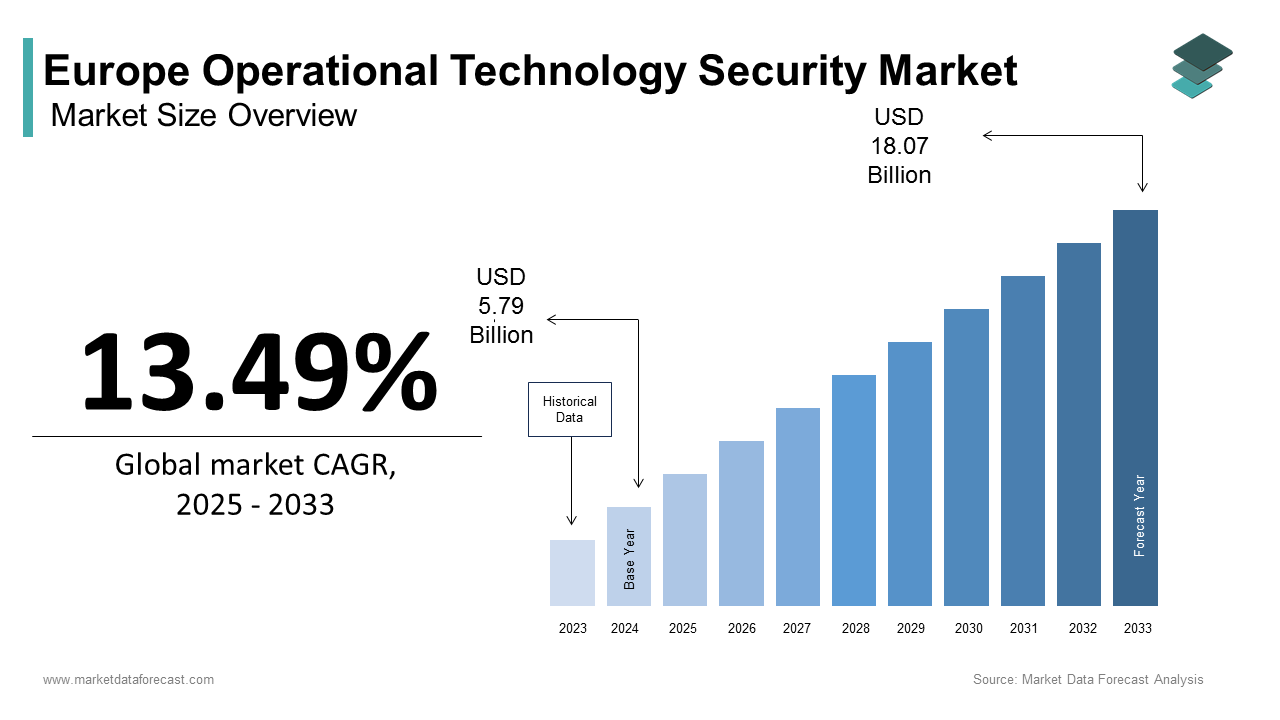
Operational Technology Security refers to the specialized discipline of protecting industrial control systems, critical infrastructure assets, and physical processes from cyber threats by securing devices and networks that monitor and manage physical operations. Unlike enterprise IT security, OT security prioritizes system availability, safety, and integrity over data confidentiality, given its direct link to industrial continuity and public safety. The European landscape is uniquely shaped by converging regulatory mandates such as the NIS2 Directive and the EU Cyber Resilience Act, which extend cybersecurity obligations to previously unregulated sectors, including water, waste, and district heating. Across the EU, essential entities designated under NIS2 are required to implement robust OT security measures. Many energy grid operators now manage hybrid IT‑OT environments due to smart grid deployments, which are significantly expanding the attack surface. According to the European Commission, a large share of manufacturing plants have integrated IoT sensors into production lines without adequate segmentation from corporate networks. These structural and regulatory shifts underscore that OT security in Europe is no longer optional but a foundational component of industrial sovereignty and societal resilience.
MARKET DRIVERS
Mandatory Implementation of the NIS2 Directive Across Critical Sectors
The strategic commitment of Europe to NIS2 across all EU member states is a primary driver of the operational technology security market in Europe. According to the European Commission, NIS2 expands the scope of regulated sectors to include wastewater treatment, food processing, and public administration entities managing critical databases, which brings an estimated 13,000 additional organizations under mandatory cybersecurity governance as this expansion directly widens the addressable market for OT security solutions and accelerates compliance-driven procurement across critical sectors. These entities must implement risk management measures, including asset inventory, vulnerability handling, and incident response specifically tailored to OT environments, which elevates the need for OT-aware tools and services and increases recurring spend on audits and monitoring. According to the Federal Office for Information Security, over 90 percent of newly designated essential entities in the energy and water sectors initiated OT security assessments in early 2025 to meet national implementation deadlines in Germany. Such assessment activity immediately converts into demand for OT asset discovery, network segmentation, and incident response capabilities. Similarly, France’s ANSSI mandated annual OT security audits for all NIS2-covered operators, with non-compliance subject to fines up to 10 million euros or 2 percent of global turnover, as this penalty framework incentivizes proactive investment in certified OT controls and supports sustained market growth. This regulatory pressure transforms OT security from a discretionary investment into a legal obligation, and, with supply chain risk management requirements forcing asset owners to evaluate OT vendor posture, cascades demand deep into the industrial ecosystem. Consequently, NIS2 acts as a structural catalyst, embedding OT security into the operational DNA of Europe’s critical infrastructure, which justifies its role as a core growth driver.
Convergence of IT and OT Networks Accelerating Threat Exposure
The accelerating fusion of information technology and operational technology networks in European industry has expanded the cyber-attack surface, which is further boosting the European operational technology security market growth. As per the European Environment Agency, 71 percent of EU manufacturing and energy facilities have deployed industrial IoT sensors and cloud connectivity to enable predictive maintenance and remote monitoring, often without adequate network segmentation, as this high adoption rate increases attack pathways and directly raises the need for OT segmentation, traffic inspection, and device authentication. This convergence introduces IT-borne threats such as ransomware into previously air-gapped OT environments, as evidenced by the 2023 cyber incident at a major Danish water utility, where a phishing attack on the corporate network led to unauthorized access to SCADA systems, and such cross-domain breaches demonstrate the business impact of insufficient segregation and push buyers toward OT-aware IDS and secure remote access. According to the European Union Agency for Cybersecurity, a 47% year-on-year increase in OT-targeted malware incidents across the EU in 2023, with sectors like chemical manufacturing and rail transport among the most affected. The sharp rise amplifies risk perception and triggers budget reallocation to continuous monitoring and protocol anomaly detection. In response, the European Railway Agency now requires all signaling system vendors to demonstrate OT security by design in procurement tenders, and the European Chemical Industry Council mandates network traffic monitoring and protocol anomaly detection for hazardous materials sites, as these sector directives formalize requirements and convert compliance into steady demand for validated OT solutions. These operational realities leave asset owners with no choice but to deploy OT-aware intrusion detection, asset discovery, and secure remote access, which justifies convergence-driven risk as a decisive market growth driver.
MARKET RESTRAINTS
Persistent Reliance on Legacy Industrial Control Systems Without Security Features
One of the primary restraints facing the European OT security market is the widespread use of aging industrial control systems that lack fundamental security capabilities. According to ENTSO-E, more than 65 percent of substations in Central and Eastern Europe still operate on RTUs and PLCs installed before 2010, many running obsolete operating systems without patching support, as this prevalence of outdated assets restricts the adoption of modern controls and drives costly compensating measures instead of full replacements. These systems were designed for closed environments and often cannot accommodate encryption, authentication, or logging, which limits compliance pathways and inflates integration time for secure telemetry. In the water sector, according to the European Environment Agency, 58% of wastewater treatment plants in Southern Europe rely on Modbus and DNP3 protocols transmitting data in plain text, leaving them vulnerable to spoofing and injection attacks as insecure protocols elevate breach likelihood and increase demand for protocol-aware monitoring that may not fully mitigate root causes. Replacement is hindered by long asset lifecycles; industrial machinery in sectors like steel and cement often remains operational for 20–30 years due to high capital costs, which is slowing modernization cycles and prolonging exposure to legacy risks. Consequently, operators must deploy compensating controls such as unidirectional gateways or passive monitoring, which increase complexity and cost without eliminating root vulnerabilities, which justifies legacy dependence as a durable restraint on market velocity.
Shortage of Cross-Domain Expertise in OT Cybersecurity Workforce
The supply chain disruptions and raw material shortages are hampering the European OT security market growth. According to CEDEFOP, the EU will need an additional 225,000 OT security specialists by 2027 to meet NIS2 compliance demands, yet fewer than 18,000 individuals currently hold recognized certifications in ICS security, as this skills gap suppresses implementation capacity and elongates deployment timelines for OT solutions. This gap is especially acute in energy and manufacturing, where engineers understand process control but lack threat modeling skills, while IT security teams are unfamiliar with protocol semantics like PROFINET or IEC 61850, which is reducing the effectiveness of detection tuning and incident response in complex plants. According to the European Union Agency for Cybersecurity, in 2025, 73% of OT incident response delays in the EU were attributed to miscommunication between IT and OT teams during breach containment, as communication breakdowns translate directly into longer dwell times and higher remediation costs, hindering ROI. Academic institutions have been slow to respond, as only four EU member states offer dedicated undergraduate programs integrating automation and cybersecurity, as per the European University Association, which is limiting near-term pipeline expansion and forcing reliance on external consultants.
MARKET OPPORTUNITIES
Integration of OT Security into EU Green and Digital Twin Initiatives
The expansion of EU industrial digitalisation programmes is creating a major opportunity for OT security adoption across factories and transport infrastructure. According to IDC’s European Cloud, Edge, and IoT Demand Survey, 700 organisations across EU countries reported active IoT use cases in 2023, which increases telemetry exposure and directly raises demand for device authentication, encrypted data pipelines, and secure monitoring in OT networks, thereby expanding the market for OT security solutions. As per the Rail Security Expert Group Procurement Guideline published in 2025, EU rail tenders now reference cybersecurity requirements for signalling and control systems, which formalises OT security‑by‑design in procurement and converts compliance needs into recurring demand for validated OT security products and services. According to CEFIC safety and security policy updates, chemical producers are strengthening site operational security frameworks, which include traffic monitoring and incident response, which directly elevates the need for protocol‑aware intrusion detection and managed OT security operations in hazardous environments. These policy and procurement shifts embed OT security into operational modernisation programmes and justify industrial digitalisation as a high‑conviction opportunity that scales market demand.
Expansion of Sovereign OT Security Testing and Certification Frameworks
The EU’s focus on sector‑specific security guidance is opening opportunities for OT vendors that align with European standards and practices. According to ANSSI’s 2025 NIS2 brochure, over 10,000 entities across 18 sectors are involved under the directive, which expands the pool of operators that must adopt harmonised cybersecurity practices and translates into addressable demand for OT risk management and monitoring aligned with national guidance. As per CEFIC and ECTA joint transportation security guidelines, hazardous chemical logistics must implement governance and operational controls that directly increase requirements for secure telemetry, audit trails, and anomaly detection in connected OT systems across storage and loading operations. According to the EU Agency for Railways procurement pages and associated guidance, vendor selection increasingly evaluates cybersecurity capabilities, which drives preference for OT solutions with demonstrable conformity to EU procurement criteria and justifies investment in certification readiness and product hardening. These actions build trust in compliant solutions and justify sector guidance and public procurement as an enduring opportunity for OT security market expansion.
MARKET CHALLENGES
Fragmented National Implementation of EU Cybersecurity Directives
The uneven transposition of EU directives creates operational ambiguity that challenges cohesive OT security deployment across Europe. According to the European Commission’s NIS2 policy summary, the directive covers 18 critical sectors and sets harmonised obligations that require national alignment, and where varied interpretations of reporting and audit criteria increase administrative burden for cross‑border operators and directly slow unified OT control rollouts. As per industry legal briefings on Germany’s NIS2 Implementation Act approved in late 2026, thousands of undertakings will face immediate obligation, which illustrates how national timelines can diverge and directly complicate governance harmonisation for multinational firms operating OT systems in multiple jurisdictions. According to ENISA guidance and surveys, organisations frequently maintain country‑specific cybersecurity polices which inflate audit overhead and create coverage gaps in OT incident playbooks, thereby increasing risk exposure and delaying investments in standardised protections. These divergences justify fragmented implementation as a persistent challenge that constrains market maturity and slows enterprise adoption.
Inadequate Incident Response Coordination for Cross-Sector OT Threats
The lack of unified operational frameworks for cross‑sector cyber incidents exposes OT environments to cascading risks during complex attacks, which further challenges the growth of the European operational technology security market. According to ENISA’s Telecom Security Incidents 2025 summary, reported incidents increased by 20.5% year over year, and this signals stress on interconnected infrastructure and directly underscores the need for coordinated incident response spanning telecom, energy, and transport OT domains. As per ENISA’s Threat Landscape 2023, escalating ransomware and supply chain compromises affect critical infrastructure, which directly raises requirements for OT‑aware playbooks, protocol monitoring, and secure remote maintenance to contain lateral movement into industrial control systems. According to sector experience notes captured in EU rail procurement guidance, security‑by‑design and secure maintenance are tender criteria that directly push vendors to demonstrate OT incident readiness and improve baseline resilience, but still leave gaps where national CERTs lack ICS handlers and specialised forensics. These constraints justify coordination shortfalls and capability gaps as material challenges that reduce resilience across Europe’s critical operations.
REPORT COVERAGE
| REPORT METRIC | DETAILS |
| Market Size Available | 2025 to 2034 |
| Base Year | 2025 |
| Forecast Period | 2026 to 2034 |
| CAGR | 13.49% |
| Segments Covered | By Component, Deployment, End Use Industry, and Region |
| Various Analyses Covered | Global, Regional & Country Level Analysis; Segment-Level Analysis; DROC, PESTLE Analysis; Porter’s Five Forces Analysis; Competitive Landscape; Analyst Overview of Investment Opportunities |
| Regions Covered | UK, France, Spain, Germany, Italy, Russia, Sweden, Denmark, Switzerland, Netherlands, Turkey, and the Czech Republic |
| Market Leaders Profiled | Microsoft, Broadcom, Cisco Systems, Fortinet, Forcepoint, Tenable, Check Point Software Technologies, Palo Alto Networks, Darktrace, Nozomi Networks, Claroty, Honeywell, Siemens, Schneider Electric, Rockwell Automation, GE Vernova, Armis Security, Forescout, Waterfall Security Solutions, OPSWAT, Radiflow, Indegy, BAE Systems, Tripwire, Kaspersky Lab |
SEGMENTAL ANALYSIS
By Component Insights
The solutions segment led the market and accounted for 67.7% of the Europe OT security market share in 2025, owing to the urgent need for automated, scalable defenses in industrial environments. According to ENISA’s 2025 cybersecurity report, critical infrastructure operators across the EU have accelerated deployment of OT security solutions such as network monitoring appliances, asset discovery tools, and protocol‑aware firewalls to meet NIS2 compliance requirements. As per the European Network of Transmission System Operators for Electricity, grid operators increasingly rely on passive OT monitoring to detect anomalous SCADA traffic without introducing latency. The European Commission’s Cyber Resilience Act further mandates security‑by‑design for new industrial devices, boosting demand for certified OT hardware and software. This segment is expected to remain dominant over the forecast period as embedded, always‑on defenses continue to align with Europe’s regulatory emphasis on proactive risk mitigation.
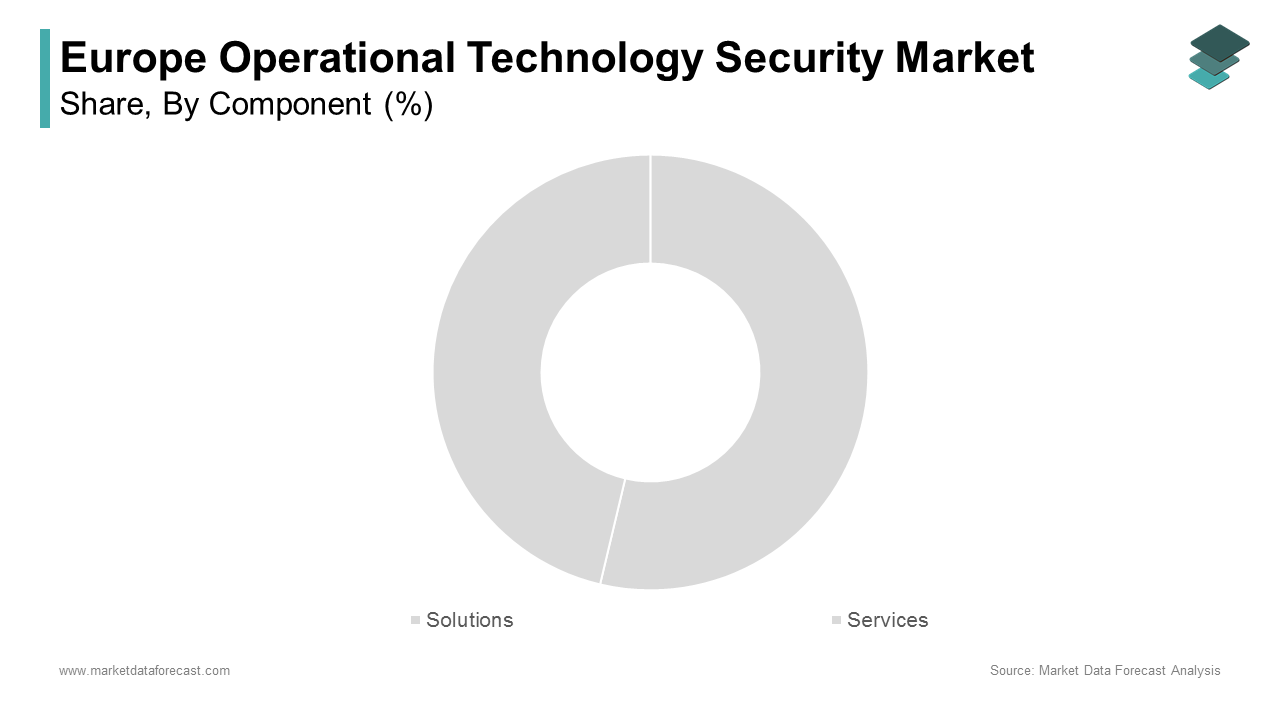
The services segment is anticipated to grow at the fastest CAGR of about 12.8% over the forecast period in the European market. The complexity of regulatory interpretation, legacy system integration, and cross‑domain risk assessments is propelling the growth of the services segment. According to the European Centre for the Development of Vocational Training, many NIS2‑designated entities lack in‑house expertise to design OT‑specific security architectures, driving demand for specialized consulting. As per Germany’s Federal Office for Information Security, industrial firms commissioned external OT security audits in 2025 to validate compliance with national NIS2 transposition. France’s ANSSI requires third‑party validation for OT incident response plans, creating recurring demand for testing and exercises. According to ENISA, a significant share of European manufacturers outsources OT monitoring due to staffing gaps. This segment is expected to expand rapidly over the forecast period as outsourcing, managed services, and vendor risk assessments become indispensable for sustainable OT resilience.
By Deployment Mode Insights
The on‑premise segment dominated the Europe OT security market by holding 71.4% of the market share in 2025. The dominance of the on‑premise segment in this European market is attributed to stringent data sovereignty mandates and real‑time performance requirements. According to the European Data Protection Supervisor, utilities and water facilities restrict transmission of OT telemetry to external cloud environments due to national security concerns. As per Germany’s Federal Ministry for Economic Affairs and Climate Action, monitoring for critical manufacturing infrastructure must occur within national borders using isolated systems. France’s ANSSI classifies OT network traffic as sensitive national infrastructure data under the Cloud de Confiance framework, requiring on‑site analysis. ENISA highlights that latency constraints in industrial automation, where control loops operate in sub‑10 millisecond windows, make cloud‑based analysis impractical for anomaly detection. This segment is expected to sustain dominance over the forecast period as sovereignty and safety remain prioritized.
The cloud segment is expected to register the fastest CAGR of 13.3% over the forecast period in the European market. The emergence of sovereign cloud infrastructures and centralized threat intelligence is supporting the growth of the cloud segment. According to the GAIA‑X initiative, OT telemetry processing within EU jurisdiction enables secure cross‑facility correlation. As per the European Cloud Partnership, mid‑sized manufacturers in industrial networks adopted cloud‑hosted OT monitoring to standardize security baselines. The European Commission’s Digital Europe Programme allocated significant funding for cloud‑based OT security pilots using federated learning to detect anomalies without transferring raw OT data. According to the European Environment Agency, renewable operators managing offshore wind farms rely on secure edge‑to‑cloud pipelines for consolidated visibility. This segment is expected to expand rapidly over the forecast period as sovereign cloud providers enhance OT protocol support and latency optimization.
By End User Industry Insights
The power utilities segment occupied approximately 26% of the Europe OT security market share in 2025. The leading position of the power utilities segment in this European market is attributed to systemic importance, high threat exposure, and early adoption of regulatory mandates. According to ENTSO‑E, transmission system operators across the EU have implemented continuous OT network monitoring in response to escalating cyber threats to grid infrastructure. As per ENISA, power utilities progressed early on OT asset inventories and vulnerability assessments in preparation for NIS2 obligations. According to the European Environment Agency, smart grid rollouts have deployed millions of smart meters across the EU, expanding the attack surface in distribution networks. National regulators such as Germany’s BNetzA and France’s CRE require enhanced intrusion detection capabilities on substation networks. This segment is expected to remain dominant over the forecast period as utilities continue prioritizing cross‑border grid stability and resilience investments.
The transportation and logistics segment is anticipated to grow at the fastest CAGR of 14.4% over the forecast period in the European market. The digitalization of rail signaling, port automation, and multimodal freight systems is propelling the growth of the transportation and logistics segment. According to the European Union Agency for Railways, new ETCS deployments embed security‑by‑design requirements across modernization projects. As per the European Commission, billions of euros have been allocated for smart port infrastructure requiring OT security for automated crane systems and robotics. ENISA documented a sharp increase in ransomware targeting European logistics hubs, with major ports reporting operational impacts. The NIS2 Directive newly classified inland waterways and freight terminals as essential entities, which is mandating OT asset management and incident reporting. This segment is expected to expand robustly over the forecast period as operators adopt OT security to protect supply chains and mobility systems.
REGIONAL ANALYSIS
Germany OT Security Market Analysis
Germany dominated the European OT security market in 2025 by holding 25.5% of the regional market share. The leading position of Germany in the European market can be credited to its dense industrial base, proactive regulation, and strong cybersecurity ecosystem. According to the Federal Office for Information Security (BSI), critical infrastructure operators are required to undergo regular OT security maturity assessments under NIS2 transposition. As per the Federal Ministry for Economic Affairs and Climate Action, industrial control systems in the energy and water sectors are subject to mandated penetration testing, reinforcing continuous OT defense. Germany’s participation in GAIA‑X supports secure industrial data spaces for OT threat intelligence while preserving sovereignty. Furthermore, OT security compliance is linked to Industry 4.0 subsidies, which are incentivizing SMEs to adopt certified solutions. With more than 45,000 industrial plants requiring protection, Germany is expected to remain the regulatory and technological benchmark for OT security in Europe.
France OT Security Market Analysis
France accounted for a substantial share of the European OT security market in 2025. The state‑led digital sovereignty, concentrated defense and energy assets, and strict operational continuity mandates are boosting the French market growth. According to ANSSI, France enforces some of the EU’s strictest OT security requirements, including real‑time monitoring and backup segregation for nuclear and rail systems. As per EDF, France operated 56 nuclear reactors in 2025, with enhanced industrial controls and cybersecurity measures. The Cloud de Confiance framework restricts OT data processing to certified national providers such as Thales and Orange Cyberdefense. The OT Cyber Campus, launched in 2023, provides a national testbed for simulating industrial attacks. With over 1,200 essential entities designated under NIS2, France is expected to sustain its defense‑first posture in OT security.
United Kingdom OT Security Market Analysis
The United Kingdom is anticipated to account for a prominent share of the European OT security market over the forecast period owing to the advanced energy infrastructure, offshore operations, and strong regulatory alignment. According to the National Cyber Security Centre (NCSC), revised NIS Regulations require Category 1 and 2 operators to implement OT‑specific controls. As per the Department for Energy Security and Net Zero, National Grid substations are being upgraded with monitoring and anomaly detection systems. According to the Oil and Gas Authority, North Sea platforms have expanded remote OT monitoring to reduce risks while maintaining vigilance. NCSC advisories published in 2023 highlighted attempted OT breaches, which are fostering sector‑wide awareness. The UK is expected to maintain interoperable practices aligned with ENISA guidance, sustaining its influential OT security posture.
Italy OT Security Market Analysis
Italy maintained a significant role in the European OT security market in 2025. The EU‑funded modernization, regulatory pressure under NIS2, and heightened activity in energy and manufacturing are propelling the Italian operational technology security market. According to the Italian National Cybersecurity Agency, over 600 essential entities were designated under NIS2 transposition in 2025, with mandatory OT risk assessments. As per the Ministry of Economic Development, large manufacturing plants in Lombardy and Emilia‑Romagna initiated OT security projects under the National Recovery and Resilience Plan, which allocated €1.3 billion for industrial cyber resilience. Terna, Italy’s transmission operator, expanded OT intrusion detection across its substations. Ferrovie dello Stato is upgrading signaling systems with embedded security modules to comply with European Railway Agency mandates. Italy is expected to accelerate OT security adoption, which is consolidating its fourth‑place standing in Europe.
Netherlands OT Security Market Analysis
The Netherlands is expected to exhibit a healthy CAGR in the European OT security market during the forecast period due to logistics and energy transit prominence, advanced digital governance, and strong public‑private collaboration. According to the Dutch National Cyber Security Centre (NCSC), OT‑related incidents in critical infrastructure were reported and mitigated in 2023. As per the Ministry of Infrastructure and Water Management, OT controls are mandated for automated port systems and pipeline SCADA networks. Gasunie and TenneT collaborate on GAIA‑X‑based platforms to correlate threats across energy transmission assets while keeping data within EU borders. The Dutch government’s “Secure by Design” procurement policy requires OT security architecture in all public industrial projects. The Netherlands is expected to strengthen its role as a connected OT security hub in Europe.
COMPETITION OVERVIEW
Competition in the Europe operational technology security market is defined by a dynamic interplay between global cybersecurity leaders and specialized industrial vendors, each striving to align with the region’s unique regulatory and operational imperatives. Unlike other markets where feature breadth dominates competition, in Europe hinges on demonstrable compliance with NIS2, the Cyber Resilience Act, and national sovereignty frameworks. Established players leverage deep industrial integrations and government trust, while niche entrants focus on protocol-specific detection or lightweight solutions for small manufacturers. The absence of universal OT security standards creates both fragmentation and opportunity as vendors differentiate through certifications, localized threat intelligence, and sovereign infrastructure partnerships. Public procurement rules further shape the landscape, favoring vendors with EU-based R and D and transparent supply chains. As critical infrastructure operators transition from reactive to proactive defense, the competitive edge increasingly lies in the ability to merge industrial engineering rigor with cyber resilience in a manner that is auditable, transparent, and aligned with Europe’s vision of digital autonomy and societal safety.
KEY MARKET PLAYERS
A few major players of the Europe operational technology security market include
- Microsoft
- Broadcom
- Cisco Systems
- Fortinet
- Forcepoint
- Tenable
- Check Point Software Technologies
- Palo Alto Networks
- Darktrace
- Nozomi Networks
- Claroty
- Honeywell
- Siemens
- Schneider Electric
- Rockwell Automation
- GE Vernova
- Armis Security
- Forescout
- Waterfall Security Solutions
- OPSWAT
- Radiflow
- Indegy
- BAE Systems
- Tripwire
- Kaspersky Lab
Top Strategies Used by the Key Market Participants
Key players in the Europe operational technology security market prioritize regulatory alignment by embedding NIS2 and Cyber Resilience Act requirements directly into product architectures and service delivery models. They invest in sovereign cloud and on-premises deployment options to satisfy EU data residency and latency constraints for critical infrastructure. Strategic partnerships with national agencies and industrial consortia such as GAIA-X and European rail operators enable co-development of sector-specific security controls. Companies also expand professional services and training academies to address the acute shortage of OT cybersecurity talent across the region. Additionally, they enhance threat intelligence through region-focused research units that monitor ICS targeted campaigns and share actionable indicators with European CERTs and asset owners.
Leading Players in the Market
Siemens AG
Siemens AG is a cornerstone of the Europe operational technology security market through its industrial cybersecurity portfolio under Siemens Energy and Siemens Digital Industries. The company integrates security into its automation hardware and software stack, including SIMATIC controllers and Teamcenter, ensuring OT resilience by design. Siemens actively contributes to global standards such as IEC 62443 and collaborates with ENISA on critical infrastructure protection frameworks. In 2025, Siemens expanded its OT security consulting services across Southern Europe and launched a sovereign cloud-based threat intelligence platform hosted in German GGAIA-X-compliant data centers. These initiatives reinforce its position as a trusted European industrial partner that embeds cybersecurity into the fabric of digital manufacturing and energy operations both regionally and worldwide.
Palo Alto Networks Inc
Palo Alto Networks Inc...has established a significant footprint in the Europe operational technology security market through its specialized OT security platform acquired via the 2021 acquisition of Bridgepoint Technologies and enhanced with AAI-driven anomaly detection. The company’s OT security offering is tailored for European energy and manufacturing sectors with ppre-validatedrule rule sets for protocols like Modbus and DNP3. Globally, Palo Alto Networks contributes to OT threat intelligence sharing through its Unit 42 research team, which publishes actionable advisories on IICS-targeted malware. In early 2025, the company opened an OT Security Operations Center in Amsterdam to support real-time monitoring for European critical infrastructure clients and partnered with Dutch grid operators to pilot autonomous response capabilities aligned with NIS2 requirements.
Fortinet Inc
Fortinet Inc...plays a pivotal role in the Europe operational technology security market by delivering purpose-built firewalls and segmentation solutions that meet stringent EU regulatory demands. Its FortiGate industrial security appliances support deep packet inspection for over 60 OT protocols and are certified under national schemes in Germany, France, and Italy. Fortinet contributes globally by integrating OT telemetry into its Security Fabric architecture, enabling unified IT OT visibility. In 2025, Fortinet launched a dedicated OT security training academy in partnership with European technical universities to address the cross-domain skills gap. The company also enhanced its FortiNAC solution with automated asset discovery features validated against ENISA’s OT security controls framework, strengthening its relevance for NIS2-compliant deployments across the region.
MARKET SEGMENTATION
This research report on the Europe operational technology security market has been segmented and sub-segmented based on component, deployment industry, and region.
By Component
- Solutions
- Services
By Deployment
- On Premise
- Cloud
By End Use
- Power Utilities
- Transportation and Logistics
By Region
- UK
- France
- Spain
- Germany
- Italy
- Russia
- Sweden
- Denmark
- Switzerland
- Netherlands
- Turkey
- Czech Republic
- Rest of Europe
Frequently Asked Questions
1. Which industries drive OT security demand in Europe?
Energy, oil & gas, manufacturing, utilities, transportation, mining, chemicals, and water treatment are the major adopters.
2. Why is OT security important in Europe?
Critical infrastructure in Europe is increasingly targeted by cyberattacks, making protection essential for national security, public safety, and uninterrupted industrial operations.
3. What are the key technologies used in OT security?
Firewall solutions, network monitoring, intrusion detection systems, identity and access management, threat intelligence, endpoint protection, and secure remote access tools.
4. Who are the major OT security vendors operating in Europe?
Top vendors include Fortinet, Cisco, Microsoft, Palo Alto Networks, Darktrace, Claroty, Nozomi Networks, Siemens, Schneider Electric, and Honeywell.
5. How does digital transformation impact OT security in Europe?
The rise of IIoT, smart factories, and Industry 4.0 increases network connectivity, making industries more vulnerable to cyberattacks and driving demand for advanced OT security.
6. What regulations influence OT security adoption in Europe?
Key regulations include the NIS2 Directive, GDPR, IEC 62443 standards, and industry-specific compliance frameworks like ISO/IEC 27001.
7. What are the major threats affecting OT systems in Europe?
Ransomware, state-sponsored cyberattacks, supply-chain attacks, phishing, and malware targeting ICS and SCADA networks.
8. What are the key challenges in implementing OT security in Europe?
Lack of skilled workforce, integration issues with legacy systems, high deployment cost, and limited visibility into complex industrial networks.
9. What opportunities exist in the Europe OT security market?
Growing smart manufacturing initiatives, IIoT adoption, increasing cyber threats, and government-funded security programs are driving growth opportunities.
10. How does cloud adoption impact OT security?
Cloud-based monitoring and remote access improve security orchestration but require robust access control and encryption to prevent breaches.
11. What role does AI play in OT security?
AI-powered analytics help in real-time threat detection, predictive maintenance, anomaly detection, and automated response to cyber incidents.
12. Who are the primary end users of OT security services in Europe?
Public utilities, industrial enterprises, critical infrastructure operators, manufacturing plants, and government security agencies are the major end users.
Related Reports
Access the study in MULTIPLE FORMATS
Purchase options starting from
$ 2000
Didn’t find what you’re looking for?
TALK TO OUR ANALYST TEAM
Need something within your budget?
NO WORRIES! WE GOT YOU COVERED!
Call us on: +1 888 702 9696 (U.S Toll Free)
Write to us: sales@marketdataforecast.com