- Product Description Description
- Table of Contents TOC
- List of Table & Figure LOT
- Get Free Sample PDF Sample PDF
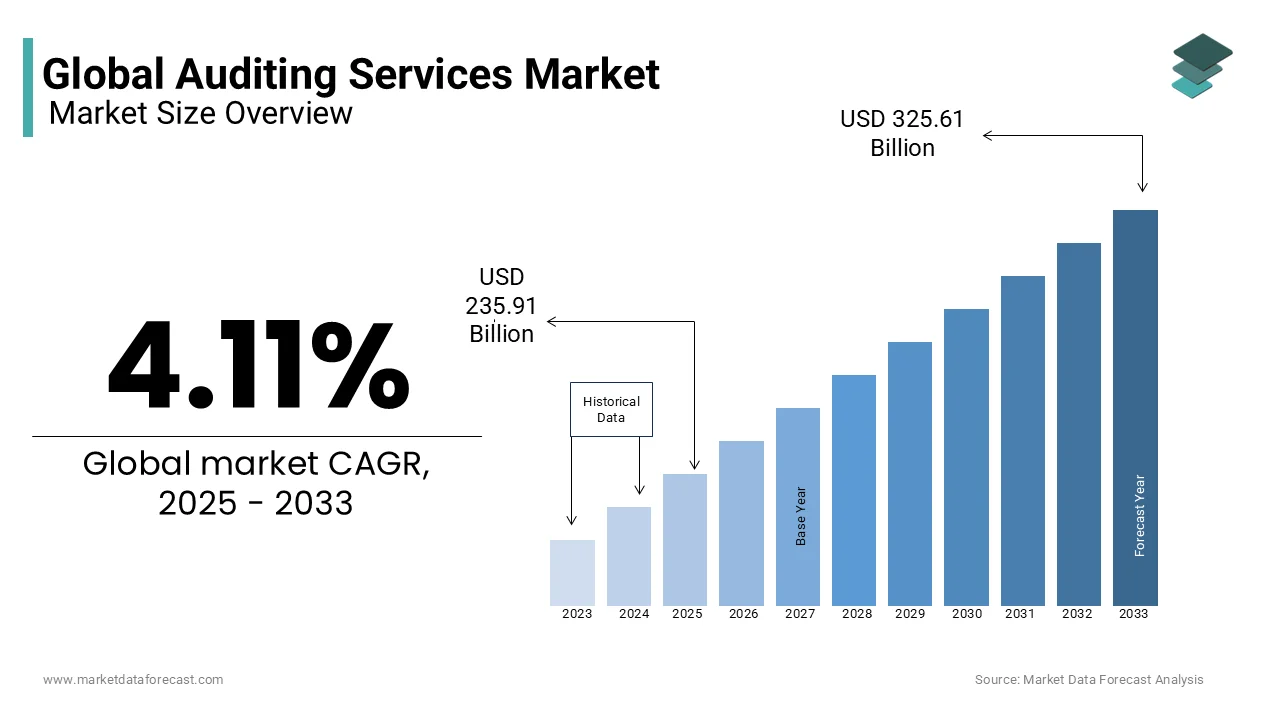
Market Size, 2025
$235.91 BnMarket Estimate, 2026
$245.61 BnMarket Forecast, 2034
$339.98 BnCAGR, 2026–2034
4.11%Global Auditing Services Market Size
The global auditing services market was worth USD 235.91 billion in 2025. The global market is estimated to be worth USD 338.98 billion by 2034 from USD 245.61 billion in 2026, growing at a CAGR of 4.11% during the forecast period 2026 to 2034.
The Auditing Services range from independent examination procedures conducted by qualified professionals to evaluate the accuracy, transparency, and compliance of financial statements, internal controls, and regulatory adherence within organizations. These services are fundamental to ensuring accountability in corporate governance, investor confidence, and capital market integrity. External audits, mandated for publicly traded entities and increasingly required for large private firms, verify that financial disclosures conform to established accounting frameworks such as International Financial Reporting Standards (IFRS) or U.S. Generally Accepted Accounting Principles (GAAP). According to the International Federation of Accountants, over 140 countries have adopted IFRS for public companies, creating a standardized demand for audit rigor across global markets.
MARKET DRIVERS
Increasing Regulatory Mandates for Financial Transparency and Corporate Accountability
The expansion of global regulatory frameworks requiring audited financial disclosures is boosting the growth of the Auditing Services Market. Jurisdictions worldwide are tightening corporate governance standards in response to financial scandals and systemic risks. The European Union’s Audit Regulation and Directive, effective since 2016, mandates mandatory audit firm rotation every 10 years for public-interest entities, affecting over 11,000 companies across member states, as documented by the European Commission. In India, the Companies Act of 2013 requires all companies with a turnover exceeding INR 1 billion or outstanding loans above INR 500 million to undergo annual audits, covering over 650,000 entities as per the Ministry of Corporate Affairs. Similarly, in Saudi Arabia, the Capital Market Authority mandates external audits for all listed firms and private companies raising capital above SAR 100 million, aligning with Vision 2030’s financial sector reform agenda. The U.S. Public Company Accounting Oversight Board reports that over 98% of public companies in the United States undergo annual audits, with enhanced scrutiny on revenue recognition and related-party transactions post-Enron reforms.
Surge in Cross-Border Investments and Multinational Corporate Structures
The proliferation of multinational enterprises and cross-border capital flows has significantly amplified the need for standardized and international services that is solely amplifying the growth of the Auditing Services Market. These complex corporate structures necessitate consolidated financial statements audited under globally accepted standards to ensure comparability and trust among international stakeholders. For instance, a single multinational with operations in 30 countries must reconcile diverse accounting practices and submit audited reports acceptable to regulators in each jurisdiction, often requiring coordination among multiple audit firms under a lead auditor. The International Financial Reporting Standards Foundation confirms that over 140 jurisdictions now require IFRS-compliant audits for public companies, creating a unified demand for auditors with cross-border expertise.
MARKET RESTRAINTS
Persistent Talent Shortage in the Professional Auditing Workforce
The scalability and quality of auditing services is the global deficit of qualified audit professionals, particularly at the mid-tier and senior associate levels that is hindering the growth of the Auditing Services Market. The American Institute of CPAs reports that U.S. accounting firms faced a shortfall of over 25,000 auditors in 2023, with attrition rates exceeding 20% annually due to burnout and competitive tech-sector recruitment. In India, the Institute of Chartered Accountants of India confirms that while over 400,000 students are enrolled in the CA program, only 18% pass the final audit and assurance examination, limiting the pool of certified practitioners. The International Federation of Accountants identifies that 70% of audit firms in emerging markets lack staff trained in International Standards on Auditing (ISA), compromising audit quality. Furthermore, mandatory audit partner rotation regulations in the EU and Australia increase the burden on experienced personnel, exacerbating gaps.
Growing Public Skepticism and Erosion of Trust in Audit Firms
The credibility of the auditing profession has come under increasing scrutiny following high-profile corporate failures where auditors failed to detect material misstatements or fraud. The collapse of Carillion in the UK, which was audited by KPMG, prompted the Financial Reporting Council to conclude that the audit lacked professional skepticism and failed to challenge management assumptions. According to a 2023 Edelman Trust Barometer, only 43% of institutional investors express strong confidence in audit reports, down from 58% in 2018. In Australia, the Royal Commission into Misconduct in the Banking, Superannuation and Financial Services Industry found that audit firms prioritized client retention over independence, undermining public trust.
MARKET OPPORTUNITIES
Expansion of ESG and Sustainability Assurance Services
The rapid institutionalization of environmental, social, and governance (ESG) reporting is creating a new opportunities for the growth of the Auditing Services Market. The European Financial Reporting Advisory Group estimates that this will generate over 120 million EUR in annual assurance fees by 2027. In the United States, the Securities and Exchange Commission’s proposed climate disclosure rules would mandate greenhouse gas emissions verification for public companies, opening a new audit frontier. Firms like EY and PwC have already launched dedicated ESG assurance divisions, training thousands of professionals in carbon accounting and social impact metrics. The International Auditing and Assurance Standards Board has issued ISAE 3410 for greenhouse gas verification, providing a standardized framework.
Adoption of AI and Data Analytics in Audit Processes
The integration of artificial intelligence and advanced data analytics into audit workflows is likely to leverage the growth opportunities for the Auditing Services Market. Traditional audits often rely on sampling, reviewing only a fraction of transactions; AI enables full-population testing, analyzing millions of entries for anomalies. According to a Deloitte case study, AI-powered audit tools reduced transaction review time by 65% while increasing anomaly detection rates by 40%. The Institute of Internal Auditors reports that 58% of global audit firms now use data analytics platforms for risk assessment and fraud detection. Regulatory bodies are encouraging this shift; the Canadian Public Accountability Board has issued guidance on the ethical use of AI in audits.
MARKET CHALLENGES
Conflicts of Interest Arising from Non-Audit Services Provided by Audit Firms
The conflict of interest created when audit firms provide lucrative consulting and advisory services to the same clients they are tasked with independently auditing is to hamper the growth of the auditing market. According to the European Commission, non-audit fees accounted for 61% of total revenue for the Big Four audit firms in the EU in 2022 by raising concerns about compromised objectivity. The collapse of Wirecard in Germany, audited by EY, revealed that the firm had also earned substantial fees for internal control consulting, blurring the lines between assurance and advisory roles. The U.S. Public Company Accounting Oversight Board’s 2023 inspection report found that 38% of inspected firms failed to maintain adequate independence safeguards when providing non-audit services.
Rapidly Evolving Cybersecurity and Digital Asset Reporting Requirements
The increasing digitization of financial systems and the emergence of digital assets are introducing unprecedented complexity into audit engagements that is challenging the growth of the auditing market. As of 2023, the World Economic Forum reports that over 70% of corporate transactions are processed through cloud-based platforms, exposing audit trails to cyber threats and data integrity risks. Auditors must now assess the reliability of IT controls, encryption protocols, and access governance systems—areas outside conventional accounting expertise. The rise of cryptocurrencies and blockchain-based assets further complicates financial reporting; the Financial Action Task Force estimates that over $20 billion in crypto assets are held on corporate balance sheets globally, yet standardized audit procedures for wallet verification and private key custody remain under development.
REPORT COVERAGE
| REPORT METRIC | DETAILS |
| Market Size Available | 2025 to 2034 |
| Base Year | 2025 |
| Forecast Period | 2026 to 2034 |
| CAGR | 4.11% |
| Segments Covered | By Type, Service, End Use, and Region. |
|
Various Analyses Covered | Global, Regional & Country Level Analysis, Segment-Level Analysis, DROC, PESTLE Analysis, Porter’s Five Forces Analysis, Competitive Landscape, Analyst Overview of Investment Opportunities |
| Regions Covered | North America, Europe, APAC, Latin America, Middle East & Africa |
| Market Leaders Profiled | ProtivitiRSM US, Grant Thornton International Ltd., Moore Stephens International Limited, Mazars, Nexia International Limited, Ernst & Young, Deloitte, KPMG, PwC and Others. |
SEGMENTAL ANALYSIS
By Type Insights
The External audit segment held a prominent share of the global auditing services market in 2024, with the mandatory nature for publicly listed companies, regulated financial institutions, and large private enterprises across jurisdictions. The primary driver of this dominance is statutory compliance: over 140 countries require external audits for public-interest entities under frameworks aligned with International Standards on Auditing (ISA). In the United States, the Securities and Exchange Commission mandates annual external audits for all public companies, affecting more than 5,000 entities, according to the U.S. Public Company Accounting Oversight Board. Additionally, stock exchanges such as the London Stock Exchange and Tokyo Stock Exchange enforce audit compliance as a listing condition. In emerging markets like India, the Companies Act of 2013 requires external audits for firms exceeding INR 1 billion in turnover, encompassing over 600,000 businesses per the Ministry of Corporate Affairs.

By Service Insights
The Financial Audits segment held 48.3% of the auditing market share in 2024, with the universal requirement for verified financial statements across public and private sectors. In Australia, the Corporations Act 2001 requires financial audits for large proprietary companies, defined as those with consolidated revenue above AUD 50 million, impacting over 10,000 firms per the Australian Securities and Investments Commission. The International Organization of Securities Commissions emphasizes that audited financial statements are a prerequisite for bond issuances and IPOs, with 95% of global equity offerings requiring three years of audited results. The World Bank reports that countries with robust financial audit regimes attract 32% more foreign direct investment than those without. Additionally, lending institutions rely on audited financials for credit risk assessment, with the Federal Reserve noting that 89% of commercial loan approvals above $10 million require recent financial audit reports.
The advisory & consulting segment is anticipated to grow at a CAGR of 9.4% from 2026 to 2034 with the increasing complexity of regulatory environments and the need for strategic financial guidance beyond traditional assurance. Companies are increasingly engaging audit firms for post-audit support, including tax restructuring, ESG integration, and digital transformation planning. According to PwC’s 2023 Global Risk Survey, 71% of CEOs now consult their auditors on strategic risk mitigation, up from 48% in 2018. According to Deloitte’s 2023 Technology Integration Report, 60% of ERP implementations in multinational firms involve audit firms for control alignment and data integrity assurance. Additionally, mergers and acquisitions activity has amplified demand for due diligence and integration planning with the advisory fees from M&A engagements growing by 18% in 2023.
By End-Use Insights
The BFSI (Banking, Financial Services, and Insurance) sector was the largest by capturing 36.4% of the auditing services market share in 2024, with the sector’s high regulatory intensity and systemic importance to economic stability. Financial institutions are subject to stringent audit requirements under global frameworks such as Basel III, which mandates annual independent audits of capital adequacy, risk exposure, and liquidity coverage ratios. In the United States, the Federal Deposit Insurance Corporation requires all banks with assets exceeding $500 million to undergo annual external audits, affecting over 2,800 institutions, according to the Office of the Comptroller of the Currency. Similarly, in the European Union, the Solvency II Directive compels insurance firms to submit audited reports on technical provisions and solvency margins, covering over 1,200 insurers as documented by the European Insurance and Occupational Pensions Authority.
The healthcare sector is swiftly emerging with a CAGR of 9.1% from 2026 to 2034, owing to the escalating regulatory scrutiny and financial complexity in healthcare delivery systems. In the United States, the Centers for Medicare & Medicaid Services reports that over $98 billion in improper payments were identified in 2022, prompting increased audits of billing practices, coding accuracy, and compliance with the False Claims Act. The U.S. Department of Health and Human Services mandates that hospitals receiving federal funds undergo annual financial and compliance audits, affecting over 6,000 facilities. Similarly, in the European Union, the Cross-Border Healthcare Directive requires audited financial statements for cross-border service providers to ensure reimbursement transparency.
REGIONAL ANALYSIS
North America Auditing Services Market Insights
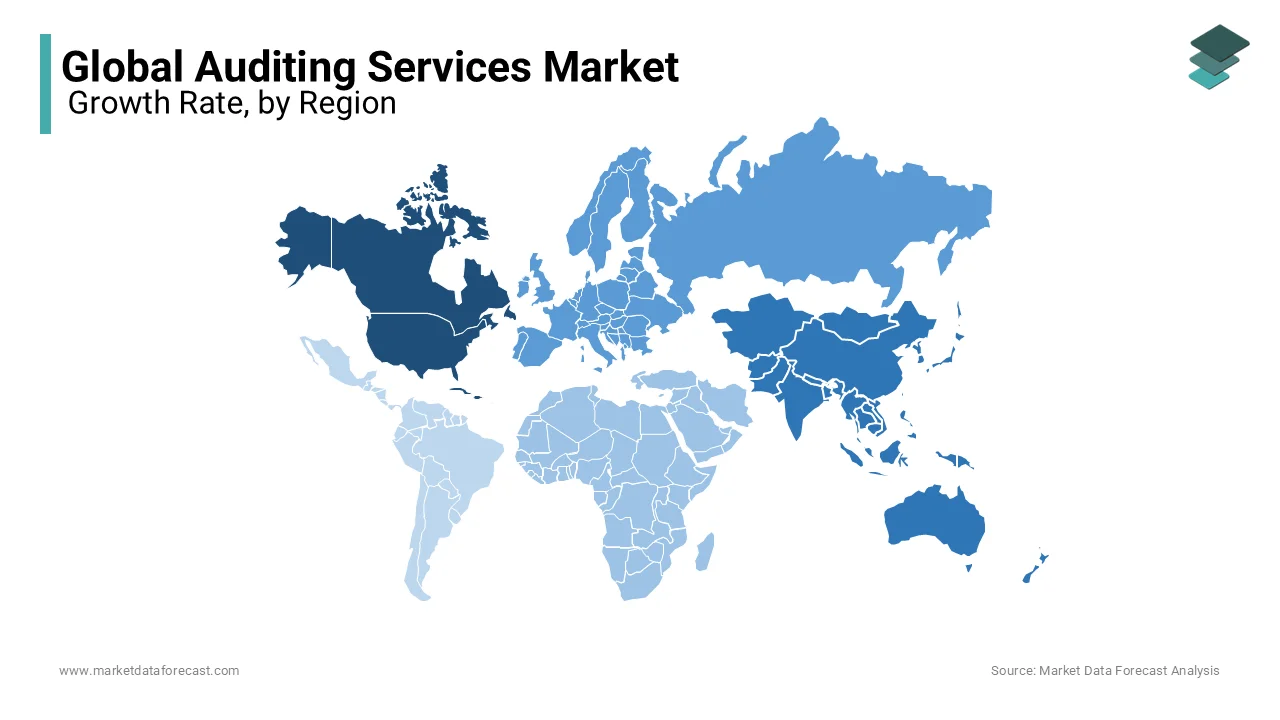
North America was the top performer of the global auditing services market with 37.4% of the share in 2024. The United States sets the global benchmark for audit quality and enforcement, which is driven by the Sarbanes-Oxley Act of 2002, which established strict auditor independence rules and mandatory audit committee oversight. The Securities and Exchange Commission requires over 5,000 public companies to file audited financial statements annually, with the PCAOB conducting inspections of audit firms to ensure compliance. According to the American Institute of CPAs, U.S. audit fees exceeded $18 billion in 2023, reflecting high service intensity. Canada complements this with a robust framework under the Canadian Public Accountability Board, which mandates audit firm rotation and enhanced disclosure for public companies. The Canadian Securities Administrators reports that 96% of TSX-listed firms undergo external audits, with increasing demand for ESG assurance. The presence of all Big Four firms’ global hubs in New York and Toronto fosters innovation in audit technology, including AI-driven anomaly detection and blockchain-based transaction verification.
Europe Auditing Services Market Insights
Europe auditing services market held 31.2% of the share in 2024. The EU Audit Regulation has harmonized key aspects of audit quality, including mandatory audit firm rotation and enhanced transparency for public-interest entities by affecting over 11,000 companies. In Germany, the country’s strict commercial code requires audits for mid-sized firms, which is creating a dense audit culture. The German Federal Statistical Office reports that over 150,000 entities undergo annual audits. The UK, despite Brexit, maintains a high audit intensity through the Financial Reporting Council and the upcoming transition to the Audit, Reporting and Governance Authority. The British Bankers’ Association notes that all major UK banks undergo biannual audits for prudential compliance.
Asia-Pacific Auditing Services Market Insights
The Asia-Pacific auditing services market is anticipated to grow steadily with growth propelled by rising corporate formalization and financial sector development. China leads the region, where the Ministry of Finance mandates audits for all listed companies and foreign-invested enterprises, covering over 50,000 entities. The Shanghai and Shenzhen Stock Exchanges require audited financials for all IPOs, with the China Securities Regulatory Commission conducting annual reviews of audit quality. India is witnessing rapid expansion with the Companies Act mandating audits for over 600,000 firms, and the Securities and Exchange Board of India strengthening auditor independence rules post-IL&FS and Satyam scandals.
Latin America Auditing Services Market Insights
Latin America auditing services market growth is driven by financial sector regulation and capital market integration. Brazil leads the region, where the Comissão de Valores Mobiliários requires external audits for all publicly traded companies and financial institutions, affecting over 800 entities. The Brazilian Institute of Certified Public Accountants reports that audit penetration in the private sector has increased by 22% since 2020 due to tax compliance requirements. In Mexico, the National Banking and Securities Commission mandates audits for all banks and securities firms, with the Mexican Stock Exchange requiring audited statements for listing. Chile has one of the most advanced audit frameworks in the region, with the Superintendence of Securities and Insurance enforcing ISA-compliant audits for pension fund managers, which oversee over $200 billion in assets. Colombia and Peru are modernizing their audit standards under the hemispheric integration agenda, with the Andean Community promoting mutual recognition of audit reports.
Middle East and Africa Auditing Services Market Insights
The Middle East and Africa auditing services market growth is driven by growth concentrated in nations pursuing economic transparency and post-oil diversification. The UAE leads the region, where the Securities and Commodities Authority mandates external audits for all listed companies and free zone entities, with Dubai International Financial Centre enforcing International Financial Reporting Standards. Saudi Arabia’s Vision 2030 includes financial sector reforms requiring audited statements for privatized entities and public-private partnerships, with the Capital Market Authority overseeing over 200 listed firms. The Saudi Organization for Certified Public Accountants reports that audit demand grew by 19% in 2023 due to NEOM and Red Sea Project financings.
COMPETITIVE LANDSCAPE
The competition in the auditing services market is defined by a combination of regulatory scrutiny, technological differentiation, and reputational capital rather than price-based rivalry. The competitive landscape is shifting from traditional financial verification to integrated assurance, encompassing ESG, cybersecurity, and operational resilience. Technological innovation has become a key differentiator, with firms deploying AI, data analytics, and blockchain to enhance audit quality and real-time monitoring. Regulatory reforms in the U.S., UK, and EU are increasing pressure on audit independence, prompting structural changes such as legal entity separation between audit and consulting. In Asia Pacific and Latin America, competition is intensifying as local firms partner with international networks to meet rising demand for credible audits.
KEY PLAYERS IN THE MARKET
Companies playing a notable role in the global auditing services market include
- Protiviti
- RSM US
- Grant Thornton International Ltd.
- Moore Stephens International Limited
- Mazars
- Nexia International Limited
- Ernst & Young
- Deloitte
- KPMG
- PwC
TOP LEADING PLAYERS IN THE MARKET
- PwC has established a dominant presence in the Asia Pacific auditing landscape through its extensive network of member firms and deep integration with regional regulatory frameworks. The firm serves a vast portfolio of multinational corporations, state-owned enterprises, and emerging market leaders across jurisdictions, including Singapore, India, Japan, and Australia. In 2023, PwC launched its Audit Accelerator platform in the region, leveraging AI and data analytics to enhance audit quality and real-time risk detection for clients in financial services and technology sectors. The firm strengthened its ESG assurance capabilities by partnering with the Singapore Exchange to develop audit-ready sustainability reporting templates aligned with IFRS Sustainability Disclosure Standards. PwC also expanded its forensic audit practice in Indonesia and Vietnam to support anti-corruption initiatives and capital market transparency.
- EY has significantly advanced its footprint in the Asia Pacific auditing market by focusing on innovation, regulatory collaboration, and sector-specific audit transformation. The firm has played a pivotal role in shaping audit standards across the region, working closely with regulators such as the Institute of Chartered Accountants of India and the Hong Kong Institute of Certified Public Accountants to promote audit quality reforms. In 2022, EY introduced its EY Helix platform across major offices in Sydney, Mumbai, and Seoul, enabling full-population transaction testing and predictive analytics for financial audits. The firm also established the EY Asia Pacific Audit Excellence Centre in Manila, centralizing data review and compliance monitoring for multinational clients. EY has been at the forefront of ESG assurance, launching a dedicated Climate Change and Sustainability Services (CCaSS) division that conducted over 300 limited assurance engagements in 2023 across ASEAN and ANZ markets.
- Deloitte has its position in the Asia Pacific auditing market through strategic investments in technology, talent, and regulatory alignment across high-growth economies. The firm operates one of the most integrated audit networks in the region, supporting clients in compliance with both local regulations and global standards such as IFRS and PCAOB requirements. In 2023, Deloitte rolled out its Illuminated audit platform across China, Japan, and South Korea, integrating AI-driven anomaly detection and blockchain-based transaction verification to improve audit precision. The firm expanded its sustainability audit practice by assisting over 200 companies in Thailand and Malaysia with CSRD-aligned disclosures ahead of ASEAN’s 2025 ESG mandate. Deloitte also launched a regional audit innovation lab in Bengaluru, focused on automating risk assessment models for banking and fintech clients.
TOP STRATEGIES USED BY THE KEY MARKET PARTICIPANTS
Key players in the auditing services market are deploying a range of strategic initiatives to enhance service quality, expand capabilities, and strengthen client trust. Major strategies include technological integration, regulatory collaboration, workforce upskilling, expansion of ESG and sustainability assurance, and geographic footprint enhancement. Firms are investing heavily in AI, data analytics, and cloud-based audit platforms to improve accuracy and efficiency. Partnerships with regulatory bodies help align audit practices with evolving standards. Training programs focus on digital literacy, cybersecurity, and sustainability reporting. The development of specialized audit units for fintech, healthcare, and green finance enables differentiation. Mergers with local firms facilitate market entry in emerging economies. These strategies collectively enhance audit relevance, compliance readiness, and competitive advantage in an increasingly complex global business environment.
RECENT MARKET DEVELOPMENTS
- In January 2022, PwC launched its Audit Accelerator platform in Singapore, integrating artificial intelligence and machine learning to automate risk assessment and transaction testing by enhancing audit precision and scalability for multinational clients across Southeast Asia.
- In June 2022, EY established the EY Asia Pacific Audit Excellence Centre in Manila, centralizing data analytics and compliance monitoring to support over 1,200 audit engagements annually and improve consistency in audit delivery across emerging markets.
- In March 2023, Deloitte introduced its Illuminated audit platform in Tokyo, enabling real-time transaction analysis and anomaly detection for financial audits which significantly improving audit quality and client reporting speed for Japanese corporate and financial sector clients.
- In September 2023, PwC partnered with the Singapore Exchange to co-develop audit-ready sustainability reporting templates aligned with IFRS S1 and S2 standards, which is positioning itself as a leader in ESG assurance adoption in the Asia Pacific region.
- In November 2023, EY expanded its Climate Change and Sustainability Services division in Jakarta, conducting over 100 limited assurance engagements for Indonesian firms preparing for mandatory ESG disclosures under upcoming capital market regulations.
MARKET SEGMENTATION
This research report on the global auditing services market has been segmented and sub-segmented based on type, service, end-use, and region.
By Type
- Internal audit
- External audit
By Service
- Operational Audits
- Financial Audits
- Advisory and Consulting
- Investigation Audit
By End-Use
- BFSI
- Government
- Manufacturing
- Healthcare
- Retail & consumer
- It & communications
By Region
- North America
- Europe
- Asia-pacific
- Latin America
- Middle East and Africa