- Product Description Description
- Table of Contents TOC
- List of Table & Figure LOT
- Get Free Sample PDF Sample PDF
Market Size, 2025
$107.21 MnMarket Estimate, 2026
$109.20 MnMarket Forecast, 2034
$126.55 MnCAGR, 2026–2034
1.86%Europe Piano Market Summary
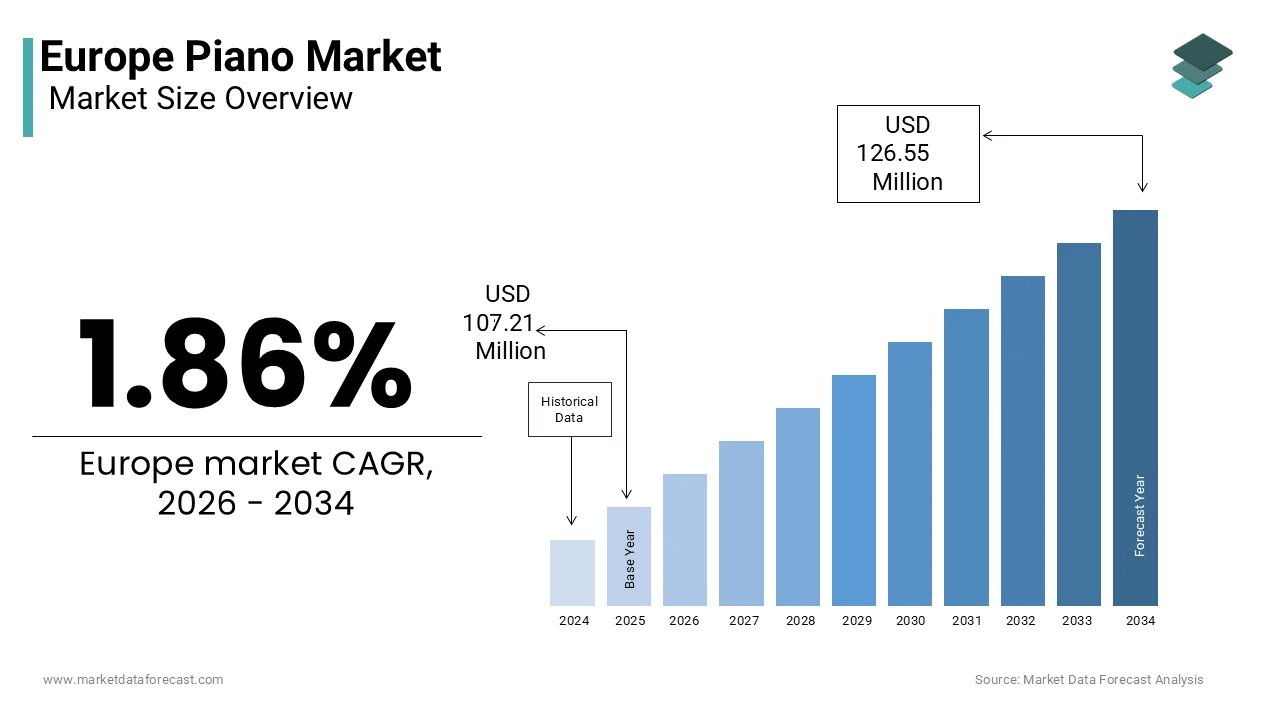
The Europe piano market, valued at USD 107.21 million in 2025, is projected to reach USD 126.55 million by 2034, expanding at a CAGR of 1.86%, driven by strong music education culture, premium acoustic instrument demand, and rising adoption of digital and hybrid pianos in urban households.
Market Snapshot
- 2025 Market Size: USD 107.21 million
- 2026 Estimate: USD 109.20 million
- 2034 Forecast: USD 126.55 million
- CAGR (2026–2034): 1.86%
- Base Year: 2025
- Forecast Period: 2026–2034
Quick Growth Drivers
- Deeply embedded music education systems across Europe
- Government-supported arts and cultural education programs
- Europe’s global leadership in premium acoustic piano craftsmanship
- Rising demand for luxury, handcrafted musical instruments
- Continued enrollment in conservatories and professional music institutions
Principal Restraints
- Shrinking urban living spaces are limiting acoustic piano adoption
- High purchase, maintenance, and logistics costs for acoustic pianos
- Strong competition from advanced digital pianos
- Time and attention diversion toward digital entertainment platforms
High-Value Opportunities
- Integration of hybrid (acoustic + digital) piano technologies
- Expansion of online music education and app-connected learning
- Direct-to-consumer sales models and virtual showrooms
- Bundled offerings combining instruments with digital lessons
Key Market Challenges
- Shortage of skilled piano craftsmen, tuners, and technicians
- An aging artisan workforce and limited apprenticeship intake
- Complex cross-border logistics for high-value instruments
- Regulatory and VAT complexities impacting SME piano makers
Fastest-Growing Segments
- Digital Pianos: CAGR 9.8% driven by urbanization and affordability
- Hybrid Acoustic Pianos: Premium niche with strong margin expansion
- Online Distribution: CAGR 12.4% driven by younger buyers
Regional Leadership & Dynamics
- Germany (25.7%) — Manufacturing leadership and public music schools
- Italy (12.3%) — Luxury, handcrafted concert grand production
- United Kingdom — Strong retail network and curriculum-backed demand
- France — Conservatory-driven institutional demand
- Austria — Cultural epicenter of piano heritage and premium brands
What Wins Commercially
- Strong brand heritage and craftsmanship credibility
- Hybrid piano innovation addressing modern living constraints
- Deep integration with music education institutions
- Premium positioning as cultural and luxury assets
- Robust after-sales service, tuning, and restoration networks
Top Strategic Ask for Executives
Invest in hybrid piano innovation, artisan workforce renewal, and direct-to-consumer digital engagement while preserving Europe’s premium acoustic craftsmanship to sustain long-term cultural and commercial relevance.
Leading Players
Some of the companies that are playing a dominating role in the Europe piano market include:
- Yamaha Corporation
- Steinway & Sons
- Kawai Musical Instruments Manufacturing Co., Ltd.
- Bechstein Group
- Bösendorfer Piano GmbH
- Roland Corporation
- Schimmel Pianofortefabrik GmbH
- Fazioli Pianoforti
- Blüthner Pianofortefabrik GmbH
- Petrof Pianos
Europe Piano Market Size
The Europe piano market was valued at USD 107.21 million in 2025, is estimated to reach USD 109.20 million in 2026, and is projected to reach USD 126.55 million by 2034, growing at a CAGR of 1.86% from 2026 to 2034.
The piano is a versatile acoustic musical instrument played using a keyboard. It produces sound when keys are depressed, activating a mechanical "action" that causes felt-covered wooden hammers to strike tuned metal strings. The market encompasses grand pianos, upright pianos, and digital pianos, each serving distinct user needs from professional concert performance to home education and leisure. Europe’s position as the birthplace of the modern piano, with legendary brands like Steinway & Sons, Bösendorfer, and Fazioli rooted in its soil, imbues the market with an unparalleled heritage that continues to influence global standards of quality and artistry. This cultural significance is supported by a robust educational infrastructure. Formal education initiatives across the European Union maintain a strong emphasis on arts education, resulting in a consistent influx of students engaging with musical training. Furthermore, Europe serves as a major international center for professional musical training, with numerous renowned institutions supporting the development of talent and driving demand for high-quality instruments.
MARKET DRIVERS
Enduring Cultural Value of Music Education in European Society
The deeply ingrained cultural value placed on music education across the continent is a primary driver of the European piano market. Learning a musical instrument, particularly the piano, is widely regarded not just as a hobby but as a fundamental component of a well-rounded education and personal development. This belief is institutionalized in national curricula and supported by public funding for arts programs. In countries like Germany, Austria, and the Nordic states, access to subsidized music schools is nearly universal, ensuring that piano lessons are accessible to a broad socioeconomic spectrum. As per a study, Early childhood engagement with musical instruments is associated with enhanced cognitive and social development, encouraging continued investment in musical education. This societal commitment creates a consistent and resilient base of demand for entry-level and intermediate instruments, forming the bedrock of the market’s long-term stability.
Resurgence of Interest in High-End Acoustic Instruments as Luxury Art Objects
The growing perception of premium acoustic pianos as luxury art objects and heirloom investments rather than mere functional instruments contributes to the expansion of the European piano market. In an era of digital saturation, there is a powerful counter-movement among affluent consumers who seek authentic, tactile, and emotionally resonant experiences. Handcrafted grand and upright pianos from Europe’s historic ateliers fulfill this desire, offering a unique blend of sonic excellence, visual beauty, and artisanal heritage. These instruments are increasingly purchased for their aesthetic and symbolic value, becoming centerpieces in private residences, luxury hotels, and corporate lobbies. The market for premium cultural goods, including fine musical instruments, displays strong stability despite economic volatility, supported by reports from high-end industry alliances. This trend transforms the piano from a depreciating asset into a potential store of value, attracting a new clientele of collectors and connoisseurs who drive demand at the very top end of the market.
MARKET RESTRAINTS
Declining Urban Living Space and Practical Constraints of Acoustic Pianos
The ongoing trend of urbanization and the corresponding reduction in average living space are significant rrestraintson the European piano market. This is particularly true for acoustic models. The rising trend of compact apartment living in Europe makes the space-intensive nature and heavy weight of traditional upright or grand pianos major barriers to adoption. An upright piano can occupy over one square meter of floor space and weigh several hundred kilograms, making it unsuitable for many modern dwellings. The average size of new residential units in certain densely populated European cities is decreasing, reflecting a shift towards more compact urban living. This spatial constraint directly limits the addressable market for acoustic pianos, pushing potential buyers towards more compact digital alternatives or away from piano ownership altogether, thereby capping the growth potential of the traditional segment.
Intense Competition from Advanced Digital Pianos and Alternative Entertainment
Relentless pressure from the rapid technological advancement of digital pianos and the broader landscape of digital entertainment impedes the expansion of the European piano market. Modern digital instruments offer a compelling value proposition: they are significantly more affordable, require no tuning, are portable, and feature headphone compatibility for silent practice, addressing the key drawbacks of acoustic pianos. Simultaneously, the attention of younger generations is fiercely contested by smartphones, video games, and streaming services, which offer instant gratification and social connectivity. Young people in the EU dedicate a substantial portion of their day to digital screens for non-educational activities, prompting calls for consumption limits. This competition for time and disposable income makes the long-term commitment required to learn the piano a harder sell, especially when a convincing and cheaper digital alternative exists for casual playing.
MARKET OPPORTUNITIES
Integration of Hybrid Technologies in Premium Acoustic Pianos
The development and adoption of hybrid acoustic pianos seamlessly integrate advanced digital technology into traditional instruments, which is a major opportunity for the European piano market. These sophisticated models retain the authentic touch and sound of a handcrafted acoustic piano while incorporating features like silent practice modes with high-quality headphone sound, built-in recording capabilities, and connectivity to educational apps. This fusion directly addresses the core restraints of noise and space limitations without compromising on the irreplaceable acoustic experience. There is a heightened demand among serious musicians for musical instruments that offer portability and technological flexibility to fit within contemporary, compact living environments. European manufacturers are revitalizing acoustic instruments for urbanites and attracting tech-savvy musicians by offering a "best of both worlds" solution, justifying premium pricing in the process.
Expansion of Online Music Education Platforms and Direct-to-Consumer Channels
The explosive growth of online music education platforms creates new pathways to piano ownership, which is expected to boost the expansion of the European piano market. Digital learning services have removed geographical and financial barriers to music instruction, making lessons more accessible than ever before. Piano brands can forge strategic partnerships with these platforms to offer bundled packages that include an instrument, a subscription to lessons, and interactive learning software. Furthermore, by developing robust direct-to-consumer e-commerce channels with virtual showrooms and augmented reality tools, manufacturers can reach a pan-European audience without the overhead of physical retail. The European online music education sector is experiencing rapid expansion, driven by the increasing adoption of digital learning tools and professional-level virtual training. This ecosystem presents a powerful opportunity to convert new learners into instrument owners by providing a seamless, end-to-end solution that supports their entire musical journey from day one.
MARKET CHALLENGES
Critical Shortage of Skilled Artisan Craftsmen and Luthiers
The critical shortage of highly skilled artisans, technicians, and luthiers required to build and maintain high-quality acoustic pianos acts as a major obstacle to the European piano market. The craft of piano making is a complex, multi-year apprenticeship that combines woodworking, metallurgy, and acoustics, and the current workforce is aging, with too few young people entering the trade. The specialized musical instrument manufacturing sector in Europe is facing a critical labor challenge, with a high proportion of master builders approaching retirement and insufficient recruitment for training programs. This labor crisis threatens the long-term viability of Europe’s historic piano ateliers, risks a decline in the quality of new instruments, and increases the cost and wait times for both manufacturing and essential maintenance services like tuning and regulation, ultimately undermining the market’s most valuable asset: its artisanal heritage.
Complex Regulatory and Logistical Hurdles for Cross-Border Trade
Complex regulatory and logistical hurdles complicate cross-border trade, particularly for high-value acoustic instruments, which further hampers the expansion of theEuropeane piano market. While the EU is a single market, transporting a delicate grand piano across borders involves navigating varying national regulations on wood treatment, customs documentation, and value-added tax (VAT) reclaim processes. The physical logistics are equally daunting; moving a piano requires specialized vehicles, trained handlers, and climate-controlled environments to prevent damage, making international sales expensive and risky. As per the European Commission’s Directorate-General for Internal Market, small and medium-sized piano makers often lack the administrative resources to manage these complexities efficiently. This fragmentation acts as a significant barrier to scaling, preventing many talented European craftsmen from reaching a wider continental audience and limiting consumer choice, thereby stifling the market’s overall dynamism and growth potential.
REPORT COVERAGE
| REPORT METRIC | DETAILS |
| Market Size Available | 2025 to 2034 |
| Base Year | 2025 |
| Forecast Period | 2026 to 2034 |
| Segments Covered | By Distribution Channel, Product, and Region. |
| Various Analyses Covered | Global, Regional, and Country-Level Analysis, Segment-Level Analysis, Drivers, Restraints, Opportunities, Challenges; PESTLE Analysis; Porter’s Five Forces Analysis, Competitive Landscape, Analyst Overview of Investment Opportunities |
| Countries Covered | UK, France, Spain, Germany, Italy, Russia, Sweden, Denmark, Switzerland, Netherlands, Turkey, Czech Republic, Rest of Europe |
| Market Leaders Profiled | Yamaha Corporation, Steinway & Sons, Kawai Musical Instruments Manufacturing Co., Ltd., Bechstein Group, Bosendorfer (part of Yamaha), Roland Corporation, Schimmel Pianofortefabrik GmbH, Pearl River Piano Group, Bösendorfer Piano GmbH, Fazioli Pianoforti, Hoffmann (C. Bechstein brand), August Förster GmbH, Petrof Pianos, Kohler & Campbell (Young Chang), Nordiska Pianofabriken (Nordiska), Feurich Pianoforte GmbH, Samick Musical Instrument Co., Ltd., Korg Inc., Blüthner Pianofortefabrik GmbH |
SEGMENTAL ANALYSIS
By Distribution Channel Insights
The offline distribution channel segment was the largest segment in the European piano market by accounting for a substantial share in 2025. The supremacy of the offline segment is driven by the highly experiential and tactile nature of purchasing a piano, especially an acoustic instrument. A piano is not a commodity but a significant investment that requires the buyer to physically interact with the instrument, testing its touch, listening to its tonal quality in a controlled acoustic environment, and assessing its aesthetic presence in a room. This sensory evaluation is impossible to replicate online. A significant majority of first-time piano buyers and professional musicians prefer to make their final purchase decision following an in-person, hands-on, or expert consultation in a specialized music store or a manufacturer’s showroom. These physical retail spaces provide essential services like expert advice, on-site demonstrations, and immediate access to after-sales support, which are critical for building trust and confidence in such a high-value, long-term purchase.
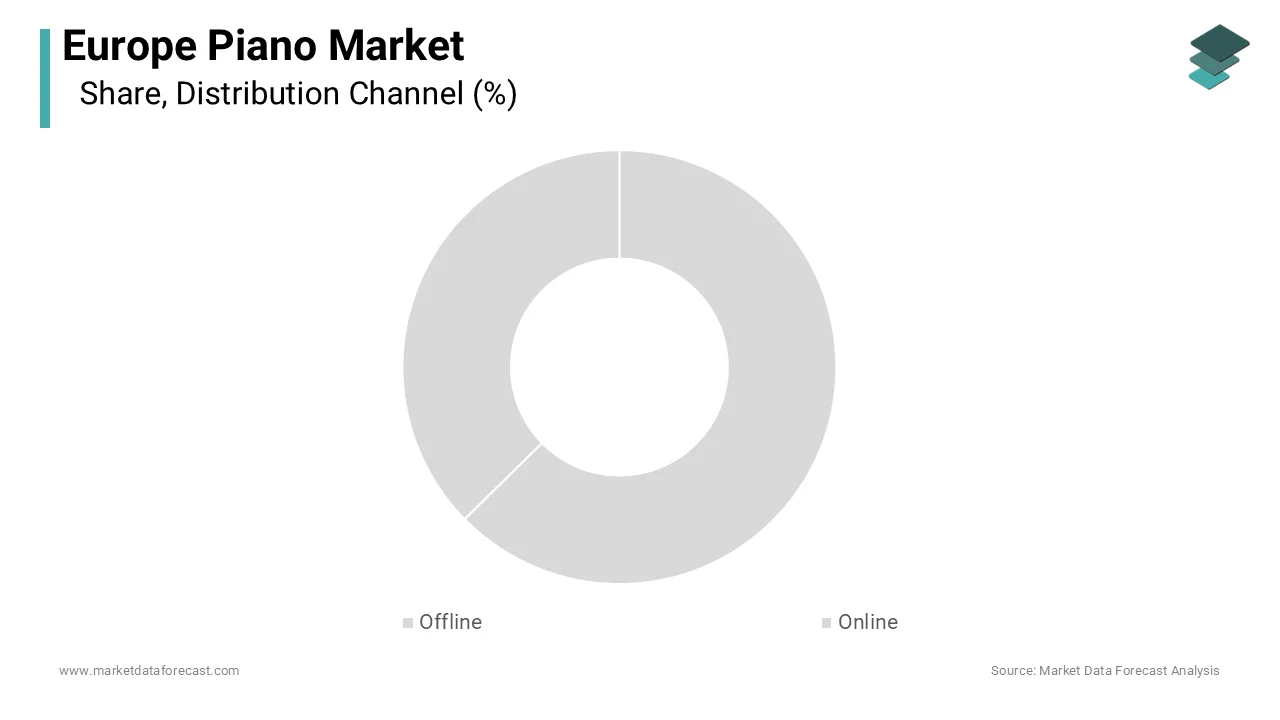
The online distribution channel segment is on the rise and is expected to be the fastest-growing segment in the market by witnessing a CAGR of 12.4% from 2026 to 2034 due to the rising demand for digital pianos and entry-level instruments among younger, tech-savvy consumers who are comfortable with online research and purchasing. The online model offers unparalleled convenience, a vast product comparison capability, and often more competitive pricing due to lower overhead costs. Furthermore, the proliferation of high-quality video reviews, detailed specification sheets, and virtual showroom tours has significantly reduced the information asymmetry that once hindered online musical instrument sales. According to European e-commerce industry reports, a significant majority of younger consumers now initiate their research for major, durable purchases, including musical instruments, on digital platforms, frequently utilizing online resources to inform their buying decisions before choosing to visit a physical store or complete the transaction remotely.
By Product Insights
The acoustic piano segment held the majority share of the European piano market in 2025. The prominence of the acoustic piano segment is attributed to Europe’s unparalleled cultural heritage as the birthplace of the modern piano and the home to world-renowned manufacturers like Steinway & Sons in Hamburg, Bösendorfer in Vienna, and Fazioli in Italy. These instruments are not merely musical tools but are revered as works of art and engineering, commanding premium prices that reflect centuries of accumulated craftsmanship. The acoustic piano remains the undisputed standard for serious musical education, professional performance, and composition. Reflecting pedagogical traditions within European higher music education, specialized music institutions and conservatories consistently prioritize the use of high-quality acoustic pianos for training, sustaining a continuous demand for such instruments. This deep-rooted cultural and educational imperative ensures that the acoustic segment, while niche in volume, continues to drive the market’s overall value and prestige.
The digital piano segment is expected to exhibit a noteworthy CAGR of 9.8% over the forecast period, owing to its ability to directly address the practical constraints of modern urban living while offering an increasingly authentic playing experience. Digital pianos are significantly more affordable, require no tuning, are compact and portable, and feature silent practice modes with headphones, making them ideal for apartment dwellers and beginners. Continuous advancements in technology have dramatically improved their sound quality and key action, with many models now using samples from top-tier acoustic pianos and sophisticated hammer-action mechanisms. According to sources, the rise of online music education platforms has been a key enabler, as these services often recommend specific digital models to their students, creating a direct pipeline from learning to purchase that favors the accessibility and features of the digital format.
COUNTRY LEVEL ANALYSIS
Germany Piano Market Analysis
Germany led the European piano market by holding a share of 25.7% in 2025. The leading position of the German market is driven by a powerful combination of world-class manufacturing, a deeply ingrained musical culture, and a robust educational system. The country is home to the legendary Steinway & Sons factory in Hamburg, which produces some of the most coveted concert grand pianos globally. Beyond its industrial prowess, Germany’s extensive network of public music schools, known as Musikschulen, ensures that piano education is accessible to a broad population. The extensive state-subsidized music education network in Germany, coupled with high cultural valuation of musical education, ensures substantial and consistent demand for both digital and traditional pianos, cementing the nation's position as Europe's premier center for piano craftsmanship and consumption.
Italy Piano Market Analysis
Italy followed closely in the European piano market by occupying a 12.3% share in 2025. The expansion of the Italian market is supported by its legacy of artisanal excellence and luxury craftsmanship. The nation is the home of Fazioli, a manufacturer celebrated for its handcrafted concert grand pianos that are prized by virtuosos for their exceptional tonal clarity and dynamic range. The Italian market thrives on a deep appreciation for design, beauty, and heritage, where a piano is often viewed as a centerpiece of interior architecture and a symbol of refined taste. According to sources, this cultural reverence for fine arts extends to musical instruments, fostering a strong domestic market for high-end acoustic pianos. Italy’s influence is less about volume and more about setting the global benchmark for artistic quality and innovation in piano making.
United Kingdom Piano Market Analysis
The United Kingdom holds a significant and dynamic position in the European piano market due to a vibrant ecosystem that blends historic tradition with modern innovation. London serves as a major hub for international piano competitions, concerts, and trade, attracting global talent and brands. The UK also has a strong base of independent piano retailers and technicians who provide essential expertise and service. As per the Department for Education in England, music is a statutory component of the national curriculum for children throughout their primary and early secondary school years, providing a structured foundation for young learners. This foundation, combined with a large and affluent middle class with a strong interest in arts and culture, creates a resilient and diverse market that supports everything from student uprights to professional concert grands.
France Piano Market Analysis
France expanded steadily in the European piano market. The country’s legacy is intertwined with the history of piano composition and performance, having been home to iconic figures like Debussy and Ravel. This heritage fosters a deep societal respect for the instrument, particularly within its extensive network of conservatoires and municipal music schools. The French market shows a strong preference for instruments that combine technical excellence with aesthetic elegance, reflecting the nation’s broader design sensibilities. The French Ministry of Culture continues to prioritize public investment in music education, supporting a widespread network of state-recognized conservatoires and public music schools throughout the country. This institutional support, coupled with a discerning consumer base, ensures a steady demand for high-quality pianos that uphold France’s distinguished musical tradition.
Austria Piano Market Analysis
Austria is predicted to grow in the European piano market from 2026 to 2034. The nation is the historic home of the piano, with Vienna serving as the birthplace of the fortepiano and the city where legends like Mozart and Beethoven composed. This heritage is embodied today by Bösendorfer, a manufacturer whose Imperial Grand is considered one of the finest pianos ever made. The Austrian market is small in absolute terms but is a global epicenter for piano culture, hosting prestigious events like the Vienna Piano Festival. As per studies, the state actively supports its musical institutions and instrument makers as part of its national cultural identity. This unwavering commitment to preserving and promoting its piano-making legacy ensures that Austria remains a vital and revered heart of the European piano world.
COMPETITIVE LANDSCAPE
The competition in theEuropeane piano market is a nuanced contest between heritage, craftsmanship, and technological adaptation. At the apex, a handful of legendary European brands compete not on price but on their unique sonic signatures, historical legacy, and artisanal prestige, catering to professional musicians and affluent collectors. Below this, a broader segment of established manufacturers competes on quality, service, and value for the serious amateur and educational markets. The market is increasingly pressured by high-end digital pianos that replicate the acoustic experience at a fraction of the cost. Success requires a delicate balance: preserving centuries-old craftsmanship while innovating to meet the practical demands of modern urban life, all within a market where consumer decisions are driven by deep emotional connection and cultural significance rather than mere functionality.
KEY MARKET PLAYERS
Some of the companies that are playing a dominating role in the global europe piano market include
- Yamaha Corporation
- Steinway & Sons
- Kawai Musical Instruments Manufacturing Co., Ltd.
- Bechstein Group
- Bosendorfer (part of Yamaha)
- Roland Corporation
- Schimmel Pianofortefabrik GmbH
- Pearl River Piano Group
- Bösendorfer Piano GmbH
- Fazioli Pianoforti
- Hoffmann (C. Bechstein brand)
- August Förster GmbH
- Petrof Pianos
- Kohler & Campbell (Young Chang)
- Nordiska Pianofabriken (Nordiska)
- Feurich Pianoforte GmbH
- Samick Musical Instrument Co., Ltd.
- Korg Inc.
- Blüthner Pianofortefabrik GmbH
TOP LEADING PLAYERS IN THE MARKET
- Steinway & Sons is a legendary name in the European piano market, renowned for its Hamburg-manufactured concert grand and upright pianos that are the gold standard for professional musicians worldwide. Its contribution to the global market is defined by its unwavering commitment to handcrafted excellence and its iconic status as a symbol of artistic achievement. To strengthen its position in Europe, Steinway has recently intensified its focus on its Spirio high-resolution player piano technology, which allows its acoustic instruments to play back performances by the world’s greatest artists with astonishing accuracy. The company has also expanded its network of exclusive Steinway Hall showrooms in major European capitals, offering immersive brand experiences that connect its rich heritage with cutting-edge innovation.
- Bösendorfer is an Austrian icon and a cornerstone of the European piano market, celebrated for its Vienna-crafted instruments that are famed for their unique tonal warmth and the extended keyboard of its Imperial Grand model. Its global contribution lies in preserving a distinct Central European piano-building tradition that offers an alternative voice to the dominant German school. To fortify its market stance, Bösendorfer has leveraged its ownership by Yamaha to enhance its global distribution while fiercely protecting its artisanal manufacturing process in Vienna. The company has recently invested in advanced wood seasoning facilities and launched bespoke customization programs, allowing clients to commission instruments with unique finishes and materials, thereby reinforcing its position as a luxury art object for discerning connoisseurs.
- Fazioli is an Italian powerhouse in the high-end European piano market, distinguished by its relatively young but meteoric rise to the pinnacle of piano craftsmanship. Founded in 1981, it has earned a reputation among virtuosos for its exceptional clarity, dynamic range, and meticulous attention to detail. Fazioli’s global impact stems from its innovative approach, such as its patented fourth pedal that reduces volume without altering tone. To strengthen its presence, Fazioli has recently expanded its factory in Sacile, Italy, to increase production capacity while maintaining its rigorous handcrafting standards. The company has also deepened its partnerships with international music competitions and conservatories, ensuring its pianos are the preferred choice for the next generation of elite performers.
TOP STRATEGIES USED BY THE KEY MARKET PARTICIPANTS
Key players in the Europe piano market are deploying a strategic triad to maintain their leadership. They are investing heavily in hybrid technologies that integrate silent digital systems into their premium acoustic pianos, addressing modern living constraints without compromising on authentic sound. Simultaneously, they are enhancing their direct customer engagement through flagship showrooms and bespoke customization services that transform the piano purchase into a luxury experience. Finally, they are forging strong alliances with educational institutions and international music competitions to embed their instruments at the heart of the professional and pedagogical ecosystem, ensuring long-term brand loyalty and cultural relevance in a competitive and evolving market landscape.
MARKET SEGMENTATION
This research report on the europe piano market is segmented and sub-segmented into the following categories.
By Distribution Channel
- Offline
- Specialty Music Stores
- Manufacturer Showrooms
- Online
By Product
- Acoustic Pianos
- Grand Pianos
- Upright Pianos
- Digital Pianos
By Country
- Germany
- Italy
- United Kingdom
- France
- Austria
- Spain
- Netherlands
- Rest of Europe