Europe Platelet Rich Plasma Market Size, Share, Trends & Growth Forecast Report By Application, Product, Origin and Country (Germany, UK, France, Italy, Rest of Europe) – Industry Analysis From 2026 to 2034.
Europe Platelet-Rich Plasma Market Size
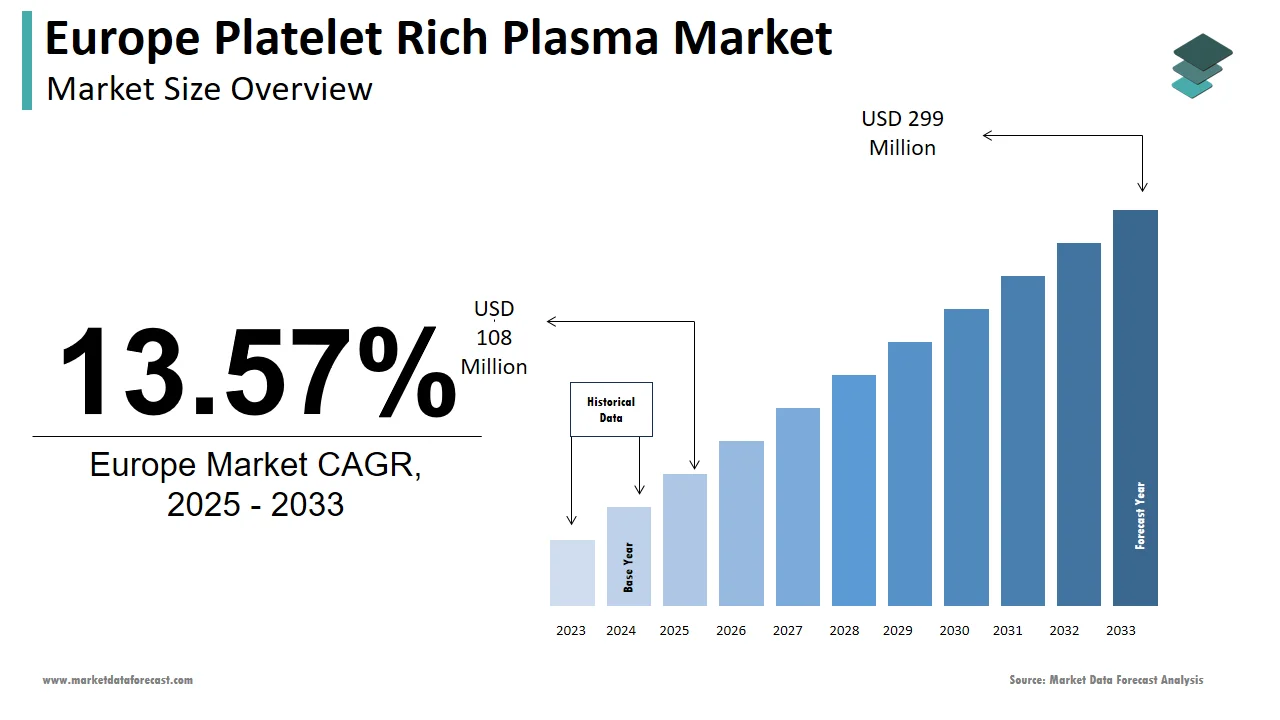
The platelet-rich plasma market size in Europe was valued at USD 108 million in 2025. The European market is estimated to be worth USD 340 million by 2034 from USD 122.66 million in 2026, growing at a CAGR of 13.57% from 2026 to 2034.
Platelet-rich plasma (PRP) is an autologous concentrate of platelets suspended in plasma, enriched with growth factors such as platelet-derived growth factor, transforming growth factor beta, and vascular endothelial growth factor that modulate tissue repair and regeneration. In Europe, Directive 2002/98/EC, also known as the European Blood Directive, set the initial standards of quality and safety for human blood and its components. However, it was repealed and replaced by Regulation (EU) 2024/1938. It is predominantly applied in orthopedics for osteoarthritis and tendinopathies, in dermatology for androgenetic alopecia and skin rejuvenation, and in wound care for chronic ulcers. According to research, regulatory frameworks in Europe classify platelet-rich plasma prepared directly at the point of care as a non-medicinal product, enabling broader clinical use without complex licensing requirements. As per sources, a growing number of orthopedic centers across Germany, France, and Italy are incorporating platelet-rich plasma into standard conservative treatment protocols, which reflects its expanding role in regenerative medicine and sports injury management. Apart from these, the European Wound Management Association recognizes PRP as a viable adjunct for non-healing diabetic foot ulcers, reflecting its expanding therapeutic legitimacy across medical disciplines.
MARKET DRIVERS
Increasing Adoption in Sports Medicine for Tendon and Ligament Injuries
The integration of platelet-rich plasma into sports medicine protocols across Europe is a major driver of the growth of the Europe platelet-rich plasma market. This is fueled by the high incidence of overuse injuries among both professional and recreational athletes. According to sources, tendon disorders account for a portion of all sports-related consultations in primary care settings, with conditions like patellar tendinopathy and rotator cuff tears showing limited response to conventional physiotherapy alone. PRP offers a biologic alternative that stimulates collagen synthesis and neovascularization at the injury site. As per studies, clinical studies indicate that platelet-rich plasma therapy can accelerate recovery and shorten rehabilitation periods for athletes with chronic tendon injuries compared to conventional treatment approaches. National sports federations have taken notice. As per sources, sports medicine authorities in Germany have formally integrated platelet-rich plasma therapy into official injury management frameworks for elite athletes, which reflects its growing acceptance within evidence-based sports rehabilitation protocols. Furthermore, private sports clinics in cities like Barcelona, Milan, and Amsterdam routinely offer PRP as part of comprehensive recovery packages, often covered by private insurance. This convergence of clinical evidence, institutional endorsement, and athlete demand strengthens PRP’s role as a cornerstone of modern sports injury rehabilitation in Europe.
Rising Prevalence of Androgenetic Alopecia and Demand for Natural Hair Restoration
It has emerged as a preferred intervention for hair loss in Europe due to growing consumer aversion to pharmaceuticals like finasteride and surgical options such as follicular unit extraction, which in turn propels the expansion of the Europe platelet-rich plasma market. According to research, a significant portion of adults in Western Europe experience hereditary hair loss, contributing to the growing demand for advanced and minimally invasive hair restoration therapies. PRP’s appeal lies in its autologous nature, absence of systemic side effects and compatibility with microneedling to enhance follicular delivery. Research shows that clinical evaluations show platelet-rich plasma treatment can substantially improve hair density and thickness over sustained periods, supporting its use as an effective regenerative approach for hair loss management. Dermatology clinics across Italy, Sweden, and the Netherlands now offer standardized PRP hair restoration protocols often bundled with nutritional counseling. Social media and celebrity endorsements have further normalized the procedure. As per sources, consumer perception across Europe increasingly identifies platelet-rich plasma as a natural and safe option for addressing hair thinning, driving its rising acceptance within aesthetic and dermatological care. This cultural and clinical alignment drives consistent demand in the aesthetic dermatology segment.
MARKET RESTRAINTS
Absence of Harmonized Clinical Guidelines Across European Countries
The lack of unified clinical guidelines results in inconsistent treatment protocols and variable reimbursement decisions across member states that restrict the growth of the Europe platelet-rich plasma market. According to research, national medical authorities across Europe adopt varying positions on the clinical use of platelet-rich plasma, with some countries supporting its application in musculoskeletal conditions while others maintain a more cautious or research-focused stance. As per sources, this lack of regulatory alignment contributes to uncertainty among healthcare professionals, leading many clinicians to exercise caution when recommending platelet-rich plasma treatments due to inconsistent national guidelines. The absence of consensus on optimal platelet concentration, number of injections, or activation methods further complicates cross-border studies and meta-analyses. Consequently, health technology assessment bodies struggle to evaluate cost-effectiveness uniformly. Widespread institutional adoption will remain hindered by the current regulatory and clinical confusion until bodies like the European Commission’s Expert Panel on Health Systems Performance establish pan-European clinical practice guidelines.
High Out-of-Pocket Costs and Limited Public Reimbursement
High out-of-pocket costs and limited public reimbursement create a significant access barrier for the general population, which hinders the expansion of the European platelet-rich plasma market. According to research, public reimbursement for platelet-rich plasma therapy in Europe remains limited, with only a few countries offering partial coverage for specific orthopedic indications. As per sources, in several markets such as Spain, Italy, and the Netherlands, platelet-rich plasma continues to be classified as an elective procedure outside public health insurance schemes, which leads most patients to bear the full cost of This financial burden disproportionately affects elderly patients who are most afflicted by degenerative joint diseases. Private insurers also rarely cover PRP, citing the lack of two-year outcome data required for economic modeling. PRP will only reach a larger segment of the European population and increase its public health impact if it is included in national diagnostic tariffs or conditional reimbursement schemes based on outcome registries.
MARKET OPPORTUNITIES
Integration into Diabetic Foot Ulcer and Chronic Wound Care Pathways
Its systematic incorporation into multidisciplinary wound care protocols for diabetic foot ulcers provides new opportunities for the growth of the Europe platelet-rich plasma market. Diabetic foot ulcers affect a large number of patients across the region. According to studies, a portion of Europeans with diabetes will develop a foot ulcer in their lifetime, with 20 percent progressing to amputation without effective intervention. Standard care often fails in cases with biofilm colonization or impaired angiogenesis, creating a vital need for biologic adjuvants. According to research, platelet-rich plasma is recognized as a supportive secondary option for managing chronic or non-healing ulcers, with clinical evidence demonstrating enhanced wound closure outcomes compared to conventional therapies. As per sources, healthcare systems in the United Kingdom are exploring pilot initiatives incorporating platelet-rich plasma gels for complex wound care, aiming to reduce hospitalization time and improve patient recovery rates. Similarly, as per studies, hospitals in countries such as the Netherlands and Denmark are adopting platelet-rich plasma within multidisciplinary diabetic foot care programs, which contributes to faster healing times and improved clinical efficiency. A scalable, clinically validated PRP application offers a new, high-impact path for treatment beyond musculoskeletal and aesthetic fields, which aligns with healthcare goals of limb salvage and cost management.
Advancement of Point of Care Automation and Standardized Kits
Technological innovation in PRP processing offers an opportunity for the expansion of the Europe platelet-rich plasma market. This is because it enhances reproducibility, safety, and accessibility across diverse clinical environments. Leading European manufacturers are introducing closed system centrifugation devices that minimize contamination risk, reduce preparation time to under 12 minutes, and incorporate real-time quality controls such as platelet counting and activation triggers. According to research, recent years have seen a surge in the introduction of CE-marked platelet-rich plasma kits in Europe, with standardized collection and preparation protocols enhancing reproducibility and clinical reliability. These advancements address previous barriers related to manual processing variability and biosafety concerns, particularly in dermatology and sports medicine practices without dedicated laboratory support. As per sources, automation in platelet-rich plasma processing is improving consistency across treatment centers in countries such as Sweden, ensuring that most prepared samples meet established quality and performance benchmarks. Furthermore, regulatory alignment under the EU Medical Devices Regulation. Automation in PRP delivery is expanding Europe's regenerative point-of-care market by making advanced therapeutics more widely accessible beyond specialized hospitals to community clinics.
MARKET CHALLENGES
Regulatory Ambiguity in Classification Under Advanced Therapy Frameworks
The inconsistent interpretation of its regulatory status under the EU’s advanced therapy medicinal product framework, which varies significantly between member states, thereby challenges the growth of the Europe platelet-rich plasma market. According to research, platelet-rich plasma is typically exempt from advanced therapy classification in Europe when it is prepared and used at the point of care without significant modification, simplifying its regulatory pathway for clinical use. However, national competent authorities in Belgium and France have classified certain activated PRP formulations as advanced therapies requiring full marketing authorization if combined with scaffolds or used off-label. This divergence creates market access uncertainty; a PRP kit approved as a medical device in Germany may face clinical trial requirements to be used in the same indication in Spain. Such inconsistency deters investment from small innovators and delays patient access to novel formulations. Harmonization under a unified EU regulatory pathway remains elusive despite ongoing discussions within the European Commission’s expert group on tissues and cells.
Lack of Long-Term Comparative Effectiveness Data for Health Policy Decisions
The absence of robust long-term comparative effectiveness data is a major challenge to the Europe plasma-rich plasma market. While short-term benefits are well documented in conditions like lateral epicondylitis and knee osteoarthritis, few studies track outcomes beyond 18 months or compare PRP directly with emerging biologics like bone marrow aspirate concentrate. According to studies, a portion of PRP studies submitted for evaluation included follow-up or quality-adjusted life year metrics required for economic modeling. This evidence gap is particularly acute in aesthetic and dermatological applications, where placebo-controlled trials are ethically and methodologically complex. Consequently, national agencies such as NICE in the UK and HAS in France maintain cautious stances, citing insufficient durable benefit. PRP's pathway to becoming a mainstream therapeutic in Europe's value-based healthcare systems depends on the establishment of large pragmatic trials and the routine collection of real-world data.
REPORT COVERAGE
| REPORT METRIC | DETAILS |
| Market Size Available | 2025 to 2034 |
| Base Year | 2025 |
| Forecast Period | 2026 to 2034 |
| Segments Covered | By Application, Product, Origin, and Region. |
| Various Analyses Covered | Global, Regional and Country-Level Analysis, Segment-Level Analysis, Drivers, Restraints, Opportunities, Challenges; PESTLE Analysis; Porter’s Five Forces Analysis, Competitive Landscape, Analyst Overview of Investment Opportunities |
| Countries Covered | UK, France, Spain, Germany, Italy, Russia, Sweden, Denmark, Switzerland, Netherlands, Turkey, Czech Republic, and the Rest of Europe. |
| Market Leaders Profiled | DR. PRP AMERICA, LLC, Glofinn Oy, Zimmer Biomet, DePuy Synthes, Emcyte Corporation, Terumo BCT, Anthrex Inc, T-Biotechnology, and Stryker. |
SEGMENTAL ANALYSIS
By Application Insights
The orthopedics segment held the largest share of 61.7% of the Europe platelet-rich plasma market in 2024. The growth of the orthopedics segment is primarily driven by the high and growing burden of degenerative joint diseases and sports-related soft tissue injuries across the region. According to sources, millions of adults in the European Union suffer from osteoarthritis, with knee involvement being the most prevalent and functionally limiting form. National clinical guidelines increasingly recognize PRP as a viable conservative option. Medical associations in Germany have updated clinical guidelines to include platelet-rich plasma as a conditional treatment option for early-stage knee osteoarthritis, supported by evidence demonstrating sustained reductions in pain levels. Besides, as per research, overuse tendon injuries represent a major portion of musculoskeletal consultations among active adults in Europe, driving interest in regenerative treatments such as platelet-rich plasma. Public healthcare integration further amplifies adoption. As per sources, certain European countries, including Switzerland, are beginning to introduce partial insurance coverage for platelet-rich plasma in specific orthopedic conditions following favorable health technology assessments. The segment’s dominance is strengthened by extensive clinical research.

The cosmetic surgery segment is on the rise and is expected to be the fastest-growing segment in the global market by witnessing a CAGR of 14.1% from 2026 to 2034. The expansion of the cosmetic surgery segment is fueled by rising consumer demand for natural autologous aesthetic solutions that avoid synthetic fillers, foreign body reaction,s or prolonged downtime. PRP is routinely used in hair restoration, facial bio rejuvenation, and scar remodeling, often combined with microneedling or fat grafting to enhance engraftment and neovascularization. According to research, dermatology and aesthetic surgery clinics across Western Europe are increasingly adopting platelet-rich plasma treatments, with hair restoration emerging as the leading application area. As per studies, clinical evaluations in Europe demonstrate improved hair density outcomes when platelet-rich plasma is combined with microneedling, which supports its effectiveness in managing hereditary hair loss. Patient preference is a decisive factor. As per sources, consumer perception across multiple European markets strongly favors autologous or own blood therapies, which are viewed as safer and more ethically aligned compared to animal-derived or synthetic alternatives. Regulatory clarity under EU medical device rules, where point-of-care PRP used homologously is not classified as a medicinal product, further enables rapid clinic adoption. This convergence of clinical efficacy, aesthetic trends and regulatory permissiveness drives accelerated growth in private dermatology networks.
By Product Type Insights
The pure platelet-rich plasma segment led the Europe platelet-rich plasma market and captured a 52.6% share in 2024. The prominence of the pure platelet-rich plasma segment is because of its favourable biological profile and strong clinical endorsement in applications where inflammation must be minimized. Characterized by high platelet concentration and minimal leukocyte content, pure PRP avoids the release of pro-inflammatory cytokines such as interleukin 1 beta and tumor necrosis factor alpha, which can impair healing in sensitive tissues like articular cartilage or facial skin. According to sources, pure PRP is the preferred formulation for intra-articular injections in knee osteoarthritis based on Level I evidence showing better cartilage preservation and lower post-injection synovitis compared to leukocyte-rich variants. Leading orthopedic centers in Germany, Sweden, and the Netherlands exclusively use pure PRP for tendon and ligament injuries, citing faster functional recovery and reduced pain scores. Technological enablers also contribute. This clinical consensus on controlled biologic activity, especially in regenerative rather than inflammatory contexts, strengthens pure PRP as the standard of care across evidence driven European practices.
The leukocyte-rich fibrin segment is expected to exhibit a noteworthy CAGR of 16.3% from 2026 to 2034. Unlike liquid PRP, this second-generation concentrate forms a stable three-dimensional fibrin matrix that provides sustained release of growth factors, antimicrobial peptides, and cytokines, making it ideal for complex tissue regeneration. According to sources, leukocyte-rich fibrin dressings have demonstrated a higher epithelialization rate in diabetic foot ulcers compared to standard hydrocolloid dressings in real world data from the Dutch Wound Registry. Its adoption is also accelerating in oral maxillofacial and reconstructive surgery, where the fibrin scaffold enhances bone and soft tissue integration. Regulatory recognition supports expansion. Leukocyte-rich fibrin (LRF) is gaining traction in European surgery, replacing traditional PRP in surgical and chronic wound care, because it functions as a biomimetic matrix that provides both structural support and regulates the immune response.
By Origin Insights
The autologous platelet-rich plasma segment was the prominent segment of the Europe platelet-rich plasma market and accounted for a substantial share in 2024. The growth of the autologous platelet-rich plasma segment is attributed to its alignment with EU blood safety directives, its zero immunogenic risk, and strong patient preference for “self-derived” biologics. Sourced from the patient’s own venous blood, autologous PRP complies with Directive 2002/98/EC and is exempt from advanced therapy medicinal product classification when used homologously at the point of care. This regulatory clarity enables immediate preparation and injection in outpatient clinics without centralized authorization. Clinical adoption is near universal. Patient trust is equally decisive. The logistical simplicity of same-day preparation, requiring only a centrifuge and sterile kit, also makes autologous PRP economically viable for private and public settings alike. These combined regulatory, clinical and psychological factors ensure autologous origin remains the unchallenged foundation of Europe’s PRP ecosystem.
The allogeneic platelet-rich plasma segment is predicted to witness the highest CAGR of 19.7% during the forecast period, owing to emerging demand for standardized off-the-shelf regenerative solutions in hospital and emergency care. Sourced from rigorously screened donors and processed in certified blood establishments, allogeneic PRP offers consistent potency, immediate availability, and batch to batch reproducibility, important advantages in trauma surgery, large surface wound care, or burn units where autologous draw is impractical. Early adoption is concentrated in specialized centers. Regulatory evolution supports this trajectory. Allogeneic PRP is establishing a profitable niche in institutional settings, offering a scalable and time-sensitive solution that is more practical than the currently dominant autologous method.
COUNTRY LEVEL ANALYSIS
Germany Platelet Rich Plasma Market Analysis
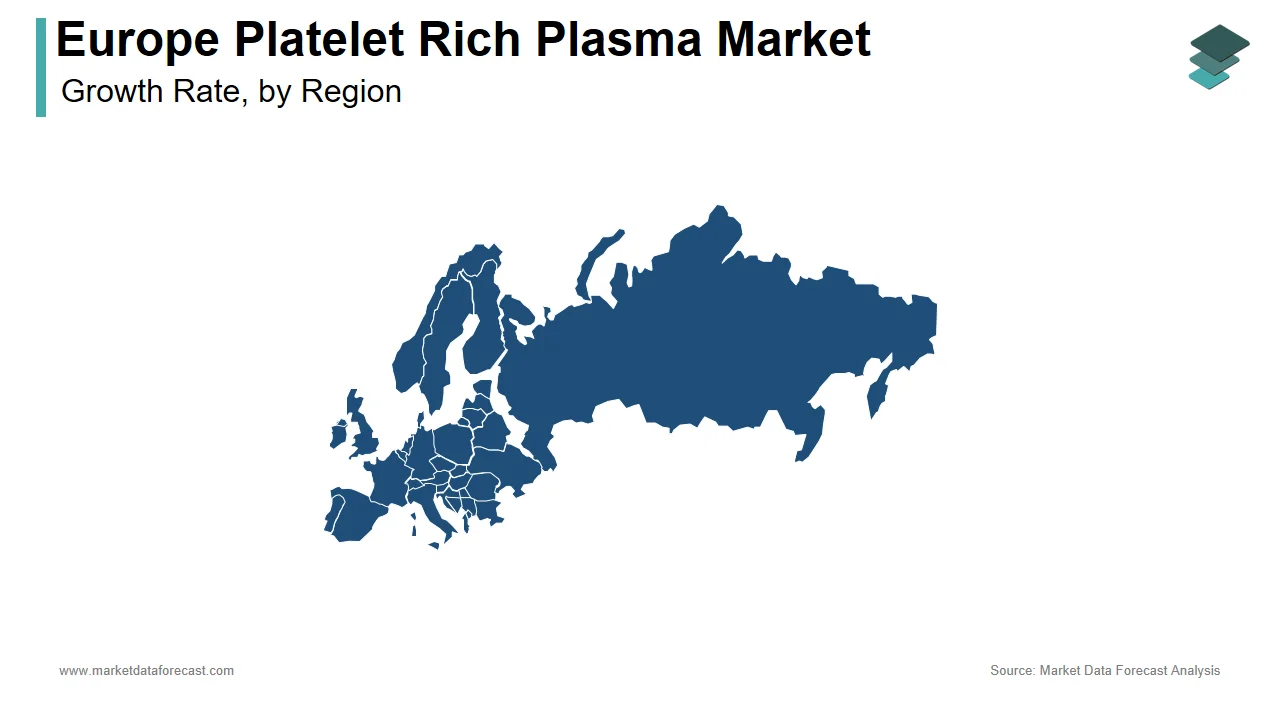
Germany was the top performer in the Europe platelet-rich plasma market by accounting for 27.1% share in 2024. The domination of Germany is primarily driven by its advanced orthopedic infrastructure, early integration of regenerative protocols, and partial public reimbursement for specific indications. According to sources, a portion of university and tertiary hospitals now include PRP in conservative management pathways for knee osteoarthritis and chronic tendinopathies. Germany also hosts leading PRP technology developers such as Sarstedt and EBM Technologies, whose CE-marked closed system kits are used across Europe. Germany's regenerative medicine market maintains its leadership through an integrated system of regulation, innovation, and clinical practice, supported by strong research output from institutions like Charité Berlin and a network of certified centers.
France Platelet Rich Plasma Market Analysis
France is the next prominent region in the Europe platelet-rich plasma market and is capturing a 20.8% share in 2024. Its centralized oversight, robust real-world evidence generation, and strong uptake in both orthopedic and aesthetic domains drive the growth of France. The French National Authority for Health maintains a mandatory national registry for PRP procedures requiring outcome reporting, which has generated one of Europe’s most comprehensive datasets on efficacy and safety. France also leads in standardized aesthetic protocols. Regulatory clarity from the National Agency for Medicines and Health Products Safety ensures that point-of-care PRP is classified as a blood derivative, not a drug, facilitating clinic-based use. Major teaching hospitals in Paris, Lyon,n and Marseille serve as national training hubs, further disseminating best practices and strengthening France’s role as a clinical and policy leader.
United Kingdom Platelet Rich Plasma Market Analysis
The United Kingdom is growing steadily in the European platelet-rich plasma market. The growth of the United Kingdom is attributed to a dynamic private sector and evolving engagement from the National Health Service. NICE's guidance was updated to support PRP use for refractory lateral epicondylitis in specialized musculoskeletal services after positive evidence emerged from the UK Regenerative Medicine Platform, even though PRP is still predominantly self-funded. The UK also excels in regenerative research. Aesthetic adoption is equally robust. Post Brexit, the MHRA has maintained alignment with EU blood safety standards while enabling faster innovation pathways for closed system kits. This balance of scientific rigor, private market agility, and cautious public integration positions the UK as a high-potential growth market.
Italy Platelet Rich Plasma Market Analysis
Italy expanded consistently in the Europe platelet-rich plasma market with particular strength in aesthetic dermatology and sports medicine applications. Italian dermatologists were among the first in Europe to adopt PRP for facial rejuvenation and androgenetic alopecia, creating a mature private care ecosystem with standardized protocols. In sports medicine, Italy’s Serie A football clubs routinely integrate PRP into injury recovery protocols. Regulatory oversight is managed by the Italian Medicines Agency, which classifies autologous PRP as a non-medicinal procedure when prepared at the point of care. Public hospitals in Milan, Rome, and Turin have also integrated PRP into orthopedic outpatient services driven by high osteoarthritis prevalence among the elderly. This dual excellence in aesthetic innovation and sports regenerative care ensures Italy’s sustained relevance in the European landscape.
Switzerland Platelet Rich Plasma Market Analysis
Switzerland is likely to grow in the Europe platelet-rich plasma market from 2026 to 2034 due to its unique partial public reimbursement policy. Switzerland includes PRP for chronic tendinopathies in its mandatory basic health insurance scheme. The country also hosts advanced biologics research. High patient out-of-pocket capacity and multilingual clinics attract medical tourists from neighboring countries, further amplifying procedural volume. Switzerland leads the way in equitable access to regenerative therapies within Europe, thanks to its combination of stringent blood safety laws (aligned with EU directives) and flexible reimbursement policies that prioritize evidence-based coverage.
COMPETITIVE LANDSCAPE
The Europe platelet rich plasma market features a competitive environment shaped by global medical technology firms, specialized biologics companies, and agile regional innovators, all operating under rigorous regulatory oversight. Competition is not driven by price but by clinical validation, product consistency, and seamless integration into existing care pathways. Leading companies differentiate through proprietary centrifugation technologies that ensure precise control over platelet concentration, leukocyte content, and activation status. The absence of harmonized preparation standards creates both opportunity and complexity as firms compete to establish their protocols as clinical norms. Orthopedic and aesthetic segments attract the most entrants, yet sustained success requires robust outcome data, physician trust, and regulatory foresight. Classification ambiguity under advanced therapy versus blood product frameworks adds strategic nuance, particularly in cross border commercialization. Despite moderate fragmentation, market leaders maintain an advantage through extensive training networks, real-world evidence generation, and partnerships with key opinion leaders, ensuring enduring influence across Europe’s diverse and evidence-driven healthcare ecosystems.
KEY MARKET PLAYERS
Some of the companies that are playing a dominating role in the Europe platelet-rich plasma market include
- PRP AMERICA, LLC
- Glofinn Oy
- Zimmer Biomet
- DePuy Synthes
- Emcyte Corporation
- Terumo BCT
- Arthrex, Inc.
- T-Biotechnology
- Stryker Corporation
TOP PLAYERS IN THE MARKET
- Stryker Corporation is a global leader in medical technologies and plays a significant role in the Europe platelet-rich plasma market through its RegenKit platform, which delivers standardized closed-system PRP preparation for orthopedic and aesthetic applications. The company integrates PRP into broader regenerative care strategies, leveraging its extensive surgical and sports medicine portfolio. In Europe, Stryker has deepened its clinical footprint by collaborating with university hospitals in Germany and France to conduct prospective studies on PRP efficacy in early knee osteoarthritis. It also expanded its physician training initiatives through its Lyon-based academy, offering hands-on certification in ultrasound-guided PRP injections. These efforts support Stryker’s commitment to evidence-based practice and protocol standardization across European healthcare settings.
- Terumo Corporation contributes to the Europe platelet-rich plasma market primarily through its subsidiary Harvest Therapeutics and its SmartPrep system, known for high platelet yield and controlled leukocyte content. The platform is widely used in orthopedic wound care and sports medicine clinics across Western Europe. Terumo has strengthened its position by partnering with national wound care networks in the Netherlands and Spain to validate PRP protocols for diabetic foot ulcers. It also achieved updated CE certification in 2023 under the EU Medical Devices Regulation, ensuring continued compliance and market access. Through clinical education, regulatory diligence, and real-world evidence generation, Terumo maintains strong credibility among European regenerative medicine practitioners.
- EmCyte Corporation is a specialized provider of point-of-care PRP systems with a growing presence in Europe’s dermatology and orthopedic sectors. The company focuses on minimal manipulation, rapid processing, and user-friendly centrifugation technology, enabling same-day treatment in outpatient clinics. EmCyte has enhanced its European reach by launching an advanced centrifuge with integrated platelet concentration feedback in Sweden and Italy. It also established a physician training consortium with aesthetic societies to standardize PRP use in hair restoration and facial rejuvenation. These initiatives position EmCyte as a trusted partner for clinics seeking reliable, accessible, and compliant autologous biologic solutions across diverse European markets.
TOP STRATEGIES USED BY THE KEY MARKET PARTICIPANTS
Key players in the Europe platelet-rich plasma market prioritize regulatory compliance by ensuring their systems meet EU Medical Devices Regulation and blood safety directive requirements to maintain uninterrupted market access. Companies invest in clinical evidence generation through partnerships with academic hospitals to support health technology assessments and inclusion in national treatment guidelines. Standardization of preparation protocols via closed system kits reduces biological variability and enhances reproducibility across clinical settings. Strategic physician education programs, including certification courses and hands-on workshops build technical proficiency and drive consistent clinical adoption. Geographic expansion is pursued through localized collaborations with national medical societies to align product messaging with regional clinical practices and reimbursement pathways. These coordinated strategies reinforce scientific credibility, operational reliability, and long-term market integration in Europe’s highly regulated regenerative medicine landscape.
MARKET SEGMENTATION
This Europe platelet-rich plasma market research report is segmented and sub-segmented into the following categories.
By Application
- Orthopedics
- Cosmetic Surgery
- Ophthalmic Surgery
- Neurosurgery
By Product
- Pure
- Leukocyte-Rich
- Leukocyte-Rich Fibrin
By Origin
- Homologous PRP
- Autologous PRP
- Allogeneic PRP
By Country
- UK
- France
- Spain
- Germany
- Italy
- Russia
- Sweden
- Denmark
- Switzerland
- Netherlands
- Turkey
- Czech Republic
- Rest of Europe
Frequently Asked Questions
1. What is driving growth in the Europe Platelet-Rich Plasma Market?
Growth is fueled by rising sports injuries, increased orthopedic and aesthetic applications, and advancements in PRP preparation technology
2. Which PRP type leads Europe Platelet-Rich Plasma Market share?
Leukocyte-rich PRP dominates the market due to established effectiveness in treating musculoskeletal and tendon disorders across Europe
3. How is PRP used in orthopedics in Europe Platelet-Rich Plasma Market?
PRP is widely used for tendon injuries, arthritis, ligament sprains, and bone healing, promoting faster recovery and pain reduction in orthopedic patients
4. How does aging population affect Europe Platelet-Rich Plasma Market?
Aging populations increase musculoskeletal problems, accelerating demand for PRP regenerative therapies and expanding clinical adoption in Europe
5. What role do outpatient clinics play in Europe Platelet-Rich Plasma Market?
Outpatient clinics are seeing rapid PRP adoption for in-office, minimally invasive procedures, boosting patient convenience and therapy uptake
6. Who are major vendors in Europe Platelet-Rich Plasma Market?
Arthrex GmbH, Regen Lab SA, Zimmer Biomet, and Adimarket LLC are leading PRP device and system manufacturers in the European market
7. What is PRP’s use in cosmetic and dermatology applications?
Cosmetic PRP is popular for facial rejuvenation, scar treatment, and hair restoration, with rising demand in clinics across European countries
8. How is PRP used in dental and oral surgery in Europe?
PRP accelerates healing in oral surgery, supports bone regeneration, and improves dental tissue repair, increasing its acceptance among dentists
9. What is the impact of PRP therapy on patient outcomes in Europe?
PRP therapy shortens recovery time, reduces reliance on medications, and improves patient satisfaction in both sports and chronic care settings
10. Which countries lead Europe Platelet-Rich Plasma Market growth?
Germany, France, and the UK have the highest growth rates, driven by advanced healthcare infrastructure and evidence-based treatment protocols
Related Reports
Access the study in MULTIPLE FORMATS
Purchase options starting from
$ 2000
Didn’t find what you’re looking for?
TALK TO OUR ANALYST TEAM
Need something within your budget?
NO WORRIES! WE GOT YOU COVERED!
Call us on: +1 888 702 9696 (U.S Toll Free)
Write to us: sales@marketdataforecast.com