- Product Description Description
- Table of Contents TOC
- List of Table & Figure LOT
- Get Free Sample PDF Sample PDF
Market Size, 2025
$84.14 BnMarket Estimate, 2026
$87.17 BnMarket Forecast, 2034
$115.68 BnCAGR, 2026–2034
3.60%Europe Pork Meat Market Size, Growth, Trends & Forecast (2026–2034)
The Europe pork meat market size was calculated to be USD 84.14 billion in 2025, is estimated to reach USD 87.17 billion in 2026, and is projected to scale up to USD 115.68 billion by 2034, registering a compound annual growth rate (CAGR) of 3.60% during the forecast period from 2026 to 2034. Propelled by cultural and culinary entrenchment in national diets, high protein demand across aging and active demographics, and premiumization through Protected Designation of Origin (PDO) and Protected Geographical Indication (PGI) frameworks, the European market continues to expand steadily.
Key Executive Metrics (At-a-Glance)
- 2025 Base Valuation: USD 84.14 Billion
- 2026 Current Valuation: USD 87.17 Billion
- 2034 Forecast Valuation: USD 115.68 Billion
- Compound Annual Growth Rate (CAGR): 3.60% (2026–2034)
- Dominant Product Segment: Chilled Pork Meat (65.5% share in 2025)
- Fastest-Growing Product Segment: Frozen Pork Meat (CAGR of 5.5%)
- Dominant Distribution Channel Segment: Specialty Stores (55.4% share in 2025)
- Fastest-Growing Distribution Channel Segment: Online Distribution (CAGR of 13.3%)
- Dominant Regional Market: Germany (25.5% share in 2025)
- Fastest-Growing Regional Market: Poland
Core Market Drivers
- Cultural & Culinary Entrenchment: Deep integration into national food identities and traditional recipes across Western and Eastern Europe.
- High Protein Demand: Strong nutritional demand for lean pork cuts among aging populations and fitness/sports nutrition sectors.
Primary Market Restraints & Challenges
- Regulatory Compliance: Strict EU animal welfare mandates, nitrogen crisis rules, and environmental directives raising operating and retrofit costs.
- Disease Outbreaks: Recurrent African Swine Fever (ASF) outbreaks disrupting supply chains and triggering export bans.
- Consumer Backlash & Costs: Growing scrutiny of intensive farming and volatility in feed and energy expenses squeezing producer profit margins.
Europe Pork Meat Market Classification Breakdown
| Segment Category | Largest (Dominant) Segment | Fastest-Growing Segment |
|---|---|---|
| By Product | Chilled Pork Meat | Frozen Pork Meat |
| By Distribution Channel | Specialty Stores | Online Distribution |
| By Region | Germany | Poland |
Major Industry Players Profiled
Key enterprises shaping the competitive European pork meat market include Danish Crown A/S, Vion Food Group, Tönnies Group, Westfleisch SCE mbH, Bigard Group, Perdue Farms Europe, Friland A/S, Pini Group, Müller Group, Grupo Jorge, Atria Plc, Cranswick Plc, HKScan Corporation, Vall Companys Group, and Tulip Ltd.
Europe Pork Meat Market Size
The Europe pork meat market size was calculated to be USD 84.14 billion in 2025 and is anticipated to be worth USD 115.68 billion by 2034, growing from USD 87.17 billion in 2026 at a CAGR of 3.60% during the forecast period.
Pork meat products are fresh, chilled, frozen, and processed pork products derived from domestic pig production and regulated imports, and serve as a cornerstone of dietary protein across the continent. Pork is the most consumed meat in the European Union, deeply embedded in regional cuisines from Italian prosciutto and Spanish jamón ibérico to German bratwurst and Polish kiełbasa. The European pig herd stood at approximately 147 million head in 2025, according to Eurostat, with the sector supporting over 2.1 million farms and employing more than 500 000 people directly in primary production. The EU’s stringent animal welfare and food safety frameworks, governed by Regulation EC No 853 2004 and the Farm to Fork Strategy, mandate traceability, humane slaughter, and antimicrobial use restrictions that differentiate European pork from global counterparts. In 2025, the EU produced over 22 million metric tons of pig meat, as confirmed by the European Commission’s Directorate General for Agriculture and Rural Development, with domestic consumption absorbing nearly 85% of output. This self-sufficiency, coupled with cultural specificity and regulatory rigor, positions European pork not merely as a commodity but as a geographically and ethically defined food system shaped by tradition, sustainability mandates, and evolving consumer ethics.
MARKET DRIVERS
Cultural and Culinary Entrenchment in National Diets
Pork meat remains indispensable across Europe due to its deep integration into national food identities and daily culinary practices to ensure resilient demand despite health or ethical trends, which is primarily driving the European pork meat market growth. According to the Spanish Ministry of Agriculture household surveys, a majority of Spanish families regularly consume cured pork products such as jamón serrano, which is reflecting strong cultural attachment. Similarly, Germany’s meat culture centers on pork sausages and roasts. As per the German Federal Ministry of Food and Agriculture, pork remains the most consumed meat in the country, which indicates its dietary prominence. In Eastern Europe, pork is the primary meat for festive dishes such as Czech svíčková and Romanian tochitură, with national statistics in Romania indicating that pork is the preferred meat for traditional holiday meals. These consumption patterns are intergenerational and ritualistic; in Italy, the production of Parma ham and San Daniele prosciutto is protected under EU Protected Designation of Origin schemes, linking regional economics to gastronomic heritage. This cultural anchoring insulates pork from short-term dietary shifts, as substitution would require abandoning deeply rooted social and culinary traditions.
High Protein Demand in Aging and Active Populations
The nutritional profile of pork fuels consistent demand across both aging and physically active demographics in Europe, which is further contributing to the pork meat market expansion in Europe. According to Eurostat, the EU population aged 65 and over reached tens of millions in 2025, which indicates the growing importance of senior nutrition. Lean pork cuts, such as tenderloin and loin chops, provide over 30 grams of protein per 100-gram serving with moderate fat content, making them ideal for senior nutrition. Simultaneously, the fitness and sports nutrition sector promotes lean pork as a whole food protein source among athletes and gym goers. National dietary guidelines in France, the Netherlands, and Sweden explicitly include lean pork in recommended weekly protein rotations. As per consumer research from European universities, a significant share of adults aged 30 to 55 prioritize high-protein meals for satiety and muscle maintenance, with pork ranking among commonly consumed options. This dual demographic pull creates a stable, health-aligned demand base that transcends fashion-driven food trends.
MARKET RESTRAINTS
Stringent Animal Welfare and Environmental Regulations
The European pork meat market faces escalating compliance burdens due to tightening EU regulations on animal housing, manure management, and greenhouse gas emissions. According to the European Commission’s Joint Research Centre, recent revisions to the Industrial Emissions Directive require large pig farms to adopt ammonia reduction technologies, increasing capital needs. Simultaneously, the Farm to Fork Strategy mandates a 50% reduction in nutrient losses by 2030, which is forcing producers to implement precision feeding and manure separation systems. In the Netherlands, the nitrogen crisis has triggered farm buyouts and production caps, with the Dutch Central Bureau of Statistics reporting notable reductions in the national sow herd in recent years. Germany’s 2025 ban on non-enriched farrowing crates necessitates costly pen redesigns, with the German Farmers’ Association estimating substantial retrofit expenses per sow. These measures, while environmentally necessary, raise production costs and accelerate small farm exits, threatening supply stability and rural livelihoods.
African Swine Fever Outbreaks and Trade Disruptions
Recurrent African swine fever outbreaks across Eastern and Central Europe continue to destabilize pork supply chains and restrict market access, which is further hindering the pork meat market growth in Europe. According to the European Food Safety Authority, multiple EU member states reported ASF outbreaks in 2025, resulting in substantial culling to contain the spread. These events trigger immediate export bans from key third countries. As per trade data from German industry associations, import suspensions by major partners have caused significant revenue losses for producers. Domestically, movement restrictions fragment the internal market, preventing live animal transport from high-risk to processing zones. The disease’s persistence in wild boar populations creates a constant spillover risk. Without a vaccine or effective biosecurity in extensive farming systems, the sector remains vulnerable to episodic collapse, eroding investor confidence and discouraging long term herd expansion despite strong consumption demand.
MARKET OPPORTUNITIES
Premiumization Through Protected Geographical Indications
The expansion of EU Protected Designation of Origin and Protected Geographical Indication labels offers a high-value pathway for differentiated pork products, which aligns heritage with premium pricing and offers a promising opportunity to the European pork meat market. According to the European Commission’s quality schemes register, numerous pork‑based products hold PDO or PGI status, including Parma ham, Bayonne ham, and Lardo di Colonnata, and these labels typically command substantial price premiums over standard equivalents. These designations enforce strict production rules on breed, feed, aging, and geography, creating defensible market niches. As per the Italian Ministry of Agricultural, Food and Forestry Policies, Italian DOP cured pork exports represent a significant share of national agri‑food exports, reflecting steady growth in recent years. Consumers increasingly associate these labels with authenticity and traceability; Eurobarometer surveys consistently show that a majority of shoppers in major EU markets are willing to pay more for certified regional products. This system not only preserves rural craftsmanship but also insulates producers from commodity volatility, transforming regional pork into a luxury export asset with global appeal.
Growth in Value Added and Ready to Cook Segments
The rise of convenience‑driven consumption is accelerating demand for portion-controlled, marinated, and pre-cooked pork products tailored to urban and time-constrained households, which is another major opportunity in the European pork meat market. According to the European Consumer Organisation, many dual‑income families across Europe report preparing fewer fresh meals per week, driving reliance on ready-to-cook proteins. Retailers have responded with expanded chilled pork sections: Tesco and Carrefour now offer over 30 pork SKUs per store, including sous vide chops, spice-rubbed roasts, and pre-sliced stir-fry. Industry associations such as the European Meat Processors Federation report continued growth in the EU value‑added meat category, with pork representing a major share of new product development. Innovations like vacuum-tumbled marinades and edible coatings extend shelf life while enhancing flavor penetration, meeting both convenience and sensory expectations. This shift transforms pork from a raw ingredient into a solution‑oriented product, capturing higher margins and expanding usage occasions beyond traditional Sunday roasts.
MARKET CHALLENGES
Consumer Backlash Against Industrial Farming Practices
Growing public scrutiny of intensive pig farming is eroding trust in conventional pork supply chains, which is pressuring retailers and brands to adopt higher welfare standards and challenging the pork meat market expansion in Europe. According to Eurobarometer, a large majority of EU citizens express concern about current pig farming conditions, with many supporting stricter welfare requirements. This sentiment has triggered corporate action: over 80 major European retailers and foodservice operators have committed to sourcing only from farms providing enriched housing by 2027 as per the European Chicken Commitment framework extended to pork. However, the cost of transitioning to such systems is prohibitive for many. Research from Wageningen University, higher‑welfare pork production carries significantly elevated costs compared with standard systems. The gap between consumer expectation and retail pricing creates a “welfare gap,” where demand exists but supply lags due to economic and spatial constraints. This misalignment risks brand reputational damage and fuels alternative protein adoption, challenging the sector’s social license to operate.
Volatility in Feed Costs and Energy Dependence
The European pork meat market remains highly vulnerable to fluctuations in feed commodity prices and energy expenses, both critical inputs in pig production. According to the European Commission’s Market Observatory for Cereals, feed ingredients such as grains and oilseeds have experienced notable price volatility, driven by global supply disruptions and climatic events. Concurrently, Eurostat reports that EU industrial electricity prices remained elevated in 2025, inflating ventilation, heating, and processing costs, particularly in farrowing and nursery units requiring precise climate control. The EU’s Carbon Border Adjustment Mechanism further burdens feed importers, adding indirect levies on soy from non-EU countries. These cost pressures are difficult to pass on; Eurostat data shows that retail pork prices have risen more slowly than farm‑gate costs, squeezing producer margins. European farming organisations report that a substantial share of EU pig farms operate at break‑even or loss, highlighting structural fragility that threatens long‑term production capacity and food security.
REPORT COVERAGE
| REPORT METRIC | DETAILS |
| Market Size Available | 2025 to 2034 |
| Base Year | 2025 |
| Forecast Period | 2026 to 2034 |
| CAGR | 3.60% |
| Segments Covered | By Product, Distribution Channel, and Region |
| Various Analyses Covered | Global, Regional & Country Level Analysis; Segment-Level Analysis; DROC, PESTLE Analysis; Porter’s Five Forces Analysis; Competitive Landscape; Analyst Overview of Investment Opportunities |
| Regions Covered | UK, France, Spain, Germany, Italy, Russia, Sweden, Denmark, Switzerland, Netherlands, Turkey, and the Czech Republic |
| Market Leaders Profiled | Danish Crown A/S, Vion Food Group, Tönnies Group, Westfleisch SCE mbH, Bigard Group, Perdue Farms Europe, Friland A/S, Pini Group, Müller Group, Grupo Jorge, Atria Plc, Cranswick Plc, HKScan Corporation, Vall Companys Group, Tulip Ltd |
SEGMENTAL ANALYSIS
By Product Insights
The chilled pork meat segment held 65.5% of the Europe pork meat market share in 2025. The dominance of the chilled segment in this regional market is driven by consumer preference for freshness, retail infrastructure, and culinary expectations. European shoppers consistently prioritize sensory attributes when purchasing meat. Chilled pork stored at 0–4°C retains a bright pink hue and firm texture that signals freshness, particularly in countries such as Spain and Italy, where butcher‑counter display remains culturally embedded. According to Eurostat, the EU produced 21.1 million tonnes of pig meat in 2025, which indicates the scale of fresh‑meat circulation across retail channels. In Germany, chilled formats dominate supermarket sales due to expectations of same‑day or short‑term consumption. According to the European Food Safety Authority, chilled pork maintains microbiological safety for 4–6 days under proper cold‑chain conditions to align with weekly household shopping patterns. Chilled pork is expected to maintain its lead over the forecast period as European consumers continue to prioritize freshness, sensory quality, and traditional culinary practices.
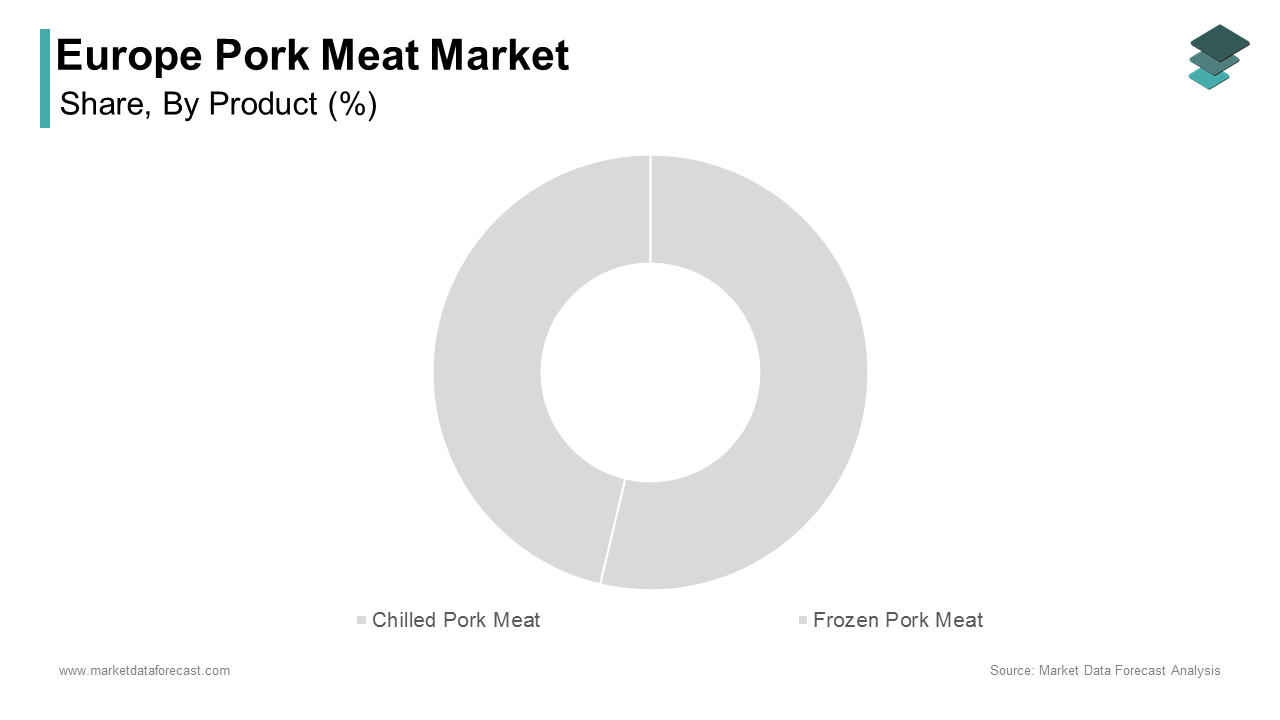
The frozen pork meat segment is the fastest-growing product segment and is estimated to witness a CAGR of 5.5% over the forecast period. The foodservice sector’s shift toward centralized production and portion control is driving institutional demand for frozen pork. Chain restaurants, school canteens, and hospital kitchens increasingly rely on pre‑cut, blast‑frozen pork for consistency, labor savings, and extended shelf life. The processed‑meat industry also depends on frozen blocks for sausage and pâté production, where stable core temperatures ensure uniform grinding and emulsification. Eurostat data confirm that EU pig meat production remains substantial, supporting both chilled and frozen supply chains across Europe. Frozen formats also enable strategic stockpiling during periods of price volatility, supporting risk management for processors. Frozen pork is expected to grow steadily as foodservice, industrial processing, and cross‑border trade rely on frozen formats for operational efficiency and supply stability.
By Distribution Channel Insights
The specialty stores segment occupied 55.4% of the Europe pork meat market share in 2025. The trust, traceability, and experiential retail of specialty stores are majorly driving the dominance of the segment in this regional market. European shoppers increasingly associate specialty butchers with higher animal welfare, regional breeds, and transparent supply chains. According to the European Commission, the EU is one of the world’s largest pork producers, with Germany, Spain, and France accounting for roughly half of total production, which is a structure that supports strong regional sourcing networks. Specialty stores often partner directly with local farms to enable detailed communication about breed, feed, and slaughter practices. The European Commission’s 2023 study on food trust found that consumers placea high value on knowing the origin of their meat, a need specialty stores meet through visible carcass displays and direct interaction. This type of s relational commerce fosters loyalty and higher customer spending. Specialty stores are expected to retain their lead as European consumers continue to prioritize provenance, craftsmanship, and personalized service in meat purchasing.
The online distribution segment is the fastest growing channel in the Europe pork meat market and is expected to register a promising CAGR of 13.3% over the forecast period. Digital platforms enable small and medium‑sized pig farms to bypass wholesalers and sell directly to consumers, offering traceability and premium differentiation. Subscription‑box models and direct‑farm delivery appeal to ethically conscious urban consumers seeking transparency in sourcing. Eurostat reports that European households increasingly purchase food online, reflecting broader digital‑commerce adoption across the region. Online platforms also provide detailed farm profiles, breed information, and sustainability metrics, strengthening consumer trust. Subscription frequency drives retention, transforming pork from a commodity into a relationship‑based product. Online sales are expected to grow rapidly as digital retail infrastructure expands, and consumers increasingly seek traceable, farm‑direct meat options.
REGIONAL ANALYSIS
Germany Pork Meat Market Analysis
Germany led the pork meat market in Europe in 2025 by holding 25.5% of the regional market share. The high domestic consumption, advanced processing capacity, and strong export performance are fuelling pork meat market growth in Germany. Per capita pork intake remains among the highest in Europe, reflecting the country’s deep culinary traditions. Germany operates a large network of slaughterhouses and processing plants that collectively produce several million metric tons of pork each year. The country is also a major European pork exporter, supplying key markets across the EU and Asia. Structural consolidation continues as smaller farms exit and larger operations expand herd sizes to meet efficiency and welfare requirements. Regions such as Bavaria and Lower Saxony remain central to national production, supported by integrated cooperatives that streamline supply chains. With its combination of scale, processing sophistication, and export orientation, Germany maintains a dominant position in the European pork sector.
Spain Pork Meat Market Analysis
Spain held the second largest share of the Europe pork meat market in 2025. The growth of Spain in the European market is attributed to its globally recognized cured‑meat tradition and the Iberian pig production system. Spain produces several million metric tons of pork annually, with a significant share dedicated to dry‑cured specialties such as jamón ibérico and chorizo. The Iberian pig, raised in oak‑forest grazing systems, underpins a premium segment that supports rural employment and regional economies. Domestic consumption of cured pork remains strong, with widespread household purchasing. Spain is also a major exporter of pork and processed pork products, supplying markets across Europe and North America. This blend of heritage breeds, artisanal processing, and international branding ensures Spain’s continued influence in the European pork landscape.
France Pork Meat Market Analysis
France is expected to account for a promising share of the Europe pork meat market over the forecast period. The deep culinary integration and progressive animal‑welfare standards are propelling the French market growth. Pork remains a staple in traditional French cuisine and contributes to high household consumption. France maintains a large number of pig farms, though ongoing welfare reforms have accelerated modernization and reduced overall farm counts. Premium certification schemes such as Label Rouge support differentiated, higher‑value production. France imports pork to meet domestic demand but also exports specialty products protected under EU quality schemes. With its combination of gastronomic heritage, regulatory ambition, and quality‑focused production, France retains a strong and distinctive position in the European pork sector.
Poland Pork Meat Market Analysis
Poland is estimated to register a healthy CAGR in the Europe pork meat market during the forecast period, owing to the competitive production costs and strong export orientation. The country produces several million metric tons of pork annually and exports significant volumes to neighboring EU markets. Pork consumption remains culturally embedded, contributing to stable domestic demand. The sector is characterized by a mix of small farms and large integrated producers, creating a diverse production landscape. African swine fever continues to pose challenges, prompting increased investment in biosecurity and disease‑control measures. With its strategic location, cost advantages, and expanding processing capacity, Poland remains a key supply hub within the European pork network.
Italy Pork Meat Market Analysis
Italy is projected to hold a notable share of the Europe pork meat market during the forecast period. Italy is known for its geographically protected cured meats and strong regional traditions. The country produces more than one million metric tons of pork annually, with a substantial share transformed into high‑value products such as Parma ham, San Daniele prosciutto, and Culatello. Distinct regional styles contribute to Italy’s diverse cured‑meat portfolio, and consumers show strong loyalty to local specialties. The sector supports a large number of farms, including producers of indigenous breeds that supply premium markets. While Italy imports fresh pork to meet processing demand, its export strength lies in certified, high‑value cured products sold worldwide. This combination of craftsmanship, regional identity, and global recognition sustains Italy’s premium position in the European pork industry.
COMPETITION OVERVIEW
Competition in the Europe pork meat market is defined by a three-tiered structure encompassing large integrated cooperatives, national processors, and artisanal specialty producers. At the top, cooperatives like Danish Crown and Westfleisch compete on scale, export reach, and compliance infrastructure, leveraging vertical integration to manage costs and ensure traceability. Mid-tier players such as Campofrío focus on processed and branded pork, differentiating through regional authenticity, clean label reformulation, and culinary heritage. Meanwhile, small butchers and local charcutiers thrive on hyperlocal trust, direct farm relationships, and craft expertise, often protected by geographical indications. Regulatory pressure from animal welfare laws and environmental mandates raises entry barriers, favouring established players with capital for modernization. However, consumer polarization creates divergent competitive arenas. Success requires balancing operational efficiency with cultural resonance, as pork remains both a commodity and a cultural artifact across Europe.
KEY MARKET PLAYERS
A few major players of the Europe pork meat market include
- Danish Crown A/S
- Vion Food Group
- Tönnies Group
- Westfleisch SCE mbH
- Bigard Group
- Perdue Farms Europe
- Friland A/S
- Pini Group
- Müller Group
- Grupo Jorge
- Atria Plc
- Cranswick Plc
- HKScan Corporation
- Vall Companys Group
- Tulip Ltd
Top Strategies Used by the Key Market Participants
Key players in the Europe pork meat market prioritize animal welfare certification and compliance with EU Farm to Fork requirements to address consumer ethics and retailer mandates. They invest in traceability technologies such as blockchain and QR code systems to provide farm-level transparency and build brand trust. Companies expand value-added product portfolios, including marinated, sous vide, and portion-controlled formats to meet convenience demands. Strategic partnerships with retailers enable co-developed clean-label and reduced additive pork lines. Additionally, they enhance cold chain logistics and adopt carbon labeling to align with sustainability regulations and differentiate in premium segments.
Leading Players in the Europe Pork Meat Market
- Danish Crown is a leading European pork producer headquartered in Denmark, operating one of the continent’s most integrated and export-oriented meat supply chains. The cooperative supplies fresh and processed pork to over 100 countries globally, with major markets in Asia, the UK, and continental Europe. It plays a pivotal role in advancing animal welfare and traceability through its proprietary “Track and Trace” system, which provides full farm-to-fork visibility. In 2025, Danish Crown launched a new line of carbon-labeled pork products in German and Dutch supermarkets, displaying verified emissions data per kilogram. It also invested in a state-of-the-art slaughterhouse in Poland to enhance capacity for Eastern European demand. These initiatives reinforce its leadership in sustainability, transparency, and operational scale.
- Westfleisch is Germany’s largest meat processing cooperative, deeply embedded in the national pork value chain through partnerships with over 5 000 pig farmers. The company supplies a wide range of fresh, frozen, and value-added pork products to retail, foodservice, and industrial customers across Europe. Westfleisch contributes to the global market by exporting premium German pork cuts to Japan, South Korea, and the United States under strict quality protocols. In 2025, the cooperative rolled out a welfare-certified pork program requiring all supplier farms to adopt enriched farrowing pens by 2026. It also introduced sous vide-ready pork loins in collaboration with major retailers to capture convenience-driven demand. These actions demonstrate its commitment to ethical production and consumer trend alignment.
- Campofrío, part of the Spanish multinational company Sigma Alimentos, is a dominant force in European processed pork, renowned for its portfolio of cured hams, sausages, and cooked meats. The company leverages Spain’s rich charcuterie heritage to supply both domestic and international markets, with a significant presence in France, Portugal, and Latin America. Campofrío contributes globally by exporting Iberian pork products under protected geographical indications, reinforcing Spanish gastronomic identity. In 2025, the company launched a new range of clean-label cooked hams with no added phosphates or nitrites, responding to clean-eating trends. It also expanded its cold chain logistics network across Southern Europe to ensure product integrity. These moves strengthen its position as an innovator in premium processed pork.
MARKET SEGMENTATION
This research report on the Europe pork meat market has been segmented and sub-segmented based on product, distribution channel, and region.
By Product
- Chilled Pork Meat
- Frozen Pork Meat
By Distribution Channel
- Specialty Stores
- Online
By Region
- UK
- France
- Spain
- Germany
- Italy
- Russia
- Sweden
- Denmark
- Switzerland
- Netherlands
- Turkey
- Czech Republic
- Rest of Europe