- Product Description Description
- Table of Contents TOC
- List of Table & Figure LOT
- Get Free Sample PDF Sample PDF
Market Size, 2025
$11.33 BnMarket Estimate, 2026
$12.45 BnMarket Forecast, 2034
$26.44 BnCAGR, 2026–2034
9.87%Europe Pre-Insulated Pipe Market Report Summary
The Europe pre-insulated pipe market was valued at USD 11.33 billion in 2025, is estimated to reach USD 12.45 billion in 2026, and is projected to reach USD 26.44 billion by 2034, growing at a CAGR of 9.87% during the forecast period from 2026 to 2034. The growth of the Europe pre-insulated pipe market is driven by increasing investments in district heating and cooling infrastructure, rising demand for energy-efficient pipeline systems, and stringent environmental regulations promoting reduced energy losses. Expanding urbanization, modernization of utility infrastructure, and the growing adoption of sustainable heating networks are further supporting market growth. Additionally, government initiatives to improve energy efficiency and reduce carbon emissions are accelerating the deployment of pre-insulated pipe systems across Europe.
Key Market Trends
-
Rising investments in district heating and cooling networks are driving demand for pre-insulated pipe systems.
-
Increasing focus on energy efficiency and reduction of heat loss in pipeline infrastructure is supporting market growth.
-
Growing modernization of aging water and utility infrastructure is creating new opportunities for advanced piping solutions.
-
Expansion of renewable energy integration and sustainable urban development projects is boosting market adoption.
-
Advancements in insulation materials and pipe manufacturing technologies are improving system durability and operational efficiency.
Segmental Insights
-
Based on installation, the below-ground installation segment dominated the Europe pre-insulated pipe market in 2025. The segment's leadership is attributed to its extensive use in district heating, cooling, water distribution, and underground utility networks, where long-term durability and thermal efficiency are critical.
-
Based on end-use industry, the district heating and cooling segment held the largest share of the Europe pre-insulated pipe market by accounting for 55.3% of the market share in 2025. The segment's dominance is driven by increasing investments in centralized heating systems, government initiatives for energy-efficient infrastructure, and the expansion of sustainable urban utility networks.
Regional Insights
-
The Europe pre-insulated pipe market is witnessing strong growth due to increasing investments in energy-efficient infrastructure, expanding district heating systems, and growing emphasis on sustainable urban development.
-
Germany dominated the Europe pre-insulated pipe market by accounting for 28.3% of the regional market share in 2025. The country's leadership is supported by extensive district heating infrastructure, strong investments in renewable energy integration, stringent energy efficiency regulations, and continuous modernization of utility networks.
-
Denmark remains a significant market due to its well-established district heating systems and long-standing commitment to energy-efficient infrastructure..
Competitive Landscape
The Europe pre-insulated pipe market is moderately competitive, with manufacturers focusing on product innovation, advanced insulation technologies, and expansion of energy-efficient piping solutions to strengthen their market positions. Companies are investing in sustainable manufacturing processes, research and development, and strategic partnerships to meet the growing demand from district heating, cooling, water distribution, and industrial infrastructure sectors. Key players operating in the Europe pre-insulated pipe market include Georg Fischer AG (Switzerland), Kabelwerke Brugg (Switzerland), Polypipe Group PLC (UK), Logstor (Denmark), Uponor (Finland), Watts Water Technologies (U.S.), Perma-Pipe International Holdings (U.S.), and Isoplus Fernwärmetechnik GmbH (Germany).
Europe Pre-Insulated Pipe Market Size
The Europe Pre-Insulated Pipe market size was valued at USD 11.33 billion in 2025. The European market size is estimated to be worth USD 26.44 billion by 2034 from USD 12.45 billion in 2026, growing at a CAGR of 9.87% from 2026 to 2034.
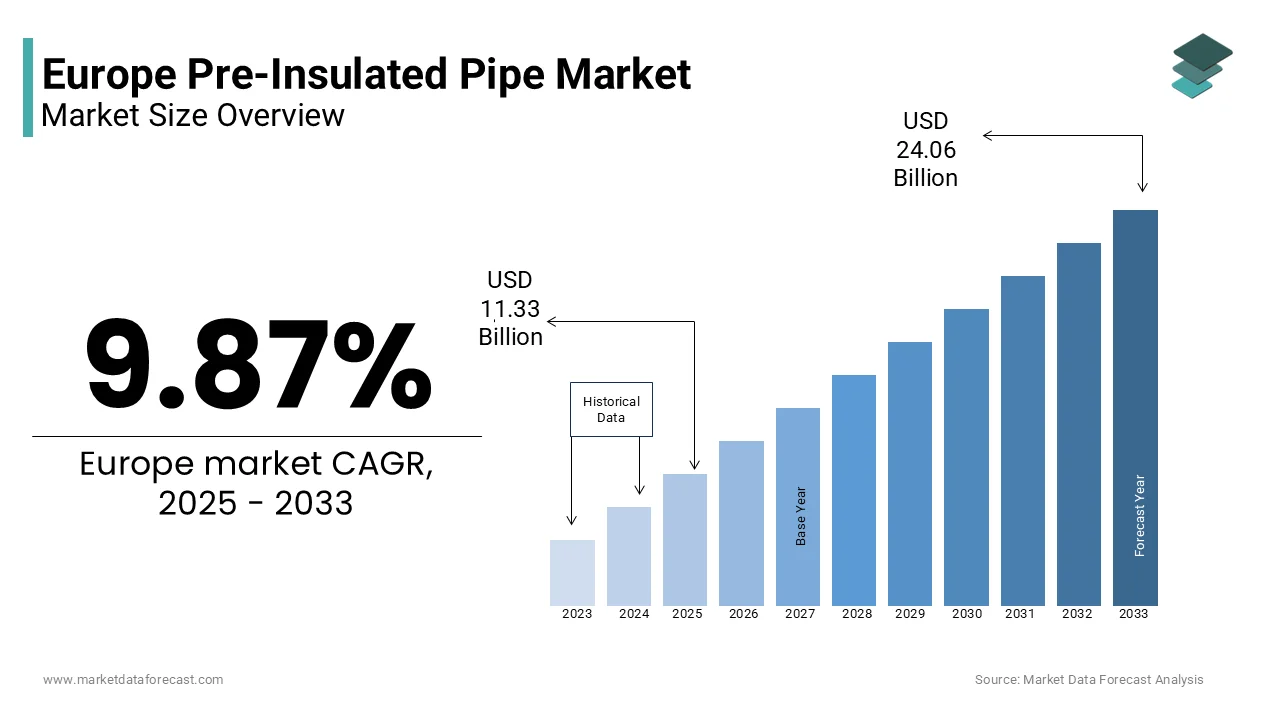
The pre-insulated pipe is an energy-efficient infrastructure development. As per Eurostat, the region's focus on sustainable district heating systems has positioned pre-insulated pipes as indispensable for reducing heat loss during energy transmission. The adoption of pre-insulated pipes is further propelled by urbanization trends, with cities like Paris and Stockholm integrating advanced heating solutions.
MARKET DRIVERS
Growing Demand for Energy Efficiency
The energy efficiency of sustainability agenda is boosting the growth of Europe pre-insulated pipe market. According to the International Energy Agency, buildings account for nearly 40% of the continent’s energy consumption, necessitating efficient thermal distribution systems. Pre-insulated pipes reduce heat loss by up to 70%, as per the Danish Board of District Heating, making them pivotal for modern district heating networks. The European Union’s directive on energy performance mandates member states to enhance building efficiency, creating a surge in retrofitting projects.
Expansion of District Heating Infrastructure
The proliferation of district heating infrastructure is an another factor fuelling the growth of Europe pre-insulated pipe market. As per the European District Heating Association, district heating supplies about 12% of Europe’s total heating demand, with Scandinavia leading adoption rates at 60%. Pre-insulated pipes are preferred due to their durability and ability to maintain consistent temperatures over long distances. According to a study by the Fraunhofer Institute, these pipes reduce maintenance costs by 25% compared to traditional alternatives. Furthermore, urbanization trends are accelerating demand, with cities like Berlin and Helsinki prioritizing centralized heating solutions. The integration of renewable energy sources, such as geothermal and biomass, into district heating systems also amplifies the need for efficient piping, ensuring sustained market momentum.
MARKET RESTRAINTS
High Initial Costs
The high upfront cost, which often deters smaller municipalities and private developers is solely restricting the growth of Europe pre-insulated pipe market. According to the study, the installation of pre-insulated pipes can be 30-40% more expensive than conventional alternatives. This financial burden is particularly pronounced in economically challenged regions, such as Southern Europe, where Spain and Italy face budget constraints for large-scale infrastructure projects. The initial investment required for materials and skilled labor poses a challenge. This disparity limits market penetration, especially in areas with limited access to funding or subsidies.
Stringent Regulatory Compliance
The stringent regulatory standards governing material quality and environmental is another factor hampering the growth of the pre-insulated pipe market. According to the European Committee for Standardization, manufacturers must comply with EN 253 standards, which mandate rigorous testing for thermal conductivity and mechanical strength. While these regulations ensure product reliability, they increase production complexity and costs, ultimately raising prices for end-users. For example, Germany requires adherence to DIN 16893 standards, which differ slightly from those in France or the UK. This fragmentation complicates cross-border trade and increases administrative burdens.
MARKET OPPORTUNITIES
Renewable Energy Integration
The integration of renewable energy sources into district heating systems is anticipated to fuel the growth of the Europe pre-insulated pipe market. As per the European Renewable Energy Council, renewables accounted for 22% of Europe’s total energy mix in 2022, with projections indicating a rise to 32% by 2030. Countries like Denmark and Sweden are pioneering this trend, investing heavily in hybrid heating systems. Similarly, Germany’s Energiewende initiative allocates €10 billion annually to renewable heating projects, creating a burgeoning demand for advanced piping solutions.
Smart City Development Initiatives
Europe’s smart city initiatives offer is another factor prompting the growth of the Europe pre-insualted pipe market. According to the studies, over 300 cities across the continent are implementing smart infrastructure projects, many of which prioritize energy-efficient heating solutions. For instance, Amsterdam’s smart district heating network uses pre-insulated pipes equipped with sensors to optimize energy flow by reducing operational costs by 15%. Similar projects in cities like Barcelona and Vienna highlight the growing synergy between smart technologies and advanced piping systems. Additionally, the European Innovation Partnership on Smart Cities forecasts a €2 billion investment in smart heating infrastructure by 2026.
MARKET CHALLENGES
Supply Chain Disruptions
The supply chain disruptions exacerbated by geopolitical tensions and logistical issues is certainly one of the challenging factor for the growth of Europe pre-insulated pipe market. According to the European Manufacturers’ Association, raw material shortages, particularly polyurethane foam and steel, have led to a 15% increase in production costs since 2021. These disruptions are particularly acute in Eastern Europe, where reliance on imports from Russia and China has been curtailed due to trade restrictions. A report by McKinsey & Company estimates that supply chain inefficiencies could reduce market growth by 2-3% annually unless resolved. Addressing these issues requires strategic diversification of suppliers and increased local manufacturing capabilities, which remain underdeveloped in several regions.
Intense Market Competition
Intense competition with the growing number of companies is significantly challenging the growth of Europe pre-insulated pipe market. As per the European Federation of Insulation Manufacturers, over 50 companies operate in the region, leading to price wars and margin pressures. This competitive landscape is further complicated by the entry of low-cost Asian manufacturers, who undercut prices by 20-30%. Additionally, rapid technological advancements necessitate continuous innovation, straining R&D budgets for mid-sized firms. Navigating this competitive environment requires strategic differentiation and robust branding efforts.
REPORT COVERAGE
| REPORT METRIC | DETAILS |
| Market Size Available | 2025 to 2034 |
| Base Year | 2025 |
| Forecast Period | 2026 to 2034 |
| CAGR | 9.87% |
| Segments Covered | By Installation, End-Use Industry, and Region |
| Various Analyses Covered | Global, Regional, & Country Level Analysis; Segment-Level Analysis; DROC; PESTLE Analysis; Porter’s Five Forces Analysis; Competitive Landscape; Analyst Overview of Investment Opportunities |
| Regions Covered | UK, France, Spain, Germany, Italy, Russia, Sweden, Denmark, Switzerland, Netherlands, Turkey, Czech Republic, Rest of Europe |
| Market Leaders Profiled | Georg Fischer AG (Switzerland), Kabelwerke Brugg (Switzerland), Polypipe Group PLC (UK), Logstor (Denmark), Uponor (Finland), Watts Water Technologies (US), Perma-Pipe International Holdings (US), Isoplus Fernwaermetechnik GmbH (Germany), and others. |
SEGMENT ANALYSIS
By Installation Insights
The below-ground installation segment was the largest by holding a significant share of the Europe pre-insulated pipe market in 2025 with its ability to minimize heat loss and protect pipes from external damage. Urbanization trends further bolster this dominance, with cities like London and Paris prioritizing underground networks to preserve aesthetics and maximize space utilization. Technological advancements, such as trenchless installation methods, have also enhanced feasibility, reducing deployment costs by 15%.
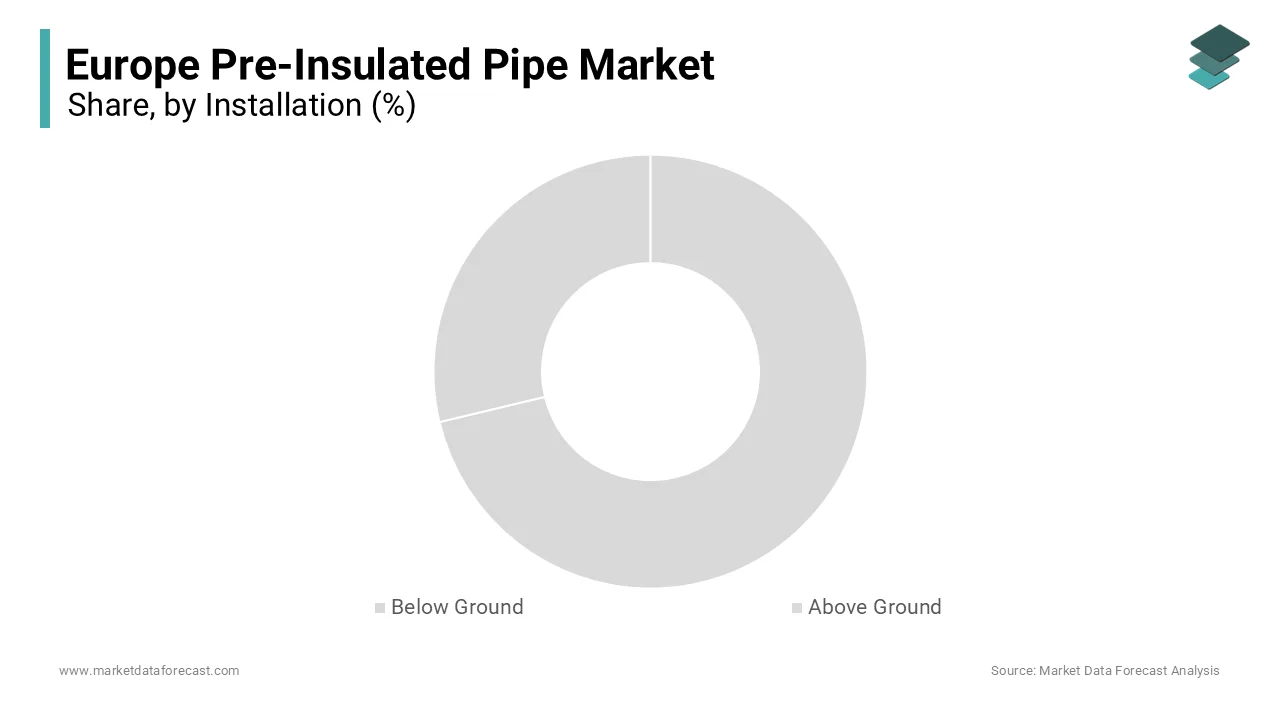
The above-ground installation segment is projected to register a fastest CAGR of 6.2% from 2026 to 2034 due to its cost-effectiveness and ease of maintenance in rural and industrial settings. Rising demand for modular heating solutions further accelerates adoption. Additionally, advancements in corrosion-resistant coatings have extended the lifespan of these pipes, addressing previous durability concerns. These innovations, coupled with supportive government policies, position above-ground installation as a dynamic and rapidly expanding segment within the market.
By End Use Industry Insights
The district heating and cooling segment was the largest by occupying 55.3% of the Europe pre-insulated market share in 2025 with the commitment to decarbonization and district heating systems playing a pivotal role in reducing carbon emissions. For instance, Sweden’s district heating networks prevent approximately 2 million tons of CO2 annually, according to the Swedish Environmental Protection Agency. Government incentives further amplify adoption. Germany’s KfW Development Bank offers subsidies covering up to 40% of project costs by encouraging municipalities to invest in district heating infrastructure.
The oil and gas segment is likely to grow at a fastest CAGR of 7.5% during the forecast period with the increasing use of pre-insulated pipes for transporting heated crude oil and natural gas. For example, Norway’s offshore oil fields utilize these pipes to maintain optimal temperatures by reducing viscosity and enhancing flow efficiency by 20%. Technological advancements, such as multi-layer insulation have expanded application scope by enabling operations in extreme conditions. These developments position oil and gas as a high-growth segment, driven by innovation and rising energy demands.
REGIONAL ANALYSIS
Germany Market Analysis
Germany was the top performer of the Europe pre-insulated pipe market by holding 28.3% of share in 2025. This leadership is rooted in the country’s unwavering commitment to energy efficiency and sustainable infrastructure development. Germany’s district heating systems are among the most advanced globally, with pre-insulated pipes playing a critical role in minimizing heat loss during energy transmission. The German government has implemented stringent regulations mandating energy-efficient building practices, further propelling demand. For instance, the Energy Efficiency Directive requires all new buildings to achieve near-zero energy consumption by 2026 by creating a fertile ground for pre-insulated pipe adoption.
France Market Analysis
France and Italy are anticipated to experience steady growth, supported by EU funding and increasing urbanization trends. France’s focus on retrofitting aging infrastructure and Italy’s push for energy-efficient residential heating solutions create significant opportunities for market expansion. Spain, while currently lagging due to economic constraints, holds untapped potential, particularly in regions like Madrid and Barcelona, where smart city projects are gaining traction.
COMPETITIVE LANDSCAPE
The Europe pre-insulated pipe market is characterized by fierce competition, driven by the presence of established players and the entry of new entrants seeking to capitalize on growing demand. As per the European Federation of Insulation Manufacturers, over 50 companies operate in the region, creating a highly fragmented yet dynamic landscape. Market leaders such as Logstor, Uponor, and Brugg Pipe Systems dominate through innovative product offerings and strategic alliances. However, smaller players face significant challenges, including pricing pressures and limited access to advanced technologies. The competitive environment is further intensified by the influx of low-cost Asian manufacturers, who undercut prices by 20-30%. Additionally, regulatory compliance adds another layer of complexity, as companies must adhere to stringent standards governing material quality and environmental impact.
KEY MARKET PLAYERS
Some of the notable key players in the Europe pre-insulated pipe market.
- Georg Fischer AG (Switzerland)
- Kabelwerke Brugg (Switzerland)
- Polypipe Group PLC (UK)
- Logstor (Denmark)
- Uponor (Finland)
- Watts Water Technologies (US)
- Perma-Pipe International Holdings (US)
- Isoplus Fernwaermetechnik GmbH (Germany)
TOP STRATEGIES USED BY KEY PLAYERS
Key players in the Europe pre-insulated pipe market employ diverse strategies to maintain their competitive edge and expand their footprint. Mergers and acquisitions are a primary tactic, enabling companies to consolidate resources and enhance technological capabilities. Partnerships and collaborations are another critical strategy, exemplified by Uponor’s alliance with a German research institute in June 2023 to develop eco-friendly materials that align with EU sustainability goals. Geographic expansion is also a priority, with Brugg Pipe Systems opening a new production facility in Eastern Europe to tap into emerging markets.
TOP PLAYERS IN THE MARKET
The Europe pre-insulated pipe market is dominated by three key players such as Logstor, Uponor, and Brugg Pipe Systems each contributing significantly to global innovation and sustainability efforts. The company specializes in developing high-performance pre-insulated pipes tailored for district heating systems powered by wind, solar, and geothermal energy. Its Smart Heating Solutions division develops IoT-enabled pipes that allow real-time monitoring of temperature and pressure, enhancing operational efficiency. Uponor’s partnerships with research institutions across Europe have positioned it as a leader in technological innovation. Brugg Pipe Systems, with a 15% share, distinguishes itself through its corrosion-resistant product line, catering to industrial applications in the oil and gas sector.
RECENT HAPPENINGS IN THE MARKET
- In April 2025, Logstor acquired a Danish startup specializing in IoT-enabled pipes, enhancing its ability to offer smart heating solutions.
- In June 2023, Uponor partnered with a German research institute to develop eco-friendly materials, aligning with EU sustainability mandates.
- In March 2023, Brugg Pipe Systems launched a corrosion-resistant product line, targeting the oil and gas sector and expanding its application scope.
- In September 2022, Logstor expanded its production facility in Poland, increasing capacity to meet rising demand in Eastern Europe.
- In January 2022, Uponor invested €50 million in R&D for smart heating solutions, reinforcing its leadership in technological innovation.
MARKET SEGMENTATION
This research report on the Europe pre-insulated pipe market is segmented and sub-segmented into the following categories.
By Installation
- Below Ground
- Above Ground
By End-use Industry
- District Heating & Cooling
- Oil & Gas
- Infrastructure & Utility
- Others
- Food Processing
- Pharmaceuticals
- Wineries
- Chemicals
- Water Treatment
By Country
- UK
- France
- Spain
- Germany
- Italy
- Russia
- Sweden
- Denmark
- Switzerland
- Netherlands
- Turkey
- Czech Republic
- Rest of Europe