- Product Description Description
- Table of Contents TOC
- List of Table & Figure LOT
- Get Free Sample PDF Sample PDF
Market Size, 2025
$19.27 BnMarket Estimate, 2026
$21.07 BnMarket Forecast, 2034
$43.04 BnCAGR, 2026–2034
9.34%Europe Process Automation Market Report Summary
The Europe process automation market was valued at USD 19.27 billion in 2025 and is estimated to reach USD 21.07 billion in 2026, and is projected to reach USD 43.04 billion by 2034, growing at a CAGR of 9.34% during the forecast period. The growth of the Europe process automation market is driven by increasing adoption of industrial automation technologies, rising demand for operational efficiency, and the need to improve productivity across manufacturing and process industries. Companies across sectors such as oil and gas, chemicals, power generation, and pharmaceuticals are investing in advanced automation systems to enhance process control, reduce operational costs, and improve safety standards. In addition, the growing integration of industrial internet of things technologies, artificial intelligence driven analytics, and smart manufacturing initiatives is further accelerating the adoption of process automation solutions across Europe.
Key Market Trends
- Increasing adoption of industrial automation technologies across manufacturing and process industries to enhance operational efficiency and productivity.
- Growing integration of industrial internet of things and advanced analytics with automation systems to enable real time monitoring and predictive maintenance.
- Rising demand for energy efficient industrial operations encouraging companies to implement automated control systems.
- Expanding digital transformation initiatives in industries such as chemicals, pharmaceuticals, and power generation driving automation investments.
- Continuous advancements in control systems, sensors, and industrial software improving process visibility and operational safety.
Segmental Insights
- Based on communication protocol, the wired communication segment accounted for 61.6% of the Europe process automation market share in 2025. The dominance of this segment is attributed to its reliability, stable connectivity, and ability to support mission critical industrial operations that require secure and uninterrupted data transmission.
- Based on deployment model, the on premise segment held 56.4% of the Europe process automation market share in 2025. The strong adoption of on premise deployment is driven by the need for greater control over industrial systems, enhanced data security, and the ability to manage complex automation environments within industrial facilities.
- Based on end user industry, the oil and gas segment accounted for 25.7% of the Europe process automation market share in 2025. The leadership of this segment is supported by the extensive use of automation technologies for monitoring, process control, safety management, and operational optimization across upstream, midstream, and downstream operations.
Regional Insights
- The Europe process automation market is witnessing significant growth across major industrial economies supported by increasing adoption of smart manufacturing technologies and industrial digitalization initiatives.
- Germany was the leading contributor to the Europe process automation market, accounting for 27.7% of the regional market share in 2025. The country’s strong industrial base, advanced manufacturing sector, and significant investments in Industry 4.0 technologies are driving the demand for process automation solutions across various industries.
- Other European countries are also expanding automation adoption to enhance production efficiency, improve safety compliance, and support digital transformation across industrial operations.
Competitive Landscape
The Europe process automation market is highly competitive with the presence of several global technology providers focusing on innovation, advanced automation systems, and integrated industrial solutions. Companies are investing in research and development to introduce intelligent control systems, digital automation platforms, and industrial analytics technologies that support next generation manufacturing environments. Strategic collaborations, product innovations, and expansion of industrial automation portfolios are helping market players strengthen their presence across Europe. Prominent companies operating in the Europe process automation market include AMETEK Inc., Azbil Corp., Delta Electronics Inc., Eaton Corp plc, Emerson Electric Co., Endress Hauser Group Services AG, Fuji Electric Co. Ltd., General Electric Co., Hitachi Ltd., Honeywell International Inc., Mitsubishi Electric Corp., OMRON Corp., Robert Bosch GmbH, Rockwell Automation Inc., Schneider Electric SE, Siemens AG, Xylem Inc., and Yokogawa Electric Corp.
Europe Process Automation Market Size
The Europe process automation market size was valued at USD 19.27 billion in 2025 and is projected to reach USD 43.04 billion by 2034 from USD 21.07 billion in 2026, growing at a CAGR of 9.34%.
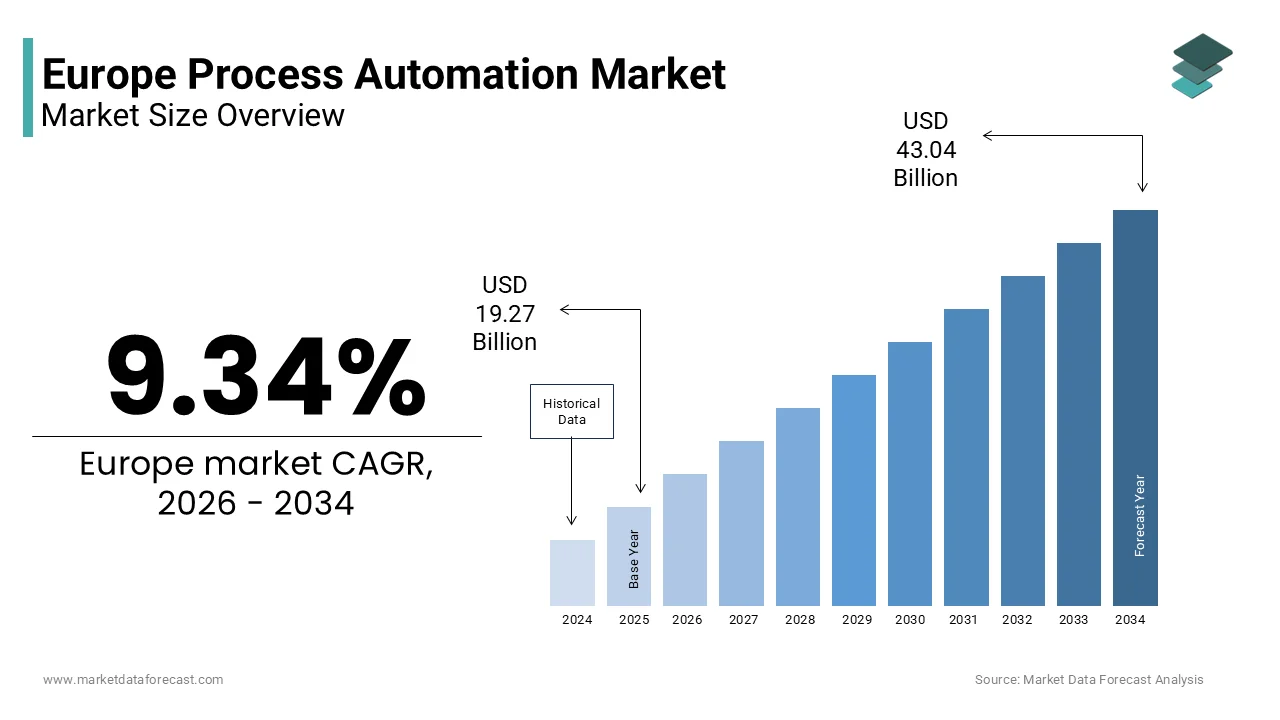
Process automation encompasses the deployment of hardware, software, and control systems designed to operate industrial machinery and business workflows with minimal human intervention, thereby enhancing precision, speed, and safety across diverse sectors. This ecosystem integrates robotics, programmable logic controllers, and artificial intelligence to transform traditional manufacturing and service delivery into agile, data-driven operations. The urgency for such transformation stems from a severe structural labor deficit that threatens continental productivity. According to Eurostat, the European Union faces a shortage of skilled workers, with millions of vacancies remaining unfilled in recent quarters, which is compelling industries to mechanize routine tasks. Furthermore, as per the European Environment Agency, industrial activities account for a significant share of total greenhouse gas emissions in the region, driving the adoption of automated systems that optimize energy consumption and reduce waste. According to the European Commission, the push toward climate neutrality by 2050 necessitates a fundamental reengineering of production lines to meet sustainability targets. Consequently, process automation has evolved from a mere efficiency tool into a strategic imperative for maintaining global competitiveness while adhering to regulatory standards regarding environmental impact and workforce safety in an aging demographic landscape.
MARKET DRIVERS
Escalating Labor Shortages and Demographic Shifts Driving Mechanization
The acute scarcity of available workforce coupled with a rapidly aging population is driving the growth of the European process automation market. Nations are increasingly unable to rely on human labor to fill repetitive or physically demanding roles, which is forcing a structural shift toward robotic and software-based solutions. According to Eurostat, the median age of the European Union population has risen, while the old age dependency ratio is projected to increase significantly, indicating a shrinking pool of working age individuals. This demographic reality creates a vacuum in sectors such as automotive manufacturing, logistics, and food processing where manual labor was once abundant. As per the European Centre for the Development of Vocational Training, skill mismatches leave many job vacancies in technical fields unfilled due to a lack of qualified candidates. Companies respond by investing heavily in collaborative robots and autonomous guided vehicles to maintain output levels without relying on scarce human resources. As per the International Federation of Robotics, Europe remains one of the largest markets for industrial robot installations globally, driven largely by the necessity to compensate for the declining workforce.
Stringent Regulatory Mandates for Sustainability and Energy Efficiency
Rigorous environmental regulations and the overarching goal of achieving climate neutrality are further boosting the European process automation market growth. The European Green Deal sets binding targets for carbon reduction that traditional manual processes often fail to meet due to inherent inefficiencies and energy wastage. According to the European Environment Agency, the industrial sector must reduce its emissions significantly compared to 1990 levels, which is a target that necessitates precise control over energy usage and material flows. Automated systems equipped with real time sensors and adaptive algorithms enable manufacturers to minimize scrap rates and optimize power consumption dynamically. As per the European Commission, the Ecodesign for Sustainable Products Regulation will soon require digital product passports, demanding a level of data granularity that only fully automated tracking systems can provide. Furthermore, the EU Emissions Trading System imposes financial penalties on excessive carbon output, making energy efficient automation a financial necessity. Industries such as chemicals and steel are deploying automated control loops to ensure compliance with these strict limits while maintaining profitability.
MARKET RESTRAINTS
High Initial Capital Expenditure and Complex Integration Costs
The substantial financial burden associated with acquiring and implementing advanced automation infrastructure acts as a significant restraint for the regional market growth, particularly for small and medium sized enterprises that form the backbone of the European economy. The upfront costs for industrial robots, sophisticated software licenses, and the necessary sensory networks often exceed the liquidity capabilities of smaller firms, creating a barrier to entry. According to the European Investment Bank, access to finance remains a top concern for many SMEs in the Eurozone, limiting their ability to invest in long term capital projects like automation. Beyond the purchase price, the complexity of integrating new automated systems with legacy machinery inflates implementation costs and extends deployment timelines. As per Eurofound, the average cost of digital transformation for a medium sized manufacturer can range widely depending on the scale and sophistication required. This financial hurdle forces many companies to delay modernization efforts or rely on outdated manual processes that compromise competitiveness. Additionally, the return on investment period for such high-cost projects can span several years, which is deterring risk averse management teams. The lack of standardized plug and play solutions further exacerbates these costs, requiring bespoke engineering for each installation.
Acute Shortage of Specialized Technical Skills for System Management
The severe deficit of professionals possessing the specialized skills required to design, operate, and maintain complex automated systems is further hindering the expansion of the European process automation market. While companies invest heavily in hardware and software, the absence of a qualified workforce to manage these technologies limits their effective utilization and scalability. According to the European Centre for the Development of Vocational Training, the EU could face a shortage of millions of workers in science, technology, engineering, and mathematics fields by 2030, directly impacting the automation sector. Operating modern automated lines requires proficiency in robotics programming, data analytics, and cyber physical system maintenance, skills that are currently in short supply. As per the European Commission, a majority of employers in the technology sector report difficulties in finding candidates with the right digital competencies. This skills gap leads to underutilized assets, increased downtime due to maintenance errors, and slower deployment rates as companies struggle to staff their new facilities. Educational institutions often lag behind industry needs, producing graduates with theoretical knowledge but limited practical experience with cutting edge automation tools. The reliance on external consultants to bridge this gap increases operational costs and reduces internal control over critical processes. Without a concerted effort to upskill the existing workforce and reform educational curricula, the lack of human capital will remain a formidable constraint on the market’s potential growth.
MARKET OPPORTUNITIES
Expansion of Smart Manufacturing and Industry 4.0 Ecosystems
The widespread transition toward smart manufacturing and the broader Industry 4.0 paradigm presents a promising opportunity for the Europe process automation market by enabling interconnected, data driven production environments. This shift moves beyond simple mechanization to create cyber physical systems where machines communicate autonomously to optimize workflows in real time. According to the European Commission, funding has been allocated through the Digital Europe Programme to support the adoption of these advanced technologies, signaling strong institutional backing. As per the Fraunhofer Institute, factories implementing fully integrated Industry 4.0 solutions have reported notable productivity gains and reductions in time to market. The opportunity lies in the ability to leverage operational data to predict maintenance needs, adjust production schedules dynamically, and customize products at scale without sacrificing efficiency. Furthermore, the integration of digital twins allows companies to simulate and refine processes virtually before physical implementation, reducing risks and costs.
Adoption of Artificial Intelligence and Machine Learning in Operational Workflows
The integration of artificial intelligence and machine learning into process automation systems offers a profound opportunity to elevate operational intelligence from reactive monitoring to predictive and prescriptive action. Unlike traditional rule-based automation, AI driven systems can learn from historical data to identify patterns, anticipate failures, and optimize parameters continuously without human intervention. According to the European Association of Artificial Intelligence, the adoption of AI in industrial settings could add significant value to the European economy by 2030. As per Siemens AG case studies, AI enhanced automation has reduced maintenance costs in pilot plants while extending asset lifecycles. Moreover, machine learning algorithms optimize energy consumption by adjusting machine speeds and heating cycles based on real time electricity prices and production demands. The ability to process unstructured data from visual inspections or audio sensors expands the scope of automation to quality control tasks previously reserved for human experts.
MARKET CHALLENGES
Cybersecurity Vulnerabilities in Interconnected Industrial Networks
The increasing interconnectivity of automated systems introduces severe cybersecurity vulnerabilities that threaten operational continuity and data integrity, which is one of the significant challenges to the growth of the European process automation market. As factories and business processes become more digitized and linked to the internet, the attack surface for malicious actors expands exponentially. According to the European Union Agency for Cybersecurity, the industrial sector experienced a sharp increase in cyber incidents, with automated control systems being prime targets due to their critical role in production. As per ENISA, the average cost of a cyberattack on a European industrial firm now exceeds millions of euros when accounting for downtime and recovery efforts. The challenge is compounded by the presence of legacy equipment that lacks modern security protocols, creating weak links in otherwise advanced networks. Ensuring robust security requires continuous investment in encryption, intrusion detection systems, and employee training, which strains resources.
Regulatory Fragmentation and Compliance Complexity Across Member States
The lack of harmonized regulations regarding data privacy, safety standards, and cross border data flows across European member states creates a complex compliance landscape that hinders the seamless deployment of process automation solutions, which is further challenging the expansion of the regional market. While the EU strives for a single digital market, national interpretations of laws like the General Data Protection Regulation and varying industrial safety codes force companies to navigate a patchwork of requirements. According to the European Parliament, regulatory fragmentation increases the cost of doing business for companies operating in multiple jurisdictions, as they must customize their automation systems to meet local legal stipulations. As per the Digital Single Market Strategy reports, divergent national rules on liability for autonomous systems create legal uncertainty, discouraging investment in robotic applications. Companies must dedicate significant resources to legal counsel and compliance auditing rather than innovation, slowing down the pace of technological adoption. Until a unified regulatory framework is established that provides clarity and consistency, this fragmentation will continue to act as a drag on the scalability and efficiency of process automation initiatives across the continent.
REPORT COVERAGE
| REPORT METRIC | DETAILS |
| Market Size Available | 2025 to 2034 |
| Base Year | 2025 |
| Forecast Period | 2026 to 2034 |
| CAGR | 9.34% |
| Segments Covered | By Communication Protocol, Deployment Model, End User Industry, and Region |
| Various Analyses Covered | Global, Regional, & Country Level Analysis; Segment-Level Analysis; DROC, PESTLE Analysis; Porter’s Five Forces Analysis; Competitive Landscape; Analyst Overview of Investment Opportunities |
| Regions Covered | UK, France, Spain, Germany, Italy, Russia, Sweden, Denmark, Switzerland, Netherlands, Turkey, and the Czech Republic |
| Market Leaders Profiled | AMETEK Inc., Azbil Corp., Delta Electronics Inc., Eaton Corp plc, Emerson Electric Co., Endress Hauser Group Services AG, Fuji Electric Co. Ltd., General Electric Co., Hitachi Ltd., Honeywell International Inc., Mitsubishi Electric Corp., OMRON Corp., Robert Bosch GmbH, Rockwell Automation Inc., Schneider Electric SE, Siemens AG, Xylem Inc., and Yokogawa Electric Corp |
SEGMENTAL ANALYSIS
By Communication Protocol Insights
The wired communication segment dominated the market by accounting for 61.6% of the regional market share in 2025. The dominance of wired communication segment in the European market can be credited to the reliability and security that physical connections offer in critical industrial environments where data loss or latency is unacceptable. According to the European Agency for Safety and Health at Work, industrial facilities often contain heavy machinery generating electromagnetic interference that can disrupt wireless signals, whereas fiber optic and copper cabling remain immune, ensuring continuous operation. As per the International Society of Automation, many existing brownfield sites in Germany and Italy utilize wired backbones due to the prohibitive cost and risk associated with retrofitting entire plants with wireless technology. The European Commission mandates strict safety protocols for chemical and power sectors, where wired connections provide guaranteed response times necessary to prevent failures. Consequently, despite the rise of wireless options, the requirement for absolute dependability in core processes ensures that wired protocols remain the backbone of European industrial automation.

On the other hand, the wireless communication segment is on the rise and is likely to witness a CAGR of 13.3% over the forecast period due to the increasing need for flexibility, mobility, and deployment of sensors in hard-to-reach locations within modern smart factories. According to the European Telecommunications Standards Institute, the adoption of private 5G networks in industrial zones has increased significantly, enabling high-speed low-latency connectivity for thousands of devices simultaneously. As per the Fraunhofer Institute, flexible manufacturing cells utilizing wireless protocols can reduce installation time compared to wired counterparts, lowering capital expenditure. The ability to monitor rotating equipment and mobile assets like autonomous guided vehicles in real time without slip rings or trailing cables opens new operational efficiencies. Advancements in battery life and energy harvesting technologies further support long-term wireless sensor deployment. As European industries strive for greater agility and data granularity, wireless communication is becoming the preferred choice for edge connectivity and expansion.
By Deployment Model Insights
The on-premise deployment segment led the market by capturing 56.4% of the regional market share in 2025. The dominance of on-premise deployment segment in the European market is attributed to the stringent data sovereignty laws and the need for ultra-low latency control in critical processes. According to the European Union Agency for Cybersecurity, critical infrastructure operators in the energy and water sectors are increasingly mandated to keep control systems air-gapped or strictly on-premise to mitigate cyberattack risks. As per the German Engineering Federation, automotive assembly lines rely heavily on local servers to manage robot coordination with millisecond precision, which is difficult to guarantee via remote cloud infrastructure. The fear of downtime due to internet outages further reinforces the preference for local hosting. Until edge computing fully bridges the gap between local control and cloud scalability, on-premise solutions will remain the standard for mission-critical industrial operations across the continent.
However, the cloud deployment segment is experiencing the most rapid growth and is anticipated to record a CAGR of 16.4% over the forecast period. According to the European Commission’s Digital Europe Programme, investments have been made to support cloud adoption among SMEs, noting that cloud-based analytics can improve equipment effectiveness through predictive maintenance and optimized scheduling. As per IDC, the adoption of industrial cloud platforms in Europe has grown significantly, driven by the need for supply chain visibility and collaborative ecosystems. Hybrid cloud architectures allow firms to keep sensitive control data on-premise while pushing non-critical data to the cloud for deep learning and long-term storage. Companies are increasingly using cloud environments to simulate production scenarios and test new algorithms before deploying them to the factory floor. This ability to scale resources dynamically and collaborate across borders makes cloud deployment the fastest evolving segment in the market.
By End User Industry Insights
The oil and gas segment dominated the market with 25.7% of the regional market share in 2025. The leading position of oil and gas segment in the European market is attributed to the imperative to maintain operational continuity and safety in offshore and onshore facilities where human presence is risky and costly. According to the European Offshore Wind Deployment Centre, aging oil and gas infrastructure requires sophisticated automation to extend asset life and prevent leaks, with many platforms now utilizing advanced distributed control systems. Furthermore, as per the International Energy Agency, European refineries have increased their automation spending to meet stricter emission standards and optimize energy consumption during the transition to lower carbon fuels. The complexity of subsea operations also demands high levels of automation for valve control and flow management, reducing the need for dangerous diver interventions. The sector’s high capital intensity allows for significant investment in state-of-the-art automation technologies, ensuring it remains the dominant end-user industry despite the broader energy transition.
On the other side, the pharmaceutical segment is emerging as the fastest growing segment and is expected to exhibit a CAGR of 14.4% over the forecast period due to the stringent regulatory framework enforced by the European Medicines Agency, which mandates rigorous documentation and control over every step of the drug manufacturing process to ensure patient safety. Automation provides the digital thread necessary to track raw materials through to finished products, eliminating human error in data recording. According to the European Federation of Pharmaceutical Industries and Associations, the shift toward personalized medicine and biologics requires smaller, more flexible production batches that traditional manual lines cannot handle efficiently, driving the adoption of modular automated systems. Additionally, the need for sterile environments in vaccine and biologic production makes automation essential to minimize contamination risks. As per the European Commission, the post-pandemic push for supply chain resilience has accelerated investments in automated fill-finish lines and packaging systems, with capacity expansion projects increasing across the region. The ability of automated systems to rapidly switch between different product formulations without extensive downtime offers a competitive advantage in a market characterized by rapid innovation cycles.
REGIONAL ANALYSIS
Germany Process Automation Market Analysis
Germany had the leading spot in the European process automation market in 2025 with 27.7% of the regional market share. The dominance of Germany in the European market is attributed to a deep integration of cyber physical systems across automotive, chemical, and machinery sectors. According to the Federal Ministry for Economic Affairs and Climate Action, billions of euros have been allocated to fund smart factory projects and AI research. As per the German Engineering Federation, many German manufacturing companies have implemented automated production lines to counteract high labor costs and maintain global competitiveness. The presence of world leading automation vendors like Siemens and Festo creates a synergistic ecosystem where innovation is rapidly commercialized. Furthermore, Germany’s dual education system ensures a steady supply of skilled technicians capable of managing complex automated systems.
United Kingdom Process Automation Market Analysis
The United Kingdom held a promising share of the European process automation market in 2025. The UK market is evolving rapidly as the nation seeks to boost productivity through technology following recent economic shifts. According to the UK government’s Made Smarter initiative, thousands of manufacturers are being supported to adopt digital technologies, including process automation, to increase GDP. As per the Office for National Statistics, robotics density in the UK manufacturing sector has increased annually, particularly in automotive and life sciences industries. The presence of major research institutions and a vibrant tech startup scene fosters innovation in AI driven automation and collaborative robotics. Additionally, the need to comply with strict safety and quality standards in the pharmaceutical sector drives significant investment in automated validation and tracking systems.
France Process Automation Market Analysis
France is expected to exhibit a prominent CAGR in the European process automation market during the forecast period due to the strong state led industrial policies and a focus on nuclear energy, aerospace, and luxury goods manufacturing. According to the French Ministry of Economy, the France 2030 investment plan includes substantial funding for robotics and artificial intelligence in industry, aiming to create fully automated production facilities. The nuclear sector relies heavily on process automation for safety and efficiency, while the aerospace industry anchored by Airbus utilizes advanced automation for composite material processing and assembly. The French government also incentivizes SMEs to automate through tax credits and subsidized loans.
Italy Process Automation Market Analysis
Italy represents a crucial market in Southern Europe and is driven by a gradual but accelerating transition from traditional craftsmanship to hybrid automated systems, especially in the small and medium enterprise sector. According to the Italian National Institute of Statistics, investments in industrial robots have grown significantly, with the automotive and packaging sectors leading adoption. The food and beverage industry is increasingly automating packaging and sorting lines to meet hygiene standards and export volumes. Additionally, the clustering of industrial districts in the north facilitates knowledge sharing and rapid adoption of new technologies.
Sweden Process Automation Market Analysis
Sweden is estimated to command for a notable share of the European process automation market during the forecast period owing to a strong emphasis on green manufacturing and fully connected smart factories. According to Statistics Sweden, the country has one of the highest densities of industrial robots per worker in Europe, particularly in mining, steel, and automotive sectors. The presence of global innovators like ABB and Atlas Copco fosters a domestic ecosystem that rapidly prototypes and deploys new automation solutions. The Swedish government actively supports research and development through grants focused on AI and IoT integration in industry. Furthermore, the high labor costs in Sweden make automation an economic imperative, driving widespread adoption in repetitive tasks.
COMPETITIVE LANDSCAPE
The competition within the Europe process automation market is characterized by intense rivalry among established multinational conglomerates and agile specialized firms who vie for dominance through technological superiority and service differentiation. Major incumbents leverage their vast research and development budgets to launch integrated platforms that combine hardware, software, and services into cohesive ecosystems appealing to large-scale industrial clients. However, the emergence of niche players focusing on specific applications like collaborative robotics or industrial internet of things sensors has disrupted traditional dynamics by offering highly customizable and cost-effective solutions. Regulatory fragmentation across European nations creates a complex battlefield where local compliance expertise and adaptability serve as significant competitive advantages. Companies are increasingly competing on the ability to deliver sustainable outcomes and carbon reduction metrics rather than just raw performance or price. The race to integrate generative artificial intelligence and edge computing capabilities has become a defining feature of the landscape, forcing all participants to innovate rapidly. This environment fosters continuous evolution as providers strive to balance global scalability with the need for localized support and tailored solutions that address the unique demands of diverse European industrial sectors.
KEY MARKET PLAYERS
Some of the notable key players in the Europe process automation market are
- AMETEK Inc.
- Azbil Corp.
- Delta Electronics Inc.
- Eaton Corp plc
- Emerson Electric Co.
- Endress Hauser Group Services AG
- Fuji Electric Co. Ltd.
- General Electric Co.
- Hitachi Ltd.
- Honeywell International Inc.
- Mitsubishi Electric Corp.
- OMRON Corp.
- Robert Bosch GmbH
- Rockwell Automation Inc.
- Schneider Electric SE
- Siemens AG
- Xylem Inc.
- Yokogawa Electric Corp.
Top Players in the Market
- Siemens AG stands as a paramount force in the Europe process automation landscape, leveraging its extensive portfolio of digitalization solutions to redefine industrial efficiency globally. The company contributes significantly to the global market by pioneering the concept of the digital twin, which allows manufacturers to simulate and optimize processes before physical implementation. Recently, Siemens has strengthened its position by expanding its Xcelerator open digital business platform, enabling seamless integration of hardware and software across diverse industries. The firm actively invests in artificial intelligence capabilities to enhance predictive maintenance and autonomous decision-making within factory environments. By fostering strategic partnerships with cloud providers and edge computing specialists, Siemens ensures its customers achieve unprecedented levels of flexibility and sustainability. These initiatives underscore a commitment to leading the Industry 4.0 revolution, providing robust tools that empower enterprises to navigate complex supply chains and meet rigorous environmental standards while maintaining operational excellence throughout their global networks.
- ABB Group operates as a dominant entity in the Europe process automation sector, renowned for its groundbreaking advancements in robotics, electrification, and industrial digitalization. Globally, the company influences market trends by delivering integrated solutions that connect machinery, systems, and people through unified data ecosystems. Recent actions to solidify its market standing include the launch of its Ability Genius industrial AI platform, which empowers operators to optimize energy usage and reduce downtime through real-time analytics. ABB has also expanded its manufacturing footprint in Europe to meet surging demand for collaborative robots and autonomous mobile robots designed for flexible production lines. The group frequently acquires innovative software startups to incorporate cutting-edge machine learning algorithms into its control systems. These moves demonstrate a dedication to evolving from a hardware provider to a holistic technology partner, addressing the growing need for sustainable and agile manufacturing processes that resonate with European regulatory frameworks and customer expectations.
- Schneider Electric maintains a robust presence in the Europe process automation market, distinguished by its unwavering focus on energy management and sustainable industrial transformation. On the global stage, Schneider Electric contributes by developing eco-efficient automation solutions that help industries minimize carbon footprints while maximizing productivity. To reinforce its market position, the company recently unveiled significant enhancements to its EcoStruxure architecture, integrating advanced cybersecurity features and edge control capabilities to protect critical infrastructure. Schneider Electric has also forged strategic alliances with major technology firms to accelerate the adoption of hydrogen energy solutions and smart grid technologies within industrial settings. The firm emphasizes circular economy principles by offering services that extend asset lifecycles and reduce waste through predictive analytics. By continuously innovating its service delivery models and expanding its digital advisory capabilities, Schneider Electric ensures it remains competitive and responsive to the dynamic energy and automation requirements of the European industrial sector.
Top Strategies Used by Key Market Participants
Key players in the Europe process automation market primarily employ strategies centered on digital ecosystem integration and sustainable innovation to maintain competitive advantages. Companies are aggressively investing in artificial intelligence and machine learning to transform traditional automation systems into intelligent, self-optimizing networks that predict failures and adjust parameters autonomously. Another prevalent strategy involves forming strategic alliances with cloud computing giants and software developers to create open platforms that allow seamless data exchange across entire value chains. Providers are also focusing heavily on sustainability by designing energy-efficient hardware and offering consulting services that help clients meet stringent European environmental regulations. Expansion into niche sectors such as biopharmaceuticals and renewable energy allows vendors to address specific industry challenges effectively. Furthermore, acquisitions of specialized technology startups remain a critical tool for rapidly incorporating novel capabilities like digital twins and advanced cybersecurity measures. These collective efforts aim to shift the business model from selling isolated products to delivering comprehensive, lifecycle-oriented solutions that ensure long-term operational resilience and efficiency.
MARKET SEGMENTATION
This research report on the European process automation market has been segmented and sub-segmented based on categories.
By Communication Protocol
- Wired
- Wireless
By System Type
- Hardware
- Supervisory Control and Data Acquisition System (SCADA)
- Distributed Control System (DCS)
- Programmable Logic Controller (PLC)
- Manufacturing Execution System (MES)
- Valves and Actuators
- Electric Motors
- Human Machine Interface (HMI)
- Process Safety Systems
- Sensors and Transmitters
- Software
- Advanced Process Control (APC)
- Data Analytics and Reporting Software
- Other Software
By Deployment Model
- On Premise
- Cloud
- Edge
By End User Industry
- Oil and Gas
- Chemical and Petrochemical
- Power and Utilities
- Water and Wastewater
- Food and Beverage
- Paper and Pulp
- Pharmaceutical
- Other End User Industry
By Country
- UK
- France
- Spain
- Germany
- Italy
- Russia
- Sweden
- Denmark
- Switzerland
- Netherlands
- Turkey
- Czech Republic
- Rest of Europe