- Product Description Description
- Table of Contents TOC
- List of Table & Figure LOT
- Get Free Sample PDF Sample PDF
Market Size, 2025
$0.06 BnMarket Estimate, 2026
$0.08 BnMarket Forecast, 2034
$1.01 BnCAGR, 2026–2034
35.73%Europe Recovered Carbon Black Market Size, Growth, Trends & Forecast (2026–2034)
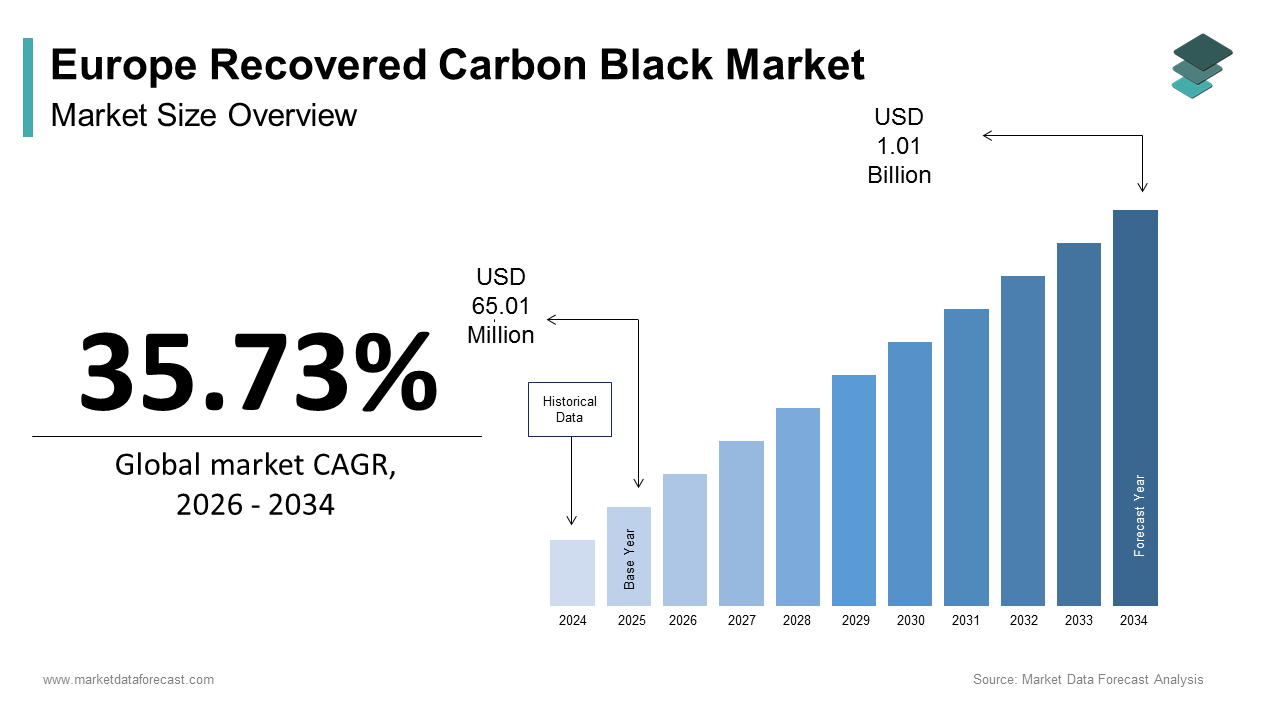
The Europe recovered carbon black market size was calculated to be USD 65.01 million in 2025, is anticipated to reach USD 88.24 million in 2026, and is projected to be worth USD 1.01 billion by 2034, growing at a remarkable CAGR of 35.73% during the forecast period from 2026 to 2034. Driven by binding regulatory frameworks for circular content, decarbonization imperatives, and advancements in purification technologies, the market is expanding rapidly across Europe.
Key Executive Metrics (At-a-Glance)
- 2025 Base Valuation: USD 65.01 Million
- 2026 Current Valuation: USD 88.24 Million
- 2034 Forecast Valuation: USD 1.01 Billion
- Compound Annual Growth Rate (CAGR): 35.73% (2026–2034)
- Dominant Application Segment: Tire Applications (54.4% share in 2025)
- Fastest-Growing Application Segment: Plastics Application (Anticipated CAGR of 13.2% over the forecast period)
- Dominant Regional Market: Germany (25.4% share in 2025)
Core Market Drivers
- EU Regulatory Push for Circular Content: Frameworks such as the Ecodesign for Sustainable Products Regulation and the updated End of Life Vehicles Regulation mandate minimum recycled content in durable goods, establishing structural demand.
- High-Performance Rubber and Polymer Adoption: Advances in purification and surface modification are closing performance gaps with virgin grades, expanding adoption into demanding industrial seals, hoses, and polyolefin compounds.
Primary Market Restraints & Challenges
- Inconsistent Feedstock Quality: Variability in end-of-life tire collection and composition across European countries complicates consistent rCB parameter output.
- High Capital Intensity: Limited advanced pyrolysis infrastructure and high investment barriers restrict scalable commercial production.
Europe Recovered Carbon Black Market Classification Breakdown
| Segment Category | Largest Segment | Fastest-Growing Segment |
|---|---|---|
| By Application | Tire (54.4% share in 2025) | Plastics (CAGR of 13.2% over the forecast period) |
| By Region | Germany (25.4% share in 2025) | Italy & United Kingdom (Promising CAGRs driven by infrastructure investment and regulatory alignment) |
Major Industry Players Profiled
Key market participants include Birla Carbon, Orion Engineered Carbons, Cabot Corporation, Black Bear Carbon, Delta Energy, Pyrolyx AG, Scandinavian Enviro Systems, Klean Industries, Radhe Group, and Bolder Industries.
Europe Recovered Carbon Black Market Size
The Europe recovered carbon black market size was calculated to be USD 65.01 million in 2025 and is anticipated to be worth USD 1.01 billion by 2034, growing from USD 88.24 million in 2026 at a CAGR of 35.73% during the forecast period.
Recovered carbon black (rCB) is a sustainable material produced through the thermochemical devulcanization of end-of-life tires, serving as a circular alternative to virgin carbon black derived from fossil fuels. In Europe, rCB is primarily utilized in rubber compounding, plastics, and coatings, offering comparable reinforcement properties while significantly lowering carbon footprint. As per the European Tyre Recycling Association, millions of metric tons of end-of-life tires were collected across the European Union in 2024, with less than 30% processed via pyrolysis, which is the primary route for rCB recovery. The European Commission’s Circular Economy Action Plan identifies rCB as a strategic secondary raw material, and the updated End of Life Vehicles Regulation mandates 95% material recovery by weight from scrapped vehicles by 2035, which is intensifying pressure to valorize tire waste. According to the European Chemicals Agency, rCB is now classified under REACH as a distinct substance from virgin carbon black, enabling clearer regulatory pathways. Despite its environmental promise, rCB adoption hinges on consistent quality, scalability of pyrolysis infrastructure, and alignment with evolving product safety standards, positioning the Europe recovered carbon black market at the intersection of industrial decarbonization, waste policy enforcement, and advanced material innovation.
MARKET DRIVERS
EU Regulatory Push for Circular Content in Industrial Materials
The European Union’s binding regulatory framework mandating recycled content in industrial materials acts as a powerful catalyst for recovered carbon black demand, which is one of the major factors propelling the growth of the European recovered carbon black market. The EU Strategy for Sustainable and Circular Textiles and the Ecodesign for Sustainable Products Regulation require manufacturers to incorporate verified secondary raw materials in durable goods, including tires and technical rubber products. As per the European Commission, the Ecodesign Regulation introduces minimum recycled content requirements for products, and future working plans include thresholds for tires, with ambitions to increase recovered material use. This directly benefits rCB as the most technically viable recycled component in tire treads and sidewalls. As per the Joint Research Centre, the EU Taxonomy for Sustainable Activities recognizes rCB production from end-of-life tires as a green activity when lifecycle greenhouse gas emissions are substantially reduced compared to virgin carbon black. EU Science Hub. Tire giants such as Michelin have announced sustainability strategies aiming for higher use of sustainable materials by 2030. These policy levers create a structural demand pull that transcends voluntary sustainability goals, embedding rCB into the legal fabric of European manufacturing compliance.
Growing Adoption in High-Performance Rubber and Polymer Applications
Recovered carbon black is increasingly accepted in demanding rubber and polymer formulations due to advances in purification and surface modification technologies that narrow performance gaps with virgin grades, which is further boosting the expansion of the European recovered carbon black market. Leading European compounders such as LANXESS and Arlanxeo now specify rCB in seals, hoses, and industrial belts where abrasion resistance and tensile strength are critical. rCB with controlled ash and hydrocarbon levels is increasingly aligned with technical standards for rubber goods, enabling use in automotive and construction sectors. Technical validation studies confirm that rCB blends can substitute a significant portion of virgin carbon black while maintaining mechanical properties within acceptable ranges. Moreover, the European Plastics Converters Association notes that rCB enhances UV stability in polyolefin compounds used in agricultural films and geomembranes. Lifecycle assessments consistently show that rCB production results in significantly lower CO2 emissions compared to virgin carbon black, shifting perception from waste derivative to engineered material and unlocking premium industrial channels beyond low-grade rubber fillers.
MARKET RESTRAINTS
Inconsistent Feedstock Quality and Limited Standardization
The variability in end-of-life tire composition across European countries undermines the consistency and reliability of recovered carbon black output, which is posing a significant market restraint. Tires collected in Southern Europe often contain higher steel and textile residues due to less advanced shredding infrastructure, while Northern European feedstock tends to be cleaner but includes more synthetic rubber with different sulfur content. The European Environment Agency highlights that waste collection systems vary widely across member states, leading to heterogeneous input streams for pyrolysis plants. This inconsistency directly affects rCB properties such as surface area, particle size distribution, and residual zinc content, as these are key parameters for rubber reinforcement. As per the European Committee for Standardization, there is currently no harmonized EN standard for rCB, meaning buyers rely on proprietary specifications, increasing qualification costs and delaying adoption. Major tire makers require tighter variability controls, yet current pyrolysis outputs fluctuate significantly batch to batch. Until feedstock pre-sorting and pyrolysis protocols are standardized across the value chain, rCB will struggle to achieve the quality assurance demanded by high-performance sectors.
High Capital Intensity and Limited Pyrolysis Capacity
The Europe recovered carbon black market faces structural limitations due to the high capital costs and slow deployment of advanced pyrolysis infrastructure required for high-quality rCB production. A single commercial-scale pyrolysis plant with post-processing capabilities requires substantial investment and several years for permitting and commissioning, as noted by the European Investment Bank. As of 2024, Europe hosts a limited number of advanced pyrolysis facilities capable of producing rCB suitable for rubber applications, with combined annual capacity far below the levels needed to meet future tire recycling targets. As per the European Tyre and Rubber Manufacturers’ Association, while most end-of-life tires are collected, only a small share undergoes pyrolysis, with the remainder downcycled into lower-value applications. Grid connection constraints and stringent air emission permits under the Industrial Emissions Directive further delay project timelines. Without scalable and bankable pyrolysis assets, rCB supply remains fragmented and insufficient to support large scale off take agreements, deterring major rubber producers from committing to long term substitution despite regulatory incentives.
MARKET OPPORTUNITIES
Integration into EU Battery and Electric Vehicle Supply Chains
Recovered carbon black is emerging as a strategic conductive additive in battery components for Europe’s rapidly expanding electric vehicle ecosystem, which is creating a high-value opportunity for the European recovered carbon black market. rCB’s graphitic structure and residual carbon content enable electron mobility suitable for battery casings, thermal interface materials, and even anode binders in lithium-ion cells. According to the European Battery Alliance, the EU aims to produce 8 million electric vehicles annually by 2030, requiring over 600 gigawatt hours of battery capacity, much of it manufactured within the bloc under the Net Zero Industry Act. Companies like Northvolt and ACC are actively evaluating rCB as a sustainable alternative to fossil-based carbon additives. As per the Fraunhofer Institute for Silicate Research, rCB with controlled metal impurities enhances thermal conductivity in battery module housings without compromising electrical insulation. According to the EU’s Critical Raw Materials Act, substitution of fossil carbon with circular alternatives in strategic technologies is explicitly encouraged. This convergence positions rCB not merely as a rubber filler but as a functional material in next-generation clean tech supply chains, commanding premium pricing and long-term off-take potential.
Development of Mass Balance Certified rCB for Premium Markets
The adoption of chain of custody models, such as mass balance certification, enables recovered carbon black to enter high-value polymer and specialty chemical markets previously inaccessible due to traceability concerns, which is a notable opportunity for the regional market. According to ISCC, over 15 European rCB producers achieved certification in 2023, including Pyrum Innovations and Black Bear Carbon. This unlocks partnerships with global polymer producers like Borealis and SABIC, which use rCB in polyethylene and polypropylene grades for automotive and consumer goods. As per the European Brand Association, 73% of its members now require third-party verified recycled content in packaging and durable goods, driven by the Corporate Sustainability Reporting Directive. Mass balance rCB meets this demand while bypassing color and odor limitations of physical blends. As regulatory and consumer pressure intensifies, this certification pathway transforms rCB from a commodity filler into a traceable, sustainable ingredient, enabling premium pricing and integration into circular product portfolios across multiple sectors.
MARKET CHALLENGES
Technical Performance Gaps in Critical Tire Applications
Despite progress, recovered carbon black still faces performance limitations in high-stress tire components such as tread compounds, where rolling resistance, wet grip, and durability are non-negotiable, which is one of the significant challenges to the growth of the European recovered carbon black market. Virgin carbon black grades like N220 and N330 offer tightly controlled particle morphology and surface chemistry that optimize polymer interaction, attributes difficult to replicate with current rCB due to residual ash, zinc, and inconsistent surface functionalization. According to the European Tyre and Rubber Manufacturers’ Association, rCB substitution above 20% in tread formulations leads to a measurable increase in rolling resistance, reducing fuel efficiency by up to 2% in passenger car tires. As per Continental’s 2024 field trial, prototype tires with 30% rCB showed 15% faster tread wear under high mileage testing compared to reference tires. These gaps matter because the EU tire labeling regulation penalizes products with poor rolling resistance and wet braking performance, directly affecting marketability. Until rCB achieves performance parity through advanced post treatment such as plasma activation or acid leaching, its use will remain confined to sidewalls, inner liners, and non-tread areas, capping its value realization in the most demanding and lucrative segment of the tire market.
Lack of Harmonized End-of-Life Tire Collection Infrastructure
The fragmented and unevenly developed end-of-life tire collection systems across Europe constrain the reliable supply of feedstock necessary for consistent rCB production, which is further challenging the European recovered carbon black market expansion. According to Eurostat’s 2024 waste statistics, countries like Germany and the Netherlands achieve collection rates exceeding 98% due to extended producer responsibility schemes, while others, such as Bulgaria and Romania, report rates below 70%. As per the European Court of Auditors’ 2023 review, only 14 EU member states have implemented digital tracking systems for tire flows, allowing illegal dumping and unregulated exports to persist. According to Eurostat, in 2023, an estimated 400,000 metric tons of end-of-life tires were exported outside the EU, often to countries with lower environmental standards, depriving European rCB producers of valuable feedstock. Without a harmonized EU-wide tire passport and mandatory collection quotas enforced through the upcoming Ecodesign Regulation, the rCB industry will remain dependent on volatile and geographically uneven feedstock availability, undermining investment security and scale.
REPORT COVERAGE
| REPORT METRIC | DETAILS |
| Market Size Available | 2025 to 2034 |
| Base Year | 2025 |
| Forecast Period | 2026 to 2034 |
| CAGR | 35.73% |
| Segments Covered | By Application, And Region |
| Various Analyses Covered | Global, Regional & Country Level Analysis; Segment-Level Analysis; DROC, PESTLE Analysis; Porter’s Five Forces Analysis; Competitive Landscape; Analyst Overview of Investment Opportunities |
| Regions Covered | UK, France, Spain, Germany, Italy, Russia, Sweden, Denmark, Switzerland, Netherlands, Turkey, and the Czech Republic |
| Market Leaders Profiled | Birla Carbon, Orion Engineered Carbons, Cabot Corporation, Black Bear Carbon, Delta Energy, Pyrolyx AG, Scandinavian Enviro Systems, Klean Industries, Radhe Group, Bolder Industries |
SEGMENTAL ANALYSIS
By Application Insights
The tire applications segment dominated the market by accounting for 54.4% of the regional market share in 2025. The dominance of the tire applications segment in the European market is driven by regulatory mandates and circular economy commitments from major tire manufacturers. The primary use of rCB in this segment is in sidewalls, inner liners, and bead fillers, areas where performance tolerance allows higher substitution rates than in treads. According to the European Tyre and Rubber Manufacturers’ Association, all major EU-based tire producers, including Michelin, Continental, and Bridgestone, have pledged to incorporate at least 30% sustainable materials by 2030, with rCB as a cornerstone. According to the European Commission, the updated End of Life Vehicles Regulation requires that by 2035 each new tire placed on the EU market contain a minimum share of recycled content, creating a binding demand signal. As per the EU Ecodesign for Sustainable Products Regulation, digital product passports for tires will be mandated starting in 2027, which is enabling traceability of rCB content. According to Michelin, its Visionary Concept tire launched in 2023 contained 28% rCB, while Continental’s ContiRe.Tex line achieved 15% rCB integration in passenger car tires. These commercial validations demonstrate technical feasibility and market readiness, reinforcing tire applications as the anchor segment for rCB consumption across Europe.
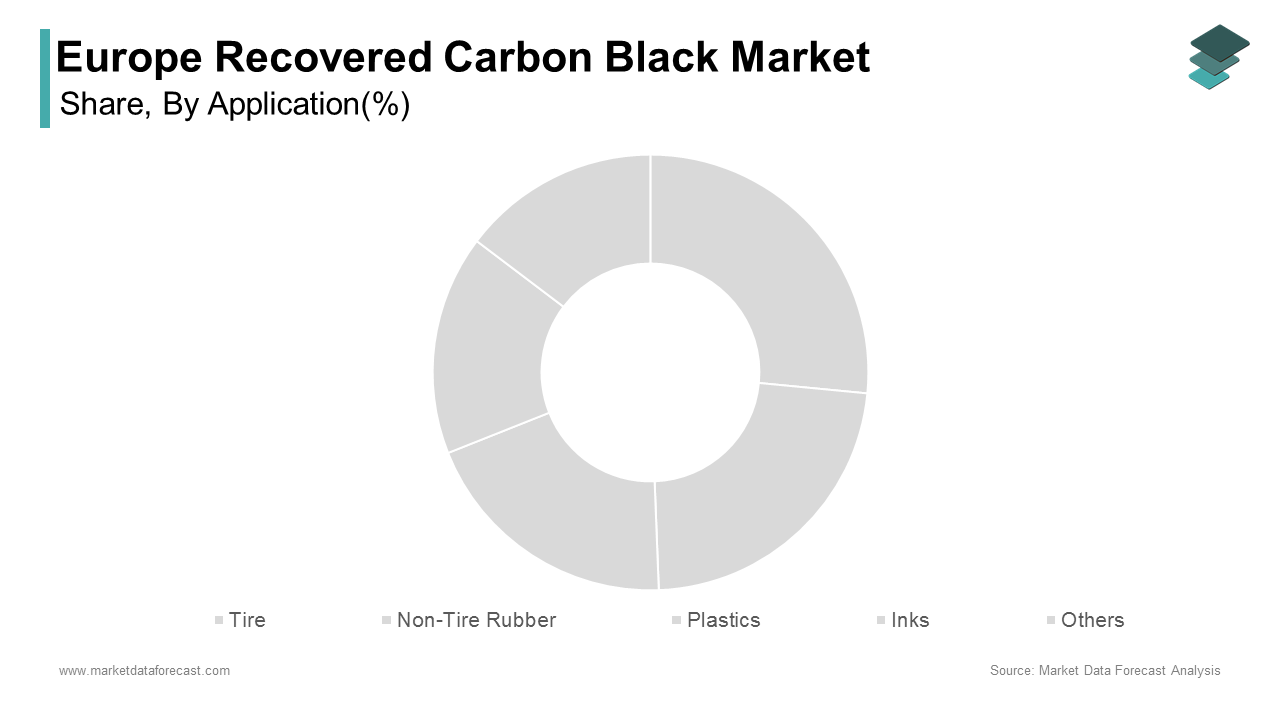
The plastics application segment is also promising and is anticipated to register a CAGR of 13.2% over the forecast period, owing to the increasing demand for conductive and UV-stable compounds in automotive under-the-hood components, construction films, and industrial packaging, where black coloration is acceptable. Unlike rubber applications constrained by performance thresholds, plastics offer greater formulation flexibility for rCB integration. According to Plastics Europe, European production of engineering thermoplastics reached 9.8 million metric tons in 2024, with growing interest in circular additives. As per Borealis and SABIC, polyolefin grades containing 20 to 40% rCB are now offered and certified under mass balance protocols by the International Sustainability and Carbon Certification system. According to the EU Packaging and Packaging Waste Regulation, 65% plastic packaging recycling is mandated by 2025, favoring dark colored recyclates that tolerate rCB inclusion. As per the European Plastics Converters Association, agricultural film producers in Spain and Italy increasingly use rCB to enhance UV resistance, extending product life by up to 30%. The convergence of regulatory pressure, material innovation, and functional benefits positions plastics as the highest growth frontier for rCB in Europe.
REGIONAL ANALYSIS
Germany Recovered Carbon Black Market Analysis
Germany dominated the market and held 25.4% of the regional market share in 2025. The leading position of Germany in the European market is attributed to its leadership in advanced recycling infrastructure and industrial demand. The country hosts Europe’s highest concentration of pyrolysis plants, including facilities operated by Pyrum Innovations and Delta Energy Systems, supported by robust extended producer responsibility schemes under the German Circular Economy Act. According to the German Federal Environment Agency, Germany collected and processed 780,000 metric tons of end-of-life tires in 2023, achieving a 99% recovery rate, which is the highest in the EU. This reliable feedstock stream enables consistent rCB output for tire and automotive suppliers. Major rubber compounders like LANXESS and Evonik source rCB for industrial seals and hoses, while Volkswagen Group mandates recycled content in non-visible vehicle components under its Way to Zero strategy. As per the German government’s High-Tech Strategy 2025, over €150 million has been allocated to circular carbon technologies, accelerating rCB adoption. Germany’s combination of regulatory rigor, technical expertise, and industrial integration solidifies its position as the market’s core engine.
France Recovered Carbon Black Market Analysis
France occupied 18.8% of the regional market share in 2025. The growth of France in the European market can be credited to the strong policy support and strategic investments in circular tire value chains. According to the French government’s Anti-Waste for a Circular Economy Law, by 2030, all tires sold in France must contain at least 25% recycled or bio-based materials. As per the French Environment and Energy Management Agency, France processed 520,000 metric tons of end-of-life tires in 2023, with 35% directed to pyrolysis, double the EU average. According to Michelin, headquartered in Clermont-Ferrand, over €200 million has been invested since 2021 in rCB integration, including a joint venture with Pyrolyx to build a 10,000 ton per year rCB plant in Lorraine. The company’s Vision tire roadmap targets 100% sustainable materials by 2050, with rCB as a critical pillar. As per France’s national low-carbon strategy, tax credits are provided for companies using certified secondary raw materials, lowering adoption barriers. This policy and industrial synergy positions France as a dynamic growth pole for high-quality rCB demand and innovation.
Italy Recovered Carbon Black Market Analysis
Italy is estimated to grow at a promising CAGR in the Europe recovered carbon black market over the forecast period, owing to its large tire manufacturing base and expanding pyrolysis capacity. According to Pirelli, with its Milan-based R&D center, rCB use in high-performance tires has been pioneered, achieving 15% substitution in its Cyber Tyre line for electric vehicles. According to the Italian National Institute of Statistics, Italy generated 480,000 metric tons of end-of-life tires in 2023, with collection rates improving to 92% following the 2022 revision of the CONAU extended producer responsibility system. As per EU Innovation Fund grants, new pyrolysis facilities in Lombardy and Emilia Romagna have increased rCB output by 40% since 2022. According to the Italian Ministry of Ecological Transition’s National Recovery and Resilience Plan, €800 million has been allocated to circular economy projects, including advanced tire recycling. Furthermore, Italy’s construction sector uses rCB-enhanced geomembranes for landfill liners, leveraging its UV stability. This blend of industrial heritage, regulatory modernization, and infrastructure investment sustains Italy’s role as a key rCB consumer and processor.
Netherlands Recovered Carbon Black Market Analysis
The Netherlands is predicted to hold a prominent share of the European recovered carbon black market over the forecast period. The Netherlands is emerging as a logistics and certification hub for circular carbon materials. The country’s strategic port infrastructure in Rotterdam facilitates feedstock aggregation from Northwest Europe and hosts Europe’s first ISCC plus certified rCB plant operated by Black Bear Carbon. According to the Dutch Ministry of Infrastructure and Water Management, the Netherlands achieved a 97% end of life tire recovery rate in 2023, with 45% processed via advanced pyrolysis, the highest proportion in the EU. The facility in Twente produces rCB for global brands including Adidas and Philips, used in sports shoes and electronic housings. As per the Dutch government’s Green Deals program, a covenant has been signed with 15 companies to scale rCB use in polymers by 2027. According to the Netherlands Enterprise Agency, subsidies covering up to 35% of capital costs are provided for circular material start-ups. This ecosystem of certification, logistics, and policy support makes the Netherlands a gateway for rCB into premium consumer and electronics markets across Europe.’
United Kingdom Recovered Carbon Black Market Analysis
The United Kingdom is estimated to register a healthy CAGR in the European recovered carbon black market during the forecast period. The UK is maintaining significant activity despite its post Brexit regulatory divergence. According to the UK’s Department for Environment, Food and Rural Affairs, 410,000 metric tons of end-of-life tires were collected in 2023, with pyrolysis capacity doubling since 2021 through investments by companies like Alterra Energy. As per the UK’s Environment Agency, high-quality rCB is now classified as a non-waste product under the end-of-waste criteria published in 2023, simplifying commercial trade. Major tire retreaders and rubber product manufacturers in the West Midlands and Yorkshire increasingly specify rCB to meet corporate net zero targets. According to Jaguar Land Rover’s Reimagine strategy, recycled carbon materials are used in interior trims and underbody components. Although no longer bound by EU Ecodesign rules, the UK’s 2023 Waste Prevention Programme encourages recycled content in durable goods through voluntary agreements. This pragmatic regulatory stance, combined with industrial demand, ensures the UK remains a stable and evolving rCB market within the European landscape.
COMPETITION OVERVIEW
The Europe recovered carbon black market features an evolving competitive dynamic shaped by technology providers, tire manufacturers, and specialty chemical companies. Unlike commodity markets, competition is not based on price alone but on rCB quality certification, feedstock security, and application expertise. A handful of advanced pyrolysis operators lead in technology and output consistency,y while major tire brands act as demand catalysts through sustainability commitments. New entrants face high barriers, including capital intensity, permitting timelines, and the need for REACH registration. Differentiation occurs through proprietary refining methods, traceability systems, and sector-specific formulation support. Collaborative models dominate, with joint ventures between recyclers and industrial users becoming common. Regulatory momentum from the EU Circular Economy Action Plan creates a favorable tailwind but also raises quality and reporting expectations. As a result, the market rewards integration innovation and strategic partnerships while marginalizing players unable to meet performance or compliance thresholds in a rapidly professionalizing landscape.
KEY MARKET PLAYERS
A few major players of the European carbon black market include
- Birla Carbon
- Orion Engineered Carbons
- Cabot Corporation
- Black Bear Carbon
- Delta Energy
- Pyrolyx AG
- Scandinavian Enviro Systems
- Klean Industries
- Radhe Group
- Bolder Industries
Top Strategies Used by the Key Market Participants
Key players in the Europe recovered carbon black market employ four core strategies to enhance competitiveness and scale. First, they pursue vertical integration by securing end-of-life tire feedstock through partnerships with collectors or extended producer responsibility schemes, ensuring consistent input quality. Second, they invest in advanced post-processing technologies such as plasma treatment, acid washing, and classification systems to improve rCB purity and performance for high-value applications. Third, they obtain third-party certifications like ISCC Plus or RecyClass to enable mass balance accounting and access premium markets in automotive and consumer goods. Fourth, they form strategic alliances with tire manufacturers, polymer producers, and brand owners to co-develop rCB grades and establish long-term off-take agreements that de-risk capital investment and validate technical feasibility across diverse applications.
Leading Players in the Europe Recovered Carbon Black Market
- Pyrum Innovations AG is a German technology company specializing in pyrolysis-based tire recycling and a pioneer in high-purity recovered carbon black production in Europe. The company operates multiple plants in Germany and licenses its proprietary vacuum pyrolysis technology to partners across the continent. Pyrum supplies rCB to major tire and rubber manufacturers seeking certified circular materials compliant with EU chemical regulations. In 2024, the company commissioned a new facility in Dillingen with integrated post-processing to reduce ash and zinc content, enabling rCB use in demanding rubber applications. Pyrum also collaborates with research institutions like the German Institute for Rubber Technology to validate rCB performance in industrial compounds. These initiatives reinforce its role as a technology enabler and premium rCB supplier within global circular material supply chains.
- Black Bear Carbon B.V. is a Netherlands-based innovator that transforms end-of-life tires into high-quality recovered carbon black and oil using a proprietary low-emission process. The company supplies rCB to global brands in automotive, consumer goods, and electronics under mass balance certification from ISCC. Black Bear’s rCB is distinguished by its low polycyclic aromatic hydrocarbon content and consistent particle size, enabling use in premium polymers. In 2023, the company inaugurated Europe’s first ISCC plus certified rCB plant in Twente and secured long-term off-take agreements with multinational polymer producers. Black Bear also partners with tire collectors across Benelux and Germany to secure feedstock, ensuring supply chain transparency. Its focus on certification premium applications and closed-loop partnerships positions it as a key player in the global transition to circular carbon materials.
- Michelin Group, although primarily a tire manufacturer, plays a strategic role in the Europe recovered carbon black market through vertical integration and material innovation. The company actively develops rCB formulations for its tires and invests in recycling technologies to secure sustainable raw materials. Michelin co-founded the Circular Carbon Black Alliance and launched the “Vision” concept tire containing significant rCB content. In 2023, Michelin formed a joint venture with Pyrolyx to build an rCB production unit in France targeting 10,000 metric tons annually. The company also participates in EU fundeEU-fundeds like CIRC-PACK to validate rCB in polymer applications beyond tires. By driving demand setting, technical standards, and investing in supply infrastructure, Michelin accelerates rCB adoption across industrial sectors and influences global sustainability benchmarks in the mobility and materials industries.
MARKET SEGMENTATION
This research report on the Europe recovered carbon black market has been segmented and sub-segmented based on application and region.
By Application
- Tire
- Non-Tire Rubber
- Plastics
- Inks
- Others
By Region
- UK
- France
- Spain
- Germany
- Italy
- Russia
- Sweden
- Denmark
- Switzerland
- Netherlands
- Turkey
- Czech Republic
- Rest of Europe