- Product Description Description
- Table of Contents TOC
- List of Table & Figure LOT
- Get Free Sample PDF Sample PDF
Market Size, 2025
$9.49 BnMarket Estimate, 2026
$11.98 BnMarket Forecast, 2034
$77.18 BnCAGR, 2026–2034
26.22%Europe Robotic Vacuum Cleaner Market Summary
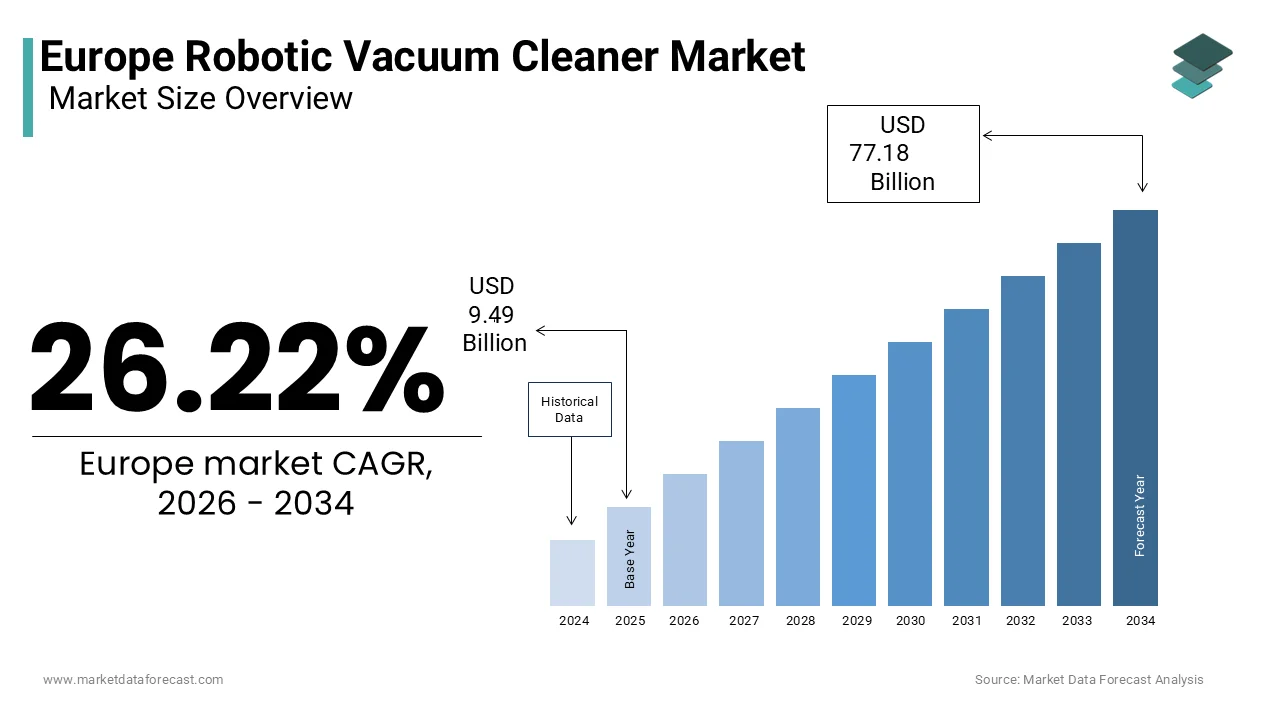
The Europe robotic vacuum cleaner market was valued at USD 9.49 billion in 2025 and is projected to reach USD 77.18 billion by 2034, growing at a CAGR of 26.22% from 2026 to 2034, driven by urbanization, smart home integration, and rising demand for autonomous home cleaning solutions.
Market Snapshot
- 2025 Market Size: USD 9.49 billion
- 2026 Market Size: USD 11.98 billion
- 2034 Forecast: USD 77.18 billion
- CAGR (2026–2034): 26.22%
- Base Year: 2025
- Forecast Period: 2026–2034
Quick Growth Drivers
- Rapid urbanization and shrinking living spaces across European cities
- Rising adoption of smart home ecosystems and voice assistants
- Growth in dual-income and time-constrained households
- Increasing pet ownership, driving frequent floor cleaning needs
- Technological advancements in LiDAR, AI navigation, and obstacle detection
Principal Restraints
- High upfront cost limiting penetration among price-sensitive households
- Performance gaps on hard floors and pet hair in mid-tier models
- Limited perceived necessity compared to traditional vacuum cleaners
- Uneven adoption across Southern and Eastern Europe due to income disparities
High-Value Opportunities
- Expansion of self-emptying, vacuum-mop hybrid models
- Growth of subscription, rental, and product-as-a-service models
- Rising demand for premium, fully autonomous cleaning systems
- Integration with Matter, Apple HomeKit, and cross-platform smart home standards
- Circular economy initiatives supporting refurbishment and take-back programs
Key Market Challenges
- Software fragmentation and limited cross-brand interoperability
- Short and inconsistent firmware update lifecycles
- Compliance costs related to WEEE and battery disposal regulations
- Low consumer awareness of repair and recycling pathways
Fastest-Growing Segments
- Window Cleaning Robots – driven by high-rise urban living and safety concerns
- Commercial Applications – hotels, offices, hospitals facing labor shortages
- Above USD 500 Price Segment – demand for fully autonomous, self-maintaining units
Regional Leadership & Dynamics
- Germany (24.7%) – high disposable income, engineering-driven purchasing behavior
- United Kingdom (19.4%) – high pet ownership and dense urban housing
- France – strong mid-tier demand through mass retail channels
- Netherlands – early adopter of smart home and circular economy models
- Sweden – premium-heavy market driven by affluent, dual-income households
What Wins Commercially
- Reliable cross-surface cleaning performance
- Seamless smart home ecosystem integration
- High autonomy through self-emptying and self-washing docks
- Strong after-sales support and localized software
- Compliance with EU repairability and sustainability norms
Top Strategic Ask for Executives
Accelerate innovation in fully autonomous, interoperable robotic vacuum systems while lowering entry barriers through subscription models and strengthening compliance with Europe’s sustainability and right-to-repair frameworks.
Leading Players
Some of the companies that are playing a dominating role in the Europe robotic vacuum cleaner market include
iRobot Corporation, Ecovacs Robotics, Roborock, Samsung Electronics, LG Electronics, SharkNinja, Dyson, Miele, Rowenta (Groupe SEB), Dreame Technology, Eufy (Anker Innovations), Bissell, Tineco, Neato Robotics, and Proscenic.
Europe Robotic Vacuum Cleaner Market Size
The europe robotic vacuum cleaner market was valued at USD 9.49 billion in 2025, is estimated to reach USD 11.98 billion in 2026, and is projected to reach USD 77.18 billion by 2034, growing at a CAGR of 26.22% from 2026 to 2034.
A robotic vacuum cleaner (also called a "robovac") is an autonomous, programmable device that cleans floors with minimal human intervention using a combination of sensors, motors, and cleaning algorithms. These appliances integrate technologies such as LiDAR, visual simultaneous localization and mapping (vSLAM), and AI-driven obstacle recognition to navigate complex indoor environments. Unlike conventional vacuums, robotic models emphasize convenience, scheduled operation, and compatibility with smart home ecosystems. Growing adoption of connected devices across European households is fostering a favorable environment for smart, automated cleaning appliances. Increasing quantities of end-of-life small household appliances in the EU are intensifying pressure on sustainability, driving demand for repairable products and better waste management. The market is shaped not only by technological adoption but also by urbanization trends. Rising urbanization in the EU, characterized by smaller living spaces, is driving higher demand for compact, automated home appliances. This convergence of digitalization, demographic density, and evolving domestic labor expectations defines the unique trajectory of robotic vacuum adoption across Europe.
MARKET DRIVERS
Urbanization and Shrinking Living Spaces Increase Demand for Space-Efficient Automation
The region’s accelerating urban concentration has led to smaller average dwelling sizes, particularly in major cities. This makes manual cleaning more burdensome and reduces the space available for traditional appliances, driving growth in the European robotic vacuum cleaner market. In many Western European cities, rising housing costs and high demand have limited the expansion of living space, with new developments increasingly focused on smaller, high-density units, particularly in high-demand urban centers. Driven by densification policies and affordability pressures, a significant portion of new housing in major cities like Paris, Berlin, and Amsterdam consists of smaller apartments and studio units, increasing the share of compact living spaces in the new-build market. Robotic vacuums address this constraint by eliminating the need for bulky upright models and enabling daily maintenance without storage trade-offs. Additionally, high rental turnover in cities increases demand for quick cleaning between tenants, a task robots perform autonomously via app scheduling. This spatial pressure, combined with individual-income households seeking time savings, positions robotic vacuums as a functional necessity rather than a luxury in dense European urban cores.
Integration with Smart Home Ecosystems Enhances Daily Utility and User Retention
Robovacs have evolved from standalone gadgets into integral nodes within broader smart home networks, which significantly increases their perceived value and usage frequency, and thereby propels the growth of theEuropeane robotic vacuum cleaner market. Modern models sync with voice assistants like Amazon Alexa and Google Assistant and respond to routines such as “Goodnight” commands that trigger cleaning before bed. Voice-activated automation, such as smart speaker integration, encourages more frequent use of robotic vacuums compared to relying solely on app-based controls. Apple’s HomeKit compatibility further deepens integration for iOS users who prioritize ecosystem cohesion. Moreover, geofencing features automatically start cleaning when residents leave home, leveraging smartphone location data to optimize energy use. Furthermore, a significant majority of consumers prioritize seamless smart home ecosystem compatibility when purchasing robotic cleaners. This embeddedness transforms the device from an occasional tool into a persistent environmental manager, driving repeat engagement and reducing abandonment rates common in early generation models.
MARKET RESTRAINTS
High Upfront Cost Relative to Disposable Income Limits Mass Market Penetration
The premium pricing of advanced robovacs remains a significant barrier for middle andlower-incomee European households, despite technological advances, which impedes the expansion of the European robotics vacuum cleaner market. The market for smart home cleaning has diverged, with basic, entry-level robotic vacuums occupying the low-cost segment, while advanced, all-in-one models with automated maintenance functions dominate the premium, high-cost sector. Research indicates a persistent economic divide in disposable income, with median households in Southern and Eastern Europe earning considerably less than their counterparts in the rest of the European Union. Robotic vacuum ownership is not uniform across Europe, showing a much higher saturation rate in Germany compared to Italy, where adoption remains comparatively lower. Even in affluent markets, price sensitivity persists. Unlike smartphones or televisions, robotic vacuums lack strong social signaling value, reducing willingness to stretch budgets. Absent accessible financing or compelling long-term savings narratives, the category risks staying limited to affluent urban demographics, curbing broader European volume growth.
Inconsistent Performance on Hardwood Floors and Pet Hair Reduces Consumer Trust
Many European homes feature hardwood, tile, or laminate flooring, yet numerous robovacs struggle with fine dust adhesion and edge cleaning on smooth surfaces, which hinders the expansion of theEuropeane robotics vacuum cleaner market. Simultaneously, pet ownership is rising. A significant portion of households across Europe now include pets, with cats and dogs remaining the most popular companions. This rising population of pets frequently introduces challenges for home maintenance, as animal fur can obstruct vacuum brush rolls and gradually diminish overall suction performance. Despite claims made in product marketing, independent testing of prominent vacuum models suggests that many units struggle to effectively remove pet hair that has become deeply embedded in flooring surfaces. Hair-straining tools prevent clogs, but high-performance cleaning on challenging surfaces remains a struggle for top brands. Consumer feedback and market analysis indicate that a common reason for returning robotic vacuum cleaners is their inability to match the deep-cleaning effectiveness of traditional manual vacuums, particularly on hard flooring. These devices offer convenient daily maintenance; however, they often lack the suction capacity required for deep cleaning or significant debris. These performance gaps erode trust, especially among first-time buyers who expect parity with manual vacuums. Premium vacuums continue to innovate, but mid-tier, cost-saving measures keep user skepticism alive. Adoption will lag until reliable, cross-surface performance becomes the standard, not the exception.
MARKET OPPORTUNITIES
Expansion of Self-Emptying and Mopping Hybrid Models Creates Premium Upsell Pathways.
The introduction of all-in-one robotic cleaners that vacuum, mop, and autonomously empty dustbins has openedhigh-margingin segment appealing to convenience-focused consumers, which is likely to promote the growth of Europeanrope robotics vacuum cleaner market. Self-emptying bases reduce user interaction, addressing a key pain point of daily bin maintenance. According to European home appliance industry trends, the shipment of hybrid vacuum-mop robots increased significantly, with growth in this dual-purpose category far outpacing that of traditional, standalone robotic vacuums. Brands like Dreame and Ecovacs now offer hot water mopping with automatic pad washing, features previously exclusive to manual steam mops. In the Netherlands, where hard flooring is the predominant type of flooring in homes, hybrid models that both vacuum and mop have become the majority choice, driving sales in the robotic cleaner market. These units command price premiums over basic models, yet conversion rates remain strong among dual-income households. Manufacturers are transforming home cleaning from a niche gadget into a total maintenance solution by bundling several functions into a single autonomous device.
Growth of Rental and Subscription Models Lowers Entry Barriers and Encourages Trial
The regional retailers and manufacturers are piloting flexible ownership models that align with regional preferences for service-based consumption to overcome upfront cost resistance. This strategy provides fresh prospects for theEuropeane robotic vacuum cleaners market. Retailers in Germany are offering subscription-based models for robotic vacuums, bundling the devices with maintenance and upgrade options to encourage adoption. Similarly, peer-to-peer rental platforms in the UK facilitate the trial of, and low-commitment access to, robotic cleaning devices. Young urban consumers across Europe show significant interest in acquiring, rather than purchasing, advanced home cleaning technology through subscription models. These models also support circular economy goals, and manufacturers retain ownership, ensuring proper recycling at the end of life. Electrolux’s pilot program in Sweden includes take-back and refurbishment, reducing waste. These approaches increase tech accessibility and generate steady revenue while providing valuable data for refining products.
MARKET CHALLENGES
Software Fragmentation and Lack ofCross-Brandd Interoperability Undermine User Experience
Proprietary ecosystems prevent seamless coordination with non native devices, despite smart home integration, and inhibit the growth of theEuropeane robotic vacuum cleaner market. A Roomba may work with Alexa but not with Apple HomeKit unless manually bridged, while Ecovacs units often exclude Samsung SmartThings. According to a study, only a portion of robotic vacuums sold in Europe support Matter, the new universal smart home protocol, limiting true plug-and-play functionality. This fragmentation forces consumers to choose appliances based on existing ecosystem allegiance rather than performance, distorting purchasing behavior. Moreover, firmware updates are inconsistently rolled out. Such practices shorten usable lifespans and contradict the EU right to repair principles. User frustration and reduced brand loyalty will continue until the industry establishes universal, long-term update standards.
E-Waste Regulations and Battery Disposal Complexities Increase End-of-Life Burden
Robovac contains lithium ion batteries, circuit boards, and plastic composites that fall under the EU’s Waste Electrical and Electronic Equipment Directive, which requires separate collection and certified recycling, and thereslowslow down the expansion ofEuropeanurope robotic vacuum cleaner market. However, convenient take-back channels remain scarce;e, only a portion of European municipalities offer door-to-door waste pickup. Consumers often discard units in general waste due to confusion or inconvenience. Additionally, battery removal is rarely user serviceable, complicating safe handling. Manufacturers face rising compliance costs for producer responsibility schemes, which may be passed to consumers. Poor disposal options and difficult disassembly threaten the eco-friendly image of robot vacuums, risking regulatory scrutiny and consumer backlash.
REPORT COVERAGE
| REPORT METRIC | DETAILS |
| Market Size Available | 2025 to 2034 |
| Base Year | 2025 |
| Forecast Period | 2026 to 2034 |
| Segments Covered | By Type, Application, Price Range, and Region. |
| Various Analyses Covered | Global, Regional, and Country-Level Analysis, Segment-Level Analysis, Drivers, Restraints, Opportunities, Challenges; PESTLE Analysis; Porter’s Five Forces Analysis, Competitive Landscape, Analyst Overview of Investment Opportunities |
| Countries Covered | UK, France, Spain, Germany, Italy, Russia, Sweden, Denmark, Switzerland, Netherlands, Turkey, Czech Republic, Rest of Europe |
| Market Leaders Profiled | iRobot Corporation, Ecovacs Robotics, Roborock (Shanghai Chēzhì Intelligent Technology), Neato Robotics (Vorwerk Group), Samsung Electronics Co., Ltd., LG Electronics Inc., SharkNinja Operating LLC, Bissell Homecare, Inc., Eufy (Anker Innovations), Dyson Ltd., Miele & Cie. KG, Rowenta (Groupe SEB), Proscenic Technology Co., Ltd., ILIFE (Chuwi Innovation Technology), Dreame Technology Co., Ltd., Tineco (China Hong Kong Group), Sharp Corporation, Coredy Robotics, ECOVACS DEEBOT |
SEGMENTAL ANALYSIS
By Type Insights
The floor vacuum cleaners segment dominated theEuropeane Robotic Vacuum Cleaner Market by accounting for a substantial share in 2025. The dominance of the floor vacuum cleaner segment is driven by universal applicability in residential settings and continuous technological refinement. Floor cleaning remains a daily necessity regardless of dwelling size, flooring material, or household composition. Unlike window or pool robots, which serve niche needs, floor vacuums address a universal pain point: dust, pet hair, and debris accumulation high-trafficfic surfaces. According to EU housing data, the vast majority of European households utilize hard flooring or carpets in living areas, creating a consistent need for regular upkeep. In dense European urban centers like Berlin and Madrid, compact, automated floor cleaners are increasingly popular to maintain smaller living spaces without sacrificing cleaning performance. The desire for effortless daily floor upkeep is the primary driver for robot vacuum ownership, significantly outweighing demand for specialized, non-routine cleaning. This foundational utility ensures consistent demand across income levels and geographies, making floor robots the default entry point into home automation for millions of households. Manufacturers have significantly improved floor robot performance through LiDAR mapping, anti-tangle brushrolls, and adaptive suction control. Models like the Roborock S8 Pro Ultra now detect carpet presence and boost suction automatically, a critical feature in mixed flooring homes common in the UK and Scandinavia. Additionally, self-emptying bases reduce user intervention to once every two months, addressing a key abandonment driver identified in earlier generations. These tangible time savings, combined with reliable performance, transform the device from a novelty into a habitual domestic tool, reinforcing its dominance.
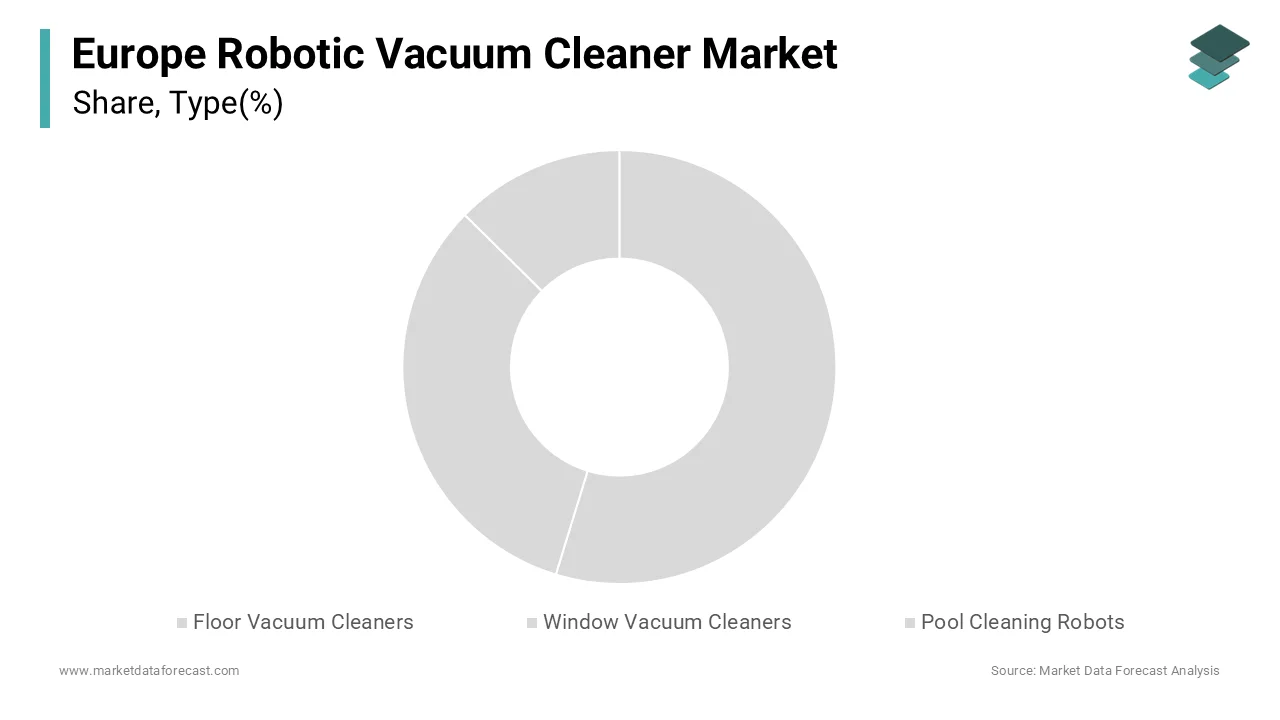
The window vacuum cleaner segment is anticipated to witness the fastest CAGR of 14.2% between 2026 and 2034 due to urban architecture and safety concerns. Europe’s urban centers are increasingly vertical. Traditional window cleaning on upper floors poses fall risks, prompting residents to seek automated alternatives. Window cleaning robots like the Ecovacs Winbot use suction adhesion and microfiber pads to clean glass without ladders or scaffolding. These devices appeal particularly to elderly residents and dual-income households lacking time for risky manual cleaning. Rising urban density and building heights are driving window robots beyond niche markets, thanks to their safety and convenience value. Recent models feature closed-loop water systems that spray, squeegee, and reuse cleaning fluid, minimizing mess on interior sills, a common complaint in early versions. Advanced sensors now detect window frames and prevent falls, a critical reliability upgrade. Brands like Mamibot have also introducedAI-basedd dirt recognition that adjusts cleaning intensity based on grime levels. These refinements address previous barriers of inefficiency and water spillage, transforming window robots from gimmicks into practical tools for maintaining natural light and curb appeal inglass-dominatedd modern architecture.
By Application Insights
The household use segment occupied the majority share of thEuropeanpe robotic vacuum cleaner market in 2025. The prominence of this segment is attributed to the rise of dual-income and time-poor households, which fuels demand for domestic automation, while a strong retail presence and aggressive promotional campaigns boost accessibility. According to research, the high prevalence of full-time dual-earner couples in Europe has led to a significant reduction in discretionary time available for household chores. Robotic vacuums offer scheduled, hands-free cleaning that aligns with busy lifestyles. European adults, particularly women, dedicate significant weekly time to unpaid domestic work, with floor cleaning frequently cited as a time-consuming and unpopular household chore. The German labor market is characterized by a high and growing number of women in the workforce, with a particularly strong participation rate among women over the age of 55, as per sources. Robotic vacuum ownership is high in Germany, making it a leading market in Europe for automated floor cleaning, supported by high employment rates that increase the demand for household automation. The ability to initiate cleaning remotely via smartphone while commuting or working provides psychological relief even if physical cleanliness gains are marginal. This emotional utility, freedom from chore burden, drives repeat purchases and brand loyalty more than raw performance metrics alone. Major electronics retailers like MediaMarkt, Fnac, and Currys dedicate prominent in-store displays to robotic vacuums, often featuring live demos on simulated home floors. Black Friday and Prime Day promotions regularly discountmid-tierr models, lowering trial barriers. According to a study, online sales of household robotic vacuums grew, with bundled accessories like extra filters and virtual walls increasing average order value. Manufacturer financing further democratizes access. This retail saturation ensures constant visibility and normalized perception, positioning robotic vacuums not as luxury gadgets but as standard home appliances akin to microwaves or coffee machines.
The commercial segment is likely to experience the fastest CAGR of 18.7% over the forecast period,, od owing to labor shortages and hygiene mandates. Europe faces a deficit of a substantial number of facility workers, exacerbated by aging populations and post pandemic workforce exits. Hotels, hospitals, and offices are turning to robotic vacuums to maintain baseline cleanliness with fewer personnel. In the Netherlands, a portion ofmid-scalee hotels now deploy floor robots for nightly corridor cleaning. Similarly, German clinics use autonomous units fonon-criticalal zone maintenance to reduce human traffic and infection risk. These robots operate during off-hours, logging cleaning maps for compliance audits, a feature increasingly required under EU health regulations. The predictable performance and audit trail make them indispensable in institutional settings where consistency outweighs upfront cost. Advanced commercial robots like the BraiCorp-powered models feed usage data into central facility dashboards, flagging high traffic zones needing deep cleaning or equipment wear. At Copenhagen Airport, robotic vacuums coordinate with flight schedules to clean gate areas between arrivals, optimizing resource use. The data-driven approach transforms cleaning from a reactive task into a strategic operational function, justifying premium investment commercial-gradeade autonomy.
By Price Insights
The USD 150–300 segment led Europe robotic vacuum cleaner market by capturing a 48.6% share in 2025. The supremacy of the USD 150–300 segment is credited to the optimal feature-to-price ratio meeting mainstream consumer expectations, and strong distribution through mass merchandisers ensures high visibility. This price band delivers essential smart features, app control, scheduled cleaning, decent suction, and basic mapping, without the complexity or cost of premadd-ons ons likeself-emptyingg or mopping. Brands dominate with models offering 2,500 Pa suction 120-minutenute runtime at €220–€280. Retailers reinforce this positioning through bundle deals.ls, MediaMarkt often includes spare filters and virtual walls at no extra cost. Crucially, this tier avoids the performance pitfalls of sub-USDSD 150 models, which frequently lack systematic navigation and get stuck in complex layouts. By meeting core expectations at accessible prices, the USD 150–300 segment captures the pragmatic middle ground where volume resides. Electronics chains and online marketplaces heavily promote this price range as the “sweet spot” for value-conscious shoppers. Amazon’s “Robotic Vacuums under 300 Euros” category consistently ranks among top selling home appliance lists in Germany, France, and Italy. Manufacturers support this channel with co-funded advertising and exclusive color variants, ensuring shelf dominance. The segment benefits from economies of scale, high production volume, and lower component costs, enabling competitive pricing without sacrificing quality. This virtuous cycle of accessibility, reliability, and promotion solidifies its leadership in a market where most consumers seek functional automation and cutting-edge innovation.
The above USD 500 segment is on the rise and is expected to be the fastest-growing segment in the market by witnessing a CAGR of 16.3% between 2026 and 2034. The swift expansion of this segment is propelled by ecosystem integration and performance parity with manual cleaning. High-end models feature self-emptying docks, auto mop washing, and AI obstacle avoidance eliminate nearly all user interaction, addressing the final friction points of ownership. Modern premium robotic vacuums, such as the Roborock S8 Pro Ultra, feature advanced docking stations that handle waste disposal, water replenishment, and maintenance automatically for extended periods. Research into domestic robotics indicates that as these devices become more autonomous, users experience a significant decrease in the time and effort required for manual floor maintenance. In Switzerland, high average household disposable incomes, among the highest in Europe, support a robust market for advanced home automation and premium consumer electronics. Research suggests that Swiss consumers increasingly prefer high-end robotic cleaning systems that offer comprehensive self-maintenance features over entry-level models. Affluent urban professionals view these devices not as appliances but as lifestyle enablers that reclaim time for leisure or work. As performance gaps narrow, the willingness to pay for true autonomy intensifies. Top-tierr robots now support Matter protocol, Apple HomeKit, and voice routines that trigger context-aware cleaning, such as activating after pet feeding times detected by smart cameras. Ecovacs’ Deebot X2 Omni integrates with Google Home to adjust cleaning zones based on calendar events. The interoperability transforms the robot from a standalone gadget into a responsive environmental manager, appealing totech-savvyy households already invested in connected ecosystems. The resulting lock-in effect and perceived sophistication sustain premium pricing and accelerate adoption among early majority consumers seeking holistic home automation.
COUNTRY LEVEL ANALYSIS
Germany Robotic Vacuum Cleaner Market Analysis
Germany outperformed other countries in theEuropeane robotic vacuum cleaner market by accounting for a 24.7% share in 2025. The leading position of the German market is driven by high disposable income,ome strong engineering culture,ure and demand for precision appliances. German consumers prioritize suction power, er navigation accuracy, and durability over price, favoring brands like Roborock and Dreame that publish detailed test data. Retailers like MediaMarkt and Saturn offer extensivein-storee testing zones where customers can observe robots navigating obstacle courses. Additionally, Germany’s stringent energy labeling requirements push manufacturers to optimize battery efficiency, indirectly raising product quality standards across the continent. This combination of discerning consumers and rigorous retail validation makes Germany the benchmark market foperformance-orienteded innovation.
United Kingdom Robotic Vacuum Cleaner Market Analysis
The United Kingdom was the second largest country in theEuropeane robotic vacuum cleaner market by occupying a 19.4% share in 2025. The growth of the UK market is fuelled by high urban density and widespread pet ownership. A vast majority of the United Kingdom population is concentrated in urban environments, inhabiting some of the smallest average residential dwellings in Europe. Moreover, a significant proportion of UK households own pets, establishing a high demand for services and products related to pet hair removal. These factors make robotic vacuums a pragmatic solution rather than a luxury. Brands like Shark and iRobot dominate withtangle-freee brushrolls and high torque suction. The UK’s store-commerce infrastructure also enables rapid delivery and easy returns, lowering trial barriers. This function-based adoption pattern sustains steady volume growth across income segments.
France Robotic Vacuum Cleaner Market Analysis
France is another major player in tEuropeanope robotic vacuum cleaner market due to strong preference for the USD 150–300 price segment and influential big box retail channels. In France, the majority of robotic vacuum purchases are concentrated within major physical and online mass retail chains, such as Fnac Darty and Boulanger, which actively push their own private label products alongside mid-tier brand alternatives. French consumers exhibit high price sensitivity but expect reliable basic functionality, systematic cleaning pattern,rns and app control are considered essential. The government’s energy transition program also offers small eco subsidies for efficient appliances, indirectly supporting upgrades. The adoption of robotic cleaners is rapidly growing in French households, driven by a preference for brands like Xiaomi and Rowenta, which successfully combine affordability with dependable, functional performance. Unlipremium-focused markets, France thrives on accessible automation, making it a critical volume engine for mainstream adoption across Southern Europe.
Netherlands Robotic Vacuum Cleaner Market Analysis
The Netherlands witnessed a steady expansion of theEuropeane robotic vacuum cleaner market and served as a testbed for smart home interoperability and circular economy models. According to sources, a significant share of Dutch households own at least one smart home device, creating fertile ground for Matter-compatible robots. Brands like Ecovacs and Neato gain traction through seamless integration with Philips Hue and Nest ecosystems. The country also leads in sustainability;y, retailer Coolblue offers take-back and recycling, while the government’s Repair Café network provides DIY maintenance workshops. A growing number of robotic vacuum purchasers are prioritizing long-term repairability over immediate replacement, focusing on sustainability. The prevalence of hard, level flooring in Dutch households enables superior efficiency for robotic navigation, enabling smoother operation across domestic spaces. This blend of digital fluency, environmental consciousness, and architectural suitability positions the Netherlands as forward-lookingng indicator of broader European trends.
Sweden Robotic Vacuum Cleaner Market Analysis
Sweden is likely to grow in the European market from 2026 to 2034 and exhibits the highest per capita spending on robotic vacuums in the region. Sweden's high-income, dual-career households drive strong demand for time-saving home appliances. Consequently, Swedish consumers favor premium robotic vacuum cleaners that feature both self-emptying and mopping capabilities, with a significant portion of the market shifting toward higher-priced, advanced models. The cold climate also plays a role; le, long winters increase indoor time tracked in snow residue, boosting cleaning frequency. Retailers like Elgiganten emphasize demonstration and service, offering extended warranties and in-home setup. Furthermore, Sweden’s strong social norm around cleanliness, reflected in the cultural concept of “dugnad” or communal upkeep, extends to personal spaces, making automated maintenance socially acceptable. This confluence of affluence, time pressure, and cultural values drives Sweden’s disproportionate influence in premium segment growth.
COMPETITIVE LANDSCAPE
The European robotic vacuum cleaner market features intense rivalry among global innovators and agile regional brands competing on technology reliability and ecosystem fit rather than price alone. While US and Chinese companies dominate product developmen the,t competition is increasingly defined by localized execution, including multilingual apps, region-specific floorplan adaptation, and after-sales service. Premium segments see head-to-head battles over suction power, er mopping efficiency, ic,acy, and autonomy dura,tion, where mid-tier competition focuses on value engineering and retail visibility. New entrants face high barriers due to consumer expectations for proven navigation accuracy and brand trust built over years of real-world use. At the same time,ime regulatory pressures around repairability,ity battery recycling, and energy efficiencythat are reshaping design priorities. This dynamic environment rewards continuous innovation in both hardware intelligence and user experience while penalizing generic or poorly adapted offerings lacking deep European market understanding.
KEY MARKET PLAYERS
Some of the companies that are playing a dominating role in the global European Robotic Vacuum Cleaner Market include
- iRobot Corporation
- Ecovacs Robotics
- Roborock (Shanghai Chēzhì Intelligent Technology)
- Neato Robotics (Vorwerk Group)
- Samsung Electronics Co., Ltd.
- LG Electronics Inc.
- SharkNinja Operating LLC
- Bissell Homecare, Inc.
- Eufy (Anker Innovations)
- Dyson Ltd.
- Miele & Cie. KG
- Rowenta (Groupe SEB)
- Proscenic Technology Co., Ltd.
- ILIFE (Chuwi Innovation Technology)
- Dreame Technology Co., Ltd.
- Tineco (China Hong Kong Group)
- Sharp Corporation
- Coredy Robotics
- ECOVACS DEEBOT (European distribution partners)
TOP LEADING PLAYERS IN THE MARKET
- iRobot Corporation is a global pioneer in robotic vacuum technology and maintains a strong presence across theEuropeane robotic vacuum cleaner market through its Roomba and Braava product lines. The company supplies advanced navigation and mapping solutions to households and light commercial users throughout the region. In recent years,s iRobot has strengthened its European position by enhancing compatibility with Apple HomeKit and Amazon Alexa and introducing models with automatic dirt disposal and precision jet mopping. The company also launched localized customer support centers in Germany and France to improve service responsiveness. Following its acquisition by Amazon, iRobot has accelerated integration with smart home ecosystems, offering exclusive features for Prime members such as early access to firmware updates and bundled device discounts.
- Ecovacs RobotiCo, Ltd.Ltd isChinese-headquarteredred innovator that has gained significant traction in Europe with its Deebot series featuring advanced obstacle avoidance and self-cleaning stations. The company tailors its product portfolio to European preferences by emphasizing hard floor performance,ce pet hair removal, al and quiet operation suitable for urban apartments. Ecovacs has reinforced its market position by achieving Matter protocol certification for its X2 Omni mode,l ensuring seamless interoperability with major smart home platforms. Additionally, Ly EcoLycs partners with major retailers like MediaMarkt and Currys to offer in-store demonstrations and extended warranty programs.
- Roborock Technology Co., Ltd.d is renowned in Europe for its high suction power, LiDAR-based mapping, and hybrid vacuum mop robots that deliver performance comparable to manual cleaning. The company serves discerning consumers in Germany, Scandinavia, and the Benelux region who prioritize technical specifications and build quality. Roborock has strengthened its European footprint by launching the S8 Pro Ultra with VibraRise mopping aAI-poweredred object recognition that distinguishes shoes and pet waste. To enhance after-sales support, Roborock expanded its network of authorized service centers to numerous countries and implemented a 24-hour chatbot assistance system in eight European languages.
TOP STRATEGIES USED BY THE KEY MARKET PARTICIPANTS
Key players in the European robotic vacuum cleaner market are prioritizing smart home ecosystem integration by adopting universal protocols like Matter to ensure cross-platform compatibility and reduce consumer friction. They are investing in advanced sensor fusion combining LiDAR cameras and AI to enable precise obstacle recognition aroom-specificfic cleaning. Companies are expanding self-maintenance capacapabilitiesncluding automatic dustbin emptying, ng momopping washingd brush cleaning to minimize user intervention. Strategic retail partnerships with electronics chains providein-storee demonstration zones and bundled promotions that drive trial and trust. Additionally, ly they are localizing software interfaces,ces customer support, and navigation algorithms to address regional home layouts itss flooring types, and language preferences across diverse European markets.
MARKET SEGMENTATION
This research report on the European robotic vacuum cleaner market is segmented and sub-segmented into the following categories.
By Type
- Floor Vacuum Cleaners
- Window Vacuum Cleaners
- Pool Cleaning Robots
- Others
By Application
- Household
- Commercial
By Price Range
- Below USD 150
- USD 150–300
- USD 300–500
- Above USD 500
By Country
- Germany
- United Kingdom
- France
- Netherlands
- Sweden
- Italy
- Spain
- Rest of Europe