- Product Description Description
- Table of Contents TOC
- List of Table & Figure LOT
- Get Free Sample PDF Sample PDF
Market Size, 2025
$6.28 BnMarket Estimate, 2026
$7.67 BnMarket Forecast, 2034
$38.02 BnCAGR, 2026–2034
22.15%Europe Smart Robots Market Report Summary
The Europe smart robots market was valued at USD 6.28 billion in 2025 and is projected to grow from USD 7.67 billion in 2026 to USD 38.02 billion by 2034, expanding at a CAGR of 22.15% from 2026 to 2034. Market growth is driven by labor shortages, demographic aging, EU digital sovereignty initiatives, and increasing automation across manufacturing, logistics, healthcare, and agriculture. Smart robots, powered by artificial intelligence, computer vision, and sensor fusion, are becoming essential tools for productivity enhancement, service continuity, and industrial resilience in Europe’s high-wage economy.
Key Market Trends
- Rapid adoption of AI-enabled collaborative and mobile robots
- Expansion of service and healthcare robotics
- Rising deployment of autonomous warehouse and logistics systems
- Integration of digital twins and predictive maintenance
- Growth of human-centric and explainable AI robotics
- Increasing use of leasing and robotics-as-a-service models
Segmental Insights
-
Based on type:
-
The professional robots segment dominated the market in 2025 due to strong adoption in logistics, healthcare, defense, and industrial automation, delivering high ROI and operational reliability.
-
-
Based on mobility:
-
Mobile robots held the largest share in 2025, driven by their flexibility in warehouses, hospitals, and public services.
-
-
Based on application:
-
Material handling and sorting led the market in 2024 with 41.4% share, driven by e-commerce growth and labor shortages.
-
-
Based on end user:
-
Manufacturing remained the largest end-user segment in 2024 with 48.3% share, supported by Industry 4.0 and defense manufacturing.
-
Regional Insights
The European smart robots market exhibits strong concentration in technologically advanced and policy-driven economies.
- Germany leads the market, supported by its manufacturing ecosystem, robotics R&D, and skilled workforce.
- France benefits from state-backed robotics programs under France 2030 and defense modernization.
- Sweden emphasizes ethical, healthcare, and agricultural robotics.
- United Kingdom focuses on surgical, inspection, and infrastructure robotics.
Competitive Landscape
The Europe smart robots market features competition between global automation leaders, service robotics specialists, and innovative regional startups. Market rivalry is shaped by regulatory compliance, safety certification, ethical AI design, and interoperability rather than cost leadership alone. The EU AI Act and Machinery Regulation create high entry barriers, favoring vendors with strong validation frameworks and transparent algorithms. Differentiation increasingly depends on domain specialization, ecosystem partnerships, and the ability to deliver socially responsible automation aligned with Europe’s human-centric innovation model.
Key competitors include ABB, KUKA, FANUC, Universal Robots, SoftBank Robotics, Samsung Electronics, and Intuitive Surgical.
Europe Smart Robots Market Size
The Europe smart robots market was valued at USD 6.28 billion in 2025, is estimated to reach USD 7.67 billion in 2026, and is projected to reach USD 38.02 billion by 2034, growing at a CAGR of 22.15% from 2026 to 2034.
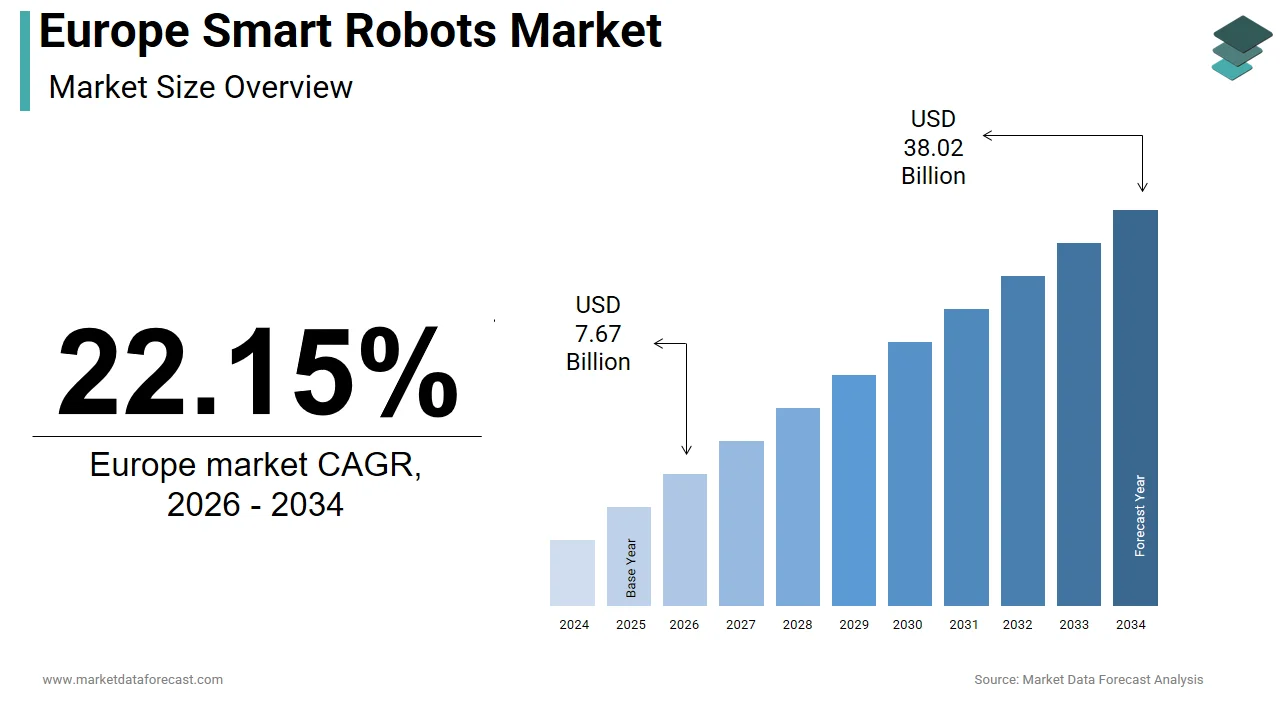
Smart robots refer to the autonomous or semi-autonomous machines equipped with artificial intelligence, computer vision, sensor fusion, and real-time decision-making capabilities deployed across industrial, service, and specialized professional domains. These systems go beyond traditional automation by adapting to dynamic environments, learning from interactions, and collaborating safely with humans. Europe’s adoption is shaped by advanced manufacturing needs, labor shortages, and strong policy support for technological sovereignty. According to an OECD review, approximately 14% of jobs in OECD countries are highly automatable, and another 32% could face substantial changes in how they are carried out. The European Commission's Joint Research Centre has indicated that as many as one-third of the working population in the EU have little or no digital skills, highlighting a significant skills gap. As per sources, an increase in robot installations could lead to a 5.3% boost in global GDP by 2030, which could add nearly $4.9 trillion to the global economy annually. Furthermore, in the EU, 30% of workers are already using AI, particularly for text-related tasks like writing and translation, which indicates a growing integration of AI into daily work life. These demographic, economic, and policy drivers position smart robotics as a cornerstone of Europe’s resilient and human-centric industrial future.
MARKET DRIVERS
Labor Shortages and Aging Workforce in Critical Sectors
The region’s deepening labor scarcity, particularly in logistics, manufacturing, and eldercare, accelerates the growth of the Europe smart robots market. The proportion of older workers within the EU workforce is increasing. Specific sectors, including warehousing and nursing, are experiencing significant job vacancy rates. The logistics industry faces a substantial lack of qualified personnel for key roles, which is accelerating the adoption of autonomous mobile robots equipped with artificial intelligence. The healthcare sector anticipates a future shortage of nurses, leading hospitals to introduce smart delivery and disinfection robots. A majority of farms in Southern Europe have difficulty securing temporary seasonal workers, resulting in the testing of autonomous robots for agricultural tasks. These robots do not replace workers but augment productivity in roles where human availability is structurally constrained. The increasing demographic shifts in Europe mean that smart robots are now essential for ensuring operational continuity and service quality in an aging economy.
EU Industrial Strategy and Digital Sovereignty Initiatives
The region’s strategic push for technological autonomy and resilient supply chains is boosting investment in homegrown smart robotics capabilities, which in turn contributes to the expansion of the Europe smart robots market. According to studies, European Union (EU) initiatives are channeling significant funding into the development of domestic AI processors and robotic operating systems through large-scale programs, fostering growth within the continent. There is a clear trend towards developing autonomous defense systems to decrease dependency on international suppliers, with specific funding allocated for collaborative security and defense robotics. National governments are mirroring the EU's commitment by heavily investing in the integration of collaborative robotics within their own industries, particularly focusing on small and medium enterprises. This coordinated policy framework transforms smart robotics from a commercial product into a pillar of European strategic autonomy and industrial resilience.
MARKET RESTRAINTS
Stringent Safety and Liability Regulations Under Machinery Regulation
Rigorous regulatory environment, particularly the new EU Machinery Regulation, poses a restraint on the Europe smart robots market. This is due to complex conformity assessment and liability uncertainties. New regulations are classifying autonomous robots as high-risk systems, necessitating third-party certification, thorough risk assessments, and detailed technical documentation. Unlike traditional machines, smart robots operate in unpredictable environment,s making it difficult to define exhaustive safety perimeters. Furthermore, the absence of harmonized standards for machine learning validation complicates CE marking. As per research, a majority of consumers have expressed worry over the issue of liability in potential accidents involving autonomous service robots. Innovation will remain suppressed, especially for small developers and novel application areas, until the regulatory pathways mature and the costs associated with certification drop.
High Total Cost of Ownership and Integration Complexity
The substantial acquisition, integration, and maintenance expenses of these robots restrict widespread adoption, particularly among small and medium enterprises, which in turn hampers the expansion of the Europe smart robots market. According to sources, the financial investment for an AI-enabled collaborative robot is substantial, often varying greatly based on specific software and safety requirements. Integrating this new technology into existing production lines is a significant challenge requiring considerable engineering time to resolve compatibility issues. For smaller operations, particularly in logistics, the current cost of these robotic systems makes it difficult to justify a clear return on investment. Furthermore, ongoing costs for software updates, cybersecurity patches, and specialized maintenance are added annually to total ownership. Smart robotics will remain limited to large enterprises and well-funded institutions due to economic hurdles that include a lack of scalable financing models and "plug-and-play" interoperability.
MARKET OPPORTUNITIES
Integration of Smart Robots into European Health and Social Care Systems
The deployment of these robots in healthcare and eldercare provides a key opportunity for the Europe smart robots market. This addresses Europe’s demographic crisis and improves the quality of life. According to sources, a share of Europeans will be aged 65 or older by 2030, creating unprecedented demand for assisted living solutions. Apart from these, the EU’s Joint Programme on Neurodegenerative Disease Research supports robotic platforms for cognitive stimulation in dementia patients. Smart robots provide scalable support that complements human care in home-based and preventive health systems, a strategy that aligns perfectly with Europe’s ethical and social values.
Smart Robots as Enablers of Sustainable and Circular Manufacturing
These robots are emerging as vital tools for achieving the region’s Green Deal objectives by optimizing resource use, enabling circular economy practices, and reducing industrial emissions, a situation which offers major prospects for the expansion of the Europe smart robots market. According to research, industrial processes account for a share of EU greenhouse gas emissions, with material waste contributing significantly. Smart robots equipped with hyperspectral vision and AI can sort recyclable materials with high accuracy. The combination of precision autonomy and sustainability in smart robots helps Europe move toward more resource-efficient and climate-neutral production methods.
MARKET CHALLENGES
Ethical Concerns and Public Trust Deficits in Autonomous Systems
Persistent ethical questions and low public trust surrounding autonomous decision-making by robots pose a societal challenge to the Europe smart robots market. According to studies, many EU citizens support a ban on autonomous robots in caregiving roles involving emotional interaction. The European Group on Ethics in Science and New Technologies has repeatedly cautioned that AI-driven robots in public spaces may reinforce bias or erode human dignity if not designed with inclusive values. Societal resistance will continue to limit the deployment of robotic systems in sensitive areas until developers embed explainable AI, human oversight, and participatory design.
Interoperability Gaps and Fragmented Technical Standards
The absence of unified technical standards for communication data formats and AI validation severely limits the scalability and interoperability of these robots, which affects the expansion of the Europe smart robots market. In manufacturing, the lack of common middleware prevents collaborative robots from different vendors from working on the same production line. These fragmentation issues not only inflate costs but also hinder the creation of pan-European robotic ecosystems. Until harmonized standards for safety data and intelligence are established, the market will remain siloed and inefficient.
REPORT COVERAGE
| REPORT METRIC | DETAILS |
| Market Size Available | 2025 to 2034 |
| Base Year | 2025 |
| Forecast Period | 2026 to 2034 |
| Segments Covered | By Type, Mobility, Application, End-User, and Country. |
| Various Analyses Covered | Global, Regional, and Country-Level Analysis, Segment-Level Analysis, Drivers, Restraints, Opportunities, Challenges; PESTLE Analysis; Porter’s Five Forces Analysis, Competitive Landscape, Analyst Overview of Investment Opportunities |
| Countries Covered | UK, France, Spain, Germany, Italy, Russia, Sweden, Denmark, Switzerland, Netherlands, Turkey, Czech Republic, and the Rest of Europe. |
| Market Leaders Profiled | SoftBank Corp, GeckoSystems Intl. Corp, Aethon, Inc., Neato Robotics, Inc., Samsung Electronics Co., Ltd, ABB Ltd, KUKA Aktiengesellschaft, FANUC CORPORATION, Hanson Robotics Limited, YASKAWA ELECTRIC CORPORATION, BLUE FROG ROBOTICS SAS, Kongsberg Gruppen ASA, Universal Robots A/S, ECA GROUP, iRobot Corporation, DeLaval Inc., Intuitive Surgical, Inc., Rethink Robotics GmbH, Honda Motor Co., Ltd., and Others. |
SEGMENTAL ANALYSIS
By Type Insights
The professional robots segment dominated the Europe smart robots market by accounting for a substantial share in 2025. The dominance of the professional robots segment is attributed to its vital role in industrial logistics, healthcare, and infrastructure operations. According to research, more autonomous mobile robots are being used in European warehouses and factories to help with labor shortages. Also, large distribution centers in Germany, France, and the Netherlands have started using AI-powered robots for tasks like sorting and stacking goods. National defense initiatives further amplify demand. Unlike personal robots, professional systems deliver measurable ROI through productivity gains, safety improvements, and operational continuity, making them indispensable in Europe’s post-pandemic economic landscape.
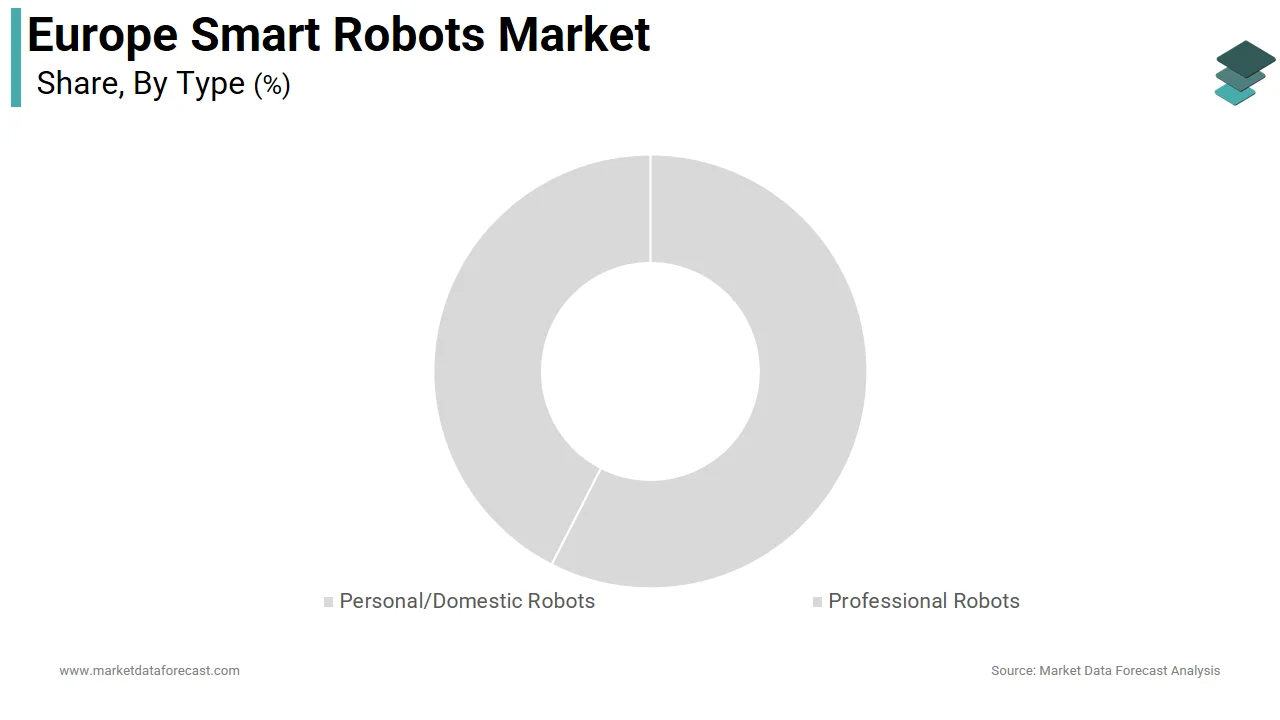
The personal/domestic robots segment is predicted to witness the highest CAGR of 21.4% from 2025 to 2033. The rapid growth of the personal/domestic robots segment is fueled by rising disposable incomes, aging-in-place policies, and advances in affordable AI for household assistance. According to sources, a share of Europeans were aged 60 or older, with national strategies in Sweden and Germany promoting home-based eldercare through assistive technologies. Advances in vision and natural language processing have also enabled low-cost vacuum and lawn mowing robots with smart mapping used in millions of European households. Personal robots are transitioning from luxury items to essential tools for independent living and domestic efficiency, a shift driven by growing social acceptance and falling prices.
By Mobility Insights
The mobile robots segment held the leading share of the Europe smart robots market in 2025. Its versatility in dynamic environments across logistics, healthcare, and public services propels the growth of the mobile robots segment. According to sources, some autonomous mobile robots operate in European e-commerce fulfillment centers with faster order processing. Security applications are also expanding. The European Commission’s Urban Mobility Framework encourages municipal trials of mobile service robots for waste collection and street monitoring. Unlike fixed systems, mobile robots adapt to changing layouts and tasks, making them ideal for Europe’s complex and space-constrained urban and industrial settings.
The fixed/stationary robots segment is estimated to register the fastest CAGR of 18.9% during the forecast period, owing to the integration of AI and vision systems into traditional industrial arms, enabling smarter inspection, assembly, and quality control. A majority of new robotic workcells installed in German and Italian factories incorporated AI-driven stationary robots designed for real-time defect detection. In electronics recycling, stationary sorting robots achieved high material purity using advanced imaging technology, supporting compliance with circular economy standards. Hospitals in the UK and France utilize enhanced precision stationary surgical robots for a significant number of medical procedures. Fixed smart robots provide crucial accuracy and repeatability in controlled environments, making them indispensable for high-value production and regulated processes where manufacturers prioritize quality, sustainability, and traceability.
By Application Insights
The material handling and sorting segment led the Europe smart robots market by occupying a share of 41.4% in 2024. The prominence of the material handling and sorting segment is propelled by e-commerce growth, labor scarcity, and warehouse automation mandates. Major retailers, including IKEA and Decathlon, have standardized on AI-enabled robotic sortation in their regional hubs. This confluence of economic pressure, regulatory compliance, and operational necessity solidifies material handling as the core application driver in Europe.
The inspection and maintenance segment is anticipated to witness the fastest CAGR of 22.7% from 2025 to 2033 due to factors such as the need to inspect aging infrastructure, energy assets, and industrial facilities in hazardous or hard-to-reach environments. The European Commission’s Critical Entities Resilience Directive mandates regular infrastructure assessments, making smart inspection robots essential for compliance. These systems proactively and precisely monitor asset integrity and public safety, a necessity as climate change heightens the risks of extreme weather events.
By End User Insights
The manufacturing segment was the largest in the Europe smart robots market and captured a 48.3% share in 2024, with its early adoption of automation, advanced digital infrastructure, and strong policy support. National initiatives reinforce this trend. The European Defence Industrial Strategy also drives smart robot adoption in defense manufacturing for precision assembly of sensitive components. Europe's manufacturing sector, a key contributor to EU GDP and facing intense global competition, relies on smart robots to ensure continued quality, productivity, and resilience in high-wage economies.
The healthcare segment is likely to experience the fastest CAGR of 24.3% from 2025 to 2033. The swift expansion of the healthcare segment is driven by aging demographics, workforce shortages, and post-pandemic infection control priorities. According to research, a share of Europeans will be aged 65 or older by 2030, creating unprecedented demand for care assistance. Surgical robotics is also accelerating. The EU’s Joint Programme on Neurodegenerative Disease Research funds social companion robots for dementia care, now active in many countries. Smart robots are becoming integral to Europe’s sustainable and compassionate care model, helping health systems prioritize efficiency, safety, and human dignity.
COUNTRY LEVEL ANALYSIS
Germany Smart Robots Market Analysis
Germany was the top performer in the Europe smart robots market and occupied a 25.6% share in 2024. Its world-class manufacturing base and proactive industrial policy have mainly contributed to the supremacy of the German market. Germany also leads in healthcare robotics, with the Fraunhofer Institute developing certified disinfection and logistics robots now deployed in hospitals. The dual education system ensures a steady pipeline of robotics technicians. This fusion of industrial demand, public investment, and skilled labor establishes Germany as Europe’s most advanced and scalable smart robotics ecosystem.
France Smart Robots Market Analysis
France was the next-biggest country in the Europe smart robots market and accounted for 18.4% in 2024. The growth of the French market is fuelled by its France 2030 investment plan and strategic autonomy goals. The government committed funds to develop domestic robotic platforms for healthcare, agriculture, and defense. France also hosts the European Robotics Week headquarters, promoting public engagement and STEM education. This coordinated approach blending security, social welfare, and industrial policy positions France as a multidimensional robotics leader.
Sweden Smart Robots Market Analysis
Sweden maintains a noteworthy position in the Europe smart robots market due to its ethical human-centered approach and deep integration into public services. Smart delivery and monitoring robots have been widely deployed in hospitals to significantly increase staff efficiency. A large senior demographic is the key factor driving national investment in assistive robotics designed for independent living. The country also leads in agricultural robotics with autonomous berry harvesters now used on farms. By prioritizing dignity, usability, and social impact, Sweden has created a robotics model that balances innovation with societal values.
United Kingdom Smart Robots Market Analysis
The United Kingdom is steadily growing in the European smart robots market, with leadership in surgical robotics and urban security applications. The UK Research and Innovation agency allocated funds to AI robotics for critical national infrastructure inspection. Despite Brexit, the UK remains deeply integrated into European research networks through Horizon Europe association. This focus on high precision, high impact applications sustains the UK’s position as a specialized and influential market.
Italy Smart Robots Market Analysis
Italy is likely to expand in the Europe smart robots market between 2025 and 2033, owing to its agile manufacturing sector and pressing agricultural labor shortages. The country also leads in food processing robotics, with companies like Barilla using AI vision robots for quality control on high-speed lines. Italy leverages smart robotics to maintain competitiveness in high-mix, low-volume production while addressing rural demographic decline, building upon its strong maker culture and family-owned industrial base.
COMPETITIVE LANDSCAPE
The Europe smart robots market features a dynamic competitive landscape shaped by stringent regulations, ethical expectations, and diverse application needs. Competition is led by established industrial automation giants such as ABB and KUKA alongside specialized service robotics firms like SoftBank Robotics and emerging European startups. Unlike other regions, European competition emphasizes safety, explainability, and human collaboration over raw performance or cost. The EU’s AI Act and Machinery Regulation create high entry barriers, favoring vendors with certified risk management systems and transparent algorithms. National industrial strategies further segment the market, with Germany prioritizing manufacturing robotics while Nordic countries lead in healthcare and eldercare applications. Differentiation arises through domain expertise, interoperability, and trust rather than hardware alone. Startups thrive in niche areas such as agricultural or inspection robotics, supported by Horizon Europe funding. As the market evolves, competition increasingly centers on sustainable design, data sovereignty, and the ability to deliver measurable social and economic value within Europe’s human-centric innovation model.
KEY MARKET PLAYERS
Some of the companies that are playing a dominating role in the Europe smart robots market include
- SoftBank Corp
- GeckoSystems Intl. Corp.
- Aethon, Inc.
- Neato Robotics, Inc.
- Samsung Electronics Co., Ltd
- ABB Ltd
- KUKA Aktiengesellschaft
- FANUC CORPORATION
- Hanson Robotics Limited
- YASKAWA ELECTRIC CORPORATION
- BLUE FROG ROBOTICS SAS
- Kongsberg Gruppen ASA
- Universal Robots A/S
- ECA GROUP
- iRobot Corporation
- DeLaval Inc.
- Intuitive Surgical, Inc.
- Rethink Robotics GmbH
- Honda Motor Co., Ltd.
TOP PLAYERS IN THE MARKET
- ABB Ltd is a leading force in the Europe smart robots market, offering AI-integrated robotic solutions for manufacturing logistics and inspection across the automotive and electronics sectors. The company strengthens its European footprint through its Robotics and Discrete Automation division, headquartered in Germany, which develops collaborative robots with embedded machine vision and predictive maintenance capabilities. It also partnered with the German Aerospace Center on autonomous inspection robots for aircraft maintenance compliant with EASA safety standards. ABB’s open architecture software platform RobotStudio supports seamless integration with European MES and ERP systems. Through its focus on industrial interoperability, safety certification, and SME accessibility, ABB reinforces its global leadership while advancing Europe’s resilient manufacturing agenda.
- SoftBank Robotics Group plays a pivotal role in the Europe smart robots market through its humanoid and service robots, including Pepper and Whiz, deployed in retail, healthcare, and public services. The company has deepened its presence by aligning its platforms with EU data protection and ethical AI guidelines, ensuring GDPR compliant data handling and transparent decision-making. It also expanded its Whiz cleaning robot fleet across 1200 facilities in the UK and Germany with real-time hygiene reporting for post-pandemic compliance. By prioritizing human-robot interaction safety and social acceptance, SoftBank Robotics shapes the service robotics landscape in Europe while influencing global standards for socially intelligent machines.
- KUKA AG is a cornerstone of the Europe smart robots market, providing intelligent automation solutions for automotive, aerospace, and e-commerce logistics with strong integration into German and Central European industrial ecosystems. The company has enhanced its competitiveness by launching its KUKA.Sim AI platform enabling digital twin-based robot programming and performance optimization compliant with EU machinery safety standards. KUKA also collaborated with the Fraunhofer Institute on autonomous mobile manipulators for battery cell production, supporting Europe’s electric vehicle supply chain. Through its commitment to industrial sovereignty, precision engineering, and workforce development, KUKA AG remains instrumental in shaping both European and global smart manufacturing paradigms.
TOP STRATEGIES USED BY THE KEY MARKET PARTICIPANTS
Key players in the Europe smart robots market pursue strategies centered on regulatory alignment, human-centric design, and ecosystem integration. Compliance with the EU Machinery Regulation, AI Act, and GDPR is foundational, requiring robust safety validation, data governance, and algorithmic transparency. Companies invest in European-based research and training facilities to build local trust and address skilled labor shortages. Strategic partnerships with public institutions, universities, and industry consortia accelerate co-development of ethical and interoperable solutions. Open software platforms and standardized APIs enable seamless integration with existing factory and hospital IT systems. Focusing on the total cost of ownership through modular design, remote diagnostics, and leasing models improves accessibility for small and medium enterprises. Additionally, firms actively participate in European standardization bodies to shape future technical and ethical frameworks, ensuring long-term market leadership and societal acceptance.
MARKET SEGMENTATION
This research report on the Europe smart robots market has been segmented and sub-segmented into the following categories.
By Type
- Personal/Domestic Robots
- Professional Robots
By Mobility
- Mobile
- Fixed/Stationary
By Application
- Inspection and Maintenance
- Material Handling and Sorting
- Security and Surveillance
- Education and Entertainment
- Sanitation and Disinfection
- Others
By End-User
- Manufacturing
- Healthcare
- Agriculture
- Military and Defense
- Logistics and Warehouse
- Education and Entertainment
- Others
By Country
- United Kingdom
- France
- Spain
- Germany
- Italy
- Russia
- Sweden
- Denmark
- Switzerland
- Netherlands
- Rest of Europe