- Product Description Description
- Table of Contents TOC
- List of Table & Figure LOT
- Get Free Sample PDF Sample PDF
Market Size, 2025
$1.04 BnMarket Estimate, 2026
$1.11 BnMarket Forecast, 2034
$1.91 BnCAGR, 2026–2034
7.03%Europe Secondary Tickets Market Summary
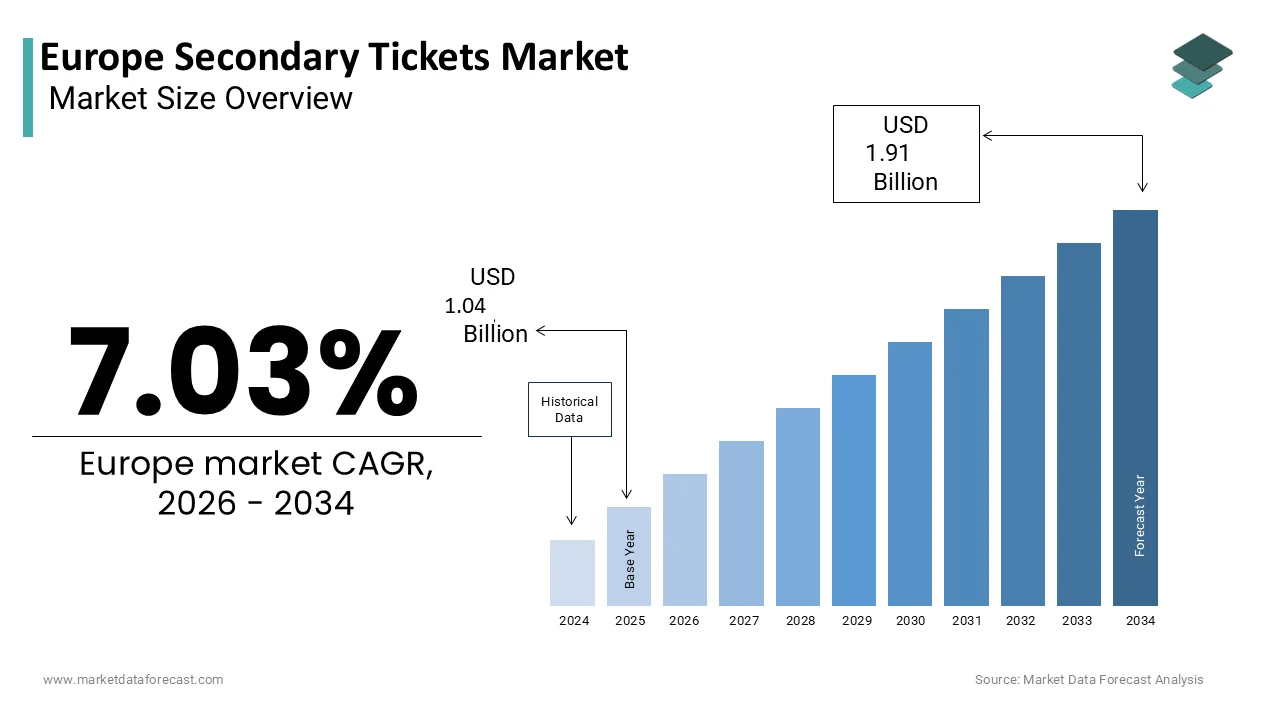
The Europe secondary tickets market was valued at USD 1.04 billion in 2025 and is projected to reach USD 1.91 billion by 2034, growing at a CAGR of 7.03% from 2026 to 2034, driven by sold-out event scarcity, mobile-first ticket purchasing behavior, and the integration of regulated resale platforms within Europe’s live entertainment ecosystem.
Market Snapshot
- 2025 Market Size: USD 1.04 Billion
- 2026 Market Size: USD 1.11 Billion
- 2034 Forecast: USD 1.91 Billion
- CAGR (2026–2034): 7.03%
- Base Year: 2025
- Forecast Period: 2026–2034
Quick Growth Drivers
- Persistent demand for sold-out concerts, football matches, and premium cultural events
- Consumer shift toward last-minute and flexible ticket purchases
- Growth in sports tourism and pan-European leisure travel
- Digital-first ticket distribution and mobile wallet integration
- Increasing integration of authorized resale platforms within primary ticketing ecosystems
Principal Restraints
- National legislation capping resale prices at face value plus limited fees
- Mandatory resale through official organizer-controlled platforms
- Regulatory fragmentation across EU member states
- Increased compliance burden for cross-border secondary marketplaces
High-Value Opportunities
- Blockchain-enabled ticket authentication and NFT-based ownership verification
- Government-backed digital identity integration for fraud prevention
- AI-powered dynamic pricing within regulated price cap frameworks
- Expansion of official venue and league resale partnerships
- Real-time demand analytics to improve liquidity and price transparency
Key Market Challenges
- Persistent counterfeit ticket fraud across unofficial channels
- Consumer trust erosion due to scam incidents
- Offshore unregulated resale platforms undermining regulated markets
- Complex multi-country tax, licensing, and compliance structures
Fastest-Growing Segments
- Sporting Events – fastest CAGR of 15.8% due to football tournament demand and international sports tourism
- Desktop Transactions – fastest device CAGR of 12.3% driven by higher-value and corporate bookings
- Offline Premium Brokerage – niche growth of 8.5% fueled by corporate hospitality and VIP event demand
Regional Leadership & Dynamics
- United Kingdom (26.7%) – mature secondary ecosystem supported by Premier League demand and strong regulatory oversight
- Germany (21.1%) – tightly regulated face-value resale environment shaped by consumer protection laws
- France – strict cultural event price caps under national legislation; sports segment more dynamic
- Spain – strong football tourism driven by clubs like Real Madrid and FC Barcelona; integrated digital resale systems at venues such as Santiago Bernabéu Stadium
- Italy – growing adoption of digital ticket verification for opera, football, and major cultural events
What Wins Commercially
- Official organizer and venue resale partnerships
- Strong buyer protection guarantees and fraud insurance mechanisms
- Fully compliant dynamic pricing algorithms
- Secure digital ticket transfers with identity verification
- Transparent pricing aligned with national regulatory frameworks
Top Strategic Ask for Executives
Prioritize regulatory alignment, fraud-proof digital infrastructure, and official resale integrations to transform secondary ticketing from a speculative marketplace into a compliant liquidity engine embedded within Europe’s regulated live entertainment value chain.
Leading Players
Some of the companies that are playing a dominating role in the Europe secondary tickets market include
Viagogo,
StubHub,
SeatGeek,
TicketSwap,
Ticketmaster,
CTS Eventim,
AXS,
Europe Secondary Tickets Market Size
The Europe secondary tickets market was valued at USD 1.04 billion in 2025, is estimated to reach USD 1.11 billion in 2026, and is projected to reach USD 1.91 billion by 2034, growing at a CAGR of 7.03% from 2026 to 2034.
Secondary tickets refer to event tickets that are resold after being originally purchased from an official source (the primary market). This market serves as a crucial liquidity mechanism for live entertainment, enabling fans to buy tickets for sold out events or sell unwanted ones. Its current structure is being fundamentally reshaped by a wave of national legislation aimed at curbing speculative pricing and fraud. European authorities are increasing scrutiny on secondary ticket marketplaces, pushing for greater transparency and driving national legislative efforts to restrict excessive resale pricing and encourage authorized resale channels. Furthermore, high rates of participation in tourism across Europe indicate a strong, recovering, and consistent public engagement in leisure activities, which drives significant demand for both primary and secondary event markets. This context positions the secondary market at the intersection of consumer rights, artist revenue protection, and the digital economy, where regulatory intervention is actively redefining its operational boundaries.
MARKET DRIVERS
High Demand for Sold Out Events and Limited Primary Allocation
The persistent and often overwhelming demand for tickets to high profile events that far exceeds the available supply from primary vendors is a primary driver of the Europe secondary tickets market. Major concerts, international football matches, and theater premieres frequently sell out within minutes of their primary release, leaving a vast number of eager fans without access. This scarcity creates an immediate and powerful incentive for a secondary market to emerge. The situation is exacerbated by the practice of primary vendors allocating a significant portion of inventory to fan clubs, sponsors, and hospitality packages, further reducing the pool of tickets available to the general public. Research indicates that while premier festivals and elite tours often sell out immediately, the wider European live music landscape is defined by robust attendance recovery paired with ongoing economic challenges for smaller venues and mid-tier artists. This structural imbalance between supply and demand ensures a continuous, robust flow of tickets into the secondary market, as disappointed fans seek alternative avenues to attend these highly sought after events, making scarcity the fundamental economic engine of the entire sector.
Consumer Preference for Last Minute and Flexible Ticket Purchases
The modern consumer’s preference for flexibility and spontaneity in their entertainment planning further propels the expansion of the Europe secondary tickets market. Many individuals are unwilling or unable to commit to purchasing tickets weeks or months in advance due to uncertain schedules, budgeting constraints, or simply a desire to make decisions closer to the event date. The secondary market caters perfectly to this behavior by providing a dynamic inventory of tickets right up to the day of the event. This is particularly true for business travelers or tourists who may only decide to attend a local event during their stay. The European Travel Commission indicates that travelers to major European cities are increasingly leveraging digital platforms to secure event tickets and experiences after arrival, often utilizing secondary channels to maximize flexibility. This trend is driven by high demand and the adoption of mobile-first technology for last-minute booking. This shift toward just in time consumption creates a reliable and consistent demand stream for the secondary market, as it fulfills a need that the rigid, advance only nature of the primary market cannot satisfy, thereby embedding itself as an essential component of the modern live entertainment economy.
MARKET RESTRAINTS
Stringent National Legislation Capping Resale Prices
The proliferation of national laws that impose strict caps on the resale price of event tickets restrains the growth of the Europe secondary tickets market. Countries like France, Germany, and the Netherlands have enacted legislation that limits the resale price to no more than the original face value plus a small, fixed service fee. This policy, designed to protect consumers from perceived price gouging, directly attacks the core economic model of professional ticket resellers, whose business relies on the ability to capture the market value of scarce tickets. Legislative efforts to limit secondary market ticket prices often result in a shift of inventory toward unregulated channels, reducing the availability of tickets on monitored, consumer-safe platforms as sellers seek higher margins elsewhere. This unintended consequence often drives the trade underground to unregulated, offshore websites that ignore these laws, increasing the risk of fraud for consumers and undermining the very consumer protection the legislation was meant to provide, thereby creating a fragmented and less transparent market.
Mandatory Use of Official Resale Platforms by Event Organizers
The growing trend of event organizers and venues mandating that all secondary sales occur exclusively through their own official in-house platforms is hindering the expansion of the Europe secondary ticket market. This practice, while promoted as a way to ensure ticket authenticity and control pricing, effectively monopolizes the secondary market for that specific event and excludes independent, third party marketplaces. For consumers, this can mean fewer choices, less competitive pricing, and a potentially inferior user experience compared to specialized secondary platforms. More critically, it fragments the market, preventing the creation of a large, liquid, pan European secondary exchange. A growing number of major sports and entertainment venues across Europe are adopting integrated digital ticketing platforms to better regulate the secondary market and enhance the fan experience. This trend focuses on managing secondary ticket sales rather than enforcing a, universal, mandatory resale system. This balkanization of the market increases operational complexity for consumers and stifles innovation from independent tech companies, ultimately limiting the efficiency and scale of the secondary ticketing ecosystem across the continent.
MARKET OPPORTUNITIES
Integration of Digital Identity and Secure Transfer Protocols
The adoption of advanced digital identity verification and secure, blockchain based transfer protocols provides new opportunities for the growth of the Europe secondary tickets market. By integrating government verified digital IDs with non fungible token (NFT) technology, platforms can create a secure, transparent, and fraud proof system for ticket ownership and resale. Each ticket could be a unique digital asset tied to a verified identity, allowing for seamless, instant transfers while ensuring that only the rightful owner can use it for entry. This would virtually eliminate the scourge of counterfeit tickets, which accounts for a portion of all secondary market transactions in Europe. Furthermore, such a system would allow event organizers to enforce their own rules, such as resale price caps or royalty collection, automatically through smart contracts. European public sector partnerships are actively testing blockchain-based digital identity and verifiable credentials to securely exchange data across borders in Sweden and Estonia. This technological foundation promises to build unprecedented trust and security, addressing the market’s biggest pain points and unlocking its full potential as a legitimate and efficient part of the live entertainment value chain.
Development of Dynamic Pricing Models for Authorized Resale
Shift from traditional resale to sophisticated price discovery is also a major opportunity for the Europe secondary tickets market. This shift is driven by dynamic algorithms on authorized platforms. Instead of fixed markups, platforms could use real time data on demand, historical sales, and event specifics to adjust prices continuously, much like the airline industry. This would create a more efficient market where prices accurately reflect true supply and demand, benefiting both sellers who get a fair market value and buyers who gain access to a transparent pricing system. Crucially, this model can be designed to comply with national regulations. For instance, the algorithm could be capped at a maximum multiple of the face value as mandated by law. Compliant secondary markets are increasingly adopting dynamic pricing models to drive higher transaction volumes compared to traditional fixed-price approaches. Authorized platforms can leverage data-driven strategies to prove that regulated secondary markets are fair, efficient, and sustainable for all participants.
MARKET CHALLENGES
Persistent Threat of Fraud and Counterfeit Tickets
The pervasive threat of fraud and counterfeit tickets erodes consumer trust and tarnishes the entire sector’s reputation, which challenges the growth of the Europe secondary tickets market. Despite advances in technology, fraudulent actors continue to exploit the market by selling fake tickets through unofficial websites or social media, often at prices below face value to lure unsuspecting buyers. The financial and emotional cost to consumers is significant, as they arrive at an event only to be denied entry. Counterfeit event tickets are an increasing component of online fraud, with deceptive sales causing significant annual financial losses to consumers across Europe, according to research. This constant risk forces legitimate platforms to invest heavily in buyer protection guarantees and verification systems, increasing their operational costs. The lack of a unified, secure ticketing standard allows a shadow market to persist, damaging industry reputation and consumer adoption.
Complex and Inconsistent Regulatory Landscape Across Member States
A highly complex and inconsistent regulatory environment is holding back the expansion of the Europe secondary tickets market. In this environment, each member state has its own distinct set of rules regarding pricing, platform authorization, and consumer protections. This patchwork of national laws creates a significant compliance burden for any platform seeking to operate across borders. A company must navigate different price cap structures, licensing requirements, and tax regimes in each country, which is costly and administratively challenging. The European Commission identifies high administrative burdens, regulatory fragmentation, and challenges in digital scaling as primary obstacles to the internal market, rather than focusing on ticket resale regulations. This fragmentation prevents the emergence of large, efficient, pan European secondary platforms that could offer greater liquidity and better prices. Instead, it encourages a fragmented market of national players, stifles innovation, and ultimately reduces consumer choice and convenience, making it a fundamental structural challenge to the market’s long term growth and integration.
REPORT COVERAGE
| REPORT METRIC | DETAILS |
| Market Size Available | 2025 to 2034 |
| Base Year | 2025 |
| Forecast Period | 2026 to 2034 |
| Segments Covered | By Platform, Device, Event Type, and Region. |
| Various Analyses Covered | Global, Regional, and Country-Level Analysis, Segment-Level Analysis, Drivers, Restraints, Opportunities, Challenges; PESTLE Analysis; Porter’s Five Forces Analysis, Competitive Landscape, Analyst Overview of Investment Opportunities |
| Countries Covered | UK, France, Spain, Germany, Italy, Russia, Sweden, Denmark, Switzerland, Netherlands, Turkey, Czech Republic, Rest of Europe |
| Market Leaders Profiled | Viagogo, StubHub, SeatGeek, TicketSwap, Ticketmaster Resale, AXS Official Resale, GetMeIn!, Twickets, See Tickets Resale, LiveFootballTickets.com, Fansale, Gigsberg, Eventim Resale, Festicket Marketplace, SportPesa Tickets, FanMarket.com |
SEGMENTAL ANALYSIS
By Platform Insights
The online platform segment was the largest segment in the Europe secondary tickets market and accounted for a substantial share in 2025. The supremacy of the segment is driven by a direct consequence of the digital transformation of consumer behavior and the inherent advantages of internet based marketplaces. The primary driver is the unparalleled convenience and reach offered by online platforms, which aggregate inventory from thousands of sellers across the continent into a single, searchable interface. This creates a level of liquidity and price transparency that physical, offline channels can never match. As per Eurostat, a strong majority of internet users across Europe engaged in online shopping in 2024, marking a decade of significant growth and demonstrating that e-commerce has become a mainstream, deeply integrated component of daily life for most of the population. For event tickets, this means consumers expect to be able to browse, compare, and buy instantly from their devices. The online model also enables sophisticated features like real time price tracking, verified buyer protection programs, and instant digital delivery, all of which build trust and streamline the purchasing process, making it the default choice for virtually all secondary ticket transactions.
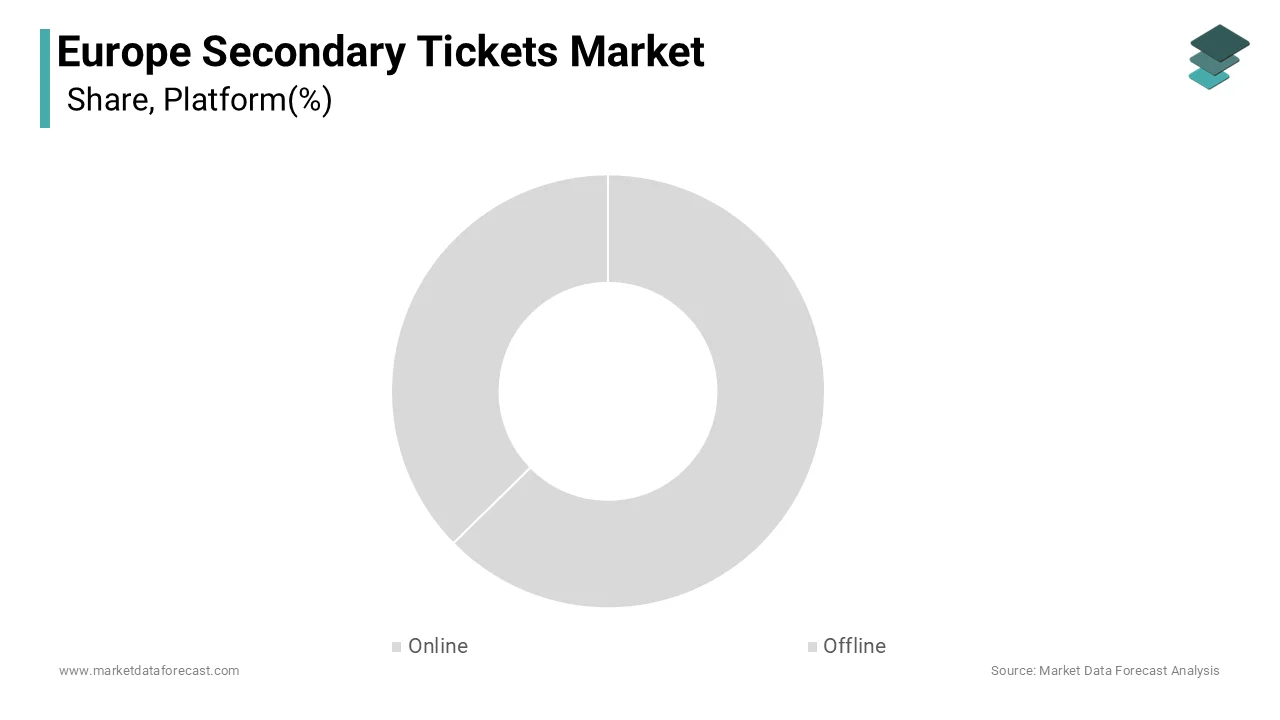
The offline segment is likely to experience the fastest CAGR of 8.5% from 2026 to 2034 due to a niche but growing demand for high touch, personalized service in the luxury and corporate hospitality segments. For ultra premium events like major football finals or exclusive concerts, corporate clients and high net worth individuals often prefer to work with a dedicated broker who can source specific seats, handle complex logistics, and provide white glove service. These transactions are less about price and more about certainty, access, and discretion. Corporate demand for tailored event ticketing experiences across Europe continues to rise as businesses seek premium, personalized hospitality options. This segment thrives on personal relationships and trust, where a face to face meeting or a phone call is preferred over an impersonal website. The growth is also fueled by the rise of official venue box offices offering in person resale services, providing a secure, regulated alternative for fans wary of online fraud, thus creating a small but resilient and expanding offline channel.
By Device Insights
The mobile device segment dominated the Europe secondary tickets market and captured a significant share in 2025. The prominence of the segment is attributed to the continent’s pervasive smartphone culture and the on the go nature of modern event planning. Consumers increasingly discover events through social media, receive last minute invitations, or decide to attend a local show while out and about, making the ability to purchase a ticket instantly from a mobile device essential. The primary driver is the superior user experience offered by dedicated mobile apps from leading secondary platforms, which feature one click purchasing, digital wallet integration, and instant ticket storage in a phone’s wallet. According to research, the majority of the population relies on smartphones for daily internet access, with social networking and entertainment-related content dominating the time spent on these devices. Studies indicate that high levels of daily usage are driven by digital activities. This constant connectivity means the decision to buy a ticket and the act of purchasing it often happen in the same moment, a behavior that is perfectly served by a seamless mobile experience, cementing its position as the dominant transaction channel.
The desktop segment is on the rise and is expected to be the fastest growing segment in the market by witnessing a CAGR of 12.3% during the forecast period owing to the increasing complexity and value of transactions being conducted on secondary platforms. Mobile is perfect for impulse buys, but for planning major trips or complex events, shoppers turn to the, detailed, in-depth view of a desktop. They can easily compare multiple seating options across different sections, read comprehensive venue maps, and manage more complex payments involving higher ticket values. Sources indicate that while mobile devices drive the majority of shopping traffic, desktop users consistently complete transactions with a higher average order value. This trend is amplified by the rise of business to business sales, where corporate buyers use desktops to manage bulk purchases and expense reporting. The desktop’s role as a research and high value transaction tool is ensuring its continued relevance and growth in a mobile first world.
By Event Type Insights
The live concerts segment held the majority share of 41.1% of the Europe secondary tickets market in 2025. The leading position of the segment is credited to the unique combination of high fan passion, limited tour dates, and the frequent occurrence of sold out shows. Major music artists often perform only once or twice in a major European city during a global tour, creating an intense, time sensitive demand that far outstrips the available supply from primary vendors. This scarcity is the perfect catalyst for a vibrant secondary market. The primary driver is the emotional connection fans have with their favorite artists. They are often willing to pay a significant premium to secure a seat for a once in a lifetime performance. Studies indicate that European music markets continue to see steady growth driven primarily by digital streaming platforms and artist investment. This massive, passionate audience, coupled with the inherent scarcity of concert tickets, ensures that live music remains the single largest and most dynamic segment of the entire secondary market.
The sporting events segment is expected to exhibit a noteworthy CAGR of 15.8% from 2026 to 2034. The rapid growth of the segment is propelled by the continent’s deep cultural obsession with sports, particularly football, and the global prestige of its major tournaments. Events like the UEFA Champions League final, domestic cup finals, and international championships such as the Olympics or World Cups generate an enormous, pan European demand that vastly exceeds the limited ticket allocations for the general public. A key factor is the rise of international tourism centered around sports. Recent reports on European tourism indicate that high-profile sporting events serve as a significant catalyst for international travel, though most attendees secure their entry through official primary channels rather than resale platforms. Furthermore, the emotional stakes of these events are incredibly high, with fans viewing attendance as a core part of their identity, making them highly motivated to secure tickets by any legitimate means. This powerful mix of cultural significance, global appeal, and intense fan loyalty is driving the segment’s exceptional growth trajectory.
COUNTRY LEVEL ANALYSIS
United Kingdom Secondary Tickets Market Analysis
The United Kingdom led the Europe secondary tickets market and held a share of 26.7% in 2025. The dominance of the UK market is driven by its world class live entertainment industry, which includes London’s West End, a dense network of major music venues, and the globally popular Premier League football. The UK market is characterized by a mature and sophisticated consumer base that is highly active in the secondary market. A key driver is the regulatory framework established by the Digital Economy Act, which, while banning the use of bots, has created a more stable environment for authorized resellers. According to the Society of Ticket Agents and Retailers (STAR), 2024 saw high levels of consumer engagement with member platforms, accompanied by a rise in the number of disputes referred for resolution, necessitating continued vigilance in the UK ticketing sector. This blend of a massive event ecosystem, a tech savvy population, and a relatively clear (though strict) legal landscape makes the UK the single most important and liquid market for secondary tickets in Europe.
Germany Secondary Tickets Market Analysis
Germany followed closely in the Europe secondary tickets market and captured a 21.1% share in 2025. The German market is fuelled by its strong consumer protection laws and a cultural preference for transparency and fairness in pricing. The primary driver of market activity is the nation’s immense passion for football, with the Bundesliga being one of the best attended leagues in the world, and its vibrant electronic music and rock concert scene. However, the market operates under the strict constraints of the German Price Indication Ordinance, which effectively caps resale prices at face value for many events. German event regulations and contractual restrictions have discouraged unauthorized ticket touting, leading to the rapid expansion of official resale, where ticketing companies and venues manage ticket transfers. Legal actions against high-markup resale have increased the prominence of authorized, controlled platforms. This unique regulatory environment has shaped a market that is large in volume but tightly controlled, with a focus on authorized, compliant transactions.
France Secondary Tickets Market Analysis
France is also a key player in the Europe secondary tickets market due to a top down, state led approach to regulating the cultural sector. A major factor is the “Loi Lescure” and its subsequent amendments, which impose a strict ban on resale above face value for all cultural events, including concerts and theater. This has effectively outlawed the professional secondary market for these categories, pushing most activity to official, in house resale platforms operated by the venues themselves. However, the market for sporting events, particularly high profile football matches, remains more dynamic. French market surveillance authorities, in their effort to protect consumers from excessive pricing, have implemented measures that observers note may have also reduced overall market liquidity. This creates a bifurcated market where cultural events are tightly controlled while sports retain a more traditional secondary dynamic, making France a unique and highly regulated landscape.
Spain Secondary Tickets Market Analysis
Spain occupies a significant position in the European secondary tickets market owing to its world renowned football culture, centered on iconic clubs like Real Madrid and FC Barcelona, whose matches are among the most sought after tickets in the world. A key driver is the massive influx of international tourists, who often plan their trips around attending a major football match or a summer music festival. According to Spain's National Institute of Statistics, international tourist arrivals in the country reached record highs during the designated year, with a significant portion of visitors contributing to high demand for cultural, culinary, and event-related activities. The market is also seeing growth in the official resale segment, as major venues like the Santiago Bernabéu adopt digital ticketing systems that include integrated, regulated resale options. This combination of a passionate domestic fan base and a huge international tourist audience creates a robust and resilient demand for secondary tickets, particularly for high profile sporting and musical events.
Italy Secondary Tickets Market Analysis
Italy is anticipated to expand in the Europe secondary tickets market from 2026 to 2034 due to its deep love for opera, classical music, and football, creating a diverse demand profile. The primary driver is the cultural significance of events like La Scala opera performances in Milan or major Serie A derbies, which command intense local and international interest. A key factor shaping the market is the government’s recent efforts to combat ticket fraud, which has led to a push for digital ticketing and official resale channels. According to studies, the use of secure digital tickets for major events is experiencing continued growth as part of regulatory efforts to reduce unauthorized secondary ticketing. This focus on security, combined with the enduring appeal of Italy’s rich cultural and sporting calendar, sustains a steady and passionate demand for secondary tickets, with a growing emphasis on safe, authorized transactions through official platforms.
COMPETITIVE LANDSCAPE
The competitive landscape of the Europe secondary tickets market is defined by a stark division between authorized, regulated platforms and an illicit, unregulated fringe. The legitimate segment is dominated by a few major players who have successfully integrated with primary ticketing ecosystems or obtained official status from event organizers. These companies compete fiercely on trust, security, and regulatory compliance rather than just price, as national laws in many countries severely restrict markup potential. Their primary battleground is securing exclusive partnerships with top venues and artists to become the sole approved resale channel. Meanwhile, the unregulated market persists on offshore websites and social media, posing a constant threat through lower prices but at high risk of fraud. This bifurcated structure creates intense competition among the authorized players to demonstrate superior safety and service, while the entire sector grapples with the challenge of eradicating the shadow market to protect consumers and ensure a fair, transparent ecosystem for all stakeholders.
KEY MARKET PLAYERS
Some of the companies that are playing a dominating role in the global europe secondary tickets market include
- Viagogo
- StubHub (eBay Inc.)
- SeatGeek
- TicketSwap
- Ticketmaster Resale (Live Nation Entertainment)
- AXS Official Resale (AEG / Ticketmaster)
- Ticketswap BV
- GetMeIn!
- Twickets
- See Tickets Resale
- LiveFootballTickets.com
- FansEurope / Fansale
- Gigsberg
- Viagogo AG
- Eventim Resale (CTS Eventim)
- Festicket Marketplace
- SportPesa Tickets
- FanMarket.com
TOP LEADING PLAYERS IN THE MARKET
- Viagogo, now fully integrated into the StubHub brand, is a major global player with a deep-rooted presence across the European secondary tickets market. The company operates a technology driven platform that connects buyers and sellers for a vast array of live events, from concerts to sports. To strengthen its position in the post merger landscape, the combined entity has been actively aligning its European operations with local regulatory requirements. A key recent action was the full integration of its European marketplace with official event organizer ticketing systems in Germany and France, ensuring all resold tickets are verified and compliant with national price cap laws, thereby enhancing consumer trust and legitimacy.
- Ticketmaster, through its official secondary market platform TicketExchange, holds a significant position in Europe by leveraging its dominant primary ticketing relationships. The company provides a secure, fan to fan resale environment that is directly integrated into the primary purchase flow for thousands of events across the continent. In a strategic move to solidify its leadership, Ticketmaster launched a pan European “FanProtect” guarantee for all secondary transactions on its platform. This initiative ensures authenticity and on time delivery, directly addressing the market’s biggest pain point of fraud and building a powerful value proposition based on safety and reliability.
- Seatwave, now operating as the official secondary marketplace for CTS Eventim, is a key European player that benefits from deep integration with one of the continent’s largest primary ticketing networks. The platform offers a regulated resale service for concerts, theatre, and sports events, primarily in the UK, Germany, and Spain. Its investment ensures the platform remains a trusted, compliant, and user friendly option for fans looking to buy or sell tickets.
TOP STRATEGIES USED BY THE KEY MARKET PARTICIPANTS
Key players in the Europe secondary tickets market are primarily deploying three core strategies to navigate the complex regulatory environment and build sustainable businesses. First, they are forging official partnerships with event organizers and venues to become the designated, authorized resale channel, which ensures ticket authenticity and compliance with local laws. Second, they are investing heavily in buyer protection guarantees and secure digital ticketing technologies to eliminate fraud and build consumer trust, which is the market’s most critical barrier. Third, they are developing sophisticated, compliant pricing models that operate within national price cap regulations while still providing liquidity, often using dynamic algorithms that adjust within legal boundaries to reflect real time demand.
MARKET SEGMENTATION
This research report on the europe secondary tickets market is segmented and sub-segmented into the following categories.
By Platform
- Online
- Offline
By Device
- Mobile
- Desktop
By Event Type
- Live Concerts
- Sporting Events
- Theatre & Performing Arts
- Festivals
- Others
By Country
- United Kingdom
- Germany
- France
- Spain
- Italy
- Rest of Europe