- Product Description Description
- Table of Contents TOC
- List of Table & Figure LOT
- Get Free Sample PDF Sample PDF
Market Size, 2025
$36.63 BnMarket Estimate, 2026
$38.14 BnMarket Forecast, 2034
$52.63 BnCAGR, 2026–2034
4.11%Europe Siding Market Summary
The Europe siding market is characterized by steady expansion as governments and private stakeholders prioritize energy-efficient building envelopes, fire-safe façade systems, and long-term durability across residential and commercial construction.
Market Size and Growth
- Valuation (2025): The market was valued at USD 36.63 billion in 2025.
- Estimation (2026): The market is estimated to reach USD 38.14 billion in 2026.
- Forecast (2034): The market is projected to reach USD 52.63 billion by 2034, growing at a CAGR of 4.11% from 2026 to 2034.
- Key Drivers: Growth is driven by the EU Renovation Wave Strategy, stricter fire-safety regulations following post-Grenfell reforms, rising demand for low-maintenance façade materials, and national decarbonization incentives such as MaPrimeRénov (France), Ecobonus 110% (Italy), and KfW renovation loans (Germany).
Infrastructure Segments
- Material Types: Fiber cement dominates the market due to its non-combustible classification, durability, and compliance with Euroclass A1 fire standards, followed by metal siding in public and industrial buildings.
- Application: Residential buildings account for the largest share, supported by large-scale housing renovation programs, while commercial applications represent the fastest-growing segment due to public procurement and corporate sustainability mandates.
- Performance Systems: Insulated siding systems are the fastest-growing category as they support nearly zero-energy and passive house building standards across Europe.
Regional Leaders
- Germany: The largest siding market in Europe, driven by aggressive building decarbonization targets, high renovation activity, and strong preference for zero-maintenance fiber cement façades.
- France: A leading market supported by MaPrimeRénov subsidies and national bans on combustible cladding in mid- and high-rise buildings.
- United Kingdom: Growth is anchored by strict fire-safety legislation mandating non-combustible façade materials across residential and social housing projects.
- Netherlands & Nordics: Adoption is reinforced by coastal climate requirements, circular construction policies, and high sustainability certification standards.
Key Market Players
- European and global manufacturers such as James Hardie Industries, Equitone AG, and Trespa International BV lead the market, supported by companies including CertainTeed, LP Building Solutions, Nichiha, and Royal Building Products. These players focus on fire-rated materials, integrated insulation, and regulatory-compliant façade systems. Public and private construction stakeholders are the primary demand drivers for siding installations.
Strategic Trends & Challenges
- Insulated and Fire-Safe Siding: Strong shift toward factory-integrated insulated and non-combustible siding systems aligned with EU energy and safety mandates.
- Architectural & Heritage Compatibility: Rising demand for context-sensitive cladding that replicates traditional materials in historic urban districts.
- Market Fragmentation: Differing national approval processes and building codes across EU member states limit cross-border product standardization.
- Labor Constraints: Shortages of skilled façade installers slow project execution and increase installation risk.
Europe Siding Market Size
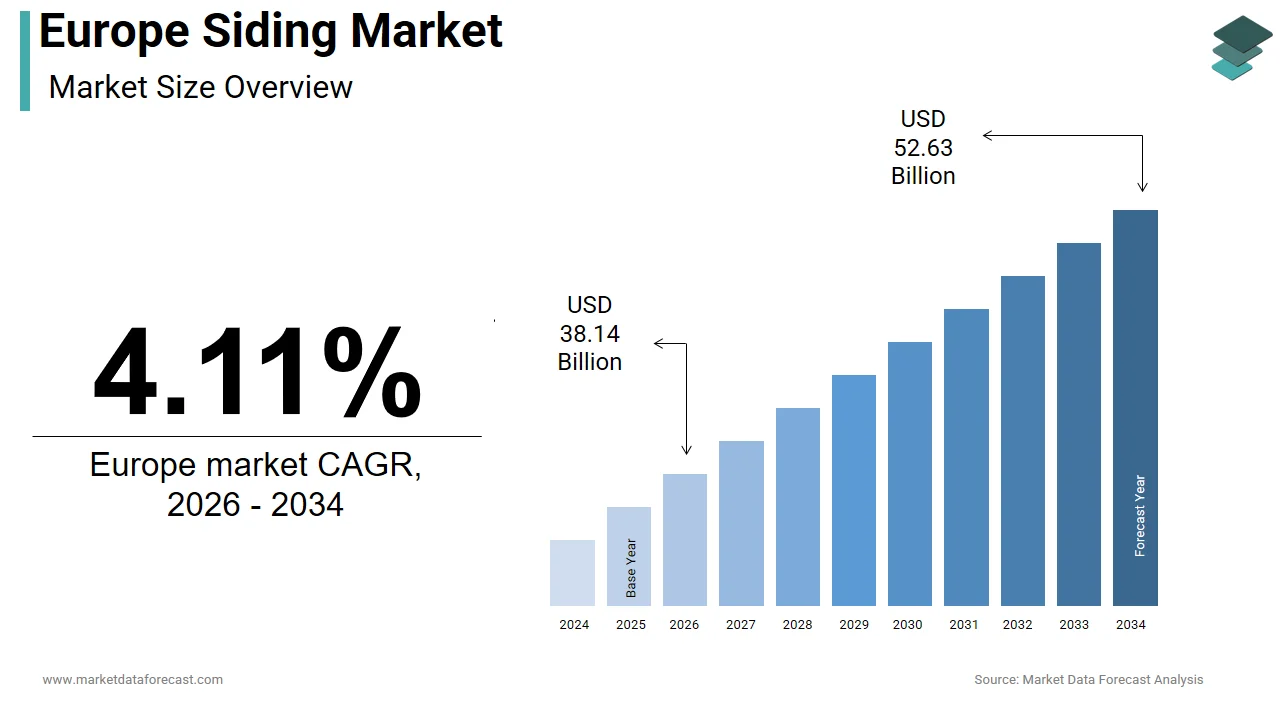
The Europe siding market was valued at USD 36.63 billion in 2025, is estimated to reach USD 38.14 billion in 2026, and is projected to reach USD 52.63 billion by 2034, growing at a CAGR of 4.11% from 2026 to 2034.
The siding is an exterior cladding material applied to residential and commercial buildings to enhance weather resistance, aesthetic appeal, and thermal performance. These systems include vinyl fiber cement, wood composite, and metal-based solutions installed vertically or horizontally across building façades. The European Commission reports that improved building envelopes, where high-performance siding plays a role, can reduce space heating needs by up to25%. Additionally, national renovation waves in countries like France and Germany prioritize façade upgrades as part of broader decarbonization strategies. Urban densification trends further amplify demand for durable, low-maintenance cladding that withstands pollution and moisture in high-density environments. These regulatory materials and demographic forces position modern siding not merely as a protective layer but as a functional component of Europe’s sustainable built environment.
MARKET DRIVERS
EU Building Renovation Wave Accelerates Siding Retrofits
The European Union’s Renovation Wave Strategy targets the upgrading of 35 million buildings by 2030, with façade modernization as a central pillar to improve thermal performance and reduce energy poverty. The EU building renovation wave accelerates siding retrofits is majorly fuelling the growth of Europe siding market. According to the European Commission, the EU’s building stock was constructed before 1990 with inadequate insulation and deteriorating exteriors. Similarly, Germany’s KfW Bank reported that some of the approved renovation loans in 2024 included exterior cladding upgrades primarily using fiber cement and composite panels with integrated thermal breaks. National technical standards, such as the UK’s Future Homes Standard and Italy’s Ecobonus 110%, further incentivize high-performance siding by linking subsidies to verified energy savings. These coordinated policy instruments transform siding from a cosmetic choice into a mandatory element of compliant building renewal, driving consistent demand across residential and public housing sectors.
Rising Demand for Low-Maintenance and Durable Façade Solutions
Homeowners and developers across Europe are increasingly prioritizing exterior cladding that minimizes lifecycle maintenance while resisting regional climatic stressors. The rising demand for low-maintenance and durable façade solutions is driving the growth of Europe siding market. According to the European Construction Observatory, the average cost of repainting or repairing traditional wood or render façades exceeds, every five years. In contrast, modern vinyl and fiber cement siding systems offer service lives of 25 to 40 years with no repainting or sealing required. In Scandinavia, where freeze-thaw cycles and high humidity accelerate material degradation, over 65% of new single-family homes installed composite or fiber cement siding in 2024, as per the survey. Similarly, the Netherlands mandates fire-resistant and mold-resistant materials for multi-unit dwellings near coastal zones, leading to widespread adoption of mineral-based cladding. This shift toward performance-driven material selection sustains robust demand for engineered siding even in price-sensitive markets.
MARKET RESTRAINTS
Strict Fire Safety Regulations Limit Use of Certain Siding Materials
Following the 2017 Grenfell Tower tragedy, the European Union intensified scrutiny of combustible building materials, leading to restrictive national bans on specific siding types. The strict fire safety regulations limit the use of certain siding materials, which is solely inhibiting the growth of Europe siding market. According to the European Committee for Standardization, façade systems on buildings over 18 meters must now achieve Euroclass A2 s1 d0 fire performance ratings, which exclude most traditional vinyl and wood polymer composites. In the United Kingdom, all combustible materials are prohibited on residential high rises regardless of height, as per the updated Building Safety Act 2023. Similarly, France’s decree of January 2021 requires non-combustible cladding for all public and multi-occupancy buildings over eleven meters. These regulations have eliminated entire product categories from urban markets where mid and high-rise construction dominates. The compliance burden disproportionately affects small contractors and delays renovation timelines in Southern Europe, where enforcement mechanisms remain inconsistent, but penalties are severe.
Volatility in Raw Material Prices Disrupts Cost Predictability
The significant pricing instability due to fluctuating costs of key inputs, including polyvinyl chloride resins, fiber cement pulp, and aluminum coil, is additionally impeding the growth of Europe siding market. According to a survey, European PVC spot prices surged by 42% between mid-2023 and early 2024 due to energy-driven production curtailments in Germany and Belgium. Since vinyl siding contains up to 90% PVC, this spike directly increased finished product costs by over 30% for manufacturers without long term feedstock contracts. Similarly, the European Paper Confederation reported a 28% rise in kraft pulp prices in 2024, affecting fiber cement producers reliant on cellulose reinforcement. These cost pressures compress margins for fabricators and complicate fixed price quoting for contractors.
MARKET OPPORTUNITIES
Integration of Insulated Siding in Net Zero Energy Building Projects
The emergence of thermal performance requirements and aesthetic demands is driving the adoption of factory-integrated insulated siding systems across Europe’s net-zero construction pipeline. The integration of insulated siding in net-zero energy building g projects is ascribed to bolstering the growth of Europe siding market. According to the Buildings Performance Institute, Europe façades with continuous insulation eliminate thermal bridging and can contribute up to 15% of a building’s required energy efficiency gain. In 2024, Denmark revised its Building Regulations to mandate minimum R values of four point zero for all new residential walls, achievable only with insulated cladding or additional exterior insulation. Companies like James Hardie and Trespa have launched composite panels with vacuum-insulated cores that deliver R values above five while maintaining slim profiles suitable for historic urban districts. The Passive House Institute certified over two hundred such systems in 2024 for use in certified projects across Germany, Austria, and the Netherlands.
Revitalization of Historic Urban Districts with Context Sensitive Cladding
European cities are investing in façade-sensitive renovation programs that preserve architectural heritage while upgrading energy performance by creating demand for siding that mimics traditional materials, such as timber shingles or lime render. The revitalization of historic urban districts with context-sensitive cladding is gearing up for new opportunities for the growth of Europe siding market. According to the European Heritage Alliance, many historic districts received EU funding in 2024 under the Cultural Heritage and Creative Industries program for façade modernization using visually compatible cladding. In Portugal, Lisbon’s municipal retrofit initiative approved the use of fiber cement panels with wood grain finishes for buildings in the Alfama district, ensuring compliance with UNESCO aesthetic guidelines. Similarly, Belgium’s Wallonia region offers subsidies for cladding that replicates historic textures, while meeting modern insulation standards. Manufacturers like Equitone and Cembrit have developed colored fiber cement boards that age naturally without peeling for conservation zones.
MARKET CHALLENGES
Fragmented Technical Approval Processes Across Member States
The individual countries maintain divergent national technical assessment frameworks for facade systems, creating barriers to cross-border product adoption. The fragmented technical approval processes across member states are acting as a barrier for the growth of Europe siding market. According to the European Organisation for Technical Assessment, siding manufacturers report delays of 6 to 18 months in obtaining national approvals when holding a European Technical Assessment certificate. In Italy, the Superior Council of Public Works requires separate seismic resilience tests for cladding in earthquake-prone zones, while Spain mandates additional condensation risk modeling under its CTE DB HE standard. These fragmented requirements force companies to maintain multiple product variants, increasing R&D costs and complicating inventory management.
Labor Shortages in Skilled Façade Installation Trades
The deployment of advanced siding systems increasingly requires certified installers trained in air barrier integration, thermal continuity, and moisture management, which is additionally hampering the growth of Europe siding market. According to Cedefop, the European Centre for the Development of Vocational Training, the construction sector will face a deficit of thousands of skilled workers by 2027, with facade technicians among the most scarce. In Germany, the Federal Institute for Vocational Education estimates that fewer than cladding firms have sufficient staff trained in insulated siding installation. This gap leads to improper detailing, such as unsealed joints or misplaced vapor barriers that compromise thermal performance and trigger callbacks.
REPORT COVERAGE
| REPORT METRIC | DETAILS |
| Market Size Available | 2025 to 2034 |
| Base Year | 2025 |
| Forecast Period | 2026 to 2034 |
| Segments Covered | By Material, Application, and Country. |
| Various Analyses Covered | Global, Regional, and Country-Level Analysis, Segment-Level Analysis, Drivers, Restraints, Opportunities, Challenges; PESTLE Analysis; Porter’s Five Forces Analysis, Competitive Landscape, Analyst Overview of Investment Opportunities |
| Countries Covered | UK, France, Spain, Germany, Italy, Russia, Sweden, Denmark, Switzerland, Netherlands, Turkey, Czech Republic, and the Rest of Europe. |
| Market Leaders Profiled | James Hardie Industries plc, Equitone AG, CertainTeed, Trespa International BV, LP Building Solutions, Nichiha, Royal Building Products, Alside, GAF, Cedar Shake & Shingle Bureau, and Others. |
SEGMENTAL ANALYSIS
By Material Insights
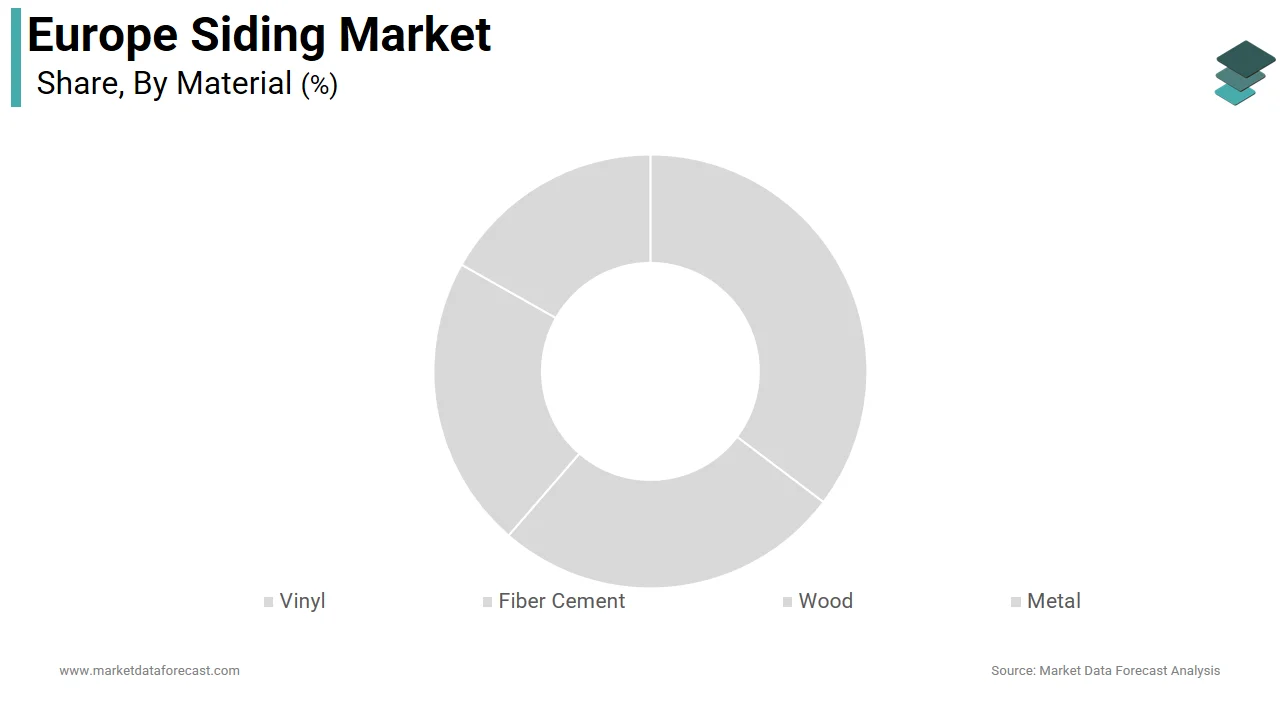
The fiber cement segment accounted in holding 38.2% of the Europe siding market share in 2024, from an optimal balance of fire resistance, durability, and aesthetic versatility aligned with stringent EU building codes. Unlike vinyl, fiber cement achieves Euroclass A1 non-combustible classification, making it mandatory for multi-story residential and public buildings in countries like the UK, France, and Germany following post Grenfell safety reforms. The material’s resistance to rot, insects, and moisture also ensures a service life exceeding 50 years with zero maintenance in Northern Europe’s humid climates. According to Statistics, Sweden has over 70% of new single-family homes in the country used fiber cement cladding in 2024 due to its compatibility with passive house standards. Manufacturers like James Hardie and Equitone have further enhanced appeal by offering colored panels that mimic wood or stone without requiring paint. National renovation programs, such as France’s MaPrimeRénov, explicitly list fiber cement as an eligible material for façade subsidies, reinforcing its regulatory and consumer acceptance across the region.
The fiber cement segment is anticipated to witness the fastest CAGR of 7.2% throughout the forecast period, with the converging regulatory, environmental, and architectural trends. The EU’s Energy Performance of Buildings Directive mandates that all new constructions achieve nearly zero energy standards by 2026 and fiber cement panels with integrated insulation deliver U values below 0.20 W/m²K, meeting this threshold without secondary cladding layers. Additionally, urban planners in Amsterdam and Copenhagen prioritize fiber cement for infill developments due to its dimensional stability and compatibility with historic brick contexts. These performance attributes position fiber cement as the material of choice for decarbonized, resilient, and context-sensitive building envelopes.
By Application Insights
The residential application segment was the largest by holding 64.3% of the Europe siding market share in 2024. This predominance reflects Europe’s vast stock of single and multi-family dwellings undergoing energy-efficient façade retrofits under national renovation schemes. Over thirty-five million homes across the EU are targeted for deep energy upgrades by 2030 as part of the Renovation Wave Strategy, with exterior cladding identified as a key intervention to reduce heating demand. In Poland, the National Fund for Environmental Protection allocated over 1.2 billion euros in 2024 to subsidize insulated siding for detached houses, reducing average household energy bills by 32%, according to the survey. Similarly, in Italy, the Ecobonus 110% scheme enables homeowners to deduct the full cost of fiber cement or composite cladding installations from income taxes. The segment is further amplified by rising homeownership rates in Southern Europe, where new builds increasingly adopt low-maintenance siding to replace traditional render. These policy-driven and demographic forces cement residential as the core driver of siding demand.
The commercial application segment is anticipated to witness the fastest CAGR of 6.8% from 2025 to 2033, with the corporate sustainability mandates, public procurement rules, and evolving workplace design standards. The EU Public Procurement Directive now requires all government-funded buildings, including schools, hospitals, and administrative offices, to achieve Level 3 environmental certification, which mandates non-combustible, durable facades with verified recycled content. In Denmark, all new public schools must use fiber cement or metal cladding with a minimum fifty year lifespans, as per the 2023 Building Code amendment. Additionally, multinational corporations like IKEA and Unilever are retrofitting European distribution centers with insulated metal siding to meet the Science Based Targets initiative commitments, reducing building energy intensity.
COUNTRY-LEVEL ANALYSIS
Germany Siding Market Analysis
Germany was the top performer of the Europe siding market by accounting for 21.5% of the share in 2025, with the aggressive building decarbonization policies and high renovation activity in both urban and rural housing stocks. The country’s Climate Protection Act mandates a 65% reduction in building emissions by 2030, driving mass adoption of insulated fiber cement and composite cladding. In 2024, the KfW Bank approved over 48,000 renovation loans that included façade upgrades with thermal performance exceeding EnEV 2023 standards. German homeowners also prioritize durability due to high labor costs for maintenance cite “zero upkeep for 30 years” as a key cladding criterion per a GfK survey. Leading domestic manufacturers like Cembrit and Eternit supply certified non-combustible panels that meet stringent DIN 4102 fire ratings. These regulatory, economic, and cultural factors position Germany as the continent’s most sophisticated and volume-driven siding market.
France Siding Market Analysis
France was positioned second by holding 16.4% of the Europe siding market share in 2024 with its ambitious MaPrimeRénov subsidy program and dense urban renewal agenda. According to the French Ministry of Ecological Transition, many facade renovation projects received state support in 2024 with fiber cement and insulated metal systems. The ban on combustible cladding for buildings over eleven meters, enacted in 2021, has eliminated vinyl from multi-unit developments, particularly in Paris, Lyon, and Marseille. Additionally, France’s emphasis on architectural harmony in historic districts has spurred demand for fiber cement panels that replicate traditional lime render or stone textures without compromising thermal performance. The French Environment and Energy Management Agency certifies these products under the ACERMI scheme, ensuring compliance with both energy and aesthetic criteria.
United Kingdom Siding Market Analysis
The United Kingdom siding market growth is likely to grow with the post-Grenfell building safety reforms and a surge in retrofit activity, among private landlords and social housing providers. The Building Safety Act 2023 prohibits all combustible materials on residential buildings over eighteen meters, effectively mandating fiber cement or metal cladding nationwide. In 2024, the Social Housing Decarbonisation Fund allocated 700 million pounds to upgrade social homes with energy-efficient façades, achieving EPC ratings of B or higher. Manufacturers like James Hardie have established UK-specific production lines to meet fire and wind load requirements under BS 8414 testing protocols.
Italy Siding Market Analysis
Italy siding market growth is likely to grow with the Ecobonus 110% tax credit, which allows homeowners to deduct the full cost of energy-efficient façade interventions from income taxes over five years. Many households claimed this benefit for insulated cladding installations primarily in Lombardy, Emilia, Romagna, and Tuscany. Italian architects also increasingly specify fiber cement for new builds due to its seismic resilience in earthquake-prone zones and compatibility with Mediterranean design aesthetics.
Netherlands Siding Market Analysis
The Netherlands siding market growth is likely to grow eventually in the coming years, with the compact urban planning, stringent sustainability certifications, and coastal climate demands. The Dutch Building Decree 2022 mandates that all façades in flood-prone or high-wind zones withstand suction pressures of over 2.5 kN/m², a standard that excludes many lightweight systems. Additionally, the government’s Circular Construction Program promotes cladding with at least recycled content and end-of-life recyclability. Companies like Trespa and Hunter Douglas supply locally manufactured panels that meet these criteria, while offering sleek, minimalist aesthetics favored in Dutch architecture. This integration of safety circularity and design cements the Netherlands as a high-performance niche market.
COMPETITIVE LANDSCAPE
Competition in the Europe siding market is characterized by differentiation through technical performance, regulatory compliance, and architectural integration rather than price competition. The market features a mix of multinational manufacturers like James Hardie and regional specialists such as Equitone and Trespa, each targeting distinct segments based on fire safety, thermal efficiency, and design flexibility. Fiber cement dominates due to its non-combustible nature and durability, aligning with EU building codes that restrict vinyl and wood composites in multi-story construction. Innovation focuses on factory-integrated insulation, recycled content, and digital specification tools to meet energy and circular economy mandates. National renovation subsidies further shape demand by favoring certified products that deliver verifiable energy savings.
KEY MARKET PLAYERS
The leading companies operating in the Europe siding market include:
- James Hardie Industries plc
- Equitone AG
- CertainTeed
- Trespa International BV
- LP Building Solutions
- Nichiha
- Royal Building Products
- Alside
- GAF
- Cedar Shake & Shingle Bureau
TOP PLAYERS IN THE MARKET
- James Hardie Industries plc is a global leader in fiber cement building products with a significant footprint across the Europe siding market. The company supplies high-performance weather-resistant cladding systems that meet stringent EU fire and thermal regulations. In Europe, James Hardie focuses on residential and commercial renovation segments, particularly in the UK, Germany, and Scandinavia, where non-combustible façades are mandated. Recent actions include the 2024 expansion of its production facility in Belgium to support insulated fiber cement panels compliant with nearly zero energy building standards. The company also launched its “Climate Shield” product line featuring through colored finishes that eliminate painting. These initiatives reinforce James Hardie’s commitment to sustainability, durability, and regulatory alignment in Europe’s evolving construction landscape.
- Equitone AG, a Switzerland-based manufacturer, specializes in through colored fiber cement façade panels widely used in European commercial and public infrastructure projects. The company contributes globally by exporting its architectural cladding solutions to over sixty countries while maintaining deep integration in EU urban development programs. In Europe, Equitone’s products are specified in Passive House certified buildings, heritage retrofits, and public schools due to their A1 fire rating and 50 year service life. Equitone introduced its “Tectiva” series with enhanced thermal anchoring systems enabling direct integration with exterior insulation. The company also partnered with Dutch architects to develop façade solutions for circular construction pilots funded by the European Investment Bank. These moves position Equitone as a premium provider of design-led sustainable cladding.
- Trespa International BV, headquartered in the Netherlands, is a key European producer of high-pressure compact laminate and fiber cement panels used in both exterior and interior applications. Its Pura NFC and Meteor lines serve residential, commercial, and educational sectors across Germany, France, and the Benelux region with emphasis on weather resistance and low maintenance. Trespa contributes globally through exports to North America and Asia while anchoring innovation in its European R&D center. The company launched a new façade panel with integrated recycled content exceeding forty% and certified under the EU Ecolabel scheme. It also enhanced its digital configurator tool to assist architects in visualizing façade performance under local climate conditions.
TOP STRATEGIES USED BY THE KEY MARKET PARTICIPANTS
Key players in the Europe siding market pursue strategies centered on regulatory compliance, product innovation, and sustainability differentiation. They invest in non-combustible fire-rated materials to meet post Grenfell building safety mandates across the EU. Companies develop insulated cladding systems that integrate thermal performance to align with nearly zero energy building standards. Vertical integration through localized manufacturing reduces lead times and carbon footprint. Firms also collaborate with architects and public agencies to position their products in heritage-sensitive and public infrastructure projects. Additionally, they enhance digital tools for specification visualization and lifecycle assessment to support green building certifications.
MARKET SEGMENTATION
This research report on the Europe siding market has been segmented and sub-segmented into the following categories.
By Material
- Vinyl
- Fiber Cement
- Wood
- Metal
- Others
By Application
- Residential
- Commercial
- Industrial
By Country
- United Kingdom
- France
- Spain
- Germany
- Italy
- Russia
- Sweden
- Denmark
- Switzerland
- Netherlands
- Rest of Europe