Europe Silica Market Research Report By Type (Hydrated Silica, Fumed Silica, Colloidal Silica, Silica Gel, and Others), End-User Industry (Building and Construction, Automotive, Water Treatment, Electronics, Pharmaceuticals and Personal Care, and Others), and Country (Germany, France, Italy, United Kingdom, Spain, and Rest of Europe) – Industry Analysis, Size, Share, Trends, and Growth Forecast (2026 to 2034)
Europe Silica Market Report Summary
The Europe Silica Market was valued at 118.93 million tons in 2024, is estimated to reach 126.52 million tons in 2025, and is projected to reach 207.51 million tons by 2033, growing at a CAGR of 6.38% from 2025 to 2033. Market expansion is driven by the rising demand for silica in construction materials, glass manufacturing, and industrial applications, coupled with its increasing use in renewable energy, electronics, and specialty chemicals. The growing emphasis on sustainable building materials, advanced glass composites, and industrial filtration technologies across Europe continues to fuel silica consumption.
Key Market Trends
- Growing Demand in Construction: Expansion of the building and infrastructure sector across Europe, supported by public housing and renewable projects, is driving silica use in cement, concrete, and sealants.
- Rising Adoption in Glass and Ceramics: Increasing demand for high-purity silica in glass manufacturing—particularly for solar panels, smart glass, and automotive glass—is a major market catalyst.
- Technological Advances in Silica Processing: Innovations in nano-silica production and surface-modified silica are enhancing its performance in coatings, paints, and polymers.
- Sustainability and Circular Economy Focus: The European market is witnessing a transition toward low-carbon silica production, utilizing recycled and renewable raw materials.
- Growth in Renewable Energy Applications: Rising demand for silica in photovoltaic glass, battery separators, and offshore wind composites is boosting long-term market potential.
- Emerging Role in Water Treatment: Hydrated and colloidal silica are increasingly used as eco-friendly flocculants and adsorbents in industrial and municipal water purification.
- R&D Expansion in Specialty Silica: Continuous investment in precipitated and fumed silica technologies is broadening applications in rubber, paints, cosmetics, and healthcare products.
Segmental Analysis
By Type Insights
- The hydrated silica segment dominated the European silica market in 2024, accounting for a 64.4% share.
- The segment’s leadership is attributed to its wide industrial applicability in toothpaste, coatings, food additives, and rubber reinforcement.
- Its superior absorption, thickening, and polishing properties make it a preferred choice across multiple sectors, including construction and consumer goods.
By End User Industry Insights
- The building and construction segment held the leading share of 32.4% of the European silica market in 2024.
- The dominance of this segment is driven by the growing use of silica as a key additive in cement, concrete, glass, and insulation materials.
- Europe’s increasing investment in green buildings, smart infrastructure, and low-emission construction materials continues to boost silica demand.
Regional Analysis
- Germany was the largest country in the European silica market, accounting for a 21.4% share in 2024. The country’s strong automotive, chemical, and glass manufacturing sectors, coupled with its leadership in industrial-grade silica production and R&D, position it as the regional market leader.
- France ranked as the second-largest market, capturing a 14.8% share in 2024. Growth is supported by the country’s robust construction industry, expanding renewable energy initiatives, and focus on sustainable material innovation.
- Italy maintains a notable market share, underpinned by its globally competitive glass ceramics and foundry industries, which rely heavily on high-purity silica sand. Italy’s manufacturing sector continues to be a key driver of silica demand, particularly in precision casting and architectural glass applications.
- The United Kingdom experienced moderate growth, aided by post-Brexit regulatory flexibility that has enabled faster adoption of innovative silica formulations in sectors such as offshore wind, water treatment, and green construction.
- Spain is expected to demonstrate steady growth during the forecast period, supported by its dual focus on solar energy expansion and large-scale construction projects. Increasing investments in photovoltaic glass and silica-based insulation materials are projected to strengthen its market position through 2033.
Competitive Landscape
The European silica Market is fragmented yet innovation-driven, featuring a diverse mix of multinational chemical producers, materials companies, and specialized silica manufacturers. Leading companies are investing in green silica production technologies, value-added applications, and capacity expansions to meet growing regional demand. Collaborations with construction, renewable, and chemical industries are strengthening the supply chain and enhancing product customization capabilities. Some of the companies that are playing a dominating role in the global Europe Silica Market include Evonik Industries AG, Wacker Chemie AG, Solvay SA, PPG Industries, Inc., Cabot Corporation, Nippon Chemical Industrial Co., Ltd., Tokuyama Corporation, Heraeus Holding GmbH, QSilica GmbH, Huntsman Corporation, WR Grace & Co., Elkem ASA, 3M Company, Imerys S.A., Sibelco N.V., Applied Material Solutions, Inc., Alpine Silica, LLC, Simcoa Operations Pty Ltd., PQ Corporation, and Dow Silicones Corporation.
Europe Silica Market Size
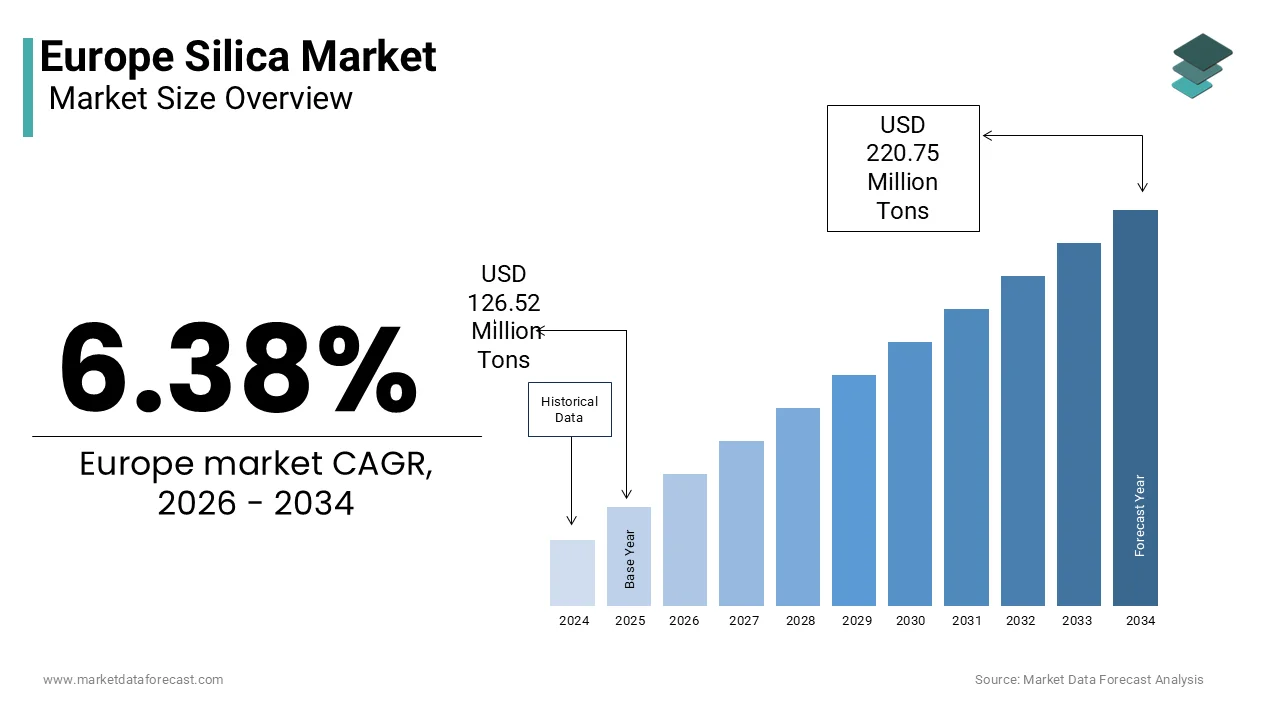
The europe silica market was valued at 126.52 million tons in 2025, is estimated to reach 134.59 million tons in 2026, and is projected to reach 220.75 million tons by 2034, growing at a CAGR of 6.38% from 2026 to 2034.
Silica refers to silicon dioxide, a naturally occurring chemical compound found abundantly in sand, quartz, and other minerals. Europe’s commitment to decarbonization and circular economy principles has intensified demand for high-purity silica with low embedded carbon. The European Union consumes a significant amount of silica annually, with the majority of this usage concentrated in Germany, France, and Italy. The EU's regulations, particularly under the new Euro 7 type-approval rules effective for new vehicle types from November 2026, will introduce limits on tire abrasion (non-exhaust emissions), which is expected to prompt reformulation in the tire industry to reduce microplastics. The market operates under evolving REACH and CLP regulatory frameworks that increasingly differentiate between crystalline and amorphous forms due to divergent health implications.
MARKET DRIVERS
Accelerated Adoption of Green Tire Technologies
The European Union’s aggressive vehicle emissions reduction targets have caused widespread integration of high surface area precipitated silica in passenger and commercial tire treads as a critical enabler of low rolling resistance, which drives the growth of the European silica market. Unlike traditional carbon black fillers, silica reduces energy dissipation during deformation,n which directly improves fuel efficiency and lowers CO2 output. Silica-based tread compounds are increasingly adopted in EU passenger car tires due to regulations prioritizing high performance. Major manufacturers like Michelin and Continental are integrating significant silica content to meet new standards for wet grip and rolling resistance, which contributes to reduced CO₂ emissions. To support this trend, chemical companies are expanding production of low-carbon precipitated silica. These developments underscore silica’s irreplaceable role in Europe’s sustainable mobility infrastructure.
Expansion of Silica in Pharmaceutical and Nutraceutical Formulations
Amorphous silica’s function as a free-flowing anti-caking agent and tablet disintegrant has become indispensable in the region’s rapidly growing pharmaceutical and dietary supplement sectors, which propels the expansion of the European silica market. The European Medicines Agency has documented the authorization of tens of thousands of medicinal products within the European Economic Area. Silica’s exceptional surface area and regulatory acceptance under Ph Eur monograph 0590 ensure its widespread use in solid oral dosage forms. The nutraceutical boom has further amplified consumption. Companies rely on silica to stabilize powdered formulations and ensure uniform active ingredient distribution. Importantly, the European Pharmacopoeia updated its silica specifications in 2023 to mandate tighter controls on heavy metals and residual solvents, reflecting heightened safety expectations. Moreover, the rise of personalized medicine and 3D printed tablets has created new demand for silica grades with precise particle size distribution. This confluence of demographic health and regulatory factors sustains consistent demand for fopharma-grade silica across Western and Central Europe.
MARKET RESTRAINTS
Stringent Classification of Crystalline Silica Under EU Carcinogen Regulations
The European Union’s reclassification of respirable crystalline silica as a carcinogen has imposed significant operational and compliance burdens on industries utilizing silica sand or quartz-containing materials that restrict the growth of the European silica market. The EU Carcinogens and Mutagens Directive requires workplaces to adhere to a binding occupational exposure limit (OEL) of 0.1 mg/m³ for respirable crystalline silica dust generated by a work process, implementing control measures and monitoring as necessary to stay below this limit. This affects not only the construction and foundry sectors but also suppliers of raw materials to ceramics and refractories. As per the European Agency for Safety and Health at Work, over 3.2 million workers across the EU are potentially exposed to crystalline silica dust primarily in building renovation and tunneling operations. Consequently, many manufacturers are reformulating products to use amorphous silica alternatives even where performance trade-offs exist. The increased regulatory scrutiny and reclassification of health risks associated with respirable crystalline silica are expected to influence operational costs and potentially insurance markets for relevant industries. Safety enhancements lead to greater production outlays and complex traceability issues, particularly impacting SMEs that lack the necessary EHS knowledge. Regulatory ambiguity between natural and synthetic forms further hampers innovation in borderline applications.
Volatility in Energy and Raw Material Costs
Persistent burden from fluctuating energy prices and the high cost of sodium silicate feedstock, which directly impacts precipitated silica economics, is thereby hampering the expansion of the European silica market. "Energy costs, including natural gas, are a significant component of production costs in thermal processes for fumed silica, and have been subject to volatility due to the energy crisis. "Following the 2022 energy crisis, European industrial gas prices have decreased from their peak but remain significantly higher than pre-2021 levels, settling into a new equilibrium by early 2024. This has forced several smaller producers in Southern Europe to curtail output or shift to batch production models. Water usage regulations under the EU Industrial Emissions Directive have also raised wastewater treatment costs, particularly for precipitated silica plants requiring extensive washing cycles. These input cost pressures are difficult to pass on fully to downstream customers in price-sensitive sectors like construction and rubber goods. Consequently, margins have compressed for mid-tier suppliers, prompting consolidation and strategic exits from non-core segments. The high costs associated with current renewable energy integration will persist in limiting capacity growth and pricing options until the technology achieves widespread scale.
MARKET OPPORTUNITIES
Rise of Bio-Based and Recycled Silica Sources
Sourcing silica from agricultural and industrial waste streams is emerging as an opportunity for the European silica market. This is aligned with the European Green Deal’s circular economy action plan. Rice husk ash, a byproduct of biomass power generation, contains a significant portion of amorphous silica and is gaining traction as a sustainable alternative to mined quartz. According to sources, in Europe, rice husk is a significant agricultural byproduct with a growing trend towards its use in sustainable construction and biomass energy. Companies have piloted rice husk-derived silica for use in rubber reinforcement, achieving tensile strength comparable to conventional grades. Similarly, recovered silica from end-of-life tires and glass is being evaluated for non-critical applications in construction and coatings. The European Union is increasingly funding projects focused on developing and scaling methods to purify and recover valuable materials like silica from waste streams, which alignswith a broader commitment to a circular economy.
Integration of Silica in Battery and Energy Storage Applications
Silica’s potential as a high-capacity anode material in next-generation lithium-ion batteries is opening a key opportunity within the region’s electrification ecosystem, which fuels the expansion of the European silica market. Silicon-based anodes can theoretically store ten times more lithium than graphite, but suffer from volume expansion issues, es which nanostructured silica helps mitigate. As per studies, the European Union is undergoing a substantial and swift expansion of its internal battery production capabilities, with many large manufacturing plants under construction throughout the region to fulfill the increasing need for batteries. Several facilities are trialing silica composite anodes to boost energy density. The EU, through initiatives like the Important Project of Common European Interest (IPCEI) on Batteries, is significantly investing in research, development, and industrial deployment of advanced battery materials, including novel anode technologies such as silica processing. Startups' partners are scaling up production of engineered silica powders tailored for battery use.
MARKET CHALLENGES
Supply Chain Fragmentation and Lack of Standardized Grades
Fragmentation in product specifications across applications impedes downstream efficiency, and material substitution is among the major challenges to the European silica market. Unlike polymers or metals, silica lacks harmonized industry standards for surface ar volumeolu, and particle morphology across the fiber,,,, and pharma sectors. As per research, numerous commercial grades of precipitated silica (e.g., rubber grade, food grade, etc.) are marketed in Europe and globally, with varying specifications to suit specific applications such as tires and oral care products. This complicates reformulation efforts, particularly for multinational manufacturers operating across regulatory jurisdictions. In the rubber industry, for instance, a tire maker may require separate silica sourcing agreements for tread base and sidewall compounds due to nuanced performance requirements. Similarly, pharmaceutical users must qualify each silica batch per individual monograph despite chemically identical composition. The complexity and diversity of precipitated silica grades across a fragmented market can lead to challenges in product validation and potentially impact market entry timelines and costs for manufacturers. This structural inefficiency stifles innovation and discourages new entrants seeking to compete on technical parity rather than established relationships.
Geopolitical Constraints on High Purity Quartz Sourcing
Dependence on imported high-purity quartz for fumed silica and semiconductor-grade applications exposes the region to strategic supply vulnerabilities that hold back the expansion of the European silica market. Over 75 percent of Europe’s quartz feedstock for specialty silica originates from Brazil, NorNorwaynd the United States, according to trade flow data published by Eurostat in 2024. Domestic reserves in Germany and Sweden are either depleted or restricted due to environmental protection in protected landscapes. The European Commission’s 2023 Critical Raw Materials classified high-purity quartz as a strategic material due to its role in photovoltaic batteries and microelectronics. However, processing capacity remains limited. Export controls from key suppliers and shipping disruptions in the Red Sea corridor have already caused delivery lead times to stretch several weeks for critical grades. This fragility is exacerbated by the lack of recycling infrastructure for high-end silica applications. The European market will continue to be vulnerable to external shocks, potentially disrupting tire and renewable energy component production, until secure domestic sources or technically viable substitutes like bio-silica are established.
REPORT COVERAGE
| REPORT METRIC | DETAILS |
| Market Size Available | 2024 to 2033 |
| Base Year | 2024 |
| Forecast Period | 2025 to 2033 |
| Segments Covered | By Type, End-User Industry, and Region. |
| Various Analyses Covered | Global, Region,, al and Country-Level Analysis, Segment-Level Analysis, Drivers, Restraints, Opportunities, Challenges; PESTLE Analysis; Porter’s Five Forces Analysis, Competitive Landscape, Analyst Overview of Investment Opportunities |
| Countries Covered | UK, France, Spain, Germany, Italy, Russia, Sweden, Denmark, Switzerland, Netherlands, Turkey, Czech Republic, Rest of Europe |
| Market Leaders Profiled | Evonik Industries AG, Wacker Chemie AG, Solvay SA, PPG Industries, Inc., Cabot Corporation, Nippon Chemical Industrial Co., Ltd., Tokuyama Corporation, Heraeus Holding GmbH, QSilica GmbH, Huntsman Corporation, WR Grace & Co., Elkem ASA, 3M Company, Imerys S.A., Sibelco N.V., Applied Material Solutions, Inc., Alpine Silica, LLC, Simcoa Operations Pty Ltd., PQ Corporation, Dow Silicones Corporation. |
SEGMENTAL ANALYSIS
By Type Insights
The hydrated silica segment dominated the European silica market and accounted for a 64.4% share in 2024. Its irreplaceable role as a supporting filler in silica-based green tires, which have become standard across the European automotive sector under emissions regulations, drives the domination of the hydrated silica segment. The physical properties of precipitated silica, including high surface area tunable porosity and strong polymer interaction, enable low rolling resistance without compromising wet grip. Apart from these, the segment benefits from broad applicability in toothpaste, anti-caking agents, and pharmaceuticals, where its controlled particle size and purity are critical. A substantial metric tons of precipitated silica are used annually in European oral care formulations, as per sources. Continuous process optimization has also reduced production costs, making it economically viable for mass market industrial use compared to energy-intensive fumed silica.
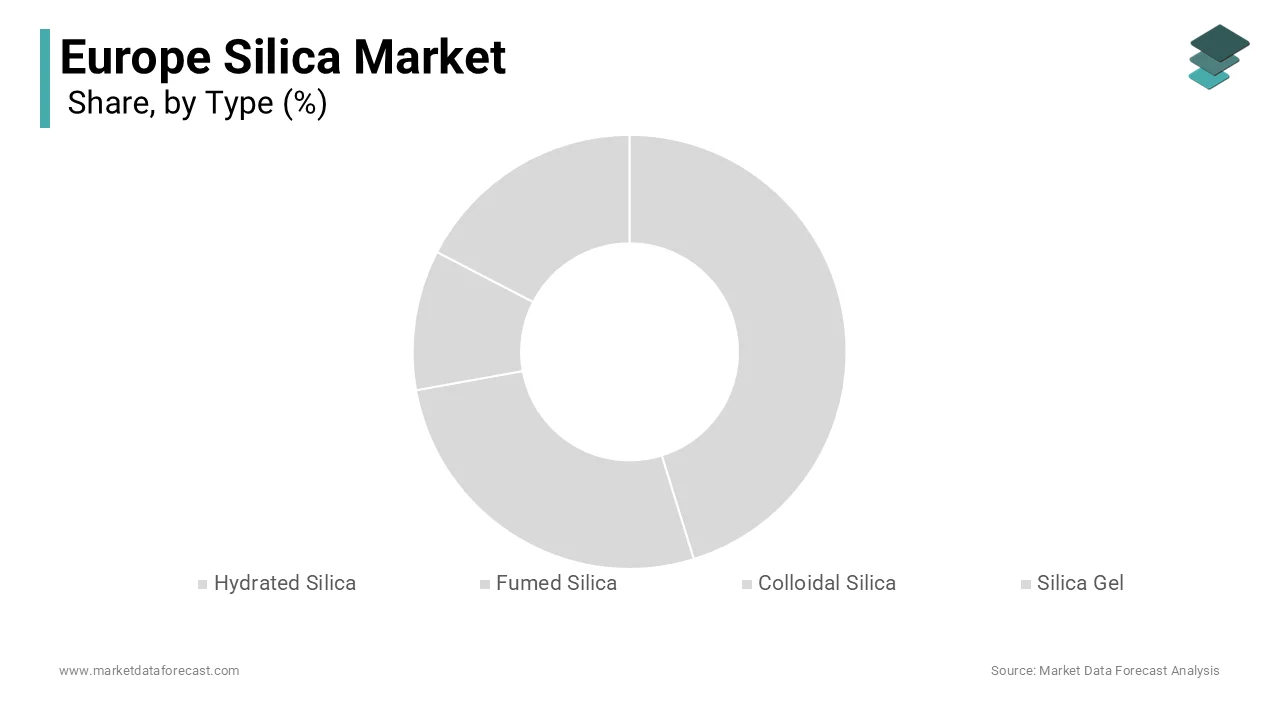
The fumed silica segment is predicted to witness the highest CAGR of 8.7% from 2025 to 2033 due to its unique performance in high-value applications requiring extreme thixotropy, thermal stability, and optical clarity. In the coatings and adhesivesectorrto fumed silica prevents pigment settling in high solids formulations and enhances scratch resistance in automotive clear coats. Moreover, demand from lithium-ion battery manufacturers is accelerating as fumed silica acts as a binder and rheology modifier in silicon anode slurries. Additionally, the expansion of high-performance sealants in offshore wind turbine assembly, where fumed silica provides UV and saltwater resistance, has created new demand in Northern Europe. Despite its higher cost compared to precipitated silica, its functional superiority in niche applications ensures sustained growth.
By End User Industry Insights
The building and construction segment held the leading share of 32.4% the European silica market in 2024. Silica sand and microsilica are fundamental components in concrete mortars and high-strength cementitious composites where they enhance compressive strength, permeability ty and improve workability. The EU's Renovation Wave initiative targets a doubling of the annual energy renovation rate (currently around 1%) by 2030, which has intensified demand for high-performance construction materials. In Germany, millions of metric tons of silica sand were consumed in concrete production in 2024, according to studies. Furthermore, the use of silica fume, a byproduct of ferrosilicon production, in ultra-high-performance concrete for bridges and tunnels has become standard in countries like France and Switzerland. European standards for concrete production have evolved to formally incorporate the use of silica fume as a recognized supplementary material. Urban infrastructure resilience projects in flood-prone regions such as the Netherlands also rely on silica-modified concrete for durability. This regulatory and infrastructural momentum ensures the construction sector remains the largest industrial consumer of silica in Europe.
The water treatment segment is estimated to register the fastest CAGR of 9.3% from 2025 to 2033, owing to silica’s dual role as both a filtration medium and a coagulant aid in municipal and industrial wastewater systems. Hydrated silica’s porous structure effectively adsorbs heavy metals such as lead anarsenicni while amorphous silica gels stabilize pH during tertiary treatment. The EU’s revised Urban Wastewater Treatment Directive, formally adopted in November 2024, mandates tertiary nutrient removal by 2039 and quaternary micropollutant removal by 2045 for urban wastewater treatment plants serving a population equivalent of 150,000 or more. Apart from these, the semiconductor and pharmaceutical industries generate high-purity wastewater streams that require silica-based polishing steps to meet discharge limits under the Industrial Emissions Directive. Hence, demand for efficient treatment technologies will continue to drive silica adoption in this critical sector.
COUNTRY LEVEL ANALYSIS
Germany Silica Market Analysis
Germany was the largest country in Europe's silica market and accounted for a 21.4% share in 2024. The supremacy of Germany in the regional market is primarily driven by its robust automotive and construction sectors. Germany produces millions of vehicles annually, and all major tire plants operated by Continental and Michelin use precipitated silica in eco tire treads compliant with EU labeling standards. The country also hosts Europe’s most advanced fumed silica production facilities run by Evonik in Han, which supply high-purity grades to electronics and battery manufacturers. Apart from these, Germany’s Energiewende policy has spurred infrastructure upgrades requiring silica-modified concrete for grid substations and rail expansions. Strong R and D integration between industry and technical universities ensures continuous innovation in silica applications from catalysis to thermal insulation.
France Silica Market Analysis
France was the second-largest country in the European silica market by capturing a 14.8% share in 2024. Factors such as a strong nuclear and renewable energy infrastructure that relies on high-purity silica for glass and composite components fuel the growth of the French market. France generates a notable share of its electricity from nuclear power, and each reactor contains thousands of silica-based insulators and shielding materials. The country is also a leader in green tire production, with Michelin’s headquarters in Clermont-Ferrand driving domestic precipitated silica demand. The construction sector further contributes through large-scale public workswhich specify silica fume-enhanced concrete for tunnel linings. Environmental regulations under the French Anti-Waste Law have also boosted recycled silica usage in glass manufacturing. This blend of energy mobility and circular economy policies sustains France’s strategic silica consumption.
Italy Silica Market Analysis
Italy maintains a notable share in the European silica market. Its globally competitive glass ceramics and foundry industries, where high-quality silica sand is essential, propel the demand for silica in the Italian market. Italy produces millions of metric tons of container and flat glass annually, with silica constituting a notable share of batch composition. The Veneto and Emilia Romagna regions host clusters of luxury tableware and sanitaryware manufacturers that depend on low-iron silica for optical clarity and thermal shock resistance. Besides, Italy’s extensive building renovation programs under the National Recovery and Resilience Plan have increased demand for silica in self-compacting concrete and tile adhesives. The country also leads food-grade silica usage due to its large nutraceutical sector, with supplement brands requiring E551 as a flow agent. These diverse industrial linkages ensure Italy remains a core European silica consumer.
United Kingdom Silica Market Analysis
The United Kingdom grew moderately in the European silica market. Post-Brexit regulatory autonomy has enabled faster adoption of innovative silica applications, particularly in offshore wind and water treatment. The Environment Agency is implementing stricter standards for wastewater treatment, focusing on reducing pollutants like nitrogen and phosphorus, which drives the adoption of advanced treatment technologies. The country also maintains a strong specialty chemicals sector with Croda and Johnson Matthey utilizing fumed silica in catalysts and personal care formulations. UK Research and Innovation (UKRIcontinuesue to allocate substantial funding to advanced manufacturing and materials science research, with investments in various hubs and projects across UK universities aimed at improving efficiency, sustainability, and technological innovation in key industries. Additionally, the UK’s aging water infrastructure renewal program is driving demand for silica sand in pipe bedding and trench backfill. These policies and industrial dynamics anchor the UK’s significant silica footprint.
Spain Silica Market Analysis
Spain is expected to grow in the European silica market during the forecast period due to its dual focus on solar energy and construction. Spain is Europe’second-largestst solar photovoltaic installer with notable gigawatts of new capacity added in 2024. The Iberian Peninsula’s abundant quartz deposits in regions supply both domestic glassmakers and export markets. Simultaneously, Spain’s urban regeneration programs have spurred concrete production where silica fume improves durability in coastal and high seismic zones. The country also leads in desalination, with a portion of municipal water in southern regions sourced from seawater plants that use silica gel in pretreatment to prevent membrane fouling. This strategic alignment of energy infrastructure and resource efficiency ensures Spain’s continued prominence in the European silica landscape.
COMPETITIVE LANDSCAPE
Competition in the European silica market is characterized by a mix of large multinational chemical firms and specialized regional producers vying for leadership in high-value applications. The market is not driven by price alone but by technical performance, regulatory compliance, and sustainability credentials. Major players such as Evon,ik Solv, ay, and Wacker compete through continuous innovation in particle engineering, ring surface modification, and process efficiency. Smaller producers focus on niche segments like food-grade or foundry silica, where local sourcing and rapid service provide competitive edges. Regulatory pressures under REACH CLP and the EU Green Deal have raised barriers to entry, favoring incumbents with strong EHS and R and D capabilities. Simultaneously, demand from emerging sectors like battery materials and water treatment is attracting new entrants and fostering collaboration between material suppliers and end users. This dynamic creates a competitive landscape where technological agility and environmental stewardship are as critical as production scale.
KEY MARKET PLAYERS
Some of the companies that are playing a dominating role in the global European silica market include
- Evonik Industries AG
- Wacker Chemie AG
- Solvay SA
- PPG Industries, Inc.
- Cabot Corporation
- Nippon Chemical Industrial Co., Ltd.
- Tokuyama Corporation
- Heraeus Holding GmbH
- QSilica GmbH
- Huntsman Corporation
- WR Grace & Co.
- Elkem ASA
- 3M Company
- Imerys S.A.
- Sibelco N.V.
- Applied Material Solutions, Inc.
- Alpine Silica, LLC
- Simcoa Operations Pty Ltd.
- PQ Corporation
- Dow Silicones Corporation
TOP LEADING PLAYERS IN THE MARKET
- Evonik Industries is a leading global specialty chemicals company with a significant footprint in the European silica market through high-performance AEROSIL fumed silica and SIPERNAT precipitated silica product lines. The company supplies critical silica grades to the automotive, pharmaceutical, and battery sectors across Europe. It also launched anebio-based precipitated silica derived from rice husk ash in partnership with European agri processors. These initiatives reinforce its commitment to sustainability and technological leadership while strengthening its integration into Europe’s green industrial value chains.
- Solvay SA plays a pivotal role in the European silica landscape through its Zeosil range of precipitated silica used extensively in green tires, od and cosmetics. Headquartered in Brussels, the company leverages deep application expertise to serve both industrial and consumer sectors. The company also introduced Zobead, a spherical silica innovation for pharmaceutical fluid bed coating that enhances drug dissolution rates. These advances position Solvay at the intersection of performance and sustainability in Europe’s evolving silica demand.
- Wacker Chemie AG is a key European producer of fumed silica under its HD brand, nd serving industries including construction, electronicshealthcare. Based in a uniq ie uniqueintegrates silica production with its silicone polymer business to deliver synergistic material solutions. It also developed a new hydrophobic fumed silica gradient moisture-sensitive battery electrode formulation tested in collaboration with German automotive suppliers. These actions underscore Wacker’s focus on energy efficiency and advanced materials innovation within the European market.
TOP STRATEGIES USED BY THE KEY MARKET PARTICIPANTS
Key players in the European silica market focus on vertical integration to secure raw material supply and reduce cost volatility, particularly for high-purity quartz. They invest heavily in sustainable production technologies, including renewable energy adoption, water recyclingnd carbocapture-readydy infrastructure. Product differentiation through engineered silica grades for fobatteries, es, pharmaceutic, l,, and green tires remains a core strategy. Companies also pursue circular economy initiatives by developing silica recovery from industrial waste streams such as rice husk ash and end-of-life glass. Strategic partnerships, e che mi, and construction firms, enaco-developmentmentapplication-specific solutions that enhance performance and regulatory compliance across the European Union.
MARKET SEGMENTATION
This research report on the europe silica market is segmented and sub-segmented into the following categories.
By Type
- Hydrated Silica
- Fumed Silica
- Colloidal Silica
- Silica Gel
- Others
By End-User Industry
- Building and Construction
- Automotive
- Water Treatment
- Electronics
- Pharmaceuticals and Personal Care
- Others
By Country
- Germany
- France
- Italy
- United Kingdom
- Spain
- Rest of Europe
Frequently Asked Questions
1. Which are the major product segments in the Europe Silica Market?
The major product segments include crystalline silica, which is the largest revenue generator, and amorphous silica, both with strong growth potential in Europe.
2. What are the key applications driving the Europe Silica Market?
Key applications include tire and rubber manufacturing, coatings, adhesives, cosmetics, personal care, lithium-ion batteries, and construction.
3. How is the Europe Silica Market segmented by product type?
It is segmented mainly into precipitated silica, fumed silica, crystalline silica, amorphous silica, silica gel, and silica powder.
4. What is the role of precipitated silica in the Europe Silica Market?
Precipitated silica is widely used in the tire industry for enhanced performance and fuel efficiency, as well as in cosmetics and personal care products.
5. Which countries are leading the Europe Silica Market?
Germany, France, Italy, Spain, and the Netherlands are leading countries, with Germany having the highest market share due to its automotive and chemical sectors.
7. What is the impact of environmental regulations on the Europe Silica Market?
Strict environmental regulations in Europe are driving sustainable silica production and greener manufacturing technologies.
8. Who are the key players in the Europe Silica Market?
Major players include Akzo Nobel NV, Cabot Corp, Evonik Industries AG, Imerys, Kemira Oyj, Nissan Chemical Corp, PPG Industries Inc, Solvay SA, Tosoh Corp, and Wacker Chemie AG.
9. How does silica benefit European tire manufacturing?
Silica improves rolling resistance, wet grip, and wear resistance in tires, aiding in fuel efficiency and safety compliance.
10. How does the Europe Silica Market support sustainability goals?
The market is investing in green technologies, circular production methods, and compliance with regulations to reduce environmental impact.
Related Reports
Access the study in MULTIPLE FORMATS
Purchase options starting from
$ 2000
Didn’t find what you’re looking for?
TALK TO OUR ANALYST TEAM
Need something within your budget?
NO WORRIES! WE GOT YOU COVERED!
Call us on: +1 888 702 9696 (U.S Toll Free)
Write to us: sales@marketdataforecast.com