- Product Description Description
- Table of Contents TOC
- List of Table & Figure LOT
- Get Free Sample PDF Sample PDF
Market Size, 2025
$0.55 BnMarket Estimate, 2026
$0.58 BnMarket Forecast, 2034
$0.88 BnCAGR, 2026–2034
5.28%Europe Snowmobile Market Size, Growth, Trends & Forecast (2026–2034)
The Europe snowmobile market size was calculated at USD 0.55 billion in 2025, is estimated to reach USD 0.58 billion in 2026, and is anticipated to be worth USD 0.88 billion by the end of 2034, registering a compound annual growth rate (CAGR) of 5.28% during the forecast period from 2026 to 2034. Driven by the expansion of experiential winter adventure tourism, remote area utility requirements, and rapid technological pivots toward electrification, the European snowmobile market is navigating climate-induced snow volatility through sustainable fleet modernization.
Key Executive Metrics (At-a-Glance)
- 2025 Base Valuation: USD 0.55 Billion
- 2026 Current Valuation: USD 0.58 Billion
- 2034 Forecast Valuation: USD 0.88 Billion
- Compound Annual Growth Rate (CAGR): 5.28% (2026–2034)
- Largest Vehicle Type Segment: Utility Segment (38.6% share in 2025)
- Fastest-Growing Vehicle Type Segment: Crossover Segment (6.8% CAGR)
- Largest Engine Type Segment: 2-Stroke Engines (52.1% share in 2025)
- Fastest-Growing Engine Type Segment: Electric Engines (28.4% CAGR)
- Largest Application Segment: Recreation and Tourism (57.3% share in 2025)
- Largest Country Market: Sweden (24.3% share in 2025)
Core Market Drivers
- Winter Adventure Tourism: Increasing integration of snowmobiling into curated, sustainable Arctic and Alpine travel itineraries, including indigenous Sámi-led excursions.
- Remote Utility Demands: Ongoing reliance on snowmobiles for essential infrastructure maintenance, emergency medical evacuations, and border patrolling in roadless northern terrains.
Primary Market Restraints & Challenges
- Climate Change & Snow Volatility: Shorter seasonal windows, receding snow lines, and unstable snow depth truncating operational periods in marginal Alpine zones.
- Stringent Environmental Regulations: Strict noise and emissions frameworks (such as Natura 2000 zone restrictions) limiting operational geography for fossil-fueled machines.
Europe Snowmobile Market Segmentation Breakdown
| Segment Category | Dominant / Leading Segment | Fastest-Growing / High-Potential Segment |
|---|---|---|
| By Vehicle Type | Utility (38.6% share in 2025) | Crossover (6.8% CAGR) |
| By Engine Type | 2-Stroke (52.1% share in 2025) | Electric (28.4% CAGR) |
| By Application | Recreation & Tourism (57.3% share) | Utility / Rescue / Law Enforcement (7.2% CAGR) |
| By Region | Sweden (24.3% share in 2025) | Finland, Norway, Austria |
Major Industry Players Profiled
Key enterprises shaping the European snowmobile market include Arctic Cat, Polaris Inc., Bombardier Recreational Products Inc. (BRP / Ski-Doo / Lynx), Yamaha Motor Co., Ltd., Alpina Snowmobiles, and electric pioneer Taiga Motors.
Europe Snowmobile Market Size
The Europe snowmobile market size was calculated at USD 0.55 billion in 2025 and is anticipated to reach USD 0.88 billion by 2034, from USD 0.58 billion in 2026, growing at a CAGR of 5.28% during the forecast period.
A snowmobile is a motorized vehicle designed for travel over snow and ice, typically featuring two skis at the front for steering and a continuous track at the rear for propulsion. These machines serve dual roles as recreational equipment and essential utility transport in remote northern communities. Core markets include Sweden, Finland, Norway, and Alpine nations such as Austria and Switzerland, where snowmobiling supports tourism, emergency services, forestry, and indigenous livelihoods. According to the World Meteorological Organization and Copernicus Climate Change Service, temperatures in Europe as a whole have risen by more than twice the global average, contributing to reduced snow reliability across the continent. The World Meteorological Organization has pointed out a gradual decrease in the duration and extent of Northern Hemisphere snow cover in recent decades, with significant decreases in areas where seasonal mean air temperatures are near freezing. The number of tourists traveling to Antarctica has skyrocketed, with nearly 125,000 visitors in the 2023-2025 season, indicating a broader trend in adventure tourism, though this is unrelated to the Scandinavian market. These contextual dynamics illustrate a market shaped by environmental fragility, rising experiential demand, and infrastructural necessity.
MARKET DRIVERS
Rising Demand for Winter Adventure Tourism
The expansion of experiential winter tourism in Northern and Alpine Europe has become a key factor propelling the growth of the Europe snowmobile market. Snowmobiling is increasingly integrated into curated adventure packages that appeal to high-spending travelers seeking thrill and immersion. Tour operators have responded by enhancing route diversity and incorporating cultural narratives, particularly through Sámi guided tours in Norway and Finland. This alignment with experiential and sustainable tourism trends has solidified snowmobiling as a premium attraction, driving consistent fleet demand and rental activity across core regions.
Growth in Remote Area Utility Applications
These vehicles remain indispensable for logistical and emergency operations in the region’s roadless northern territories, which in turn drives the expansion of the Europe snowmobile market. Emergency services frequently deploy snowmobiles for medical evacuations and supply delivery in rural areas. Border Patrol agencies rely on snowmobiles for effective frontier monitoring during the winter months, as per sources. Unlike recreational use, this utility segment operates on operational necessity rather than seasonalpreferencece providing a resilient and predictable demand base. The growing mobility challenges in Arctic zones, caused by permafrost degradation and extreme weather, mean that snowmobiles will remain functionally relevant for public services and rural connectivity, reinforcing this need as a permanent market pillar.
MARKET RESTRAINT
Climate-Induced Snow Cover Volatility
Unstable snow conditions driven by climate change pose an operational and economic barrier to the Europe snowmobile market. Snow depth in the European Alps is decreasing. The duration of continuous snow cover in southern Norway is becoming shorter. These shifts truncate the operational season, particularly in marginal zones such as the Austrian and German pre-Alps. As per research, Low-altitude ski resorts in Austria are experiencing delays in opening snow trails. This unpredictability discourages capital investment and reduces consumer confidence. Operators in vulnerable regions face declining revenues and heightened financial risk, limiting their ability to maintain fleets or innovate. Consequently, snow cover volatility acts as a geographic and temporal ceiling on market expansion, especially outside the high latitude core.
Stringent Environmental and Noise Regulations
The region’s robust environmental governance increasingly restricts the vehicle’s access in ecologically sensitive areas, which further affects the expansion of the Europe snowmobile market. EU and national regulations widely restrict motorized vehicles in protected zones, such as Natura 2000 sites, covering nearly a fifth of EU land. According to studies, a significant majority of Alpine snowmobile trails overlap with protected habitats, prompting seasonal closures. National laws enforce strict environmental standards, resulting in the exclusion of older, more polluting snowmobile models from use. Compliance costs are rising as operators retrofit or replace equipment to meet standards. These regulatory and social pressures constrain operational geography, elevate ownership cost, and deter market entry, particularly for small-scale providers lacking capital for fleet modernization.
MARKET OPPORTUNITIES
Electrification and Sustainable Mobility Initiatives
The emergence of electric snowmobiles aligns with Europe’s decarbonization mandates and opens a major opportunity for the growth of the Europe snowmobile market. Registrations of electric recreational vehicles in Europe are increasing significantly year over year. Models currently on the market offer a greater range, which enables full-day use without needing to refuel or recharge. Government bodies are providing financial incentives to encourage the adoption of electric snowmobiles, particularly among tour operators. This infrastructure expansion supports commercial scalability and enhances environmental credentials. Electrification not only reduces regulatory risk but also commands premium pricing and brand loyalty. As battery efficiency improves and lifecycle costs decline, electric snowmobiles are positioned to capture a significant share in both utility and luxury tourism segments.
Integration with Indigenous and Community-Based Tourism
Indigenous led tourism models offer a key opportunity to the Europe snowmobile market. Sámi cooperatives in Norway, Sweden, and Finland are increasingly managing snowmobile excursions that emphasize heritage storytelling and land stewardship. The European Union’s Just Transition Mechanism also includes funding streams for rural communities to develop low-impact tourism, including snowmobile services. This model fosters local economic resiliency, promotes environmental responsibility, ty and appeals to travelers seeking authenticity. The increasing demand for regenerative tourism means that community-integrated snowmobiling presents a scalable and values-aligned path for growth that prioritizes local communities and environmental well-being.
MARKET CHALLENGES
High Total Cost of Ownership and Maintenance Complexity
The financial burden of acquiring, maintaining, and operating snowmobiles remains an issue for the Europe snowmobile market. Newer models are expensive to purchase and require costly annual upkeep, according to studies. In remote areas, logistics inflate costs further. Geographical distance significantly increases the cost of spare parts and repairs. Fuel supply is another challenge, particularly for two-stroke engines requiring specialized oil blends that must be stockpiled before winter. Insurance premiums compound the burden. These cumulative costs deter individual ownership and limit fleet renewal among small tour operators, constraining market depth and technological adoption outside major tourism hubs.
Seasonal Employment and Skilled Labor Shortages
The inherently seasonal nature of snowmobiling creates structural workforce challenges that impede the expansion of the Europe snowmobile market. This instability affects service consistency and safety training. More critically,y there is a severe shortage of certified mechanics capable of servicing modern or electric models. Recruitment in northern regions is further hampered by housing shortages and youth outmigration. The absence of investment in year-round employment frameworks, vocational certification, and remote technical support is preventing the industry from upholding quality standards and scaling its operations. This human capital deficit represents a fundamental bottleneck to market maturity and resilience.
REPORT COVERAGE
| REPORT METRIC | DETAILS |
| Market Size Available | 2025 to 2034 |
| Base Year | 2025 |
| Forecast Period | 2026 to 2034 |
| CAGR | 5.28% |
| Segments Covered | By Vehicle Type, Engine Type, Application, and Region |
| Various Analyses Covered | Global, Regional & Country Level Analysis; Segment-Level Analysis; DROC, PESTLE Analysis; Porter’s Five Forces Analysis; Competitive Landscape; Analyst Overview of Investment Opportunities |
| Regions Covered | UK, France, Spain, Germany, Italy, Russia, Sweden, Denmark, Switzerland, Netherlands, Turkey, and the Czech Republic |
| Market Leaders Profiled | Arctic Cat, Polaris Inc., Bombardier Recreational Products Inc., Yamaha Motor Co., Ltd., Alpina Snowmobiles |
SEGMENTAL ANALYSIS
By Vehicle Type Insights
The utility segment dominated the Europe snowmobile market by accounting for a 38.6% share in 2025. The dominance of the utility segment is driven by its critical role in non-recreational applications across Northern Europe’s remote and sparsely populated regions. According to sources, a large number of residents in northern Scandinavia depend on utility snowmobiles for winter access to healthcare, education, and essential supplies due to the absence of all-weather road networks. These vehicles feature enhanced cargo capacity, durable chassis, and cold start reliability, ty making them indispensable for municipal forestry and rescue operations. Government procurement programs further reinforce demand. Unlike recreational models, utility snowmobiles operate on functional necessity, ensuring consistent year-on-year procurement cycles and insulating the segment from tourism volatility.
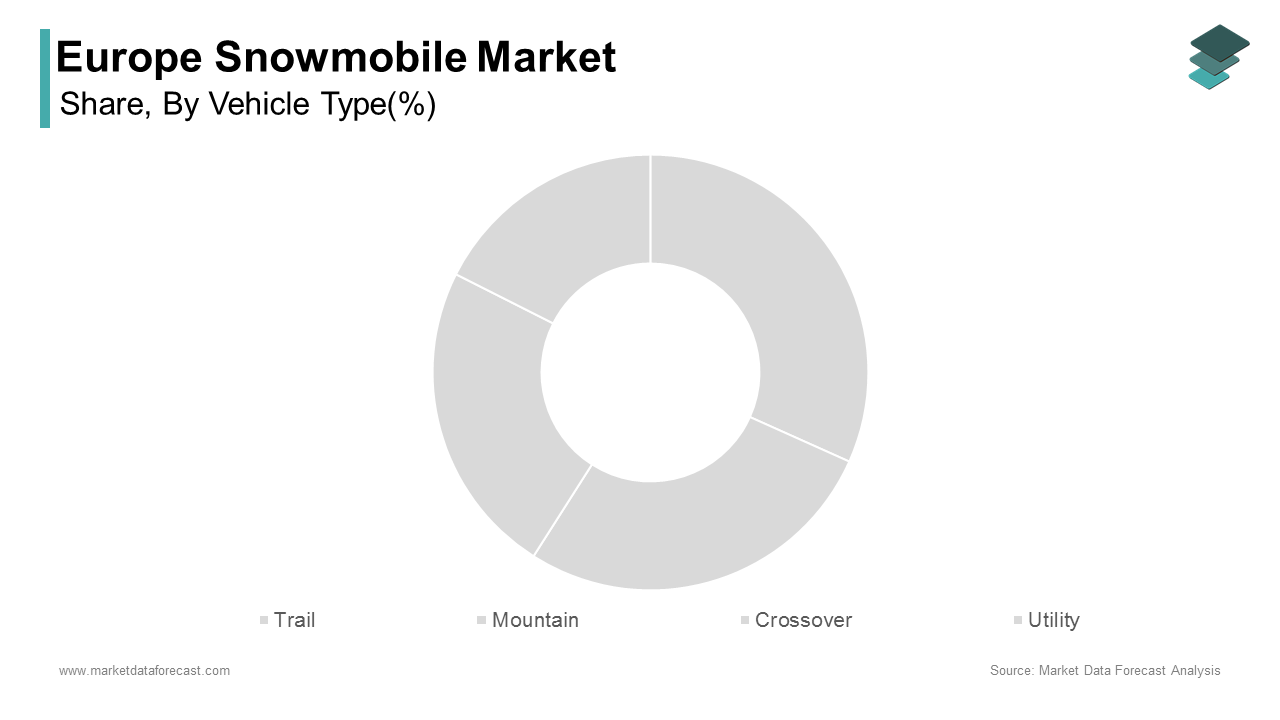
The crossover segment is likely to experience the fastest CAGR of 6.8% between 2026 and 2034, owing to rising consumer demand for versatile machines that perform effectively across both groomed trails and ungroomed backcountry terrain. Manufacturers have responded with lightweight chassis, advanced suspension systems, and adaptive track designs that bridge the performance gap between Trail and Mountain categories. Tour operators are also adopting crossovers to reduce fleet complexity and maintenance costs while offering diverse itineraries. The ability to navigate mixed terrain is driving sustained consumer and commercial preference for this adaptive category, as increasing snow unpredictability due to climate change enhances both safety and operational reliability.
By Engine Type Insights
In 2025, the 2-stroke engine segment led the Europe snowmobile market by occupying a 52.1% share 2025. The prominence of the 2-stroke engine segment is fuelled by its historical dominance, cost efficiency, and performance characteristics suited to cold climate operation. Two-stroke engines deliver high power-to-weight ratios, enabling rapid acceleration and reliable cold starts, vital attributes in Arctic conditions. Spare parts and repair expertise for these engines remain widely available even in remote service centers. Additionally, many utility and rescue agencies continue to operate two-stroke fleets owing to their mechanical simplicity and ease of field maintenance. The market presence of older models will continue for some time because there is such a vast existing base, even as newer emission regulations phase them out in protected areas. The transition to cleaner alternatives is gradual, particularly in regions where budget constraints outweigh environmental compliance priorities, reinforcing the entrenched position of two-stroke engines across Europe’s operational core.
The electric engine segment is on the rise and is expected to be the fastest-growing segment in the market by witnessing a CAGR of 28.4% from 2026 to 2034. The rapid expansion of the electric engine segment is propelled by Europe’s stringent environmental policies, rising consumer eco-consciousness, and rapid advancements in battery technology. National support mechanisms are accelerating adoption. Modern electric models such as the Taiga Orca now achieve ranges exceeding notable kilometres on a single charge, sufficient for a full day of guided tours. Electric snowmobiles are positioned for exponential uptake as noise regulations in urban, alpine, and protected areas become stricter by offering a compliant and unique alternative to traditional models.
By Application Insights
The recreation and tourism application segment led the share of 57.3% of the Europe snowmobile market in 2025. The growth of the recreation and tourism application segment is attributed to the deep integration of snowmobiling into Europe’s winter tourism economy, particularly in Nordic and Alpine destinations. Tour operators have professionalized offerings with certified guides GPS GPS-tracked routes, and eco itineraries that appeal to high-spending travellers. Destination marketing agencies actively promote snowmobiling as a signature attraction. The segment’s scale is further amplified by private ownership among leisure users in countries like Switzerland and Austria, where snowmobiling complements ski resort culture. This commercial and cultural embedding ensures Recreation and Tourism remains the market’s primary revenue driver.
The utility/rescue/law enforcement segment is expected to exhibit a noteworthy CAGR of 7.2% from 2026 to 2034 due to increasing institutional reliance on snowmobiles for critical winter operations in regions with limited road access. Climate change is exacerbating mobility challenges as permafrost degradation and extreme weather events disrupt conventional transport. Municipalities are responding with dedicated procurement budgets. Indigenous communities also utilize these vehicles for wildlife monitoring and postal services under national support programs. Unlike tourism, this segment operates on operational necessity, ensuring steady demand unaffected by seasonal visitor fluctuations.
REGIONAL ANALYSIS
Sweden Snowmobile Market Analysis
Sweden was the largest country in the Europe snowmobile market and accounted for a 24.3% share in 2025. The supremacy of Sweden in the regional market is driven by its extensive Arctic territory, strong tourism infrastructure, and institutional adoption. The country’s northern regions, particularly Norrbotten and Västerbotten, serve as hubs for both commercial and utility snowmobiling. Government policy supports the sector through the Arctic Strategy, which includes mobility funding for remote communities. Apart from these, Sweden hosts major service and training centers for Nordic operators, enhancing regional supply chain resilience. The presence of indigenous Sámi cooperatives further diversifies demand, with culturally embedded tour operations gaining international recognition. Hence, Sweden maintains its position as the continent’s most mature and multifaceted snowmobile market.
Finland Snowmobile Market Analysis
Finland followed closely in the European snowmobile market, accounting for a 21.8% share in 2025, aided by its vast Lapland region for both tourism and essential transport. Snowmobile safaris represented a share of all winter activity bookings in Lapland, which reflects strong commercial integration. Beyond recreatio, Finland’s institutional reliance is profound. National policy reinforces this duality. Finland also leads in safety standardization, hosting the Nordic Snowmobile Safety Forum, which sets cross-border operational guidelines. This blend of cultural tourism, logistical necessity, and policy support positions Finland as a balanced and resilient market second only to Sweden in continental scale.
Norway Snowmobile Market Analysis
Norway continues to be a notable player in the Europe snowmobile market due to strong Sámi stewardship and progressive environmental regulation. It allocated funds to expand community-based snowmobile access, enhancing indigenous control over tourism and transport. Southern Norway has experienced a clear reduction in continuous snow cover since the year 2000, which increases the demand for dependable over-snow travel options where snow still exists. Consequently, a large percentage of northern municipalities have implemented stricter snowmobile regulations, which leads operators to explore environmentally friendly technologies. Norway also leads in electric adoption. The combination of cultural authority, environmental policy, and infrastructure investment makes Norway a unique market where tradition and sustainability co-drive evolution.
Switzerland Snowmobile Market Analysis
Switzerland expanded gradually in the European snowmobile market, with its high-end alpine tourism sector. Unlike Nordic nations, Switzerland’s snowmobiling is almost exclusively recreational, centered in resorts such as Zermatt, St. Moritz, and Verbier. However operational scope is constrained by strict environmental laws. Consequently, fleet sizes remain modest with most operators managing fewer units. Despite these limits, Switzerland’s high per unit revenue and brand association with Alpine excellence sustain its position among Europe’s top five markets. The segment thrives not on volume but on exclusivity and integration within luxury winter experiences.
Austria Snowmobile Market Analysis
Austria is anticipated to grow in the Europe snowmobile market from 2026 to 2034 due to operating under increasing climatic and regulatory pressure. Most activity is concentrated in Tyrol and Carinthia, where high elevation preserves seasonal reliability. Nevertheless, demand persists among domestic enthusiasts and German tourists seeking accessible winter experiences. Despite these challenges, Austria retains relevance through proximity to Germany’s large leisure market and integration with ski resort packages. Its position reflects the fragility of snowmobiling in marginal snow regions where climate change directly dictates commercial viability.
COMPETITION OVERVIEW
The Europe snowmobile market features moderate competition characterized by a mix of global leaders and niche innovators. Dominance is held by established North American manufacturers who tailor products to European environmental regulations, ns terrain diversity, and operational needs. These players compete on technological sophistication, service network density, and brand heritage rather than price. The entry of electric specialists like Taiga Motors has intensified innovation, particularly in sustainability and noise reduction, prompting incumbents to accelerate their own electrification roadmaps. Competition is geographically segmented, with Nordic countries favoring utility and indigenous tourism models while Alpine regions prioritize premium recreation. Regulatory compliance, especially in protected areas, creates a high barrier to entry, limiting the number of active players. Differentiation arises through customization, safety features, and integration with local tourism ecosystems. Overall, the competitive landscape is evolving toward performance sustainability and service excellence, with collaboration often supplementing direct rivalry.
KEY MARKET PLAYERS
A few major players of the Europe snowmobile market include
- Arctic Cat
- Polaris Inc
- Bombardier Recreational Products Inc
- Yamaha Motor Co., Ltd
- Alpina Snowmobiles
Top Strategies Used by the Key Market Participants
Key players in the Europe snowmobile market employ targeted strategies to sustain competitiveness and address regional challenges. Product diversification remains central with manufacturers offering specialized models for trail mountain crossover and utility applications to cater to varied terrain and user needs. Electrification is a dominant strategic thrust as companies invest heavily in battery technology,gy, charging infrastructure, and government-compliant zero-emission platforms. Partnerships with tourism authorities and indigenous cooperatives enhance market access and brand authenticity, particularly in Nordic regions. After-sales service expansion through localized training centers and spare parts logistics improves customer retention in remote areas. Additionally, firms leverage experiential marketing by sponsoring winter adventure events and safety certification programs to build community trust and rider loyalty across Europe.
Leading Players in the Market
BRP Inc
BRP Inc. is a pivotal force in the Europe snowmobile market, offering a diverse portfolio under its Ski Doo and Lynx brands. The company has strengthened its position through continuous innovation in engine efficiency and chassis design tailored to European terrain and emissions standards. In recent years, BRP introduced electric start and semi-active suspension systems across its European lineup, enhancing rider comfort and performance. The company also expanded its network of authorized dealers and service centers in Nordic countries to improve after-sales support. BRP actively collaborates with tour operators in Sweden and Finland to co-develop guided experience packages, aligning its products with experiential tourism trends and reinforcing its global leadership in recreational snowmobiling.
Polaris Inc
Polaris Inc. plays a significant role in the Europe snowmobile market through its INDY and RMK series, which cater to both trail and mountain segments. The company has focused on enhancing cold-weather reliability and cargo utility to meet the demands of European utility and rescue operations. Recently, Polaris upgraded its Pro Ride chassis with improved weight distribution and track grip for variable snow conditions prevalent in the Alps and Scandinavia. It also launched targeted financing programs for small tour operators in Norway and Austria to lower entry barriers. Polaris supports rider training initiatives in partnership with national snowmobile associations to promote safety and brand loyalty. These efforts underscore its commitment to both recreational and functional applications across the continent.
Taiga Motors
Taiga Motors has emerged as a transformative player in the Europe snowmobile market by pioneering zero-emission electric snowmobiles. Its Orca model delivers over 100 kilometers of range and rapid torque response, making it suitable for both guided tours and utility use in protected areas. The company has secured partnerships with Finnish and Swedish tourism boards to deploy pilot fleets in national parks where combustion engines face restrictions. Taiga alsco-developed fast charging protocols with a Nordic energy provider,30-minute top-ups at remote locations. By aligning with Europe’s Green Deal and indigenous eco tourism value,,s Taiga is redefining snowmobiling as a sustainable winter mobility solution and accelerating the continent’s shift toward electric snow transport.
MARKET SEGMENTATION
This research report on the Europe snowmobile market has been segmented and sub-segmented based on vehicle type, engine type, apapplicationand region.
By Vehicle Type
- Trail
- Mountain
- Crossover
- Utility
By Engine Type
- 2-Stroke
- 4-Stroke
- Electric
By Application
- Recreation and Tourism
- Utility/Rescue/Law-Enforcement
- Military and Industrial
By Region
- UK
- France
- Spain
- Germany
- Italy
- Russia
- Sweden
- Denmark
- Switzerland
- Netherlands
- Turkey
- Czech Republic
- Rest of Europe