- Product Description Description
- Table of Contents TOC
- List of Table & Figure LOT
- Get Free Sample PDF Sample PDF
Market Size, 2025
$435 MnMarket Estimate, 2026
$454 MnMarket Forecast, 2034
$637 MnCAGR, 2026–2034
4.31%Europe Sorbitol Market Size
The Europe sorbitol market size was valued at USD 435.78 million in 2025 and is projected to reach USD 637.09 million by 2034 from USD 454.56 million in 2026, growing at a CAGR of 4.31%.
Sorbitol is a sugar alcohol derived primarily from corn or wheat starch through catalytic hydrogenation of glucose. Sorbitol serves as a multifunctional ingredient valued for its humectant, sweetening, and texturising properties across food, pharmaceutical, and personal care applications. It is recognised as a safe food additive under Regulation (EC) No 1333/2008 and listed in the European Pharmacopoeia for medicinal use. According to the European Food Safety Authority, sorbitol is approved for use in a wide range of food categories with a well-established acceptable daily intake. As per Eurostat, more than 9 million metric tons of starch are processed annually in the EU for industrial uses, including polyol production. According to the European Starch Association, over 80% of European sorbitol is produced from non-genetically modified European crops to ensure supply chain transparency. National dietary strategies in countries like France and Germany actively promote sugar reduction in processed foods, creating sustained demand for bulk sweeteners such as sorbitol in confectionery, beverages and diabetic foods.
MARKET DRIVERS
Growing Consumer Demand for Sugar-Reduced and Diabetic-Friendly Food Products
The rising prevalence of obesity and diabetes across Europe is driving strong demand for sugar-free and low-calorie food formulations where sorbitol serves as a functional bulk sweetener, which is one of the major factors driving the European sorbitol market growth. According to the World Health Organisation, almost 60% of adults in the WHO European Region live with overweight or obesity, while diabetes affects nearly 10% of the population. As per the European Commission’s Farm to Fork Strategy, national programs in Finland and the Netherlands incentivise food manufacturers to reduce added sugars by at least 20% in key product categories. According to UNESDA (European Soft Drinks Association), the soft drinks sector has committed to continuous sugar reduction, with sugar-free beverages showing strong growth across Europe. In the confectionery segment, sorbitol remains widely used in sugar-free chewing gums and candies in Germany and Italy due to its cooling effect and non-cariogenic properties. This public health imperative ensures consistent demand for sorbitol in food applications.
Widespread Use as a Critical Excipient in Pharmaceutical Formulations
Sorbitol’s role as a non-hygroscopic sweetening and stabilising agent in oral pharmaceuticals makes it indispensable in Europe’s highly regulated medicine manufacturing sector, which is further boosting the sorbitol market expansion in Europe. According to the European Medicines Agency, sorbitol is included in hundreds of approved medicinal products across the EU, primarily in liquid suspensions, chewable tablets and syrups. As per the European Federation of Pharmaceutical Industries and Associations, it is especially critical in pediatric and geriatric formulations where palatability directly impacts treatment adherence. For instance, sorbitol is widely used in over-the-counter cough syrups and multivitamin liquids in France, Spain and Sweden due to its compatibility with active ingredients and long-term stability. Its GRAS status and compliance with Ph Eur monographs ensure seamless regulatory acceptance. With Europe accounting for nearly one-quarter of global pharmaceutical production, sorbitol remains a cornerstone excipient in solid and liquid dosage forms requiring sweetness, viscosity control and shelf-life extension.
MARKET RESTRAINTS
Mandatory Laxative Warning Labels and Consumer Perception Barriers
Regulatory requirements for prominent digestive warning statements on sorbitol-containing products significantly constrain the regional market growth. According to the European Commission Regulation (EU) No 1169/2011, any food product in which polyols exceed 10% of total weight must carry the label “Excess consumption may have a laxative effect.” As per the European Food Safety Authority, this warning is triggered at intake levels above 20 grams per day, which is leading manufacturers to limit sorbitol content or reformulate. In Sweden and Finland, national health authorities have issued public advisories cautioning against daily sorbitol consumption in children under 12. For instance, a significant share of Europeans actively avoids products listing sorbitol due to perceived digestive risks, even when used within safe limits. Consequently, food brands increasingly substitute sorbitol with erythritol or allulose in premium categories to avoid warning labels and maintain clean label appeal. This regulatory and perceptual headwind curbs innovation in high polyol applications despite sorbitol’s functional and cost advantages.
Volatility in Agricultural Feedstock Prices and Energy Costs
The European sorbitol market is highly sensitive to fluctuations in corn and wheat prices, as well as natural gas costs, which directly impact glucose syrup and hydrogenation economics. According to the European Commission, the average price of wheat in the EU rose by more than 20% in 2023 compared to 2021 due to adverse weather and Black Sea export disruptions. As per the International Grains Council, corn prices averaged around 280 euros per metric ton in 2023, up from about 215 euros in 2020, increasing raw material costs for starch processors. Since sorbitol production requires high-pressure hydrogenation, natural gas prices further affect operational expenses, with European energy costs remaining 30–50% higher than global averages in 2025 according to Eurostat. In 2023, European sorbitol producers reported double-digit increases in input costs, forcing some to pass on expenses to downstream customers in price-sensitive segments like generic confectionery and over-the-counter pharmaceuticals. This volatility undermines long-term pricing stability and complicates procurement planning for formulators.
MARKET OPPORTUNITIES
Development of Second-Generation Bio-Based Sorbitol from Non-Food Biomass
The shift toward circular and sustainable chemistry is a strategic opportunity for the European sorbitol market. According to the European Bioplastics Association, sorbitol derived from wheat straw or corn stover can reduce lifecycle greenhouse gas emissions by more than 60% compared to conventional production routes. As per the European Institute of Innovation and Technology, pilot biorefineries in the Netherlands and Germany successfully produced food-grade sorbitol from lignocellulosic biomass using enzymatic hydrolysis and catalytic conversion in 2025. The EU’s Circular Economy Action Plan and Corporate Sustainability Reporting Directive incentivise the adoption of bio-based platform chemicals in food, pharma and cosmetics. Companies like Roquette and Tereos are investing in second-generation biorefineries aligned with the Renewable Energy Directive II. This innovation allows sorbitol to transcend its traditional role and become a certified sustainable ingredient in Europe’s green industrial strategy, enhancing market differentiation and regulatory favour.
Expansion in Natural and Organic Personal Care Formulations
The clean beauty movement and demand for plant-derived humectants are driving sorbitol adoption in Europe’s rapidly growing natural cosmetics sector, which is one of the promising opportunities in the European sorbitol market. According to Cosmetics Europe, naturally sourced polyols such as sorbitol are increasingly featured in new moisturisers and oral care products launched in Western Europe due to their biodegradability and skin compatibility. As per the European Commission’s Cosmetic Regulation, sorbitol is fully compliant with Annexe III and carries no concentration restrictions, making it highly versatile for formulators. In certified natural cosmetic lines adhering to COSMOS or NATRUE standards, sorbitol is preferred over synthetic alternatives like propylene glycol for its renewable origin and non-irritating profile. Consumer and trade association data confirm that sorbitol is widely present in certified organic toothpaste launches, reflecting its strong role in natural formulations. With the EU pushing for safer chemical substitution in everyday products, sorbitol’s benign toxicological and environmental profile offers a durable advantage in high-growth personal care categories.
MARKET CHALLENGES
Intensifying Competition from Newer Low-Calorie Sweeteners
The growing substitution pressure from emerging polyols and rare sugars that offer superior taste profile, lower caloric content, and reduced digestive side effects is a notable challenge to the sorbitol market expansion in Europe. According to the European Food Information Council, erythritol and allulose are increasingly gaining market share in sugar-free confectionery launches due to their near-zero calorie content and minimal gastrointestinal impact. As per the European Commission’s Novel Food Catalogue, allulose received authorisation in early 2025, which is enabling broad use across the EU and accelerating adoption by major food brands. In the pharmaceutical sector, xylitol and mannitol are increasingly favoured for chewable tablets due to faster dissolution and more pronounced cooling effects. Market insights confirm that sorbitol’s presence in sugar-free gum launches has declined significantly since 2020, as manufacturers shift to erythritol, stevia, or monk fruit blends. This substitution trend is strongest in premium functional and children’s products, where digestive tolerance and clean-label perception are key purchase drivers.
Geographic Concentration of Production and Import Dependency
The European sorbitol market is constrained by limited and geographically concentrated manufacturing capacity, which creates supply chain vulnerability and reliance on imports. According to the European Starch Association, the majority of EU sorbitol production is controlled by three companies with primary facilities located in France, Germany and Belgium. As per Eurostat, Europe imported tens of thousands of metric tons of sorbitol in 2025, which is primarily from the United States and China, to meet seasonal demand peaks in the confectionery sector. This concentration increases risk from energy price shocks, logistics disruptions and regulatory changes affecting starch processing. In 2023, a temporary shutdown at a major French facility due to natural gas supply constraints led to regional shortages and double-digit price spikes. Without investment in decentralised or modular production using diverse feedstocks, Europe’s sorbitol supply remains fragile and susceptible to external shocks despite stable end-user demand across food, pharma and cosmetics.
REPORT COVERAGE
| REPORT METRIC | DETAILS |
| Market Size Available | 2025 to 2034 |
| Base Year | 2025 |
| Forecast Period | 2026 to 2034 |
| CAGR | 4.31% |
| Segments Covered | By Product, Application, End Use, and Region |
| Various Analyses Covered | Global, Regional, & Country Level Analysis; Segment-Level Analysis; DROC, PESTLE Analysis; Porter’s Five Forces Analysis; Competitive Landscape; Analyst Overview of Investment Opportunities |
| Regions Covered | UK, France, Spain, Germany, Italy, Russia, Sweden, Denmark, Switzerland, Netherlands, Turkey, and the Czech Republic |
| Market Leaders Profiled | Tereos, Sappi Ltd ADR, American International Group Inc, Cargill, Genpact Ltd, Ingredion Inc, DuPont de Nemours Inc, Archer-Daniels Midland Co, and Merck KGaA |
SEGMENTAL ANALYSIS
By Product Insights
The liquid or syrupy sorbitol segment was the major segment and accounted for 59.5% of the European market share in 2025. The dominance of the liquid or syrupy segment in the European market is driven by its superior solubility, ease of handling, and direct compatibility with wet processing in food, pharmaceutical and cosmetics manufacturing. According to the European Starch Association, liquid sorbitol accounts for the majority of industrial sorbitol consumption in the EU because it integrates seamlessly into continuous production lines without requiring dissolution steps. As per the European Food Safety Authority, liquid sorbitol is the preferred format for sugar-free beverage and syrup formulations where homogeneity and stability are critical. In the pharmaceutical sector, sorbitol syrup is widely used in oral liquid medicines as a sweetening and humectant base due to its viscosity and microbial stability. Major producers such as Roquette and Tereos operate dedicated liquid sorbitol pipelines connected directly to downstream customers in France and Germany, reducing transport costs and contamination risks. This operational efficiency and functional suitability cement liquid sorbitol as the dominant format across high-volume applications.
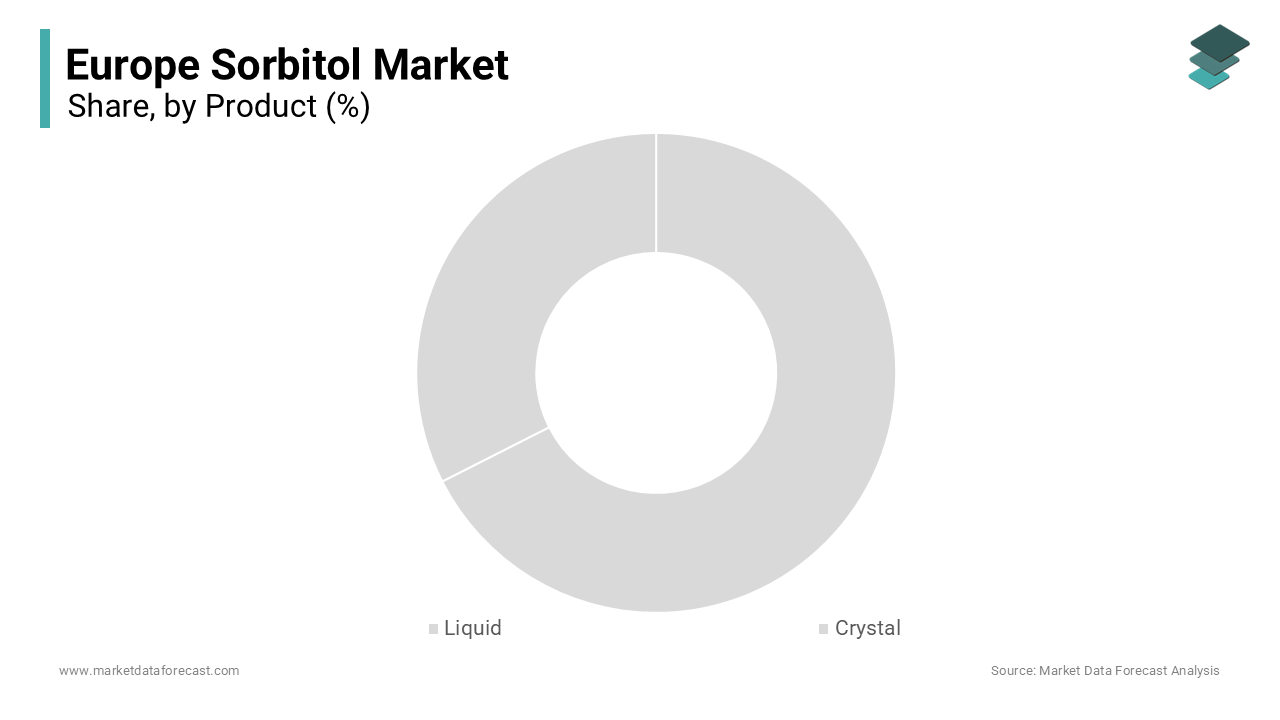
The powder or crystalline sorbitol segment is the fastest-growing type segment in the European sorbitol market and is estimated to register a CAGR of 7.07% over the forecast period. The rising demand in solid dosage pharmaceuticals sugar sugar-free confectionery, and natural cosmetics, where dry formats offer better stability, dosing precision and consumer perception,, driving the growth of the powder segment in the European market. According to Cosmetics Europe, crystalline sorbitol is increasingly specified in solid cosmetic launches because of its free-flowing properties and ability to retain moisture without stickiness. As per the European Federation of Pharmaceutical Industries and Associations, crystalline sorbitol is widely used in chewable and orally disintegrating tablets due to its rapid dissolution and cooling effect, which enhances palatability. Innovations in agglomeration technology have reduced dust and improved compressibility, which is making it ideal for high-speed tablet presses. Additionallythe , clean-label movement favours visible crystalline ingredients over syrups in premium confectionery, with brands such as Katjes and Valeo using powdered sorbitol in transparent packaging to signal natural formulation.
By Application Insights
The food and beverages segment led the market and accounted for 50.8% of the regional market share in 2025. Food and beverages are the primary application area for this polyol due to its dual function as a sweetener and humectant sin ugar-reduced products. According to the European Commission, sorbitol is widely used in sugar-free and “no added sugar” food products across the EU, often in combination with other polyols. As per the European Soft Drinks Association, sugar-free beverage sales have grown steadily in recent years, with sorbitol commonly incorporated into cordials and functional drinks to improve mouthfeel and reduce the aftertaste of high-intensity sweeteners. In confectionery, sorbitol plays an essential role sin ugar-free hard candies and chewing gums because it prevents crystallisation and maintains texture over an extended shelf life. National dietary guidelines in Germany and several Nordic countries encourage the use of polyols in diabetic and children’s foods, further institutionalising their role. The segment’s scale, ingredient versatility and alignment with EU public health sugar-reduction targets ensure sorbitol’s continued importance in food applications.
The personal care and cosmetics segment represents the ffastest-growingapplication segment in the European sorbitol market and is predicted to showcase a CAGR of 8.04% over the forecast period, owing to the clean beauty movement demand for naturally derived humectants and regulatory alignment with EU cosmetic safety standards. According to Cosmetics Europe, sorbitol is widely used in moisturisers, serums and oral care products in Western Europe because of its non-irritating and noncomedogenic profile. As per the European Commission’s Cosmetic Regulation, sorbitol is fully compliant with Annexe III and carries no concentration limits, making it highly versatile for formulators. In certified natural cosmetic lines adhering to COSMOS or NATRUE standards, sorbitol is often preferred over synthetic alternatives such as propylene glycol due to its biodegradability and renewable origin from starch. Brands including Weleda aDrDr. Hauschka have reformulated core products to highlight sorbitol as a natural moisture binder, enhancing consumer trust. This regulatory clarity and positive consumer perception position sorbitol as a strategic ingredient in Europe’s expanding green personal care economy.
REGIONAL ANALYSIS
Germany Sorbitol Market Analysis
Germany stands as one of the pillars of the European sorbitol market, consistently ranking among the largest contributors to regional demand. Its position is reinforced by a strong pharmaceutical industry and a dominant oral care sector, where sorbitol is widely used in toothpaste and syrups. The country’s emphasis on reducing sugar intake and its large diabetic population create a steady demand base. Germany’s industrial strength also ensures reliable production capacity, making it a stabilising force in the European sorbitol landscape.
France Sorbitol Market Analysis
France occupies a leading position in the regional sorbitol market, reflecting both scale and dynamism. France is one of the fastest-expanding markets in Europe. Its position is anchored by a globally competitive cosmetics industry, where sorbitol functions as a humectant in lotions and creams. Food and beverage reformulation also plays a major role, as French consumers increasingly demand sugar-free alternatives. France’s pharmaceutical sector adds depth, using sorbitol in syrups and tablets. This combination of diverse applications secures France’s place as a growth engine in the regional market.
United Kingdom Sorbitol Market Analysis
The United Kingdom holds a steady but more moderate position in Europe’s sorbitol market. The UK’s growth rate is lower than continental peers, yet its role remains important. The country’s position is defined by strong demand in food and beverage, particularly sugar-free confectionery and diet drinks. Cosmetics and oral care also contribute with sorbitol used in moisturisers and toothpaste. Regulatory pressure to reduce sugar in processed foods sustains demand, while consumer preference for healthier alternatives ensures the UK remains a consistent contributor to the regional market.
Italy Sorbitol Market Analysis
Italy holds a prominent position in the European sorbitol market, combining scale with steady growth. Its position is reinforced by strong demand in food and beverage, especially sugar-free confectionery and chewing gum, alongside a vibrant cosmetics industry. Italian consumers value design and wellness, which supports sorbitol’s use in lotions and creams. Pharmaceutical applications add resilience, particularly in pediatric formulations. Italy’s balanced demand across multiple sectors ensures its position as a reliable growth contributor within the European sorbitol market.
Spain Sorbitol Market Analysis
Spain has carved out a dynamic position in the European sorbitol market, distinguished by its rapid growth. Its position is defined by strong adoption in food and beverage reformulation, rising demand in cosmetics and expanding pharmaceutical applications. Government health campaigns and increasing diabetes prevalence drive consumer preference for sugar substitutes. Spain’s fast pace of growth positions it as a rising star in the regional market, complementing the scale of Germany and France with momentum that reshapes the competitive landscape.
COMPETITIVE LANDSCAPE
Competition in the European sorbitol market is characterised by a concentrated landscape dominated by a few large agro-industrial players with integrated starch processing capabilities. These incumbents leverage long-standing relationships with food, pharmaceutical and cosmetic formulators and benefit from economies of scale in hydrogenation and purification. The market is highly regulated under EFSA and European Pharmacopoeia standards, which act as barriers to entry for smaller or non-European suppliers. Competition centres less on price and more on purity, sustainability certifications and application support, particularly in high-value segments like oral care and solid dosage pharmaceuticals. While demand remains stable, driven by sugar reduction and clean label trends, cost pressures from volatile corn and wheat prices constrain margins. New entrants face significant hurdles in replicating the feedstock access production scale and regulatory compliance infrastructure that established players have refined over decades. As a result, strategic differentiation through bio-based credentials and technical service partnerships defines competitive advantage.
KEY MARKET PLAYERS
Some of the notable key players in the European sorbitol market are
- Tereos
- Sappi Ltd ADR
- American International Group Inc
- Cargill
- Genpact Ltd
- Ingredion Inc
- DuPont de Nemours Inc
- Archer-Daniels Midland Co
- Merck KGaA
TOP PLAYERS IN THE MARKET
- Roquette Frères is a cornerstone of the European sorbitol market, leveraging its vertically integrated starch processing capabilities to supply high-purity liquid and crystalline sorbitol across the food, pharmaceutical and cosmetic sectors. Headquartered in France, the company operates biorefineries in Lestrem and Feyzin and exports its sorbitol solutions to over 100 countries, reinforcing Europe’s leadership in renewable polyols. Roquette actively contributes to sustainable ingredient innovation through its NUTRALYS and NEOSORB portfolios. Recently, Roquette enhanced bio-based sorbitol production using non-GMO wheat starch and achieved ISCC PLUS certification for circular feedstock use. It also launched a dedicated pharma-grade sorbitol line compliant with European Pharmacopoeia standards. These initiatives strengthen its position as a trusted partner for clean label and regulated applications globally.
- Tereos Group holds a prominent position in the European sorbitol market through its integrated agro-industrial model that transforms corn and wheat into high-quality polyols for diverse end uses. Based in France, the cooperative serves food confectionery and oral care manufacturers across Europe and supplies global brands with sorbitol derived from traceable European crops. Tereoemphasises sustainability by utilising co-products like animal feed and bioethanol to maximise resource efficiency. Recently, Tereos expanded its sorbitol hydrogenation capacity at its Moulin de Rémery site to meet rising demand for liquid sorbitol sugar-free beverages. It also invested in digital batch traceability systems to ensure compliance with EU food safety and labelling regulations. These actions enhance supply reliability and reinforce its commitment to responsible starch chemistry.
- Cargill Incorporated plays a vital role in the European sorbitol market through its extensive ingredient portfolio and global supply chain expertise. Though headquartered in the United States, Cargill operates starch processing facilities in the Netherlands and Germany that produce sorbitol for European food, pharmaceutical, and personal care customers. The company bridges global innovation with local regulatory compliance, offering solutions tailored to EU clean label and sustainability expectations. Recently, Cargill introduced a lower-carbon-footprint sorbitol grade produced using renewable energy at its Krefeld plant. It also collaborated with European confectionery brands to develop sugar-free formulations combining sorbitol with natural sweeteners. These efforts demonstrate Cargill’s strategic alignment with Europe’s health and environmental priorities while supporting global customers with region-specific ingredient solutions.
Top Strategies Used by the Key Market Players
Key players in the European sorbitol market prioritise vertical integration from non-GMO European starch sources to finished polyols, ensuring traceability and supply security. They invest in sustainable production by adopting renewable energy, achieving ISCC PLUS certification, minimising waste ugh biorefinerco-production. Companies actively align with EU clean label and sugar reduction initiatives by promoting sorbitol as a natural low low-calorie humectant and sweetener. Strategic focus on pharma and cosmetics grade purity enhances value addition beyond commodity food applications. Furthermore, they enhance digital batch tracking and regulatory compliance systems to meet stringent EU food safety and labelling mandates, supporting customer formulation innovation through technical service partnerships.
MARKET SEGMENTATION
This research report on the European sorbitol market has been segmented and sub-segmented based on categories.
By Product
- Liquid
- Crystal
By Application
- Oral Care
- Vitamin C
- Diabetic & Diabetic Food & Beverage
- Surfactant
- Others
By End Use
- Personal Care
- Chemical
- Food
- Pharmaceuticals
- Other
By Country
- UK
- France
- Spain
- Germany
- Italy
- Russia
- Sweden
- Denmark
- Switzerland
- Netherlands
- Turkey
- Czech Republic
- Rest of Europe