- Product Description Description
- Table of Contents TOC
- List of Table & Figure LOT
- Get Free Sample PDF Sample PDF
Market Size, 2025
$0.88 BnMarket Estimate, 2026
$0.93 BnMarket Forecast, 2034
$1.46 BnCAGR, 2026–2034
5.82%Europe Sourdough Market Size, Growth, Trends & Forecast (2026–2034)
The Europe sourdough market size was calculated at USD 0.88 billion in 2025, is anticipated to reach USD 0.93 billion in 2026, and is projected to reach USD 1.46 billion by 2034, registering a compound annual growth rate (CAGR) of 5.82% during the forecast period from 2026 to 2034. Driven by clean-label preferences, cultural recognition of heritage baking, digestive wellness benefits, and retail expansion, the market continues to expand steadily across the region.
Key Executive Metrics (At-a-Glance)
- 2025 Base Valuation: USD 0.88 Billion
- 2026 Current Valuation: USD 0.93 Billion
- 2034 Forecast Valuation: USD 1.46 Billion
- Compound Annual Growth Rate (CAGR): 5.82% (2026–2034)
- Dominant Form Segment: Ready-to-Use Liquid (holding a 64.5% share in 2025 due to superior fermentation and workflow integration)
- Fastest-Growing Form Segment: Dry Mix / Premix (projected at a CAGR of 12.4% from 2026 to 2034)
- Dominant Application Segment: Bread and Buns (capturing a substantial share in 2025 anchored by daily staple consumption)
- Fastest-Growing Application Segment: Pizza Crusts and Bases (anticipated to register the fastest CAGR of 14.8% over the forecast period)
- Dominant Distribution Channel Segment: Foodservice (holding a 53.7% share in 2025 driven by direct consumer engagement and culinary expertise)
- Fastest-Growing Distribution Channel Segment: Retail (projected at a CAGR of 11.2% over the forecast period)
- Regional Highlights: France led the market in 2025, capturing a 22.6% share due to its legally protected artisanal baking culture and UNESCO heritage recognition.
Core Market Drivers
- Clean Label & Natural Foods: Growing consumer rejection of industrial additives in favor of wholesome, additive-free fermented alternatives.
- Artisanal Revival & Heritage: Cultural recognition of traditional breadmaking, supported by geographical indications and UNESCO heritage status.
- Gut Health & Digestibility: Scientific validation regarding reduced FODMAPs and enhanced nutrient bioavailability.
Primary Market Restraints & Challenges
- Production Complexity: Time-intensive fermentation constraints limiting scalability in high-throughput commercial bakeries.
- Regulatory Ambiguity: Absence of a harmonized EU legal definition for sourdough, leaving room for greenwashing and misleading labeling.
- Supply & Skill Deficits: Climate change vulnerabilities affecting heritage grain supply chains alongside a shortage of skilled artisan bakers.
Europe Sourdough Market Segmentation Breakdown
| Segment Category | Largest Segment in 2025/2026 | Fastest Growing Segment / Growth Rate |
|---|---|---|
| By Form | Ready-to-Use Liquid (64.5% share in 2025) | Dry Mix / Premix (12.4% CAGR from 2026 to 2034) |
| By Application | Bread and Buns (Capturing a substantial share in 2025) | Pizza Crusts and Bases (14.8% CAGR over forecast period) |
| By Distribution Channel | Foodservice (53.7% share in 2025) | Retail (11.2% CAGR over forecast period) |
| By Region | France (22.6% share in 2025) | United Kingdom, Spain & Germany (Driven by craft baking revivals, health awareness, and traditional rye consumption) |
Major Industry Players Profiled
Key prominent companies operating in the Europe sourdough market include Lesaffre, Puratos, Lallemand, Ireks GmbH, GoodMills Group, Backaldrin, Tate & Lyle, DSM-Firmenich, Angel Yeast, VIVESCIA Group, Euralis Group, CSM Ingredients, AB Mauri, Zeelandia, and Kerry Group.
Europe Sourdough Market Size
The Europe sourdough market size was calculated to be USD 0.88 billion in 2025 and is anticipated to be worth USD 1.46 billion by 2034, growing from USD 0.93 billion in 2026 at a CAGR of 5.82% during the forecast period.
Sourdough refers to bread and baked goods leavened through the natural fermentation of wild yeast and lactic acid bacteria present in flour and air, cultivated in a living starter culture rather than commercial yeast. This traditional method, deeply embedded in regional culinary identities from French pain au levain to German Roggenbrot, has experienced a significant revival driven by consumer demand for clean-label, digestible, and artisanal foods. According to sources, Natural, prolonged fermentation methods, particularly those used in traditional sourdough, are increasingly studied and recognized within nutritional and food science for their potential to reduce fermentable carbohydrates (FODMAPs) and improve the bioavailability of nutrients compared to rapid-rise alternatives. Besides, as per research, there is a significant and growing market trend across the EU indicating a strong consumer preference for natural food products and the avoidance of artificial additives, a shift that aligns with increased public interest in health-conscious diets and ingredient transparency. The European Commission's Farm to Fork Strategy encourages sustainable food processing practices and supports the broader principles of the circular economy, fostering an environment where traditional and innovative methods that reduce waste and enhance sustainability can thrive. Following the UNESCO inscription of the artisanal know-how and culture of the French baguette as intangible cultural heritage in 2022, traditional breadmaking methods are increasingly viewed as symbols of culinary authenticity and regional heritage across Europe.
MARKET DRIVERS
Growing Consumer Preference for Clean Label and Naturally Fermented Foods
European consumers are increasingly rejecting industrially leavened bread in favor of sourdough due to its perception as a wholesome, additive-free alternative aligned with clean eating principles, which in turn propels the growth of the Europe sourdough market. According to sources, A significant majority of citizens in the European Union are observed to actively avoid foods containing certain additives, with baked goods a primary category of concern. Sourdough’s natural fermentation process eliminates the need for dough conditioners, preservatives, and commercial yeast, resonating strongly with this sentiment. Additionally, Clinical studies indicate that the fermentation process used in sourdough production can alter components of the grain, potentially enhancing how the body absorbs certain nutrients and reducing some types of digestive discomfort. Retailers have responded decisively. In addition, A notable pattern in major supermarkets across several European countries is the introduction of specialized sections dedicated to sourdough products, which feature clear ingredient information. This convergence of health consciousness, ingredient transparency, and scientific validation has transformed sourdough from a niche artisan product into a mainstream dietary choice across urban and rural Europe alike.
Revival of Artisanal Baking and Cultural Heritage Recognition
The resurgence of artisanal baking, supported by policy and public sentiment, has revitalized sourdough as a symbol of regional identity and culinary craftsmanship, which contributes to the expansion of the Europe sourdough market. Traditional breadmaking practices, including those using sourdough fermentation, are increasingly being recognized under national or EU geographical indications. The international inscription of artisanal breadmaking on a cultural heritage list appears to have increased interest in formal baking education programs in certain regions. There has been a noted rise in the number of small, independent bakeries opening, with a significant majority focusing on naturally leavened products. Local governments in regions offer tax incentives for bakeries using heritage grains and traditional fermentation, reinforcing sourdough’s role in rural economic resilience. This cultural renaissance, backed by institutional recognition and grassroots entrepreneurship, ensures sourdough’s enduring relevance beyond transient food trends.
MARKET RESTRAINTS
Time-Intensive Production Process Limiting Scalability for Commercial Bakeries
The inherent time requirements of authentic sourdough fermentation pose a significant barrier to large-scale adoption in industrial baking environments where speed and throughput dictate profitability, which restricts the growth of the Europe sourdough market. Observational shifts in baking practices indicate a move away from processes that require extended fermentation periods, such as those traditionally associated with sourdough [1]. The shift appears to be influenced by the operational demands of high-volume production, which generally favor shorter fermentation cycles characteristic of commercial yeast methods. Consequently, a limited proportion of industrial bakery operations have adapted their production lines to accommodate the longer preparation times associated with traditional sourdough. This resistance to reconfiguration is often tied to the logistical needs for additional equipment and labor scheduling adjustments. Furthermore, managing live starter cultures presents specific challenges in large-scale settings. Variations in environmental conditions can affect starter consistency, requiring a level of hands-on skill and daily adjustments to factors like hydration and temperature, which are difficult to incorporate into automated systems. Supermarkets demanding daily deliveries further pressure bakeries to shorten cycles, often resulting in hybrid “sourfaux” products that mimic flavor but lack true fermentation benefits. The authentic sourdough method's mass market penetration is limited because the necessary automation and process standardization have not yet advanced enough to move beyond artisanal and premium segments.
Lack of Standardized Definition and Regulatory Framework for “Sourdough” Labeling
The absence of a harmonized EU legal definition for sourdough enables widespread misleading labeling, eroding consumer trust and disadvantaging authentic producers, which further constrains the expansion of the Europe sourdough market. Some breads labeled as "sourdough" in major retail chains use commercial yeast, dough conditioners, or artificial acidulants to simulate fermentation. Regulations regarding the use of the term "sourdough" vary, with only a few nations having national standards requiring exclusive natural leavening. This results in a diverse range of products available under the same name. This inconsistency confuses consumers. A common consumer belief suggests that products marketed as "sourdough" inherently lack artificial additives. However, food labeling standards do not currently enforce transparency regarding the presence of such additives in these specific products. In response, authentic bakers’ associations have launched certification schemes, but without legal backing, these remain voluntary. The EU's delay in setting binding standards for sourdough leaves the market open to greenwashing, which diminishes the value of true artisanal craft.
MARKET OPPORTUNITIES
Integration of Sourdough into Functional and Gut Health-Oriented Food Products
Sourdough’s natural fermentation profile positions it as a key enabler of the burgeoning functional food sector, particularly in gut health and digestibility applications. This provides new opportunities for the growth of the Europe sourdough market. A notable shift in consumer preferences is evident as many individuals now actively look for foods designed to enhance digestive wellness. This demand is encouraging the market for products incorporating beneficial probiotic or prebiotic components. While sourdough starters themselves are not probiotic post baking, the fermentation process produces bioactive peptides and short-chain fatty acids that enhance gut microbiota diversity, as validated by research from the University of Copenhagen. In response, companies like Germany’s Bäko and France’s Bridor have launched sourdough fermented breakfast cereals, crackers, and pizza bases with clinically tested digestibility claims. Besides, there is ongoing research and development focused on creating alternative bread products. Specific projects are exploring the use of particular bacterial strains within a sourdough base to produce breads that are modified to potentially be less problematic for those with certain sensitivities. This scientific validation, combined with clean label appeal, opens avenues beyond traditional bread into snacks, baby food, and clinical nutrition, which transforms sourdough from a baking method into a functional ingredient platform.
Expansion of Sourdough Starters as Consumer-Facing Microbial Products
The rise of home baking and microbial literacy has created a new market for live sourdough starters sold directly to consumers as heritage or specialty cultures, which is expected to fuel the expansion of the Europe sourdough market. A notable portion of households in the region are engaging in home bread production, with significant interest among home bakers for traditional sourdough preparations. Commercial entities are now providing specialized starters with specific regional characteristics and documented origins, including detailed maintenance guidelines. These products are marketed not just as ingredients but as living heritage, with QR codes linking to fermentation science and baker stories. Retailers and specialty grocers have dedicated “culture” shelves featuring starters alongside kombucha and kefir, normalizing microbial ownership. This shift transforms sourdough from a finished good into an interactive, educational, and customizable experience, which aligns with broader trends in food personalization and microbial wellness across Europe.
MARKET CHALLENGES
Vulnerability to Climate Change Impacts on Heritage Grain Supply Chains
Authentic sourdough relies on diverse, locally adapted heritage grains whose yields and quality are increasingly threatened by climate volatility, which jeopardizes both flavour consistency and supply security, and thereby negatively impacts the growth of the Europe sourdough market. Recurrent dry periods in some southern regions reduced the harvest of certain heritage grains, while heavy rains in northern areas affected the quality of another common crop through premature sprouting. These grains, often grown without synthetic inputs, lack the agronomic resilience of modern high-yield varieties. Additionally, the amount of land in Europe used for growing older varieties of grains is relatively small. The systems used to get these grains from farms to consumers are often disconnected, making it hard to maintain a steady supply when the weather is unusually bad. In regions such as Tuscany and Provence, people who make bread by hand have seen a noticeable rise in the amount they pay for flours made from organic heritage grains. As a result, some bakers have had to mix these specialty flours with more common types of wheat or produce fewer of their specialty items. The sensory identity of European sourdough is at risk of homogenization or scarcity, potentially undermining its significant cultural and commercial value, unless coordinated investment in resilient agricultural systems occurs.
Shortage of Skilled Artisan Bakers Proficient in Natural Fermentation Techniques
A serious shortage of bakers trained in the nuanced science and sensory evaluation of natural fermentation, despite rising demand, which impedes the expansion of the Europe sourdough market. There is a reported difficulty among numerous micro bakeries in securing staff proficient in traditional bread-making skills, such as managing starter health, adapting fermentation processes to ambient conditions, and evaluating dough behavior without relying on digital assistance. Vocational training programs remain heavily oriented toward industrial baking. Furthermore, a significant majority of member states across the continent do not mandate the inclusion of dedicated sourdough modules within their certified baking education programs. This skills gap leads to inconsistent product quality, especially among new entrants, damaging consumer trust in the category. Moreover, a substantial percentage of artisan bakery business failures have cited issues related to fermentation mismanagement as a key contributing factor. Online communities and masterclasses provide useful resources, but their absence of standardization remains a key challenge. Widespread availability of authentic sourdough is hindered by a lack of investment in hands-on fermentation training within educational institutions.
REPORT COVERAGE
| REPORT METRIC | DETAILS |
| Market Size Available | 2025 to 2034 |
| Base Year | 2025 |
| Forecast Period | 2026 to 2034 |
| CAGR | 5.82% |
| Segments Covered | By Form, Application, Distribution Channel, And Region |
| Various Analyses Covered | Global, Regional & Country Level Analysis; Segment-Level Analysis; DROC, PESTLE Analysis; Porter’s Five Forces Analysis; Competitive Landscape; Analyst Overview of Investment Opportunities |
| Regions Covered | UK, France, Spain, Germany, Italy, Russia, Sweden, Denmark, Switzerland, Netherlands, Turkey, and the Czech Republic |
| Market Leaders Profiled | Lesaffre, Puratos, Lallemand, Ireks GmbH, GoodMills Group, Backaldrin, Tate & Lyle, DSM-Firmenich, Angel Yeast, VIVESCIA Group, Euralis Group, CSM Ingredients, AB Mauri, Zeelandia, Kerry Group |
SEGMENTAL ANALYSIS
By Form Insights
The ready-to-use liquid segment dominated the Europe sourdough market and accounted for a 64.5% share in 2025. The dominance of the ready-to-use liquid segment is driven by its superior fermentation performance, flavor authenticity, and seamless integration into both artisanal and semi-industrial baking workflows. Unlike dry mixes, liquid starters contain live microbial cultures that actively ferment dough, delivering the complex acidity, improved texture, and enhanced shelf life associated with true sourdough. Industrial bakeries are also adopting stabilized liquid formats. Medium-scale bread producers are increasingly incorporating refrigerated liquid sourdough from specialized fermenters into their processes. This shift in sourcing practices helps producers achieve more uniform results across different batches while still using natural leavening methods. The use of liquid sourdough is also widely recognized as a processing aid that allows products to meet standards for clean label status, as it does not contribute artificial residues to the final product. This dual advantage, technical efficacy for professionals and regulatory clarity for labelling, cements liquid form as the gold standard across Europe’s authentic sourdough ecosystem.
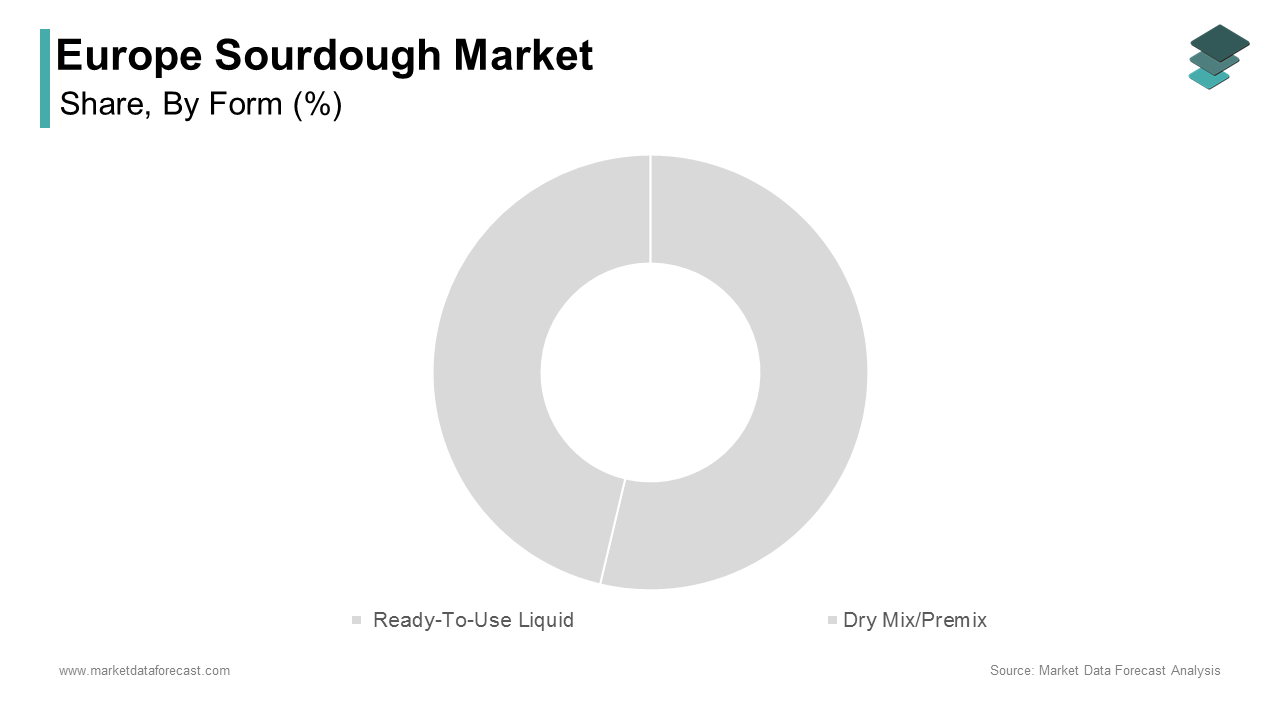
The dry mix or premix segment is estimated to register the fastest CAGR of 12.4% from 2026 to 2034 because of rising demand from home bakers, small cafes, and convenience-focused foodservice operators seeking the flavor and health halo of sourdough without the complexity of maintaining live cultures. A preference for convenient sourdough products is emerging among individuals new to baking, favoring those with attributes like longer storage times, straightforward preparation, and reliable outcomes without the need for routine fermentation maintenance. Food manufacturers are introducing shelf-stable dry blends that combine dehydrated sourdough with various grain flours, and these products, when prepared according to directions, are recognized by food authorities as fulfilling specific leavening criteria. In urban settings, a number of smaller-scale bakeries are adopting these dry premixes to broaden their product lines, which may include items like sourdough pizza bases and buns, while managing space constraints. The segment also benefits from ee-commercegrowth. Online sales of dry sourdough kits rose. The widespread availability and ease of use provided by dry premixes are helping make sourdough baking accessible to everyone, not just those in specialized baking communities.
By Application Insights
The bread and buns segment led the Europe sourdough market and captured a substantial share in 2025. The leading position of the bread and buns segment is credited to sourdough’s historical and cultural roots as a primary leavening method for staple loaves. From German Roggenbrot to French pain de campagne, regional identities are woven into naturally leavened bread traditions that continue to dominate daily consumption. European households frequently purchase fresh bread, with sourdough varieties often featured prominently in retail environments. The European Commission’s Farm to Fork Strategy has further elevated artisanal bread by promoting short supply chains and traditional processing, directly benefiting sourdough bakers. Additionally, consumers who are health-conscious may prefer sourdough, possibly due to characteristics like a lower glycemic index and enhanced mineral content. National bread protection schemes, such as Italy’s labeling, also reinforce authenticity. This deep cultural embedding, combined with health validation and policy support, ensures bread and buns remain the cornerstone of sourdough demand across Europe.
The pizza crusts and bases segment is anticipated to witness the fastest CAGR of 14.8% during the forecast period, owing to the fusion of Italian culinary heritage with clean-label consumer expectations in fast casual dining. Sourdough crust is increasingly offered by pizzerias as a premium option, noted for its enhanced digestibility and crispier texture. The adoption of sourdough bases has expanded among chain operators across Europe. This shift indicates a growing preference for sourdough pizza over conventional yeast versions. A majority of younger consumers perceive sourdough pizza as having artisanal quality and causing less bloating, positioning it as an important menu innovation for attracting younger demographics. Frozen food manufacturers have also entered the space. The application’s scalability, from artisan ovens to industrial freezers, and strong sensory appeal position pizza as the highest momentum frontier for sourdough expansion.
By Distribution Channel Insights
The foodservice segment was the largest in the Europe sourdough market and held a 53.7% share in 2025. The prominence of the foodservice segment is credited to direct consumer engagement, where staff can communicate the heritage and health benefits of naturally leavened products. A general pattern suggests a noticeable rise in the availability of sourdough products within the European bakery sector following the pandemic period. A significant majority of smaller bakeries expanded their selection to include more sourdough options, aligning with a broader consumer preference for wholesome food choices. This trend is particularly evident in France, where traditional bakeries, operating within a framework that encourages their sustained presence, continue to produce sourdough items regularly. Across the wider European food service industry, there has also been a steady increase in the share of pizza sales attributed specifically to sourdough varieties. The channel’s dominance stems from its ability to control the entire fermentation process, ensure freshness, and command premium pricing, factors that align perfectly with sourdough’s value proposition. Foodservice will likely remain the leading source for authentic sourdough experiences as long as retail struggles to match its ability to provide immediate consumption and a compelling backstory.
The retail segment is likely to experience the fastest CAGR of 11.2% over the forecast period, owing to supermarket investment in premium bakery sections, private label innovation, and at-home baking trends. According to sources, there is an observed increase in the number of households across Europe purchasing packaged sourdough bread from stores. This shift is likely influenced by factors such as the convenience and perceived freshness that come with this type of product. Major retailers have launched in-store artisan lines using liquid sourdough supplied by industrial fermenters, with clear labeling such as Naturally Leavened, No Added Yeast. Additionally, a similar trend is noted in the home baking sector. Sales of dry sourdough premixes intended for household use have also risen. This growth appears to be supported by the availability of modern instructional resources, such as online tutorials and promotional activities on social media platforms. The channel also benefits from e-commerce. Online grocery platforms report sourdough as a top-five fastest-moving bakery category. Retail channels are transforming sourdough from a niche item into a regular household purchase for middle-income consumers, leveraging the sector's vast reach, convenience, and promotional power, even if it lacks the instant availability of foodservice.
REGIONAL ANALYSIS
France Sourdough Market Analysis
France was the top performer in the Europe sourdough market and accounted for a 22.6% share in 2025. The dominance of the French market is driven by its legally protected artisanal baking culture, daily bread consumption norms, and UNESCO-recognized breadmaking heritage. French regulations promote traditional baking methods, ensuring specific types of bread meet particular quality standards. A large number of bakeries across the country produce naturally leavened bread daily, following rules that restrict certain processing and artificial ingredients. A legislative act guarantees that only fresh, naturally leavened loaves can use a specific "tradition" label, protecting this type of bread from industrial processes. Furthermore, many households consume fresh bread daily, with naturally leavened bread often selling at a higher price point in city markets. A significant number of bakeries in the capital city specialize in this kind of product, including some well-known establishments. The government’s certification further validates heritage grain and fermentation practices. This unique blend of legal protection, cultural ritual, and consumer loyalty makes France the undisputed heartland of European sourdough.
Germany Sourdough Market Analysis
Germany followed closely in the European sourdough market and captured a share of 18.3% in 2025. The growth of the German market is propelled by its deep tradition of rye sourdough breads, strong regulatory support for natural fermentation, and high per capita rye consumption. Many traditional bread varieties in Germany, such as Pumpernickel and Roggenbrot, commonly use a sourdough starter as the leavening agent and for flavor development. The country enforces strict Brotregister standards that require minimum fermentation times and natural ingredients for protected bread names. Additionally, these breads are a typical part of the diet, valued for their higher fiber content and lower impact on blood sugar levels. The inclusion of such breads is consistent with general dietary guidance regarding fiber intake. Berlin and Munich alone host numerous micro bakeries specializing in heritage grain sourdough, many supplying organic supermarkets. Sourdough's scientific validation and deep cultural roots, coupled with daily consumption by many Germans and growing gut health interest, secure its top market spot.
Italy Sourdough Market Analysis
Italy holds a significant position in the Europe sourdough market because of its regional bread diversity, pizza innovation, and protected designation of origin breads. Many types of traditional breads in one country, like Pane di Altamura and Ciriola Romana, have official recognition, with many requiring natural fermentation using local starters. The sourdough pizza movement has further accelerated demand. A growing number of eating establishments that specialize in a particular flatbread are now using fermented dough, suggesting benefits like better digestibility and crust texture. Furthermore, the Slow Food movement has revitalized heritage grain cultivation, with numerous presidia supporting ancient wheat varieties, which are ideal for sourdough fermentation. A government initiative was introduced to connect food preparers with local grain sources, aiming to shorten supply chains and preserve regional characteristics. Italy's sourdough market is booming, marrying its rich tradition of daily bread and global pizza exports with modern twists and international influences.
United Kingdom Sourdough Market Analysis
The United Kingdom is rapidly expanding in the Europe sourdough market due to post Brexit food sovereignty movements, craft baking revival, and strong consumer health awareness. According to sources, a large number of micro bakeries now operate across the country, with a significant percentage specializing in sourdough using British heritage grains like Maris Widgeon. Supermarkets have responded aggressively. Waitrose and Sainsbury’s observe that sourdough makes up a large part of their high-end bread purchases. These products often provide details about the fermentation duration and where the grain was grown. There is a trend in the UK for consumers to believe sourdough is gentler on the stomach. This perception is encouraging people who are sensitive to gluten to try it. In London, there is a significant number of bakeries specializing in sourdough. Other areas are also highlighting local grains and the fermentation process through various food events. This fusion of grassroots activism, retail innovation, and health consciousness has transformed the UK from a laggard into a dynamic sourdough hub within a decade.
Spain Sourdough Market Analysis
Spain is anticipated to grow in the Europe sourdough market from 2026 to 2034 due to regional bread traditions, rising artisanal bakery density, and integration into Mediterranean diet narratives. A diverse selection of traditional Spanish breads is available, some utilizing long-established sourdough starters. There has been an observable rise in smaller, independent bakeries, with key urban areas showing particular interest in new approaches to sourdough products. Sourdough items are often positioned as part of a traditional healthy eating pattern, appealing to those interested in health and sustainable consumption habits. Local governments in regions offer grants for bakers using native wheat varieties and traditional methods. Spain's culinary heritage, where bread is paramount, and its booming food tourism have sparked a sourdough renaissance, blending traditional baking with wellness, making it a leading European market.
COMPETITION OVERVIEW
The Europe sourdough market features a unique duality between small-scale artisan bakers and large ingredient suppliers, creating a competitive landscape defined by authenticity versus scalability. Artisan producers emphasize heritage grains, wild fermentation, and geographical identity, often protected by national laws or cultural designations, while multinational ingredient companies like Puratos and Lesaffre provide standardized, microbiologically controlled sourdough solutions that ensure consistency for industrial and semi-industrial bakeries. Competition is not primarily price-based but centers on credibility—proving that a product is genuinely naturally leavened without commercial yeast or acidifiers. The absence of a harmonized EU definition for sourdough enables misleading labeling, intensifying the battle for consumer trust. New entrants must navigate this authenticity gap, either by aligning with certified artisan networks or by investing in transparent fermentation science. Meanwhile, retailers and foodservice chains increasingly demand both shelf stability, pushing suppliers to innovate in preservation without compromising microbial integrity. This tension between tradition and technology defines the market’s evolution, where success belongs to those who can honor fermentation’s craft while meeting modern operational realities.
KEY MARKET PLAYERS
A few major players of the Europe sourdough market include
- Lesaffre
- Puratos
- Lallemand
- Ireks GmbH
- GoodMills Group
- Backaldrin
- Tate & Lyle
- DSM-Firmenich
- Angel Yeast
- VIVESCIA Group
- Euralis Group
- CSM Ingredients
- AB Mauri
- Zeelandia
- Kerry Group
Top Strategies Used by the Key Market Participants
Key players in the Europe sourdough market focus on developing region-specific starter cultures that reflect local terroir, achieving clean label and additive-free certifications to meet EU regulatory standards, expanding into pizza and functional food applications, offering both liquid and dry formats to serve artisanal and industrial segments, and collaborating with research institutions to validate health and digestibility benefits of authentic fermentation.
Leading Players in the Market
- Puratos Group is a leading global supplier of sourdough solutions with deep integration across the Europe sourdough market, offering ready-to-use liquid and dry sourdough cultures tailored to regional baking traditions. The company partners with artisanal and industrial bakeries in France, Germany, and Italy to deliver consistent, clean-label fermentation backed by microbiological expertise. It also introduced a certified gluten-reduced sourdough for sensitive consumers, developed in collaboration with research institutes in Belgium. Puratos utilizes its worldwide innovation centers to introduce European fermentation standards to Asia and North America, scaling authentic sourdough production through a blend of scientific expertise and respect for local terroir.
- Lesaffre Group holds a prominent position in the Europe sourdough market through its specialized sourdough division, leveraging decades of yeast fermentation knowledge to develop stable, high-performance natural leavening solutions. The company supplies liquid and dehydrated sourdough to bakeries, pizza makers, and industrial food producers across Southern and Western Europe, emphasizing traceability and process reliability. It also achieved EU clean label certification for all its sourdough products, ensuring compliance with strict additive regulations. Lesaffre bridges the gap between artisanal methods and industrial scale, providing consistent sourdough solutions that allow global bakers to adopt European fermentation standards.
- Dr Oetker Professional is a key player in the Europe sourdough market, particularly in the retail and foodservice segments, offering accessible dry sourdough premixes and ready-to-bake bases for pizzerias and cafes. The company’s products cater to small businesses and home bakers seeking convenience without compromising on natural fermentation claims. It also partnered with culinary schools to provide training on sourdough handling for emerging chefs. Dr. Oetker is making sourdough accessible to a global audience by offering user-friendly products and educational resources, merging traditional baking methods with modern consumer demand for affordable, authentic fermented goods.
MARKET SEGMENTATION
This research report on the Europe sourdough market has been segmented and sub-segmented based on form, application, distribution channel, and region.
By Form
- Ready-To-Use Liquid
- Dry Mix/Premix
By Application
- Bread and Buns
- Pizza Crusts and Bases
- Cakes and Pastries
- Other Applications
By Distribution Channel
- Food Processing
- Foodservice
- Retail
By Region
- UK
- France
- Spain
- Germany
- Italy
- Russia
- Sweden
- Denmark
- Switzerland
- Netherlands
- Turkey
- Czech Republic
- Rest of Europe