- Product Description Description
- Table of Contents TOC
- List of Table & Figure LOT
- Get Free Sample PDF Sample PDF
Market Size, 2025
$1.08 BnMarket Estimate, 2026
$1.14 BnMarket Forecast, 2034
$1.73 BnCAGR, 2026–2034
5.3%Executive Summary: Europe Southern Blotting Market
- Market Scope: Comprehensive European regional market evaluation of the southern blotting sector covering product categories, end-user settings, application fields, and country-level distribution frameworks.
- Market Valuation: Valued at USD 1.08 billion in 2025, estimated at USD 1.14 billion in 2026, and projected to reach USD 1.73 billion by 2034, registering a CAGR of 5.3% from 2026 to 2034.
- Primary Growth Drivers: Continued reliance on southern blotting for clinical validation of genetic disorders (such as Huntington's disease and FSHD), mandatory regulatory requirements for GMO and ATMP characterization, and high diagnostic accuracy.
Key Market Segment Metrics (2026–2034)
| Category | Leading Segment (2025 Position) | Fastest-Growing / Preferred Segment |
|---|---|---|
| By Product | Consumables (dominated by accounting for a substantial share in 2025 due to recurring requirements for every assay cycle) | Instruments Segment (fastest-growing with a CAGR of 6.8% through 2033 driven by semi-automated workflows and digital scanners) |
| By End User | Academic Research Institutes (captured a majority share of 52.7% in 2025 as custodians of foundational molecular biology) | Pharmaceutical and Biotechnology (fastest-growing with a CAGR of 8.2% driven by ATMP and gene therapy compliance) |
| By Application | Scientific Research (led with a 61.5% share in 2025 for fundamental genomic investigations and CRISPR validation) | Medical Diagnosis (growing with a CAGR of 7.9% through 2033 driven by persistent clinical reliance for repeat disorders) |
| By Country | Germany (top performer with a 24.6% share in 2025 anchored by public research infrastructure and rigorous regulations) | United Kingdom & France (key regional hubs driven by genetic healthcare strategies and agricultural biotechnology) |
Major Market Players & Market Structure
Market Structure: Highly specialized and technically conservative market featuring established life science leaders competing on reliability, product consistency, non-radioactive detection safety, and strict regulatory compliance under EU standards.
Key Companies: Thermo Fisher Scientific, Merck KGaA (MilliporeSigma), Bio-Rad Laboratories, Agilent Technologies, Applied Biosystems, Aplegan, PerkinElmer Inc., Cleaver Scientific Ltd., and Pall Life Science Laboratories.
Europe Southern Blotting Market Size
The Europe Southern Blotting Market is projected to grow from USD 1.08 billion in 2025 to USD 1.14 billion in 2026 and reach USD 1.73 billion by 2034, registering a CAGR of 5.3% during the forecast period from 2026 to 2034.

Southern blotting refers to laboratory techniques and associated reagents used to detect specific DNA sequences through restriction enzyme digestion, gel electrophoresis, membrane transfer, and hybridization with labeled probes. Despite the emergence of next-generation sequencing, Southern blotting remains a gold standard for confirming genomic rearrangements, transgene integration, and complex repeat expansions due to its high specificity and ability to resolve large DNA fragments. According to sources, Southern blotting remains a standard and frequent practice in a majority of European academic and clinical genetics laboratories for validating structural variants found through high-throughput methods. The technique is indispensable in diagnosing disorders such as facioscapulohumeral muscular dystrophy and Huntington’s disease, where precise sizing of repetitive elements is critical. As per studies, Europe has a substantial and extensive infrastructure of public and private institutions dedicated to life science research, including a significant number of university hospitals involved in molecular diagnostics. The European Union consistently directs considerable financial resources towards advancing research in genomics and rare diseases through dedicated funding programs. Southern blotting is largely a legacy method, but it persists in specialized applications where accuracy and reproducibility are more important than high throughput.
MARKET DRIVERS
Continued Reliance on Southern Blotting for Clinical Validation of Genetic Disorders
Its dominance in the diagnostic confirmation of certain genetic conditions, where alternative methods lack resolution or reliability, contributed to the growth of the European Southern blotting market. According to research, Southern blotting has largely been superseded by newer techniques such as optical genome mapping (OGM) and molecular combing for sizing D4Z4 repeat arrays in facioscapulohumeral muscular dystrophy (FSHD), which offer better accuracy, precision, and efficiency. Regulatory frameworks and national health systems in several European countries institutionalize the use of Southern blotting within accredited diagnostic pathways for certain rare diseases. Independent audits and national genomic test directories confirm that Southern blotting retains a crucial role for specific genomic indications due to its high diagnostic accuracy and specificity. The growing use of newborn screening and whole genome sequencing for rare diseases has not diminished the need for orthogonal validation via Southern blotting, which maintains persistent demand within European clinical genetics laboratories.
Integration into Academic and Regulatory Research for Genetically Modified Organism Characterization
Southern blotting is mandated by European regulatory frameworks for the molecular characterization of genetically modified organisms, particularly in agricultural and therapeutic contexts, a requirement that further escalates the expansion of the European Southern blotting market. According to the European Food Safety Authority (EFSA) guidance, applicants for GM crop approval must provide data demonstrating copy number integrity and insertion site stability of transgenes. The European Commission processes various GM crop applications for food/feed use or cultivation, with EFSA conducting the risk assessments. Similarly, the European Medicines Agency (EMA) requires robust data to confirm the integration site(s), copy number, and genetic stability of gene therapy products (including lentiviral and adeno-associated virus-based products). Academic institutions such as the Max Planck Institute and Wageningen University routinely use Southern blotting to validate CRISPR-edited cell lines and transgenic animal models. This regulatory and research entrenchment ensures sustained technical relevance despite advances in sequencing technologies.
MARKET RESTRAINTS
Time-intensive and Demanding Workflow Limits Throughput Adoption
Inherent slowness and manual labour, which require several days to complete from DNA extraction to signal detection, hamper scalability in modern high-throughput laboratories and negatively affect the growth of the European Southern blotting market. The protocol involves multiple hands-on steps, including restriction digestion, gel electrophoresis, capillary or vacuum transfer, probe labeling, hybridization, and autoradiography or chemiluminescent detection. The inefficiency is particularly problematic in clinical settings where turnaround time directly impacts patient care. Furthermore, the technique consumes significant reagents and hazardous chemicals such as ethidium bromide and radioisotopes, increasing operational costs and safety compliance burdens. These practical limitations constrain its use to essential validations only.
Declining Expertise and Training Gaps Among New Generation Molecular Biologists
The shift in genomics education towards computational methods has led to a rapid erosion of hands-on expertise in traditional techniques like Southern blotting among early-career scientists, and this restrains the expansion of the European Southern blotting market. According to research, modern methods like PCR, quantitative PCR (qPCR), and next-generation sequencing (NGS) have replaced the traditional Southern blot for most routine DNA analyses due to their superior efficiency and sensitivity. Thus, dedicated mandatory training for Southern blotting is less common in current postgraduate programs, and fewer young laboratory technicians are gaining independent proficiency in the technique compared to previous generations of scientists. This knowledge gap forces institutions to rely on senior staff whose retirement is imminent. Consequently, many laboratories outsource Southern blotting to specialized reference centers, causing delays and sample shipping risks. The lack of standardized commercial kits further complicates adoption, as most protocols remain lab-specific and poorly documented. The risk of functional obsolescence for this foundational technique is high, even where scientifically justified, unless expertise is preserved through concerted efforts like training modules or automation.
MARKET OPPORTUNITIES
Development of Semi-Automated and Chemiluminescence-Based Southern Blot Systems
Innovations in workflow simplification and detection chemistry signal a key future growth potential to revitalize Southern blotting for contemporary laboratories, which in turn drives forward the European Southern blotting market. Companies are introducing semi-automated capillary transfer systems and non-radioactive chemiluminescent probes that reduce hands-on time and eliminate radiation safety protocols. Startups have launched integrated benchtop systems that complete transfer and hybridization in under 24 hours with digital signal quantification. These advances align with the European Union’s push for safer and greener laboratory practices under the REACH and CLP regulations. Developers are extending the utility of a legacy technique in precision diagnostics and regulatory science by modernizing it into a faster, safer, and digitally integrated workflow.
Expansion in Gene Therapy and Cell Therapy Quality Control Applications
The exponential growth of advanced therapy medicinal products in the region is creating new demand for Southern blotting in vector integration analysis, which is likely to promote fresh opportunities for the European Southern blotting market. According to reports from early 2023, there were over 3,700 gene, cell, and RNA therapies in clinical and preclinical development worldwide, with hundreds of those trials active in the European Union, requiring rigorous genomic characterization of modified cells. Southern blotting remains the only method capable of distinguishing between episomal and integrated vector forms and detecting large rearrangements that next-generation sequencing may miss due to short read limitations. Some of the institutions routinely use it for batch validation of CAR T cell and stem cell therapies. As per the European Commission’s Innovative Health Initiative, a notable amount was allocated to support ATMP manufacturing infrastructure, including analytical validation. This regulatory and therapeutic momentum offers a high-value niche for Southern blotting beyond traditional genetics.
MARKET CHALLENGES
Competition from Faster and More Sensitive Molecular Alternatives
Next-generation technologies such as digital PCR, droplet digital PCR, and long-read sequencing are obstructing the expansion of the European Southern blotting market. Digital PCR is increasingly used for sizing specific genetic conditions like Huntington's disease because it is faster and more cost-effective than Southern blotting while providing highly comparable results. Oxford Nanopore and PacBio long-read platforms can now span entire repeat regions and detect methylation status simultaneously, capabilities that Southern blotting lacks. Sequencing-based methods are largely replacing Southern blotting for diagnosing repeat disorders among diagnostic laboratories. This shift is accelerating as sequencing costs decline, with the cost of whole genome sequencing having significantly decreased in recent years. The regulatory status of Southern blotting is secure for now, but its scientific relevance is diminishing as more accurate, faster, and higher-capacity alternatives emerge, which challenge its future necessity.
Lack of Standardized Commercial Kits and Reagent Fragmentation
The absence of fully integrated commercial kits leading to protocol variability and reproducibility issues across laboratories also impedes the expansion of the European Southern blotting market. Most European researchers assemble reagents from multiple suppliers, including restriction enzymes from New England Biolabs, membranes from GE Healthcare, and probes from custom oligo vendors. As per studies, a portion of the variation in band intensity and sizing for identical samples is due to differences in transfer buffers and detection substrates. This inconsistency complicates data comparison in multicenter trials and regulatory submissions. Major diagnostic companies have deprioritized Southern blot kit development. The absence of harmonized reagents forces labs to validate in-house protocols under ISO by adding months to test implementation. Southern blotting will remain vulnerable to displacement by more reliable, ready-to-use options until a complete and standardized methodology emerges.
REPORT COVERAGE
| REPORT METRIC | DETAILS |
| Market Size Available | 2025 to 2034 |
| Base Year | 2025 |
| Forecast Period | 2026 to 2034 |
| Segments Covered | By Product, End User, Application, and Region. |
| Various Analyses Covered | Global, Regional, and Country-Level Analysis, Segment-Level Analysis, Drivers, Restraints, Opportunities, Challenges; PESTLE Analysis; Porter’s Five Forces Analysis, Competitive Landscape, Analyst Overview of Investment Opportunities |
| Countries Covered | UK, France, Spain, Germany, Italy, Russia, Sweden, Denmark, Switzerland, Netherlands, Turkey, Czech Republic, Rest of Europe |
| Market Leaders Profiled | Agilent Technologies, ThermoFisher Scientific, Applied Biosystems, Aplegan, Bio-Rad Laboratories, PerkinElmer Inc., Cleaver Scientific Ltd., Pall Life Science Laboratories. |
SEGMENTAL ANALYSIS
By Product Insights
The consumables segment dominated the European Southern Blotting market by accounting for a substantial share in 2025. The supremacy of the consumables segment is attributed to its recurring nature and essential role in every assay cycle. This category includes restriction enzymes, hybridization probes, nitrocellulose or nylon membranes, electrophoresis gels, and detection substrates, which must be replenished with each experiment. According to sources, a substantial majority of the costs associated with Southern blotting in academic and clinical environments are allocated toward the repeated purchase of reagents and single-use materials, rather than one-time capital equipment purchases. The manual and multi-step nature of the Southern blotting technique inherently necessitates high volumes of consumables for each blot performed. Moreover, regulatory restrictions on radioactive isotopes within the European Union are accelerating the adoption of alternative, more expensive chemiluminescent kits, leading to more frequent reordering cycles. As per studies, a considerable number of laboratories are transitioning to non-radioactive detection systems in compliance with European chemical regulations. This dependency on high-turnover consumables ensures their sustained dominance in the market structure.
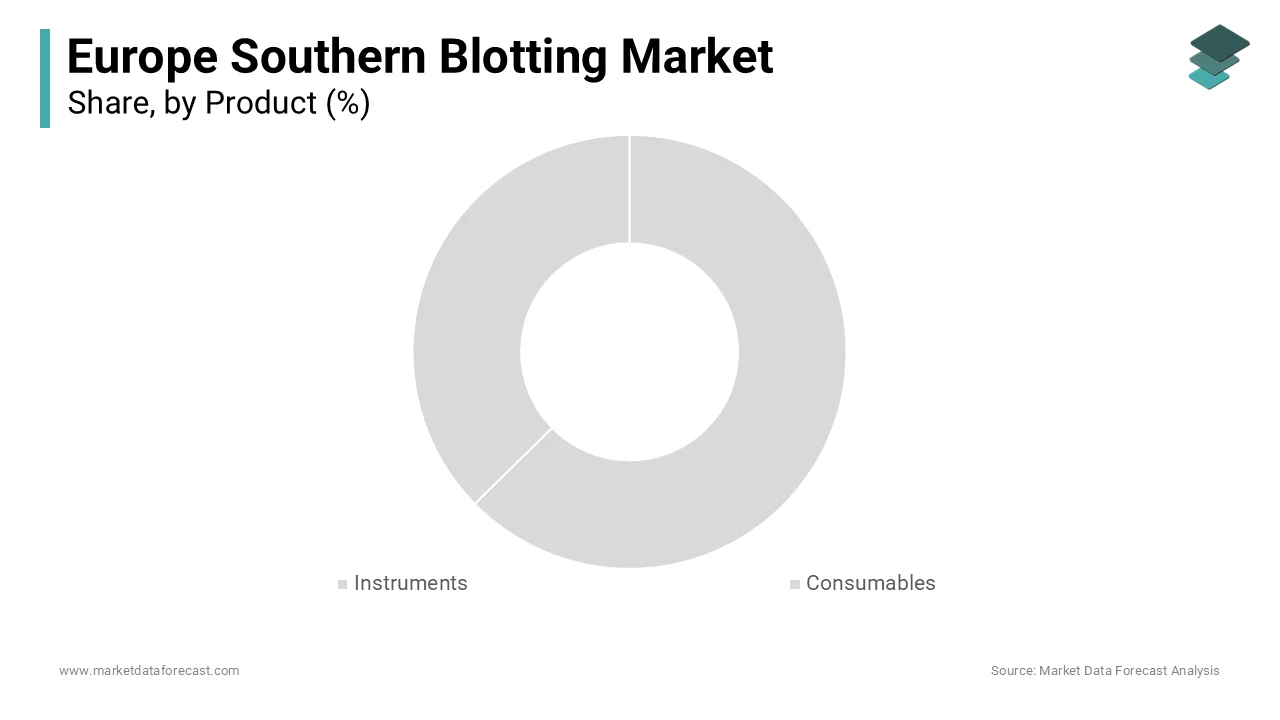
The instruments segment is likely to experience the fastest CAGR of 6.8% from 2025 to 2033 due to modernization efforts to reduce manual labor and improve reproducibility in legacy workflows. Demand for semi-automated Southern blotting systems is increasing, despite the technique traditionally requiring low technology, with these modern systems integrating features like vacuum transfer, digital imaging, and temperature-controlled hybridization. Academic core facilities in some of the countries have begun investing in digital membrane scanners that replace X-ray film with CCD-based detection, enabling quantitative analysis and electronic archiving. Apart from these, the European Medicines Agency’s emphasis on reproducible manufacturing data for gene therapies has prompted biotech firms to adopt standardized blotting workstations. Instrument adoption is accelerating, driven by Horizon Europe's funding emphasis on digitally advanced labs, and this is occurring despite the technique's niche status.
By End User Insights
The academic research institutes segment captured the majority share of 52.7% of the European Southern Blotting market in 2025. They remain the primary custodians of foundational molecular biology techniques, which drive the growth of the academic research institutes segment. Universities and public research centers across Europe continue to use Southern blotting for transgenic model validation, genomic stability testing, and rare disease mechanism studies. Moreover, national PhD curricula in countries still require trainees to master classical blotting methods to understand genomic principles. This deep institutional entrenchment, combined with public funding for basic research, ensures academic dominance in Southern blotting utilization.
The pharmaceutical and biotechnology segment is on the rise and is expected to be the fastest-growing segment in the regional market by witnessing a CAGR of 8.2% during the forecast period, owing to regulatory requirements in advanced therapy development. Regulatory agencies such as the European Medicines Agency (EMA) and the U.S. Food and Drug Administration (FDA) require comprehensive data on vector copy number and genomic integration integrity for marketing authorization applications of gene therapies, particularly those using integrating vectors like lentiviruses. Companies have reactivated Southern blotting capabilities specifically for lot release testing of viral vector-based products. This convergence of therapeutic innovation and compliance necessity is transforming a legacy academic tool into a critical industrial quality control asset.
By Application Insights
In 2025, the scientific research segment led the European Southern blotting market and occupied a 61.5% share, as Southern blotting remains indispensable for fundamental genomic investigations in European laboratories. The technique is routinely used to confirm knockout and knock-in efficiency in murine models validate CRISPR editing outcomes, and to characterize endogenous retroviral elements. According to studies, the Southern blot technique remains a widely used and often required methodology in European biological research, particularly in fields like developmental biology, immunology, and epigenetics. This sustained usage is driven by the fact that major national funding organizations and research institutions mandate its application for key research activities, such as validating genomic modifications and confirming transgenic lines. Its continued relevance is also evident in its frequent inclusion as a core methodology in major collaborative research projects across Europe. The method’s ability to detect large structural variants and repetitive sequences that short read sequencing misses ensures its continued relevance.
The medical diagnosis segment is expected to exhibit a noteworthy CAGR of 7.9% from 2025 to 2033. The rapid growth of the medical diagnosis segment is driven by persistent clinical reliance on Southern blotting for specific genetic disorders, where alternatives lack precision. Southern blotting remains the established standard for sizing D4Z4 repeats in the diagnosis of facioscapulohumeral muscular dystrophy, as per research. Similarly, Regulatory bodies and professional guidelines require Southern blot confirmation in cases where initial genetic testing methods, such as PCR, provide inconclusive results for certain conditions like Friedreich's ataxia. National health directories in various regions mandate Southern blotting as the definitive "gold standard" diagnostic technique for a number of specific, rare genetic conditions. In addition, the total volume of Southern blot diagnostic referrals is increasing, driven by the implementation of expanded screening programs. Moreover, recent regulatory changes in genetic testing are reinforcing the continued use of established and rigorously validated methods like Southern blotting for diagnostic accuracy. This regulatory and diagnostic entrenchment fuels steady growth despite technological disruption.
COUNTRY LEVEL ANALYSIS
Germany Southern Blotting Market Analysis
Germany was the top performer in the European Southern Blotting market and accounted for a 24.6% share in 2025. The supremacy of Germany in this market is attributed to its dense network of public research institutions, strong biotech sector, and rigorous regulatory environment. The country hosts Max Planck and Helmholtz centers, along with medical universities, all actively engaged in genomic research. Germany is also home to major gene therapy developers, which use Southern blotting for vector characterization under Paul Ehrlich Institute oversight. The Federal Institute for Drugs and Medical Devices enforces strict documentation standards that favour classical methods with proven traceability. Besides, national accreditation bodies require ISO 15189 compliance for diagnostic labs performing genetic testing, strengthening methodological conservatism. This combination of research intensity, ty industrial innovation, and regulatory stringency ensures Germany’s continued dominance in Southern blotting activity.
United Kingdom Southern Blotting Market Analysis
The United Kingdom followed closely in the European Southern blotting market and captured a18.1% share in 2025. The growth of the UK market is driven by its world-class academic genetics infrastructure and centralized diagnostic services. Institutions routinely employ Southern blotting for genome integrity studies and transgenic validation. Southern blotting remains a standard component of national genomic healthcare strategies for the confirmation of rare diseases. Regulatory and healthcare bodies formally recognize Southern blotting as a necessary and accredited test for specific medical conditions. Despite Brexit, the UK aligns with EU In Vitro Diagnostic Regulation standards, requiring extensive validation data that favors established techniques. Southern blotting is considered a foundational or benchmark method in the field of genomics, often used to validate results from newer technologies in research projects. This integration of clinical diagnostics and foundational research sustains robust demand across public and academic sectors.
France Southern Blotting Market Analysis
France is a key player in the European Southern blotting market due to its strong national programs in rare diseases and agricultural biotechnology. According to research, Regulatory guidelines for advanced therapies, including those from the French ANSM and the EMA, emphasize robust characterization of gene therapy vectors, using modern molecular techniques alongside traditional methods where appropriate for specific analyses like integration site determination. Furthermore, France is a leader in transgenic crop research with INRAE using Southern blotting for biosafety assessments of GM cereals as required by the European Food Safety Authority. Public funding remains robust. This dual focus on human health and agricultural innovation creates diverse and sustained demand.
Switzerland Southern Blotting Market Analysis
Switzerland is growing moderately in the European Southern biotech market because it concentrates global pharmaceutical and diagnostics headquarters alongside elite research universities. Companies maintain Southern blotting capabilities for gene therapy and cell line characterization to meet European Medicines Agency requirements. Academic institutions use the technique for fundamental studies on genomic imprinting and retrotransposon biology. Switzerland’s alignment with the EU regulatory methodological continuity. Moreover, the country hosts specialized reagent manufacturers that supply high-quality kits across Europe. This synergy of industrial compliance and academic excellence sustains high per capita Southern blotting activity.
Sweden Southern Blotting Market Analysis
Sweden is anticipated to expand considerably in the European Southern blotting market from 2025 to 2033,, anis being fueled by its command in rare disease research and public investment in genomic medicine. The Karolinska Institute and SciLifeLab operate centralized Southern blotting facilities serving all Nordic countries for diagnostic confirmation of repeat expansion disorders. Sweden’s participation in the European Reference Network for Rare Diseases ensures continuous demand for high-accuracy validation. Public funding is substantial. Apart from these, Sweden’s strict interpretation of the EU In Vitro Diagnostic Regulation favors methods with decades of clinical evidence. This combination of public health policy, scientific reputation, and regulatory conservatism maintains Sweden as a key market despite its small population.
COMPETITIVE LANDSCAPE
The competition in the European Southern Blotting market is defined by a small group of established life science companies operating in a highly specialized and technically conservative segment. Unlike high-growth diagnostics markets, here competition is not driven by innovation speed but by reliability, regulatory compliance, and historical trust. Players compete on the purity, consistency, and validation depth of consumables rather than price, as laboratories prioritize reproducibility over cost in confirmatory testing. The market is insulated from disruption by next-generation sequencing due to entrenched regulatory and clinical validation requirements that mandate Southern blotting for specific applications. New entrants face high barriers, including the need for CE marking under the In Vitro Diagnostic Regulation, extensive performance documentation, and long-standing relationships with academic and diagnostic institutions. Incumbents maintain dominance through comprehensive product ecosystems spanning enzymes, membranes, detection reagents, and imaging systems. The market remains stable, though small, with demand driven by gene therapy, rare disease diagnostics, and transgenic research. Competition focuses on scientific merit and regulatory preparedness rather than increasing market size.
KEY MARKET PLAYERS
Companies playing a leading role in the European Southern blotting market are
- Agilent Technologies
- ThermoFisher Scientific
- Applied Biosystems
- Aplegan
- BioRad Laboratories
- Perkin Elmer Inc.
- Cleaver Scientific Ltd
- Pall Life Science Laboratories.
TOP LEADING PLAYERS IN THE MARKET
- Thermo Fisher Scientific is a global life science leader with a significant presence in the European Southern Blotting market through its comprehensive portfolio of reagents, instruments, and detection systems. The company supplies restriction enzymes, hybridization buffers, chemiluminescent substrates, and nylon membranes under its Invitrogen and Thermo Scientific brands, widely used in academic and clinical laboratories. Thermo Fisher contributes to global molecular biology standards by providing CE-marked kits compliant with EU In Vitro Diagnostic Regulation requirements. In recent years, the company has strengthened its position by phasing out radioactive detection systems in favor of safer chemiluminescent alternatives and enhancing digital compatibility of its imaging platforms. It also offers extensive technical support and protocol optimization services across European core facilities, supporting its role as a trusted partner in genomic validation workflows.
- Merck KG, aA headquartered in Darmstadt, Germany, is a key European player in the Southern Blotting market through its MilliporeSigma life science division. The company provides high-purity restriction enzymes, electrophoresis reagents, and premium nitrocellulose and nylon transfer membranes known for consistent performance and low background noise. Merck supports both research and diagnostic applications with products compliant with ISO and EU regulatory standards. Recent strategic actions include the launch of non-radioactive labelling kits that align with REACH chemical safety mandates and the integration of digital documentation for traceability under the EU In Vitro Diagnostic Regulation. Merck's firm establishment within the European scientific community allows it to continue supplying vital consumables, upholding the integrity and reproducibility of Southern blotting procedures.
- Bio-Rad Laboratories is a prominent global provider of molecular biology tools with a strong footprint in Europe’s Southern Blotting market. The company offers specialized electrophoresis systems, MS, transfer apparatus, and chemiluminescent detection reagents designed for high sensitivity and reproducibility. Bio-Rad’s ChemiDoc imaging systems are widely adopted in accredited European diagnostic laboratories for their quantitative accuracy and compliance with digital record requirements under ISO 15189. The company has strengthened its market position by developing semi-automated blotting workflows that reduce hands-on time and enhance standardization. It also provides extensive application notes and validation data supporting regulatory submissions for gene therapies. Bio-Rad is enabling European researchers and clinicians to bring the foundational principles and reliability of Southern blotting into the modern era, due to ongoing innovations in detection chemistry and imaging.
TOP STRATEGIES USED BY THE KEY MARKET PARTICIPANTS
Key players in the European Southern Blotting market employ focused strategies to sustain relevance in a niche yet essential segment. They prioritize the development of non-radioactive chemiluminescent and enzyme-based detection systems to align with EU chemical safety and laboratory sustainability regulations. Companies invest in digital imaging platforms that support electronic archiving, quantitative ananalysisnd compliance with ISO 15189 and In Vitro Diagnostic Regulation documentation standards. Strategic emphasis is placed on providing comprehensive technical support, rt protocol optimization, and validation data to meet regulatory requirements in gene therapy and rare disease diagnostics. Product portfolios are maintained with high-quality consumables such as membranes,, enzym, es and buff, ers, ensuring reproducibility across academic and clinical settings. Partnerships with core facilities and reference laboratories enhance adoption through training and application development. These firms are committed to maintaining Southern blotting's status as a gold standard for precision genomics validation by focusing on reliability, regulatory alignment, and scientific trust over maximizing sales volume.
MARKET SEGMENTATION
This research report on the European Southern blotting market has been segmented and sub-segmented into the following categories.
By Product
-
Instruments
- Manual
- Automated
- Semi-Automated
- Consumables
- Reagents
- Kits
By End User
- Pharmaceutical and Biotechnology Industry
- Academic Research Institute
- Contract Research Organizations
- Forensic labs
By Application
- Scientific Research
- Medical Diagnosis
- Agricultural Applications
- Genetic Fingerprinting and Sex Determination
By Country
- UK
- France
- Spain
- Germany
- Italy
- Russia
- Sweden
- Denmark
- Switzerland
- Netherlands
- Turkey
- Czech Republic
- Rest of Europe