- Product Description Description
- Table of Contents TOC
- List of Table & Figure LOT
- Get Free Sample PDF Sample PDF
Market Size, 2025
$116.83 BnMarket Estimate, 2026
$124.19 BnMarket Forecast, 2034
$202.74 BnCAGR, 2026–2034
6.3%Europe Sports Equipment Market Summary
The Europe sports equipment market, valued at USD 116.83 billion in 2025, is forecast to reach USD 202.74 billion by 2034, expanding at a CAGR of 6.3% driven by public health initiatives, grassroots sports participation, and digital fitness adoption.
Key Market Insights
- 2025 Market Size: USD 116.83 billion
- 2026 Market Size: USD 124.19 billion
- 2034 Forecast: USD 202.74 billion
- CAGR (2026–2034): 6.3%
- Base Year: 2025
- Forecast Period: 2026–2034
Quick Growth Drivers
- Government-led public health and physical activity initiatives
- Strong participation in grassroots and club-based sports systems
- Expansion of school and municipal sports infrastructure
- Rising adoption of home fitness and outdoor training equipment
- Growth in connected and smart sports equipment
- Increased funding for youth, senior, and community sports programs
Principal Restraints
- Stringent EU product safety, chemical, and sustainability regulations
- High compliance costs under REACH and Ecodesign regulations
- Volatility in raw material prices for polymers, textiles, and metals
- Supply chain disruptions affecting seasonal inventory cycles
- Disproportionate impact on small and artisanal manufacturers
High-Value Opportunities
- Integration of AI, sensors, and connectivity into training equipment
- Expansion of inclusive and adaptive sports equipment for disabled athletes
- Growth of prescribed fitness equipment under preventive healthcare models
- Circular economy initiatives including recyclable and modular gear
- Rising demand for premium, data-driven performance products
Key Market Challenges
- Proliferation of counterfeit and non-certified equipment via e-commerce
- Rising costs of brand protection and authentication technologies
- Highly fragmented regional sporting cultures across Europe
- Need for multiple SKUs to address country-specific sports preferences
- Limited economies of scale compared to more homogeneous markets
Fastest-Growing Segments
- Athletics Training Equipment driven by youth talent programs and federation investments
- Smart & Connected Fitness Equipment data-driven and app-integrated tools
- Adaptive Sports Equipment supported by accessibility legislation and funding
Regional Leadership & Dynamics
- Germany largest market, strong club culture, and engineering-led standards
- United Kingdom high adoption of fitness technology and school sports mandates
- France state-led sports democratization and public health integration
- Italy strong demand from football and niche artisanal sports segments
- Spain fast growth driven by outdoor sports, padel, and youth participation
What Wins Commercially
- Alignment with public procurement and school sports programs
- Strong offline retail and institutional distribution networks
- Certified, durable products meeting EU safety and sustainability norms
- Smart technology integration for training and injury prevention
- Localization of products to regional sports cultures and climates
Top Strategic Ask for Executives
Invest in compliant, smart, and inclusive product lines while strengthening institutional partnerships with schools, clubs, and municipalities to capture long-term, policy-backed demand.
Leading Players
Some of the companies that are playing a dominating role in the Europe Sports Equipment Market include:
Nike, Inc., Adidas AG, Puma SE, Under Armour, Inc., Decathlon S.A., ASICS Corporation, New Balance Athletics, Inc., Columbia Sportswear Company, The North Face (VF Corporation), Head N.V., Wilson Sporting Goods Co., Yonex Co., Ltd., Mizuno Corporation, Callaway Golf Company, TaylorMade, Lululemon Athletica Inc., Skechers USA, Inc., and Salomon Group (Amer Sports).
Europe Sports Equipment Market Size
The Europe sports equipment market was valued at USD 116.83 billion in 2025, is estimated to reach USD 124.19 billion in 2026, and is projected to reach USD 202.74 billion by 2034, growing at a CAGR of 6.3% from 2026 to 2034.
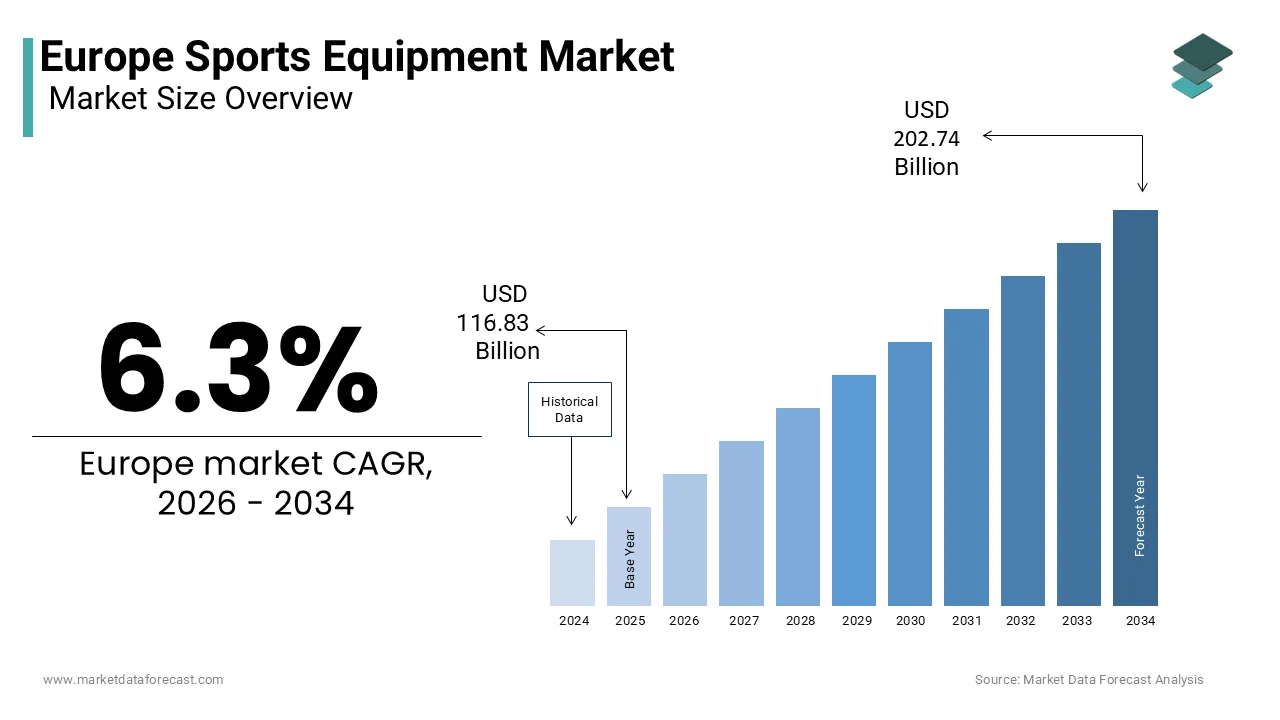
Sports equipment includes gear, apparel,l and accessories used across organized and recreational physical activities, es ranging from team sports to individual fitness pursuits. This market is deeply interwoven with Europe’s cultural emphasis on physical well-being, public health policy,y and grassroots athletic development. Unlike purely commercial sectors, it reflects societal values around inclusivity, sustainability,y and performance. According to Eurostat, more than six in ten adults in the European Union engaged in moderate or vigorous physical activity at least once a week in 2024, which indicates a broad behavioral foundation for sports equipment demand. Furthermore, the European Commission’s Erasmus+ programme allocated over 380 million euros in 2024 to support school‑based sports initiatives, which directly stimulate procurement of safe, standardized equipment across educational institutions. National federations such as the German Olympic Sports Confederation also enforce technical specifications that shape product innovation and safety standards. This ecosystem of public investment, regulatory oversight, and civic participation distinguishes the European market as both mature and highly segmented by sport discipline, demographic profile, and regional preference.
MARKET DRIVERS
Rising Public Health Initiatives Promoting Physical Activity
European governments are increasingly treating physical inactivity as a public health crisis, driving policy interventions that indirectly boost demand for sports equipment, which is one of the major factors propelling the growth of the European sports equipment market. As per the World Health Organization Europe, one in three adults does not meet physical activity guidelines, nd almost half never exercise or play sport, which is making inactivity a top preventable risk factor for non-communicable diseases. In response, the European Union launched the HealthyLifestyle4All campaign in 2022, which coordinates national strategies to increase daily movement among citizens of all ages. France, for instance, mandates that primary schools provide 30 minutes of daily physical activity beyond regular physical education classes, a policy requiring durable age-appropriate equipment such as soft balls, balance beams, and resistance bands. France also announced a plan to build 5000 new sports facilities by 2024 to expand access to community infrastructure. Germany has introduced initiatives encouraging seniors to remain active, including programs that provide subsidized training equipment through local partnerships. This state led programs create stable, recurring demand for basic, durable, nd certified equipment while also normalizing fitness as a lifelong practice,e thereby expanding the addressable consumer base beyond elite or competitive athletes.
Growth of Grassroots and Community-Based Sports Participation
Europe’s unique club-based sports model, where millions of citizens join local associations rather than relying on commercial gygyms sustains consistent demand for specialized equipment across diverse disciplines, which is further boosting the growth of the European sports equipment market. According to the European Club Association, millions of Europeans are registered members of amateur sports clubs spanning football, handball,, basketba, ll, athletics, and winter sports. These organizations operate on annual budgets funded by membership fees, municipal grants, ts, and sponsorshipsand routinely reinvest in gear replacement and expansion. In Sweden, the Swedish Sports Confederation represents more than 70 national sport federations and thousands of clubs, reflecting decentralized yet systematic consumption of training equipment. Italy’s National Olympic Committee oversees youth academies that regularly acquire sports gear to meet federation safety and performance standards. This bottom-up structure ensures that equipment demand is not solely tied to consumer trends but anchored in institutional rout,ines seasonal cycles, and national sporting calendars, making the market resilient even during economic downturns.
MARKET RESTRAINTS
Stringent Product Safety and Environmental Compliance Requirements
Manufacturers operating in the European sports equipment market face escalating regulatory burdens related to chemical content material traceability and end-of-life management, which increase production complexity and cost, hindering the sports equipment market growth in Europe. The EU’s REACH regulation restricts over 200 substances commonly found in synthetic rubber foams and dyes used in footwear, protective padding, ng, and exercise mats. European enforcement authorities have reported significant levels of non-compliance in imported products during 2024 checks, with sports goods among the categories frequently flagged. Additionally, the Ecodesign for Sustainable Products Regulation, set to take full effect in 2027, will mandate digital product passports detailing material composition, repairability, ty and recyclability for all sports equipment sold in the bloc. For instance, many small manufacturers lack the internal capacity to generate these passports without third-party support. These compliance layers disproportionately affect niche and artisanal producers who cannot absorb certification costs or redesign legacy products, forcing some to exit cross-border trade altogether and reducing product diversity in certain segments like traditional martial arts or regional folk sports gear.
Volatility in Raw Material Costs and Supply Chain Disruptions
The production of sports equipment in Europe relies heavily on imported polymers, textiless and specialty metals whose prices have exhibited sharp fluctuations due to geopolitical instability and energy market shifts, which is further impeding the growth of the European sports equipment market. For instance, ethylene prices in Europe rose substantially in 2024 due to rising energy and feedstock costs. This directly impacts items such as running shoe midsoles, tennis racket frames,,s and bicycle helmets where material consistency is critical to performance and safety certification. Furthermore, according to the European Apparel and Textile Confederation, a large share of performance fabric used in European sportswear originates from Asia, with supply chain delays during port congestion episodes like those seen in Rotterdam and Hamburg in early 2023. These delays disrupt seasonal inventory planning, ng particularly for winter sports brands that must finalize product lines 12 months in advance. While some large firms hedge raw material purchases or nearshore production, smaller players lack such buffers, leading to margin compression or stockouts that erode brand loyalty in a highly competitive retail environment.
MARKET OPPORTUNITIES
Integration of Smart Technology into Training Equipment
The convergence of sports science and digital connectivity is creating high-value opportunities for the European sports equipment market. European consumers, particularly in Northern and Western markets, show w a strong willingness to pay premiums for data-driven fitness tools. According to the European Consumer Organisation surveys, many gym goers in Germany and the Netherlands reported owning connected training devices in 2024, such as smart jump ropes, resistance bands with force sensor,s, or basketballs with shot tracking. Startups likeBerlin-basedd Exer Labs have developed AI-powered wall-mounted systems that analyze movement form during bodyweight exercises using computer vision, eliminating the need for wearables. MeMeanwhilele established brands like Salming in Sweden embed pressure mapping in running insoles to help prevent injuries among amateur marathoners. The European Institute of Innovation and Technology has funded more than 30 sports tech pilots since 2022, focusing on injury prevention and performance analytics, indicating institutional validation of this trend. As 5G coverage expands and edge computing becomes affordable, le these intelligent tools are transitioning from elite training centers to mainstream homes and clubse opening new revenue streams beyond traditional hardware sales.
Expansion of Inclusive and Adaptive Sports Infrastructure
Policy momentum toward social inclusion is driving demand for specialized equipment designed for athletes with disabilities and is creating a rapidly growing niche segment. As per the European Disability Forum,orum more than 87 million people in the EU live with some form of disability, yet historically faced limited access to adapted sports gear. Recent legislative advances are changing this landscape. The EU’s European Accessibility Act, which began phased implementation in 2025, requires public sports facilities to procure inclusive equipment such as wheelchair basketball chairs, tandem handcycles, etc., and sensory footballs with audible signals. In Spain, the Ministry of Social Rights allocated funding in 2024 specifically for adaptive sports programs in schools and community centers,s resulting in orders for specialized wheelchairs and prosthetic running blades. Similarly, Norway’s National Sports Federation partnered with Oslo Metropolitan University to design low-cost modular prosthetics for youth amputee athletes, reducing unit costs through 3D printing. These initiatives not only fulfill human rights obligations but also unlock commercial potential in an underserved market, which the European Paralympic Committee estimates will grow at double-digit rates through 2030 as awareness and funding align.
MARKET CHALLENGES
Counterfeit and Non-Certified Equipment Undermining Consumer Trust
The proliferation of counterfeit sports gear, particularly through online marketplaces, poses a serious threat to brand integrity and user safety across Europe, which is majorly challenging the sports equipment market growth in Europe. These products often mimic reputable designs but use substandard materials that fail under ststress leading to injury risks. According to the European Union Intellectual Property OfOfficece counterfeit sports goods accounted for 9% of all seized fake products at EU borders in 2024, with football jerseys, climbing shoes, and cycling helmets among the most replicated items. A joint study by European consumer safety agencies found that a significant share of uncertified resistance bands sold online snapped unexpectedly during routine use, posing laceration hazards. Unlike genuine prproduct these counterfeits bypass CE marking requirements and independent safety testing yet reach consumers through algorithm-driven e-commerce platforms that lack rigorous vetting. This erodes trust, especially among parents purchasing youth equipment, and forces legitimate brands to invest heavily in authentication technologies such as QR code verification and blockchain traceability, which increase costs without adding functional value to the end user.
Fragmented Consumer Preferences Across Regional Sporting Cultures
Europe’sdeep-rootedd regional sporting identities create significant challenges for standardized product development and marketing, which is further challenging the regional market expansion. What constitutes essential equipment in one country may be irrelevant in another due to historical tradition, climate, and federation influence. For example, handball dominates school sports in Denmark and GerGermanyequiring specific indoor shoes and resin bag,s, while Gaelic football in Ireland demands uniquely shaped balls and protective headgear rarely used elsewhere. According to the Council of Europe’s Enlarged Partial Agreement on Sport, national federations in the EU recognize more than 200 distinct competitive disciplines, each with its own technical specifications. This fragmentation forces manufacturers to maintain dozens of SKUs with low volume runs, ns increasing inventory costs and complicating supply chain forecasting. A footwear brand might need separate lasts for alpine skiing in Austria, ria trail running in Scotland, and futsal in Portugal, despite similar base technologies. Moreover, language barriers and localized retail partnerships mean that digital marketing campaigns cannot be easily scaled across borders. Consequently, even pan-European brands must operate with quasi-national subsidiaries to navigate this mosaic of demand patterns, slowing the innovation cycle e, es and limiting economies of scale compared to more homogeneous markets like North America.
REPORT COVERAGE
| REPORT METRIC | DETAILS |
| Market Size Available | 2025 to 2034 |
| Base Year | 2025 |
| Forecast Period | 2026 to 2034 |
| Segments Covered | By Product, Distribution Channel, and Region. |
| Various Analyses Covered | Global, Regional, and Country-Level Analysis, Segment-Level Analysis, Drivers, Restraints, Opportunities, Challenges; PESTLE Analysis; Porter’s Five Forces Analysis, Competitive Landscape, Analyst Overview of Investment Opportunities |
| Countries Covered | UK, France, Spain, Germany, Italy, Russia, Sweden, Denmark, Switzerland, Netherlands, Turkey, Czech Republic, Rest of Europe |
| Market Leaders Profiled | Nike, Inc., Adidas AG, Puma SE, Under Armour, Inc., Decathlon S.A., ASICS Corporation, New Balance Athletics, Inc., Columbia Sportswear Company, The North Face (VF Corporation), Reebok (Adidas brand), Head N.V., Wilson Sporting Goods Co., Yonex Co., Ltd., Mizuno Corporation, Callaway Golf Company, TaylorMade (KPS Capital Partners), Lululemon Athletica Inc., Skechers USA, Inc., Salomon Group (Amer Sports), Recreational Equipment, Inc. (REI) |
SEGMENTAL ANALYSIS
By Product Insights
The fitness and strength equipment segment led the market and accounted for 30.8% of the regional market share in 2025. The dominance of the fitness and strength equipment segment in the European market is driven by the structural shifts in consumer behavior and public health infrastructure. Following pandemic induced disruptions to gym access, Europeans have sustained high engagement with decentralized fitness models supported by municipal investment and digital coaching. According to Eurostat, more than half of adults in the EU reported using home or outdoor fitness equipment regularly in 2024, a habit solidified through continued urban planning. According to the European Commission’s Urban Agenda for the EU, thousands of cities installed permanent outdoor gyms between 2022 and 2024, with Germany alone adding hundreds of such installations in public parks. These facilities rely on durable strength training apparatus such aspull-upp bars, resistance stations, and balance beams sourced from certified European manufacturers. In France, the “Sport Santé” initiative funded by the Ministry of Health distributed subsidized resistance bands and adjustable dumbbells to households managing chronic conditions like diabetes and hypertension. This institutional endorsement transforms fitness equipment from discretionary purchases into prescribed health tools, accelerating adoption across age groups and income levels.
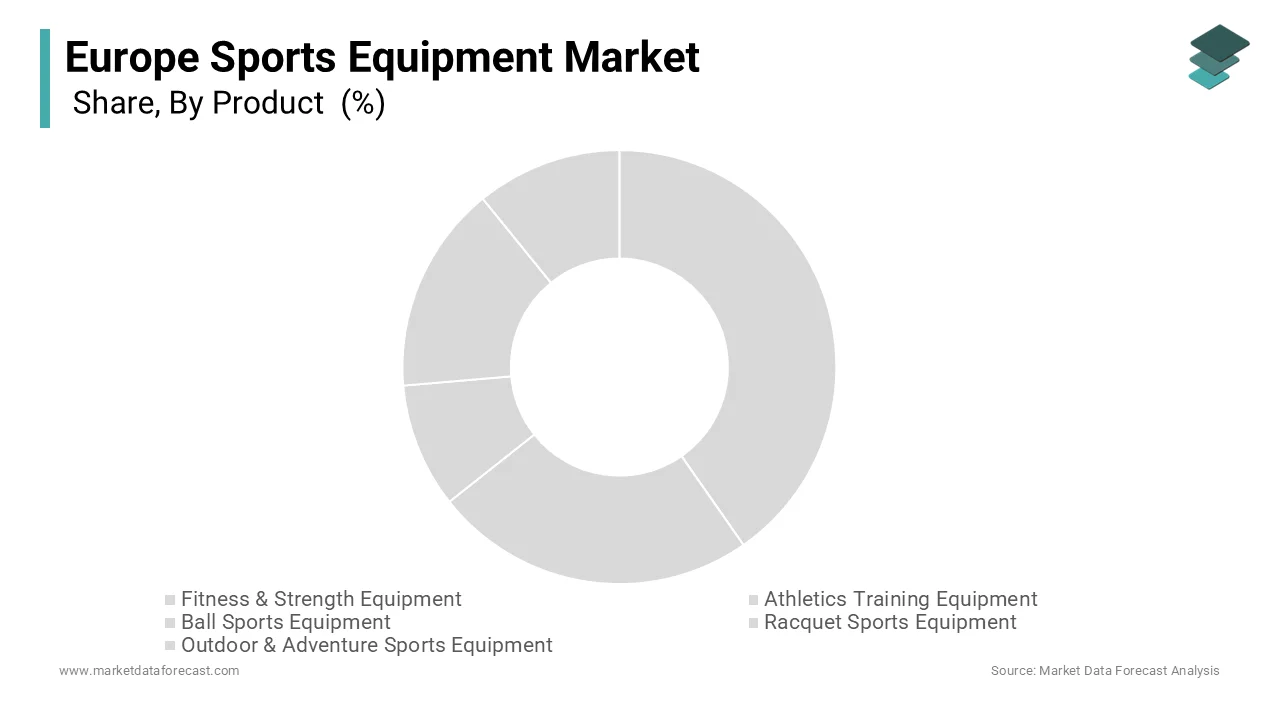
The athletics training equipment segment is anticipated to register a promising CAGR of 10.12% over the forecast period, due to the converging macro trends reshaping grassroots sports development. European athletics federations are investing heavily in early detection and nurturing of sprinting, jumping, ing andfieldingg talent to regain global competitiveness. World Athletics’ “European Athletics Rising Stars” program, which operates in dozens of countries, has established certified training hubs since 202,2 each requiring standardized equipment such as starting blocks, laser timing gates, Avelinnn markers, nd foam landing pits. According to the European Athletic Association, national federations collectively procured thousands of units of specialized training gear in 2024, with Germany, France, and the UK accounting for the majority of orders. In the Netherlands, the Royal Dutch Athletics Federation partnered with local municipalities to convert underused school tracks into high-performance micro centers equipped with force plate analyzers and wind-resistant hurdles. These investments not only elevate competitive output but also democratize access to elite-grade tools for amateur clubs, creating spillover demand in the broader market.
By Distribution Channel Insights
The offline segment dominated the market by commanding 56.5% of the regional market share in 2025. The growth ofthe offline segment in the European market is driven by the deep-rooted consumer preferences and institutional procurement patterns. A significant portion of sports equipment in Europe is purchased not by individuals but by schools, clubs, municipalities, and national federations through established B2B relationships with brick-and-mortar distributors. According to the European Club Association, most amateur sports clubs source gear through regional specialty retailers who provide technical advice,ce bulk pricing, and post-sale servicing. In Germany, industry associations report that a large share of team sports equipment, including footballs, handballs, and protective padding, is sold via independent sports stores that maintain direct ties with local leagues. These retailers often offer customization, such as club logo embroidery, uniform numbering,g and equipment fitting services that online platforms cannot replicate. Furthermore, public tenders for school and municipal contracts legally requirein-personn product demonstrations and compliance documentation, which offline vendors are structured to deliver. This institutional reliance on trusted local partners creates a resilient demand base less susceptible to e-commerce disruption.
The online segment is the fastest-growing distribution segment and is estimated to witness a CAGR of 13.1% over the forecast period, owing to the evolving digital behaviours and platform innovation. Younger European consumers increasingly discover and purchase sports gear through integrated shopping features on social media platforms rather than traditional e-commerce sites. According to the European Interactive Digital Advertising Alliance surveys, a significant share of consumers aged 18 to 34 bought fitness accessories in 2024 after seeing them demonstrated in Instagram Reels or TikTok tutorials. Brands like Gymshark and Ellesse leverage athlete influencers to showcase real-time use of resistance bands, yoga mats,s and training apparel with one-click checkout, bypassing search-based shopping entirely. In Spain, TikTok Shop generated hundreds of millions of euros in sports equipment sales in 202,4 with viral challenges around home workouts driving impulse buys of affordable items like sliders and foam rollers. This shift transforms discovery from functional search to emotional inspiration, compressing the path to purchase and favoring visually engaging compact products ideal for social demonstration.
COUNTRY LEVEL ANALYSIS
Germany Sports Equipment Market Analysis
Germany captured 20.9% of the European sports equipment market share in 2025. The dominating position of Germany in the European market is attributed to its dense network of sports and clubs and robust public investment in physical education and engineering-driven product standards. According to the German Olympic Sports Confederation, more than 27 million citizens are active members of registered clubs, creating consistent institutional demand for certified equipment across football, handball, gymnastics, and winter sports. The Federal Ministry of the Interior allocated hundreds of millions of euros in 2024 to modernize municipal sports halls with inclusive energy-efficient training infrastructure. Furthermore, Germany’s DIN standards for sports equipment, particularly in strength and athletics segments, are often adopted as de facto benchmarks across the EU, influencing design and safety protocols continent-wide. The presence of global brands like Adidas and Puma alongside specialized manufacturers such as Kettler ensures a vertically integrated ecosystem that supports both mass market and high-performance segments, which is reinforcing Germany’s role as Europe’s manufacturing and consumption epicenter for sports gear.
United Kingdom Sports Equipment Market Analysis
The United Kingdom accounted for 16.2% of the regional market share in 2025. The growth of the UK in the European market is driven by the commercialized sports culture, strong school sports programs, and rapid adoption of fitness technology. According to Sport England, millions of adults participated in organized team sports in 2024, while many more engaged in regular gym or home workouts. The Department for Education mandates that all state primary schools provide daily physical activity requiring standardized equipment such as agility ladders, cones,s and soft balls procured through centralized frameworks. The UK also leads in connected fitness, ss with companies like Fiit and Les Mills offering equipment bundles integrated with live streaming classes. Post Brexit, the British Standards Institution has accelerated alignment of sports product safety rules with global norms, facilitating exports while maintaining stringent CE equivalent testing. London’s status as a global retail hub further amplifies trend diffusion with flagship stores serving as innovation showcases that influence continental buying patterns,s particularly in premium and lifestyle-oriented categories.
France Sports Equipment Market Analysis
France is expected to occupy a promising share of the European sports equipment market during the forecast period. The country’s strength lies istate-leded sports democratization and integration of physical activity into public health strategy. The French Ministry of Sports reported that millions of citizens hold licenses with accredited federations spanning rugby, basketball, and pétanque, ensuring structured equipment consumption. The “Plan Sport Santé” launched in 2023 allocated hundreds of millions of euros to equip thousands of community health centers with strength and mobility gear for chronic disease management. Additionally, France’s extensive network of municipal multisport complexes known as “Maisons des Sports” requires standardized inventories renewed every five years under national procurement guidelines. The French standardization body AFNOR enforces rigorous testing for impact absorption and chemical safety,y particularly for children’sequipmente,nt making compliance a key market entry barrier. With Paris hosting the 2024 Olympic and Paralympic Games, national pride has further galvanized investment in grassroots infrastructure and adaptive sports gear, creating a multi-year demand tailwind across both public and private sectors.
Italy Sports Equipment Market Analysis
Italy is projected to witness a healthy CAGR in the European sports equipment market during the forecast period,, od owing to the regional sporting passions, strong artisanal manufacturing, nd late-cycle digital adoption. Football dominates equipment demand with thousands of amateur clubs requiring balls, kits, and training aids annually, ly as documented by the Italian Football Federation. However, Italy also excels in niche disciplines such as volleyball, skiing, and fencing, each supported by specialized domestic producers like Mikasa Italia and Zoppas. According to ISTAT, the majority of sports equipment purchases still occur in physical stores, particularly in Southern regions where trust in local vendors outweighs online convenience. The government’s “Sport e Salute” agency distributed hundreds of millions of euros in 2024 to renovate schools, focusing on multi-sport versatility, which boosted orders for modular apparatus like adjustable basketball hoops and removable court markings. While e-commerce is growing, it remains concentrated in urban centers, which iindicatesItaly’s dual track market where tradition and innovation coexist unevenly across geography.
Spain Sports Equipment Market Analysis
Spain is predicted to account for a notable share of the European sports equipment market during the forecast period, owing to the climate-driven outdoor activity, high youth paparticipationand post pandemic public investment. According to the Spanish High Council for Sports, more than half of children aged 6 to 14 regularly play team sports, with football, ll basketball, and padel leading equipment consumption. Padel has exploded nationally with thousands of courts built since 2020, requiring specialized rackets, balls,s and nets almost exclusively sourced from Spanish manufacturers like Bullpadel and StarVie. The Ministry of Education’s 2024 “Escuelas Deportivas” program funded equipment kits for thousands of public schools, emphasizing inclusivity with adaptive gear for students with disabilities. Furthermore, Spain’s warm climate sustains year-round demand for outdoor fitness stations, beach volleyball sets, and cycling accessories. Municipalities in Andalusia and Valencia have converted coastal promenades into active recreation corridors lined with publicly accessible strength and cardio equipment, driving steady procurement from EU-certified suppliers. This blend of cultural passion, infrastructural expansion,n and seasonal consistency positions Spain as a resilient anfast-evolvingng market within Southern Europe.
COMPETITIVE LANDSCAPE
The European sports equipment market features a dynamic mix of global giants, regional specialists, and agile niche innovators competing across quality, sustainability,y and digital engagement. Competition is not solely price-driven but centers on brand authenticity, technical certification, and alignment with local sporting cultures. Large players leverage scale and R&D to dominate mass participation sports like football and fitness, while smaller European brands thrive in specialized domains such as winter sports, fencing,g or padel through artisanal craftsmanship and federation endorsements. Regulatory complexity around chemical safety, recyclability, and labeling creates barriers that favor established firms with compliance infrastructure. At the same time, rising consumer demand for transparency pushes all participants toward traceable supply chains and eco-conscious design. Digital channels intensify visibility, but physical retail remains crucial for trust building,g especially in high involvement categories. This multi-dimensional rivalry fosters continuous innovation yet demandeep localisationoni, making Europe one of the most sophisticated and segmented sports equipment markets globally.
KEY MARKET PLAYERS
Some of the companies that are playing a dominating role in the global European Sports Equipment Market include
- Nike, Inc.
- Adidas AG
- Puma SE
- Under Armour, Inc.
- Decathlon S.A.
- ASICS Corporation
- New Balance Athletics, Inc.
- Columbia Sportswear Company
- The North Face (VF Corporation)
- Reebok (Adidas brand)
- Head N.V.
- Wilson Sporting Goods Co.
- Yonex Co., Ltd.
- Mizuno Corporation
- Callaway Golf Company
- TaylorMade (KPS Capital Partners)
- Lululemon Athletica Inc.
- Skechers USA, Inc.
- Salomon Group (Amer Sports)
- Recreational Equipment, Inc. (REI)
TOP LEADING PLAYERS IN THE MARKET
- Adidas maintains a strong presence in the European sports equipment market through its comprehensive portfolio spanning footwear, apparel, and performance gear for football runnin,g and training. The company leverages its German engineering heritage to emphasize innovation, durability, and aathlete-centricdesign. In 2024, Adidas expanded its sustainability initiatives by launching a fully recyclable football made from bio-based polymers certified under EU Ecolabel standards. It also deepened partnerships with national federations, including the French Football Federation,n to supply match and training equipment for youth academies. Additionally, Adidas enhanced its direct-to-consumer digital experience across Europe with virtual fitting tools and localized product drops aligned with regional sporting events, reinforcing brand loyalty and operational agility in a competitive landscape.
- Decathlon plays a pivotal role in the European sports equipment market as both a retailer and manufacturer, offering over 80 private label brands covering more than 70 sports disciplines. Headquartered in France,e the company operates more than 1500 stores across the continent,nt emphasizing accessibility,ity affordability, and in-store experiential testing. In 2024, Decathlon accelerated its circular economy strategy by introducing a pan-European equipment take-back program, enabling customers to return used bikes,s tents, and fitness gear for refurbishment or recycling. It also launched modular strength training systems designed for small urban apartments,s responding to shifting consumer lifestyles. By integrating product development, retail,l and sustainability under one roof, Decathlon continues to shape inclusive and practical sports participation across diverse European demographics.
- Nike exerts significant influence in theEuropeane sports equipment market through premium performance products and digital ecosystem integration. The company focuses onhigh-growthh categories such as running basketball and training with a strong emphasis on data-driven personalization. In 2024, Nike rolled out its Nike Fit scanning technology across all European flagship storess enabling precise footwear recommendations through augmented reality. It also strengthened collaborations with elite European clubs, bs including FC Barcelona and Paris Saint-Germain, to co-develop match-specific equipment that trickles down to consumer lines. Furthermore, Nike expanded its membership platform, rm offering exclusive access to limited edition gear and a d virtual coach,, ing which enhances customer retention and positions the brand at the intersection of sport culture and digital engagement across the region.
TOP STRATEGIES USED BY THE KEY MARKET PARTICIPANTS
Key players in the European sports equipment market prioritize sustainability by adopting circular design principles,s using recycled materials, and launching take-back programs compliant with EU environmental directives. They invest heavily in digital transformation, integrating virtual fitting, augmented reality, and AI-driven personalization to enhance omnichannel experiences. Strategic partnerships with national sports federations, clubs, and educational institutions secure institutional procurement and grassroots brand loyalty. Product innovation focuses on performance, safety, ty and inclusivi, ty, particularly in adaptive and youth segments aligned with public health agendas. Additionally, companies localize offerings to reflect regional sporting traditions, climate conditions, and regulatory standards, ensuring cultural relevance and compliance across diverse European markets.
MARKET SEGMENTATION
This research report on the europe sports equipment market is segmented and sub-segmented into thefollowing categories.
By Product
- Fitness & Strength Equipment
- Athletics Training Equipment
- Ball Sports Equipment
- Racquet Sports Equipment
- Outdoor & Adventure Sports Equipment
- Others
By Distribution Channel
- Offline
- Online
By Country
- Germany
- United Kingdom
- France
- Italy
- Spain
- Netherlands
- Sweden
- Rest of Europe