- Product Description Description
- Table of Contents TOC
- List of Table & Figure LOT
- Get Free Sample PDF Sample PDF
Market Size, 2025
$188.65 BnMarket Estimate, 2026
$201.86 BnMarket Forecast, 2034
$346.83 BnCAGR, 2026–2034
7%Europe Sporting Goods Market Report Summary
The Europe sporting goods market was valued at USD 188.65 billion in 2025 and is projected to grow from USD 201.86 billion in 2026 to USD 346.83 billion by 2034, registering a CAGR of 7% from 2026 to 2034. Market growth is driven by increasing participation in sports and fitness activities, rising health and wellness awareness, and growing consumer spending on premium sports equipment and apparel. The expansion of e-commerce channels, innovation in sports technologies, and increasing government support for recreational and competitive sports are further contributing to market growth.
Key Market Trends
- Rising participation in sports, fitness, and outdoor recreational activities.
- Increasing demand for high-performance and technologically advanced sporting goods.
- Growing adoption of sustainable and eco-friendly sports equipment and apparel.
- Expansion of online retail channels and direct-to-consumer (D2C) sales.
- Increasing investments in sports infrastructure, youth development programs, and major sporting events.
Segmental Insights
- Based on product type, the football segment dominated the Europe sporting goods market in 2025, driven by the sport's deep cultural significance, widespread participation across all age groups, well-established professional leagues, and continuous demand for football equipment, apparel, and accessories.
Regional Insights
The Europe sporting goods market continues to expand across major economies, supported by strong sports culture, increasing fitness awareness, and growing investments in recreational infrastructure.
- Germany dominated the European sporting goods market in 2025, supported by its strong sporting culture, high consumer spending on sports equipment, well-developed retail network, and large participation in professional and recreational sports.
- The United Kingdom held the second-largest position in the regional market, driven by increasing participation in fitness activities, strong demand for sports apparel and equipment, and a well-established sporting ecosystem.
- France is expected to witness steady market growth during the forecast period, supported by government-led sports initiatives, significant investments in sports infrastructure, and increasing youth participation in organized sports and fitness activities.
Competitive Landscape
The Europe sporting goods market is highly competitive, with leading global and regional manufacturers focusing on product innovation, sustainability, digital retail expansion, and performance-enhancing sports technologies. Companies are investing in research and development, strategic partnerships, athlete sponsorships, and omnichannel retail strategies to strengthen their market presence. Continuous innovation in sports apparel, footwear, fitness equipment, and connected sports technologies continues to shape the competitive landscape.
Prominent companies operating in the Europe sporting goods market include Adidas AG, Nike, Inc., Under Armour, Inc., PUMA SE, Decathlon SA, Amer Sports, Odlo, Hammer Sport AG, Polar Electro, KETTLER, and WaterRower.
 Download Free Sample Report
Europe Sporting Goods Market Size
The sporting goods market size in Europe was valued at USD 188.65 billion in 2025. The European market is estimated to be worth USD 346.83 billion by 2034 from USD 201.86 billion in 2026, growing at a CAGR of 7% from 2026 to 2034.

Sporting goods are a diverse array of equipment, apparel, and accessories designed for participation in physical activity, fitness training, and organized sports across recreational and professional domains. This includes categories such as footwear, team sport gear, fitness devices, outdoor equipment, and wearable performance technology. According to Eurostat, over 64% of adults in the European Union engaged in at least 30 minutes of moderate physical activity per week in 2024, reflecting strong societal anchoring of sport as a pillar of well-being. Urban planning initiatives such as Copenhagen’s 2025 Active City roadmap and Barcelona’s superblocks model prioritize walkability and recreational space, thereby indirectly stimulating demand for personal sporting goods.
MARKET DRIVERS
Public Health Policies Promoting Physical Activity Across EU Member States
Government-led health strategies constitute a foundational driver of sporting goods by institutionalizing physical activity as a preventive healthcare measure. The public health policies promoting physical activity across EU member states are majorly propelling the growth of the Europe sports goods market. The growing sporting goods The European Commission’s 2021 Council Recommendation on Health-Enhancing Physical Activity established binding national targets for adult and youth participation, which member states have operationalized through localized programs. According to the Organisation for Economic Co-operation and Development, 22 European countries implemented school-based mandatory physical education reforms between 2020 and 2024, requiring students to engage in 150 minutes of structured activity weekly. This policy shift directly increased procurement of team sport equipment in educational institutions, with France alone allocating 87 million euros in 2023 for school sports kits, as documented by the French Ministry of National Education. As per the Robert Koch Institute, 41% of German seniors reported purchasing new sporting goods in 2024, specifically due to public health outreach. These top-down interventions create sustained baseline demand insulated from economic volatility by framing sport not as discretionary leisure but as a civic health responsibility.
Rise of Hybrid Fitness Models Integrating Digital and Physical Engagement
The integration of digital technology with traditional physical activity has redefined consumer engagement and product expectations, and is additionally to further accelerate the growth of the Europe Sporting Goods Market. Hybrid fitness, which blends in-person training with app-based tracking, virtual coaching, and community challenges, has gained significant traction, particularly in urban centers. This behavioral shift has spurred demand for sensor-enabled gear such as smart basketballs, GPS running watches, and resistance bands with force feedback. Brands like Decathlon and Adidas have responded by embedding NFC chips and motion sensors into entry-level products to capture real-time performance data.
MARKET RESTRAINTS
Inflationary Pressure on Disposable Income and Discretionary Spending
The persistent inflation across Europe has significantly constrained household budgets, thereby dampening demand for non-essential sporting goods, particularly among middle- and lower-income segments. The inflationary pressure on disposable income and discretionary spending is a certain factor declining the growth of the Europe sports goods market. This disparity has forced consumers to prioritize essential expenditures, with Kantar’s 2024 Household Spending Monitor revealing that 31% of European families reduced or postponed purchases of fitness gear and recreational equipment. Consequently, retailers report declining basket sizes and increased price sensitivity, with discount chains like Action and Lidl gaining market share in basic sportswear at the expense of premium brands.
Stringent Environmental Regulations on Material Sourcing and End-of-Life Management
The European Union’s aggressive sustainability agenda imposes substantial compliance burdens on sporting goods manufacturers, particularly regarding material composition and product circularity. The stringent environmental regulations on material sourcing and end-of-life management are under the EU Strategy for Sustainable and Circular Textiles, enacted in 2022. All textile-based sportswear must include standardized digital product passports by 2030, detailing fiber origin, chemical content, and recyclability. According to the European Environment Agency, over 60% of current sportswear SKUs fail to meet upcoming requirements due to blended synthetic fabrics that impede mechanical recycling. Simultaneously, the Extended Producer Responsibility framework, now active in 15 member states, mandates brands to fund the collection and processing of end-of-life products with non-compliance penalties reaching 4% of national turnover, as per the European Commission’s 2024 enforcement bulletin. These rules disproportionately affect small and medium enterprises lacking infrastructure for reverse logistics or bio-based material R and D. Even industry leaders face cost escalations, with Adidas estimating a 12% rise in production expenses by 2026 to meet circularity thresholds. The regulatory push, while environmentally sound, complicates supply chain agility and elevates barriers to entry, thereby restricting market fluidity.
MARKET OPPORTUNITIES
Integration of Sporting Goods with Health Insurance and Corporate Wellness Programs
The formal partnerships with public health insurers and corporate wellness platforms that subsidize or reimburse fitness equipment as preventive interventions are expected to substantially expand the growth of the Europe sporting goods market. Germany pioneered this model through its statutory health insurance system, which since 2023, permits certified fitness devices, such as heart rate monitors and resistance bands, to be prescribed by physicians and partially reimbursed under §20 SGB V. According to the German Federal Joint Committee, over 1.2 million such prescriptions were issued in 2024, covering items from approved manufacturers like Beurer and Kettler. Parallel trends are emerging in the private sector, with companies like Allianz and AXA offering policyholders vouchers for Decathlon or Peloton products upon completing annual health assessments.
Growth of Niche and Inclusive Sport Communities Driving Specialized Product Innovation
The proliferation of hyper-specific and inclusive sporting communities is a demand for highly tailored equipment that addresses unmet ergonomic, cultural, or adaptive needs. Grassroots movements, such as wheelchair pickleball, adaptive climbing, and women-only outdoor adventure groups, have surged with the European Federation of Sport for All reporting a 70% increase in registered inclusive clubs between 2022 and 2024. This fragmentation demands product diversification beyond mass market offerings. Brands like Salomon and Patagonia have responded with gender specific trail running shoes and non-binary fit hiking apparel developed through co-creation with community leaders. Similarly, Norway’s Nordic Strong launched magnetic adjustable dumbbells designed for home users with limited mobility following clinical input from Oslo University Hospital. This shift rewards agility and social relevance, enabling smaller players to compete on purpose rather than scale.
MARKET CHALLENGES
Counterfeit and Gray Market Infiltration Undermining Brand Integrity
The persistent erosion of brand value and consumer trust due to sophisticated counterfeit operations and unauthorized gray imports. The counterfeit and gray market infiltration undermining brand integrity is challenging the growth of the Europe sporting goods market. Europol’s 2024 Intellectual Property Crime Threat Assessment identified sports footwear and team jerseys as the second most counterfeited consumer category in the EU, with over 11 million fake units seized in 2023 alone. Gray market goods further distort pricing as unauthorized distributors import lower-cost Asian variants into Europe, bypassing regional compliance checks.
Geopolitical Disruptions Affecting Raw Material and Component Supply Chains
The ongoing geopolitical instability continues to fragment and destabilize supply chains for performance textiles and electronic components essential to modern sporting goods, which is a challenge for the growth of the Europe sporting goods market. The war in Ukraine disrupted Eastern European output of specialized elastane, while export restrictions from China on rare earth magnets used in smart fitness devices have caused component shortages across Western Europe. Simultaneously, the Red Sea shipping crisis elevated freight costs, with maritime rates from Asia to Rotterdam increasing by 130% between December 2023 and March 2024 as per Drewry Maritime Research. These disruptions force brands into reactive sourcing, often compromising on sustainability certifications or quality control. Although nearshoring initiatives are emerging in Portugal and Turkey, the transition remains capital-intensive and slow, undermining agility in a fast-cycle market where seasonal launches dictate revenue timing.
REPORT COVERAGE
| REPORT METRIC | DETAILS |
| Market Size Available | 2025 to 2034 |
| Base Year | 2025 |
| Forecast Period | 2026 to 2034 |
| Segments Covered | By Product Type and Country. |
| Various Analyses Covered | Global, Regional, and Country-Level Analysis, Segment-Level Analysis, Drivers, Restraints, Opportunities, Challenges; PESTLE Analysis; Porter’s Five Forces Analysis, Competitive Landscape, Analyst Overview of Investment Opportunities |
| Countries Covered | UK, France, Spain, Germany, Italy, Russia, Sweden, Denmark, Switzerland, Netherlands, Turkey, Czech Republic, and the Rest of Europe. |
| Market Leaders Profiled | Adidas AG, Nike, Inc., Under Armour, Inc., PUMA SE, Decathlon SA, Amer Sports, Odlo, Hammer Sports, Polar Electro, KETTLER, WaterRower, and Others. |
SEGMENTAL ANALYSIS
By Product Type Insights
The football segment accounted in holding 46.3% of the Europe Sporting Goods Market due to its unparalleled cultural embeddedness, institutional infrastructure, and mass participation across all age groups. The sport enjoys structured support from national federations, school systems, and professional leagues that drive consistent equipment demand. According to UEFA, over 16 million registered players participated in organized football across its 55 member associations in 2024, with Germany, England, and Spain accounting for more than 40% of that total. This scale translates directly into gear consumption with national associations mandating standardized kits, footwear, and training accessories for youth academies. Club merchandising also plays a pivotal role with top-tier teams like Manchester City, Bayern Munich, and Real Madrid licensing branded training gear through global partnerships with Adidas, Nike, and Puma.
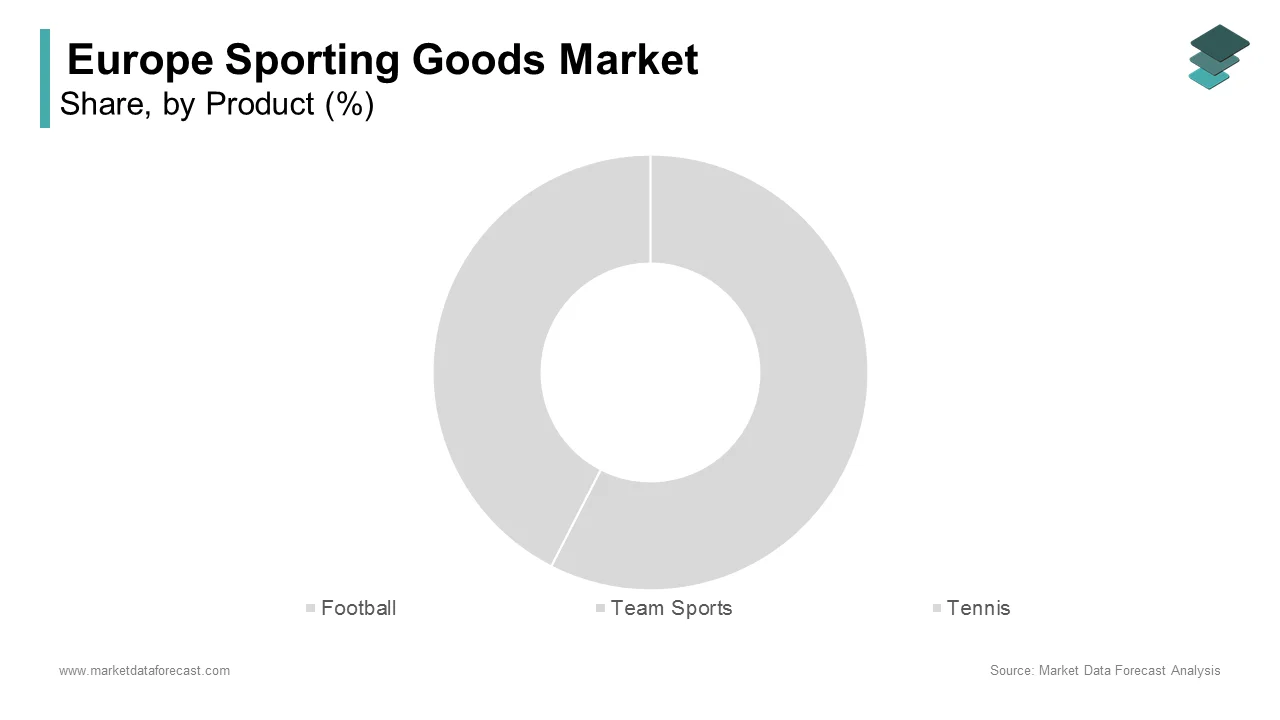
The Fitness segment is anticipated to grow at a fastest CAGR of 12.3% from 2026 to 2034, institutionalization of home and hybrid exercise routines following the pandemic, and reinforced by public health mandates. As per the European Health and Fitness Association, over 38 million Europeans subscribed to digital fitness services in 2024, with 62% also purchasing connected home gear such as resistance bands, smart mats, or compact strength trainers. Germany’s statutory health insurers now reimburse up to 150 euros annually for certified fitness devices under preventive care schemes, a policy adopted by 12 other EU countries according to the European Observatory on Health Systems and Policies. Urban spatial constraints further favor compact multi-functional equipment, with 55% of new fitness product launches in 2024 featuring foldable or vertical storage designs as tracked by Euromonitor International. Additionally, workplace wellness programs increasingly allocate budgets for home fitness kits, especially in knowledge economy hubs like Amsterdam, Zurich, and Stockholm, where remote work remains prevalent.
COUNTRY LEVEL ANALYSIS
Germany Sporting Goods Market Analysis
Germany was the largest contributor to the Europe sporting goods market share in 2025, with a deeply institutionalized sports culture, extensive public infrastructure, and strong purchasing power. Municipal investment further amplifies participation with cities like Berlin, Munich, and Hamburg, allocating over 200 euros per capita annually to sports facilities, according to the German Institute for Sports Science. Consumer preference for technical precision and durability favors premium domestic and European brands, while sustainability regulations accelerate the adoption of recycled performance textiles. This blend of civic engagement policy support and quality consciousness solidifies Germany’s leadership in both volume and value terms.
United Kingdom Sporting Goods Market Analysis
The United Kingdom was positioned second by holding a significant share of the Europe sporting goods market in 2025, with high consumer spend on premium performance gear and a dynamic fusion of traditional and digital fitness. Football remains the dominant sport with over 8 million active participants according to Sport England’s 2024 Active Lives Survey, yet the fitness and running categories have seen accelerated growth due to urban wellness trends. London, Manchester, and Birmingham host some of Europe’s highest densities of boutique fitness studios, which drive demand for branded footwear, apparel, and accessories. Post-Brexit regulatory divergence has enabled faster approval of innovative materials, although it complicates EU exports.
France Sporting Goods Market Analysis
France sporting goods market growth is driven by a state-led sports policy, ambitious infrastructure investments, and rising youth participation rates. The French Ministry of Sports reported in early 2025 that over 17 million citizens held memberships in accredited sports associations, with football, tennis, and outdoor activities leading engagement. Paris’s preparation for the 2024 Olympic and Paralympic Games catalyzed nationwide upgrades with 12 billion euros invested in regional sports facilities as documented by the French Court of Auditors. This legacy effect continues to boost equipment demand in schools and municipalities. Additionally, France’s emphasis on technical outdoor sports such as trail running, mountain biking, and alpine skiing sustains premium gear consumption, particularly in the Alps and Pyrenees. Domestic brands like Decathlon leverage local manufacturing and circular design to align with France’s anti-waste laws, further strengthening market relevance.
Italy Sporting Goods Market Analysis
Italy sporting goods market growth is likely to grow with its strong heritage in football, cycling, and winter sports, alongside growing urban fitness adoption. Football remains culturally dominant with over 1.2 million registered youth players as per the Italian Football Federation’s 2024 registry, fueling consistent demand for kits, boots, and training accessories. According to the Italian National Institute of Statistics, over 4.3 million Italians participated in skiing or snowboarding in the 2023 2024 season alone. In urban centers like Milan and Turin, a wellness renaissance has emerged with premium gyms and running clubs increasing demand for technical apparel and performance footwear. Italian design sensibility also elevates aesthetic expectations, with consumers favoring brands that merge function with style.
Spain Sporting Goods Market Analysis
Spain sporting goods market is likely to grow with its climate-enabled outdoor activity culture, rising fitness participation, and strategic public investment in sports infrastructure. Football remains the national passion, with La Liga’s global reach translating into strong merchandise and gear sales, yet running, cycling, and paddle tennis have surged in popularity among adults. Urban planning policies in cities like Barcelona, Madrid, and Valencia have expanded bike lanes and pedestrian zones, directly stimulating demand for bicycles, running shoes, and functional apparel. Additionally, Spain’s tourism sector amplifies seasonal spikes with coastal regions driving water sports gear rentals and sales during summer months, as reported by the Spanish Confederation of Sports Federations.
COMPETITIVE LANDSCAPE
The Europe Sporting Goods Market is characterized by a dual competitive structure featuring global giants and agile regional specialists. Multinationals like Adidas, Nike, and Puma dominate premium segments through brand equity, professional sponsorships, and digital ecosystems, while value-oriented players such as Decathlon and Intersport control mid-tier and entry-level demand via vertical integration and extensive retail networks. Competition is increasingly defined by sustainability compliance with EU regulations on textiles and extended producer responsibility, raising barriers for non-compliant entrants. Innovation focuses on material science, circular design, and hybrid fitness integration rather than price alone. Regional fragmentation persists as Southern Europe leans toward outdoor and team sports, whereas Northern markets emphasize fitness and winter activities. Private label expansion by supermarket chains and sports clubs further intensifies pressure on margins.
KEY MARKET PLAYERS
Some of the companies that are playing a dominating role in the Europe sporting goods market include
- Adidas AG
- Nike, Inc.
- Under Armour, Inc.
- PUMA SE
- Decathlon SA
- Amer Sports
- Odlo
- Hammer Sports
- Polar Electro
- KETTLER
- WaterRower
TOP PLAYERS IN THE MARKET
- Adidas AG is a cornerstone of the Europe Sporting Goods Market with a legacy spanning football, fitness, and lifestyle performance categories. The company maintains deep integration across professional leagues, national teams, and grassroots programs throughout the continent. In 2024, Adidas reinforced its position by renewing its long-term partnership with UEFA to supply match balls and referee kits for all major European competitions through 2030. It also expanded its Speedfactory initiative in Germany, deploying localized automated production to reduce lead times and carbon footprint. Additionally, Adidas launched a circularity pilot in France and the Netherlands, offering in-store take-back for worn footwear to be recycled into new products, demonstrating leadership in sustainable innovation aligned with EU regulatory expectations.
- Nike Inc. exerts significant influence in the Europe Sporting Goods Market through its premium performance offerings in running, football, and training segments backed by digital ecosystem integration. The company has intensified its European footprint by opening Nike Live concept stores in Berlin, Paris, and Stockholm, which use local athlete insights to curate hyper-relevant product assortments. It also deepened collaborations with elite clubs, including Paris Saint-Germain and Chelsea, offering co-branded gear that bridges fandom and function. These moves strengthen brand loyalty while aligning product development with regional athletic behaviors.
- Decathlon SA operates as a vertically integrated powerhouse in the Europe Sporting Goods Market, offering over 80000 products across 70 sports at accessible price points. Headquartered in France, the company leverages in-house design, manufacturing, and retail to maintain cost leadership without compromising safety or functionality. In 2024, Decathlon accelerated its sustainability roadmap by converting 75% of its private label textile lines to recycled or bio-based materials ahead of EU deadlines. It also launched a “Sport for All” community program across 12 European countries, providing free coaching and equipment loans to underrepresented groups. Furthermore, Decathlon enhanced its e-commerce platform with augmented reality features, allowing customers to visualize gear in use a digital upgrade that boosted online conversion rates across Germany, Italy, and Spain.
TOP STRATEGIES USED BY THE KEY MARKET PARTICIPANTS
Leading players in the Europe Sporting Goods Market prioritize localization through region-specific product design and athlete collaborations to align with cultural sporting preferences. They invest heavily in circular economy initiatives such as take-back programs, material innovation, and digital product passports to comply with EU sustainability mandates. Omnichannel retail strategies blending physical concept stores with advanced e-commerce functionalities enhance customer engagement and data capture. Partnerships with national federations, professional leagues, and public health bodies institutionalize brand presence and drive volume procurement. Additionally, companies integrate digital fitness ecosystems offering connected gear on on-demand coaching and community platforms to foster recurring engagement beyond one-time purchases.
MARKET SEGMENTATION
This Europe sporting goods market research report is segmented and sub-segmented into the following categories.
By Product Type
- Football
- Team Sports
- Tennis
- Bike Sports
- Racket Sports
- Outdoor Sports
- Fitness
- Running
- Water Sports
- Winter Sports
- Golf
- Other Sports
By Country
- UK
- France
- Spain
- Germany
- Italy
- Russia
- Sweden
- Denmark
- Switzerland
- Netherlands
- Turkey
- Czech Republic
- Rest of Europe