- Product Description Description
- Table of Contents TOC
- List of Table & Figure LOT
- Get Free Sample PDF Sample PDF
Market Size, 2025
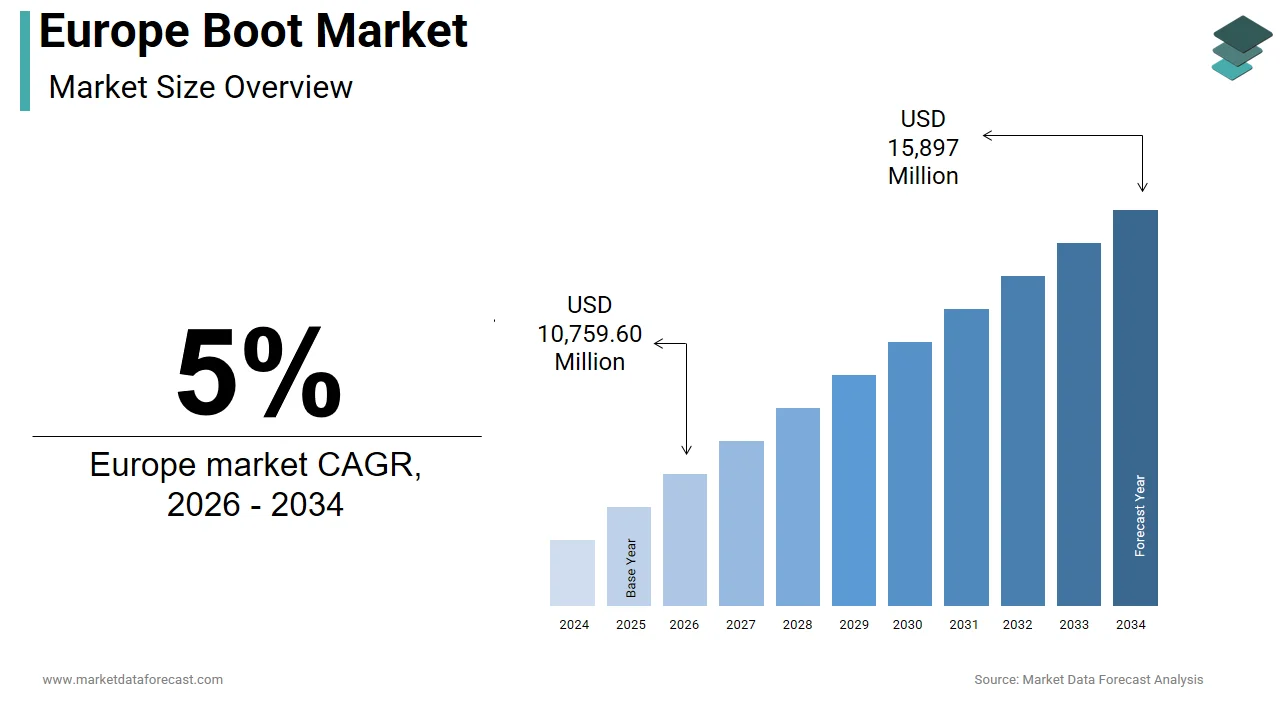
$10,247.24 MnMarket Estimate, 2026
$10,759.6 MnMarket Forecast, 2034
$15,897 MnCAGR, 2026–2034
5%Europe Boot Market Summary
The Europe boot market is experiencing steady growth, driven by a blend of heritage craftsmanship and a shifting consumer focus toward sustainability and durability.
Market Snapshot (2026 to 2034)
- Current Market Value (2026): USD 10,759.60 Million
- Projected Market Value (2034): USD 15,897 Million
- Growth Velocity (CAGR): 5%
- Base Year Value (2025): USD 10,247.24 Million
- Primary Product Segment: Regular Boots (63.1% share)
- Dominant Sales Channel: Offline Retail (58.1% share)
- Top Regional Hub: Germany (18.2% share)
Strategic Market Segments
- Dominant Product (Regular Boots): Holding a significant 63.1% share, regular boots (lifestyle and fashion-focused) remain the primary revenue driver compared to specialized or safety footwear.
- Sales Channels: Despite the rise of e-commerce, the offline channel (physical retail) maintains the majority share at 58.1%, as European consumers still prioritize tactile experiences, fitting accuracy, and in-store craftsmanship narratives.
Country-Level Performance
- Germany (18.2%): The regional leader, Germany’s market is characterized by a high demand for functional, high-quality engineering and outdoor-ready footwear.
- United Kingdom (14.7%): The second-largest market, driven by iconic heritage brands like Dr. Martens and a strong culture of both urban and rugged outdoor boot wear.
- France & Italy: Key centers for luxury and artisan excellence. France relies on its heritage luxury positioning, while Italy leads in design excellence and vertically integrated manufacturing of premium leather boots.
Competitive Landscape & Market Trends
The market is defined by a strategic shift from "fast fashion" to "longevity-driven retail."
- The "Authenticity" Race: Competition is no longer just about price. Brands are differentiating through material transparency and provenance (geographic origin).
- Sustainability & EU Mandates: New EU sustainability regulations are forcing a focus on repairability and climate-conscious manufacturing. Smaller producers are consolidating to meet these high regulatory bars.
- Climate Agility: Successful brands are those responding to European climate shifts by developing "multi-season" boots that offer both insulation and breathability.
Leading Companies
The market features a diverse mix of global powerhouses and regional heritage specialists:
- Heritage & Lifestyle: Timberland LLC, Dr. Martens Airwair, Aigle, and Sorel.
- Premium & Craftsmanship: Church & Co. Ltd., R.M. Williams, and Belstaff International.
- Outdoor & Industrial: Red Wing Shoe Company, Wolverine Worldwide, and Woodland Worldwide.
Executive Takeaway: As we move through 2025, the Europe Boot Market is rewarding brands that treat sustainability as a design principle rather than a marketing tactic. The absence of a single dominant player leaves significant room for niche brands focused on narrative authenticity and high-quality product lifecycles.
Europe Boot Market Size
The size of the Europe boot market was worth USD 10,247.24 million in 2025. The regional market is anticipated to grow at a CAGR of 5% from 2026 to 2034, reaching a value of USD 15,897 million by 2034, up from USD 10,759.60 million in 2026.
Boot refers to the footwear engineered specifically for protection, warmth, and performance across diverse climatic and occupational conditions. This segment includes consumer-focused winter and fashion boots alongside specialized occupational footwear used in construction, agriculture, logistics, and emergency response roles. Distinct from general footwear, boots are defined by functional attributes such as waterproofing, thermal insulation, ankle stability, and slip resistance. As per multiple sources, Climatic variations and seasonal weather in Europe contribute to consistent consumer demand for diverse types of protective and weather-appropriate footwear across the continent. According to research, the prevalence of cold winter temperatures, particularly in Northern, Alpine, and Eastern European regions, drives a sustained market for durable, insulated footwear options. Apart from these, Stringent European safety regulations, implemented through national mandates, require the use of certified personal protective equipment, including specialized footwear, in high-risk industrial sectors, ensuring stable institutional demand. Cultural norms in countries like Germany, France, and the United Kingdom further amplify demand through strong outdoor recreation traditions. Together, these environmental, regulatory, and lifestyle dynamics shape the structural foundation of the Europe boot market.
MARKET DRIVERS
Stringent Occupational Safety Regulations Drive Protective Boot Adoption
The rigorous enforcement of workplace safety legislation across European Union member states has become a driver of the Europe boot market. The European Agency for Safety and Health at Work (EU-OSHA) consistently emphasizes that specific sectors, such as construction, manufacturing, agriculture, and mining, continue to be classified as high-risk environments for occupational accidents and injuries. European Union legislation, including Directive 89/656/EEC and the newer Regulation (EU) 2016/425, legally requires employers to provide appropriate, certified personal protective equipment. This equipment, such as safety footwear, must meet harmonized standards like EN ISO 20345, which sets essential performance criteria for features that protect against mechanical risks, such as impact resistance, and includes additional options like puncture protection and slip resistance. In Germany, stringent workplace safety regulations require employers to provide all necessary personal protective equipment, including safety footwear. French labor law (Code du Travail) requires employers to ensure personal protective equipment, including safety footwear, is maintained in a safe and hygienic condition and replaced when it becomes worn out or damaged. Scandinavian nations have integrated digital compliance systems that track equipment usage and trigger automatic replacements. This regulatory architecture not only guarantees baseline market volume but also accelerates innovation in lightweight materials, anti-static soles, and ergonomic support systems. Consequently, the occupational boot segment remains resilient, non-discretionary, and decoupled from consumer trend cycles.
Proliferation of Outdoor Recreation Fuels Performance Boot Demand
The region’s deeply embedded outdoor recreation culture continues to sustain robust demand for performance-oriented boots, particularly in geographies with rugged terrain and seasonal snowfall, which in turn boosts the expansion of the Europe boot market. According to research, Many European citizens participate in hiking, trekking, or mountaineering. In addition, visitation to national parks has increased, with high levels of participation seen in Austria, Switzerland, and Norway. Footwear represents a significant portion of total outdoor gear expenditure, exceeding the amount spent on outerwear and backpacks. Outdoor enthusiasts often prioritize ankle support and sole traction when selecting gear. Government wellness policies have normalized performance boots as essential lifestyle gear even among non-athletes. Unlike trend-driven categories, this segment benefits from functional necessity and product longevity, ensuring consistent replacement tied to wear rather than fashion cycles.
MARKET RESTRAINTS
Escalating Raw Material Costs Erode Profit Margins
The mounting pressure from volatile pricing of critical inputs, including bovine leather, rubber compounds, and high-performance synthetics, continues to inhibit the growth of the Europe boot market. According to various sources, the average price of styrene butadiene rubber, a primary material used in outsoles, increased as a result of energy constraints and disruptions in the supply chain. As per research, bovine hide prices rose following a decline in livestock slaughter rates and heightened competition from the automotive upholstery sector. These materials constitute over sixty percent of production costs for mid to high-end boot manufacturers in Italy and Spain, where craftsmanship-driven SMEs operate with narrow margins. The necessity for specific performance features like waterproofing and abrasion resistance limits material options, creating a scenario where brands face significant challenges in balancing cost absorption versus retail price markups. A portion of European footwear producers are SMEs lacking the scale to hedge input volatility, which leads to production cutbacks and reduced regional assortment diversity.
Fragmented Consumer Preferences Hinder Brand Scalability
The pronounced heterogeneity in consumer expectations across regions, age groups, and usage contexts complicates unified product development and marketing to ultimately restrain the expansion of the Europe boot market. According to a study, Finnish consumers prioritize thermal performance, while Italian consumers primarily focus on aesthetic design when making purchase decisions. Generational divides further fragment demand. Younger consumers show a preference for hybrid urban outdoor silhouettes, whereas older consumers emphasize orthopedic support and durability. Leading boot brands manage a higher number of stock-keeping units per season compared to general footwear, indicating greater operational complexity. Retailers exacerbate this by demanding geographically tailored assortments, which results in mismatched inventory allocation. Digital personalization algorithms intensify expectations for hyper-relevant offerings, yet achieving this at scale remains elusive. Consequently, even established brands experience margin compression from excess stock, markdowns, and inefficient promotional spend, limiting pan-European brand coherence.
MARKET OPPORTUNITIES
Circular Economy Integration Enables Sustainable Revenue Models
The EU’s accelerating shift toward circularity offers a potential opportunity for boot brands to innovate beyond linear sales, which is predicted to fuel the growth of the Europe boot market. According to research, European citizens increasingly prioritize repairability and recyclability when purchasing new footwear. This consumer sentiment aligns with the EU Strategy for Sustainable and Circular Textiles. Footwear brands have responded to this shift by expanding their take-back programs to handle larger volumes of returned products. National collection systems for footwear are experiencing growth as recycling schemes continue to scale their operations. Certified pre-owned platforms have created dedicated boot resale channels, attracting eco-conscious younger shoppers. Modular designs featuring replaceable soles or detachable liners enable service-based revenue models by shifting value creation from product ownership to lifecycle management. This not only future-proofs brands against regulatory penalties but also deepens customer loyalty through environmental accountability.
Digital Customization Technologies Facilitate Precision Personalization
Advances in 3D foot scanning, digital configurators, and on-demand additive manufacturing are unlocking hyper-personalized boot offerings across the region, which creates fresh prospects for the expansion of the Europe boot market. As per sources, the trend toward customized footwear is evident in consumer interest across Europe, particularly in certain regions. This interest suggests a market for products that offer an individualized fit. Companies are addressing this demand through the implementation of advanced in-store scanning systems. These systems capture extensive biomechanical data, which is then used to create lasts and insoles that are anatomically optimized for the individual. This addresses a significant health need. Specific brands are beginning to leverage digital manufacturing technologies, such as selective laser sintering, to produce and deliver custom components, like midsoles, in a relatively short timeframe. Projections suggest that digitally customized footwear may experience an increase in its market presence in the coming years, indicating a shift in industry direction. Consumers also personalize aesthetics, selecting materials, colors, and stitching via online platforms, enhancing emotional engagement. This capability repositions boots from mass-produced commodities to precision-engineered personal assets.
MARKET CHALLENGES
Critical Shortage of Skilled Shoemakers Endangers Craft Continuity
A severe deficit in artisanal shoemaking talent threatens the operational continuity of the region’s premium boot sector, especially in historic manufacturing clusters, which acts as a major obstacle to the Europe boot market. The number of individuals completing formal footwear craftsmanship apprenticeships across the region has been declining in recent times. A significant majority of master shoemakers in some key areas are approaching retirement age. There appears to be minimal interest among younger generations in pursuing vocational training for shoemaking. Many small boot workshops have experienced issues with delayed order fulfillment, which may be related to staffing challenges within the industry. Unlike athletic shoes, high-quality boots often require hand-lasting, Goodyear welting, and hand-stitched detailing, processes resistant to full automation without quality compromise. Recruitment from non-EU countries remains limited by visa constraints, while Brexit has curtailed access to UK-based specialists. Europe's craftsmanship heritage, vital for luxury and workwear, faces permanent damage without immediate public-private investment in upskilling and apprenticeships.
Climate Instability Disrupts Seasonal Demand Forecasting
Unpredictable weather patterns across the region are increasingly destabilizing traditional boot sales cycles, which complicates inventory planning and promotional timing, and thereby hinders the expansion of the Europe boot market. According to a study, Western and Central Europe experienced a winter season with notably warm temperatures. The warm conditions during this winter led to increased levels of unsold winter boot inventories for retailers in France and Germany, as per sources. Conversely, sudden cold events triggered acute stockouts that lean supply chains could not address. The volatility inflates inventory carrying costs and markdown risks. Brands will continue to face profit erosion from mismatched supply and erratic consumer behavior until they integrate real-time meteorological data with AI-driven demand sensing.
REPORT COVERAGE
| REPORT METRIC | DETAILS |
| Market Size Available | 2025 to 2034 |
| Base Year | 2025 |
| Forecast Period | 2026 to 2034 |
| Segments Covered | By Product, Distribution Channel, and County. |
| Various Analyses Covered | Global, Regional, and Country-Level Analysis, Segment-Level Analysis, Drivers, Restraints, Opportunities, Challenges; PESTLE Analysis; Porter’s Five Forces Analysis, Competitive Landscape, Analyst Overview of Investment Opportunities |
| Countries Covered | UK, France, Spain, Germany, Italy, Russia, Sweden, Denmark, Switzerland, Netherlands, Turkey, Czech Republic, and the Rest of Europe. |
| Market Leaders Profiled | Aigle, Timberland LLC, Wolverine Worldwide, Woodland Worldwide, Dr. Martens Airwair, Red Wing Shoe Company, Church & Co. Ltd., R.M Williams, Sorel, Belstaff International Ltd., The Frye Company, and Others. |
SEGMENTAL ANALYSIS
By Product Insights
The regular boots segment dominated the Europe boot market by holding a 63.1% share in 2024. The dominance of the regular boots segment is primarily driven by the segment’s broad functional applicability across occupational, outdoor, and seasonal contexts. Its unmatched utility across climate and work environments contributes to the growth of this segment. Regular Boots serve this demand through designs that integrate steel toes, waterproof membranes, and slip-resistant outsoles compliant with EN ISO 20345 and EN ISO 20347 standards. Additionally, Europe generally experiences prolonged periods of cold weather each year, which results in a steady requirement for insulated clothing options. Furthermore, high compliance rates for the provision of protective footwear are observed across several sectors in various countries. Unlike stylistic categories, Regular Boots benefit from non-discretionary procurement cycles driven by safety audits, seasonal rotations, and equipment replacement mandates. This functional anchoring insulates the segment from fashion volatility and ensures predictable baseline demand across both B2B and B2C channels.
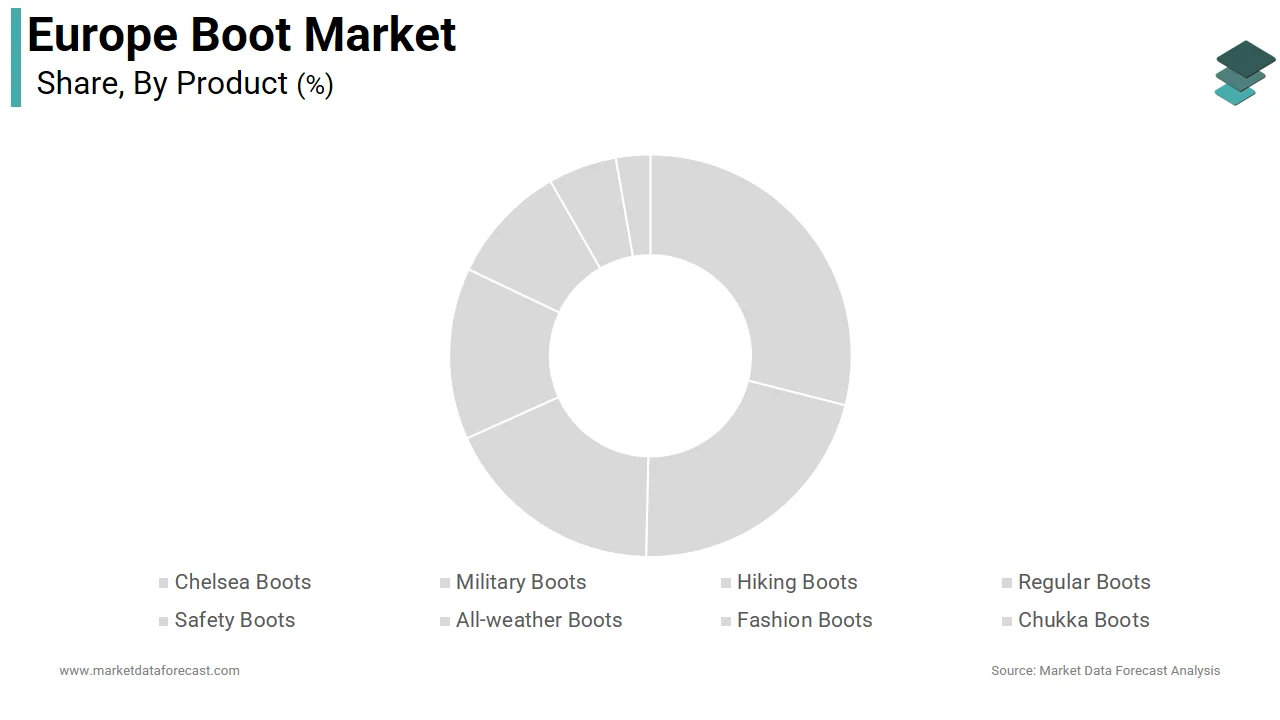
The Chelsea boots segment is predicted to witness the highest CAGR of 6.8% between 2025 and 2033. The rapid acceleration of the Chelsea boots segment is fuelled by premiumization, urbanization, and cross-seasonal wearability that defy traditional boot seasonality. Moreover, the growth of this segment is also propelled by deliberate premium positioning by European heritage brands and contemporary designers who emphasize craftsmanship narrative and material integrity. The average retail price of leather Chelsea boots in Italy has increased, which reflects a general strategic shift within the industry. This shift is toward the use of higher-quality materials and more labor-intensive and traditional construction methods. Brands operating in various markets are utilizing origin storytelling as part of their marketing strategies. This approach, which emphasizes local sourcing and artisanal craftsmanship, helps to support the premium price points of their products. Across Europe, consumer behavior indicates a strong willingness among a specific demographic of shoppers to pay more for boots that offer traceable material origins and transparent manufacturing processes. This value-based consumption decouples growth from unit volume and instead ties expansion to brand equity and perceived longevity. Consequently, Chelsea Boots are increasingly classified as investment pieces rather than seasonal disposables, reinforcing repeat engagement and reducing price sensitivity. The accelerating adoption of multimodal urban commuting is reshaping footwear preferences in favor of effortless styles like Chelsea Boots. As per sources, a portion of residents in major European cities now combine walking, cycling, and public transport in their daily commutes. In this context, lace-free entry and exit provide tangible functional advantages, particularly during rapid transit transfers or inclement weather. Retailers have responded by expanding Chelsea Boot offerings in weather-resistant materials such as waxed suede and rubberized leather to support year-round utility. This functional adaptation transforms the Chelsea Boot from a purely autumn-winter item into a true four-season staple, accelerating its market penetration beyond traditional seasonal boundaries.
By Distribution Channel Insights
In 2024, the offline channel segment maintained the majority share of 58.1% of the Europe boot market. The supremacy of the offline channel segment is attributed to the high importance European consumers place on physical fit assessment and material quality verification. Boot buyers aged above forty show a preference for in-store trials, driven by specific concerns regarding ankle support, sole flexibility, and toe box width, which they feel are difficult to assess accurately through online channels. Footwear specialty stores in certain regions report that a majority of protective and winter boot sales occur in physical locations equipped with advanced fitting technologies such as gait analysis systems and pressure mapping tools. Brick-and-mortar outlets experience significantly lower return rates for boots compared to online channels, where issues related to sizing errors are more frequent causes for returns. Besides, occupational procurement often occurs through authorized safety equipment distributors who provide certification documentation, fitting services, and bulk delivery logistics, functions difficult to replicate digitally. This experiential and trust-based dimension ensures offline channels remain indispensable for high involvement boot categories. Offline channels currently have higher conversion rates, but the online segment is growing quickly because of its importance in product research, brand engagement, and price checking. Online shopping is increasingly becoming the initial starting point for many individuals searching for boots, even if they decide to buy the final product from a physical store. Major fashion retailers are adopting new digital features, such as virtual try-on technology and foot scanning applications, for a significant number of their footwear products. The digital market for boots has expanded, partly due to improvements in the online shopping experience, including more detailed options for sorting and filtering items based on specific characteristics like weather resistance, insulation levels, and sustainability information. Free return policies have also mitigated fit anxiety, with major retailers offering up to ninety days for boot trials. Crucially, online channels excel in reaching niche audiences such as vegan footwear seekers or minimalist design enthusiasts who lack local retail options. This discovery-to-conversion funnel makes digital an essential complement even when the final purchase occurs offline.
The online segment is estimated to register the fastest CAGR of 9.3% from 2026 to 2034. The swift expansion of the online segment is propelled by technological innovation, logistical maturity, and shifting generational shopping behaviors. In addition, the growth of this is further supported by Europe’s advanced last-mile delivery and returns ecosystem, which mitigates traditional e-commerce barriers. According to research, a notable share of urban households in the European Union received next-day or same-day delivery options for footwear in 2024. Companies like Zalando and Otto have partnered with DHL and PostNL to offer scheduled evening deliveries and doorstep pick up for returns, eliminating the need for consumer-initiated drop-offs. Enhanced carrier reliability not only improves satisfaction but also supports larger basket sizes as shoppers confidently order multiple sizes or styles, knowing returns are frictionless.
Online platforms are increasingly leveraging artificial intelligence to deliver hyper-relevant boot recommendations that mimic in-store advisory services. As per research, a notable trend involves major footwear e-tailers using analytics engines to track various user data for personalizing shopping feeds. The data points gathered for this purpose can include browsing history, weather conditions, location, and past purchases. This approach enables highly specific, contextual recommendations, such as suggesting waterproof boots with detailed performance features (e.g., thermal ratings, traction scores) to a shopper during a rain alert. The implementation of these contextual recommendations is associated with improved consumer engagement and purchasing behaviors. This predictive capability transforms generic catalogs into dynamic, need-based marketplaces, enhancing both acquisition and retention. Unlike static physical displays, digital shelves adapt in real time to climate events, fashion weeks, or occupational safety updates, ensuring boots are presented at peak relevance moments.
COUNTRY-LEVEL ANALYSIS
Germany Boot Market Analysis
Germany was the top performer in the Europe boot market by accounting for a 18.2% share in 2024. The demand for boots in Germany is primarily driven by its dense industrial base, rigorous occupational safety enforcement, and temperate continental climate that necessitates seasonal footwear transitions. A significant number of individuals are employed in sectors where specific protective footwear is a legal requirement. There is widespread adherence among industrial enterprises to regulations for providing certified safety footwear. The country has a strong outdoor culture, leading to a high demand for performance-oriented hiking models. Retail infrastructure further supports market scale with over twelve thousand specialized footwear stores offering professional fitting services. Urban centers also exhibit growing interest in sustainable boot brands. This confluence of regulatory, occupational climatic, and cultural factors solidifies Germany’s position as Europe’s primary boot consumption hub.
United Kingdom Boot Market Analysis
The United Kingdom was the second largest country in the Europe boot market by capturing a 14.7% share in 2024. Its growth is attributed to its dual emphasis on urban fashion and rural practicality. A majority of households in the United Kingdom own at least one pair of waterproof boots, as this type of footwear is considered a practical necessity given the country's frequent rainy weather. Chelsea boots are a popular choice in the premium casual boot market, with strong sales attributed to the general influence of London as a global fashion capital. The large agricultural sector sustains a steady demand for durable work boots designed to meet safety standards. E-commerce penetration is among Europe’s highest. Cultural events such as music festivals and countryside shows further stimulate seasonal purchases. This blend of metropolitan style and practical necessity defines the UK’s unique market dynamics.
France Boot Market Analysis
France is another significant player in the Europe boot market, with its heritage craftsmanship, luxury positioning, and regulated retail environment. The footwear manufacturing sector includes numerous production units across the country. Key areas, such as Auvergne-Rhône-Alpes and Pays de la Loire, maintain economically active traditions in artisanal boot making. The domestic industry's products are popular in international markets, with premium segments experiencing significant growth. In the domestic market, legislation promoting a circular economy has encouraged the growth of repair and resale models. Consequently, there are a large number of certified boot repair workshops operating nationwide. Urban demand is shaped by Parisian fashion norms where minimalist silhouettes dominate. Climate also plays a role. This fusion of artisanship regulation and style consciousness positions France as Europe’s qualitative benchmark.
Italy Boot Market Analysis
Italy experienced a consistent growth in the Europe boot market owing to its global reputation for design excellence, premium materials, and vertically integrated manufacturing. Italian boot production is primarily concentrated in small and medium enterprises located within specific regions of the country. These regions, particularly the Marche and Veneto areas, have a long-standing reputation for their extensive shoemaking expertise. Boot exports constitute a significant part of the Italian fashion industry. The value of these exports is largely driven by leather variations, which are highly valued for their perceived superior craftsmanship and quality materials. Domestically, consumer preference leans toward timeless aesthetics. The country’s mountainous terrain also supports functional demand. Retail experience remains critical as a portion of boot purchases occur in independent boutiques where personalized service and fit expertise differentiate offerings. Italy’s market thus thrives on a symbiosis of heritage artistry and terrain-driven utility.
Spain Boot Market Analysis
Spain is anticipated to grow notably in the Europe boot market over the forecast period owing to distinct regional climate contrasts and evolving urban lifestyles. Spain has a diverse climate, with much of the population living in areas characterized by hot, dry summers and mild winters, while mountainous regions such as the Pyrenees and Sierra Nevada experience prolonged snowfall that makes specialized winter boots necessary. The country is a significant producer of boots, with a notable portion of its national production being exported, particularly within the work and safety footwear segments, with manufacturing centered in specific regions like Elche and Alicante. Domestically, demand is increasingly influenced by urban fashion, with Madrid and Barcelona emerging as style hubs where ankle boots dominate autumn-winter wardrobes. Consumers in the young adult demographic increasingly purchase boots to complement their personal style and outfits rather than for functional utility against the weather. The high volume of international tourism contributes to the demand for locally produced leather footwear, as visitors often select these items as commemorative purchases. This duality of functional necessity in highland zones and style-driven consumption in cities defines Spain’s heterogeneous yet expanding boot landscape.
COMPETITIVE LANDSCAPE
The Europe boot market features intense competition characterized by a blend of heritage craftsmanship, global brands, and agile regional players. Competition centers not on price alone but on authenticity, material transparency, functional innovation, and experiential retail. Global players leverage scale and digital infrastructure while local artisans compete through provenance and customization. Regulatory alignment with EU sustainability mandates creates a high bar for market entry, driving consolidation among smaller producers. Consumers increasingly evaluate brands on repairability, longevity, and climate appropriateness, intensifying pressure on product lifecycle management. The absence of dominant market share concentration fosters a dynamic environment where agility in design, responsiveness to climate shifts, and narrative authenticity determine competitive advantage. This multifaceted rivalry ensures continuous evolution in both product offering and go-to-market strategy across the European landscape.
KEY MARKET PLAYERS
The leading companies operating in the Europe boot market include:
- Aigle
- Timberland LLC
- Wolverine Worldwide
- Woodland Worldwide
- Martens Airwair
- Red Wing Shoe Company
- Church & Co. Ltd.
- M Williams
- Sorel
- Belstaff International Ltd.
- The Frye Company
TOP PLAYERS IN THE MARKET
- Dr Martens maintains a formidable presence in the Europe boot market through its iconic air-cushioned footwear that blends countercultural heritage with contemporary urban style. The company has intensified its direct-to-consumer engagement by expanding its European e-commerce platform and opening flagship stores in high-traffic districts. Its commitment to durable construction and recognizable silhouettes has fortified brand loyalty among both legacy and millennial consumers. Dr Martens also enhanced its sustainable material portfolio by introducing recycled rubber soles and water-based leather finishes, reinforcing its position as a purpose-driven footwear leader in the global arena.
- Timberland exerts significant influence in the Europe boot market by championing rugged outdoor aesthetics fused with environmental responsibility. The brand has deepened its retail footprint through strategic collaborations with European outdoor retailers and premium department stores. Recently, it accelerated its use of regenerative agriculture-sourced leather and increased investment in renewable energy across its European distribution centers. Timberland also introduced modular boot designs, allowing sole and upper replacement to extend product life cycles. These actions resonate strongly with eco-conscious European consumers and reinforce its global identity as a steward of both performance and planetary health while driving consistent innovation in functional boot engineering.
- Aigle holds a distinctive position in the Europe boot market, rooted in its French heritage of handcrafted rubber and leather boots designed for countryside and equestrian lifestyles. The company has reinforced its relevance by modernizing classic silhouettes with technical fabrics and ergonomic insoles without compromising artisanal quality. It expanded its presence in urban centers by opening concept stores that integrate workshops and customization services. Aigle also strengthened partnerships with European national parks and equestrian federations to embed its products in experiential outdoor contexts. Its vertically integrated manufacturing in France ensures traceability and rapid response to regional demand shifts. These initiatives affirm Aigle’s dual role as a guardian of tradition and an agile participant in the evolving global premium boot landscape.
TOP STRATEGIES USED BY THE KEY MARKET PARTICIPANTS
Key players in the Europe boot market prioritize vertical integration to control quality and sustainability across the supply chain. They invest heavily in direct-to-consumer channels, including flagship stores and advanced e-commerce platforms, to enhance brand experience and data capture. Product innovation focuses on modular design, material circularity, and climate-adaptive features. Strategic collaborations with outdoor institutions, urban retailers, and cultural influencers amplify relevance across diverse consumer segments. Additionally, companies deploy localized storytelling that highlights regional craftsmanship, weather resilience, and heritage to strengthen emotional connection and differentiate from mass market competitors.
MARKET SEGMENTATION
This research report on the Europe boot market has been segmented and sub-segmented into the following categories.
By Product
- Chelsea Boots
- Military Boots
- Hiking Boots
- Regular Boots
- Safety Boots
- All-weather Boots
- Fashion Boots
- Chukka Boots
- Others
By Distribution Channel
- Online
- Offline
By Country
- United Kingdom
- France
- Spain
- Germany
- Italy
- Russia
- Sweden
- Denmark
- Switzerland
- Netherlands
- Rest of Europe