- Product Description Description
- Table of Contents TOC
- List of Table & Figure LOT
- Get Free Sample PDF Sample PDF
Market Size, 2025
$1.48 BnMarket Estimate, 2026
$1.55 BnMarket Forecast, 2034
$2.30 BnCAGR, 2026–2034
5%Europe Stickers Market Report Summary
The Europe stickers market was valued at USD 1.48 billion in 2025, is estimated to reach USD 1.55 billion in 2026, and is projected to reach USD 2.30 billion by 2034, growing at a CAGR of 5% from 2026 to 2034. Market growth is driven by increasing demand for product labeling, expanding e-commerce logistics, and rising use of stickers in branding, packaging, and promotional applications. Stickers play a critical role in product identification, traceability, and marketing communication across multiple industries. Growth in retail, logistics, and creative industries is further accelerating market expansion across Europe.
Key Market Trends
- Rising demand for customized branding and promotional stickers.
- Increasing adoption of stickers in e-commerce packaging and logistics labeling.
- Growing use of eco-friendly and recyclable sticker materials.
- Expansion of premium label solutions in the luxury and consumer goods sectors.
- Strengthening the integration of digital printing technologies for personalized stickers.
Segmental Insights
- Based on type, the label stickers segment dominated the market in 2025 by capturing 50.8% share, driven by widespread use in product labeling, shipping identification, and packaging applications.
- Based on material, the paper stickers segment held 45.5% share in 2025, supported by cost efficiency, ease of printing, and high recyclability.
- Based on application, the commercial segment led the market by accounting for 65.5% share in 2025, driven by strong demand across retail, logistics, manufacturing, and promotional sectors.
Regional Insights
The Europe stickers market is witnessing steady growth across key economies, supported by expanding packaging demand, e-commerce growth, and strong branding culture.
- Germany led the regional market in 2025 with a 20.5% share, driven by its strong manufacturing base, advanced packaging industry, and high levels of logistics activity.
- The United Kingdom held a significant share in 2025, supported by booming e-commerce logistics and vibrant creative and branding industries.
- France is expected to register a prominent CAGR over the forecast period, driven by the increasing use of stickers in luxury product branding, retail packaging, and lifestyle applications.
Competitive Landscape
The Europe stickers market is characterized by strong competition among global labeling solution providers and specialty printing companies. Market participants are focusing on sustainable materials, advanced adhesive technologies, and digital printing capabilities to enhance product differentiation. Strategic investments in eco-friendly label solutions and the expansion of customized sticker offerings are shaping competitive dynamics across the region.
Prominent companies operating in the Europe stickers market include Avery Dennison Corporation, 3M, UPM Raflatac, CCL Industries, Arconvert, Multi-Color Corporation, Ritrama, Constantia Flexibles, Neenah, Inc., and Chesapeake Label Group.
Europe Stickers Market Size
The Europe stickers market was valued at USD 1.48 billion in 2025, is estimated to reach USD 1.55 billion in 2026, and is projected to reach USD 2.30 billion by 2034, growing at a CAGR of 5% from 2026 to 2034.
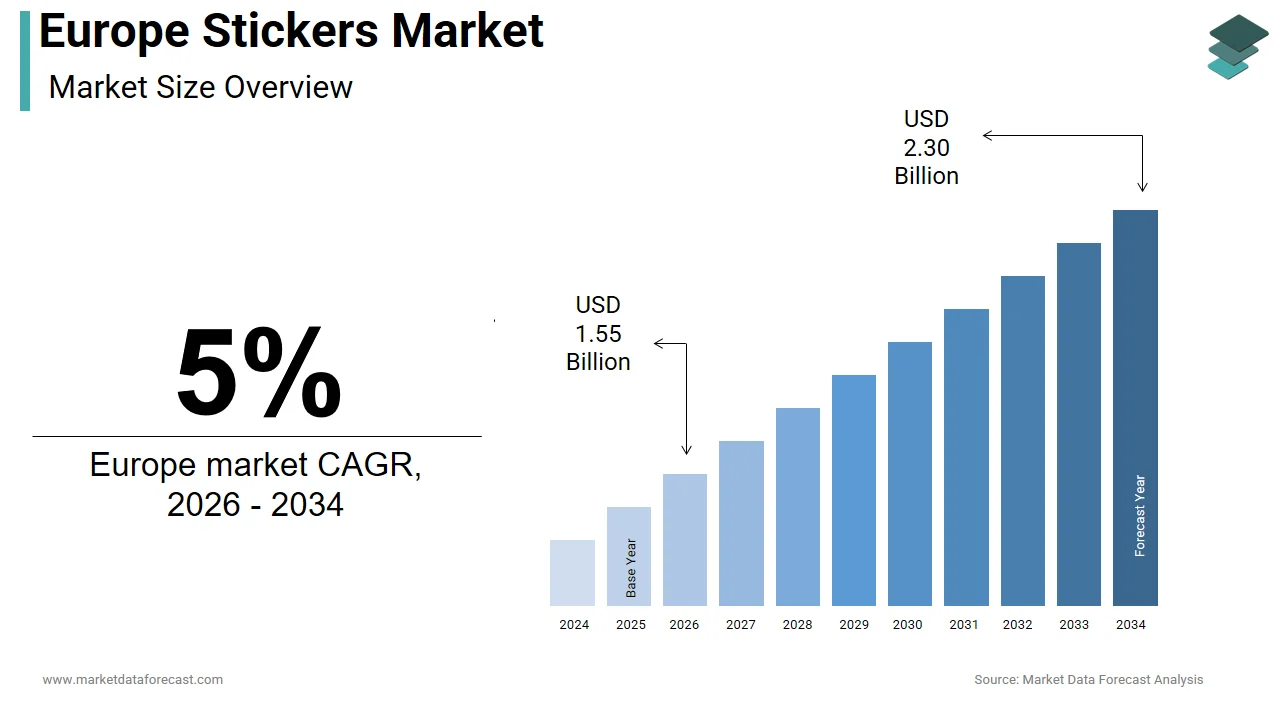
The stickers market includes a diverse range of pressure-sensitive, adhesive labels and decorative or functional decals used across packaging, branding, logistics, education, and personal expression. These products are manufactured from materials including paper film, foil, and bioplastics, often incorporating advanced features such as tamper evidence, QR codes, holography, or compostability. Unlike generic labeling, modern European stickers serve dual roles as regulatory compliance tools and brand engagement instruments. According to the European Packaging and Labeling Observatory, consumer goods in the EU carried stickers for pricing traceability or promotional messaging. As per Eurostat’s digital economy data, parcel labeling volumes increased across Western Europe between 2021 and 2023. Additionally, educational and craft sectors drive consistent consumption among children and hobbyists, with school supply retailers in Germany and France reporting annual sticker sales. This multifaceted utility, spanning industry regulation, retail communication, and creative culture, defines the structural complexity of the European stickers landscape.
MARKET DRIVERS
Mandatory Product Traceability and Regulatory Labeling Requirements
European Union regulations increasingly mandate detailed product identification through adhesive labels, which is directly fuelling industrial demand for compliant stickers and is primarily driving the stickers market expansion in Europe. The EU’s Medical Device Regulation requires unique device identifiers on all medical packaging, while the Digital Product Passport initiative under the Ecodesign for Sustainable Products Regulation will soon necessitate scannable data carriers on electronics, textiles, and batteries. According to the European Commission, food and pharmaceutical products sold in the EU must display batch numbers, expiry dates, and origin information via durable adhesive labels. The Tobacco Products Directive alone generates demand for health warning stickers annually across member states. Furthermore, customs and logistics operations rely on standardized barcode and RFID stickers for cross-border tracking within the Single Market. These legally binding requirements create non-discretionary demand that is resilient to economic cycles and ensures steady volume for industrial label converters regardless of consumer trends.
Explosion of Personalized and Experiential Consumer Culture
Stickers have evolved beyond functional labels into tools of self-expression and interactive marketing due to social media aesthetics and youth culture, which is another major factor propelling the European stickers market growth. Platforms like Instagram and TikTok have popularized “sticker bombing” laptops, water bottles, and journals as a form of digital age customization. As per a study by the European Youth Forum, Europeans aged 12 to 25 regularly purchase decorative stickers for personalization. Brands capitalize on this by including collectible or limited-edition stickers in product packaging, such as cosmetics from L’Oréal or snacks from Mondelez, to boost engagement and repeat purchases. Educational publishers in Sweden and the Netherlands integrate reward stickers into workbooks to motivate young learners, sustaining institutional demand. This cultural shift transforms stickers from passive identifiers into active participants in identity construction and brand storytelling, expanding their relevance far beyond traditional labeling functions.
MARKET RESTRAINTS
Stringent EU Restrictions on Adhesive and Substrate Chemical Composition
The European stickers market faces significant constraints due to tightening regulations on chemical substances in adhesives and face stocks under REACH and the EU Strategy for Plastics. As per the European Chemicals Agency, compliance testing for new adhesive formulations now requires extended timelines and high costs per product line. Additionally, the Packaging and Packaging Waste Directive mandates that all labels be easily separable from primary packaging to facilitate recycling, complicating design for multi-material constructions. Many small converters lack resources to navigate this evolving compliance landscape, leading to product discontinuities or market exits. These regulatory hurdles increase time to market and suppress innovation in performance adhesives, particularly for specialty applications requiring extreme durability or temperature resistance.
Volatility in Raw Material Costs and Supply Chain Disruptions
The production of stickers is highly sensitive to fluctuations in petroleum-based resins, paper pulp, and specialty films, all of which experienced severe price swings in recent years, which is also hampering the expansion of the European stickers market. As reported by Plastics Europe, the cost of biaxially oriented polypropylene film rose due to energy crises and logistical bottlenecks. Simultaneously, European paper mills reduced label stock output following natural gas shortages, creating allocation constraints for converters. These disruptions force manufacturers to absorb costs or pass them to buyers, eroding margins in an already competitive market. Unlike digital alternatives, physical stickers cannot be instantly scaled or adjusted, making inventory management risky during demand surges or raw material shortages. Without long-term supplier contracts or vertical integration, many mid-sized players struggle to maintain pricing stability and service reliability.
MARKET OPPORTUNITIES
Integration of Smart and Interactive Labeling Technologies
The convergence of digital connectivity and physical stickers presents a transformative opportunity for the European stickers market. Brands across cosmetics, food, and luxury goods are embedding scannable stickers that unlock product stories, authenticity verification, or recycling instructions. According to the European Brand Association, premium brands in France and Italy implemented interactive labels to combat counterfeiting and enhance consumer engagement. The EU’s upcoming Digital Product Passport framework will accelerate adoption by requiring machine-readable data carriers on millions of products. Companies like Avery Dennison and UPM Raflatac are developing recyclable smart label substrates compatible with existing printing infrastructure. This digitization not only adds functional value but also creates recurring revenue streams through data analytics and consumer insights, positioning stickers as dynamic interfaces rather than static identifiers.
Expansion of Sustainable and Compostable Sticker Solutions
Growing environmental consciousness is driving demand for stickers made from biobased and circular materials, which is another notable opportunity in the European stickers market. Innovations such as wood pulp-derived face stocks, algae-based adhesives, and home compostable films align with the EU’s Circular Economy Action Plan. As per the European Bioplastics Association, sales of certified compostable pressure-sensitive labels grew, led by organic food and personal care brands. Retailers like Ecover and Alnatura now mandate fully separable and biodegradable labels on all private label products. Startups in Finland and the Netherlands have commercialized mushroom mycelium and seaweed-based sticker prototypes that decompose within industrial composters. As Extended Producer Responsibility schemes expand across Europe, brands seek labeling solutions that do not compromise the recyclability of primary packaging. This sustainability imperative opens high-margin niches for eco-innovators willing to invest in certified green chemistry and closed-loop systems.
MARKET CHALLENGES
Intensifying Competition from Digital Alternatives and In-Package Printing
Traditional sticker applications are increasingly threatened by direct digital printing technologies that eliminate the need for separate labels, which is significantly challenging the European stickers market growth. Beverage companies like Carlsberg and Heineken now use laser etching or inkjet coding to apply batch data and branding directly onto glass and cans, reducing material use and cost. According to Smithers Pira, in mold and in package, digital decoration is projected to displace pressure-sensitive labels in Europe by 2027. Similarly, e-commerce platforms are adopting thermal transfer printers that generate shipping labels on demand without pre-printed stickers. This shift undermines volume stability for conventional label converters, particularly in high turnover sectors like beverages and logistics. While digital methods lack the tactile and visual appeal of premium stickers, their efficiency and waste reduction benefits resonate strongly with sustainability-focused procurement teams, creating substitution pressure in several key segments.
Fragmented Consumer Preferences and Short Product Life Cycles
The decorative and promotional sticker segment suffers from rapidly shifting aesthetic trends and hyper-fragmented demand, which is further challenging the regional market expansion. What resonates with Gen Z in Berlin may be irrelevant in Warsaw or Lisbon, forcing designers to localize content constantly. Limited edition collaborations, such as artist-designed sticker packs or seasonal motifs, require agile short-run printing capabilities that many traditional converters lack. As per the European Craft and Hobby Association, novelty sticker SKUs often have a short shelf life before being discontinued due to waning interest. This volatility complicates inventory planning and increases waste from unsold stock. Moreover, social media virality can spike demand overnight but just as quickly render designs obsolete, creating boom-bust cycles that strain production scheduling and cash flow. Without robust trend forecasting and on-demand digital printing infrastructure, businesses risk obsolescence in this fast-paced creative subsector.
REPORT COVERAGE
| REPORT METRIC | DETAILS |
| Market Size Available | 2025 to 2034 |
| Base Year | 2025 |
| Forecast Period | 2026 to 2034 |
| Segments Covered | By Type, Material, Application, and Country. |
| Various Analyses Covered | Global, Regional, and Country-Level Analysis, Segment-Level Analysis, Drivers, Restraints, Opportunities, Challenges; PESTLE Analysis; Porter’s Five Forces Analysis, Competitive Landscape, Analyst Overview of Investment Opportunities |
| Countries Covered | UK, France, Spain, Germany, Italy, Russia, Sweden, Denmark, Switzerland, Netherlands, Turkey, Czech Republic, and the Rest of Europe. |
| Market Leaders Profiled | Avery Dennison, 3M, UPM Raflatac, CCL Industries, Arconvert and Bifem, Multi-Color Corporation, Ritrama, Constantia Labels, Neenah Cold Foil, Chesapeake Label Group |
SEGMENTAL ANALYSIS
By Type Insights
The label stickers segment dominated the market by holding 50.8% of the regional market share in 2025. The dominance of the label stickers segment in the European market is driven by their indispensable role in regulatory compliance, logistics, and retail operations across nearly every industry. From food expiration dates and pharmaceutical batch codes to e-commerce shipping labels and chemical hazard warnings, label stickers serve as critical data carriers mandated by EU legislation. According to the European Commission, packaged goods sold in the EU require adhesive labels for traceability, safety, or pricing information. As per Eurostat, parcel volumes in the EU grew, each requiring multiple scannable labels for sorting and delivery. Industrial converters leverage high-speed digital and flexographic printing to produce billions of compliant labels annually, often integrated with barcodes, QR codes, or RFID chips. This non-discretionary, regulation-anchored demand ensures consistent volume regardless of economic cycles, solidifying label stickers as the structural backbone of the market.
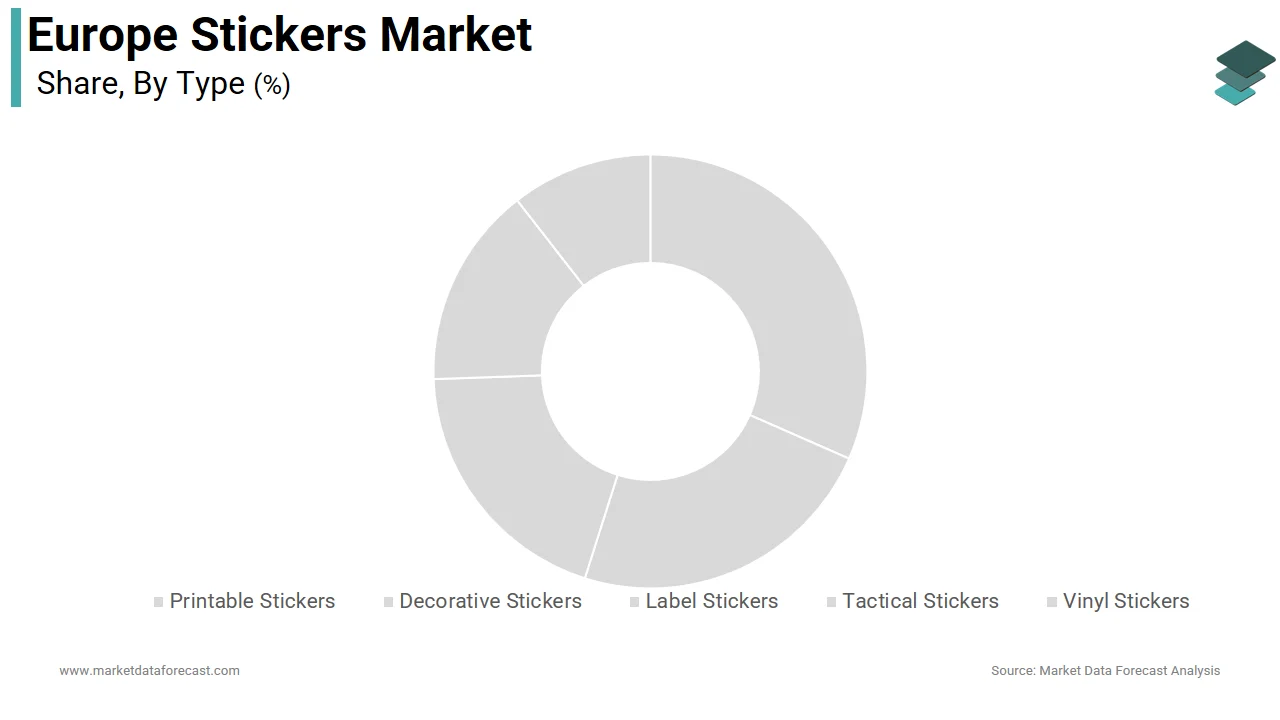
The printable stickers segment is predicted to register a CAGR of 10.6% over the forecast period, owing to the democratization of at-home and small business printing, enabled by affordable inkjet and laser printers and user-friendly design software. Consumers increasingly personalize products using custom printable sticker sheets purchased online or in craft stores. As per the European Craft and Hobby Association, sales of printable sticker kits in Germany and the UK rose, driven by social media trends like bullet journaling and DIY branding. Small enterprises such as artisanal soap makers and indie cosmetics brands rely on printable labels for low-volume, high-variety product runs without minimum order constraints. Additionally, schools and educators use them for classroom rewards and project labeling, supported by curriculum digitization. As print technology improves and eco-friendly printable media enters the market, this segment bridges creativity, entrepreneurship, and accessibility like no other.
By Material Insights
The paper stickers segment held 45.5% of the European stickers market share in 2025. The growth of the paper stickers segment in the European market is driven by their cost-effectiveness, printability, and widespread acceptance in short shelf-life applications. They dominate food labeling, price tagging, and promotional inserts where durability is secondary to affordability and recyclability. According to the European Retail Round Table, supermarkets across France and Spain use paper price and category labels annually. Their compatibility with conventional offset and digital printing makes them ideal for high-volume runs with variable data. Moreover, uncoated paper stickers are easily separable from glass and plastic packaging, aligning with EU recycling directives. While not suitable for wet or outdoor environments, their biodegradability and low carbon footprint appeal to brands targeting eco-conscious consumers in dry goods segments. This balance of functionality, sustainability, and economics ensures paper remains the default choice for everyday labeling needs across retail and logistics.
The eco-friendly stickers segment is estimated to witness a CAGR of 12.2% over the forecast period. The stringent EU packaging regulations and rising consumer demand for circular solutions are propelling the expansion of the eco-friendly stickers segment in the European market. Innovations include face stocks made from stone paper, agricultural residues, and certified compostable bioplastics, paired with water-based or bio-derived adhesives. As per the European Bioplastics Association, certified home compostable label sales grew, led by organic food and personal care brands in Scandinavia and Germany. Retailers like Ecover and Alnatura now mandate fully recyclable or compostable labeling on all private label products. Startups in Finland and the Netherlands have commercialized algae-based adhesives that decompose within industrial composters. As Extended Producer Responsibility schemes expand, brands seek labeling that does not compromise primary packaging recyclability. This regulatory and ethical convergence positions eco-friendly stickers as the future standard rather than a niche alternative.
By Application Insights
The commercial use segment commanded the leading share of 65.5% of the European market in 2025. Every consumer product, from shampoo bottles to automotive parts, relies on stickers for identification, compliance, and marketing. The EU’s Digital Product Passport initiative alone will generate demand for scannable labels annually by 2027. As per Eurostat’s logistics data, e-commerce fulfillment centers in the Netherlands and Poland apply labels per parcel for shipping, tracking, and returns. Brand owners invest heavily in premium label aesthetics to differentiate on shelf, using foil embossing, holography, and textured finishes. Meanwhile, B2B sectors like chemicals and pharmaceuticals depend on durable GHS-compliant hazard labels. This vast ecosystem of regulatory, operational, and branding needs creates massive scale and recurring demand that far exceeds personal or educational consumption.
The personal use segment is the fastest-growing application segment in the Europe stickers market and is expected to expand at a CAGR of 9.12% over the forecast period, owing to the rise of self-expression culture among Gen Z and millennials who use stickers to customize devices, notebooks, bikes, and clothing. Social media platforms like TikTok and Instagram have popularized “sticker bombing” as a form of identity curation. As per the European Youth Forum, Europeans aged 13 to 28 purchase decorative stickers monthly for personal projects. Independent artists and micro brands thrive on Etsy and local markets, selling limited edition designs featuring regional motifs, affirmations, or pop culture references. The pandemic accelerated DIY and journaling hobbies, many of which incorporate reward or decorative stickers. As personalization becomes a lifestyle norm, stickers evolve from mere accessories to tools of narrative and belonging.
COUNTRY-LEVEL ANALYSIS
Germany Stickers Market Analysis
Germany led the stickers market in Europe in 2025 by capturing 20.5% of the regional market share. The dominance of Germany in the European market is attributed to its advanced manufacturing base and strict regulatory environment. As Europe’s leading exporter of machinery, automotive parts, and chemicals, Germany generates immense demand for durable industrial labels compliant with REACH, GHS, and CE marking requirements. The country’s retail sector also enforces rigorous labeling standards for food and consumer goods, driving high-volume paper and film sticker consumption. According to the German Federal Statistical Office, product labels are applied annually in German supply chains. The nation’s strong craft and stationery culture further supports personal and educational sticker use, with brands like Memo and Leuchturm1917 integrating custom sticker sets into planners. Government support for circular economy initiatives has accelerated the adoption of recyclable and compostable label materials. This blend of industrial necessity, regulatory rigor, and creative consumption solidifies Germany’s position as the continent’s most influential sticker market.
United Kingdom Stickers Market Analysis
The United Kingdom held a promising share of the European stickers market in 2025 due to its booming e-commerce logistics and vibrant creative industries. According to the UK Office for National Statistics, British adults shop online regularly, requiring vast quantities of shipping and return labels. London’s design and publishing sectors fuel demand for premium decorative and promotional stickers used in branding, editorial, and street art. Independent creators on platforms like Not-On-The-High-Street and Etsy UK offer bespoke sticker designs reflecting British humor, heritage, and social causes. Post Brexit, UK businesses have increased domestic label printing to avoid customs delays, boosting local converter activity. Additionally, the national curriculum’s emphasis on hands-on learning sustains steady educational sticker demand. This synergy of digital commerce, artistic expression, and localized production makes the UK a dynamic and fast-evolving sticker market.
France Stickers Market Analysis
France is expected to witness a prominent CAGR in the Europe stickers market over the forecast period, owing to its integration of stickers into luxury branding and everyday lifestyle culture. French cosmetics, fashion, and wine industries rely on high-end label stickers featuring embossing, metallic foils, and tamper-evident security features to protect brand integrity. As per industry estimates, premium labels are commissioned annually by leading French luxury brands. Simultaneously, the French embrace of art de vivre extends to personalization; stationery stores like Papier Plus report consistent sales of decorative stickers for journals, gift wrapping, and children’s activities. The government’s anti-waste law mandates clear labeling for recyclability, further driving innovation in eco-friendly materials. Paris hosts annual design fairs showcasing artisanal sticker makers blending typography, illustration, and sustainability. This dual focus on opulence and everyday aesthetics positions France as a trendsetter in both functional and expressive sticker applications.
Netherlands Stickers Market Analysis
The Netherlands is anticipated to account for a notable share of the European stickers market over the forecast period. Factors such as its role as Europe’s logistics gateway and agri-food labeling hub are driving the market growth in the Netherlands. The Port of Rotterdam and Schiphol Airport handle millions of labeled parcels and pallets weekly, requiring durable weather-resistant shipping and inventory stickers. As per the Netherlands Enterprise Agency, traceability labels are applied annually to fresh produce, including QR-coded stickers linking to farm origin and sustainability metrics. The country’s tech-savvy population drives demand for smart labels with NFC chips for product authentication and recycling guidance. Companies like UPM Raflatac and Avery Dennison operate R&D centers in the Netherlands, developing recyclable and compostable label solutions aligned with EU Green Deal goals. This fusion of global trade, digital traceability, and material science makes the Netherlands a critical innovation engine for the European sticker industry.
Italy Stickers Market Analysis
Italy is estimated to register a steady CAGR in the European market during the forecast period, owing to its fusion of artisanal craftsmanship and fashion-driven labeling. Italian leather goods, eyewear, and gourmet food producers use elegant minimalist stickers to convey authenticity and origin, often incorporating tactile finishes and subtle branding. Small batch pasta, olive oil, and wine producers rely on custom paper labels with regional motifs and PGI certifications to differentiate in premium markets. According to Italy’s National Institute of Statistics, micro enterprises use stickers for product identification and storytelling. The country’s strong stationery tradition supports decorative sticker use in education and personal organization, with brands like Moleskine offering curated sticker collections. Milan’s design week regularly features experimental sticker art installations blending analog charm with digital interactivity. This cultural reverence for detail, aesthetics, and heritage ensures Italy remains a key influencer in high-value expressive labeling across Europe.
COMPETITIVE LANDSCAPE
The Europe stickers market features intense competition among multinational material science leaders, regional converters, and niche digital printers. Large players like Avery Dennison and UPM Raflatac dominate through scale innovation and sustainability credentials, while smaller firms compete on agility, customization, and local service. Competition is increasingly defined by environmental performance, regulatory expertise, and digital integration rather than price alone. The market is highly fragmented in decorative and personal use segments, where independent designers and micro brands thrive via e-commerce platforms. Meanwhile, industrial labeling is consolidating around providers who can guarantee compliance with evolving EU chemical and packaging laws. Technological disruption from in-package printing poses a long-term threat yet also creates opportunities for hybrid solutions. As brands seek to balance aesthetics, functionality, and circularity, the competitive edge lies in offering end-to-end solutions that merge material science, digital intelligence, and regulatory foresight across diverse European markets.
KEY MARKET PLAYERS
The leading companies operating in the Europe stickers market include:
- Avery Dennison
- 3M
- UPM Raflatac
- CCL Industries
- Arconvert and Bifem
- Multi-Color Corporation
- Ritrama
- Constantia Labels
- Neenah Cold Foil
- Chesapeake Label Group
TOP PLAYERS IN THE MARKET
- Avery Dennison is a global leader in labeling and functional materials with a commanding presence across the Europe stickers market. The company supplies a comprehensive portfolio including pressure-sensitive labels for food, pharmaceuticals, logistics, and retail, as well as decorative and promotional sticker solutions. Its European operations span R&D centers in the Netherlands and Germany, focused on sustainable materials and smart labeling technologies. Recently, Avery Dennison expanded its AD Circular initiative in Europe, launching fully recyclable and compostable label face stocks compatible with existing printing infrastructure. It also integrated digital watermarking into its label portfolio to support EU Digital Product Passport requirements, reinforcing its role as a strategic partner for brands navigating regulatory and sustainability transitions.
- UPM Raflatac is a key innovator in sustainable labeling solutions, headquartered in Finland with extensive manufacturing and distribution across Europe. The company specializes in paper and filmic labels made from renewable and recycled materials, serving the food, beverage, cosmetics, and logistics sectors. UPM Raflatac has pioneered wood-based bioplastics and fossil-free adhesives that align with EU circular economy goals. In recent years, it launched its Smart Label platform featuring RFID and NFC-enabled tags for product authentication and consumer engagement. The company also partners with European retailers to ensure label compatibility with packaging recycling streams, strengthening its reputation as a sustainability-driven technology provider in the European adhesive label ecosystem.
- Constantia Flexibles is a major European producer of specialty packaging and labeling solutions with significant expertise in high-end decorative and security stickers. Operating across Germany, Austria, and Italy, the company serves premium segments including luxury goods, pharmaceuticals, and wine with tamper-evident holographic and metallized labels. Constantia Flexibles has invested heavily in digital printing capabilities to support short-run personalized labeling for artisanal brands. Recently, it introduced a new line of compostable shrink sleeves and peelable labels designed to meet Extended Producer Responsibility requirements in France and Germany. These innovations position the company at the intersection of brand protection, aesthetics, and environmental compliance in Europe’s evolving label landscape.
TOP STRATEGIES USED BY THE KEY MARKET PARTICIPANTS
Key players in the Europe stickers market prioritize sustainability by developing recyclable, compostable, and bio-based label materials to comply with EU packaging directives. They invest in smart labeling technologies such as NFC QR codes and digital watermarks to enable traceability, authentication, and consumer engagement in line with Digital Product Passport mandates. Companies expand digital printing capabilities to support short-run customization and agile production for small brands and seasonal campaigns. Strategic partnerships with retailers, waste management firms, and recycling facilities ensure label designs do not compromise primary packaging recyclability. Additionally, they focus on regulatory compliance, offering pre-validated solutions for GHS pharmaceutical and food safety labeling to reduce customer risk and accelerate time to market.
MARKET SEGMENTATION
This research report on the Europe stickers market has been segmented and sub-segmented into the following categories.
By Type
- Printable Stickers
- Decorative Stickers
- Label Stickers
- Tactical Stickers
- Vinyl Stickers
By Material
- Paper Stickers
- Vinyl Stickers
- Foil Stickers
- Eco-friendly Stickers
By Application
- Personal Use
- Commercial Use
- Educational Use
By Country
- United Kingdom
- France
- Spain
- Germany
- Italy
- Russia
- Sweden
- Denmark
- Switzerland
- Netherlands
- Rest of Europe