- Product Description Description
- Table of Contents TOC
- List of Table & Figure LOT
- Get Free Sample PDF Sample PDF
Market Size, 2025
$0.77 BnMarket Estimate, 2026
$0.82 BnMarket Forecast, 2034
$1.39 BnCAGR, 2026–2034
6.77%Europe Stretch Marks Treatment Market Size, Growth, Trends & Forecast (2025–2034)
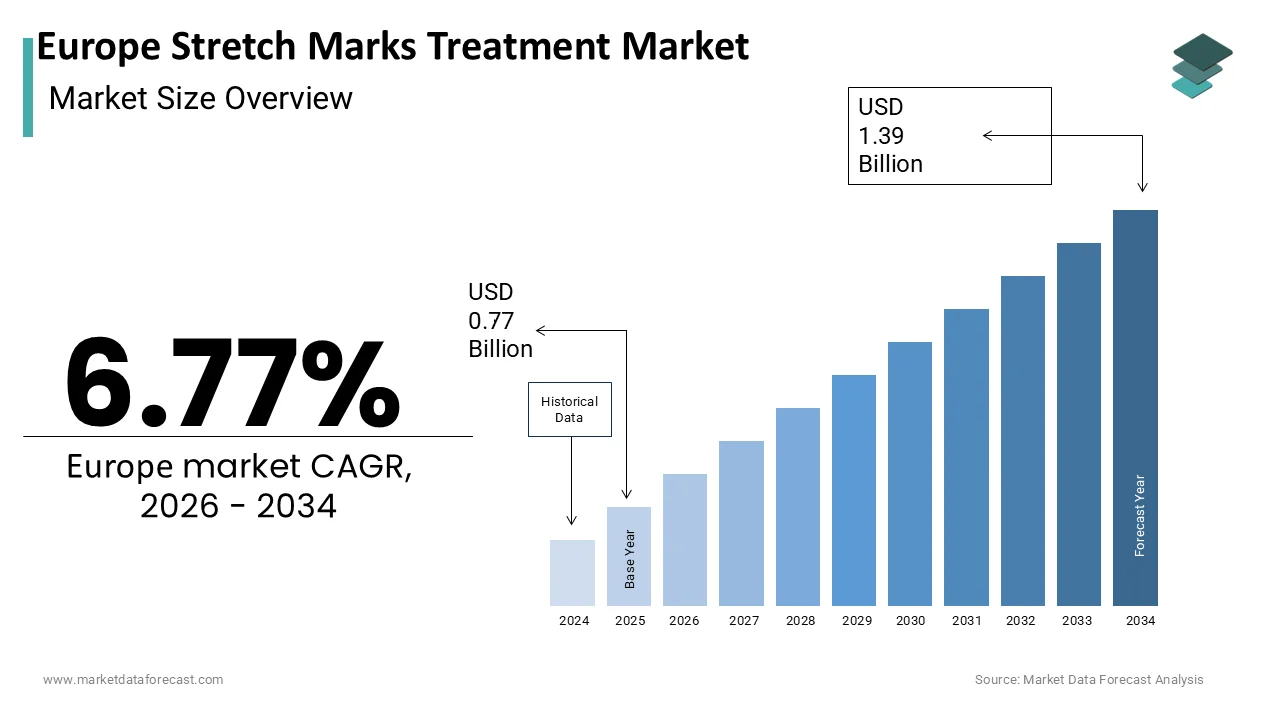
The Europe stretch marks treatment market size was valued at USD 0.77 billion in 2025, is estimated to reach USD 0.82 billion in 2026, and is anticipated to expand up to USD 1.39 billion by the end of 2034, registering a compound annual growth rate (CAGR) of 6.77% during the forecast period from 2026 to 2034. Driven by a rising prevalence of pregnancy-related striae, an expanding male consumer base seeking aesthetic body improvements, and technological innovations in fractional lasers and regenerative dermatology, the European market continues to experience robust growth.
Key Executive Metrics (At-a-Glance)
- 2025 Base Valuation: USD 0.77 Billion
- 2026 Current Valuation: USD 0.82 Billion
- 2034 Forecast Valuation: USD 1.39 Billion
- Compound Annual Growth Rate (CAGR): 6.77% (2026–2034)
- Dominant Treatment Segment: Topical Products (capturing 48.3% of the market share in 2025 through accessible daily skincare and e-commerce availability)
- Fastest-Growing Treatment Segment: Fractional Lasers (projected for high clinical adoption and precision collagen remodeling)
- Dominant End-User Segment: Specialty Dermatology Centers (occupying 39.2% market share anchored by professional expertise and advanced equipment)
- Fastest-Growing End-User Segment: Home-Use (surging at a 14.1% CAGR via digital health integration, telehealth, and regulated at-home care devices)
- Dominant Country: Germany (market leader capturing 22.3% of the share backed by high disposable income and strong preventive dermatology demand)
Core Market Drivers
- High Prevalence of Pregnancy-Related Striae: Consistent reproductive health baseline across Europe with millions of annual live births and heightened postnatal body image awareness.
- Integration of Aesthetic Dermatology in Mainstream Care: Normalization of skin integrity treatments within outpatient services and rising public funding for dermatological innovations.
Primary Market Restraints & Challenges
- Limited Clinical Validation & High Costs: Variable long-term efficacy outcomes across topical agents and energy-based procedures, compounded by non-reimbursable cosmetic classifications in national health systems.
- Stringent Regulatory Hurdles: Rigorous EU cosmetic claim standards and Medical Devices Regulation (MDR) compliance procedures creating barriers for new product approvals.
Europe Stretch Marks Treatment Market Segmentation Breakdown
| Segment Category | Leading Sub-Segment | Fastest-Growing Sub-Segment |
|---|---|---|
| By Treatment Type | Topical Products / Creams & Oils (dominant market share driven by non-invasive affordability) | Fractional Lasers (accelerating via superior microthermal collagen regeneration and low downtime) |
| By End User | Specialty Dermatology Centers (leading choice for advanced equipment and tailored scar protocols) | Home-Use Devices & Regimens (fastest growth backed by tele-dermatology kits and digital health trends) |
| By Country | Germany & France (Germany leads in preventive care and devices; France in dermocosmetic innovation) | United Kingdom & Spain (growth fueled by digital engagement, medical tourism, and private clinics) |
Major Industry Players Profiled
Key dermocosmetic and aesthetic device enterprises shaping the European stretch marks treatment market include L’Oréal SA (La Roche-Posay/Vichy), Bayer AG, Cynosure, Inc., Syneron Medical Ltd., E.T. Browne Drug Co., Inc., Union-Swiss (Pty) Ltd., Laboratoires Expanscience, Clarins Group, Merz North America, Inc., Weleda AG, and Dermaclara, Inc.
Europe Stretch Marks Treatment Market Size
The europe stretch marks treatment market was valued at USD 0.77 billion in 2025, is expected to have a 6.77 % CAGR from 2026 to 2034, and be worth USD 1.39 billion by 2034 from USD 0.82 billion in 2026.
The stretch marks or striae distensae are a common dermatological concern characterized by linear atrophic scars resulting from rapid stretching of the skin. The condition affects a significant portion of the population across diverse demographics, with prevalence particularly high among adolescents undergoing growth spurts and women during or after pregnancy. The demand for effective interventions continues to grow across major European economies, as aesthetic consciousness rises and societal norms increasingly emphasize skin perfection.
MARKET DRIVERS
Rising Prevalence of Pregnancy-Related Striae Among European Women
The pregnancy remains one of the most consistent and widespread dermatological concerns among European women, which is majorly prompting the growth of the Europe stretch marks treatment market. Approximately 4 million live births occur annually, with maternal age trends showing a steady increase in first-time mothers over the age of 30 due to reduced skin elasticity. Furthermore, a survey conducted % of postpartum women express dissatisfaction with the appearance of their skin, prompting them to seek professional aesthetic treatments within the first year after childbirth. This sustained reproductive health baseline, combined with heightened postnatal body image awareness, creates a recurring and predictable patient cohort for dermatologists and aesthetic clinics.
Growing Integration of Aesthetic Dermatology in Mainstream Healthcare
The normalization of aesthetic dermatology within routine medical and wellness frameworks is also expanding the growth of the Europe stretch marks treatment market. According to a source, over 75 % of European countries now include certain dermatological consultations under partially reimbursed outpatient services, thereby facilitating earlier intervention for skin integrity issues, including striae. Also, public funding for dermatological innovation has risen by 18 % since 2020, with several Horizon Europe projects specifically targeting regenerative skin therapies. This institutional validation reduces the stigma historically associated with seeking aesthetic treatments and encourages a preventive rather than reactive approach.
MARKET RESTRAINTS
Limited Clinical Evidence Supporting Long-Term Efficacy of Available Therapies
The lack of robust, long-term clinical validation for most interventions is negatively impacting the growth of the Europe stretch marks treatment market. Many topical agents, including those containing retinoids or hyaluronic acid, show only modest short-term improvements in skin texture, with effects often diminishing after discontinuation. Furthermore, laser and radiofrequency procedures, while more effective, exhibit variable outcomes depending on skin phototype, age of striae, and operator expertise. This inconsistency undermines consumer confidence and complicates physician recommendations, particularly in regions like Eastern Europe, where regulatory oversight of aesthetic claims is less stringent. Consequently, cautious adoption by both practitioners and patients slows market penetration, especially premium-priced modalities that require multiple sessions.
Stringent Regulatory Frameworks Governing Cosmetic Claims and Product Safety
The world’s most rigorous regulations on cosmetic and aesthetic medical products, which significantly constrain product development, are also expected to degrade the growth of the Europe stretch marks treatment market. According to the recent survey, over 40 % of stretch mark creams submitted for market authorization between 2021 and 2023 were either rejected or required reformulation due to unsubstantiated efficacy claims or inadequate toxicological profiles. Additionally, the Medical Devices Regulation 2017/745 imposes stringent conformity assessment procedures for energy-based devices used in clinics. These barriers disproportionately affect small and medium enterprises lacking resources for extensive dossier preparation, thereby limiting innovation diversity. Moreover, post-Brexit, the United Kingdom’s Medicines and Healthcare products Regulatory Agency maintains parallel but divergent standards, fragmenting the formerly unified European market and increasing compliance costs for multinational manufacturers.
MARKET OPPORTUNITIES
Advancements in Regenerative Dermatology and Biostimulatory Technologies
The emerging innovations in regenerative dermatology through biostimulatory agents that promote collagen neosynthesis and dermal remodeling are likely to pose new opportunities for the growth of the European stretch marks treatment market. Technologies such as platelet-rich plasma therapy, polynucleotide injections, and bioactive scaffolds are gaining clinical traction due to their ability to address the underlying pathophysiology of striae rather than merely masking surface irregularities. Many specialized dermatology clinics across Germany, Italy, and Spain have integrated regenerative protocols into their striae management programs since 2022, which is reporting average improvement scores of 2.8 on the modified Manchester Scar Scale after three sessions. Also, the polynucleotide-based treatments increase type I collagen density by 42 % in mature striae alba after 12 weeks. They align with Europe’s strong preference for science-led, which is minimally invasive solutions.
Expanding Male Consumer Base Seeking Body Image Enhancement
The rising number of men actively pursuing dermatological interventions for body image concerns is ascribed to the growth of the European stretch marks treatment market. Traditionally perceived as a female-dominated domain, stretch mark treatment is now gaining traction among male demographics, particularly in fitness-oriented and younger urban populations. According to a recent source, 38% of men aged 18 to 35 in Western Europe reported visible striae on shoulders, lower back, or thighs due to rapid muscle gain, with 22 % expressing willingness to invest in professional treatments. Bodybuilding and gym culture, amplified by social media aesthetics, have normalized male skin concerns, with platforms like Instagram and TikTok driving awareness of dermatological solutions. Unlike women, who often seek treatment postpartum, men typically present with newer striae rubra, which respond more favorably to early intervention with vascular lasers or microneedling.
MARKET CHALLENGES
High Treatment Costs Limiting Accessibility Across Socioeconomic Groups
The prohibitive cost of advanced therapeutic modalities, which restricts access primarily to affluent urban consumers, is a quite challenging factor for the growth of the Europe stretch marks treatment market. The median disposable income in the European Union stands at approximately 1800 euros per month, yet national health systems universally classify stretch mark treatment as cosmetic and therefore non-reimbursable. This economic barrier is particularly acute in Southern and Eastern Europe, where private healthcare expenditure remains low. Consequently, market penetration remains skewed toward premium clinics in cities like Paris, London, and Munich, exacerbating regional disparities.
Persistent Variability in Treatment Outcomes Due to Biological and Behavioral Factors
The high interindividual variability driven by genetic, hormonal, and lifestyle factors complicates standardized care protocols and patient expectations. The behavioral variables, such as inconsistent use of topical regimens, sun exposure, and smoking, further diminish treatment outcomes. Hormonal fluctuations, especially in women using combined oral contraceptives or undergoing menopause, also alter dermal repair mechanisms.
REPORT COVERAGE
| REPORT METRIC | DETAILS |
| Market Size Available | 2025 to 2034 |
| Base Year | 2025 |
| Forecast Period | 2026 to 2034 |
| Segments Covered | By Treatment, End User, and Region. |
| Various Analyses Covered | Global, Regional, and Country-Level Analysis, Segment-Level Analysis, Drivers, Restraints, Opportunities, Challenges; PESTLE Analysis; Porter’s Five Forces Analysis, Competitive Landscape, Analyst Overview of Investment Opportunities |
| Countries Covered | UK, France, Spain, Germany, Italy, Russia, Sweden, Denmark, Switzerland, Netherlands, Turkey, Czech Republic, and the Rest of Europe |
| Market Leaders Profiled | Syneron Medical Ltd., E.T. Browne Drug Co., Inc., Union-Swiss (Pty) Ltd., Basq Skincare, Ellipse A/S, Laboratoires Expanscience, Clarins Group, Merz North America, Inc., Cynosure, Inc., The Boppy Company LLC, Helix BioMedix, Inc., Weleda AG, Dermaclara, Inc., Mama Mio US, Inc., Centre Light Solutions, LLC |
SEGMENTAL ANALYSIS
By Treatment Type Insights
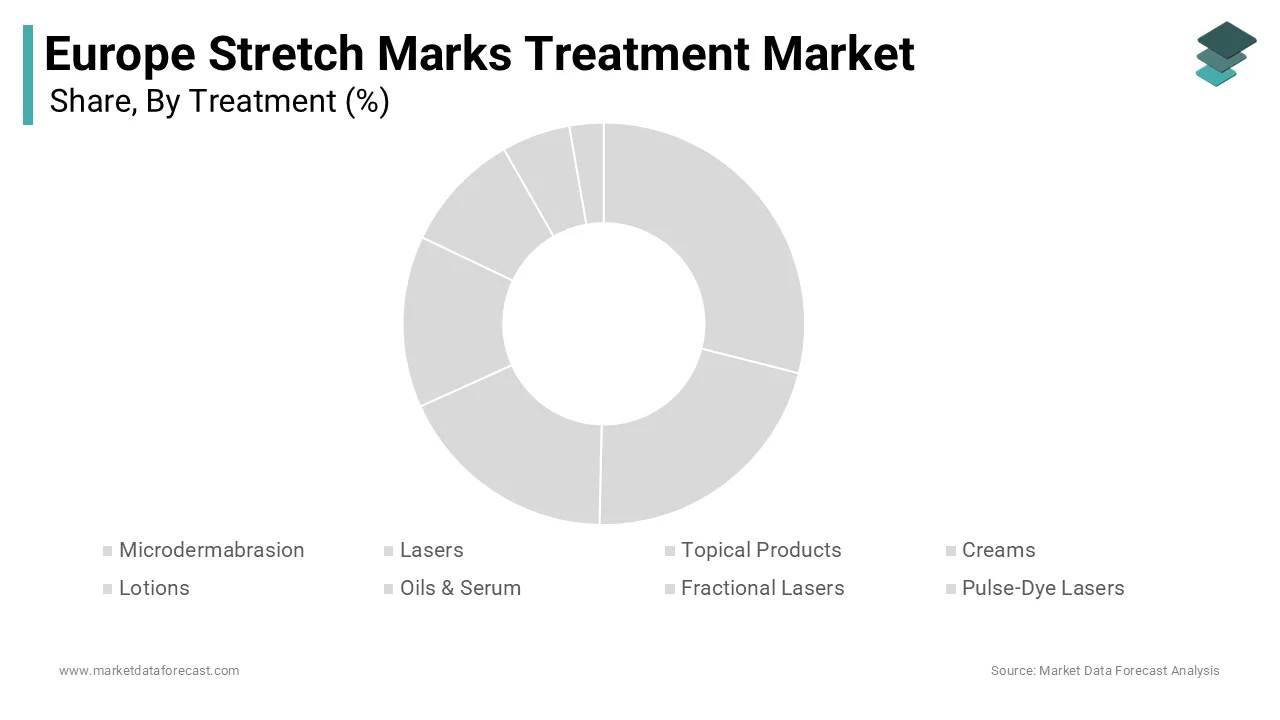
The topical products segment was the largest and held 48.3% of the Europe stretch marks treatment market share in 2025, with high consumer preference for non-invasive, affordable, and easily accessible solutions that can be integrated into daily skincare routines. The widespread retail availability through pharmacy e-commerce platforms and beauty chains further amplifies adoption. The consistent use of such advanced topical agents over 12 weeks increased dermal hydration by 34 % and reduced striae width by 18 % in a cohort of 200 postpartum women.
The fractional lasers segment is anticipated to register the fastest CAGR of 12.3% during the forecast period, with their superior clinical efficacy in treating both striae rubra and striae alba through controlled microthermal zones that stimulate collagen and elastin regeneration without damaging surrounding tissue. The rising demand for minimally invasive,e results-driven procedures among urban professionals who prioritize downtime efficiency is also gearing up the growth of the segment to some extent. A 2023 survey found that 68 % of patients aged 25 to 45 chose fractional lasers over traditional CO2 lasers due to faster recovery and lower risk of post-inflammatory hyperpigmentation. Furthermore, technological refinements have enhanced safety for Fitzpatrick skin types III and IV, which constitute a significant portion of Southern European populations. Regulatory approvals from national bodies like France’s ANSM and Italy’s Ministry of Health have also streamlined device adoption by enabling broader clinic integration and insurance partnerships for combination therapies.
By End User Insights
The specialty dermatology centers segment was the largest by occupying 39.2% of the Europe stretch marks treatment market share in 2025 due to their focused expertise, advanced equipment, and personalized care protocols. These centers are increasingly perceived as the gold standard for managing complex or persistent striae in cases involving mature or hypopigmented scars that do not respond to over-the-counter solutions. The high level of physician training and adherence to evidence-based guidelines, where continuing education in aesthetic dermatology for practitioners offering laser treatments is ensured, ensures consistent outcomes. Additionally, these centers benefit from strong referral networks with obstetricians and endocrinologists, especially in urban areas where integrated care models are prevalent.
The home use segment is likely to gain huge traction with the fastest CAGR of 14.1% from 2025 to 2033, with the integration of digital health trends, rising self-care consciousness, and the commercialization of safe, regulated at-home devices. The post-pandemic shift toward decentralized care will prefer initiating treatment at home before consulting a professional. Moreover, dermocosmetic brands have strategically partnered with telemedicine platforms to offer virtual consultations alongside product kits by enhancing adherence and perceived efficacy. Regulatory clarity under the EU Medical Devices Regulation has also enabled clearer labeling of home device capabilities by reducing misuse and building consumer confidence in self-administered regimens.
COUNTRY LEVEL ANALYSIS
Germany Stretch Marks Treatment Market Analysis
Germany was the top performer of the Europe stretch marks treatment market by capturing 22.3% of the share in 2025, with the robust healthcare infrastructure, high disposable income, and strong cultural emphasis on preventive dermatology. Many people are showing interest in aesthetic dermatology procedures with striae treatments of non-surgical interventions. The presence of leading device manufacturers such as Fotona and Asclepion, coupled with rigorous training standards enforced by the German Society for Aesthetic Dermatology that ensures consistent treatment quality.
France Stretch Marks Treatment Market Analysis
France was positioned second by capturing 18.2% of the Europe stretch marks treatment market share in 2025 with its deep-rooted dermocosmetic culture and world-renowned skincare innovation. Additionally, France’s regulatory framework under the Agence Nationale de Sécurité du Médicament facilitates rapid market entry for evidence-based topicals while restricting unsubstantiated claims, fostering consumer trust.
United Kingdom Stretch Marks Treatment Market Analysis
The United Kingdom's stretch marks treatment market growth is anticipated to have significant growth opportunities throughout the forecast period, with high digital engagement and a thriving private aesthetic sector. According to a source, online searches for “stretch marks treatment near me” increased by 73 % between 2021 and 2023. Moreover, post-Brexit regulatory autonomy has enabled faster approvals for novel biostimulatory topicals through the MHRA’s Innovation Passport scheme, which is accelerating product availability.
Italy Stretch Marks Treatment Market Analysis
Italy's stretch marks treatment market growth is likely to be driven by aesthetic sensitivity, high female workforce participation, and strong regional dermatology networks. Italian women demonstrate early and consistent engagement with body care, as per a recent study in 2023. The country also hosts a dense concentration of medical spas, over 1,200 certified facilities, many of which integrate stretch mark protocols into postpartum wellness packages. Fractional radiofrequency treatments for striae grew by 29 % in 2023 in urban centers like Milan and Rome, where disposable income supports premium services.
Spain Stretch Marks Treatment Market Analysis
Spain's stretch marks treatment market growth is steadily growing with the rising health tourism, youth demographic trends, and increasing male consumer participation. Coastal cities like Barcelona and Marbella have emerged as destinations for medical aesthetic tourism, attracting over 200,000 international patients, where many are seeking affordable yet high-quality striae treatments.
COMPETITIVE LANDSCAPE
The Europe stretch marks treatment market features a dynamic competitive landscape characterized by the coexistence of multinational dermocosmetic giants, aesthetic device manufacturers, and agile regional brands. Competition is primarily driven by scientific credibility differentiation and clinical validation rather than price alone. Leading companies invest significantly in published peer-reviewedudie,, collaborating with medical societies and obtaining regulatory endorsements to build trust among both consumers and practitioners.
KEY MARKET PLAYERS
Some of the companies that are playing a noteworthy role in the europe stretch marks treatment market include
- Syneron Medical Ltd.
- E.T. Browne Drug Co., Inc.
- Union-Swiss (Pty) Ltd.
- Basq Skincare
- Ellipse A/S
- Laboratoires Expanscience
- Clarins Group
- Merz North America, Inc.
- Cynosure, Inc.
- The Boppy Company LLC
- Helix BioMedix, Inc.
- Weleda AG
- Dermaclara, Inc.
- Mama Mio US, Inc.
- Centre Light Solutions, LLC
TOP LEADING PLAYERS IN THE MARKET
- L’Oréal SA plays a pivotal role in the Europe stretch marks treatment market through its dermocosmetic divisionhich includes brands like La Roche Posay and Vichy. The company leverages advanced skin science to develop topical formulations targeting striae with ingredients such as centella asiatica and hyaluronic acid. In recent years, L’Oréal has intensified its investment in clinical validation, partnering with European dermatology clinics to publish peer-reviewed studies on product efficacy. It also expanded its digital health ecosystem by integrating AAI-powered skin diagnostics into its mobile applications, enabling personalized striae prevention plans. These initiatives reinforce its scientific credibility and deepen consumer engagement across Western and Southern Europe.
- Bayer AG contributes significantly to the European stretch marks treatment landscape primarily through its consumer health segment, which markets the globally recognized Bepanthen brand. The company focuses on barrier repair and skin regeneration using provitamin B5-based formulations clinically shown to improve skin elasticity during pregnancy. Bayer has strengthened its position by collaborating with midwifery associations across Germany, France, and Italy to distribute educational materials on striae prevention. It also launched a telehealth pilot in 2,02,3 connecting expectant mothers with dermatologists for early intervention guidance. This integration of product science with maternal healthcare pathways enhances trust and accessibility in key European markets.
- Cy sIn.I,nc a leading aesthetic device manufacturer, exerts a strong influence in the Europe stretch marks treatment market through its advanced laser platforms, including Icon and Elite+. The company specializes in fractional and pulsed dye laser technologies designed to remodel dermal collagen in both new and mature striae. These efforts enhance clinical adoption and standardize outcomes across diverse European skin types.
TOP STRATEGIES USED BY THE KEY MARKET PARTICIPANTS
Key players in the Europe stretch marks treatment market employ several strategic approaches to maintain a competitive advantage. Product innovation remains central, with companies investing heavily in clinical research to validate new formulations and device parameters. Strategic partnerships with dermatologists, midwives, and healthcare institutions enhance credibility and facilitate early consumer engagement. Geographic expansion through localized marketing and multilingual digital platforms targets regional preferences across Western, Eastern, and Southern Europe. Regulatory compliance is prioritized to meet stringent EU cosmetic and medical device standards, ensuring swift market entry.
MARKET SEGMENTATION
This research report on the europe stretch marks treatment market has been segmented and sub-segmented into the following categories
By Treatment
- Microdermabrasion
- Lasers
- Topical Products
- Creams
- Lotions
- Oils & Serum
- Fractional Lasers
- Pulse-Dye Lasers
By End User
- Hospitals
- Clinics
- Specialty Dermatology Centers
- Home-use
By Country
- UK
- France
- Spain
- Germany
- Italy
- Russia
- Sweden
- Denmark
- Switzerland
- Netherlands
- Turkey
- Czech Republic
- Rest of Europe