- Product Description Description
- Table of Contents TOC
- List of Table & Figure LOT
- Get Free Sample PDF Sample PDF
Market Size, 2025
$0.15 BnMarket Estimate, 2026
$0.16 BnMarket Forecast, 2034
$0.25 BnCAGR, 2026–2034
5.87%Middle East and Africa Stretch Marks Treatment Market Size, Growth, Trends & Forecast (2026–2034)
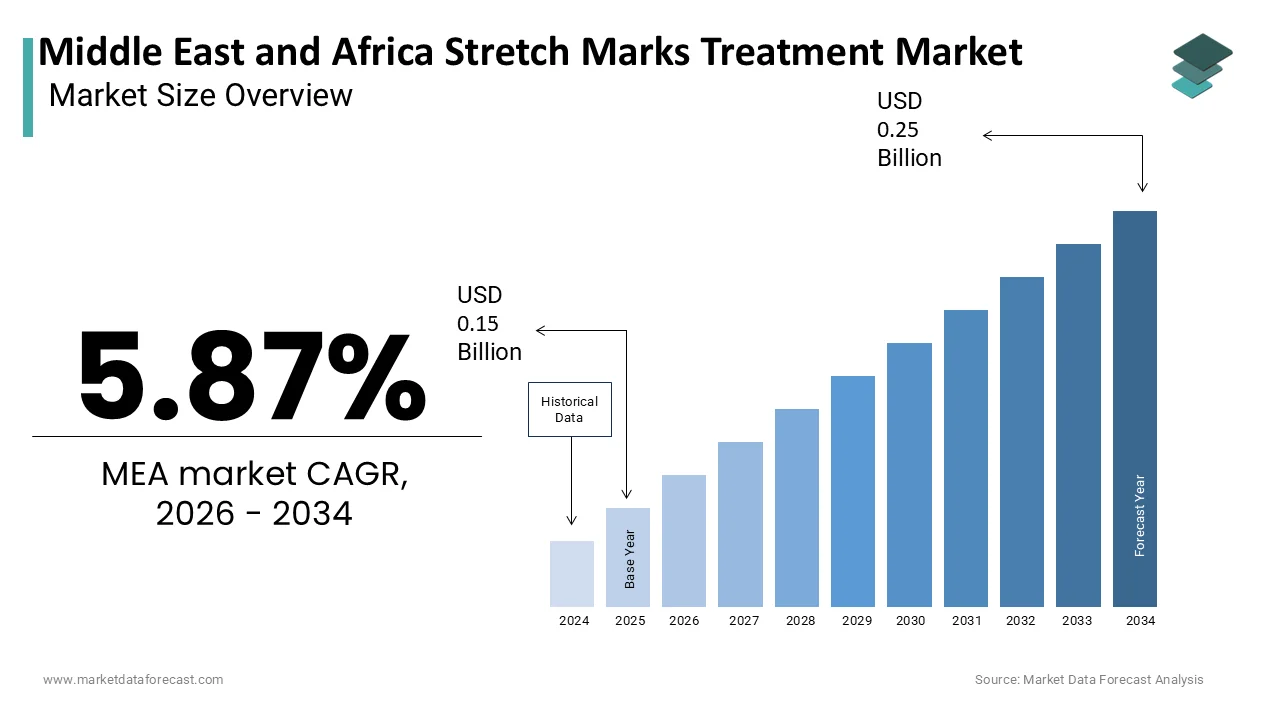
The Middle East and Africa stretch marks treatment market size was valued at USD 0.15 billion in 2025, is anticipated to reach USD 0.16 billion in 2026, and is projected to scale to USD 0.25 billion by 2034, expanding at a compound annual growth rate (CAGR) of 5.87% during the forecast period from 2026 to 2034. Market expansion across the region is uniquely propelled by high regional fertility rates, deeply rooted postpartum recovery traditions, escalating obesity rates driving non-obstetric indications, and flourishing medical tourism infrastructure.
Key Executive Metrics (At-a-Glance)
- 2025 Base Valuation: USD 0.15 Billion
- 2026 Current Valuation: USD 0.16 Billion
- 2034 Forecast Valuation: USD 0.25 Billion
- Compound Annual Growth Rate (CAGR): 5.87% (2026–2034)
- Leading Country Markets: Saudi Arabia (28.4% share in 2025) and UAE (22.1% share in 2025)
- Key Geographic Countries Covered: Saudi Arabia, UAE, Egypt, South Africa, and Rest of MEA
Core Market Drivers & Opportunities
- High Fertility & Postpartum Care: Elevated birth rates and cultural norms treating postpartum body restoration as a routine, vital component of maternal healthcare.
- Obesity & Weight Fluctuations: Rising metabolic health challenges and bariatric weight changes expanding demand into non-obstetric demographics (including male adolescents and bariatric patients).
- Medical Tourism & Digital Health: World-class aesthetic clinics in the UAE, South Africa, and Tunisia coupled with mobile health platforms driving direct consumer access.
Primary Market Restraints & Challenges
- Economic Disparities & Regulations: Severe income inequality limiting high-end treatment access, compounded by regulatory fragmentation and counterfeit product risks.
- Workforce Shortages & Cultural Stigma: Scarcity of trained dermatologists for advanced devices and cultural modesty concerns restricting treatment-seeking behaviours.
Market Segmentation
| Segment Category | Largest Segment | Fastest-Growing Segment |
|---|---|---|
| By Treatment / Type | Lasers (Preferred for high clinical efficacy on Fitzpatrick skin types III to VI) | Microdermabrasion (Projected at a CAGR of 9.8% due to affordability and zero-downtime safety) |
| By End User | Specialty Dermatology Centres (Concentrating advanced technology and privacy-focused care) | Home Use Devices (Projected at a CAGR of 14.5% via e-commerce and privacy preservation) |
Major Industry Players Profiled
Key global and regional market leaders dominating the Middle East and Africa stretch marks treatment landscape include Laboratoires Expanscience, Clarins Group, Merz North America, Inc., Syneron Medical Ltd., E.T. Browne Drug Co., Inc., Cynosure, Inc., Centre Light Solutions, LLC, and Basq Skincare.
 Download Free Sample Report
Middle East and Africa Stretch Marks Treatment Market Size
The Middle East and Africa Stretch Marks Treatment Market is projected to grow from USD 0.15 billion in 2025 to USD 0.16 billion in 2026 and reach USD 0.25 billion by 2034, registering a CAGR of 5.87% from 2026 to 2034.
Stretch marks treatment refers to various medical, laser, or topical methods used to fade and reduce the visibility of striae (stretch marks), which form when the skin stretches or shrinks quickly. While no treatment can completely erase them, options aim to rebuild collagen and make the marks blend with normal skin. This domain is uniquely influenced by high fertility rates, cultural emphasis on postpartum recovery, and varying levels of dermatological infrastructure rather than uniform consumer aesthetics. According to the World Bank, the total fertility rate in Sub-Saharan Africa dropped to an average baseline of 4.4 births per woman. As per the United Nations Population Division, regional youth populations across developing territories are driving an unprecedented expansion of the workforce age bracket. Furthermore, according to the World Health Organisation Regional Office for the Eastern Mediterranean, one in five adults across the broader Gulf region is classified as clinically obese. As per the joint Africa's Urbanisation Dynamics report coordinated by the African Development Bank, African cities already contribute roughly half of the continent's entire gross domestic product. Consequently, this market functions as an intersection of reproductive health demographic momentum and emerging aesthetic consciousness where treatment adoption is dictated by biological necessity and socioeconomic development trajectories rather than discretionary beauty trends alone.
MARKET DRIVERS
High Fertility Rates and Postpartum Care Traditions Sustaining Demand
Elevated fertility rates across significant portions of the region accelerate the growth of the Middle East and Africa stretch marks treatment market. This serves as the primary biological driver for stretch marks treatment demand, particularly within postpartum care contexts. According to the World Bank, recorded macro-demographic trends confirm that reproductive patterns across West and Central African territories continue to drive expansion in family care populations. Cultural traditions in many Arab and African societies emphasise postpartum body restoration as integral to maternal wellbeing, with families allocating specific resources for recovery products and services during the confinement period observed in numerous communities. As per UNICEF, systemic regional demographic updates reflect significant absolute annual birth volume baselines that shape maternal healthcare requirements across Sub-Saharan Africa. Unlike Western markets, where stretch mark treatment is often elective and stigma-driven, in this region it is frequently normalised as routine maternal healthcare supported by intergenerational knowledge transfer and community endorsement. Public health systems in certain countries integrate postpartum aesthetic counselling into maternal care packages, recognising the psychological benefits of body image restoration. This cultural and demographic convergence transforms stretch marks treatment from luxury indulgence to an expected component of the reproductive lifecycle, ensuring sustained utilisation independent of economic volatility or global beauty trend cycles.
Rising Obesity Prevalence and Weight Fluctuation Patterns Expanding Indications
Increasing obesity rates and associated weight cycling across the region further contribute to the expansion of the Middle East and Africa stretch mark treatment market. This creates substantial non-obstetric demand for stretch-mark treatments, expanding the addressable population beyond postpartum women. According to the World Health Organisation Regional Office for the Eastern Mediterranean, national public health intervention protocols actively track changing metabolic health profiles across Member States to implement preventative lifestyle strategies. As per localised nutritional status indicators from the South Africa Demographic and Health Survey, structural changes in lifestyle and urban food environments are actively shifting body mass indices among national population sub-groups. According to the World Health Organisation Regional Office for the Eastern Mediterranean, early-onset lifestyle and dietary factors are driving structural shifts in adolescent cardiovascular and metabolic health trajectories across regional urban landscapes. This epidemiological shift diversifies patient demographics to include male adolescents and bariatric patients, reducing market dependence on the maternity segment. Healthcare providers increasingly frame stretch mark treatment as a component of metabolic disease management rather than purely a cosmetic concern, facilitating insurance coverage discussions and clinical integration in weight management programs across affluent Gulf states and urban African centres.
MARKET RESTRAINTS
Economic Disparities and Limited Disposable Income Constraining Access
Profound economic inequality across the region limits the growth of the Middle East and Africa stretch marks treatment market. This severely restricts access to effective stretch mark treatments for the majority of affected populations despite high biological need. According to World Bank poverty and equity statistics, structural economic factors across the continent shape the broad baseline purchasing capacity of households for non-essential personal care goods. As per humanitarian vulnerability reports published by the United Nations Development Programme, persistent conflict and unstable exchange rate mechanisms continue to strain community access to basic survival resources. Private clinic concentration in wealthy urban enclaves leaves rural and periurban populations without access to professional treatments, creating geographic exclusion zones. The economic reality creates a two-tier market where elite segments access advanced technologies while the majority rely on ineffective traditional remedies or forego treatment entirely, limiting overall market realisation to a fraction of epidemiological potential.
Regulatory Fragmentation and Product Safety Concerns Undermining Trust
Inconsistent regulatory frameworks and the proliferation of unsafe counterfeit products across the region also hinder the expansion of the Middle East and Africa stretch marks treatment market. This factor undermines consumer confidence and restricts legitimate market development. According to the World Health Organisation global surveillance report on falsified therapeutic options, roughly one in ten medical product samples evaluated across developing territories fails standard quality controls. As per official medical sector oversight guidelines enforced by the Saudi Food and Drug Authority, cross-border health product imports are subject to localised commercial safety registries to guarantee public protection. Clinical validation requirements vary widely, with some jurisdictions accepting manufacturer claims without independent testing, enabling misleading efficacy assertions that disappoint consumers and erode category trust. Lack of adverse event reporting systems prevents accurate safety surveillance, leaving regulators blind to harm patterns. Traditional medicine integration further complicates oversight as herbal preparations escape regulatory scrutiny despite widespread use. This fragmented landscape discourages multinational investment in market development and forces consumers to navigate risky product ecosystems where safety cannot be assumed, constraining growth to regulated enclaves rather than achieving broad-based market maturation.
MARKET OPPORTUNITIES
Medical Tourism Infrastructure Leveraging Cost Arbitrage for Advanced Treatments
Established medical tourism ecosystems in the UAE, Turkey, South Africa, and Tunisia create substantial opportunity for stretch mark treatment export, which is expected to propel the Middle East and Africa market. This attracts international patients seeking high-quality aesthetic care at competitive prices. According to official annual performance data published by the Dubai Health Authority, international medical tourists visiting the emirate generate significant direct expenditure profiles that bolster regional clinical revenue lines. As per structural hospital financing rules monitored by the Council for Medical Schemes, statutory private medical coverage systems focus their financial outlays on treating essential clinical diagnoses rather than lifestyle interventions. Tunisian clinics specialise in Franco-African medical tourism, offering French-language services and EU-aligned standards at Maghreb pricing, capturing Francophone West African and European demand. Government visa facilitation and dedicated medical free zones in Jordan and Egypt reduce access barriers, enhancing competitiveness. Cross-border teleconsultation platforms enable pre-arrival assessment and post procedure follow up increasing conversion rates and patient confidence. This export-oriented demand stream provides revenue stability insulated from domestic economic volatility while justifying premium equipment investments that subsequently benefit local populations through technology spillover. Clinics catering to medical tourists achieve higher utilisation rates, enabling faster ROI on advanced lasers and RF devices, creating a virtuous cycle of capability enhancement and market expansion.
Digital Health Platforms Enabling Direct Consumer Access and Education
Mobile health and e-commerce penetration across the region present transformative opportunities for the Middle East and Africa stretch marks treatment market. This helps to bypass traditional distribution barriers and reach underserved populations with validated stretch-mark treatments. According to the GSMA, cellular connection trends across the subcontinent are expanding consumer interactions with mobile network services. As per the International Trade Administration, consumer transaction baselines across major digital commercial marketplaces are continuously expanding. Social media influencer partnerships with certified dermatologists combat misinformation and build trust in legitimate products reaching audiences sceptical of traditional advertising. Mobile money integration enables cashless transactions for unbanked populations, expanding financial inclusion for aesthetic purchases. This digital infrastructure leapfrogs physical retail limitations, creating direct-to-consumer channels that democratize access while generating rich behavioural data for targeted product development. Manufacturers leveraging these platforms can achieve nationwide reach without costly brick-and-mortar networks, transforming market economics and enabling scalable growth aligned with regional digital transformation trajectories.
MARKET CHALLENGES
Workforce Shortages and Training Gaps Limiting Service Quality
A critical shortage of trained dermatologists and aesthetic practitioners severely constrains the safe and effective delivery of these treatments in the Middle East and Africa stretch marks treatment market. This trend occurs despite growing demand. According to the Pan African Medical Journal, the structural distribution of specialised clinical practitioners shows severe geographic variations across Sub-Saharan Africa. As per localised health human resource tracking by the Ministry of Health and Prevention, clinical systems across major Gulf metropolitan hubs are actively expanding localised training initiatives to build long-term domestic workforce capabilities. Training programs for laser- and energy-based devices remain limited. Language barriers impede access to international training materials predominantly available in English or French, disadvantaging Arabic and indigenous language speakers. Rapid technology evolution outpaces curriculum updates, leaving graduates unprepared for the latest modalities. Unregulated practitioners operating in salons and spas cause complications, including burns and hyperpigmentation, damaging category reputation and deterring legitimate patients. Until workforce development scales through expanded training programs, regional certification harmonisation, and task-shifting models, service capacity will remain artificially constrained regardless of device availability or consumer willingness to pay, creating a persistent bottleneck between market potential and operational reality.
Cultural Stigma and Privacy Concerns Restricting Treatment Seeking
Deeply ingrained cultural norms regarding female modesty and body privacy significantly limit stretch marks treatment utilisation, which inhibits the expansion of the Middle East and Africa stretch marks treatment market. This happens despite high prevalence and cultural acceptance of postpartum recovery in principle. As per BMC Women's Health, distinct qualitative factors like personal modesty considerations heavily influence patient choices and clinical consultation experiences within regional women's healthcare settings. Male patients face even greater barriers, with stretch marks perceived as a feminine concern leading to underreporting and untreated cases despite rising obesity related striae prevalence. Social media amplification of idealised body images paradoxically increases shame around visible striae while simultaneously promoting unrealistic expectations that discourage realistic treatment engagement. Religious interpretations regarding bodily modification create additional hesitation, with some communities questioning the permissibility of aesthetic interventions despite scholarly consensus permitting treatment for psychological distress. Marketing messages frequently fail to navigate these sensitivities, either appearing too clinical and intimidating or too revealing and culturally inappropriate, alienating target audiences. Privacy-preserving solutions, including home-use devices, female-only clinics and telehealth consultations, address some concerns but remain insufficiently scaled. The market must develop culturally congruent communication strategies and service delivery models that honour privacy values while normalising treatment. Until this happens, a significant portion of addressable demand will remain suppressed by psychosocial barriers rather than economic or clinical factors.
REPORT COVERAGE
| REPORT METRIC | DETAILS |
| Market Size Available | 2025 to 2034 |
| Base Year | 2025 |
| Forecast Period | 2026 to 2034 |
| Segments Covered | By Type, Sub-Type, Application, and Region. |
| Various Analyses Covered | Global, Regional, and Country-Level Analysis, Segment-Level Analysis, Drivers, Restraints, Opportunities, Challenges; PESTLE Analysis; Porter’s Five Forces Analysis, Competitive Landscape, Analyst Overview of Investment Opportunities |
| Countries Covered | Saudi Arabia, UAE, Egypt, South Africa, Rest of MEA |
| Market Leaders Profiled | Laboratoires Expanscience, Clarins GroupMerz North America, Inc., Syneron Medical Ltd., E.T. Browne Drug Co., Inc., Cynosure, Inc., Centre Light Solutions, LLC, Basq Skincare |
SEGMENTAL ANALYSIS
By Treatment Insights
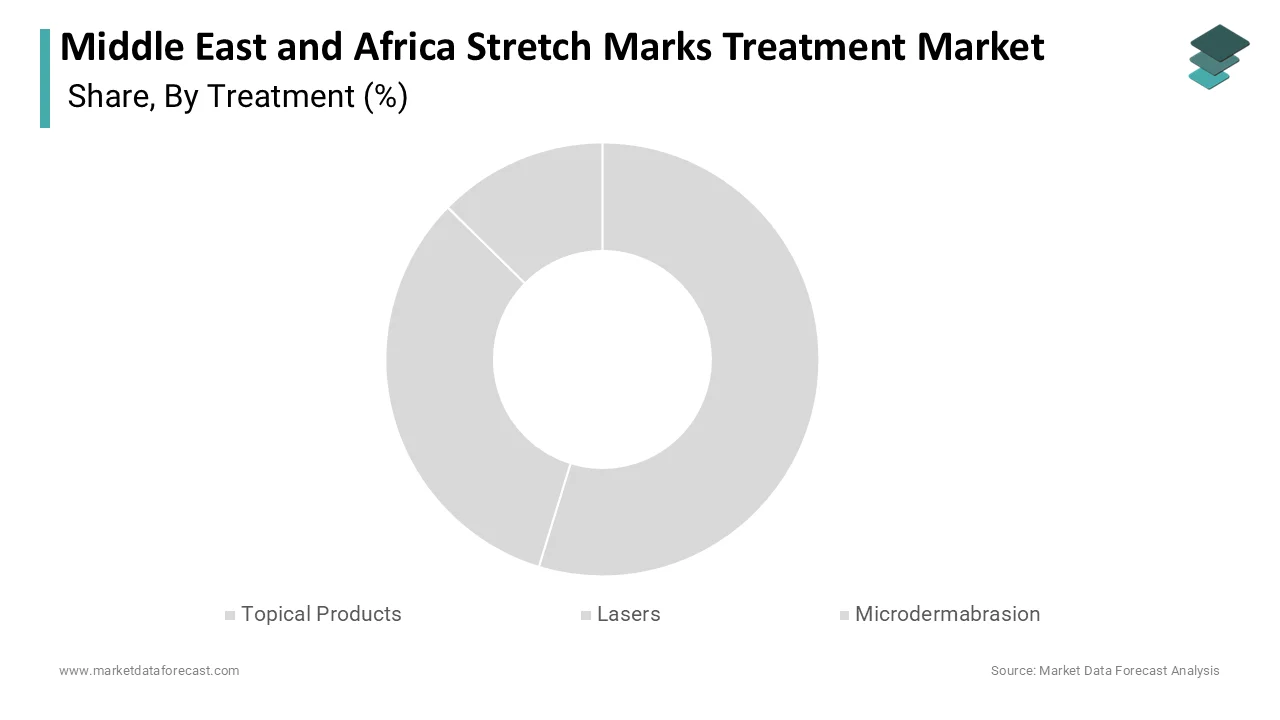
The lasers segment led the Middle East and Africa stretch marks treatment market and captured a significant share in 2025. This leading position of the segment was attributed to superior clinical efficacy for mature striae and technological advancements specifically optimised for Fitzpatrick skin types III to VI prevalent across the region. According to sources, fractional carbon dioxide and Nd: YAG lasers alter deep tissue composition to actively trigger localised neocollagenesis within damaged dermal layers. As per clinical trial reports published in the Journal of Cosmetic Dermatology, long-pulsed 1064 nm Nd: YAG laser technologies deliver precise thermal energy to expand safe clinical outcomes across high-melanin patient populations. Regulatory approvals from SFDA and UAE MOHAP specifically endorse laser protocols for ethnic skin, creating clinical confidence absent for newer modalities. As per institutional academic curriculum updates from regional medical boards, postgraduate dermatology specialisation programs integrate advanced hands-on energy-based device training modules to build specialised workforce capabilities. The evidence-based advantage combined with demographic alignment ensures lasers maintain dominance as the gold standard despite higher cost because patients prioritise efficacy over price when treating psychologically distressing conditions where suboptimal results represent an unacceptable compromise.
Laser segment dominance is structurally reinforced by medical tourism infrastructure across the UAE, South Africa, and Tunisia that anchors high-value laser utilisation through international patient demand insulated from domestic economic volatility. According to the Council for Medical Schemes, the administration of specialised aesthetic resurfacing procedures remains excluded from fundamental public or private medical benefit obligations. Medical free zones in Jordan and Egypt provide tax incentives for laser equipment import, reducing capital costs and enabling competitive pricing. International accreditation from JCI and TEMOS assures quality standards expected by foreign patients, justifying premium positioning. This export-oriented demand creates a stable utilisation base supporting continuous technology upgrades that subsequently benefit local populations through spillover access. Unlike microdermabrasion, which faces commoditization and home device competition, lasers remain procedure-dependent, requiring professional infrastructure, ensuring sustained clinic-based revenue streams resistant to retail disruption.
The microdermabrasion segment is on the rise and is expected to be the fastest-growing segment in the market, with a CAGR of 9.8% from 2026 to 2034, due to affordability and accessibility that expands the addressable population beyond elite segments able to afford laser therapies. According to commercial trade indicators monitored by the International Trade Administration, consumer demand for non-surgical cosmetic care across emerging West and East African urban markets is continuously expanding. Mobile beauty services in Johannesburg and Nairobi bring microdermabrasion directly to homes and offices, eliminating transportation barriers and privacy concerns associated with clinic visits. Social media influencers promote microdermabrasion as a safe starter treatment, building awareness among demographics previously unaware of stretch mark treatment options. This democratization effect transforms stretch mark treatment from luxury to accessible self-care, expanding total addressable market volume even if per-transaction value remains lower than the laser segment, creating a growth trajectory driven by inclusion rather than premiumization.
Growth acceleration in microdermabrasion is fundamentally enabled by safety profile and minimal recovery requirements that align with cultural norms regarding discretion and continuity of daily responsibilities. Microdermabrasion causes no visible downtime, allowing immediate return to work, social obligations, and religious practices without disclosure, enabling treatment seeking among populations previously excluded by recovery visibility concerns. Male patients increasingly adopt microdermabrasion for obesity related striae, as non invasive nature avoids stigma associated with more intensive aesthetic procedures perceived as feminine. According to Islamic jurisprudence council decrees on cosmetic interventions, non-invasive skin health practices are systematically permitted provided they focus strictly on structural skin restoration rather than altering natural features. Workplace policies in GCC countries rarely accommodate aesthetic procedure recovery leave, making zero-downtime treatments practically necessary for employed women. This cultural and practical alignment enables microdermabrasion to penetrate demographics psychologically ready for treatment but socially constrained from accessing traditional modalities, unlocking latent demand through acceptability rather than efficacy superiority.
By End User Insights
In 2025, the speciality dermatology centres segment held the majority share in the Middle East and Africa stretch marks treatment market, because they concentrate advanced laser technology and specialised expertise unavailable in general hospitals or primary care clinics. According to regional medical equipment distribution analyses across the Gulf Cooperation Council, high-intensity aesthetic technologies are increasingly concentrated within specialised dermatology networks to capture lucrative clinical care volumes. King Faisal Specialist Hospital and Cleveland Clinic Abu Dhabi maintain dermatology departments but prioritise medical over aesthetic indications, leaving stretch mark treatment predominantly to private speciality centres. Training fellowships in aesthetic dermatology at American University of Beirut and University of Witwatersrand produce graduates who establish or join speciality centres, creating talent concentration that reinforces technological advantage. Regulatory frameworks in Qatar and Oman require separate licensing for aesthetic laser facilities distinct from hospital accreditation, creating structural separation that favours dedicated centres. This specialisation enables higher procedure volumes, faster technology refresh cycles, and superior outcomes through operator experience, creating a virtuous cycle of reputation and utilisation that generalist settings cannot replicate.
Speciality dermatology centre dominance is culturally reinforced through service models specifically designed to address privacy concerns that limit treatment-seeking in mixed gender hospital environments. As per the Journal of Dermatological Treatment, systemic service quality parameters and provider communication play dominant roles in determining clinical satisfaction metrics across regional outpatient networks. Speciality centres invest in gender segregated waiting areas, female-only operating suites, and modesty-preserving gowns that hospitals with shared infrastructure cannot accommodate due to operational constraints. Marketing communications emphasise female practitioner teams and discreet facility design, resonating with cultural values that hospital branding focused on medical authority fails to address. Telehealth pre-consultation platforms offered by speciality centres like DermaClinic Dubai and SkinHealth Johannesburg enable initial assessment without a physical visit, reducing anxiety about clinic attendance for first-time patients. Staff training includes cultural competency modules addressing communication styles, consent processes, and religious sensitivity absent in general hospital curricula. This cultural alignment transforms speciality centres from mere service providers to trusted safe spaces, enabling treatment-seeking among populations otherwise deterred by institutional environments perceived as impersonal or culturally incongruent, securing market leadership through psychosocial fit rather than clinical superiority alone.
The Home use devices segment is likely to experience the fastest CAGR of 14.5% during the forecast period owing to digital commerce infrastructure that bypasses traditional retail limitations and reaches geographically dispersed populations. According to financial retail metrics released in official e-commerce performance briefings, digital commercial marketplaces throughout the region are actively tracking strong upward consumer transaction trends across the personal wellness segment. Mobile money integration via M-Pesa and Fawry enables cashless transactions for unbanked populations, expanding financial inclusion for aesthetic purchases. Social commerce through Instagram and TikTok enables influencer demonstrations and peer reviews, building trust in products that lack physical retail presence for hands-on evaluation. Cross-border e-commerce regulations under AfCFTA facilitate intra-African device trade, reducing import barriers and expanding product availability. Subscription models for consumable cartridges create recurring revenue streams, improving unit economics for manufacturers serving low-density markets. This digital leapfrog enables the home use segment to scale independently of brick-and-mortar infrastructure constraints that limit clinic and speciality centre expansion, creating a growth trajectory aligned with regional digital transformation rather than healthcare system development.
Growth acceleration in home use devices is fundamentally propelled by privacy preservation and cost efficiency that address dual barriers of cultural stigma and economic constraint limiting clinic-based treatment adoption. As per regional consumer tracking assessments organised by YouGov Middle East, shifting domestic purchasing behaviours are consistently expanding the active consumer market share for at-home cosmetic hardware alternatives. Male patients increasingly adopt home devices for obesity related striae, as private self-administration avoids the stigma of attending aesthetic clinics perceived as feminine spaces. Religious interpretations permitting self-care while cautioning against unnecessary exposure to non-family members create a theological permission structure favouring home use over professional services. Pandemic-era normalisation of self-care routines accelerated acceptance of home aesthetic devices as a legitimate rather than an inferior option. Employer-sponsored wellness programs in the UAE and South Africa increasingly include home device subsidies as a mental health benefit, recognising body image impact on wellbeing. This convergence of cultural, economic and practical factors enables the home use segment to capture demand structurally inaccessible to clinic-based models, creating growth independent of healthcare system capacity or professional workforce expansion.
COUNTRY LEVEL ANALYSIS
Kingdom Of Saudi Arabia Stretch Marks Treatment Market Analysis
The Kingdom of Saudi Arabia was the top performer in the Middle East and Africa stretch marks treatment market and occupied a 28.4% share in 2025. This supremacy of the KSA market was propelled by high disposable income, a strong regulatory framework, and Vision 2030 healthcare privatisation initiatives serving millions of inhabitants. According to the Saudi Food and Drug Authority, aesthetic laser and energy-based systems require strict conformity certifications before deployment to prevent unauthorised clinical use. As per the General Authority for Statistics, Saudi Arabia's overarching population growth dynamics continue to drive expansive regional consumer bases for specialised family health and maternal care infrastructures. According to official policy updates for the Health Sector Transformation Program of Saudi Vision 2030, a strategic financial envelope of 65 billion USD is actively driving private sector privatisation and infrastructure modernisations across national healthcare networks. Strict halal certification requirements for topical products create a differentiated market for compliant formulations favouring regional manufacturers over global brands lacking religious compliance documentation. Medical tourism from neighbouring Yemen and Sudan supplements domestic demand, though visa restrictions limit volume compared to the UAE. This combination of wealth regulation and demographic momentum makes KSA not just the largest but also most structured market where compliance and quality standards drive competitive dynamics rather than price alone.
United Arab Emirates Stretch Marks Treatment Market Analysis
The United Arab Emirates was the next prominent country in the Middle East and Africa stretch marks treatment market and secured a 22.1% share in 2025 because of a world-class medical tourism infrastructure, liberal regulatory environment, and cosmopolitan consumer base, serving 10 million residents and millions of annual visitors. According to official annual performance results by the Dubai Health Authority, international medical tourists travelling to Dubai medical facilities generated direct expenditures reaching approximately 992 million AED. As per the Ministry of Health and Prevention, the federal medical licensing architecture utilises standardised clinical evaluations to govern the structural safety of aesthetic healthcare installations. According to the Federal Competitiveness and Statistics Centre, the expatriate population baseline comprises the absolute majority of total documented residents residing across the United Arab Emirates. As per regulatory investment frameworks managed within Dubai Healthcare City, incoming commercial medical operators utilise dedicated free zone financial incentives alongside 100% corporate ownership privileges to establish clinical facilities. High smartphone penetration enables sophisticated digital marketing and telehealth integration, accelerating consumer education and appointment conversion. Obesity prevalence among nationals creates domestic demand complementing medical tourism revenue streams. This unique positioning as a regional hub makes the UAE a trendsetter where new technologies and business models are validated before diffusion to neighbouring markets, creating outsized influence relative to population size.
Israel Stretch Marks Treatment Market Analysis
Israel occupies a significant position in the regional market due to advanced technological innovation, a robust R&D ecosystem, and universal healthcare coverage that integrates certain stretch mark treatments into medical indications. According to the Israel Central Bureau of Statistics, macroeconomic tracking confirms that Israel allocates approximately 7.0% of its total gross domestic product toward sustaining national healthcare infrastructure. As per sources, global aesthetic system developers Syneron Candela and Lumenis utilise regional engineering networks to distribute specialised laser technologies across diverse international markets. Military service-related weight fluctuations and pregnancy during mandatory conscription create unique demographic demand patterns, with IDF medical corps providing treatment access, normalising intervention among young adults. The startup ecosystem attracts venture capital investment in aesthetic tech. Universal healthcare reduces economic barriers, enabling broader population access than neighbouring countries despite higher absolute costs. Cultural secularism reduces privacy constraints, enabling open marketing and mixed gender service delivery, increasing operational efficiency. This innovation-led model creates disproportionate influence on regional technology standards despite smaller market size.
South Africa Stretch Marks Treatment Market Analysis
South Africa is another key player in the regional market. It serves as a continental leader in advanced aesthetic medicine, with sophisticated private healthcare infrastructure and established medical tourism ecosystems. As per the Council for Medical Schemes, South African private medical plans legally focus their pooled financial resources on funding prescribed minimum benefits for core clinical health conditions. Discovery Health and Momentum administer wellness programs incorporating stretch mark prevention and treatment as part of holistic health incentives aligning with behavioural economics approaches to engagement. According to regional academic updates from the Colleges of Medicine of South Africa, standardised postgraduate medical specialisation programs systematically govern the certification and development of registered clinical dermatologists. The dual burden of HIV associated lipodystrophy and obesity related striae creates unique clinical indications expanding beyond traditional postpartum and weight gain etiologies. Load shedding and infrastructure challenges constrain clinic operations, creating opportunity for battery-powered and portable devices suited to unreliable power environments. This position as a gateway market makes South Africa a critical entry point for pan-African expansion despite operational complexities.
COMPETITIVE LANDSCAPE
Competition in the Middle East and Africa stretch marks treatment market is characterized by extreme heterogeneity reflecting vast economic cultural and infrastructural disparities across the region. In affluent GCC states competition centers on advanced technology differentiation premium service experiences and medical tourism positioning with global brands competing on clinical outcomes and luxury amenities. Across North Africa and Levant price sensitivity and currency constraints favor value oriented players offering flexible financing refurbished equipment and localized manufacturing reducing import dependency. Sub Saharan African markets remain fragmented with informal sector dominance unregulated practitioners and counterfeit products undermining legitimate competitors though digital platforms increasingly enable formal market penetration. Cultural adaptation creates additional competitive dimension where companies demonstrating understanding of privacy norms religious requirements and gender dynamics capture demand inaccessible to technically superior but culturally insensitive alternatives. Workforce development capabilities differentiate winners as operator competency matters more than device specifications in regions with training deficits. Medical tourism corridors create transnational competitive arenas where providers compete across borders for international patients regardless of domestic market maturity. This multifaceted landscape rewards companies balancing technological excellence with contextual intelligence recognizing that MEA comprises dozens of distinct micro markets requiring tailored approaches rather than monolithic regional strategies. Success depends on navigating complexity rather than achieving scale making agility and localization more valuable than global brand recognition alone.
KEY MARKET PLAYERS
Some of the companies that are playing a dominating role in the Stretch Marks Treatment Market include:
- Laboratoires Expanscience
- Clarins Group
- Merz North America, Inc.
- Syneron Medical Ltd.
- E.T. Browne Drug Co., Inc.
- Cynosure, Inc.
- Centre Light Solutions, LLC
- Basq Skincare
TOP LEADING PLAYERS IN THE MARKET
- Lumenis Ltd. maintains significant presence across Middle East and Africa through its fractional CO2 and Nd YAG laser platforms optimized for diverse skin phototypes prevalent in the region. The company recently established training centers in Dubai and Johannesburg addressing critical workforce gaps in safe laser operation for ethnic skin. Regulatory approvals from SFDA and UAE MOHAP validate device safety for regional populations building practitioner confidence. Service infrastructure expansion includes local spare parts inventory and bilingual technical support minimizing downtime in remote locations. Clinical evidence generation through partnerships with King Saud University and University of Cape Town demonstrates efficacy in local populations supporting reimbursement discussions and formulary inclusion. These initiatives strengthen position through education and localization rather than technology alone recognizing that market penetration depends on operator competency and cultural trust as much as device specifications in regions where safety concerns historically limited laser adoption.
- Syneron Candela leverages Israeli R&D heritage and regional proximity to serve Middle East and Africa stretch marks treatment market with Vbeam and GentleMax platforms validated across Mediterranean and African skin types. The company recently launched Arabic and French language user interfaces enabling safer operation by non English speaking practitioners expanding geographic reach beyond elite international clinics. Strategic partnerships with distributors enable affordable financing models accommodating currency volatility and import restrictions affecting capital equipment purchases. Post marketing surveillance programs exceed regulatory requirements documenting safety outcomes in regional populations building evidence base for insurance coverage expansion. Training collaborations with Tel Aviv University and American University of Beirut produce certified operators creating talent pipeline supporting sustainable utilization. Direct engagement with medical tourism facilitators in UAE and South Africa integrates Syneron devices into packaged treatment offerings attracting international patients. Supply chain investments in regional warehouses reduce delivery times and customs delays improving service reliability. These actions demonstrate commitment to long term market development through ecosystem building rather than transactional sales aligning with regional needs for accessible safe and culturally appropriate aesthetic solutions.
- Merz Aesthetics contributes to Middle East and Africa stretch marks treatment market through Ultherapy platform offering non invasive skin tightening alternative for patients avoiding ablative lasers due to downtime or cultural privacy concerns. The company recently secured halal certification for topical adjunct products enabling compliance with religious requirements in GCC markets expanding addressable patient population. Partnerships with female only clinic chains in Saudi Arabia and Kuwait align service delivery with cultural norms increasing acceptance among conservative demographics previously excluded from mixed gender facilities. Digital education platforms provide remote practitioner training overcoming geographic barriers to expertise access in underserved regions. Clinical studies conducted at Cleveland Clinic Abu Dhabi validate efficacy in Middle Eastern skin types generating locally relevant evidence supporting adoption. Patient awareness campaigns emphasize discretion and zero recovery addressing privacy concerns limiting treatment seeking. Distribution partnerships with Jumia and Noon enable direct consumer access to home maintenance products extending professional treatment outcomes. These strategies position Merz at intersection of cultural sensitivity and technological innovation capturing demand segments constrained by social norms rather than economic factors alone.
TOP STRATEGIES USED BY KEY MARKET PARTICIPANTS
Key players prioritize workforce development through regional training centers and certification programs addressing critical operator shortages limiting safe technology utilization across diverse MEA settings. Companies invest in cultural adaptation including female only service models modesty preserving protocols and halal certifications aligning with religious and social norms governing body exposure and treatment acceptability. Strategic partnerships with local distributors enable flexible financing and supply chain resilience navigating currency volatility import restrictions and logistical challenges unique to each national context. Clinical evidence generation in regional populations validates safety and efficacy for ethnic skin types building practitioner confidence and supporting reimbursement discussions with public and private payers. Digital health integration through telemedicine platforms and e commerce channels bypasses physical infrastructure limitations reaching geographically dispersed populations and privacy conscious consumers avoiding clinic visits. Medical tourism alignment positions technologies within cross border patient flows leveraging cost arbitrage and quality differentials to sustain utilization independent of domestic economic conditions. Regulatory engagement focuses on harmonization advocacy and local approval acceleration reducing market entry fragmentation across jurisdictions. These interconnected strategies reflect MEA market realities where success requires multidimensional adaptation beyond product specifications encompassing cultural economic infrastructural and human capital dimensions defining regional competitive advantage.
MIDDLE EAST AND AFRICA STRETCH MARKET NEWS
-
In May 2022, Givaudan Active Beauty a promient cosmetics company launched Centella CAST, Centella CAST is a natural ingredient that is derived from Centella asiatica, also known as gotu kola. It acts on factors that cause the Stretch Marks to restore skin elasticity, firmness, and density.
-
In April 2022, Skin Science Solutions a reputed Skin care compnay launched Icoone Roboderm, Icoone Roboderm is a new generation device that uses Multi Micro Alveolar Stimulation (MMAS) technology to offer painless and non-invasive facial and body rejuvenation, Icoone Roboderm offers a wide range of customizable and effective treatments for the face and body. MMAS technology is a patented technology that uses a series of small rollers to massage the skin, stimulating the production of collagen and elastin, this not only reduces the appearance of Stretch marks but also helps with wrinkles and other skin concerns.
MARKET SEGMENTATION
This research report on the Middle East and Africa Stretch Marks Treatment Market has been segmented and sub-segmented into the following categories.
By Type
- Topical Products
- Lasers
- Microdermabrasion
By Sub-Type
- Creams
- Oils, Gels
- Lotions
By Application
- Hospitals & Clinics
- Home use
By region
- Saudi Arabia
- UAE
- Egypt
- South Africa