- Product Description Description
- Table of Contents TOC
- List of Table & Figure LOT
- Get Free Sample PDF Sample PDF
Market Size, 2025
$59.90 MnMarket Estimate, 2026
$60.25 MnMarket Forecast, 2034
$63.10 MnCAGR, 2026–2034
0.58%Europe Sugar Market Report Summary
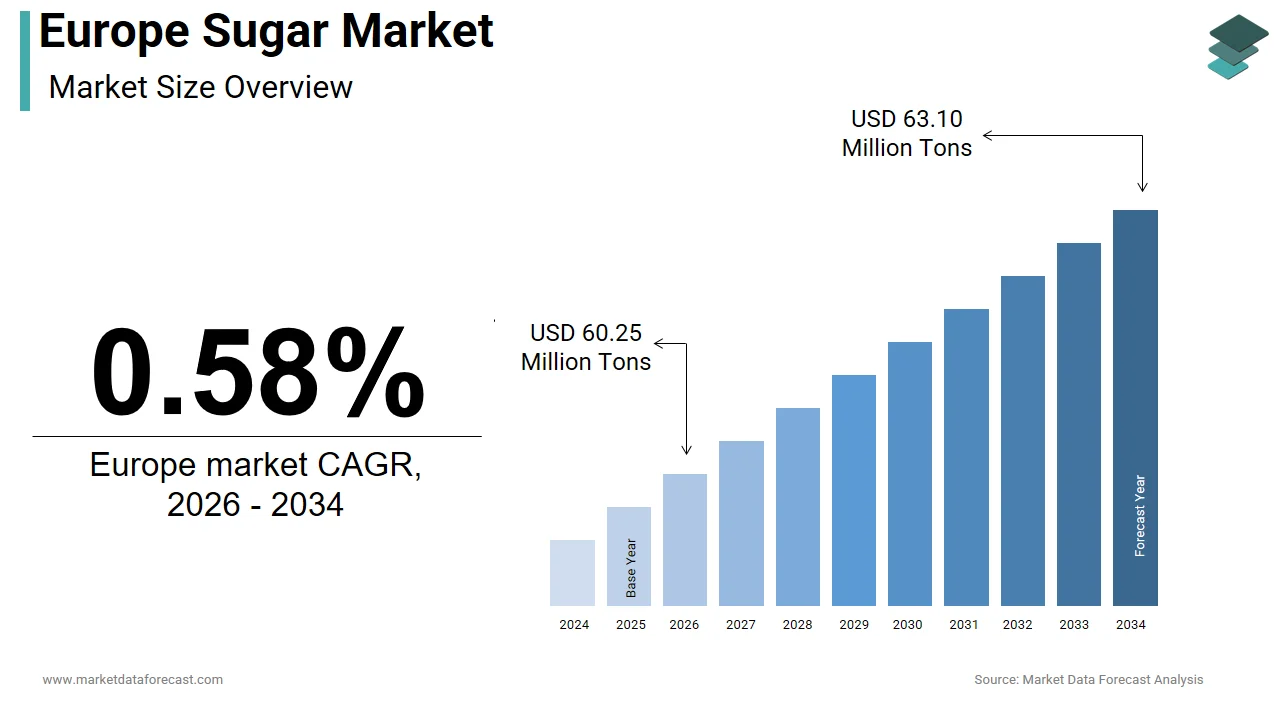
The Europe sugar market reached 59.90 million tons in 2025, is estimated to reach 60.25 million tons in 2026, and is projected to reach 63.10 million tons by 2034, growing at a CAGR of 0.58% from 2026 to 2034. Market growth is supported by steady demand from the food and beverage industry, expansion of sugar beet cultivation across European countries, and the continued use of sugar in confectionery, bakery, and processed food products. Although health concerns regarding sugar consumption are increasing, the market remains stable due to strong industrial demand and established supply chains. Additionally, improvements in agricultural productivity, modernization of sugar processing facilities, and the growing use of sugar in bio-based products are contributing to the sustained demand across the European region.
Key Market Trends
- Stable demand from the food and beverage industry, especially in confectionery and bakery products.
- Expansion of sugar beet cultivation and processing infrastructure across Europe.
- Increasing focus on sustainable agricultural practices and efficient sugar production.
- Rising investments in bio-based products and industrial applications of sugar.
- Growing innovation in sugar alternatives and reformulation strategies in food products.
Segmental Insights
- Based on product type, the white sugar segment dominated the Europe sugar market by accounting for 66.5% share in 2025, driven by its extensive use in household consumption and food processing industries.
- Based on form, the granulated sugar segment held the largest share in 2025, supported by its widespread application in food manufacturing, beverages, and retail consumption.
- Based on end-use sector, the food and beverages segment led the market by capturing 85.5% share in 2025, due to sugar’s essential role in taste enhancement, texture improvement, and preservation in numerous food products.
Regional Insights
The Europe sugar market shows stable growth across major producing countries due to strong agricultural production, well-established sugar processing industries, and sustained industrial demand.
- France led the regional market in 2025 with 23.5% share, supported by large-scale sugar beet cultivation and advanced sugar processing facilities.
- Germany ranked second in the regional market in 2025 due to its strong sugar manufacturing industry and high domestic consumption.
- Poland is expected to register notable growth during the forecast period due to expanding sugar beet production and increasing investments in sugar processing infrastructure following its integration into the European Union agricultural framework.
Competitive Landscape
The Europe sugar market is characterized by the presence of large multinational sugar producers and regional processing companies. Market participants are focusing on improving agricultural productivity, expanding refining capacities, and adopting sustainable production practices to strengthen their market position. Strategic investments in supply chain optimization and product diversification are shaping competitive dynamics across the region.
Prominent companies operating in the Europe sugar market include Al Khaleej Sugar, Associated British Foods plc, Canal Sugar, British Sugar, Dwarikesh Sugar Industries Limited, Lantic Inc., Louis Dreyfus Company, Michigan Sugar Company, Mitr Phol Sugar Co., Ltd., Nordzucker, Rajshree Sugars & Chemicals Ltd, Suedzucker AG, Tereos, Thai Roong Ruang Group, and Wilmar International Limited.
Europe Sugar Market Size
The size of the Europe sugar market was 59.90 million tons in 2025. The regional market is anticipated to grow at a CAGR of 0.58% from 2026 to 2034 and be worth 63.10 million tons by 2034 from 60.25 million tons in 2026.
Sugar is derived primarily from sugar beet that accounts for nearly all domestic output in the region. Unlike global markets dominated by sugarcane, Europe’s sugar industry is structurally defined by its temperate climate suitability for beet cultivation and a legacy of policy frameworks shaped by the European Union’s Common Agricultural Policy. As per Eurostat, the European Union has been harvesting large volumes of sugar beet cultivated across extensive arable land, which is predominantly in France, Germany, and Poland. The sector operates under a fully liberalized regime since the expiration of EU sugar quotas in 2017, which is leading to greater market responsiveness but also heightened exposure to global price volatility and sustainability pressures. According to the European Commission’s Agricultural Outlook 2023–2030, per capita sugar consumption in the EU has stabilized, with a gradual shift toward reduced intake in processed foods driven by public health initiatives. Meanwhile, the European Food Safety Authority reaffirmed that added sugars should not exceed 10% of total daily energy intake, influencing reformulation trends across food and beverage manufacturers. These intersecting forces of agricultural policy, health guidance, and supply chain dynamics define the contemporary contours of the Europe sugar market.
MARKET DRIVERS
Deep Integration of Sugar in Processed Food and Beverage Formulations
Sugar remains a functional and sensory cornerstone in a vast array of European food and beverage products, which is extending far beyond its role as a sweetener and is driving the expansion of the European sugar market. According to the European Food and Drink Association, a large majority of packaged food items in the EU contain added sugars, which serve critical roles in texture, preservation, fermentation, and browning reactions. In bakery products, sugar controls yeast activity and moisture retention; in dairy, it balances acidity in yogurts and in canned goods, it acts as a microbial inhibitor. According to the European Brewery Convention, sugar derivatives such as invert syrup are essential in specialty beer production, with craft breweries across Germany, Belgium, and the Netherlands relying heavily on them. Moreover, the confectionery sector relies almost exclusively on refined beet sugar, with France and Italy producing significant volumes of chocolate and sugar confectionery, as per Eurostat. Despite reformulation efforts, complete sugar substitution remains technically unfeasible in many applications due to the lack of functional equivalence in alternatives. This embedded utility ensures sustained industrial demand, even as consumer-facing messaging emphasizes reduction.
Structural Dependence on Sugar Beet Farming in Rural Economies
Sugar beet cultivation forms an indispensable pillar of agricultural livelihoods in several European regions, which is creating a resilient production base that supports the domestic sugar market. As per the European Commission’s Farm Structure Survey, hundreds of thousands of farms across the EU grow sugar beet, with average farm sizes being substantial in key producing countries. In northern France, the beet sector supports tens of thousands of jobs directly and indirectly, according to FranceAgriMer. Similarly, in Germany’s Lower Saxony and North Rhine-Westphalia, beet farming contributes significantly to rural income stability, with processing facilities often serving as the largest local employers. The crop’s rotation benefits make it a preferred component of agronomic planning in intensive cereal zones. According to Poland’s State Agricultural Market Agency, sugar beet provides one of the highest gross margins per hectare among non-subsidized field crops, which is incentivizing continued planting despite climate pressures. This deep socioeconomic entrenchment, which is reinforced by decades of infrastructure investment in processing and logistics, ensures a steady supply chain that buffers the market against abrupt external shocks and sustains long term production capacity.
MARKET RESTRAINTS
Public Health Policies Driving Sugar Reduction Mandates
Stringent public health measures across European nations are significantly curbing sugar demand, particularly in beverages and discretionary foods, which is primarily hampering the growth of the European sugar market. The World Health Organization’s European Regional Office has consistently advocated for fiscal and regulatory interventions to reduce free sugar intake, leading to national actions such as the United Kingdom’s Soft Drinks Industry Levy, which reduced sugar content in targeted beverages substantially, according to Public Health England. Similar measures are emerging continent-wide; Portugal implemented mandatory front-of-pack warning labels for high sugar products, while Belgium introduced sugar content caps for school meal suppliers. The European Commission’s Farm to Fork Strategy update emphasized voluntary reduction targets, but national authorities are increasingly opting for binding rules. As per the European Observatory on Health Systems and Policies, numerous EU member states now enforce either sugar taxes, advertising restrictions, or reformulation mandates affecting sugar use. These policies directly depress industrial sugar procurement, with beverage manufacturers cutting EU sugar purchases significantly, as documented by FoodDrinkEurope. The cumulative regulatory pressure reshapes product development and suppresses volume growth.
Environmental and Sustainability Pressures on Beet Cultivation
Sugar beet farming faces mounting scrutiny over its environmental footprint, particularly concerning pesticide use, water consumption, and soil degradation, which is further impeding the sugar market expansion in Europe. According to the European Environment Agency’s Soil Threats Assessment, intensive beet monocultures in regions like the Paris Basin and the Po Valley contribute to elevated nitrate leaching and reduced organic matter content. According to the European Food Safety Authority, neonicotinoid seed treatments remain under restricted emergency authorization in several countries due to pollinator risks and increasing crop vulnerability. In France, the government’s Ecophyto Plan II aims to cut pesticide use significantly by 2025, which is directly impacting beet yields; the French Institute for Agricultural Research estimated notable yield declines if alternatives are not scaled. Additionally, the EU’s Sustainable Use of Pesticides Regulation mandates buffer zones and integrated pest management, raising production costs. These ecological constraints challenge the long-term viability of current farming models and may reduce beet area allocation, thereby tightening raw material supply for sugar processors and increasing input price volatility.
MARKET OPPORTUNITIES
Expansion of Sugar into Bio-Based Industrial Applications
Emerging non-food uses of sugar present a strategic diversification avenue for the Europe sugar market, particularly in the bioeconomy and renewable chemicals sector. As per the European Bioplastics Association, bio-based ethylene derived from beet sugar is increasingly used to produce polyethylene for packaging, with production capacity in the EU continuing to grow. Companies like Corbion and Avantium have partnered with European sugar producers to develop lactic acid and furandicarboxylic acid from sucrose, serving as building blocks for biodegradable plastics. The European Commission’s Circular Economy Action Plan identifies sugar as a key non-food biomass feedstock, and its Innovation Fund has allocated substantial funding to pilot biorefineries converting beet molasses into biochemicals. In Sweden, a joint venture between Nordzucker and a green chemicals startup began commercial production of bio-based surfactants, using sugar as the primary carbon source. According to the Joint Research Centre, the EU’s potential demand for sugar in non-food industrial applications could reach significant volumes annually by 2030. This shift not only creates new revenue streams but also aligns the sugar sector with Europe’s decarbonization and circularity objectives.
Growth of Organic and Regionally Sourced Sugar Niche
Consumer demand for transparency and sustainability is fuelling a premium segment for organic and locally produced sugar, which is offering value-added opportunities for the European sugar market. As per Eurostat, the area under organic sugar beet cultivation in the EU has expanded considerably, primarily in Germany, Austria, and the Netherlands. Retailers such as Edeka and Carrefour have launched private label lines featuring “100% EU beet sugar” with traceability guarantees, responding to consumer surveys showing strong preference for locally sourced sweeteners according to the European Consumer Organisation’s Food Transparency Index. Certification schemes like EU Organic and Fair for Life enable price premiums, improving margins for processors investing in segregated supply chains. In Denmark, Nordic Sugar introduced a carbon-labeled organic sugar product, verified by third-party auditors for its reduced greenhouse gas footprint. This trend reflects a broader shift toward ethical consumption, allowing sugar producers to differentiate beyond commodity pricing and build brand loyalty in an otherwise mature market.
MARKET CHALLENGES
Volatility in Global Sugar Prices and Trade Policy Uncertainty
The Europe sugar market remains vulnerable to external price shocks and shifting trade dynamics, despite its beet-based self-sufficiency. According to the International Sugar Organization, global raw sugar prices surged significantly due to supply disruptions in Brazil and India, triggering speculative activity in EU refined sugar futures. Although the EU is a net exporter, it still imports specialty sugars and raw cane for refining, which is exposing processors to international cost fluctuations. According to the European Commission’s Trade Policy Review, retaliatory tariffs and changing preferential access for African, Caribbean, and Pacific countries create unpredictability in export volumes. Furthermore, the EU’s Everything but Arms initiative allows duty-free sugar imports from least developed nations, which have increased as per Eurostat, adding competitive pressure on domestic prices. These external forces complicate long term planning for European sugar firms, especially smaller cooperatives lacking hedging capabilities, and can trigger abrupt margin compression even in years of stable beet harvests.
Climate Change Impacts on Sugar Beet Yield Stability
Increasing climatic variability poses a direct threat to the reliability of sugar beet production across Europe, which is undermining the market’s foundational supply base and further challenging the regional market growth. According to the Copernicus Climate Change Service, the frequency of extreme weather events in key beet regions has risen, with droughts reducing yields in France and Germany as documented by national agricultural ministries. In Poland, unseasonal spring frosts damaged emerging beet crops, while excessive rainfall in the Netherlands delayed harvesting and lowered sugar content. The Joint Research Centre’s Crop Outlook warned that rising temperatures could shorten the optimal growing window in southern Europe, potentially shifting viable cultivation zones northward. Breeding programs for climate-resilient varieties are underway, but adoption lags due to regulatory hurdles under the EU’s genetically modified organism framework. Without adaptive agronomic strategies and irrigation infrastructure investment—both costly for farmers—the sector faces recurring supply shortfalls that disrupt processing schedules, inflate costs, and increase reliance on imports during deficit years, thereby destabilizing the entire market equilibrium.
REPORT COVERAGE
| REPORT METRIC | DETAILS |
| Market Size Available | 2025 to 2034 |
| Base Year | 2025 |
| Forecast Period | 2026 to 2034 |
| Segments Covered | By Product Type, Form, End-Use Sector, Source, and Country. |
| Various Analyses Covered | Global, Regional, and Country-Level Analysis, Segment-Level Analysis, Drivers, Restraints, Opportunities, Challenges; PESTLE Analysis; Porter’s Five Forces Analysis, Competitive Landscape, Analyst Overview of Investment Opportunities |
| Countries Covered | UK, France, Spain, Germany, Italy, Russia, Sweden, Denmark, Switzerland, Netherlands, Turkey, Czech Republic, and the Rest of Europe. |
| Market Leaders Profiled | Al Khaleej Sugar, Associated British Foods plc, Canal Sugar, British Sugar, Dwarikesh Sugar Industries Limited, Lantic Inc., Louis Dreyfus Company, Michigan Sugar Company, Mitr Phol Sugar Co., Ltd., Nordzucker, Rajshree Sugars & Chemicals Ltd., Südzucker AG, Tereos, Thai Roong Ruang Group, Wilmar International Limited, and Others. |
SEGMENTAL ANALYSIS
By Product Type Insights
The white sugar segment led the market with 66.5% of the regional market share in 2025. The dominance of the white sugar segment in the European market is attributed to its foundational role in both industrial processing and household use. Food and beverage manufacturers across Europe rely on white sugar for its standardized crystalline structure and predictable behavior in production processes. According to the European Food and Drink Association, the majority of confectionery and bakery formulations in the EU specify refined white sugar due to its precise solubility, caramelization properties, and shelf stability. In beverage production, particularly in soft drinks and dairy products, white sugar ensures clarity and consistent sweetness without introducing color or off notes. The European Brewery Convention reported that specialty white sugar syrups are used in a significant portion of premium lager and wheat beer recipes to fine-tune fermentability. Additionally, EU regulatory standards list refined sucrose as a permitted ingredient with no usage limits, which reinforces its acceptability. As per the European Commission’s Food Ingredients Inventory, white sugar remains the most frequently declared sweetener in processed food labeling across all member states, which is indicating its entrenched position in industrial supply chains.
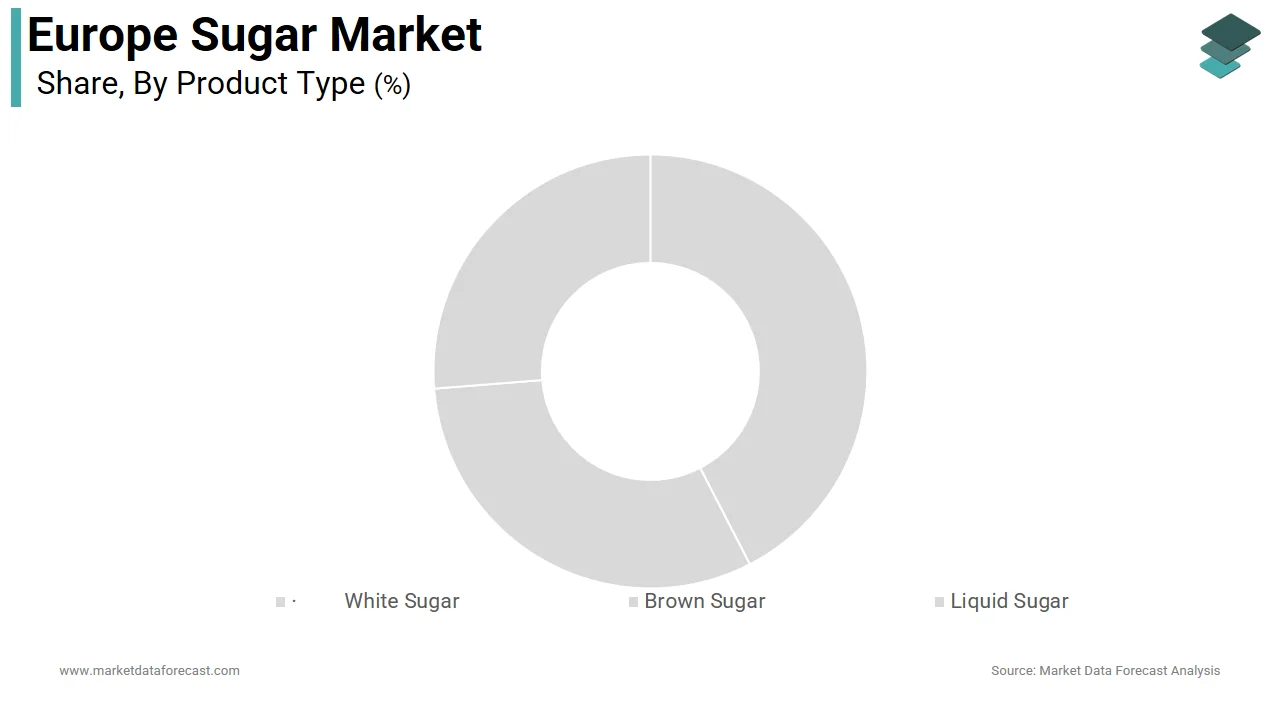
The liquid sugar segment is anticipated to register a CAGR of 10.2% over the forecast period in the European sugar market. Liquid sugar eliminates the need for on-site dissolution, reducing energy use, labor costs, and contamination risks in high-volume production environments. According to the European Dairy Association, a majority of yogurt and flavored milk producers in France, Germany, and the Netherlands switched to liquid sugar delivery systems to streamline operations. The European Soft Drinks Association noted that liquid sugar integration cut mixing time significantly in carbonated beverage lines. Major processors such as Nestlé and Danone have mandated liquid sugar use in their European facilities to ensure batch consistency and reduce cleaning downtime. Furthermore, closed pipeline delivery systems minimize dust exposure, aligning with occupational health guidelines issued by the European Agency for Safety and Health at Work. These operational advantages make liquid sugar increasingly indispensable for modern, automated food factories seeking leaner and safer production workflows.
By Form Insights
The granulated sugar segment led the market with 700.7% of the regional market share in 2025. The leading position of the granulated sugar segment in the European market is attributed to its dual utility in industrial applications and household consumption. Granulated sugar’s uniform crystal size and free-flowing properties make it ideal for a wide range of uses, from baking and beverage sweetening to fermentation and preservation. According to the German Federal Ministry of Food and Agriculture, most industrial bakeries in Germany specify medium grain granulated sugar for consistent dough performance and browning. In the beverage sector, granulated sugar remains the standard for on-premise drink preparation in cafes and restaurants across Europe. According to the European Coffee Federation, granulated sugar accounted for the overwhelming majority of tabletop sweetener use in hospitality venues. Its stability during storage further enhances its appeal for bulk procurement. National food safety authorities, including France’s ANSES, recognize granulated sucrose as a low-risk ingredient with minimal microbial concerns, which is facilitating its use in ready-to-eat products. This functional reliability ensures granulated sugar remains the default form across both commercial and domestic settings.
The syrup sugar segment is a promising segment and is estimated to grow at a CAGR of 11.5% over the forecast period. Small-scale producers of baked goods, confectionery, and specialty beverages increasingly favor syrup sugar for its ease of incorporation and moisture-enhancing properties. According to the European Artisanal Food Producers Network, a majority of craft bakeries in Italy and Belgium adopted glucose fructose syrup or invert sugar syrups to improve shelf life and texture in gluten-free and vegan products. In the premium spirits sector, sugar syrup is essential for liqueur and cordial production, where precise sweetness and clarity are critical. According to the European Spirits Organisation, a notable increase in small batch liqueur launches, all requiring liquid sweeteners. Unlike industrial liquid sugar, syrup sugar often includes functional blends that add flavor complexity, which is appealing to consumers seeking authenticity. This artisanal renaissance, supported by EU rural development funds, drives consistent demand for specialized syrup formats.
By End Use Sector Insights
The food and beverages segment dominated the market by holding 85.5% of the regional market share in 2025 due to sugar’s irreplaceable role in taste, texture, and preservation across countless products. Sugar is not merely a sweetener but a critical functional ingredient in Europe’s staple processed foods. According to the European Bakery Federation, sugar controls yeast fermentation, retains moisture, and contributes to crust color in bread and pastries. In dairy, the European Dairy Association confirmed that sugar stabilizes pH and enhances mouthfeel in yogurts, with most flavored variants containing sucrose. Confectionery relies almost entirely on sugar for structure; the European Confectionery Association reported that hard candies, caramels, and fondants require precise sucrose crystallization to achieve desired textures. Even in savory applications like canned tomatoes and sauces, sugar balances acidity, which is a practice documented in a majority of EU processed food formulations by the European Food Information Council. This multifunctionality ensures that despite reformulation efforts, sugar remains embedded in the technical DNA of European food manufacturing.
The pharma and personal care segment is anticipated to witness a CAGR of 12.2% over the forecast period in the European sugar market. Sucrose serves as a critical bulking agent, cryoprotectant, and stabilizer in vaccines, biologics, and oral medications. According to the European Medicines Agency, a majority of lyophilized injectable drugs approved in the EU included sucrose in their formulation to preserve protein integrity during freeze drying. In oral solid dosage forms, sugar masks bitter active ingredients, which improves patient compliance, particularly in pediatric medicines. According to the European Federation of Pharmaceutical Industries and Associations, sucrose-based syrups remain the preferred vehicle for liquid antibiotics in children due to palatability and stability. Additionally, the rise of mRNA vaccine platforms has increased demand for ultra-pure pharmaceutical-grade sugar, with European manufacturers sourcing certified sucrose for cold chain stabilization. As biologics account for a growing share of new drug approvals in Europe, sugar’s role as a non-reactive and biocompatible excipient continues to expand.
COUNTRY-LEVEL ANALYSIS
France Sugar Market Analysis
France led the sugar market in Europe in 2025 with 23.5% of the regional market share. The dominance of France in the European market is attributed to its status as the EU’s top sugar beet producer and a hub for food processing innovation. According to FranceAgriMer, the country harvested significant volumes of sugar beet in northern regions such as Picardy and Champagne. France’s sugar industry is vertically integrated, with cooperatives such as Tereos and Cristal Union controlling both farming and refining, ensuring supply chain resilience. The nation’s culinary tradition drives consistent domestic demand, while its confectionery and dairy sectors consume vast quantities for industrial use. According to the French government, funding has been allocated to modernize beet harvesting equipment to boost yield efficiency. Additionally, as per Tereos, a biorefinery was inaugurated to convert beet pulp into bio-based chemicals.
Germany Sugar Market Analysis
Germany held the second-largest share of the European sugar market in 2025. The growth of Germany in the European market is driven by its advanced processing infrastructure, strong export orientation, and robust demand from its world-class food and beverage sector. According to the German Federal Statistical Office, Germany processed large volumes of sugar beet primarily in Lower Saxony and Bavaria. Companies like Nordzucker operate state-of-the-art refineries that supply domestic confectionery giants and export refined sugar globally. Germany’s engineering firms, such as BMA and GEA, provide processing equipment worldwide, reinforcing domestic expertise. According to the German Ministry of Agriculture, a pilot program for climate-resilient beet varieties was launched to address yield volatility.
Poland Sugar Market Analysis
Poland is anticipated to account for a prominent share of the European sugar market during the forecast period, owing to the rapid expansion in beet cultivation and strategic investments in processing capacity following EU accession. According to Poland’s Central Statistical Office, the sugar beet area has increased significantly in recent years. The state-owned Krajowa Spółka Cukrowa modernized major refineries to boost annual capacity. Poland’s lower production costs attract EU food manufacturers, with Nestlé and Mondelez operating large facilities that rely on local sugar. According to the Polish government’s Rural Development Programme, subsidies have been introduced for beet farmers adopting precision agriculture. Additionally, Poland serves as a key export corridor to Eastern Europe and the Baltic.
Netherlands Sugar Market Analysis
The Netherlands is expected to witness a healthy CAGR in the European sugar market over the forecast period due to its role as a European logistics and food innovation hub rather than large-scale beet production. Dutch sugar demand is fueled by its dense concentration of multinational food companies, including Unilever and Mars. According to the Dutch Central Bureau of Statistics, the Port of Rotterdam handles substantial volumes of raw and refined sugar annually. In 2023, the Dutch Food and Consumer Product Safety Authority certified the first carbon-neutral beet sugar produced by Suiker Unie using renewable energy. The country’s strong research ecosystem through Wageningen University drives innovation in sugar reduction and alternative applications.
Italy Sugar Market Analysis
Italy is estimated to hold a notable share of the European sugar market during the forecast period due to high per capita consumption in traditional food applications and growing demand from its premium confectionery and gelato industries. According to ISTAT, Italy imported large volumes of sugar to supplement limited domestic beet production, primarily sourcing from France and Germany. The country’s culinary identity ensures robust demand, with the gelato sector and pastry industries relying heavily on sugar. Urban consumers increasingly seek “Italian-made” sweets, driving local production. According to the Italian Ministry of Agricultural Policies, a quality certification for “100% EU sugar” in artisanal products was launched to boost traceability. Despite health campaigns, cultural attachment to traditional recipes sustains sugar use.
COMPETITIVE LANDSCAPE
The Europe sugar market features a mix of large integrated cooperatives, national champions, and multinational processors competing on efficiency, sustainability, and product diversification. Since the abolition of EU sugar quotas in 2017, the market has shifted from policy-driven allocation to price and service-based competition, intensifying pressure on cost structures. Leading players leverage economies of scale, advanced refining technology, and grower networks to maintain margins, while smaller operators focus on niche segments such as organic or regionally branded sugar. Competition is further shaped by non-price factors, including carbon transparency, traceability, and innovation in bio-based derivatives. Regulatory compliance with evolving environmental and health policies acts as both a barrier and a differentiator. Although the market is relatively consolidated, new entrants in specialty sugars and sustainable alternatives are emerging, particularly in the Benelux and Nordic regions. Overall, rivalry centers on operational excellence, sustainability credentials, and adaptability to food industry reformulation demands rather than aggressive pricing.
KEY MARKET PLAYERS
The leading companies operating in the Europe sugar market include:
- Al Khaleej Sugar
- Associated British Foods plc
- Canal Sugar
- British Sugar
- Dwarikesh Sugar Industries Limited
- Lantic Inc.
- Louis Dreyfus Company
- Michigan Sugar Company
- Mitr Phol Sugar Co., Ltd.
- Nordzucker
- Rajshree Sugars & Chemicals Ltd
- Suedzucker AG
- Tereos
- Thai Roong Ruang Group
- Wilmar International Limited
TOP PLAYERS IN THE MARKET
- Nordzucker AG is a leading European sugar producer headquartered in Germany with operations spanning ten countries across Europe and beyond. The company processes sugar beet into a wide range of products, including white sugar, liquid sugar, and specialty syrups for food, pharmaceutical, and industrial applications. Nordzucker plays a significant role in the global market through its export activities and technology licensing in sugar refining. In early 2024, the company inaugurated a new bioethanol plant in Denmark that utilizes beet molasses, reinforcing its commitment to circular economy principles. It also launched a carbon-labeled sugar product line certified by third-party auditors, aligning with EU sustainability mandates and strengthening its position among eco-conscious food manufacturers.
- Tereos is a major French agricultural cooperative and one of Europe’s largest sugar and starch producers, with a strong presence in France, Hungary, and Brazil. The group integrates over 12000 beet growers and supplies sugar to global food and beverage companies. Tereos contributes to the global market through its diversified portfolio that includes bio-based chemicals and plant proteins derived from sugar processing by-products. In November 2023, Tereos commissioned a new biorefinery in northern France to produce isomaltulose and other functional sugars for health-oriented food applications. This strategic move enhances its value-added offerings and supports reformulation trends in the European food industry while expanding its technological footprint internationally.
- British Sugar, a subsidiary of Associated British Foods, is the sole producer of beet sugar in the United Kingdom and a key player in the European market. The company operates four advanced processing facilities and supplies over one million tonnes of sugar annually to UK and continental food manufacturers. British Sugar contributes globally through its expertise in energy-efficient refining and co-product valorization, including tomato cultivation using waste heat from sugar production. In January 2024, it partnered with a UK-based renewable energy firm to pilot green hydrogen integration at its Wissington plant, aiming to decarbonize thermal processes. This initiative underscores its leadership in sustainable sugar production and strengthens its appeal to environmentally focused customers across Europe.
TOP STRATEGIES USED BY THE KEY MARKET PARTICIPANTS
Key players in the Europe sugar market focus on vertical integration by maintaining close ties with beet growers through cooperatives or long-term contracts to ensure a stable raw material supply. They invest in sustainability initiatives such as carbon footprint labeling, renewable energy integration, and circular economy models using molasses and pulp for bioethanol and bioplastics. Companies are diversifying into value-added products like functional sugars, liquid formats, and pharmaceutical-grade sucrose to capture premium segments. Strategic modernization of refineries enhances energy efficiency and reduces emissions in line with EU Green Deal objectives. Additionally, firms actively engage in research partnerships with agricultural institutes to develop climate-resilient beet varieties and precision farming techniques. These strategies collectively reinforce supply chain resilience, regulatory compliance, and competitive differentiation in a mature and policy-sensitive market.
MARKET SEGMENTATION
This research report on the Europe sugar market has been segmented and sub-segmented into the following categories.
By Product Type
- White Sugar
- Brown Sugar
- Liquid Sugar
By Form
- Granulated Sugar
- Powdered Sugar
- Syrup Sugar
By End-Use Sector
- Food and Beverages
- Pharma and Personal Care
- Household
By Source
- Sugarcane
- Sugar Beet
By Country
- United Kingdom
- France
- Spain
- Germany
- Italy
- Russia
- Sweden
- Denmark
- Switzerland
- Netherlands
- Rest of Europe