- Product Description Description
- Table of Contents TOC
- List of Table & Figure LOT
- Get Free Sample PDF Sample PDF
Market Size, 2025
$194.24 BnMarket Estimate, 2026
$204.57 BnMarket Forecast, 2034
$309.70 BnCAGR, 2026–2034
5.32%Executive Summary: Europe Surface Plasmon Resonance Market
- Market Scope: Comprehensive Europe surface plasmon resonance (SPR) market analysis covering core hardware, consumables, application sectors, regional leadership frameworks, and biopharmaceutical R&D trends.
- Market Valuation: Valued at USD 194.24 billion (2025), estimated at USD 204.57 billion (2026), and projected to reach USD 309.70 billion by 2034, registering a steady CAGR of 5.32% (2026–2034).
- Primary Growth Drivers: Substantial pharmaceutical R&D investments across Germany, France, the UK, and Switzerland, stringent regulatory mandates for biologics/biosimilars interaction analysis, AI data integration, and biosensor miniaturization. Key challenges include high instrument costs, complex data interpretation, and label-free technology competition.
Key Market Segment Metrics (2026–2034)
| Category | Leading Segment (Position) | Fastest-Growing Segment |
|---|---|---|
| By Component & Application | Sensor systems segment (dominated in 2025 as core label-free detection hardware) & Drug discovery applications (held leading share in 2025) | Reagents (projected at a 10.5% CAGR) & Biosensor applications (anticipated highest CAGR of 11.2% driven by miniaturization and point-of-care demand) |
| By Region / Country | Germany (led regional market with a 26.2% share in 2025, supported by pharmaceutical infrastructure and R&D funding) | United Kingdom (maintains significant influence through world-class academic research and biotechnology sector strength) |
Major Market Players & Market Structure
Market Structure: Highly competitive European analytical instrumentation and life sciences ecosystem featuring prominent technology providers driving AI-integrated software, advanced sensor chip stability, and modular research customizability.
Key Companies: Bio-Rad Laboratories Inc., AMETEK Inc., Cytiva AB, Biosensing Instrument Inc., General Electric Co., Sartorius AG, Bruker Corporation, and Horiba Ltd.
 Download Free Sample Report
Europe Surface Plasmon Resonance Market Size
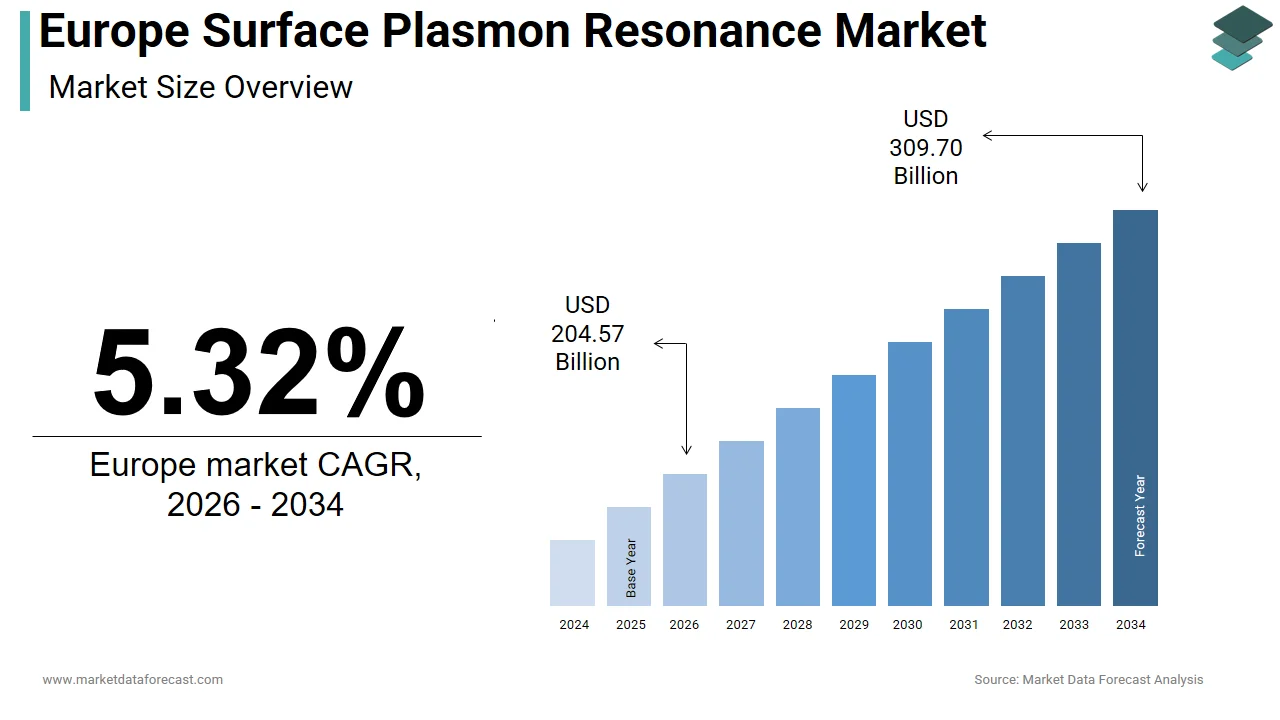
The surface plasmon resonance market size in Europe was valued at USD 194.24 billion in 2025. The European market is estimated to be worth USD 309.70 billion by 2034 from USD 204.57 billion in 2026, growing at a CAGR of 5.32% from 2026 to 2034.
The Europe surface plasmon resonance market is deeply influenced by the robust pharmaceutical and biotechnology sectors across nations such as Germany, France, the United Kingdom, and Switzerland. According to the European Federation of Pharmaceutical Industries and Associations (EFPIA), the pharmaceutical industry in Europe directly employs approximately 900,000 people and invests heavily in research and development to bring new therapies to market. The region faces increasing regulatory scrutiny regarding drug safety and efficacy, and this requires precise analytical tools like surface plasmon resonance for early-stage screening. As per Eurostat data, total research and development expenditure in the European Union reached €403.1 billion in 2024, reflecting a strong commitment to scientific innovation. Furthermore, the rising prevalence of chronic diseases drives the need for novel biologics and biosimilars, which require detailed kinetic analysis during development. As per the data from the World Health Organization, noncommunicable diseases are collectively responsible for 74% of all deaths worldwide, which is a trend mirrored in the European region, underscoring the urgency for effective therapeutic solutions. This convergence of regulatory demands, high R&D investment, and disease burden establishes a critical foundation for the adoption of sophisticated biomolecular interaction analysis tools across academic institutions and industrial laboratories in Europe.
MARKET DRIVERS
Increasing Investment in Biopharmaceutical Research and Development Drives Adoption
The substantial increase in investment in biopharmaceutical research and development is majorly driving the expansion of the Europe surface plasmon resonance market, as companies seek efficient tools to accelerate drug discovery pipelines. Biologics and monoclonal antibodies have become central to modern therapeutics, requiring precise characterization of binding kinetics and affinity to ensure efficacy and safety. According to the European Biotech Association, the biotechnology sector in Europe has seen a steady rise in venture capital funding, with billions of euros invested annually in early-stage and clinical-stage companies. Surface plasmon resonance technology enables researchers to obtain real-time data on molecular interactions without the need for fluorescent or radioactive labels, significantly reducing the time and cost associated with traditional assay methods. As per data from Invest Europe, the total amount of funds raised by the European private equity and venture capital industry has reached record levels, with a significant portion allocated to life sciences and healthcare innovations. This financial backing allows pharmaceutical companies to adopt advanced analytical instruments that enhance productivity and decision-making in drug development. The ability to screen large libraries of compounds quickly and accurately makes surface plasmon resonance indispensable for identifying promising drug candidates. Furthermore, the shift towards personalized medicine requires a detailed understanding of individual patient responses, which relies on high-quality interaction data. The continuous influx of capital into the biopharma sector ensures that laboratories are well-equipped with state-of-the-art instrumentation, driving sustained demand for surface plasmon resonance systems across the region.
Stringent Regulatory Requirements for Drug Approval Enhance Demand for Precision Analytics
Stringent regulatory requirements for drug approval in Europe enhance the demand for precision analytics such as surface plasmon resonance, as authorities mandate rigorous characterization of biological products, which is further hampering the regional market expansion. The European Medicines Agency enforces strict guidelines regarding the quality, safety, and efficacy of new medicines, particularly for complex biologics and biosimilars. According to the European Medicines Agency, the number of marketing authorization applications for new medicines has remained high, with a significant proportion being advanced therapy medicinal products. These complex molecules require detailed kinetic and thermodynamic analysis to demonstrate consistency and stability, which surface plasmon resonance provides with high sensitivity and accuracy. As per data from the International Council for Harmonisation of Technical Requirements for Pharmaceuticals for Human Use, global standards for biotechnological products emphasize the need for comprehensive binding studies to support regulatory submissions. Manufacturers must provide robust data on antibody-antigen interactions, receptor binding, and off-target effects to gain approval. Surface plasmon resonance offers a gold-standard method for generating this critical data, ensuring compliance with regulatory expectations. The increasing focus on biosimilars, which must demonstrate comparable efficacy to originator products, further drives the need for precise analytical tools. Regulatory bodies often request detailed comparative studies that rely on label-free techniques to validate structural and functional similarity. Consequently, the imperative to meet these high regulatory standards compels pharmaceutical and biotechnology companies to integrate surface plasmon resonance into their quality control and development workflows, fostering market growth.
MARKET RESTRAINTS
High Initial Costs and Maintenance Expenses Restrict Market Penetration
High initial costs and maintenance expenses act as significant restraints on the Europe surface plasmon resonance market, which is limiting accessibility for smaller research institutions and startups. The acquisition of high-performance surface plasmon resonance instruments requires substantial capital investment, with prices often exceeding hundreds of thousands of euros depending on the configuration and capabilities. For instance, the cost of ownership includes not only the instrument but also specialized software, training and ongoing technical support. For small and medium-sized enterprises and academic labs with limited budgets, these financial barriers can be prohibitive. As per data from Eurostat, research and development expenditure varies significantly across European countries, with smaller economies often having less funding available for expensive analytical equipment. Additionally, the maintenance of these sensitive instruments requires regular calibration and the replacement of consumables such as sensor chips, which adds to the operational costs. The need for highly skilled personnel to operate and interpret data from surface plasmon resonance systems further increases expenses, as specialized training is essential. Many potential users may opt for cheaper alternative techniques such as enzyme-linked immunosorbent assays (ELISA), despite their lower throughput and label requirements. The economic uncertainty in some regions also leads to budget cuts in research departments, delaying or cancelling equipment purchases. These financial constraints restrict the widespread adoption of surface plasmon resonance technology, particularly among emerging players who could benefit from its capabilities but lack the necessary resources.
Complexity of Data Interpretation and Lack of Skilled Personnel Impede Usage
The complexity of data interpretation and the lack of skilled personnel impede the expansion of the European surface plasmon resonance market. Analysing the kinetic data generated by surface plasmon resonance requires a deep understanding of binding models, mass transport limitations, and experimental artifacts. According to surveys conducted by scientific societies, many researchers struggle with the nuances of data fitting and model selection, leading to potential misinterpretation of results. The shortage of trained professionals who possess both theoretical knowledge and practical experience in label-free biosensing exacerbates this issue. As per data from the European Commission, there is a growing skills gap in the life sciences sector, with a particular deficit in experts capable of handling advanced analytical technologies. Universities and research institutes often face challenges in providing comprehensive training programs that cover the intricacies of surface plasmon resonance. This lack of expertise can result in suboptimal experimental design and unreliable data, discouraging potential users from adopting the technology. Furthermore, the turnover of skilled staff in research laboratories means that institutional knowledge is frequently lost, requiring continuous retraining. The steep learning curve associated with surface plasmon resonance software and hardware operations can delay project timelines and reduce productivity. Companies and institutions may hesitate to invest in the technology if they cannot ensure adequate staffing and training. Addressing this skills gap through education and simplified software interfaces is crucial for overcoming this restraint and enabling broader adoption of surface plasmon resonance in Europe.
MARKET OPPORTUNITIES
Expansion into Point-of-Care Diagnostics and Clinical Applications Creates Opportunities
The expansion into point-of-care diagnostics and clinical applications presents a significant opportunity for the Europe surface plasmon resonance market, as demand for rapid and accurate diagnostic tools grows. Traditional surface plasmon resonance systems are bulky and laboratory-based, but miniaturization and technological advancements are enabling the development of portable devices suitable for clinical settings. According to the European Centre for Disease Prevention and Control, the need for rapid diagnostic tests for infectious diseases and biomarkers has increased, driven by public health initiatives and pandemic preparedness. Surface plasmon resonance offers the advantage of real-time detection and high sensitivity without the need for sample labeling, making it ideal for point-of-care applications. As per data from the Medical Technology Europe industry body, the market for in vitro diagnostics is expanding, with a focus on decentralized testing solutions. Integrating surface plasmon resonance into handheld or benchtop devices allows for immediate analysis of patient samples, facilitating faster diagnosis and treatment decisions. The aging population in Europe, with individuals aged 65 and older comprising over 20% of the population in many countries as per Eurostat, increases the prevalence of chronic conditions requiring regular monitoring. Portable surface plasmon resonance devices can monitor biomarkers for conditions such as cardiovascular disease and diabetes, improving patient management. Collaborations between technology providers and healthcare institutions are driving innovation in this space, creating new revenue streams and expanding the application scope of surface plasmon resonance beyond traditional research laboratories.
Integration with Artificial Intelligence and Automation Enhances Efficiency
The integration of artificial intelligence and automation with surface plasmon resonance technology enhances efficiency and creates new opportunities for the Europe market. Artificial intelligence algorithms can automate data analysis, identify patterns, and predict binding affinities with greater accuracy and speed than manual methods. According to the European Artificial Intelligence Board, the adoption of AI in healthcare and life sciences is accelerating, with significant investments in machine learning applications for drug discovery and diagnostics. By combining AI with surface plasmon resonance, researchers can process large datasets more effectively, reducing the time required for kinetic analysis and improving the reliability of results. As per data from the Digital Europe Programme, funding for digital transformation in key sectors includes support for AI-driven innovations in medical technology. Automation of sample handling and instrument operation further increases throughput, allowing laboratories to screen more compounds in less time. This synergy reduces the burden on skilled personnel and minimizes human error, making surface plasmon resonance more accessible to users with varying levels of expertise. The ability to integrate surface plasmon resonance data with other omics data through AI platforms provides a holistic view of biological interactions, supporting systems biology approaches. Pharmaceutical companies are increasingly adopting these integrated solutions to streamline their workflows and gain competitive advantages. The continuous advancement of AI and automation technologies ensures that surface plasmon resonance remains at the forefront of biomolecular analysis, driving adoption and innovation in the European market.
MARKET CHALLENGES
Competition from Alternative Label-Free Technologies Poses a Challenge
Competition from alternative label-free technologies poses a significant challenge to the Europe surface plasmon resonance market, as researchers have multiple options for studying molecular interactions. Techniques such as bio-layer interferometry, microscale thermophoresis, and isothermal titration calorimetry offer distinct advantages in terms of sample consumption, throughput, or ease of use. According to scientific literature comparisons, bio-layer interferometry allows for higher throughput screening with lower sample volumes, appealing to laboratories with limited resources. Microscale thermophoresis works in solution without immobilization, avoiding potential artifacts associated with surface binding in surface plasmon resonance. As per data from user surveys in the life sciences community, the choice of technology often depends on specific experimental needs, budget constraints, and existing infrastructure. The availability of these alternatives fragments the market, forcing surface plasmon resonance providers to continuously innovate and justify their value proposition. Established users of alternative methods may be reluctant to switch due to familiarity and validated protocols. Additionally, some competing technologies are becoming more affordable and user-friendly, lowering the barrier to entry. The lack of a single dominant standard for label-free analysis means that surface plasmon resonance must compete on performance and specific application strengths. This competitive landscape requires manufacturers to differentiate their products through superior sensitivity, robustness, and customer support. Failure to adapt to the evolving preferences of researchers and the advancements of competing technologies can lead to loss of market share and stagnation in the Europe surface plasmon resonance sector.
Regulatory Hurdles for Clinical Diagnostic Devices Limit Commercialization
Regulatory hurdles for clinical diagnostic devices limit the commercialization of surface plasmon resonance-based point-of-care solutions in the Europe market. While surface plasmon resonance is well-established in research, transitioning to clinical diagnostics requires compliance with strict medical device regulations such as the In Vitro Diagnostic Regulation. According to the European Commission, the new In Vitro Diagnostic Regulation imposes more rigorous requirements for clinical evidence, performance evaluation, and post-market surveillance. Meeting these standards involves extensive clinical trials and documentation, which are time-consuming and costly for manufacturers. As per data from MedTech Europe, the transition to the new regulatory framework has caused delays in the launch of new diagnostic products, affecting innovation cycles. Small and medium-sized enterprises developing portable surface plasmon resonance devices may lack the resources to navigate these complex regulatory pathways effectively. The need for notified body involvement and conformity assessment adds another layer of complexity and expense. Uncertainty regarding the interpretation of certain regulatory clauses can further delay approvals. These hurdles discourage investment in clinical applications of surface plasmon resonance, as the return on investment becomes less predictable. Manufacturers must balance the potential market opportunity with the significant regulatory burden, which can slow down the introduction of innovative diagnostic tools. Until the regulatory landscape becomes more streamlined or supportive of novel technologies, the expansion of surface plasmon resonance into clinical diagnostics will face considerable challenges in Europe.
REPORT COVERAGE
| REPORT METRIC | DETAILS |
| Market Size Available | 2025 to 2034 |
| Base Year | 2025 |
| Forecast Period | 2026 to 2034 |
| Segments Covered | By Product, Application, and Country. |
| Various Analyses Covered | Global, Regional, and Country-Level Analysis, Segment-Level Analysis, Drivers, Restraints, Opportunities, Challenges; PESTLE Analysis; Porter’s Five Forces Analysis, Competitive Landscape, Analyst Overview of Investment Opportunities |
| Countries Covered | UK, France, Spain, Germany, Italy, Russia, Sweden, Denmark, Switzerland, Netherlands, Turkey, Czech Republic, and the Rest of Europe. |
| Market Leaders Profiled | Bio-Rad Laboratories Inc, AMETEK Inc, Cytiva AB, Biosensing Instrument Inc, General Electric Co, Sartorius AG, Bruker Corporation, Horiba Ltd. |
SEGMENTAL ANALYSIS
By Product Insights
The sensor system segment dominated the market by accounting for the highest share of the European market in 2025. The dominance of the sensor system segment in the European market can be credited to its critical role as the core hardware component that enables label-free detection of molecular interactions. These systems include the optical units, flow cells, and detection modules that are essential for any surface plasmon resonance experiment. For instance, the initial capital expenditure for laboratory instrumentation constitutes the largest portion of spending in the life sciences sector, with high-end sensor systems being a primary investment for pharmaceutical and academic institutions. The dominance of this segment is further driven by the continuous need for upgrading existing infrastructure to achieve higher sensitivity and throughput. As per data from the European Laboratory Industry Association, laboratories across Europe are increasingly replacing older-generation instruments with advanced sensor systems that offer multi-channel detection and improved data resolution. The longevity and durability of these systems ensure steady demand, as they form the backbone of biomolecular interaction analysis. Furthermore, the integration of automated sample-handling units with sensor systems enhances their appeal to high-throughput screening facilities. Manufacturers focus heavily on innovating sensor technology to reduce noise and improve signal-to-noise ratios, which is crucial for detecting weak interactions in drug discovery. The widespread adoption of these systems in both industrial and academic settings solidifies their leading position, as they are indispensable for generating reliable kinetic data required for regulatory submissions and scientific publications.
On the other side, the reagent segment is projected to record a promising CAGR of 10.5% over the forecast period in the European market owing to the recurring nature of reagent consumption, as every experiment requires fresh sensor chips, coupling kits, and regeneration buffers. According to the European Federation of Pharmaceutical Industries and Associations, the increasing volume of drug discovery projects directly correlates with higher consumption of consumables, as each screening campaign utilizes hundreds of sensor surfaces. The shift towards high-throughput screening in pharmaceutical companies accelerates the depletion of reagents, which is driving consistent revenue growth for manufacturers. For instance, the cost of consumables often surpasses the initial instrument cost over the lifecycle of the equipment, making this segment highly lucrative. The development of specialized sensor chips for specific applications, such as membrane protein analysis or small molecule screening, further boosts demand. Researchers require tailored surfaces to optimize binding conditions, leading to a diverse portfolio of reagents. Additionally, the rise in outsourced research activities means that contract research organizations are significant consumers of these materials. The inability to reuse sensor chips for certain sensitive assays ensures a steady stream of repeat purchases. This recurring revenue model, combined with technological advancements in surface chemistry that improve data quality, positions the reagent segment as the most dynamic and rapidly expanding part of the market.
By Application Insights
The drug discovery segment led the market by capturing the highest share of the European market in 2025. The dominance of the drug discovery segment in the European market is majorly driven by the extensive use of this technology in characterizing antibody-antigen interactions and fragment-based lead identification. The pharmaceutical industry relies heavily on surface plasmon resonance to determine binding affinity, kinetics, and specificity early in the development pipeline. According to the European Biotech Association, the majority of biotechnology companies in Europe utilize label-free technologies for hit validation and lead optimization, making drug discovery the primary application area. The complexity of modern biologics, including monoclonal antibodies and fusion proteins, necessitates precise kinetic analysis that surface plasmon resonance provides. As per data from the European Medicines Agency, a significant number of new marketing authorization applications involve biological medicines, which require detailed characterization of binding properties to ensure safety and efficacy. The ability to screen large libraries of compounds without labeling artifacts makes surface plasmon resonance indispensable for identifying promising candidates. Furthermore, the trend towards personalized medicine requires understanding individual patient responses at the molecular level, which drives the adoption of these analytical tools. The high value placed on reducing late-stage clinical failures encourages pharmaceutical companies to invest in robust early-stage screening methods. This strategic importance ensures that drug discovery remains the dominant application, with continuous investment in advanced instrumentation and methodologies to support innovative therapeutic development across the region.
On the other end, the biosensor segment is estimated to showcase a CAGR of 11.2% over the forecast period owing to the miniaturization of surface plasmon resonance technology and its integration into portable diagnostic devices for real-time monitoring of biomarkers. According to the Medical Technology Europe industry body, there is a surging demand for point-of-care diagnostics that can provide rapid and accurate results in clinical and home settings. Surface plasmon resonance-based biosensors offer the advantage of label-free detection, allowing for the direct measurement of analytes in complex samples such as blood or saliva. As per data from the European Centre for Disease Prevention and Control, the need for rapid infectious disease testing has heightened, prompting the development of sensitive biosensors capable of detecting pathogens quickly. The aging population in Europe, with a significant proportion suffering from chronic diseases, creates a vast market for continuous monitoring solutions. Innovations in nanotechnology and microfluidics have enabled the creation of compact and cost-effective biosensors that retain high sensitivity. Governments and healthcare providers are increasingly supporting the adoption of decentralized testing solutions to reduce hospital burdens. This shift towards preventive and personalized healthcare drives the rapid expansion of surface plasmon resonance-based biosensors, making it the most dynamically growing application segment in the market.
COUNTRY LEVEL ANALYSIS
Germany Surface Plasmon Resonance Market Analysis
Germany led the market by accounting for 26.2% of the regional market share in 2025. The dominance of Germany in the European market is majorly driven by its robust pharmaceutical industry and strong commitment to research and development. The country is home to major global pharmaceutical companies and a dense network of biotechnology startups that heavily invest in advanced analytical technologies. According to the German Federal Ministry of Education and Research, public funding for life sciences research has increased significantly, supporting the acquisition of state-of-the-art instrumentation in academic and industrial laboratories. The presence of leading instrument manufacturers in Germany also fosters a competitive ecosystem that drives innovation and adoption. As per data from the German Chemical Industry Association, the chemical and pharmaceutical sector is one of the largest industries in the country, with substantial exports driving the need for quality control and characterization tools. The stringent regulatory environment enforced by national authorities aligns with European standards, requiring precise data for drug approval. Additionally, the well-established healthcare infrastructure supports the integration of advanced diagnostic technologies. The strong collaboration between universities, research institutes, and industry players facilitates knowledge transfer and technology adoption. With a highly skilled workforce and significant R&D expenditure, Germany remains the central hub for surface plasmon resonance technology in Europe, setting the pace for innovation and market growth.
United Kingdom Surface Plasmon Resonance Market Analysis
The UK represents a significant and dynamic segment of the Europe surface plasmon resonance market, characterized by its world-class academic research institutions and vibrant biotechnology sector. Despite regulatory changes post-Brexit, the UK maintains strong ties with European scientific communities and continues to be a leader in life sciences innovation. According to UK Research and Innovation, the government has committed billions of pounds to strengthen the science and technology base, with a specific focus on health and life sciences. The presence of renowned universities and research centers drives the demand for high-performance analytical instruments for fundamental and applied research. As per data from the Association of the British Pharmaceutical Industry, the UK is a global leader in drug discovery, particularly in oncology and rare diseases, which rely heavily on kinetic analysis tools. The National Health Service is increasingly exploring advanced diagnostic solutions, creating opportunities for biosensor applications. The strong venture capital ecosystem supports startups developing novel surface plasmon resonance technologies and applications. Additionally, the UK’s emphasis on precision medicine and genomics integrates well with label-free binding analysis. The combination of academic excellence, industrial strength, and supportive policy frameworks ensures that the United Kingdom remains a key driver of growth and technological advancement in the European surface plasmon resonance market.
France Surface Plasmon Resonance Market Analysis
France holds a prominent position in the Europe surface plasmon resonance market, driven by its strong pharmaceutical industry and government initiatives to boost biomedical research. The country is home to several major pharmaceutical companies and a growing number of biotechnology firms that utilize advanced analytical tools for drug development. According to the French Ministry of Higher Education, Research and Innovation, national investment in research and development has been prioritized to enhance competitiveness in the life sciences sector. The Institut Pasteur and other leading research institutions contribute significantly to the demand for high-sensitivity detection systems. As per data from Leem, the national union of pharmaceutical companies, the French pharmaceutical industry invests heavily in innovation, particularly in biologics and vaccines, which require detailed characterization. The government’s France 2030 plan includes substantial funding for health technologies and digital transformation, supporting the adoption of automated and AI-integrated surface plasmon resonance systems. The strong regulatory framework ensures high standards for drug quality, driving the need for precise analytical methods. Additionally, the collaborative environment between public research bodies and private enterprises facilitates technology transfer and commercialization. With a focus on sovereign health capabilities and innovation, France continues to expand its footprint in the surface plasmon resonance market, contributing to regional growth and scientific advancement.
Switzerland Surface Plasmon Resonance Market Analysis
Switzerland represents a highly specialized and influential segment of the Europe surface plasmon resonance market, known for its concentration of global pharmaceutical headquarters and precision instrument manufacturing. The country is a global hub for life sciences, hosting major companies that drive demand for cutting-edge analytical technologies. According to the Swiss State Secretariat for Education, Research and Innovation, the country consistently ranks among the top nations in research intensity and innovation output. The presence of world-class research institutions such as ETH Zurich and the University of Basel fosters a culture of scientific excellence and technological adoption. As per data from Scienceindustries, the life sciences sector is a cornerstone of the Swiss economy, with significant exports of pharmaceuticals and medical technologies. The high standard of living and healthcare infrastructure supports the development and adoption of advanced diagnostic tools. Swiss companies are often early adopters of new technologies, driving innovation in surface plasmon resonance applications. The strong intellectual property protection and favorable business environment attract international investments in research and development. Additionally, the collaboration between academia and industry is deeply entrenched, facilitating rapid translation of research into commercial products. With its focus on quality, precision, and innovation, Switzerland plays a pivotal role in shaping the trends and demands of the European surface plasmon resonance market.
COMPETITIVE LANDSCAPE
The competition in the Europe surface plasmon resonance market is intense and characterized by the presence of established global leaders and innovative niche players striving for technological superiority. Major corporations leverage their extensive product portfolios and strong brand recognition to dominate the high-end segment of the market. These players benefit from significant research and development budgets that allow them to introduce cutting-edge features and maintain a steady pipeline of innovations. Smaller companies compete by offering specialized solutions tailored to specific applications such as membrane protein analysis or point-of-care diagnostics. The market sees continuous pressure to improve sensitivity, throughput, and ease of use, driving rapid technological advancements. Price competition is moderate, with value being derived from instrument performance and after-sales support rather than cost alone. Strategic alliances and acquisitions are common as companies seek to expand their capabilities and geographic reach. The presence of strong academic and industrial research bases in Europe fosters a culture of innovation and high standards. Regulatory compliance and adherence to quality standards also serve as key differentiators. This dynamic environment requires constant vigilance and adaptability from all market participants to sustain growth and relevance.
KEY MARKET PLAYERS
The leading companies operating in the Europe surface plasmon resonance market include:
- Bio-Rad Laboratories Inc.
- AMETEK Inc.
- Cytiva AB
- Biosensing Instrument Inc.
- General Electric Co.
- Sartorius AG
- Bruker Corporation
- Horiba Ltd.
TOP PLAYERS IN THE MARKET
- Cytiva AB maintains a leading position in the Europe surface plasmon resonance market through its comprehensive portfolio of Biacore instruments and reagents. The company focuses on providing high-sensitivity solutions for biomolecular interaction analysis that are essential for drug discovery and development. Cytiva has recently launched advanced software updates that integrate artificial intelligence capabilities to automate data analysis and improve workflow efficiency. The company actively collaborates with academic institutions and pharmaceutical companies to develop customized applications for complex biologics. By expanding its technical support network across major European hubs, Cytiva ensures rapid response to customer needs. Its commitment to innovation and quality strengthens its reputation as a trusted partner for life science researchers seeking reliable and precise analytical tools in the region.
- Sartorius AG contributes significantly to the Europe surface plasmon resonance market by offering robust and user-friendly instruments designed for both research and quality control applications. The company emphasizes ease of use and high throughput capabilities to meet the demands of modern laboratories. Sartorius has recently introduced new sensor chip technologies that enhance stability and reduce non-specific binding, improving data accuracy for challenging samples. The company leverages its strong presence in the bioprocessing sector to cross-sell surface plasmon resonance solutions to existing clients. Strategic partnerships with contract research organizations help expand its reach into specialized testing services. Sartorius continues to invest in training programs and digital resources to empower users, thereby strengthening its market position and fostering long-term customer loyalty across European scientific communities.
- Bruker Corporation plays a vital role in the Europe surface plasmon resonance market by integrating its optical sensing technologies with broader analytical platforms. The company focuses on delivering high-performance instruments that offer exceptional sensitivity and versatility for diverse applications. Bruker has recently enhanced its product line with modular systems that allow for customization based on specific research needs. The company actively participates in European scientific conferences to showcase its latest innovations and engage with the research community. By combining surface plasmon resonance with other spectroscopic techniques, Bruker provides holistic solutions for material science and life science applications. Its global service infrastructure ensures consistent support and maintenance, reinforcing its commitment to customer success. These efforts enable Bruker to maintain a competitive edge and drive adoption of its advanced technologies in the European market.
TOP STRATEGIES USED BY KEY MARKET PARTICIPANTS
Key players in the Europe surface plasmon resonance market primarily focus on product innovation and strategic collaborations to enhance their competitive position. Companies are increasingly investing in research and development to create instruments with higher sensitivity and automated features that simplify user experience. Partnerships with academic institutions and pharmaceutical companies facilitate the development of specialized applications and validate technology performance. Expansion of technical support and training services helps build customer loyalty and ensures effective utilization of complex instruments. Additionally, manufacturers are integrating artificial intelligence and machine learning algorithms to automate data analysis and improve accuracy. Sustainable practices and eco-friendly packaging are also being adopted to align with environmental regulations and consumer preferences. These combined strategies enable key participants to differentiate their offerings and maintain leadership in a dynamic and technologically advanced market landscape.
MARKET SEGMENTATION
This Europe surface plasmon resonance market research report is segmented and sub-segmented into the following categories.
By Product
- Imaging System
- Sensor System
- Reagent
By Application
- Drug Discovery
- Material Science
- Biosensor
By Country
- UK
- France
- Spain
- Germany
- Italy
- Russia
- Sweden
- Denmark
- Switzerland
- Netherlands
- Turkey
- Czech Republic
- Rest of Europe