- Product Description Description
- Table of Contents TOC
- List of Table & Figure LOT
- Get Free Sample PDF Sample PDF
Market Size, 2025
$17.51 BnMarket Estimate, 2026
$18.39 BnMarket Forecast, 2034
$27.16 BnCAGR, 2026–2034
5%Europe Analytical Instrumentation Market Size
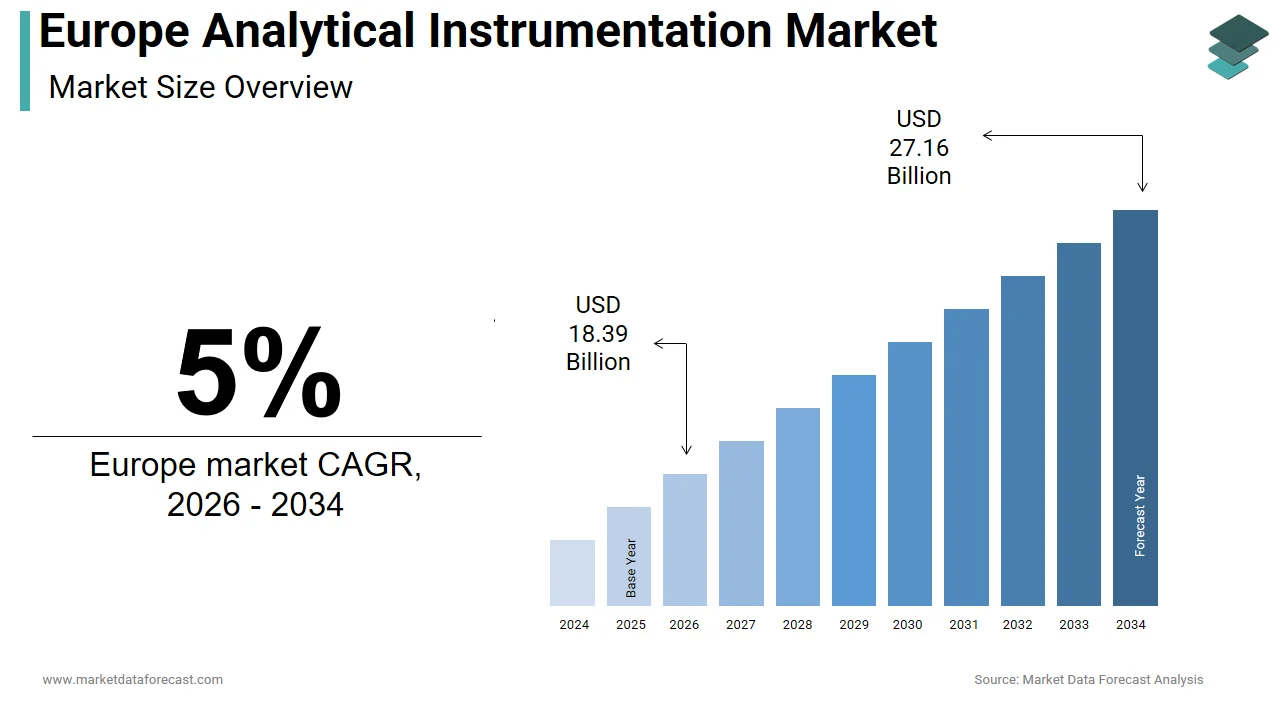
The Europe analytical instrumentation market was valued at USD 17.51 billion in 2025, is estimated to reach USD 18.39 billion in 2026, and is projected to reach USD 27.16 billion by 2034, growing at a CAGR of 5% from 2026 to 2034.
Analytical instrumentation is used to determine the chemical composition, structural properties, and physical characteristics of substances across diverse sectors such as pharmaceuticals, biotechnology, food safety, environmental science, and academic research. Core technologies encompass chromatography systems, spectroscopy platforms, mass spectrometry instruments, and elemental analyzers, all designed to deliver high precision, reproducibility, and regulatory compliance. According to Eurostat data from 2024, Europe hosts more than 2,500 public research institutions and employs over 300,000 researchers in higher education, which confirms its strong scientific infrastructure. The European Medicines Agency and the European Chemicals Agency further strengthen this ecosystem by enforcing stringent analytical validation standards that demand the use of advanced instrumentation. As per the European Commission, the Horizon Europe program has allocated €95.5 billion for research and innovation between 2021 and 2027 to ensure the continuous enhancement of laboratory and analytical capabilities. This combination of institutional depth, regulatory precision, and strategic approach is expected to boost the Europe analytical instrumentation market as a cornerstone for technological progress and innovation across scientific disciplines over the forecast period.
MARKET DRIVERS
Stringent Regulatory Requirements Drive Instrument Adoption
Regulatory mandates across the European Union serve as a primary catalyst for the procurement of analytical instrumentation, particularly in highly regulated sectors such as pharmaceuticals, food safety, and chemical manufacturing, which is one of the key factors driving the growth of the European analytical instrumentation market. According to the European Medicines Agency, all new drug submissions must undergo comprehensive analytical characterization, commonly using high-resolution mass spectrometers or ultra-high-performance liquid chromatography systems to verify identity, purity, and stability. Regulation (EC) No 882/2004 similarly mandates systematic food-safety inspections by national authorities, which is supported by advanced instrumentation for detecting residues, contaminants, and allergens. As per the European Food Safety Authority, over 12,000 food samples were analyzed for pesticide residues across all 27 EU member states in 2023, demonstrating the vast testing network in operation. According to the European Chemicals Agency, more than 22,000 chemical substances had been registered under the REACH framework by 2024, each demanding extensive physicochemical profiling. Compliance with ISO/IEC 17025 standards further obliges laboratories to maintain modern, precisely calibrated systems.
Expansion of Biopharmaceutical R&D Fuels Instrument Demand
The strategic pivot of Europe toward biologics and advanced therapies has significantly amplified demand for high-end analytical instrumentation capable of characterizing complex molecular structures, which is another major factor contributing to the growth of the European market. According to the European Federation of Pharmaceutical Industries and Associations (EFPIA), biologics represent a growing share of Europe’s pharmaceutical R&D pipeline, which is signalling a significant shift from traditional small-molecule drugs. This evolution has fuelled the demand for advanced analytical techniques such as capillary electrophoresis for charge variant profiling, surface plasmon resonance for binding kinetics assessment, and multi-angle light scattering for molecular weight determination. Germany continues to serve as a leading biotechnology hub in Europe, with hundreds of firms operating within innovation clusters that integrate universities, research institutions, and contract development organizations. According to the United Kingdom’s Medicines and Healthcare products Regulatory Agency (MHRA), numerous novel biologic entities have been approved in recent years following stringent analytical validation processes.
MARKET RESTRAINTS
High Capital and Operational Costs Impede Widespread Adoption
The substantial financial burden associated with acquiring and maintaining analytical instrumentation is one of the significant restraints to the European market. According to industry data pricing benchmarks, high-performance liquid chromatography coupled with tandem mass spectrometry (HPLC-MS/MS) systems typically cost between €250,000 and €500,000, with annual maintenance contracts generally ranging from 10 to 15 percent of the purchase price. As reported by the Federal Statistical Office of Germany (Destatis), laboratory technicians in Germany earned an average annual salary of over €55,000 in 2023, reflecting the high skill requirements associated with advanced analytical operations. Across Europe, research and development investment varies considerably, and as per the data of Eurostat, countries such as Greece and Romania allocated less than 1 percent of GDP to R&D in 2023, which is limiting funding for scientific infrastructure. In many public laboratories, lengthy procurement procedures and limited capital budgets delay equipment modernization. These structural challenges reduce analytical capacity and widen technological gaps among European research institutions, ultimately constraining the European analytical instrumentation market growth for high-end laboratory instrumentation.
Shortage of Skilled Technical Personnel Constrains Utilization
Despite technological advancements, the effective deployment of analytical instrumentation in Europe is increasingly bottlenecked by a shortage of personnel with the requisite interdisciplinary expertise, which is also impeding the analytical instrumentation market expansion in Europe. Modern systems, such as nuclear magnetic resonance spectrometers or inductively coupled plasma mass spectrometers that demand operators fluent in analytical chemistry, data science, and instrument engineering. However, the European Commission’s 2023 Skills Panorama report identified a shortfall of over 380,000 professionals in science and engineering roles across the EU, with analytical scientists among the most affected. In France, the National Observatory of Jobs and Skills in Chemistry found that 62 percent of analytical laboratories faced recruitment challenges in 2023 due to a lack of candidates experienced in hyphenated techniques like GC-MS or LC NMR. Academic programs often fail to incorporate hands-on training with current instrumentation, leaving graduates unprepared for real-world workflows. This skills gap results in underutilized equipment, prolonged method development, and increased dependence on costly external services. Vendor training is typically introductory and insufficient for advanced troubleshooting or method optimization.
Modern systems such as nuclear magnetic resonance spectrometers or inductively coupled plasma mass spectrometers demand operators fluent in analytical chemistry, data science, and instrument engineering. According to the European Commission’s Skills Panorama, Europe faces a significant shortage of professionals in science and engineering roles, with analytical scientists identified among the most affected disciplines. In France, industry surveys have noted that a majority of analytical laboratories report recruitment difficulties due to a lack of candidates experienced in hyphenated techniques like GC–MS or LC–NMR. Academic programs often fail to incorporate hands-on training with current instrumentation, leaving graduates unprepared for real-world workflows. This skills gap results in underutilized equipment, prolonged method development, and increased dependence on costly external services. Vendor training is typically introductory and insufficient for advanced troubleshooting or method optimization.
MARKET OPPORTUNITIES
Integration of Artificial Intelligence Enhances Analytical Capabilities
The strategic integration of artificial intelligence into analytical instrumentation is unlocking unprecedented efficiencies in data interpretation, method development, and instrument management across European laboratories, which is likely to be a potential opportunity for the European analytical instrumentation market. AI algorithms are increasingly being applied to accelerate chromatographic method development, which are significantly reducing optimization time in pharmaceutical quality control workflows. Pilot studies conducted by European research institutions, including the Fraunhofer Institute for Chemical Technology, demonstrate that AI-assisted modeling can substantially shorten chromatographic development cycles. Machine learning approaches also enhance spectral matching in Raman and infrared spectroscopy to improve analytical precision compared with conventional library-based methods. Predictive maintenance powered by AI has shown potential to reduce instrument downtime to support higher throughput in research and diagnostic facilities such as those operated by national health institutes. According to the European Commission, the Digital Europe Programme has earmarked 1.7 billion euros between 2021 and 2027 to promote AI integration across scientific and industrial infrastructure, which is fostering a supportive policy environment. Leading vendors, including Thermo Fisher Scientific and Agilent Technologies, have introduced AI-enabled analytical platforms designed to comply with EU data governance and cybersecurity standards.
Growing Emphasis on Environmental Monitoring Expands Application Scope
The intensified commitment to environmental sustainability of Europe is creating a robust and expanding market for analytical instrumentation in air, water, and soil monitoring applications, which is projected to add fuel to the growth rate of the regional market. According to the European Environment Agency (EEA), urban air quality monitoring networks across the EU widely employ continuous emission monitoring systems that utilize techniques such as Fourier transform infrared spectroscopy and gas chromatography for real-time detection of pollutants, including nitrogen oxides, sulfur dioxide, and volatile organic compounds. The EU’s Zero Pollution Action Plan promotes major reductions in nutrient losses from agricultural sources by 2030, which is encouraging the adoption of analytical tools such as ion chromatography and inductively coupled plasma optical emission spectrometry for monitoring nitrates and phosphates in surface and groundwater. The European Commission has strengthened requirements for micropollutant screening in wastewater treatment, expanding the use of high-sensitivity liquid chromatography–mass spectrometry to detect trace levels of pharmaceuticals and endocrine-disrupting substances. In Germany, environmental agencies have increased investment in instrumentation for microplastic quantification in freshwater ecosystems. Furthermore, the 2024 revision of the Industrial Emissions Directive introduced stricter monitoring obligations for persistent pollutants, including per- and polyfluoroalkyl substances (PFAS).
MARKET CHALLENGES
Fragmented Regulatory Landscapes Increase Compliance Complexity
Although the European Union provides overarching regulatory frameworks, inconsistent national implementation creates a fragmented compliance environment that complicates instrument validation, data reporting, and cross-border operations, which is a major challenge to the regional market. While EU-wide frameworks such as the In Vitro Diagnostic Regulation (IVDR) establish overarching principles for laboratory operations, member states retain discretion over accreditation systems, calibration traceability, and licensing requirements. For instance, Physikalisch-Technische Bundesanstalt (PTB) of Germany and Centro Español de Metrología (CEM) of Spain apply different metrological standards for analytical instruments that are resulting in variations in validation and compliance procedures. Differences in national implementation often create challenges for laboratories operating across multiple EU jurisdictions, particularly during analytical method transfers and regulatory audits. In addition, inconsistent interpretations of the General Data Protection Regulation (GDPR) complicate cloud-based data sharing from networked analytical instruments, especially in multinational clinical research. These disparities compel laboratories to maintain redundant documentation and adapt workflows to local regulatory frameworks, increasing administrative overheads and limiting efficiency. Ongoing harmonization efforts, such as the metrology and digital infrastructure initiatives of the European Commission, aim to mitigate these gaps and enhance cross-border interoperability.
Rapid Technological Obsolescence Pressures Investment Cycles
The accelerating pace of innovation in analytical instrumentation is shortening equipment lifecycles and intensifying pressure on laboratories to justify frequent capital reinvestment is also challenging the regional market expansion. Breakthroughs in detector sensitivity, automation, and data integration, such as the transition from quadrupole to time-of-flight mass analyzers, render legacy systems inadequate for cutting-edge applications like single-cell proteomics or real-time atmospheric monitoring. Aging analytical infrastructure remains a significant barrier to interoperability across European research institutions. Many chromatography systems in academic laboratories are several years old and often lack compatibility with newer software ecosystems that support remote monitoring and data integration. Manufacturers typically phase out technical support for older instruments within a few years of product launch, which accelerates replacement cycles and increases maintenance costs. In rapidly advancing fields such as metabolomics, technological innovation occurs at a pace that quickly renders previous-generation instruments less competitive. This ongoing obsolescence forces institutions to choose between operating with outdated but functional systems or investing heavily in frequent upgrades. Without greater emphasis on modular designs, extended service lifespans, and sustainable reuse initiatives, the research ecosystem risks widening the gap between well-funded and resource-constrained laboratories across Europe.
REPORT COVERAGE
| REPORT METRIC | DETAILS |
| Market Size Available | 2025 to 2034 |
| Base Year | 2025 |
| Forecast Period | 2026 to 2034 |
| Segments Covered | By Product, Technology, Application, and Region. |
| Various Analyses Covered | Global, Regional, and Country-Level Analysis, Segment-Level Analysis, Drivers, Restraints, Opportunities, Challenges; PESTLE Analysis; Porter’s Five Forces Analysis, Competitive Landscape, Analyst Overview of Investment Opportunities |
| Countries Covered | UK, France, Spain, Germany, Italy, Russia, Sweden, Denmark, Switzerland, Netherlands, Turkey, Czech Republic, and the Rest of Europe. |
| Market Leaders Profiled | Thermo Fisher Scientific, Inc., Waters Corp., Shimadzu Corp., Danaher Corporation, Agilent Technologies, Inc., Bruker Corp., PerkinElmer, Inc., Mettler Toledo, Zeiss Group, Bio-Rad Laboratories, Inc., Illumina, Inc., Eppendorf SE, F. Hoffmann-La Roche AG, Sartorius AG, and Avantor, Inc. |
SEGMENTAL ANALYSIS
By Product Insights
The instruments segment dominated the market by holding 66.9% of the European market share in 2024. The irreplaceable role of physical hardware in executing legally mandated and scientifically essential analyses across regulated sectors is driving the domination of the instruments segment in the European market. Across the European Union, thousands of Good Manufacturing Practice (GMP)–compliant laboratories support pharmaceutical production, each requiring chromatography, mass spectrometry, and spectroscopy systems for critical applications such as batch release and stability testing. Environmental monitoring further drives demand, as national agencies maintain extensive networks of analytical stations to assess air and water quality, coordinated under the European Environment Agency’s programs. Academic and public research institutions also represent a consistent source of procurement, collectively investing substantial sums each year in laboratory instrumentation, as indicated by research and innovation expenditure data of Eurostat. Unlike software or service components, analytical instruments function as long-term capital assets subject to strict validation and traceability requirements, which makes their replacement or postponement challenging. This structural reliance positions instrumentation as a central and enduring segment of the European analytical instrumentation market.
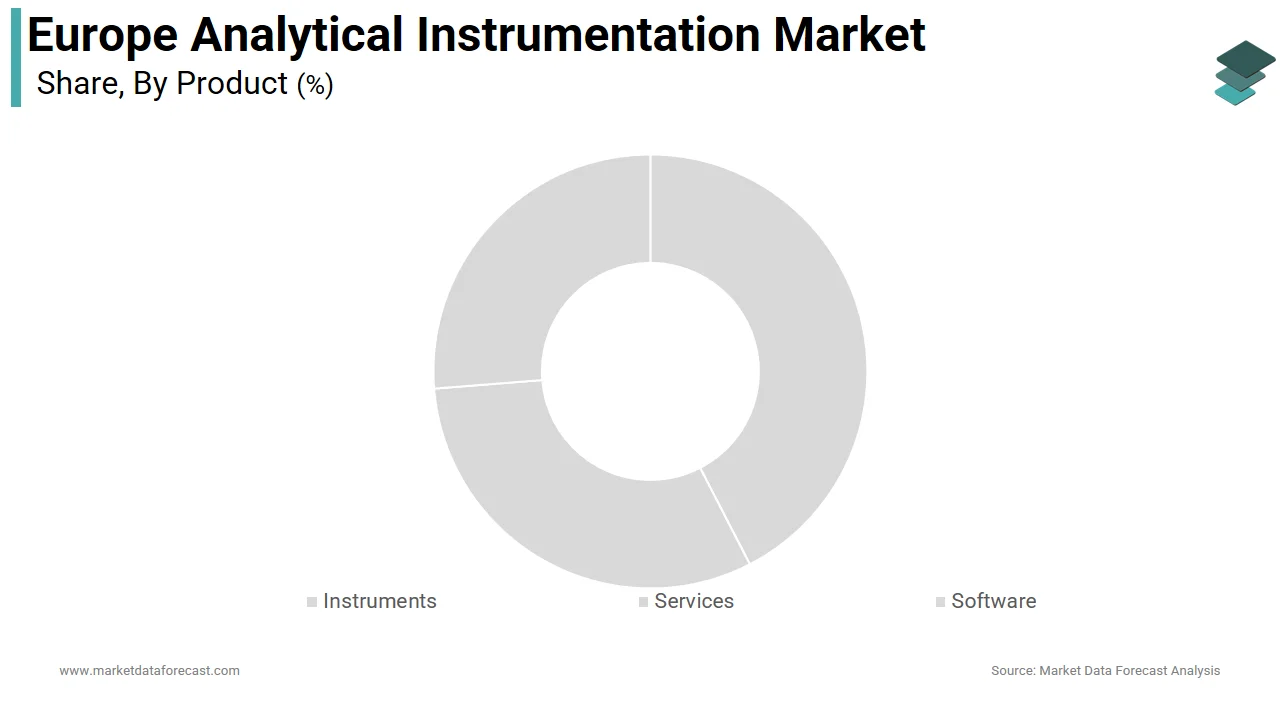
The software segment is anticipated to grow at the fastest CAGR of 10.1% over the forecast period, owing to the urgent need to digitize laboratory workflows in alignment with evolving data integrity standards and the exponential growth of analytical data volumes. The guidance of the European Medicines Agency on electronic records and data integrity emphasizes the use of validated software systems for audit trails, electronic signatures, and secure integration of instrument data, prompting laboratories across the EU to phase out paper-based workflows. National inspectorates have also encouraged modernization through stricter enforcement of electronic recordkeeping standards. Parallelly, the growing use of multi-modal analytical approaches, such as integrating LC-MS and NMR datasets in metabolomics, has increased reliance on advanced data management and fusion platforms that enable cross-technique correlation and reproducibility. The Digital Europe Programme of the European Union continues to support these efforts by funding interoperable digital research infrastructures across multiple member states.
By Technology Insights
The spectroscopy segment led the market by occupying 42.4% of the regional market share in 2024. The unparalleled versatility, non-destructive analysis capabilities, and deep integration into both industrial quality control and fundamental research of spectroscopy are primarily driving the growth of the spectroscopy segment in the European market. In the food sector, near-infrared spectroscopy is widely used across EU dairy processing plants for real-time fat and protein measurement, a practice encouraged under EU regulations on agricultural product standards. Environmental laboratories rely on atomic absorption and inductively coupled plasma optical emission spectroscopy to monitor heavy metals, with the European Environment Agency reporting extensive spectroscopic water analyses across member states in 2023. In pharmaceuticals, Raman and infrared spectroscopy are embedded in Process Analytical Technology frameworks endorsed by the European Medicines Agency to ensure continuous manufacturing quality. Academic adoption is equally widespread, with spectroscopy included in most chemistry curricula across EU universities, as noted by the European Chemical Society. This cross-sectoral indispensability, reinforced by decades of regulatory acceptance and method standardization, secures spectroscopy’s position as the leading analytical technology in Europe.
The polymerase chain reaction (PCR) segment is expected to witness the highest CAGR of 11.4% over the forecast period, owing to the technique’s migration from clinical diagnostics into food safety, environmental monitoring, and biopharmaceutical quality control. Under the EU’s 2023 update to the Official Controls Regulation, all imported meat products must undergo species authentication via real-time PCR to prevent economic fraud, supporting its deployment across numerous border inspection posts. In environmental science, eDNA metabarcoding using PCR has become a key method in biodiversity assessments, with the European Environment Agency funding multiple river basin studies in 2023 that relied on molecular techniques for species identification. The biopharmaceutical sector further drives demand, as digital PCR is required for residual host cell DNA quantification in monoclonal antibody production per EMA guidelines. National genomic initiatives amplify this trend; for example, Sweden’s National Genomics Initiative has invested heavily to expand PCR-based diagnostic capacity across its public hospital network.
COUNTRY LEVEL ANALYSIS
Germany Analytical Instrumentation Market Analysis
Germany held 22.7% of the European analytical instrumentation market share in 2024 and emerged as the most dominating player in the European market. The dual strength of Germany as Europe’s foremost chemical and pharmaceutical manufacturing hub and a global center for public research is one of the major factors behind the dominating role of Germany in the European market. Germany is home to several of the world’s leading chemical companies, collectively operating hundreds of production sites that require continuous raw material and effluent testing under REACH and the Industrial Emissions Directive. The pharmaceutical sector is equally robust, with domestic firms investing heavily in R&D in 2023, according to the German Pharmaceutical Industry Association. Public research institutions, including the Helmholtz Association and the Max Planck Society, also made significant investments in analytical instrumentation that year, primarily for energy materials and life sciences research. Moreover, Germany enforces some of the EU’s strictest laboratory accreditation standards through the German Accreditation Body, requiring regular instrument recalibration and method validation. This ecosystem of industrial scale, regulatory rigor, and scientific investment creates a uniquely dense landscape of analytical demand that sustains the market primacy of Germany.
United Kingdom Analytical Instrumentation Market Analysis
The United Kingdom had the second leading share of the European market in 2024. Despite its departure from the European Union, the UK maintains a world-leading life sciences infrastructure driven by strong public-private collaboration and globally recognized regulatory standards. According to the Medicines and Healthcare products Regulatory Agency, several new active substances were approved in 2023, each requiring extensive analytical characterization using mass spectrometry and chromatography. The life sciences sector of the UK continued to attract strong foreign direct investment, with much of it directed toward laboratory buildouts in the Golden Triangle of London, Oxford, and Cambridge. Academic demand remains significant, with Russell Group universities allocating substantial budgets to research equipment, a large portion of which supports analytical instrumentation. Additionally, the UK’s post-Brexit regulatory divergence has necessitated dual analytical validation for products targeting both UK and EU markets, effectively increasing testing requirements for exporters. This combination of scientific excellence, investment inflows, and regulatory complexity ensures the continued prominence of the UK in the European analytical instrumentation market.
France Analytical Instrumentation Market Analysis
France is predicted to account for a promising share of the European analytical instrumentation market over the forecast period. The analytical instrumentation demand in France is uniquely shaped by its national strategies in genomic medicine, agri-food authenticity, and nuclear safety. The Plan France Médecine Génomique 2025 of France has established a network of genomic platforms equipped with digital PCR and next-generation sequencing systems, which is driving molecular instrumentation adoption. France is also the EU’s largest agricultural exporter and is subject to rigorous quality controls under the Common Agricultural Policy, which mandates spectroscopic and chromatographic verification of origin for products such as wine, cheese, and honey. The French Agency for Food, Environmental, and Occupational Health Safety continues to expand food authenticity testing efforts to counter fraud across categories. The nuclear sector further contributes, with companies such as Orano and EDF operating specialized laboratories that use mass spectrometry for isotopic analysis of fuel materials. Public research organizations, including CNRS, maintain substantial investment in laboratory infrastructure, with analytical tools representing a major share of equipment expenditure. This policy-driven, multi-domain demand structure reinforces France’s position as a core European market for analytical instrumentation.
Switzerland Analytical Instrumentation Market Analysis
Switzerland is projected to showcase a prominent CAGR in the European analytical instrumentation market over the forecast period, owing to its concentration of global life sciences headquarters and its alignment with EU regulatory frameworks despite non-membership. Roche and Novartis maintain extensive R&D and quality control laboratory networks in Basel and Zurich by conducting large volumes of analytical testing to support drug substance and product release. The mutual recognition agreement of Switzerland with the EU ensures its laboratories comply with EMA and ISO standards, which is creating demand parity with EU member states. The Swiss National Science Foundation consistently funds numerous projects in analytical chemistry and molecular biology, many of which depend on advanced instrumentation. Additionally, Switzerland hosts a strong cluster of contract research organizations specializing in bioanalysis and regulatory testing for global pharmaceutical clients. This combination of industrial density, regulatory equivalence, and economic strength allows Switzerland to sustain a market influence far greater than its population size.
Italy Analytical Instrumentation Market Analysis
Italy is a notable market for analytical instrumentation in Europe and is estimated to progress at a healthy CAGR over the forecast period due to its status as Europe’s leading producer of high-value food products and a significant pharmaceutical manufacturer. Italy produces a substantial share of the European Union’s wine and olive oil, and these sectors are governed by strict authenticity controls under EU Protected Designation of Origin (PDO) rules that employ isotopic ratio mass spectrometry and near-infrared spectroscopy for verification. The Italian Ministry of Agricultural, Food and Forestry Policies continues to expand its network of accredited food testing laboratories equipped with chromatography systems to combat fraud and ensure traceability. The pharmaceutical sector adds further momentum, with Italy among Europe’s leading exporters of medicines that require extensive batch release testing under EMA guidelines. Environmental regulations also contribute to demand, as regional water authorities have strengthened real-time monitoring programs in response to EU directives on nitrate pollution. Public universities consistently allocate significant budgets for laboratory infrastructure, with analytical instrumentation representing a major portion of capital expenditure.
COMPETITIVE LANDSCAPE
The Europe analytical instrumentation market features intense competition among global technology leaders and specialized regional innovators. Dominant firms differentiate through scientific accuracy, regulatory compliance, and digital integration rather than cost-based positioning. The market is characterized by high entry barriers due to stringent accreditation requirements, long validation cycles, and the need for extensive application expertise. Competition increasingly revolves around software-enabled data management, predictive maintenance, and interoperability with laboratory information systems. Regional disparities in public funding and technical talent create segmented demand dynamics where vendors tailor offerings to Western Europe’s advanced labs and Eastern Europe’s budget-conscious institutions. Mergers and acquisitions remain limited due to antitrust scrutiny, but strategic partnerships with universities and regulatory bodies are common. Overall, the competitive landscape prioritizes trust, reliability, and scientific partnership over transactional relationships, fostering long-term customer retention and brand loyalty across the European scientific ecosystem.
KEY MARKET PLAYERS
Some of the companies that are playing a dominating role in the Europe analytical instrumentation market include
- Thermo Fisher Scientific, Inc.
- Waters Corp.
- Shimadzu Corp.
- Danaher Corporation
- Agilent Technologies, Inc
- Bruker Corp.
- PerkinElmer, Inc.
- Mettler Toledo
- Zeiss Group
- Bio-Rad Laboratories, Inc.
- Illumina, Inc.
- Eppendorf SE
- Hoffmann-La Roche AG
- Sartorius AG
- Avantor, Inc.
TOP PLAYERS IN THE MARKET
- Thermo Fisher Scientific maintains a prominent presence in the Europe analytical instrumentation market through its comprehensive portfolio spanning mass spectrometry, chromatography, and spectroscopy systems. The company actively supports pharmaceutical and environmental laboratories across the region with integrated hardware and software solutions. In recent years, Thermo Fisher has expanded its European service network by opening application support centers in Milan and Warsaw to enhance local technical assistance and method development capabilities. It also launched cloud-enabled instrument platforms compliant with EU data governance standards, reinforcing its alignment with regional regulatory expectations and digital transformation trends in scientific research.
- Agilent Technologies plays a critical role in the European analytical landscape by delivering high-performance instruments for life sciences, food safety, and chemical analysis. The company has deepened its regional engagement through strategic collaborations with academic institutions and contract testing laboratories. Agilent recently introduced AI-powered data analysis modules for its liquid chromatography system, tailored to European pharmacopeia requirements. It also upgraded its manufacturing facility in Waldbronn, Germany, to increase local production capacity and reduce supply chain lead times. These initiatives underscore its commitment to responsive innovation and regulatory alignment within the European market.
- Danaher Corporation influences the Europe analytical instrumentation market through its operating companies, including Beckman Coulter and Leica Microsystems, which offer advanced solutions in molecular diagnostics and microscopy. The corporation has strengthened its European footprint by integrating artificial intelligence into its instrument platforms and expanding its direct sales and service teams in Southern and Eastern Europe. Danaher recently launched a sustainability-focused instrument refurbishment program in the Netherlands to support circular economy principles. It also partnered with public health agencies in France and Sweden to deploy rapid pathogen detection systems, enhancing its role in public health infrastructure across the region.
TOP STRATEGIES USED BY THE KEY MARKET PARTICIPANTS
Key players in the Europe analytical instrumentation market primarily pursue strategies centered on technological integration, regulatory alignment, and localized service enhancement. Companies are embedding artificial intelligence and cloud connectivity into instruments to meet evolving data integrity standards under EU GMP and ISO guidelines. Strategic expansion of application support centers and service hubs across Germany, France, and Eastern Europe ensures faster response times and method validation assistance. Collaborations with academic institutions and public agencies facilitate the co-development of compliant workflows. Additionally, firms are investing in sustainability initiatives, including instrument take-back and refurbishment programs, to align with the European Green Deal. These approaches collectively reinforce market presence through innovation, proximity, and policy responsiveness rather than price competition.
MARKET SEGMENTATION
This research report on the Europe analytical instrumentation market has been segmented and sub-segmented into the following categories.
By Product
- Instruments
- Services
- Software
By Technology
- Polymerase Chain Reaction
- Spectroscopy
- Microscopy
- Chromatography
- Flow Cytometry
- Sequencing
- Microarray
- Others
By Application
- Life Sciences Research & Development
- Clinical & Diagnostic Analysis
- Food & Beverage Analysis
- Forensic Analysis
- Environmental Testing
- Others
By Country
- United Kingdom
- France
- Spain
- Germany
- Italy
- Russia
- Sweden
- Denmark
- Switzerland
- Netherlands
- Rest of Europe