- Product Description Description
- Table of Contents TOC
- List of Table & Figure LOT
- Get Free Sample PDF Sample PDF
Market Size, 2025
$22.65 BnMarket Estimate, 2026
$24.60 BnMarket Forecast, 2034
$47.67 BnCAGR, 2026–2034
8.62%Europe Travel Retail Market Report Summary
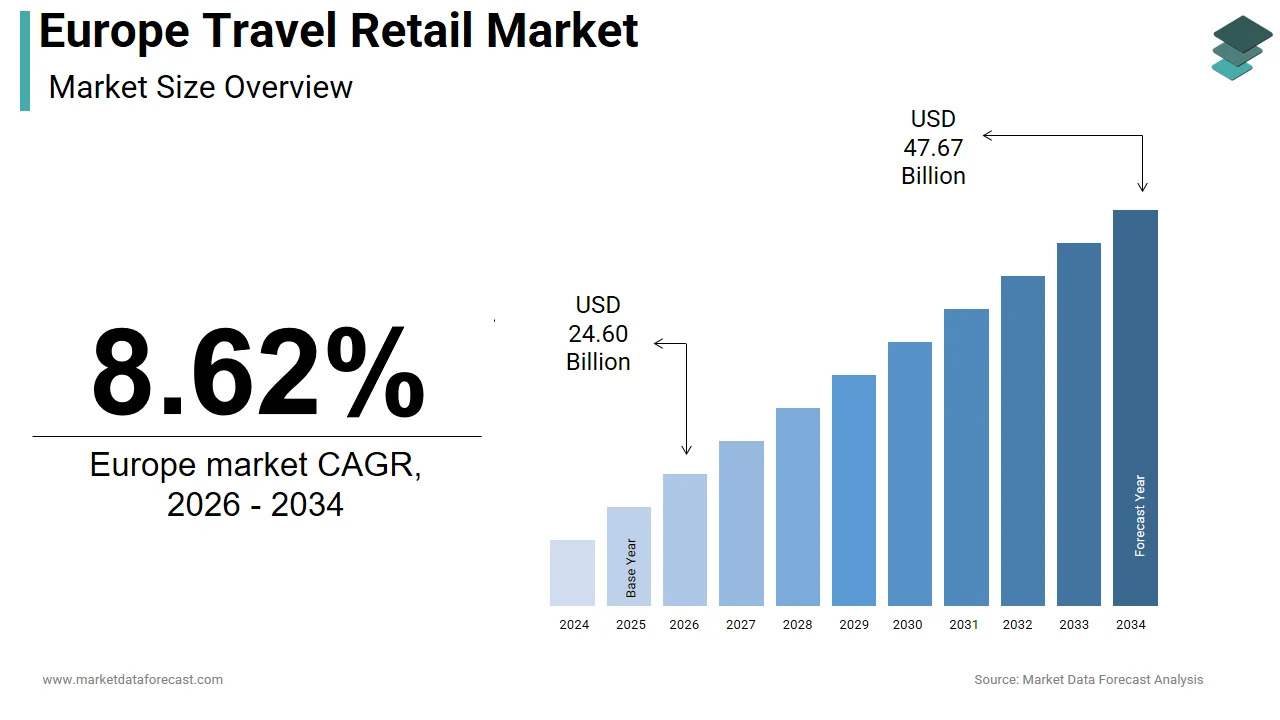
The Europe travel retail market was valued at USD 22.65 billion in 2025, is estimated to reach USD 24.60 billion in 2026, and is projected to reach USD 47.67 billion by 2034, growing at a CAGR of 8.62% from 2026 to 2034. Market growth is driven by the recovery of international travel, rising long-haul passenger volumes, and increasing demand for premium and experiential retail formats in transit environments. Airports, cruise terminals, and border shops are evolving into high-value commercial hubs, supported by digital pre-order platforms, biometric checkout systems, and sustainability-focused packaging. The integration of luxury brands, expansion of omnichannel services, and strong tourist inflows from high-spending regions are further strengthening Europe’s position as one of the world’s most mature and competitive travel retail markets.
Key Market Trends
- Rising demand for premium and experiential retail formats in major European airports.
- Growing adoption of digital pre-order and “Shop & Collect” platforms to improve conversion rates.
- Increasing presence of luxury mono-brand stores and exclusive travel-retail collections.
- Expansion of sustainable packaging and eco-friendly store designs in response to EU regulations.
- Growth of cruise and ferry retail channels as alternative high-engagement sales platforms.
Segmental Insights
-
Based on retail activity type:
-
The fragrances and cosmetics segment dominated the market in 2024 with a 47.4% share, driven by strong gifting demand, high impulse purchase rates, and extensive brand investment in experiential beauty counters.
-
-
Based on distribution channel:
-
The airports segment held the largest share in 2025, supported by high passenger volumes, extended dwell times, and concentration of premium travelers at major hubs.
-
Regional Insights
The Europe travel retail market is witnessing strong growth across major economies, supported by expanding tourism flows, advanced airport infrastructure, and strong integration of luxury retail ecosystems.
- France led the market with a 23.9% share in 2024, driven by Paris Charles de Gaulle’s role as a major luxury gateway and strong government support for tourism.
- The United Kingdom captured the second-largest share, supported by Heathrow’s global connectivity, post-Brexit duty-free policies, and retail innovation.
Competitive Landscape
The Europe travel retail market is characterized by intense competition among global concessionaires, regional specialists, and luxury brand operators competing for prime locations in high-traffic transit hubs. Leading players focus on securing long-term airport concessions, expanding digital pre-order capabilities, and strengthening partnerships with luxury brands. Experiential retail formats, sustainability initiatives, and omnichannel integration are key differentiators in the market. Despite ongoing consolidation, niche players continue to thrive in regional airports and maritime routes where localized expertise provides competitive advantage.
Prominent companies in the Europe travel retail market include Dufry AG, Lagardère Travel Retail, Gebr. Heinemann SE & Co. KG, Autogrill S.p.A. / World Duty Free, and LVMH (Moët Hennessy Louis Vuitton).
Europe Travel Retail Market Size
The Europe travel retail market was valued at USD 22.65 billion in 2025, is estimated to reach USD 24.60 billion in 2026, and is projected to reach USD 47.67 billion by 2034, growing at a CAGR of 8.62% from 2026 to 2034.
Travel retail is the sale of duty-free and duty-paid goods to international travelers within controlled environments such as airports, seaports, border shops, and onboard ferries and airlines. Unlike domestic retail, travel retail operates under a distinct regulatory and logistical framework governed by the European Union’s Excise Duty Directive and international customs conventions that permit tax-free shopping for non-EU residents. According to sources, the European travel-retail sector benefits from a very large number of international air passengers, which is a captive audience with high disposable income and limited time. The sector is characterised by its reliance on footfall, passenger mix and dwell time, which is rather than traditional marketing. For instance, a significant share of non-EU air arrivals into the Schengen Area comes from affluent and high-spending regions. Recent innovations include digital pre-order platforms, biometric checkout, and sustainability-driven packaging, which are responses to evolving traveller expectations and tightening environmental regulations. This unique intersection of mobility, taxation, and experiential commerce defines Europe’s strategic position as one of the world’s most mature and competitive travel-retail regions.
MARKET DRIVERS
Recovery and Expansion of Long-Haul International Air Connectivity
The resurgence of long-haul international air traffic into Europe is a primary driver of travel retail demand, as these passengers exhibit significantly higher spending power and brand engagement compared to regional travelers. According to the Eurocontrol European Aviation Overview, flows between Europe and Asia/Pacific in 2024 were up 8% compared to 2019, and flows between Europe and the Middle East were down 5% compared to 2019. This spending disparity stems from gifting culture, favourable exchange rates, and limited access to authentic luxury goods in home markets. For instance, the China Tourism Academy reports outbound tourism from China at about 146 million person-trips in 2024. Airlines are responding by restoring premium cabin capacity. For example, the Lufthansa Group reports overall capacity for 2024 at 91% of 2019 levels. This structural shift toward high-yield international traffic directly fuels premium product demand in travel retail corridors.
Strategic Integration of Luxury Brands into Airport Experiential Ecosystems
Luxury fashion and beauty houses are increasingly treating European airports as flagship destinations rather than transactional outlets, which is further boosting the travel retail market expansion in Europe. According to the European Luxury Association, many top-tier luxury brands now operate mono-brand stores or immersive concept spaces in multiple major European hubs. LVMH opened a 300 square-meter Louis Vuitton boutique at Munich Airport in 2024, featuring exclusive travel-retail collections and digital concierge services. Similarly, Kering’s Gucci and Saint Laurent have deployed RFID-enabled displays that provide product origin stories in multiple languages. This experiential approach aligns with the changing behavior of affluent travelers. As per a 2025 survey by the Boston Consulting Group, many luxury consumers aged 25 to 45 consider airport shopping an integral part of their travel experience. Airports actively incentivize these partnerships through revenue-share models and prime locations near boarding gates. The result is a virtuous cycle as brands gain direct access to global high-net-worth consumers while airports enhance non-aeronautical revenue and passenger satisfaction. This symbiosis has elevated travel retail from a price-driven channel to a premium storytelling platform.
MARKET RESTRAINTS
Persistent Volatility in Passenger Volumes Due to Geopolitical and Health Shocks
The sudden disruptions in international air traffic caused by geopolitical tensions, health emergencies, or regulatory shifts are majorly impeding the travel retail market growth in Europe. According to the International Air Transport Association (IATA), bookings in Europe dropped 14% in the week following Russia’s invasion of Ukraine. The 2022 Russia-Ukraine conflict led to major airspace disruptions, which altered long-haul route planning for airlines for multiple years. At the same time, data from Airports Council International Europe (ACI Europe) show that European airport connectivity remained 14% below pre-pandemic (2019) levels in 2024. Unlike domestic retail, travel retail cannot pivot to e-commerce or local consumers during crises, which is a structural inflexibility that makes long-term inventory and staffing planning exceptionally challenging.
Stringent and Fragmented EU Sustainability and Plastic Regulations
Europe’s progressive environmental legislation, while laudable and imposes significant operational and compliance burdens on travel retail operators that are not uniformly applied across member states, which is further hampering the growth of the travel retail market in Europe. The EU’s evolving plastics and packaging laws are directly affecting one of the highest-margin categories in beauty. For example, under the Packaging and Packaging Waste Regulation, brands will need to redesign once-travel-size formats so that plastic packaging is fully recyclable and includes a minimum recycled content, which is accelerating product decline and redesign costs. The regulatory framework is fragmented across member states, meaning brands often must maintain multiple SKUs to satisfy different national interpretations of the rules, which increases costs. Travel-retail is especially vulnerable because, unlike domestic retail, it cannot easily pivot to e-commerce or local consumers during crises, which is creating structural inflexibility that makes long-term inventory and staffing planning exceptionally challenging.
MARKET OPPORTUNITIES
Digital Pre-Order and Seamless Omnichannel Integration
The expansion of digital pre-order platforms that allow travelers to browse, select, and pay for products before arriving at the airport, with collection at designated pickup points airside, is one of the promising opportunities for the European travel retail market. According to the European Travel Retail Confederation (ETRC), digital pre-order sales in travel retail have seen strong growth recently. The “Shop & Collect” type services at airports such as London Heathrow Airport and the “MyTaxFree” app at Frankfurt Airport now include real-time inventory visibility, multilingual interfaces, and personalised recommendations that address critical pain points such as limited dwell time, language barriers, and product unavailability. Operators report that users of pre-order platforms spend significantly more than walk-in shoppers and record high convenience satisfaction. Crucially, these platforms generate first-party data on traveller preferences, which is enabling dynamic pricing and targeted restocking. With the Digital Services Act promoting interoperability, several airports are integrating pre-order systems with airline apps and loyalty programmes, which creates a seamless journey from booking to boarding. This digital layer is transforming travel retail from impulse-driven to intention-based commerce, which is unlocking higher conversion and basket size.
Revival of Cruise and Ferry Travel Retail in the Mediterranean and Baltic Regions
The resurgence of cruise and ferry tourism presents a high potential opportunity for travel retail expansion beyond airports, particularly in coastal and island destinations with limited domestic retail competition, and is considered a notable opportunity for the European market. The cruise-and-ferry sector has shown strong growth in Europe, particularly on Mediterranean and Baltic Sea routes, which present opportunities for travel retail. In the Mediterranean, transit cruise passenger movements rose significantly in 2024, with detailed data showing more than 26 million movements recorded. Operators of ferries serving the Baltic Sea corridor between Sweden and Finland highlight that duty-free shopping onboard and at terminals represents an important revenue stream. Ferry retail benefits from an extended captive time, which is enabling deeper engagement and higher conversion than typical airport retail. Unlike airports, these maritime channels can also attract domestic travellers under cross-border rules and duty-free eligibility. As cruise lines invest in premium experiences and expand itineraries, travel-retail stands to capture a more loyal and frequent customer base in a less saturated environment.
MARKET CHALLENGES
Intensifying Competition from Domestic Luxury Retail and E Commerce
The erosion of its traditional price advantage due to converging global pricing and aggressive domestic retail strategies is one of the major challenges to the European travel retail market growth. Luxury duty-free used to present a meaningful price gap compared with domestic luxury retail, but in recent years, brands have moved toward greater global price alignment, which has narrowed that advantage. At the same time, major city boutiques in tourist hubs such as Paris, Milan, and London increasingly offer tax-free shopping at the point of sale for non-EU residents, which is reducing the reliance on airport channels. According to the latest sources, a significant share of luxury-travelling consumers now prefer to make their purchases in city-based boutiques rather than at airport shops. Concurrently, e-commerce platforms are offering “airport-style” exclusives with global shipping and price-matching, further eroding traditional travel-retail value propositions. As a result, travel-retail operators can no longer rely solely on captive traveller traffic and price savings without differentiated experiences or exclusive product offerings; the channel risks becoming the backup option rather than the destination.
Labor Shortages and Rising Operational Costs in Major Airport Hubs
The rising pressure from acute labor shortages and escalating operational expenses, particularly in high-traffic airports where wage inflation and turnover undermine service quality, is further challenging the growth of the European travel retail market. Challenges in staffing for travel retail are mounting. According to broader tourism-industry labour studies, a large share of operators in Western Europe reported difficulty filling front-line roles in 2024, with vacancy durations averaging several months. Simultaneously, at major hubs such as London Heathrow Airport and Paris Charles de Gaulle Airport, staff turnover among front-line concession employees has reached very high levels due to comparatively better pay in domestic retail and gig-economy jobs. At the same time, airport concession fees that often amount to a substantial portion of gross sales rose in 2024 in many renegotiations of post-pandemic leases. Added cost pressures, such as higher energy bills (for example, for chilled-beauty displays), is further compressing margins just as brands demand increased investment in store design and digital integration. Many operators are therefore forced to cut staffing hours or consolidate brand footprints, leading to lower levels of customer service and lost sales. Without structural relief in labour supply or cost-sharing models, profitability and the quality of brand experience risk continuing deterioration.
REPORT COVERAGE
| REPORT METRIC | DETAILS |
| Market Size Available | 2025 to 2036 |
| Base Year | 2025 |
| Forecast Period | 2026 to 2034 |
| Segments Covered | By Retail Activity Type, Distribution Channel, Country. |
| Various Analyses Covered | Global, Regional, and Country-Level Analysis, Segment-Level Analysis, Drivers, Restraints, Opportunities, Challenges; PESTLE Analysis; Porter’s Five Forces Analysis, Competitive Landscape, Analyst Overview of Investment Opportunities |
| Countries Covered | UK, France, Spain, Germany, Italy, Russia, Sweden, Denmark, Switzerland, Netherlands, Turkey, Czech Republic, and the Rest of Europe. |
| Market Leaders Profiled | Dufry AG, Lagardère Travel Retail, Gebr. Heinemann SE & Co. KG, Autogrill S.p.A. / World Duty Free, LVMH (Moët Hennessy Louis Vuitton), and Others. |
SEGMENTAL ANALYSIS
By Retail Activity Type Insights
The fragrances and cosmetics segment occupied 47.4% of the European market share in 2024. The dominance of the fragrances and cosmetics segment in the European market is driven by the high impulse purchase propensity, universal gifting appeal, and strategic brand investment in experiential retail formats. Fragrances and cosmetics benefit from deep-rooted gifting traditions across key source markets, particularly in the Middle East and Asia, where travelers view European luxury beauty as a symbol of prestige and authenticity. Outbound travellers from China make a significant contribution to European duty-free beauty and fragrance sales, with research showing high purchase rates among that group. Similarly, travellers from Gulf Cooperation Council countries often record elevated average spends on cosmetics during European transit journeys. Beauty products have an inherent advantage in time-constrained environments like airports because they require no sizing or fitting, which reduces purchase friction. According to the European Travel Retail Council (ETRC), a large share of airport duty-free transactions are unplanned, and beauty counters tend to generate higher dwell time due to sampling and consultation activities. Brands exploit this dynamic through limited-edition travel-exclusive sets, fostering a sense of urgency and uniqueness. This combination of cultural relevance, low decision complexity, and tactical exclusivity cements beauty as a critical category in travel retail.
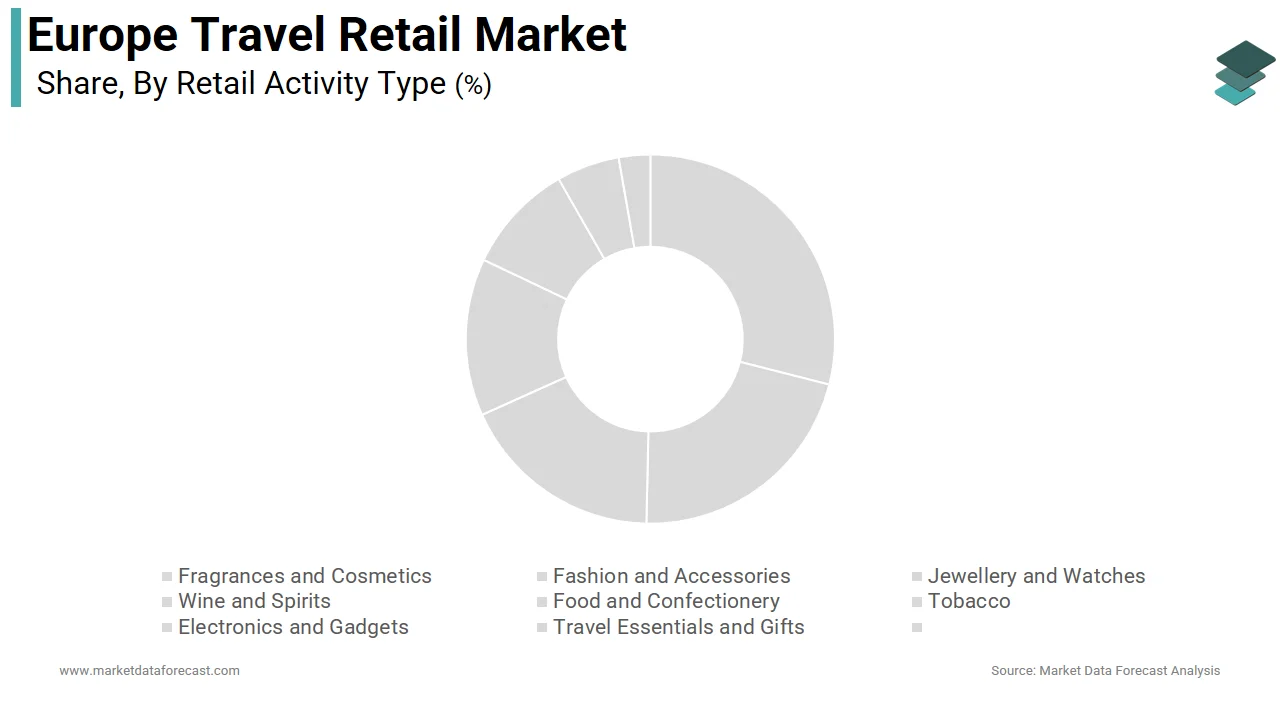
The fashion and accessories segment is expected to exhibit a CAGR of 12.5% over the forecast period in the European travel retail market, owing to the rise of experiential flagship stores, exclusive capsule collections, and the increasing share of high-net-worth travelers from emerging markets. Luxury fashion brands are increasingly reserving unique designs and collaborations exclusively for travel retail, transforming airports into must-visit destinations for fashion enthusiasts. Luxury fashion brands are increasingly deploying travel-retail exclusives tailored for airports and major city boutiques. For example, Gucci created a capsule collection with heritage prints and destination-inspired luggage tags available only in flagship outlets in Paris, Frankfurt, and Milan, which reportedly attracted significantly more foot traffic than standard lines. In a similar vein, Moncler released “Airport Exclusive” down jackets with geo-tagged embroidery at Paris Charles de Gaulle that sold out within days. These limited-edition drops appeal to affluent millennial travellers who prioritise uniqueness over price savings. According to recent luxury-consumer research by Boston Consulting Group, a strong majority of fashion-luxury buyers in the 25-to-40 age range cite travel-retail exclusives as a key motivator for their purchases. Unlike beauty, where products are largely standardised, fashion benefits from narrative potential, leveraging European heritage and destination stories such as Florence, Paris, and Milan as brand backdrops for these exclusive offers. This strategic use of scarcity and cultural resonance is shifting fashion’s role in travel retail from supplementary to central.
By Distribution Channel Insights
The airports segment dominated the Europe travel retail market by distribution channel by capturing the largest share of the regional market in 2025. The high passenger volumes, extended dwell times in security-controlled zones, and strategic partnerships between airports and global retailers are majorly driving the dominance of the airports segment in the European market. Major European airports such as London Heathrow, Paris Charles de Gaulle, and Frankfurt account for a very large share of EU inbound and transit passenger traffic. These hubs attract a disproportionate share of long-haul travellers from high-spending regions, which enhances their value for travel retail. Operators report that premium-passenger segments from the U.S., China, and the Gulf make up a substantially larger share of luxury goods purchases airside than their share of total passenger volume. Airports exploit this by optimising luxury store placement by concentrating high-end retail near long-haul boarding gates. The post-security environment also creates a captive audience with fewer competing distractions than downtown or border shops. With meaningful dwell time in major hubs, retailers have a critical window to convert browsing into buying. This concentration of affluent, time-rich travellers makes airports a central engine of travel-retail revenue.
The ferries and cruise lines channel segment is anticipated to witness the highest CAGR of 16.5% over the forecast period in the European travel retail market, owing to the resurgence of Mediterranean and Baltic itineraries, extended captive time onboard, and the eligibility of domestic travelers for duty-free purchases on cross-border routes. Cruise and ferry passengers typically spend far longer onboard than air travellers, creating a richer opportunity for browsing and impulse purchase compared with the constrained time available at airports. In certain major ferry corridors, duty-free operators report higher levels of engagement and purchase conversion than many airport formats. Cruise lines amplify this potential by creating dedicated onboard retail malls with mono-brand boutiques, live demonstrations, and digital flash-sales via passenger apps. With European cruise and ferry channels growing and benefiting from captive audiences with relatively fewer competing distractions, these maritime formats offer travel-retail operators access to a high-engagement and less saturated environment.
COUNTRY LEVEL ANALYSIS
France Travel Retail Market Analysis
France led the travel retail market in Europe in 2024 with 23.9% of the regional market share. The dominance of France in the European market is driven by the Paris Charles de Gaulle and Orly airports serving as primary European gateways for high-spending Middle Eastern and Asian travelers. Paris Charles de Gaulle Airport handled approximately 70.3 million passengers in 2024. French luxury houses, including LVMH, Kering, and Hermès, treat national airports as brand sanctuaries with hundreds of mono-brand stores operating across Paris terminals. The French government’s tourism initiative “Choose France” actively promotes luxury shopping as a key visitor experience pillar with streamlined customs processes for high-value purchases. Additionally, ferry routes from Marseille to Corsica and North Africa generate secondary duty-free revenue. With France ranking first among countries for international tourism arrivals and hosting one of the world’s most valuable luxury sectors, its position as a travel-retail epicenter is structurally entrenched.
United Kingdom Travel Retail Market Analysis
The UK captured the second-largest share of the European travel retail market in 2025. The growth of the UK market in Europe is attributed to London Heathrow’s role as a global transit nexus and leader in retail innovation. Heathrow Airport Holdings reports that about 83.9 million passengers passed through London Heathrow Airport in 2024. The UK’s post-Brexit customs regime allows duty-free sales to all non-UK residents, expanding eligibility beyond the prior EU framework. Major airports in the UK have deployed innovations like pre-order “Shop & Collect” and biometric checkout services to enhance conversion and shopping convenience. British luxury brands, including Burberry and Mulberry, maintain flagship airport stores, and premium retail offers, such as unique confectionery and gifting lines from Fortnum & Mason, further cater to global travellers. Despite the complexities introduced by Brexit, the UK’s extensive air-connectivity and a passenger base enriched in long-haul premium traffic sustain its leadership in high-value travel retail.
Germany Travel Retail Market Analysis
Germany commanded a substantial share of the European travel retail market in 2025. The central geographic position of Germany and dense network of international air and land connections are fuelling the travel retail market in Germany. Frankfurt Airport handled more than 61 million passengers in 2024, according to Fraport, marking a strong recovery year for Germany’s largest aviation hub. Germany’s land-border retail format benefits from cross-border commuter and visitor traffic, making duty-free opportunities available beyond just airports. The country’s robust economy and business travel flows support high-value purchases, while major retail operators maintain integrated logistics and distribution hubs in Germany (including in Frankfurt and Munich) to enable rapid restocking across channels. With Germany ranking among the top inbound tourism destinations in the EU and Frankfurt recognised as a major cargo and passenger hub, the market plays a key role in volume and distribution for the travel-retail ecosystem.
Italy Travel Retail Market Analysis
Italy is anticipated to hold a prominent share of the European travel retail market during the forecast period, owing to its dual strength in airport and cruise retail, anchored in luxury heritage. Italy’s major airports, including Rome Fiumicino and Milan Malpensa, handle tens of millions of international passengers each year and show strong flows from regions such as the Americas and the Gulf. More uniquely, Italy dominates Mediterranean cruise tourism, with Italy’s cruise ports recording double-digit millions of passenger movements in 2024. Italian luxury brands such as Prada, Dolce & Gabbana, and Ferragamo operate exclusive airport boutiques that showcase artisanal “Made in Italy” craftsmanship, which carries immense global cachet and drives gifting demand. Additionally, ferry routes to destinations such as Sicily, Sardinia, and Greece generate consistent secondary duty-free sales. Italy’s fusion of cultural prestige, coastal tourism, and brand authenticity creates a resilient and diversified travel-retail ecosystem.
Spain Travel Retail Market Analysis
Spain is projected to grow at a notable CAGR in the European travel retail market during the forecast period, owing to its status as Europe’s second most visited country. Major Spanish airports such as those in Barcelona and Madrid act as important gateways for travellers from Latin America and North America, who are known to spend significantly on luxury goods. Spain has also expanded its tax-free shopping ecosystem: non-EU visitors can benefit from VAT-refund shopping in city-centre locations, providing opportunities for pre-departure purchases beyond the airport environment. Spanish maritime routes including ferry services to Morocco and North Africa, and cruise ports such as Barcelona and Palma de Mallorca volume and duty-free potential, with Spanish ports handling over ten million cruise passengers in 2024. Spanish brands such as Loewe and Desigual deploy travel-exclusive collections, while global players invest in Iberia-specific marketing. Through the combination of mass tourism flows, strategic geographic location, and retail innovation, Spain holds a noteworthy position in the travel-retail landscape.
COMPETITIVE LANDSCAPE
The Europe travel retail market is marked by intense rivalry among global concessionaires, national specialists, and luxury brand operators, all competing for prime space in high-traffic airports and alternative channels. Unlike generic retail, success hinges on securing long-term airport leases, which are awarded through competitive tenders based on minimum revenue guarantees and innovation commitments. The top three players, Dufry, Gebr Heinemann, and Lagardèreleverage scale to negotiate favorable terms and invest heavily in experiential retail to meet brand expectations. Simultaneously, luxury houses are increasingly exerting direct control over their airport presence through joint ventures or mono-brand mandates, reducing reliance on multi-brand operators. Digital transformation is reshaping competition, with pre-order platforms becoming a new battleground for customer engagement. Regulatory pressures, including the EU Single Use Plastics Directive and fragmented labor laws, add operational complexity. Despite consolidation, the market remains dynamic with niche players thriving in regional airports and maritime routes where local knowledge and agility outweigh scale advantages.
KEY MARKET PLAYERS
Some of the companies that are playing a dominating role in the Europe travel retail market include
- Dufry AG
- Lagardère Travel Retail
- Heinemann SE & Co. KG
- Autogrill S.p.A. / World Duty Free
- LVMH (Moët Hennessy Louis Vuitton)
TOP PLAYERS IN THE MARKET
- Dufry is a Switzerland-based global leader in travel retail with an extensive footprint across European airports, ferry terminals, and cruise ports. The company operates over 2,200 stores worldwide, including prominent locations in London, Heathrow, Paris, Charles de Gaulle, and Frankfurt. In 2024, Dufry completed the integration of its acquisition of Hudson Americas, enhancing its omnichannel capabilities and expanding its luxury portfolio through strengthened partnerships with LVMH and Kering. The company launched a unified digital pre-order platform across 30 European airports, enabling travelers to reserve products in advance and collect them airside. Dufry also introduced sustainability-focused store designs featuring recycled materials and energy-efficient lighting in alignment with EU green building standards. These initiatives reinforce its position as an innovator in experiential and seamless travel retail across the region.
- Gebr Heinemann is a German family-owned travel retailer renowned for its dominance in European land border shops, ferry duty free and airport operations. The company operates in over 90 locations across Europe, including key ferry routes in the Baltic Sea and major airports such as Hamburg and Düsseldorf. In 2024, Gebr Heinemann expanded its onboard retail presence by signing multi-year agreements with AIDA Cruises and Tallink Silja to manage duty-free operations across their fleets. The company also launched a new logistics hub in Hamburg capable of serving 15 countries with just-in-time inventory for fast-moving beauty and spirits categories. Gebr Heinemann’s deep integration with European maritime and land border customs frameworks gives it a unique competitive edge in serving both international and intra-EU travelers under varying duty regimes.
- Lagardère Travel Retail is a France-based division of the Lagardère Group and a major force in European airport retail, specializing in fashion, luxury, and food service. The company manages over 1,500 stores across Europe, including flagship boutiques for luxury brands at Paris Orly and Lyon airports. In 2024, Lagardère deepened its luxury segment by opening mono-brand stores for Saint Laurent and Balenciaga at Charles de Gaulle Terminal 2E. It also piloted an AI-powered personalization engine in collaboration with Air France that recommends products based on passenger itinerary and past purchases. Additionally, the company integrated its “Pass’n Collect” pre-order service into the airline’s mobile app, creating a seamless shopping journey from booking to boarding. These moves underscore its strategy to position travel retail as an extension of the brand experience rather than a transactional stop.
TOP STRATEGIES USED BY KEY MARKET PARTICIPANTS
Key players in the Europe travel retail market are aggressively expanding digital pre-order and omnichannel platforms to overcome dwell time constraints and enhance customer convenience. Companies are investing in mono-brand flagship stores and exclusive travel retail collections to strengthen brand partnerships and justify premium positioning. Sustainability is being embedded through plastic-free packaging energy energy-efficient store designs, and carbon-neutral logistics in response to EU regulations. Labor optimization through AI-driven staffing and multilingual digital assistants addresses acute workforce shortages. Additionally, retailers are diversifying beyond airports into cruise, ferry, and land border channels to capture domestic travelers eligible for duty-free travel under maritime customs rules and reduce reliance on volatile air traffic.
MARKET SEGMENTATION
This research report on the Europe travel retail market has been segmented and sub-segmented into the following categories.
By Retail Activity Type
- Fragrances and Cosmetics
- Fashion and Accessories
- Jewellery and Watches
- Wine and Spirits
- Food and Confectionery
- Tobacco
- Electronics and Gadgets
- Travel Essentials and Gifts
By Distribution Channel
- Airports
- Airlines (In-flight)
- Ferries and Cruise Lines
- Railway Stations
- Land-Border Shops
- Downtown Duty-Free
By Country
- United Kingdom
- France
- Spain
- Germany
- Italy
- Russia
- Sweden
- Denmark
- Switzerland
- Netherlands
- Rest of Europe