Europe Warehouse Robotics Market Size, Share, Trends & Growth Forecast Report By Type, Function, End-User Application, Component, and By Country (Germany, United Kingdom, France, Netherlands, Italy & Rest of Europe) – Industry Analysis and Forecast, 2025 to 2033
Europe Warehouse Robotics Market Summary
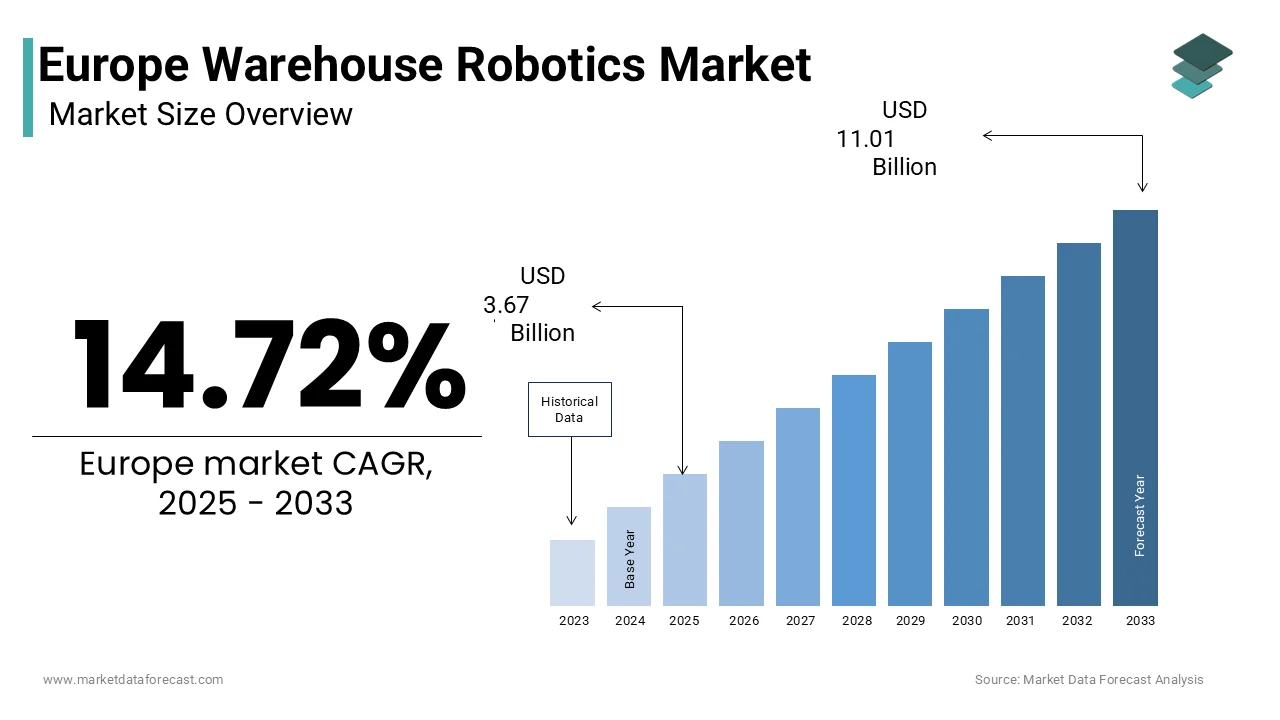
Europe warehouse robotics market was valued at USD 1.96 billion in 2024, is estimated to reach USD 3.67 billion in 2025, and is projected to grow to USD 11.01 billion by 2033, registering a CAGR of 14.72% from 2025 to 2033, driven by persistent labor shortages, rapid e-commerce expansion, and rising demand for automated, sustainable fulfillment operations.
Key Market Insights
- 2024 value: USD 1.96 billion
- 2025 (est): USD 3.67 billion
- 2033 (forecast): USD 11.01 billion
- CAGR (2025–2033): 14.72%
Quick Growth Drivers
- Chronic labor and skills shortages in logistics and warehousing
- Explosive growth of e-commerce and same-day delivery expectations
- Rising warehouse rents pushing adoption of space-efficient automation
- Government-backed digitalization and Industry 4.0 initiatives
- Increasing focus on order accuracy, speed, and worker safety
Principal Restraints
- High upfront capital investment for robotics hardware and integration
- Complexity of retrofitting robotics into legacy warehouse systems
- Stringent EU safety, machinery, and human–robot collaboration regulations
- Limited access to automation financing for SMEs
High-Value Opportunities
- Robotics deployment in reverse logistics and circular economy workflows
- Growth of cold chain and temperature-controlled warehouse automation
- Robotics-as-a-Service (RaaS) models lowering adoption barriers
- AI-driven robotic vision for returns sorting and quality inspection
- Automation in urban micro-fulfillment and last-mile hubs
Key Market Challenges
- Rising cybersecurity risks in connected robotic ecosystems
- Lack of standardized interoperability across robots and WMS platforms
- Vendor lock-in due to proprietary robotic operating systems
- Change management and workforce adaptation in unionized environments
Fastest-Growing Segments
- Automated Storage & Retrieval Systems (ASRS): 18.3% CAGR — urban density, land cost pressure
- Trans-shipment robotics: 20.1% CAGR — cross-docking and same-day delivery
- Food & beverage warehouses: 21.7% CAGR — hygiene, cold chain, traceability
- Cold-chain robotics: fastest emerging niche — pharma and fresh food logistics
Regional Leadership & Dynamics
- Germany (23.1%) — industrial automation strength, central logistics hub
- United Kingdom — dense urban fulfillment, advanced e-commerce adoption
- France — state-backed logistics digitalization and sustainability incentives
- Netherlands — gateway logistics, Port of Rotterdam, high automation density
- Italy — fashion, food exports, and EU-funded logistics modernization
What Wins Commercially (Competitive Edge)
- Scalable AMR fleets with rapid deployment capability
- Compliance with EU Machinery Regulation & NIS2 cybersecurity rules
- Cold-chain certified and food-grade robotic systems
- Modular software platforms enabling flexible integration
- Strong after-sales support and workforce training programs
Top Strategic Ask for Executives
- Prioritize mobile robotics and ASRS for space-constrained warehouses
- Invest in cybersecurity-by-design for robotic platforms
- Expand robotics into reverse logistics and returns processing
- Develop interoperable systems aligned with EU standardization efforts
- Leverage RaaS and phased automation to penetrate SME segments
Leading Players
Some of the companies that are playing a dominating role in the Europe warehouse robotics market include:
- KION Group (Dematic)
- SSI SCHAEFER
- Swisslog
- ABB Ltd.
- KUKA AG
- Geek+
- Locus Robotics
- Toyota Industries
- Daifuku Co., Ltd.
- Omron Corporation
Europe Warehouse Robotics Market Size
The Europe warehouse robotics market was valued at USD 1.96 billion in 2024, is expected to reach USD 3.67 billion in 2025, and is projected to grow at a CAGR of 14.72% from 2025 to 2033 and reach USD 11.01 billion by 2033.
Warehouse robotics is an automation ecosystem using robots and software for warehouse operations that handles strenuous tasks like item picking, packing, sorting, and moving goods. Integrates technologies like AI, machine learning, computer vision, and sensors for smart navigation and decision-making. Unlike conventional automation, modern warehouse robotics leverages artificial intelligence, real-time data exchange, and collaborative design to operate alongside human workers in dynamic environments. The European Commission's Digital Europe Programme is designed to boost the uptake of advanced digital technologies, including artificial intelligence and robotics, across various industrial sectors in the EU. This initiative, along with private sector investments, is driving the increased adoption of robotics solutions in logistics and warehousing facilities across the continent. Besides, the transport and storage sector in the EU is experiencing persistent and significant labour and skills shortages, particularly for key occupations like drivers. These workforce challenges, driven by demographic shifts and unattractive working conditions, are accelerating the industry's shift toward adopting automation and robotic solutions to augment human labor and fill critical gaps. The European Union Agency for Cybersecurity has also issued guidelines for secure human-robot collaboration in operational technology networks, recognizing robotics as critical infrastructure. Driven by the steady growth of e-commerce and regulatory pressures from initiatives such as the EU Green Deal to enhance sustainability and energy efficiency, the role of warehouse robotics is expanding. Robotics is increasingly viewed not merely as a productivity tool but as a crucial, strategic enabler for achieving supply chain resilience, meeting environmental goals, and optimizing labor resources across Europe.
MARKET DRIVERS
Persistent Labor Shortages in Logistics and Warehousing Operations
The region’s chronic deficit of warehouse and logistics personnel has become a primary enabler for robotic adoption, as companies seek to maintain throughput amid shrinking workforces, which boosts the growth of the European warehouse robotics market. The European transport and storage sector has experienced a notable shortage of available personnel. Warehouse operations in specific regions have encountered a significant number of unoccupied positions. This gap is exacerbated by demographic aging and competition from gig economy platforms offering more flexible roles. In response, companies like Zalando and ASOS have deployed fleets of autonomous mobile robots in their European fulfillment centers to reduce reliance on manual pickers. The implementation of goods-to-person robotics in facilities has been observed to decrease reliance on manual labor. The integration of automated systems has been associated with high levels of precision in order fulfillment. Besides, the European Social Fund has co-financed reskilling programs that train displaced workers to operate and maintain robotic systems, easing transition concerns. Workforce scarcity in European e-commerce is driving up labor costs, thereby strengthening the financial justification for robotics, which has become a necessity for ensuring continuous operational capability.
Rising E-Commerce Volumes and Demand for Same-Day Fulfillment
The explosive growth of online shopping in the region has intensified pressure on warehouses to process orders faster and more accurately, which contributes to the expansion of the European warehouse robotics market. This directly fuels the investment in robotic fulfillment systems. E-commerce is a growing portion of total retail activity. Consumer expectations regarding the speed of delivery have changed. Traditional manual picking cannot meet these service levels at scale. Manual order fulfillment involves substantial distances of walking. Automated systems using advanced robotics significantly increase the rate of items picked per hour and can reduce physical fatigue associated with manual methods. Retailers have adopted robotic sortation and palletizing systems to handle peak season volatility, which reduces order cycle time. This convergence of consumer expectation, competitive urgency, and operational efficiency ensures that warehouse robotics remains central to Europe’s digital commerce infrastructure.
MARKET RESTRAINTS
High Initial Investment and Integration Complexity with Legacy Systems
The substantial capital outlay and technical challenges of integrating robotics into existing warehouse infrastructure present significant barriers, particularly for small and medium-sized enterprises, which impede the growth of the European warehouse robotics market. The financial investment for a mid-sized fleet of autonomous mobile robots is substantial, covering hardware, software, and infrastructure. Recovering these initial costs can take a relatively lengthy timeframe. A significant portion of existing warehouse infrastructure uses older management software without modern interfaces for immediate integration with robotic systems. The absence of real-time data capabilities in many current logistics systems hinders the fluid coordination of autonomous machinery. Retrofitting older facilities with adequate floor loading capacity, Wi Fi 6 coverage, and safety zoning adds further cost and downtime. Many SMEs, which constitute a notable share of EU logistics firms, lack both the capital and internal IT expertise to manage such transitions. The absence of accessible financing options and modular robotic solutions limits the spread of automation to only large enterprises, preventing the democratization of technology in Europe's diverse logistics sector.
Stringent Workplace Safety Regulations and Human Robot Collaboration Standards
The region’s robust occupational safety framework imposes rigorous requirements on robotic deployment and slows adoption due to compliance complexity and operational constraints, which inhibit the expansion of the European warehouse robotics market. Regulatory frameworks and consensus-based standards require a comprehensive risk assessment process to be conducted before the deployment of any collaborative robot system to ensure human safety. National operational safety rules in Germany, aligned with international guidance, increasingly permit dynamic safety measures like speed monitoring in shared human-mobile robot workspaces, moving beyond a sole reliance on physical separation. The updated European Union legal framework for machinery places a direct regulatory emphasis on integrating robust cybersecurity measures and enhanced real-time safety functions, such as emergency stops, into connected robotic systems. Labor unions in countries like France and Sweden have also negotiated joint safety committees that must approve all robotic implementations, further delaying rollouts. The added worker protections, while vital, tend to add an average of several months to project schedules. The slow adoption rate of warehouse robotics will persist, largely due to the regulatory burden, until unified, risk-based safety protocols are established, particularly affecting multi-shift or unionized workplaces.
MARKET OPPORTUNITIES
Integration of Robotics into Circular Economy and Reverse Logistics Workflows
The region’s command in circular economy policy is creating new applications for warehouse robotics in returns processing, remanufacturing, and material recovery, which is expected to drive the growth of the European warehouse robotics market. Under the Ecodesign for Sustainable Products Regulation, companies must establish efficient reverse logistics systems for product take-back and component reuse. E-commerce return patterns indicate varying rates across different product sectors. Fashion items often have a higher incidence of returns compared to general merchandise. This results in a considerable volume of goods being returned each year. Robotics is emerging as a key enabler of rapid triage: companies use vision-guided robotic arms to sort returned items by condition. The processing of returned electronics in some areas utilizes advanced automation. This approach has proven effective in accurately sorting and recovering valuable materials and components. Besides, the European Commission’s Circular Electronics Initiative allocates funding for automated return centers that integrate robotics with digital product passports. This convergence of regulatory mandate, waste reduction targets, and automation efficiency positions reverse logistics as a high-growth and sustainability-driven frontier for warehouse robotics in Europe.
Deployment of Robotics in Cold Chain and Temperature Controlled Warehousing
The expansion of temperature-controlled logistics for pharmaceuticals, fresh food, and vaccines is opening a specialized niche for robust, cold environment-capable warehouse robotics. This, in turn,n paves the way for the expansion of the European warehouse robotics market. Sales of certain temperature-controlled food items through digital platforms have experienced growth, necessitating the use of storage and distribution hubs that can sustain very low temperatures for preservation. Human productivity drops sharply in such environments, while conventional robots risk battery failure and lubricant solidification. In response to this demand, various organizations are implementing automated mobile devices designed for cold environments, which feature specialized battery management systems and appropriate construction materials. Within some regions, the majority of vaccines are now processed through automated temperature-controlled storage facilities, which helps ensure consistent temperature monitoring and minimizes human error in handling The EU’s Farm to Fork Strategy further mandates traceability and reduced spoilage, incentivizing automation in fresh produce logistics. Hence, this segment offers a high-value, low-competition corridor for robotics vendors capable of engineering for extreme environments.
MARKET CHALLENGES
Cybersecurity Vulnerabilities in Connected Robotic Ecosystems
The integration of warehouse robotics into enterprise IT and cloud platforms expands the attack surface for cyber threats targeting logistics continuity and data integrity, and thereby poses a serious challenge to the European warehouse robotics market. Ransomware incidents in logistics involve the manipulation of management systems, which can disrupt robotic task allocation and lead to operational paralysis. Autonomous mobile robots relying on Wi Fi 6 or 5G for real-time navigation are particularly vulnerable to signal spoofing or denial of service attacks that misroute vehicles or trigger emergency stops. Besides, software components within robotic control systems may contain unpatched vulnerabilities, particularly when open-source libraries lack ongoing security maintenance. The NIS2 Directive now classifies large logistics providers as operators of essential services, requiring them to implement zero-trust architectures and continuous threat monitoring, capabilities many lack. The absence of standardized cybersecurity certifications for warehouse robots presents a risk of digital disruption. These security concerns serve as a barrier to the large-scale deployment of robotics within enterprise environments, notably in sectors handling high-value goods.
Lack of Standardized Interoperability Across Robotic Platforms and WMS Vendors
The absence of universal communication protocols between robotic systems and warehouse management software creates fragmentation that inflates integration costs and locks customers into single vendor ecosystems, and negatively impacts the expansion of the European warehouse robotics market. Numerous proprietary robotic operating systems currently exist within the regional market. Each of these individual operating systems necessitates the use of custom middleware for integration. This middleware is required to facilitate communication between the robotic systems and prominent warehouse management platforms. This lack of interoperability forces companies to choose between limited functionality and costly integration projects. Europe's adoption of new solutions is hampered by its patchwork of country-specific rules and reluctance from vendors, even with existing programs in place. As a result, a portion of European logistics managers report being unable to mix robots from different manufacturers in the same facility, reducing flexibility and increasing long term costs. The warehouse robotics sector across Europe will struggle with fragmentation and limited growth until the European Committee for Standardization implements a mandatory interoperability norm, much like the OPC UA standard used in industrial automation.
REPORT COVERAGE
| REPORT METRIC | DETAILS |
| Market Size Available | 2024 to 2033 |
| Base Year | 2024 |
| Forecast Period | 2025 to 2033 |
| Segments Covered | By Type, Function, End-User Application, Component, and Region. |
| Various Analyses Covered | Global, Regional, and Country-Level Analysis, Segment-Level Analysis, Drivers, Restraints, Opportunities, Challenges; PESTLE Analysis; Porter’s Five Forces Analysis, Competitive Landscape, Analyst Overview of Investment Opportunities |
| Countries Covered | UK, France, Spain, Germany, Italy, Russia, Sweden, Denmark, Switzerland, Netherlands, Turkey, Czech Republic, Rest of Europe |
| Market Leaders Profiled | KUKA AG, ABB Ltd., FANUC Corporation, YASKAWA Electric Corporation, Mecalux S.A.U., Dematic (KION Group), Swisslog (part of KUKA/Swisslog Holding AG), SSI SCHAEFER Group, Toyota Industries Corporation, Daifuku Co., Ltd., Geek+ (Jingdong Technology), Boston Dynamics (Hyundai Motor Group), GreyOrange Pte. Ltd., 6 River Systems (a Shopify company), Locus Robotics, Fetch Robotics (a Zebra Technologies company), Geek+ Robotics Group, Autonomous Solutions, Inc., Elettric80 S.p.A., Omron Corporation |
SEGMENTAL ANALYSIS
By Type Insights
The mobile robots segment held the leading share of 38.6% of theEuropeane warehouse robotics market in 2024. The leading position of the mobile robots segment is driven by their flexibility, scalability, and rapid deployment in dynamic e-commerce and retail fulfillment environments. Unlike fixed automation, AMRs navigate warehouses using laser or vision-based mapping without requiring facility modifications, enabling quick reconfiguration for seasonal demand shifts. Many warehouses have adopted AMR fleets in recent periods. Integrating certain AMR systems may lead to significant increases in order processing efficiency. A majority of logistics providers have chosen AMRs based on flexible pricing models, which can facilitate automation without requiring extensive upfront investment. The expansion of private wireless networks in industrial areas helps improve the real-time coordination of large numbers of robotic devices. This blend of agility, affordability, and digital readiness ensures mobile robots remain the cornerstone of Europe’s warehouse automation strategy.
The automated storage and retrieval system segment is on the rise and is expected to be the fastest-growing segment in the market by witnessing a CAGR of 18.3% from 2025 to 2033 due to rising land costs in urban logistics hubs and the need for high-density, energy-efficient storage in e-commerce and pharmaceutical distribution. Rental values in key distribution areas are rising. This trend encourages adopting more space-efficient storage methods, such as systems that store items vertically. Specific types of automated systems are now in use at modern logistics facilities. These systems contribute to a high volume of goods stored within each facility. The automated systems also operate with less power compared to older types of storage setups. Besides, the EU Green Deal’s logistics decarbonization targets favor ASRS due to their regenerative braking and optimized retrieval paths. The requirement for compact, high-velocity inventory systems in urban last-mile delivery centers means ASRS is increasingly essential for space-constrained, sustainability-driven European logistics operations.
By Function Insights
The storage segment dominated the European warehouse robotics market and accounted for a 45.6% share in 2024, as companies prioritize inventory optimization, space efficiency, and order accuracy in high-volume environments. The shift toward just-in-time inventory and micro fulfillment has intensified demand for robotic storage systems that minimize human travel and maximize SKU density. A growing number of substantial online sellers are leveraging automated storage systems to handle extensive product lines efficiently and accurately. Logistics strategies in urban areas are promoting space-saving storage methods within compact facilities in city centers, and many new sites have recently been approved for development. The use of automated temperature-controlled storage solutions for sensitive goods like medicines and fresh produce has expanded significantly, prompted by requirements for better product tracing and reduced waste. Storage provides the essential foundation for all subsequent warehouse automation processes, including picking and packing; consequently, its prominence reflects the central importance of inventory control in the design of Europe's evolving logistics systems.
The trans shipments segment is expected to exhibit a noteworthy CAGR of 20.1% over the forecast period, owing to the rise ofcross-dockingg, hub and spoke distribution, and same-day delivery networks. European consumers' rising expectation for deliveries within 24 hours is prompting a move by logistics providers from traditional storage-based models to efficient flow-through operations, where incoming goods are sorted and dispatched rapidly. There is a notable increase in cross-docking activity within regional parcel networks. The rise in shipment volume has led to a greater need for high-speed automated sorting solutions at transit points. Logistics providers are increasingly incorporating vision-guided robotic systems and specialized sorting machinery at primary distribution centers. Advanced automation technologies allow for the processing of a significant volume of items with a high degree of precision. The automation of trans-shipment processes contributes to a reduction in vehicle stationary time. Enhanced operational efficiency at hubs supports broader objectives regarding environmental sustainability and emission reductions. The segment’s explosive growth reflects a fundamental reorientation of European logistics from inventory holding to velocity management, where robotics enables seamless, rapid flow across the supply chain.
By End-user Application Insights
The retail segment led the European warehouse robotics market and occupied a 36.7% share in 2024. The prominence of the retail segment is credited to the sector’s direct exposure to e-commerce pressures, high SKU variability, and consumer demand for rapid fulfillment. European retailers face intense competition from global platforms, compelling investment in automation to maintain service levels and margin control. Online retail continues to be a significant commercial activity within the region. Specific categories of goods, such as clothing and electronic devices, are prominent in online sales and present particular complexities in their processing, especially concerning returns. Several major retail companies utilize advanced integrated robotic systems to manage operations like storage, order fulfillment, and returns handling throughout their distribution networks.
A substantial majority of the largest retailers now operate at least one fulfillment center that incorporates automation. This adoption of automation is often linked to operational considerations, including challenges in staffing and fluctuating demand during peak sales periods. The rise of ship-from-store models further increases demand for store-level robotics that manage inventory across sales and fulfillment functions. Retail's dominance in warehouse robotics adoption is both structural and strategic, positioning it at the forefront of consumer-facing logistics innovation.
The food and beverage segment is predicted to witness the highest CAGR of 21.7% from 2025 to 2033. The rapid expansion of the food and beverages segment is propelled by stringent hygiene requirements, cold chain complexity, and the rapid growth of online grocery. Robotic handling reduces the amount of contact humans have with perishable products, which helps to lower contamination risk and spoilage. Businesses have pioneered automated grocery fulfillment from start to finish, employing systems that use robotic arms to manage fresh items with integrated tracking systems. In response to strategies promoting the reduction of food waste, there has been an increase in investment in guided robots that can sort fresh produce based on factors like ripeness and predicted shelf life. Given the rising demand for fresh, traceable food, the food and beverage industry is observing a transformation in warehouse robotics, shifting them from merely tools for productivity to essential components for ensuring food safety and supporting sustainability goals.
COUNTRY LEVEL ANALYSIS
Germany Warehouse Robotics Market Analysis
Germany outperformed other countries in the European warehouse robotics market and captured a 23.1% share in 2024. The supremacy of the German market is attributed to its advanced industrial base, central logistics position, and strong public-private investment in automation. Automated storage and retrieval systems have become established within key industrial sectors. Smaller manufacturing firms have integrated collaborative robotic technologies with the assistance of public support initiatives. The deployment of private industrial networks has facilitated the coordination of autonomous mobile robot fleets. Regional logistics corridors serve as critical hubs for the movement of goods and the implementation of advanced technology. Persistent workforce gaps in logistics roles have influenced the adoption of automated solutions. The alignment of infrastructure and industrial requirements has positioned the region as a significant center for warehouse technology development and use.
United Kingdom Warehouse Robotics Market Analysis
The United Kingdom was the next prominent player in the European warehouse robotics market and held a 15.4% share in 2024, with its mature e-commerce ecosystem, high urban density, and agile adoption of last-mile automation. Online shopping has become increasingly prevalent, leading to a greater need for rapid order processing within densely populated areas. Major logistics and retail firms have integrated sophisticated automation and robotics into their distribution centers to manage high order volumes. The transition toward automated warehouse systems supports efforts to lower energy consumption per item processed. Increased reliance on robotic technology in fulfillment centers assists in meeting broader environmental sustainability objectives. Despite Brexit, the UK maintains alignment with EU machinery and cybersecurity standards, ensuring access to European robotics vendors. So, the UK’s market thrives on space efficiency, speed, and sustainability, securing its position as a high-intensity automation hub.
France Warehouse Robotics Market Analysis
France grew steadily in the European warehouse robotics market because of national digitalization strategies, retail innovation, and strategic logistics corridors linking Southern Europe to the North Sea. Over a recent period, numerous automated warehouses have been built, their development potentially supported by a public initiative aimed at modernizing logistics. Retailers have deployed AMR-based fulfillment centers near Paris and Lyon to support same-day delivery in dense urban zones. Furthermore, facilities of this type may be eligible for specific tax incentives if they achieve a significant reduction in energy consumption, a standard that a notable majority of new installations appear to meet. The country’s extensive high-speed rail freight network also favors trans shipment automation at hubs. France’s blend of state direction, retail leadership, and sustainability incentives creates a fertile environment for scalable, eco-conscious warehouse robotics deployment across continental Europe.
Netherlands Warehouse Robotics Market Analysis
The Netherlands is also a noteworthy player in the European warehouse robotics market due to its role as a global logistics gateway through the Port of Rotterdam and Schiphol Airport. A noticeable pattern in the Randstad region's new distribution centers involves the common adoption of advanced automation technology. These facilities frequently support extensive European fulfillment operations for various multinational corporations. The country’s advanced digital infrastructure, including Europe’s highest density of fiber optic and 5G industrial networks, enables seamless integration of AMRs with cloud-based warehouse management systems. The national government provides financial incentives for small and medium-sized businesses integrating automation into sustainable supply chain operations. A high volume of international e-commerce traffic through domestic distribution centers has established the region as a primary hub for logistics innovation. Strict environmental regulations have encouraged the development of automated systems to increase efficiency and reduce carbon footprints, allowing the country to maintain a significant role in global trade networks relative to its geographic scale.
Italy Warehouse Robotics Market Analysis
Italy is likely to grow in the European warehouse robotics market from 2025 to 2033, owing to its strong fashion and food export sectors, risinge-commercee adoption, and regional innovation clusters in the industrial north. Online commerce has shown significant expansion in recent periods. This growth has been noted across various product categories, including the luxury apparel market and food items that have specific fulfillment needs. The observed shift in consumer behavior indicates a general rise in digital shopping preferences, a trend noticeable across numerous retail sectors. Companies like Benetton and Barilla have deployed robotic sortation and cold chain ASRS in fulfillment centers near Milan and Bologna to manage global exports and domestic grocery delivery. Italy's economic plans have directed substantial funds toward improving digital systems in the logistics sector, leading to the approval of numerous projects aimed at automating storage facilities. The country's strong focus on exporting high-value goods, which necessitates quick, secure delivery, encourages the use of robotic systems for tracking products and checking their quality. A large number of smaller and medium-sized logistics businesses are currently upgrading their operations with financial support from European Union funds, signaling a general move away from conventional storage methods. This shift is toward more flexible automation that supports exports, which strengthens Italy's position among the leading European nations in adopting robotics technology.
COMPETITIVE LANDSCAPE
The European warehouse robotics market features intense competition among global automation giants, specialized European engineering firms, and agile Asian robotics providers, all operating under stringent EU regulatory frameworks. Incumbents like KION leverage deep integration capabilities and decades of material handling expertise to deliver turnkey systems for large enterprises, while vendors such as Geek+ disrupt with cost-effective, plug-and-play AMR fleets targeting mid-sized logistics operators. Differentiation centers on regulatory fluency—particularly compliance with the Machinery Regulation 2023, NIS2 cybersecurity mandates, and CE marking—as much as technical performance. The market is further segmented by application: e-commerce demands speed and flexibility, while pharmaceuticals require validated cold chain integrity. Interoperability remains a challenge, as proprietary software ecosystems limit multi-vendor deployments. Success increasingly depends on the ability to balance automation sophistication with human workforce transition, sustainability metrics, and rapid deployment in space-constrained urban logistics hubs. This confluence of regulation, sustainability, and labor economics defines a uniquely European competitive landscape where trust and compliance rival innovation as key success factors.
KEY MARKET PLAYERS
Some of the companies that are playing a dominating role in the global europe warehouse robotics market include
- KUKA AG
- ABB Ltd.
- FANUC Corporation
- YASKAWA Electric Corporation
- Mecalux S.A.U.
- Dematic (KION Group)
- Swisslog (part of KUKA/Swisslog Holding AG)
- SSI SCHAEFER Group
- Toyota Industries Corporation
- Daifuku Co., Ltd.
- Geek+ (Jingdong Technology)
- Boston Dynamics (Hyundai Motor Group)
- GreyOrange Pte. Ltd.
- 6 River Systems (a Shopify company)
- Locus Robotics
- Fetch Robotics (a Zebra Technologies company)
- Geek+ Robotics Group
- Autonomous Solutions, Inc.
- Elettric80 S.p.A.
- Omron Corporation
TOP LEADING PLAYERS IN THE MARKET
- KION Group is a leading European provider of warehouse robotics through its Dematic and Linde Material Handling brands, offering integrated solutions including AMRs, ASRS, and automated forklifts for high-density logistics environments. The company serves major e-commerce, retail, and automotive clients across Germany, France, and the Nordics, with a strong focus on end-to-end system integration. It also expanded its AMR portfolio with cold chain-capable units certified for food and pharmaceutical handling under EU hygiene regulations. By combining hardware, software, and service under a unified European engineering framework, KION strengthens its position as a full-stack automation partner while exporting its logistics blueprints to global markets in North America and Asia.
- Geek+ has established a strong foothold in the European warehouse robotics market with its scalable fleet of autonomous mobile robots designed for goods-to-person picking and sortation in e-commerce and retail fulfillment. The company partners with major logistics providers like DB Schenker and retailers such as Aldi to deploy modular AMR systems that require minimal infrastructure changes. Geek+ is speeding up the use of automation among European mid-market companies through a focus on rapid deployment, alignment with regulations, and cost-effective scalability, leveraging its European success to help shape global product standards for dense urban logistics operations.
- Schenck Process, through its subsidiary AutoStore, is a pivotal player in the European warehouse robotics market, specializing in high-density cubic storage and retrieval systems that maximize space efficiency in urban and temperature-controlled environments. The company’s grid-based ASRS is widely deployed by pharmaceutical distributors, grocery retailers, and e-commerce operators across the UK, the Netherlands, and Scandinavia. Schenck Process reinforces its niche leadership by prioritizing sustainability, optimizing space, and ensuring regulatory compliance, thereby exporting European space-constrained logistics models to global markets grappling with urban land scarcity.
TOP STRATEGIES USED BY THE KEY MARKET PARTICIPANTS
Key players in the European warehouse robotics market focus on achieving full compliance with EU Machinery Regulation and NIS2 cybersecurity requirements, developing cold chain and food-grade certified robotic solutions, offering modular and scalable AMR fleets for mid-market adoption, integrating AI-powered warehouse management software for real-time optimization, and aligning automation systems with EU Green Deal sustainability and energy efficiency targets.
EUROPE WAREHOUSE ROBOTICS MARKET NEWS
- In March 2024, KION Group launched its SynQ intelligent warehouse management software with AI-driven robot task optimization and predictive maintenance. This upgrade enhances system efficiency and reduces downtime across European automated fulfillment centers.
- In May 2024, Geek+ introduced the G200P collaborative AMR with multi-level shelf handling optimized for European warehouse dimensions. This model improves space utilization and picking density in urban logistics facilities.
- In February 2024, Schenck Process enhanced its AutoStore system with refrigerated bins and vision-guided robots for perishable goods. This innovation supports EU Farm to Fork goals by reducing food spoilage in automated cold chains.
- In April 2024, KION Group expanded its AMR portfolio with cold chain-certified units compliant with EU food hygiene regulations. This enables safe handling of temperature-sensitive pharmaceuticals and groceries in automated warehouses.
- In January 2024, Geek+ achieved full compliance with the EU Machinery Regulation 2023 and NIS2 cybersecurity requirements for all its AMRs. This certification strengthens trust among European logistics operators managing critical supply chains.
MARKET SEGMENTATION
This research report on the europe warehouse robotics market is segmented and sub-segmented into the following categories.
By Type
- Mobile Robots (AMRs & AGVs)
- Automated Storage and Retrieval Systems (ASRS)
- Robotic Picking Systems
- Conveyor & Sortation Robots
By Function
- Storage
- Picking & Placing
- Sorting
- Trans-shipment
- Packaging
By End-User Application
- Retail
- Food & Beverage
- E-commerce
- Pharmaceuticals
- Automotive
- Others
By Component
- Hardware
- Software
- Services
By Country
- Germany
- United Kingdom
- France
- Netherlands
- Italy
- Rest of Europe
Frequently Asked Questions
1. What are the key drivers propelling growth in the Europe Warehouse Robotics Market?
The Europe Warehouse Robotics Market is driven by multiple factors including the exponential growth of e-commerce requiring faster order fulfillment, persistent labor shortages across European nations, rising wage pressures, and technological advancements in AI and machine learning. Additionally, the Europe Warehouse Robotics Market benefits from government initiatives supporting Industry 4.0 adoption and increasing investments in supply chain resilience following global disruptions.
2. Which countries are leading the adoption in the Europe Warehouse Robotics Market?
Germany dominates the Europe Warehouse Robotics Market due to its strong automotive and manufacturing presence, followed by the United Kingdom with its robust e-commerce sector, and France with growing adoption of mobile robots and ASRS solutions. The Europe Warehouse Robotics Market also sees significant growth in Italy, Spain, Poland, and the Netherlands, where logistics hubs are deploying robotics to enhance throughput and scalability.
3. What are the main types of robotics systems used in the Europe Warehouse Robotics Market?
The Europe Warehouse Robotics Market comprises several key technologies including industrial robots, sortation systems, conveyors, palletizers, Automated Storage and Retrieval Systems (ASRS), and mobile robots such as Autonomous Guided Vehicles (AGVs) and Autonomous Mobile Robots (AMRs). Within the Europe Warehouse Robotics Market, mobile robots and ASRS solutions are experiencing the highest adoption rates due to their flexibility and space optimization capabilities.
4. What is the difference between AGVs and AMRs in the Europe Warehouse Robotics Market?
In the Europe Warehouse Robotics Market, AGVs follow pre-programmed paths using magnetic tape or wires and are suitable for repetitive tasks in structured environments, while AMRs use advanced sensors and AI for dynamic navigation, enabling them to adapt to changing warehouse layouts and avoid obstacles autonomously. The Europe Warehouse Robotics Market is seeing faster adoption of AMRs due to their flexibility, faster implementation times, and ability to deliver ROI in less than six months compared to traditional AGVs.
5. How is artificial intelligence transforming the Europe Warehouse Robotics Market?
Artificial intelligence and machine learning are revolutionizing the Europe Warehouse Robotics Market by enabling robots to make real-time decisions, optimize path planning, learn from their environment, and communicate seamlessly with Warehouse Management Systems. The Europe Warehouse Robotics Market increasingly integrates AI-driven systems for predictive analytics, task allocation optimization, and computer vision capabilities that improve picking accuracy and operational efficiency.
6. Which end-user industries are driving demand in the Europe Warehouse Robotics Market?
The Europe Warehouse Robotics Market sees strongest demand from the e-commerce sector, which holds the largest market share due to strategic investments by companies like Amazon to optimize supply chain efficiency and reduce operational costs. Other significant contributors to the Europe Warehouse Robotics Market include automotive, food and beverage, retail, pharmaceuticals, and electrical and electronics industries that require efficient order fulfillment and inventory management.
7. What functions do robotics perform in the Europe Warehouse Robotics Market applications?
Within the Europe Warehouse Robotics Market, robotic systems perform critical functions including storage optimization, picking and packing operations, trans-shipments, sortation, palletizing, and inventory management. The Europe Warehouse Robotics Market solutions enable businesses to process orders faster, safer, and more reliably compared to manual labor, resulting in increased customer satisfaction and reduced operational risk.
8. What is the typical return on investment (ROI) for implementations in the Europe Warehouse Robotics Market?
Companies investing in the Europe Warehouse Robotics Market typically see return on investment within two to three years on average for mobile robot deployments, though AMRs can achieve faster ROI in less than six months due to lower upfront costs and rapid implementation. The Europe Warehouse Robotics Market ROI depends on factors such as deployment scale, with major installations potentially costing around $1 million, but delivering long-term benefits through increased efficiency, reduced labor costs, and improved accuracy.
9. What are the main challenges facing adoption in the Europe Warehouse Robotics Market?
The Europe Warehouse Robotics Market faces several implementation challenges including high initial investment costs that are particularly prohibitive for small and medium-sized enterprises, the need for skilled labor to operate and maintain robotic systems, and integration complexities with existing warehouse management systems. Additionally, the Europe Warehouse Robotics Market contends with concerns about workforce displacement and the requirement for businesses to align automation goals with broader supply chain strategies.
10. What emerging trends are shaping the Europe Warehouse Robotics Market?
The Europe Warehouse Robotics Market is experiencing key trends including the rise of collaborative robots (cobots) that work alongside human workers, increased adoption of cloud-based warehouse management systems, and integration of predictive analytics for data-driven optimization. The Europe Warehouse Robotics Market also sees growing emphasis on sustainability and energy efficiency in warehouse operations, along with the deployment of AI-driven autonomous systems for enhanced supply chain resilience.
Related Reports
Access the study in MULTIPLE FORMATS
Purchase options starting from
$ 2000
Didn’t find what you’re looking for?
TALK TO OUR ANALYST TEAM
Need something within your budget?
NO WORRIES! WE GOT YOU COVERED!
Call us on: +1 888 702 9696 (U.S Toll Free)
Write to us: sales@marketdataforecast.com