- Product Description Description
- Table of Contents TOC
- List of Table & Figure LOT
- Get Free Sample PDF Sample PDF
Market Size, 2025
$8.18 BnMarket Estimate, 2026
$8.49 BnMarket Forecast, 2034
$11.44 BnCAGR, 2026–2034
3.80%Europe Welders Market Summary
The Europe welders market was valued at USD 8.18 billion in 2025 and is projected to reach USD 11.44 billion by 2034, growing at a CAGR of 3.80% from 2026 to 2034, driven by EU-mandated industrial modernization, reshoring of strategic manufacturing, and accelerating adoption of automated and AI-integrated welding systems.
Market Snapshot
2025 Market Size: USD 8.18 billion
2026 Market Size: USD 8.49 billion
2034 Forecast: USD 11.44 billion
CAGR (2026–2034): 3.80%
Base Year: 2025
Forecast Period: 2026–2034
Quick Growth Drivers
- EU Green Deal–driven replacement of energy-inefficient welding systems
- Reshoring of automotive, defense, and renewable energy manufacturing
- Expansion of offshore wind and EV battery enclosure fabrication
- Rapid automation and robotic welding cell integration
- Growing demand for inverter-based, digitally controlled welding systems
Principal Restraints
- Severe shortage of qualified welding technicians across EU member states
- High compliance costs under fragmented occupational health and safety regulations
- Increased total cost of ownership due to ventilation and emission control mandates
- Societal shift away from vocational trades limiting workforce replenishment
High-Value Opportunities
- AI-integrated predictive weld quality monitoring systems
- Expansion of Directed Energy Deposition (DED) additive manufacturing
- Growth in hydrogen-based steel production requiring new welding procedures
- Integration of welding systems into Industry 4.0 smart factory ecosystems
- Development of low-emission, high-efficiency inverter technologies
Key Market Challenges
- Volatility in copper, rare earth elements, and specialty steel prices
- Rapid technological obsolescence in power electronics
- Continuous R&D pressure from silicon carbide and wide bandgap semiconductor adoption
- Margin compression for SMEs amid commodity price fluctuations
- Balancing lifecycle service support with fast innovation cycles
Fastest-Growing Segments
- Consumables – fastest CAGR driven by advanced high-strength steel and lightweight alloy adoption
- Solid State Welding – rapid growth due to EV battery trays, aerospace components, and dissimilar material joining
- Aerospace Applications – strong growth from civil aviation recovery and defense expansion
- Energy & Power Applications – expansion linked to offshore wind and hydrogen infrastructure
Regional Leadership & Dynamics
- Germany (21.7%) – Automation leadership and advanced automotive manufacturing base
- France (14.5%) – Aerospace and nuclear energy–driven demand for high-integrity welding
- United Kingdom – Offshore wind infrastructure and defense sector investments
- Italy – High-precision SME metal fabrication and luxury industrial segments
- Sweden – Green steel innovation and electrified heavy vehicle manufacturing
What Wins Commercially
- High-efficiency inverter-based welding systems aligned with EU energy targets
- AI-enabled in-process weld quality monitoring
- Integration-ready robotic and automated welding cells
- Localized service and training infrastructure
- Advanced consumables compatible with lightweight alloys and high-strength steels
Top Strategic Ask for Executives
Accelerate AI-driven welding automation, invest in energy-efficient inverter platforms, and expand workforce development initiatives to mitigate skilled labor shortages while aligning product portfolios with Europe’s decarbonization and industrial sovereignty objectives.
Leading Players
Some of the companies that are playing a dominating role in the Europe welders market include
- Lincoln Electric Holdings, Inc.
- ESAB Corporation
- Fronius International GmbH
- The Miller Electric Mfg. Co.
- Air Liquide Welding
- KEMPPI Oy
- ITW Welding
- Panasonic Welding Systems Corp.
- EWM AG
- Lorch Schweißtechnik GmbH
Europe Welders Market Size
The Europe welders market was valued at USD 8.18 billion in 2025, is estimated to reach USD 8.49 billion in 2026, and is projected to reach USD 11.44 billion by 2034, growing at a CAGR of 3.8% from 2026 to 2034.

Welders cover equipment and technologies used to join metallic and thermoplastic materials through localized coalescence, primarily via arc, resistance, laser, and friction-based processes. This includes a broad spectrum of machinery ranging from manual arc welders and MIG/MAG systems to fully automated robotic welding cells integrated into industrial production lines. The market serves as a critical enabler for foundational European industries such as automotive, shipbuilding, construction, and heavy machinery. Its current trajectory is defined not by new industrial creation but by the urgent need to modernize aging infrastructure and manufacturing assets. According to various sources, European manufacturing industries are grappling with a high reliance on aging industrial machinery, with substantial amounts of core production equipment predating modern efficiency and automation standards, resulting in a need for significant modernization. Furthermore, as per research, industrial processes requiring high-precision metal joining represent a significant component of European industrial energy demand, placing these sectors at the center of efforts to decarbonize manufacturing and improve energy efficiency. This context positions the welders market at the nexus of industrial resilience, technological upgrade, and strategic autonomy.
MARKET DRIVERS
Accelerated Industrial Modernization Mandated by the EU Green Deal
The European Union’s Green Deal is acting as a powerful enabler for the replacement of outdated welding infrastructure across the continent, which is one of the factors augmenting the growth of the European welders market. The initiative’s core objective of achieving climate neutrality by 2050 necessitates a fundamental overhaul of industrial processes to drastically reduce energy consumption and emissions. Traditional transformer-based welding equipment operates with high energy loss, producing significant waste heat and maintaining a poor power factor, which makes it less energy-efficient compared to modern alternatives. In contrast, inverter-based welding technology offers superior efficiency by converting power at high frequencies, resulting in reduced energy consumption, minimal waste heat, and more stable performance. As per a study, the industrial sector in the European Union remains a major consumer of final energy, with electricity's share within this sector steadily growing as industries adopt more efficient, electrified, or automated processes. To meet binding national energy reduction targets, manufacturers are compelled to invest in this new generation of high-efficiency welding technology. This policy-driven obsolescence of old machinery is creating a massive, predictable wave of demand that transcends typical economic cycles, making the Green Deal a primary structural driver for the entire welders market.
Reshoring of Strategic Manufacturing and Supply Chain Reconfiguration
A profound geopolitical and economic shift is underway in the region, characterized by the strategic reshoring of critical manufacturing capabilities, which further boosts the expansion of the European welders market. The disruptions caused by global supply chain fragility have prompted the European Commission to prioritize industrial sovereignty in sectors like defense, renewable energy, and electric vehicles. This has led to a surge in domestic production of complex metal components, from battery enclosures for EVs to structural elements for offshore wind turbines. Each of these applications demands high integrity, precision welding that can only be achieved with advanced, digitally controlled equipment. For instance, the increasing size and complexity of offshore wind turbine foundations require high-performance, automated welding technology to ensure structural integrity and efficiency. According to research, the European Investment Bank significantly increased its financing of green technology, security, and digital innovation projects in 2024, focusing on boosting strategic autonomy within the EU. This reindustrialization drive is directly translating into robust demand for sophisticated welding solutions, positioning the market as a key beneficiary of Europe’s quest for resilient and sovereign industrial capacity.
MARKET RESTRAINTS
Severe Shortage of Qualified Welding Technicians Across the EU
A critical shortage of skilled personnel to operate it effectively remains a problem for the European welders market. The European Union is facing a worsening structural shortage of skilled welders, with industrial and manufacturing sectors struggling to fill positions as demand grows and the workforce ages, creating an urgent, long-term talent crisis. This crisis stems from an aging workforce; a notable portion of current welders are aged fifty or older, and a persistent societal bias that steers young talent away from vocational trades and toward academic paths. The problem is exacerbated by the increasing complexity of modern welding technology, which requires operators to understand digital interfaces, programming logic, and metallurgical principles. This skills gap creates a bottleneck where even companies that have invested in state of the art welding machinery cannot fully utilize its capabilities or maintain consistent quality. Consequently, the market’s growth is artificially capped, as the availability of human capital, not capital equipment, becomes the limiting factor in industrial output.
Stringent and Fragmented Occupational Health and Safety Regulations
An exceptionally dense and sometimes inconsistent web of occupational health and safety regulations acts as a significant barrier to the adoption of new technologies and to the European welders market. This affects the operational environment for welding in the region. Member states supplement the baseline standards of Directive 89/391/EEC with specific national rules concerning, for instance, noise mitigation, PPE, and ventilation systems. This fragmentation forces equipment manufacturers to navigate a complex compliance landscape, increasing the cost and time required to bring new products to market. More critically, the regulations impose heavy burdens on end users. For example, the requirement for continuous local exhaust ventilation during all welding operations, as mandated by many national laws based on EU chemical agent directives, necessitates substantial additional investment in ancillary equipment. International health authorities, supported by European agencies, now recognize all types of welding emissions as cancer-causing agents, resulting in stricter regulations on exposure, mandated controls, and higher safety requirements for workers. This regulatory pressure, while necessary for worker protection, increases the total cost of ownership for welding systems and can deter small and medium enterprises from upgrading their fleets.
MARKET OPPORTUNITIES
Integration of Artificial Intelligence for Predictive Quality Control
The convergence of welding technology with artificial intelligence to enable real-time and predictive quality assurance provides room for the expansion of the European welders market. Traditional welding quality control relies heavily on post-process inspection, which is costly and reactive. The new frontier involves embedding AI algorithms directly into the welding power source or robotic controller to analyze data from sensors monitoring arc voltage, current, and acoustic emissions during the weld itself. These systems can detect micro-anomalies indicative of defects like porosity or lack of fusion and make instantaneous corrections or flag the joint for review. This capability is of immense value in high-integrity sectors such as aerospace and nuclear, where a single weld failure can have catastrophic consequences. As per a study, the European Space Agency is prioritizing the integration of artificial intelligence for in-process inspection and manufacturing, with a focus on enhancing efficiency and quality within its industrial supply chain through advanced, automated monitoring techniques. This shift from manual inspection to intelligent, automated quality control represents a paradigm change, allowing welding equipment vendors to offer not just hardware but a complete quality assurance solution, thereby unlocking significant new revenue streams and deepening customer relationships.
Expansion of Additive Manufacturing Using Directed Energy Deposition
The rise of metal additive manufacturing, specifically through Directed Energy Deposition (DED) techniques, offers a growth frontier for the European welders market. DED, which uses a focused energy source like a laser or electron beam to melt metal powder or wire as it is deposited, is essentially a highly controlled, layer-by-layer welding process. This technology is gaining traction for producing complex, high-value components in aerospace, defense, and tooling, where its ability to create near-net shape parts and repair expensive components offers compelling economic advantages. The European Defence Fund is actively investing in and prioritizing disruptive technologies, including advanced additive manufacturing techniques like Direct Energy Deposition, to strengthen European military readiness and secure supply chains. Unlike traditional subtractive methods, DED requires specialized, high-precision welding systems capable of extreme control over heat input and material deposition rates. This emerging application is creating a new, premium segment for welding equipment manufacturers who can adapt their core arc and laser technologies to the exacting demands of additive processes, positioning them at the forefront of next-generation industrial production.
MARKET CHALLENGES
Volatility in the Price of Critical Raw Materials for Equipment Production
The extreme volatility in the prices of essential raw materials required for manufacturing its core products perpetually threatens the financial stability and the growth of the European welders market. The industry is heavily dependent on commodities such as copper for transformers and wiring, rare earth elements like neodymium for high-performance motors in inverter systems, and specialty steel alloys for robust chassis construction. In 2025, the copper landscape experienced substantial volatility and headwinds driven by supply imbalances and fluctuating demand in key markets. Simultaneously, during the same period, the price of neodymium, a critical component in permanent magnet motors, experienced high volatility in its market price due to fluctuating supply and increasing demand. This price instability makes it exceptionally difficult for manufacturers to forecast production costs, manage inventory, and maintain stable pricing. Sudden spikes can quickly erode profit margins, especially for smaller firms, and force difficult decisions between absorbing losses or risking customer attrition through price hikes, creating a constant state of financial uncertainty.
Rapid Pace of Technological Obsolescence in Power Electronics
The core of modern welding technology resides in its power electronics, and the relentless pace of innovation in this field poses a serious challenge to the European welders' market. The shift from bulky transformer rectifier systems to compact, efficient inverter technology was just the beginning. Today, the industry is moving towards even more advanced topologies using wide bandgap semiconductors like silicon carbide, which promise higher switching frequencies, greater efficiency, and smaller form factors. However, this rapid evolution means that a welding machine’s core electronic architecture can become functionally obsolete within three to five years. For manufacturers, this necessitates continuous, high-risk investment in R&D to stay competitive, while for end users, it creates a dilemma of premature asset replacement. Modern welding equipment utilizes advanced electronic components that enhance performance and efficiency, though these sophisticated systems require more diligent maintenance and specialized repair compared to older, purely mechanical alternatives. This accelerated obsolescence cycle compresses product lifecycles, increases R&D costs, and complicates long term service and support strategies, placing immense pressure on the entire value chain.
REPORT COVERAGE
| REPORT METRIC | DETAILS |
| Market Size Available | 2025 to 2034 |
| Base Year | 2025 |
| Forecast Period | 2026 to 2034 |
| Segments Covered | By Product Type, Type, Application, and Region. |
| Various Analyses Covered | Global, Regional, and Country-Level Analysis, Segment-Level Analysis, Drivers, Restraints, Opportunities, Challenges; PESTLE Analysis; Porter’s Five Forces Analysis, Competitive Landscape, Analyst Overview of Investment Opportunities |
| Countries Covered | UK, France, Spain, Germany, Italy, Russia, Sweden, Denmark, Switzerland, Netherlands, Turkey, Czech Republic, Rest of Europe |
| Market Leaders Profiled | Beneteau Group, Ferretti Group, Azimut | Benetti Group, Bavaria Yachtbau GmbH, Princess Yachts Ltd., Sunseeker International, Jeanneau, Fairline Yachts Ltd., Dufour Yachts, Viking Yachts, Galeon Shipyards, Cranchi Yachts, HanseYachts AG, Lagoon, Sealine Boats, Nimbus Boats, Axopar Boats, Bella Boats, Mercury Marine |
SEGMENTAL ANALYSIS
By Product Type Insights
In 2025, the equipment segment continued to dominate the European welders market and accounted for a substantial share. The dominance of the segment is driven by a direct consequence of the capital-intensive nature of industrial modernization and the long-term strategic value placed on advanced machinery. Among these, a driver is the continent-wide shift toward high-efficiency inverter-based welding power sources, which are replacing older, less efficient transformer models at an accelerating pace. This transition is not merely a technological upgrade but a financial and regulatory imperative. The European Commission's new sustainability regulation for products, aimed at driving a circular economy, will progressively introduce tighter environmental and energy performance requirements for equipment, making older, inefficient technology increasingly non-compliant with market standards. The average service life of a professional welding machine is now dictated more by its technological and regulatory compliance than by its mechanical wear. Consequently, manufacturers across the automotive, construction, and heavy engineering sectors are engaged in a continuous cycle of capital expenditure to acquire modern, digitally controlled, and networked welding systems that offer superior precision, lower operating costs, and seamless integration into smart factory environments.
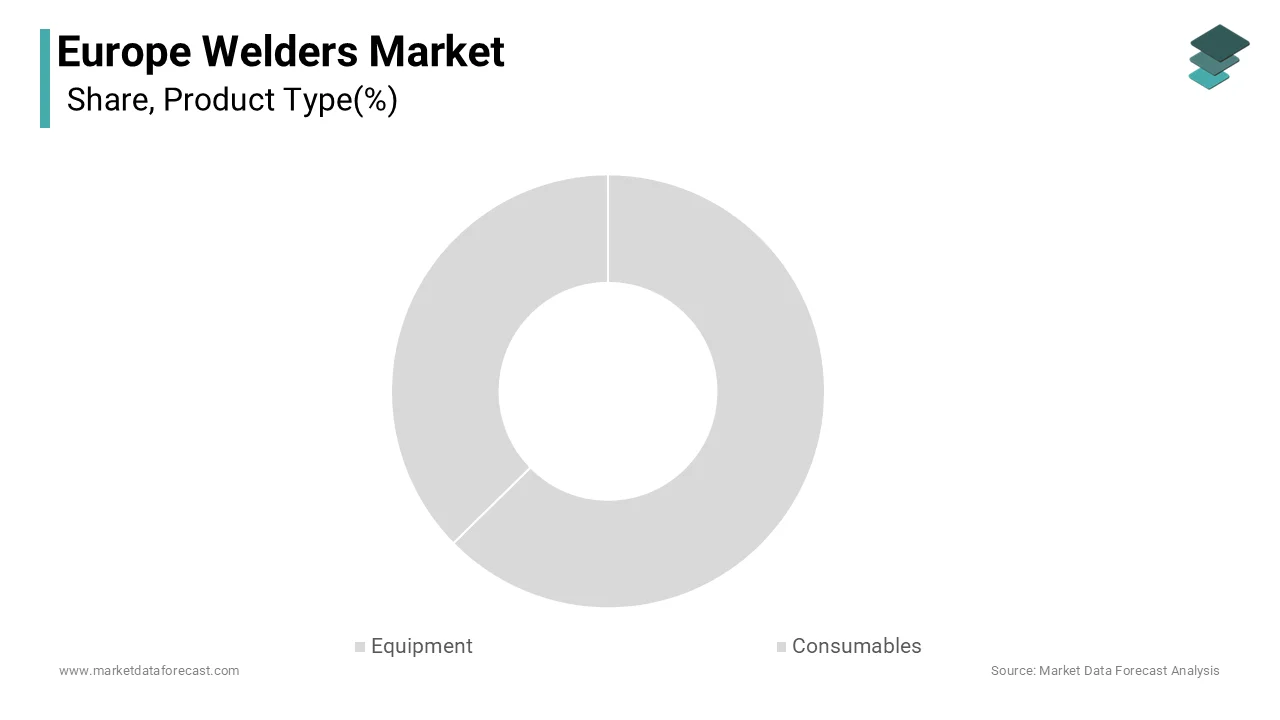
The consumables segment is likely to experience the fastest CAGR of 7.2% from 2026 to 2034. This robust growth is intrinsically linked to the rising intensity of welding activity driven by industrial reshoring and infrastructure renewal. While equipment is a one-time capital purchase, consumables represent a recurring, high-velocity revenue stream that scales directly with production volume. Moreover, a key factor is the increasing use of specialized filler metals and shielding gases required for welding advanced high-strength steels and lightweight alloys, which are now standard in electric vehicle and aerospace manufacturing. These premium consumables command significantly higher prices than traditional mild steel electrodes. The European Steel Association (EUROFER) indicates that, despite a challenging market environment in 2024, the structural shift toward lighter materials in the EU automotive sector continues to drive demand for specialized, high-performance welding consumables compatible with advanced high-strength steels. This trend ensures that as Europe’s factories run at higher capacities with more complex materials, the demand for sophisticated consumables will continue to outpace the broader market.
By Type Insights
The arc welding segment remained the largest segment in theEuropeane welders market and held a significant share in 2025. The supremacy of the segment is attributed to the widespread adoption of its advanced sub-processes, particularly Metal Inert Gas (MIG) and Tungsten Inert Gas (TIG) welding. Its prevalence is rooted in its unparalleled versatility, cost-effectiveness, and suitability for a vast array of industrial applications, from shipbuilding to automotive assembly. These methods offer a superior balance of speed, quality, and ease of automation compared to older techniques. MIG welding, in particular, has become the de facto standard for high-volume production lines due to its high deposition rates and compatibility with robotic systems. In European automotive manufacturing, automated welding cells heavily rely on Metal Active Gas (MAG) and related processes to meet demand for high-quality production, making it a dominant choice for robot-based assembly. This deep integration into the core of Europe’s most advanced manufacturing sectors ensures that arc welding remains the foundational technology of the entire metal joining industry.
The solid state welding segment is on the rise and is expected to be the fastest-growing segment in the market by witnessing a CAGR of 9.8% over the forecast period due to the urgent need to join dissimilar and heat-sensitive materials that are increasingly common in next-generation products. Traditional fusion welding often fails with these materials, causing defects like cracking or distortion. Friction stir welding, for instance, is a cold process that joins metals without melting them, making it ideal for high-strength aluminum alloys used in electric vehicle battery trays and aerospace structures. The European Space Agency has mandated the use of friction stir welding for critical components in its Ariane 6 rocket program due to its exceptional joint integrity. Similarly, Ultrasonic welding has become the preferred industry method for joining copper busbars in European electric vehicle power electronics, offering superior electrical conductivity and high-strength bonds, particularly for mixed-metal connections. This unique capability to solve previously intractable joining challenges positions solid-state welding as a critical enabler of future industrial innovation.
By Application Insights
The automotive application segment occupied the majority share of 32.6% of the European welders market in 2025. The leading position of the segment is credited to the sector’s status as the continent’s most advanced and integrated manufacturing ecosystem. Also helping this segment is the ongoing transformation of vehicle architecture driven by electrification. Electric vehicles require a far more complex and robust welded structure than their internal combustion engine counterparts, primarily to house and protect the heavy battery pack. A single EV battery enclosure can contain over two hundred meters of laser and MIG weld seams, demanding extreme precision and quality control. As per major industry analysis, the production of electric vehicles within the European Union has stabilized rather than sharply increased in recent times, contrasting with earlier, more rapid growth trajectories. This explosive growth in EV output has created an unprecedented demand for high-speed, high-integrity welding systems, particularly automated and robotic solutions, making the automotive sector the single most powerful engine of the entire European welders market.
The aerospace application segment is expected to exhibit a noteworthy CAGR of 10.5% from 2026 to 2034, owing to a confluence of ambitious civil aviation recovery and a massive ramp-up in defense and space-related manufacturing. The European aerospace industry is a global leader in the production of commercial aircraft, engines, and satellites, all of which rely heavily on specialized, high-integrity welding for critical components. The production of a modern jet engine, for example, involves hundreds of electron beam and laser welds on nickel-based superalloys that must withstand extreme temperatures and pressures. Airbus commercial aircraft deliveries experienced modest growth in 2024 despite facing significant supply chain challenges that prevented them from reaching their initial, higher targets. This dual boom in civil and defense aerospace is creating a sustained, high-value demand for the most advanced and precise welding technologies available, driving the segment’s exceptional growth trajectory.
COUNTRY LEVEL ANALYSIS
Germany Welders Market Analysis
Germany led the European welders market by capturing a share of 21.7% in 2025. The dominance of the German market is driven by its world-leading position in automotive and industrial machinery manufacturing, sectors that are among the most intensive users of advanced welding technologies. German industry is characterized by a relentless pursuit of engineering excellence and automation, which drives a consistent demand for the highest quality, most innovative welding systems. A key factor is the nation’s strong Mittelstand, its network of highly specialized small and medium enterprises that form the backbone of its manufacturing supply chain. These firms are major adopters of automated and robotic welding cells to maintain their competitive edge in global markets. According to the German Engineering Federation (VDMA), the German industrial automation and robotics sector is experiencing a period of stalled growth due to a weak domestic economy, yet it continues to prioritize investment in advanced technologies and, specifically, collaborative robots to secure long-term competitiveness and maintain its position as a leading European industrial hub.
France Welders Market Analysis
France was the second largest country in the European welders market and accounted for a 14.5% share in 2025. The expansion of the French market is fuelled by its strong presence in strategic, high-technology sectors such as aerospace, nuclear energy, and high-speed rail, all of which demand the most sophisticated and reliable welding solutions. The aerospace cluster around Toulouse, home to Airbus, is a major hub of welding activity, requiring extensive use of electron beam and laser welding for airframes and engines. Simultaneously, the country’s long-standing commitment to nuclear power necessitates a highly specialized welding workforce for constructing and maintaining reactor vessels and piping systems, where weld integrity is a matter of national safety. The French government’s commitment to constructing new nuclear reactors is creating massive, long-term demand for specialized labor in the nuclear industry, sparking a significant increase in the need for training and recruitment of skilled personnel across the sector to support both new construction and maintenance of existing infrastructure.
United Kingdom Welders Market Analysis
The United Kingdom is also a major player in the European welders market due to a diverse industrial base that includes a resurgent automotive sector, a world-class offshore wind energy industry, and a significant defense manufacturing footprint. A major catalyst for demand is the country’s aggressive push toward renewable energy infrastructure. The construction of a single offshore wind farm requires thousands of high-integrity welds for turbine towers and subsea foundations, a task that demands specialized automated and semi-automated welding systems. The UK government is targeting a rapid, large-scale increase in offshore wind energy capacity by the end of the decade, requiring a substantial expansion of the nation's heavy manufacturing and fabrication capabilities to support the necessary infrastructure development. Current policy from the Department for Energy Security and Net Zero aims to reach fifty gigawatts by 2030, with industry reports indicating that realizing this goal requires urgent acceleration in supply chain development. This focus on large-scale, complex metal joining projects ensures a steady and growing demand for professional welding equipment and consumables across the country.
Italy Welders Market Analysis
Italy occupies a significant share of the European welders market owing to its dense network of small and medium-sized enterprises specializing in high-end metal fabrication for luxury goods, including automotive, yachting, and industrial design. This ecosystem creates a strong demand for versatile, high-precision welding equipment that can handle a wide variety of materials and complex geometries, often in low to medium batch sizes. Italian manufacturers are known for their emphasis on craftsmanship and aesthetic finish, which translates into a preference for TIG welding and other processes that offer fine control and clean results. According to the Italian National Institute of Statistics, the metalworking industry maintains its central, strategic role in the national economy by employing a vast workforce, even while the sector navigates a challenging economic landscape characterized by production slowdowns and high operating costs. This focus on artisanal yet technologically advanced metal fabrication sustains a vibrant and specialized market for professional welding solutions.
Sweden Welders Market Analysis
Sweden is anticipated to expand in Europe welders market over the forecast period due to its leadership in heavy industries that operate under the most stringent environmental and safety standards globally, including mining equipment, commercial vehicles, and shipbuilding. Companies like Volvo and Scania are at the forefront of adopting automated and robotic welding to produce the robust chassis and cabs for their electric and hybrid trucks, a segment that saw an increase in European sales. Furthermore, Sweden’s ambitious climate goals have spurred innovation in green steel production, with the HYBRIT project aiming to create fossil-free steel using hydrogen. This new type of steel requires novel welding procedures and consumables, positioning Sweden as a testbed for the next generation of sustainable welding technologies. This combination of industrial strength and environmental leadership creates a dynamic and forward-looking welding market.
COMPETITIVE LANDSCAPE
The competitive dynamics of theEuropeane welders market are defined by a clear hierarchy between global technology leaders and a fragmented base of regional specialists. At the apex, a few multinational corporations like Lincoln Electric, ESAB, and Fronius dominate the high-end segment through their extensive R&D capabilities, broad product portfolios, and strong brand recognition built on decades of reliability. These players compete fiercely on innovation, offering sophisticated, digitally connected, and automated solutions. Below this tier, numerous smaller European manufacturers focus on niche applications or specific geographic markets, often competing on price and specialized service. The market is characterized by high entry barriers due to the need for deep technical expertise, compliance with stringent EU safety and environmental regulations, and established relationships with industrial customers. This structure fosters intense competition at the premium level while allowing for specialized survival in the mid and lower segments, creating a complex and multifaceted competitive environment.
KEY MARKET PLAYERS
Some of the companies that are playing a dominating role in the global European Welders Market include
- Lincoln Electric Holdings, Inc.
- ESAB Corporation
- Fronius International GmbH
- The Miller Electric Mfg. Co. (a Terex Company)
- Air Liquide Welding (Air Liquide Group)
- Boothroyd Precision Ltd.
- KEMPPI Oy
- ITW Welding (Illinois Tool Works Inc.)
- Hypertherm, Inc.
- TIG Welder Europe (regional specialist brands)
- Panasonic Welding Systems Corp.
- Messer Group GmbH
- EWM AG
- Röslau GmbH
- Bernard S.A.
- Tweco / Arcinox (ITW brands)
- Lorch Schweißtechnik GmbH
- Abbott Welders Europe (distribution network)
- Thermal Dynamics (a Thermadyne brand)
TOP LEADING PLAYERS IN THE MARKET
- Lincoln Electric is a global powerhouse in the welding industry with a formidable presence across Europe. The company offers a comprehensive portfolio of arc welding equipment, consumables, and automated solutions that serve the automotive, construction, and heavy industrial sectors. To strengthen its European foothold, Lincoln Electric has been actively expanding its manufacturing and distribution network. A key recent action was the inauguration of a new state-of-the-art consumables production facility in Poland, which enhances its ability to supply high-quality, locally produced filler metals to meet the growing demand from the region’s reshoring initiatives.
- ESAB, with its deep European heritage and global reach, is a leading innovator in advanced welding and cutting technologies. The company is particularly renowned for its expertise in automated and robotic welding systems, as well as its premium consumables for demanding applications in shipbuilding and aerospace. In a strategic move to solidify its position, ESAB launched its next generation of AI-powered welding power sources. These systems feature real-time weld quality monitoring and adaptive control, directly addressing the European market’s need for higher productivity and reduced reliance on scarce skilled labor.
- Fronius is a cornerstone of the European welding landscape, celebrated for its engineering excellence and pioneering role in digital welding technology. The company’s TPS and TransPuls Synergic series are benchmarks for precision and efficiency in both manual and automated applications. Fronius has been aggressively strengthening its market position by deepening its integration with Industry 4.0 ecosystems. Its most significant recent action was the establishment of a dedicated European Center of Excellence for welding automation, which serves as a hub for customer training, process development, and collaborative R&D with key industrial partners.
TOP STRATEGIES USED BY THE KEY MARKET PARTICIPANTS
Key players in the European welders market are primarily deploying three core strategies to secure their competitive advantage. First, they are making substantial investments in digitalization and smart welding technologies, embedding sensors and software to enable predictive maintenance and real-time quality control. Second, they are expanding their local manufacturing and service footprints to ensure supply chain resilience and faster response times for customers, a direct response to the trend of industrial reshoring. Third, they are forging strategic partnerships with industrial automation providers and end-user industries to co-develop integrated solutions that address specific application challenges, thereby moving beyond being mere equipment suppliers to becoming essential technology partners in their customers’ production processes.
MARKET SEGMENTATION
This research report on the europe welders market is segmented and sub-segmented into the following categories.
By Product Type
- Equipment
- Consumables
By Type
- Arc Welding
- Solid State Welding
- Resistance Welding
- Oxy-Fuel Welding
- Others
By Application
- Automotive
- Aerospace
- Construction
- Shipbuilding
- Energy & Power
- Heavy Engineering
- Others
By Country
- Germany
- France
- United Kingdom
- Italy
- Sweden
- Rest of Europe