- Product Description Description
- Table of Contents TOC
- List of Table & Figure LOT
- Get Free Sample PDF Sample PDF
Market Size, 2025
$5.60 BnMarket Estimate, 2026
$6.33 BnMarket Forecast, 2034
$16.90 BnCAGR, 2026–2034
13.06%Europe Wi-Fi Market Report Summary
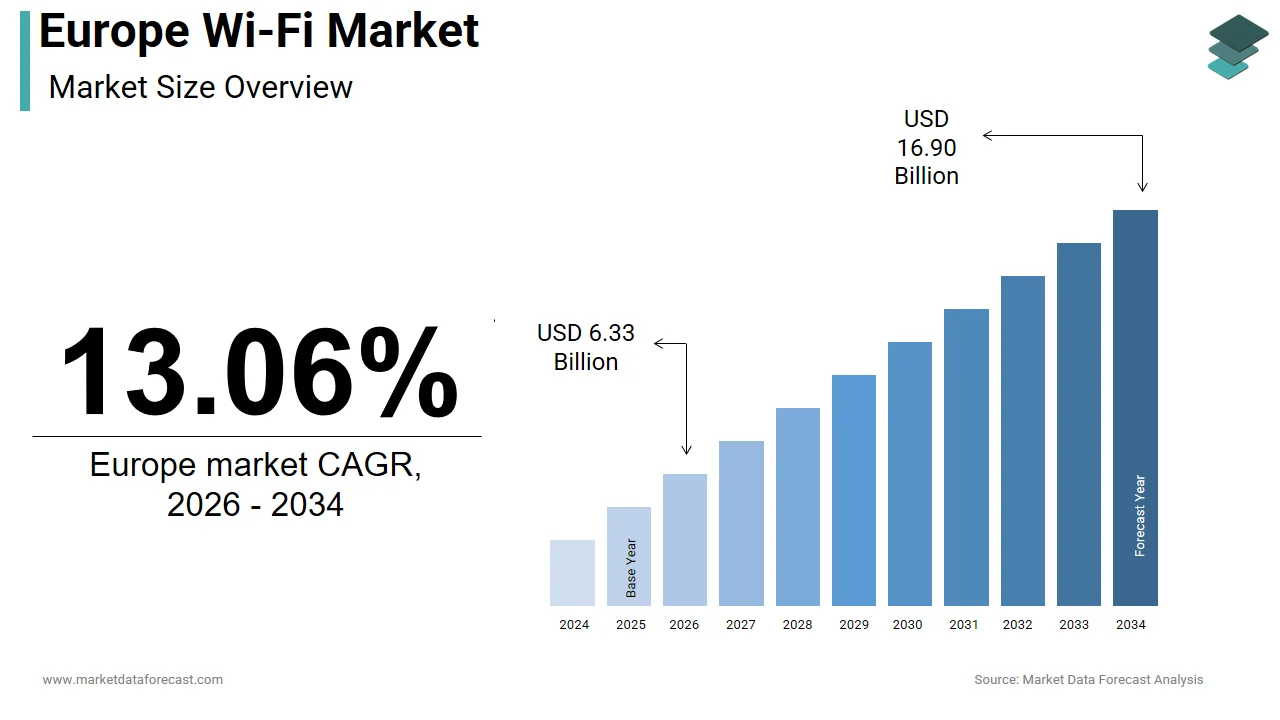
The Europe Wi-Fi market was valued at USD 5.60 billion in 2025, is estimated to reach USD 6.33 billion in 2026, and is projected to reach USD 16.90 billion by 2034, growing at a CAGR of 13.06% from 2026 to 2034. Market growth is driven by the rapid expansion of connected devices, increasing demand for high-speed wireless connectivity, and the adoption of advanced Wi-Fi standards such as Wi-Fi 6 and Wi-Fi 6E. The growing reliance on wireless networks in homes, enterprises, and public infrastructure is accelerating investments in next-generation networking solutions. Additionally, the rise of smart homes, remote work environments, IoT devices, and digital transformation initiatives across industries is further supporting the expansion of the Wi-Fi market across Europe.
Key Market Trends
- Increasing adoption of Wi-Fi 6 and next-generation wireless networking technologies.
- Growing demand for high-speed connectivity in smart homes and connected devices.
- Rising deployment of Wi-Fi networks in enterprises, public spaces, and smart cities.
- Expansion of Internet of Things (IoT) ecosystems across industries.
- Increasing investments in advanced wireless infrastructure and network upgrades.
Segmental Insights
- Based on component, the hardware segment dominated the Europe Wi-Fi market in 2025, driven by large-scale infrastructure upgrades required to support next-generation wireless standards and higher device densities.
- Based on end-user vertical, the consumer segment held the largest share in 2025, supported by the widespread adoption of Wi-Fi in households and the increasing number of connected devices per home across Europe.
Regional Insights
The Europe Wi-Fi market is experiencing significant growth across major countries due to increasing digitalization, expansion of broadband infrastructure, and growing adoption of connected technologies.
- Germany led the regional market in 2025 with 21.4% share, supported by strong broadband infrastructure and increasing demand for enterprise and residential connectivity.
- The United Kingdom ranked second in the regional market in 2025, driven by high adoption of smart home technologies and expanding wireless networking infrastructure.
- France is expected to hold a significant share during the forecast period due to strong government initiatives promoting digital infrastructure and smart city development.
Competitive Landscape
The Europe Wi-Fi market is characterized by strong competition among global networking equipment providers and telecommunications technology companies. Market players are focusing on developing advanced wireless technologies, expanding product portfolios, and supporting next-generation connectivity standards. Strategic partnerships with telecom operators, investments in research and development, and expansion of enterprise networking solutions are shaping competitive dynamics across the region.
Prominent companies operating in the Europe Wi-Fi market include Cisco Systems, Inc., Hewlett Packard Enterprise (Aruba), Huawei Technologies Co., Ltd., CommScope Holding Company Inc. (Ruckus Networks), and Telefonaktiebolaget LM Ericsson.
Europe Wi-Fi Market Size
The Europe Wi-Fi market was valued at USD 5.60 billion in 2025, is estimated to reach USD 6.33 billion in 2026, and is projected to reach USD 16.90 billion by 2034, growing at a CAGR of 13.06% from 2026 to 2034.
Wi-Fi represents the critical infrastructure layer enabling wireless local area networking across the continent, serving as the backbone for digital connectivity in homes, enterprises, and public spaces. This ecosystem encompasses access points, controllers, cloud management platforms, and client devices operating primarily on IEEE 802.11ax (Wi-Fi 6) and the emerging 802.11be (Wi-Fi 7) standards. The region is currently undergoing a profound transformation driven by the European Commission's Digital Decade policy, which mandates that all households should have gigabit connectivity by 2030.
According to Eurostat, households in the European Union had internet access in 2024, with Wi-Fi serving as the primary last-mile delivery mechanism for this connectivity. As per the Body of European Regulators for Electronic Communications, the proliferation of Internet of Things devices has further intensified reliance on robust wireless networks, with European households now connecting multiple smart devices simultaneously. Public sector initiatives are also reshaping the landscape, with the WiFi4EU project having installed free access points in public squares and libraries across member states to bridge the digital divide. Unlike mere consumer convenience, Wi-Fi in Europe is increasingly viewed as an essential utility for remote work, telemedicine, and education, necessitating high density and low latency performance. The market definition now extends beyond hardware sales to include managed services and software-defined networking solutions that ensure seamless roaming and security compliance with the General Data Protection Regulation.
MARKET DRIVERS
Accelerated Deployment of Wi-Fi 6 and Wi-Fi 7 Standards to Support High-Density Connectivity
The rapid migration towards next-generation Wi-Fi standards acts as a primary catalyst to accommodate surging device densities and bandwidth-intensive applications. European enterprises and service providers are aggressively upgrading their infrastructure to Wi-Fi 6 and Wi-Fi 7 to handle the exponential growth in connected devices and data traffic within confined spaces. The technical superiority of Wi-Fi 6 offers orthogonal frequency division multiple access, which allows simultaneous transmission to multiple devices, significantly reducing congestion in high-density environments like stadiums, airports, and large office complexes. According to the Wi-Fi Alliance, shipments of Wi-Fi 6 certified devices in Europe have grown rapidly, indicating a swift adoption curve among both consumers and businesses. The emergence of Wi-Fi 7 further propels this driver by introducing multi-link operation capabilities that aggregate multiple frequency bands to deliver higher throughput speeds. This leap in performance is critical for supporting immersive technologies such as augmented reality and virtual reality, which are gaining traction in European industrial training and retail sectors. As per the European Telecommunications Standards Institute, efficiency gains from these new standards reduce latency to levels suitable for real-time industrial automation and tactile internet applications. Furthermore, the mandatory inclusion of Wi-Fi 6 in many new smartphone and laptop models sold in the region creates a pull effect, forcing infrastructure upgrades to match client capabilities.
Ubiquitous Integration of Internet of Things Devices in Smart Cities and Industrial Automation
The explosive expansion of Internet of Things ecosystems in smart city initiatives and Industry 4.0 frameworks fuels unprecedented demand for robust wireless backbones. Europe stands at the forefront of the global smart city movement, with major metropolises deploying vast networks of sensors for traffic management, environmental monitoring, and energy optimization, all reliant on pervasive Wi-Fi connectivity. According to the European Union’s Horizon Europe program, funding has been allocated to projects that integrate digital technologies into urban infrastructure, directly stimulating the deployment of industrial-grade Wi-Fi networks. As per the International Data Corporation, the number of connected Internet of Things devices in Western Europe is projected to grow significantly, creating a massive addressable market for high-capacity wireless access points. In the industrial sector, the shift towards smart factories requires reliable wireless connections for autonomous guided vehicles, robotic arms, and predictive maintenance sensors, which traditional wired networks cannot flexibly support. According to the German Engineering Federation, manufacturing facilities in Germany are increasingly implementing wireless solutions to enhance operational agility and reduce cabling costs. Wi-Fi 6E, which operates in the six gigahertz band, provides the necessary spectrum cleanliness to support these critical machine-to-machine communications without interference from legacy devices. Municipalities are also leveraging Wi-Fi to provide public services such as smart lighting and waste management systems, further expanding the deployment footprint.
MARKET RESTRAINTS
Fragmented Spectrum Allocation and Regulatory Delays in the Six Gigahertz Band
Inconsistent regulatory approaches regarding the 6 GHz band across European nations create significant barriers to the uniform deployment of Wi-Fi 6E and Wi-Fi 7. The full potential of next-generation Wi-Fi technologies relies heavily on access to the 6 GHz spectrum, yet the regulatory landscape in Europe remains fragmented, causing uncertainty for manufacturers and network operators. While some countries have moved swiftly to open the entire six gigahertz band for unlicensed use, others have reserved portions for licensed mobile services or incumbent users, leading to a patchwork of availability. According to the Body of European Regulators for Electronic Communications, this lack of harmonization complicates the design of devices that must comply with varying national rules, increasing production costs and delaying product launches. The hesitation in some member states to release the spectrum stems from concerns about interference with existing point-to-point microwave links used for backhaul, requiring complex coordination mechanisms that slow down adoption. As per the GSM Association, without a unified approach, the economic benefits of Wi-Fi 6E could be reduced due to limited channel availability in restricted regions. This regulatory dissonance forces multinational enterprises to deploy heterogeneous network architectures that are difficult to manage and optimize.
Acute Shortage of Skilled Network Professionals and Implementation Complexity
A critical deficit in qualified personnel capable of designing and managing advanced wireless networks hampers the effective deployment and optimization of modern Wi-Fi solutions. As Wi-Fi technology evolves into a complex software-defined ecosystem, the demand for skilled network engineers who understand radio frequency planning, security protocols, and cloud management has outstripped supply across Europe. The transition from simple access point installation to sophisticated network orchestration requires a level of expertise that is currently scarce in the regional labor market. According to the European Centre for the Development of Vocational Training, the information and communication technology sector in Europe faces a shortfall of professionals, with wireless networking being a particularly acute area of deficiency. This skills gap leads to suboptimal network configurations, increased vulnerability to security breaches, and longer deployment timelines, which deter organizations from upgrading their infrastructure. Small and medium-sized enterprises are disproportionately affected as they lack the resources to hire specialized consultants or train internal staff on the intricacies of Wi-Fi 6 and Wi-Fi 7 features. As per industry surveys, many IT managers cite a lack of expertise as the primary reason for delaying network modernization projects. The complexity is further exacerbated by the integration of artificial intelligence-driven analytics, which requires new skill sets in data interpretation and algorithm tuning. Without a concerted effort to upskill the workforce through targeted education programs and certifications, the human capital constraint will remain a formidable restraint preventing the full realization of Wi-Fi market potential.
MARKET OPPORTUNITIES
Emergence of Converged Fixed Mobile Networks and Seamless Roaming Ecosystems
The convergence of fixed Wi-Fi and mobile cellular networks presents a transformative opportunity to deliver uninterrupted connectivity experiences for users across diverse environments. The blurring lines between Wi-Fi and fifth-generation mobile networks offer a lucrative avenue for service providers to create seamless roaming ecosystems where users transition effortlessly between indoor and outdoor coverage without session interruption. European telecommunications operators are increasingly adopting converged core networks that treat Wi-Fi as an integral component of their overall service portfolio rather than a separate silo. According to the GSMA, the integration of Wi-Fi calling and data offloading has already saved European mobile networks significant volumes of traffic monthly. The introduction of Passpoint and Hotspot 2.0 standards facilitates automatic and secure authentication, allowing subscribers to connect to partner Wi-Fi networks globally as if they were on their home cellular network. As per the Broadband Forum, converged networks can reduce churn rates by offering superior coverage and consistent quality of service. Furthermore, the ability to leverage Wi-Fi for indoor deep coverage complements the macro cellular layer, addressing the high cost of deploying small cells in dense urban areas.
Expansion of Managed Wi-Fi Services and Network as a Service Models for SMEs
The shift towards subscription-based Managed Wi-Fi and Network as a Service models offers significant growth potential by democratizing access to enterprise-grade connectivity for small and medium-sized enterprises. Small and medium-sized enterprises in Europe are increasingly reluctant to bear the high capital expenditure and operational burden of owning and managing complex wireless infrastructure, creating a fertile ground for managed service providers. By offering Wi-Fi as a subscription service, providers can deliver state of the art hardware, continuous monitoring, security updates, and performance optimization for a predictable monthly fee. According to IDC, the market for managed network services in Europe is expected to grow at a strong pace as businesses prioritize operational agility over asset ownership. This model allows SMEs to access advanced features such as AI-driven troubleshooting and guest analytics, which were previously affordable only to large corporations. The rise of remote and hybrid work models has further accelerated this trend, with businesses requiring reliable and secure Wi-Fi solutions that can be managed remotely by service experts. As per the European Small Business Alliance, many SMEs prefer outsourcing their IT infrastructure to focus on core business activities. Providers who can bundle Wi-Fi services with cybersecurity and cloud applications stand to capture a substantial share of this evolving market.
MARKET CHALLENGES
Escalating Cybersecurity Threats Targeting Wireless Infrastructure and User Privacy
The increasing sophistication of cyberattacks targeting Wi-Fi networks poses a severe challenge to maintaining data integrity and user trust in an era of heightened privacy regulations. Wi-Fi networks represent a prominent attack surface for cybercriminals seeking to intercept sensitive data, launch ransomware attacks, or gain unauthorized access to corporate systems. The decentralized nature of Wi-Fi deployments, especially in public spaces and remote work settings, expands the threat landscape, making it difficult to enforce consistent security policies. According to ENISA, wireless network attacks in Europe have increased, with rogue access points and man-in-the-middle attacks being the most prevalent vectors. The implementation of the General Data Protection Regulation imposes strict liabilities on organizations for data breaches, meaning any compromise of Wi-Fi security can result in massive fines and reputational damage. The challenge is compounded by the proliferation of insecure Internet of Things devices that often lack robust encryption and serve as entry points for attackers into the broader network. As per data from security firms, many Wi-Fi networks in Europe still utilize outdated security protocols that are vulnerable to known exploits. Protecting against these threats requires continuous investment in advanced encryption standards, intrusion detection systems, and user awareness training, which can be resource-intensive.
Interference Management in Congested Spectrums and Dense Urban Environments
Managing signal interference in increasingly congested spectral environments presents a formidable technical challenge for maintaining reliable Wi-Fi performance in dense European cities. The high density of buildings and the sheer volume of wireless devices in European urban centers create a chaotic radio frequency environment where signal interference severely degrades network performance and user experience. Legacy devices operating on the crowded two-point-four-gigahertz band often cause significant contention, while the limited availability of non-overlapping channels exacerbates the problem in apartment blocks and office complexes. According to research from the University of Cambridge, signal interference in dense urban areas can reduce effective Wi-Fi throughput considerably. The challenge is further complicated by the presence of non-Wi-Fi interferers such as Bluetooth devices, microwave ovens, and industrial equipment, which emit noise in the same frequency ranges. While the six gigahertz band offers relief, its limited penetration through thick masonry walls common in historic European architecture restricts its effective range, necessitating denser access point deployments. As per network performance monitors, co-channel interference remains the top cause of poor Wi-Fi quality in metropolitan areas across France, Italy, and the United Kingdom. Mitigating these issues requires sophisticated dynamic frequency selection algorithms and precise site surveys, which add complexity and cost to network planning.
REPORT COVERAGE
| REPORT METRIC | DETAILS |
| Market Size Available | 2025 to 2034 |
| Base Year | 2025 |
| Forecast Period | 2026 to 2034 |
| Segments Covered | By Component, End-User Vertical, and Country. |
| Various Analyses Covered | Global, Regional, and Country-Level Analysis, Segment-Level Analysis, Drivers, Restraints, Opportunities, Challenges; PESTLE Analysis; Porter’s Five Forces Analysis, Competitive Landscape, Analyst Overview of Investment Opportunities |
| Countries Covered | UK, France, Spain, Germany, Italy, Russia, Sweden, Denmark, Switzerland, Netherlands, Turkey, Czech Republic, and the Rest of Europe. |
| Market Leaders Profiled | Cisco Systems, Inc., Hewlett Packard Enterprise (Aruba), Huawei Technologies Co., Ltd., CommScope Holding Company Inc. (Ruckus Networks), Telefonaktiebolaget LM Ericsson, and Others. |
SEGMENTAL ANALYSIS
By Component Insights
The Hardware segment commands the largest share of the Europe Wi-Fi market, driven by the massive infrastructure refresh cycles required to support next-generation standards and increasing device densities. The dominance of this sector is primarily fueled by the urgent need for enterprises and service providers to replace legacy Wi-Fi 5 equipment with Wi-Fi 6 and Wi-Fi 6E access points to handle modern bandwidth demands. According to IDC, shipments of Wi-Fi 6 and Wi-Fi 6E access points in Europe have grown significantly as organizations rushed to upgrade their physical networks before the widespread adoption of Wi-Fi 7. The proliferation of high-throughput devices such as streaming boxes, virtual reality headsets, and dense IoT sensor arrays necessitates hardware capable of orthogonal frequency division multiple access to prevent network congestion. As per the Wi-Fi Alliance, a majority of enterprise access points sold in the region were Wi-Fi 6 certified, highlighting a decisive shift in capital expenditure towards new hardware. Furthermore, according to the European Commission, connectivity goals for gigabit speeds have prompted public sector entities to invest heavily in robust outdoor and indoor access points to cover smart city initiatives. The physical requirement for multi-gigabit Ethernet switches to backhaul these advanced access points also contributes significantly to the hardware volume. As the lifecycle of networking equipment typically spans several years, the concurrent expiration of previous-generation contracts has created a synchronized wave of procurement.
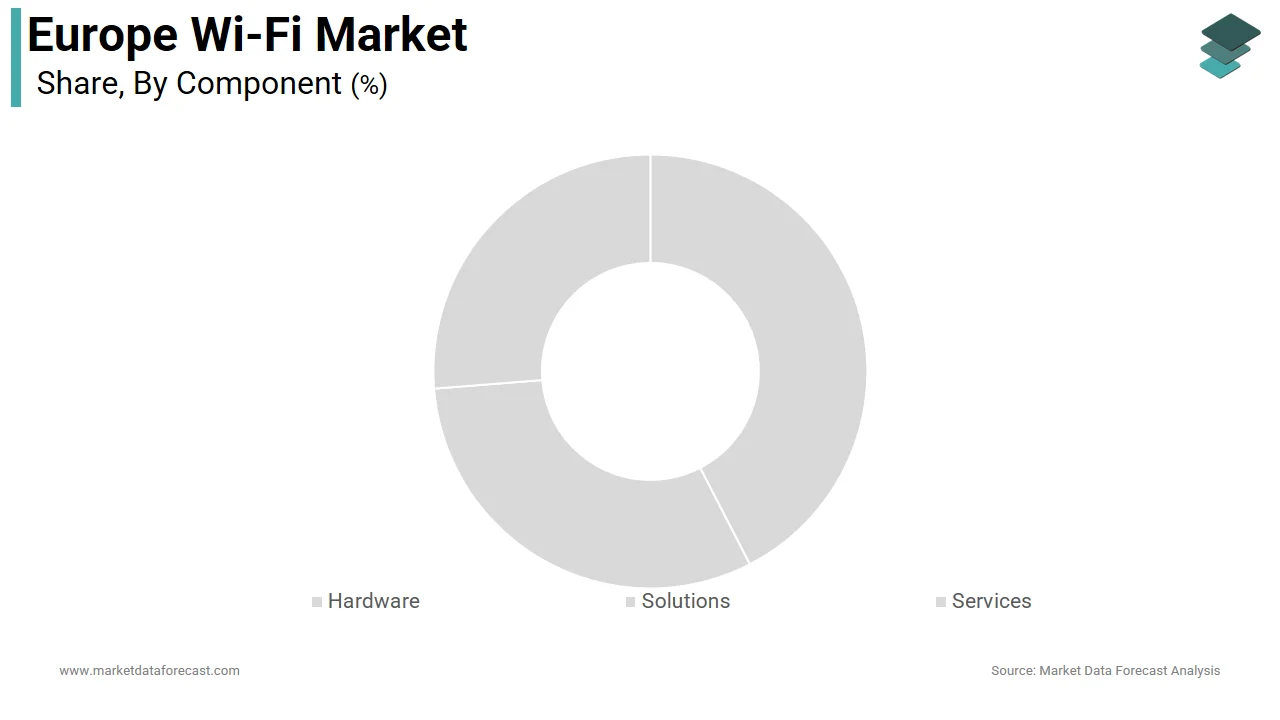
The Services segment is projected to register the highest growth rate through 2030, fueled by the complexity of managing modern wireless ecosystems and the rise of Managed Wi-Fi models. This rapid expansion is driven by the acute shortage of skilled network professionals in Europe, forcing organizations to outsource the design, deployment, and ongoing management of their Wi-Fi infrastructure to specialized providers. According to the European Centre for the Development of Vocational Training, the digital skills gap in the region has left many networking positions unfilled, making managed services an operational necessity. The transition to cloud-managed Wi-Fi architectures has further accelerated this trend, as businesses prefer subscription-based models that include continuous monitoring, security patching, and performance optimization without large upfront capital investments. As per IDC, the market for managed network services in Europe is expanding at strong rates as small and medium-sized enterprises seek to leverage enterprise-grade connectivity without maintaining internal IT teams. The complexity of securing Wi-Fi networks against evolving cyber threats under the General Data Protection Regulation also drives demand for professional security auditing and compliance services. Additionally, the integration of artificial intelligence for predictive maintenance requires specialized expertise to interpret data and tune algorithms, creating a new niche for consulting services.
By End-User Vertical Insights
The Consumer vertical holds the largest market share, propelled by the ubiquitous presence of Wi-Fi in households and the exploding number of connected devices per home across Europe. The dominance of this segment is anchored in the fact that Wi-Fi has become the primary method for last-mile connectivity in residential settings, supporting everything from remote work setups to entertainment systems. According to Eurostat, internet penetration in European households has reached high levels, with virtually every connected home relying on a Wi-Fi router as the central hub for distribution. As per the Body of European Regulators for Electronic Communications, the average European household now connects multiple smart devices simultaneously, including smartphones, tablets, smart televisions, gaming consoles, and Internet of Things appliances. This surge in device density has forced consumers to upgrade from single routers to mesh Wi-Fi systems to eliminate dead zones in increasingly large or structurally complex homes. According to GfK, sales of mesh Wi-Fi systems in Western Europe have grown rapidly as users demand seamless roaming and consistent high-speed coverage. The rise of fiber-to-the-home installations, supported by national broadband plans, further stimulates the consumer market by providing the high-speed backhaul that necessitates advanced Wi-Fi 6 routers to fully utilize the bandwidth. Moreover, the permanence of hybrid work models has elevated home network reliability to a critical utility status, driving continuous investment in higher-performance consumer-grade hardware.
The Industrial and Logistics vertical is experiencing the fastest growth, driven by the rapid digitization of manufacturing and the adoption of Industry 4.0 technologies. This explosive growth is fueled by the critical need for reliable, low-latency wireless connectivity to support autonomous guided vehicles, real-time asset tracking, and robotic automation in smart factories and warehouses. According to the German Engineering Federation, manufacturing facilities in Europe are increasingly implementing wireless solutions to replace rigid cabling and enhance operational flexibility, directly boosting demand for industrial-grade Wi-Fi 6 and Wi-Fi 6E infrastructure. As per the International Data Corporation, the number of connected industrial Internet of Things devices in Europe is projected to grow substantially, creating a massive addressable market for ruggedized access points. Logistics companies are also leveraging Wi-Fi for real-time inventory management and automated sorting systems, which require uninterrupted connectivity to maintain supply chain efficiency. According to the European Union, funding for digital transformation in small and medium-sized industrial enterprises further accelerates this adoption by subsidizing the deployment of advanced wireless networks. As industries strive for predictive maintenance and digital twin capabilities, the reliance on robust wireless backbones becomes paramount.
COUNTRY-LEVEL ANALYSIS
Germany Wi-Fi Market Analysis
Germany led the European Wi‑Fi market by holding 21.4% of the regional market share in 2025. The dominance of Germany in the European market is primarily supported by its strong industrial base and enterprise digitalization. According to the German Federal Network Agency, over 85% of enterprises have upgraded to Wi‑Fi 6 for manufacturing and logistics applications. Frankfurt and Munich are hubs for smart factory deployments, where Wi‑Fi enables IoT integration and predictive maintenance. Public initiatives such as the Digital Germany 2030 fund, Wi‑Fi expansion in schools, and public transport are ensuring nationwide coverage. With strict GDPR compliance, German enterprises prioritize secure Wi‑Fi analytics, making Germany the anchor of Europe’s enterprise‑driven Wi‑Fi ecosystem.
United Kingdom Wi-Fi Market Analysis
The UK captured the second-largest share of the European wi-fi market in 2025. The growth of the UK in the European market is attributed to consumer adoption and enterprise integration. Ofcom reports that over 70% of households use Wi‑Fi 6 routers, making the UK one of Europe’s most connected consumer markets. London’s financial services sector and retail chains deploy advanced Wi‑Fi analytics for customer engagement. The UK’s Smart London Plan has expanded public Wi‑Fi hotspots across transport and civic spaces. Post‑Brexit regulatory autonomy has enabled faster spectrum allocation for Wi‑Fi 6E, positioning the UK as an early adopter of next‑generation connectivity. With its blend of consumer penetration and enterprise demand, the UK remains a high‑value hub for Wi‑Fi innovation.
France Wi-Fi Market Analysis
France is estimated to account for a prominent share of the European wi-fi market during the forecast period, owing to the strong government support and emphasis on smart cities. The France Très Haut Débit program has connected over 90% of municipalities with public Wi‑Fi. Paris and Marseille lead in Wi‑Fi analytics adoption, particularly in retail and hospitality. Telecom operators such as Orange and Bouygues have rolled out Wi‑Fi 6E services nationwide. France also emphasizes sustainability, with 30% of new Wi‑Fi deployments powered by renewable energy sources. With its combination of policy support, urban connectivity, and enterprise adoption, France is expected to remain a stable and innovation‑driven market.
COMPETITIVE LANDSCAPE
The competition in the Europe Wi-Fi market is intense and characterized by a fierce rivalry among global technology giants and specialized regional vendors who constantly innovate to capture enterprise and consumer attention. Major competitors differentiate themselves through superior artificial intelligence capabilities that enable predictive maintenance and automated optimization of wireless performance in real time. The market sees frequent launches of new hardware supporting the latest Wi-Fi 7 standards, which promise multi-gigabit speeds and ultra-low latency for immersive applications. Privacy compliance has emerged as a critical battleground where companies strive to demonstrate adherence to strict General Data Protection Regulation rules to gain trust over rivals. Smaller niche players often focus on specific verticals like healthcare or industrial logistics to carve out sustainable positions against the dominance of large corporations. Strategic alliances with internet service providers and cloud platform vendors are common tactics used to expand reach and ensure default placement of networking equipment. This dynamic environment forces all participants to continuously evolve their technologies and business models to maintain relevance and secure long-term contracts in this rapidly advancing sector.
KEY MARKET PLAYERS
The leading companies operating in the Europe Wi-Fi market include:
- Cisco Systems, Inc.
- Hewlett Packard Enterprise (Aruba)
- Huawei Technologies Co., Ltd.
- CommScope Holding Company Inc.(Ruckus Networks)
- Telefonaktiebolaget LM Ericsson
TOP PLAYERS IN THE MARKET
- Cisco Systems remains a foundational pillar in the Europe Wi-Fi market by delivering comprehensive networking solutions that power enterprises and service providers across the continent. The company actively drives the adoption of Wi-Fi 6 and Wi-Fi 7 standards through its Catalyst series access points, which integrate advanced security and artificial intelligence capabilities. Globally, Cisco contributes significantly by setting interoperability benchmarks and fostering ecosystem partnerships that ensure seamless connectivity for diverse devices. Recent actions to strengthen its European position include the expansion of its cloud-managed Meraki platform offerings tailored for hybrid work environments and smart city initiatives. The firm has also invested heavily in local research and development centers to address specific regional regulatory requirements and sustainability goals. By focusing on software-defined networking and intent-based infrastructure, Cisco enables organizations to automate network management and enhance user experiences. These strategic moves reinforce its reputation as a trusted partner for critical digital infrastructure while supporting the broader global transition towards intelligent and secure wireless ecosystems.
- Hewlett Packard Enterprise stands as a key innovator in the Europe Wi-Fi sector through its Aruba Networks division, which provides edge-to-cloud networking solutions for various industries. The company excels in delivering secure and AI-driven wireless architectures that support high-density environments such as universities, hospitals, and large corporate campuses. On a global scale, HPE contributes by pioneering the concept of the Edge Services Platform, which unifies wired and wireless networks under a single management umbrella. Recent efforts to bolster its European presence involve launching specialized Wi-Fi 6E solutions designed to operate in the newly opened six gigahertz spectrum bands across member states. The firm has also strengthened its channel partner programs to accelerate deployment speeds for small and medium-sized enterprises seeking modern connectivity. By emphasizing zero-trust security models and sustainable hardware designs, HPE addresses critical customer concerns regarding data protection and environmental impact. These initiatives demonstrate its commitment to leading the market through technological excellence and customer-centric innovation without relying on market share metrics.
- CommScope Holding Company plays a vital role in the Europe Wi-Fi market by supplying high-performance access points and connectivity infrastructure that enable robust wireless coverage in challenging environments. The company leverages its deep expertise in radio frequency technology to deliver solutions that maximize spectrum efficiency and minimize interference for service providers and enterprises. Globally, CommScope contributes by advancing the convergence of fiber optics and wireless technologies to create seamless backhaul networks essential for next-generation Wi-Fi performance. Recent actions to solidify its standing in Europe include the introduction of ruggedized outdoor access points tailored for smart city deployments and industrial Internet of Things applications. The firm has also expanded its manufacturing footprint within the region to ensure supply chain resilience and faster delivery times for local customers. By focusing on open standards and interoperable systems, CommScope empowers operators to build flexible and scalable networks that adapt to evolving traffic demands. These strategic developments highlight its dedication to providing reliable and future-proof connectivity solutions that drive digital transformation across the continent.
TOP STRATEGIES USED BY KEY MARKET PARTICIPANTS
Key players in the Europe Wi-Fi market primarily employ strategies centered on aggressive product innovation and the rapid integration of artificial intelligence to enhance network performance and security. Companies frequently launch next-generation access points supporting Wi-Fi 6E and Wi-Fi 7 standards to capture early adopters and replace legacy infrastructure before competitors can act. Another major strategy involves expanding cloud-managed service portfolios to offer subscription-based models that appeal to small and medium-sized enterprises seeking operational simplicity and predictable costs. Firms are increasingly forming strategic alliances with telecommunications operators and system integrators to bundle Wi-Fi solutions with fiber connectivity and fifth-generation mobile services for comprehensive coverage. Participants also focus on acquiring niche startups specializing in cybersecurity or location-based analytics to enrich their feature sets and differentiate their offerings in a crowded landscape. Sustainability drives many corporate roadmaps as manufacturers design energy-efficient hardware and recycling programs to align with strict European environmental regulations. These combined approaches enable market leaders to maintain competitive advantages and drive growth in a highly dynamic and regulated environment.
MARKET SEGMENTATION
This research report on the Europe Wi-Fi market has been segmented and sub-segmented into the following categories.
By Component
- Hardware
- Access Points
- Routers and Extenders
- Wireless Controllers
- Other Device Types
- Solutions
- Services
By End-User Vertical
- Consumer
- Enterprise / Corporate Campuses
- Education
- Healthcare
- Hospitality and Retail
- Industrial and Logistics
By Country
- United Kingdom
- France
- Spain
- Germany
- Italy
- Russia
- Sweden
- Denmark
- Switzerland
- Netherlands
- Rest of Europe