- Product Description Description
- Table of Contents TOC
- List of Table & Figure LOT
- Get Free Sample PDF Sample PDF
Market Size, 2025
$12.97 BnMarket Estimate, 2026
$24.03 BnMarket Forecast, 2034
$3,340.56 BnCAGR, 2026–2034
85.30%Europe 5G Infrastructure Market Summary
The Europe 5G infrastructure market was valued at USD 12.97 billion in 2025 and is expected to reach USD 3,340.56 billion by 2034, growing at an exceptional CAGR of 85.30% from 2026 to 2034. Growth is driven by aggressive digital transformation across industries, large-scale public sector investments, and Europe’s strategic push toward digital sovereignty, smart mobility, and Industry 4.0.
5G infrastructure includes radio access networks (RAN), core networks, macro cells, small cells, and backhaul systems, forming the backbone for ultra-low latency, high-capacity connectivity. Nearly all EU member states now have commercial 5G services, with advanced coverage in Nordic countries and Germany. Strong EU-level funding through programs such as the Connecting Europe Facility, Digital Europe Programme, and Horizon Europe continues to accelerate deployment across transport corridors, smart cities, and industrial clusters.
Market Size & Growth Outlook
- 2025 Market Size: USD 12.97 Billion
- 2026 Market Size: USD 24.03 Billion
- 2034 Forecast: USD 3,340.56 Billion
- Growth Rate: 85.30% CAGR (2026 to 2034)
- Leading Market: Germany
- Fastest-Growing Market: United Kingdom
- Primary Growth Drivers: Industrial digitization, smart cities, connected mobility, edge computing integration
- Key Challenges: Regulatory fragmentation, spectrum delays, supply-chain dependencies
Key Market Insights
- Germany led the European market in 2025, supported by large-scale private 5G deployments in manufacturing and Industry 4.0 initiatives.
- United Kingdom is projected to register the fastest growth, driven by rapid spectrum release and enterprise-focused 5G adoption.
- Radio Access Networks (RAN) accounted for the largest infrastructure share due to nationwide 5G New Radio rollouts.
- Small cells are the fastest-growing segment, driven by urban densification and indoor enterprise connectivity needs.
- SDN & NFV technologies dominate network architecture, enabling network slicing and flexible 5G core deployment.
- Automotive and healthcare are the leading end-use sectors, supported by connected mobility, telemedicine, and real-time diagnostics.
Europe 5G Infrastructure Market Size
The Europe 5G infrastructure market reached USD 12.97 billion in 2025, is expected to grow to USD 24.03 billion in 2026, and is anticipated to touch USD 3,340.56 billion by 2034, at a CAGR of 85.30% from 2026 to 2034.
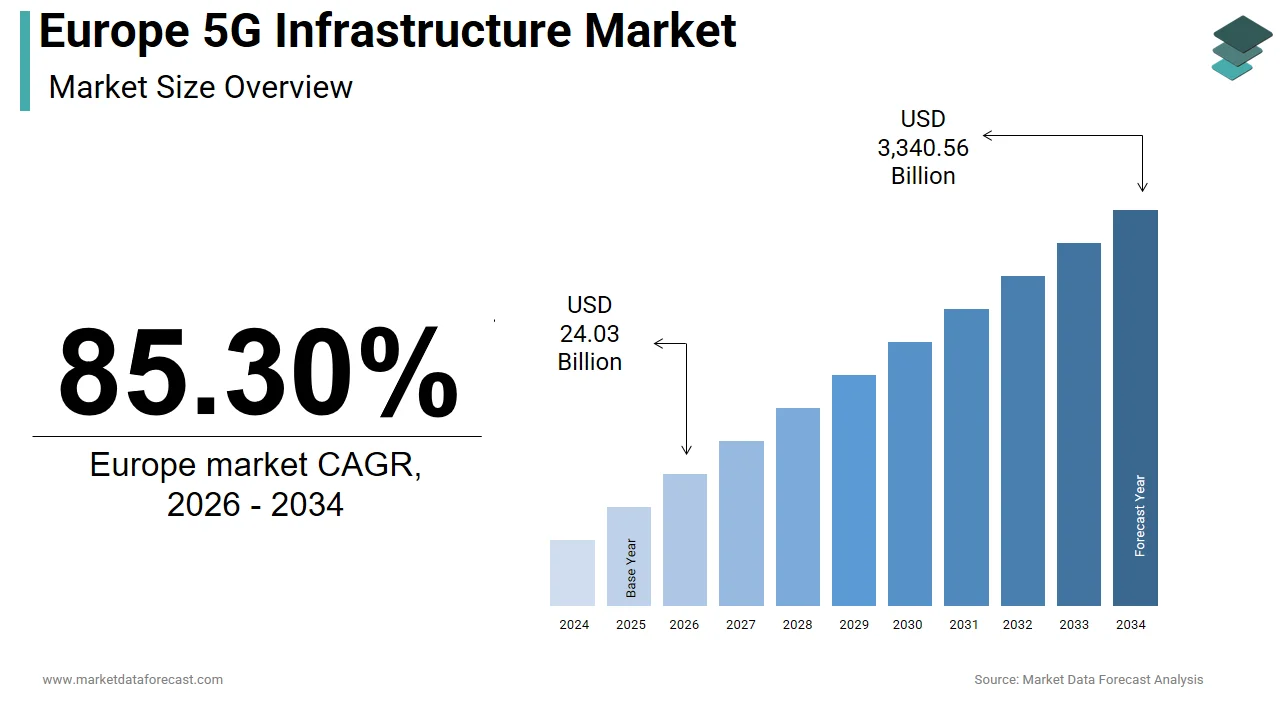
The 5G infrastructure is the deployment of foundational technologies required to enable fifth-generation wireless communication across the continent, including radio access networks, core networks, small cells, macro cells, and backhaul systems. As of 2025, 5G networks are commercially operational in nearly every European Union member state, with a major portion of the population in countries like Finland, Denmark, and Sweden already covered by at least one 5G signal, as per data from the European Commission. The European Union has allocated more than 7 billion euros under the Connecting Europe Facility to support digital infrastructure projects, including 5G corridors along major transport routes. According to the International Telecommunication Union, Europe accounted for approximately 22% of global mobile data traffic in 2024, a figure projected to double by 2028 due to increasing reliance on high-bandwidth applications. The European 5G Observatory notes that cross-border 5G deployment along the Trans European Transport Network corridors aims to ensure seamless connectivity for autonomous vehicles and smart logistics. These developments underscore a strategic pivot toward digital sovereignty and industrial transformation, positioning 5G infrastructure as a linchpin of Europe’s technological resilience and economic competitiveness in the post pandemic era.
MARKET DRIVERS
Accelerated Industrial Digitization Drives 5G Infrastructure Demand
The manufacturing and logistics sectors are undergoing a profound digital transformation, significantly elevating demand for ultra-reliable low-latency communication enabled by 5G. This is one of the major factors inclining the growth of the Europe 5G infrastructure market. The European Union’s Digital Decade Policy targets full digitalization of key industrial sectors by 2030, with large enterprises already implementing Industrial Internet of Things solutions, as per Eurostat’s 2024 enterprise digitalization survey. In Germany alone, more than 3000 smart factory initiatives leverage private 5G networks to support real-time machine control, predictive maintenance, and augmented reality-assisted assembly operations, according to the German Federal Ministry for Economic Affairs and Climate Action. The European Commission estimates that Industry 4.0 adoption could contribute an additional 1.8 trillion euros to the EU economy by 2030, with 5G serving as an enabler due to its sub-ten-millisecond latency and capacity to support up to 1 million devices per square kilometer. In the automotive sector, companies like BMW and Volkswagen have deployed localized 5G standalone networks in their production facilities to synchronize robotic automation and quality inspection systems. This industrial push aligns with national strategies such as France’s “AI and 5G for Industry” program, which has committed five hundred million euros to support factory modernization. These initiatives illustrate how industrial digitization is not merely a use case but a systemic catalyst for 5G infrastructure rollout in Europe.
Public Sector Investment in Smart Cities Fuels 5G Expansion
Municipal authorities are increasingly integrating 5G as a foundational layer for smart city ecosystems, directly stimulating infrastructure deployment in urban centers, which is additionally elevating the growth of Europe 5G infrastructure market. As per the European Innovation Partnership on Smart Cities and Communities, over 150 European cities have launched integrated 5G-enabled urban initiatives covering intelligent transportation, environmental monitoring, and public safety. The city of Barcelona has deployed more than fifteen hundred 5G-connected sensors to manage traffic flow and air quality, reducing average commute times by 12%, according to Barcelona City Council data from 2024. Similarly, Amsterdam’s Smart City Program utilizes 5G to power real-time water level monitoring in its canal network and optimize energy distribution across municipal buildings, achieving an estimated reduction of 3000 tons of annual carbon emissions, as stated by the Amsterdam Institute for Advanced Metropolitan Solutions. Financing for urban digital infrastructure since 2022, with specific allocations for 5G-enabled public service platforms. These public sector-led deployments not only validate the technical viability of 5G in complex environments but also demonstrate its capacity to deliver quantifiable societal benefits. This civic-driven adoption model reduces reliance on consumer mobile demand alone and creates a stable, long-term pipeline for infrastructure providers.
MARKET RESTRAINTS
Fragmented National Regulatory Frameworks Impede Harmonized Deployment
The absence of fully harmonized regulatory standards across member states continues to delay cohesive 5G infrastructure rollout, which is limiting the growth of Europe 5G infrastructure market. Each country maintains distinct rules regarding spectrum allocation, site licensing, and electromagnetic field exposure limits, which creates significant operational friction for cross-border network operators. According to the Body of European Regulators for Electronic Communications, EU nations had fully implemented the 2018 European Electronic Communications Code by mid-2024, which is slowing the release of mid-band spectrum essential for wide-area 5G coverage. In countries like Italy and Poland, local zoning laws mandate individual municipal approvals for every new antenna installation, which is resulting in deployment timelines that can exceed eighteen months per site, as per findings from the European 5G Infrastructure Association. Moreover, radiation safety thresholds vary markedly, with Belgium’s Brussels region enforcing limits as low as six volts per meter compared to the International Commission on Non-Ionizing Radiation Protection's recommended 41 volts per meter, effectively stalling outdoor 5G deployment in the capital for over 3 years. These regulatory inconsistencies fragment the European market, inflate compliance costs, and discourage integrated network planning.
Supply Chain Vulnerabilities Threaten Infrastructure Security and Timeliness
Europe’s dependence on non-European vendors for 5G radio and core network components exposes the region to geopolitical and logistical risks that directly impact deployment reliability, which is limiting the growth of Europe 5G infrastructure market. According to the European Court of Auditors, 5G base stations installed in the EU between 2020 and 2024 were sourced from equipment manufacturers headquartered outside Europe, primarily in Asia. The European Commission’s 2023 Telecom Supply Chain Toolbox, many member states maintain domestic capacity to produce essential radio frequency components, increasing susceptibility to export controls and shipping disruptions. In 2023, semiconductor shortages extended lead times for network interface cards, as reported by the European Semiconductor Industry Association. Furthermore, heightened scrutiny under the EU’s Cybersecurity Act has led several governments, including Sweden and the United Kingdom, to restrict or remove specific vendor equipment from national networks, triggering costly retrofitting requirements. This limited indigenous manufacturing base impedes Europe’s strategic autonomy and complicates efforts to meet the EU’s goal of secure and resilient digital infrastructure by 2030.
MARKET OPPORTUNITIES
Integration of 5G with Next Generation Transportation Systems Unlocks New Frontiers
The emergence of cooperative intelligent transport systems for 5G infrastructure through vehicle-to-everything communication is creating new opportunities for the growth of Europe 5G infrastructure market. Under the EU’s 5G for Connected and Automated Mobility initiative, more than 10,000 kilometers of road across sixteen countries have been designated as 5G transport corridors by enabling real-time data exchange between vehicles, traffic signals, and roadside infrastructure. According to the European Environment Agency, road accidents involving human error could be reduced through 5G-enabled predictive collision avoidance systems, potentially saving over five thousand lives annually, across the EU. Germany’s A9 motorway pilot project has demonstrated that 5G networks can transmit vehicle telemetry with latency under five milliseconds by allowing emergency braking signals to propagate instantly across entire traffic streams, as per the Federal Highway Research Institute. The European Commission has allocated under Horizon Europe to support vehicle infrastructure integration projects through 2027. These developments are catalyzing demand not only for roadside units and edge computing nodes but also for network slicing capabilities that guarantee bandwidth and reliability for safety-critical communications.
Edge Computing Synergy Creates High-Value Industrial Use Cases
The emergence of 5G infrastructure with distributed edge computing is unlocking transformative possibilities for time-sensitive industrial applications across Europe. This shall create new opportunities for the growth of Europe 5G infrastructure market. Unlike traditional cloud architectures, 5G-enabled multi-access edge computing places data processing within milliseconds of the device, meeting the stringent latency requirements of applications like robotic surgery, precision agriculture, and live factory analytics. According to the European Edge Computing Consortium, over 800 edge data centers are projected to be deployed across the EU by 2026, directly integrated with 5G access points. Similarly, Siemens’ Amberg Electronics Plant processes over 1 million production data points per second using an on-site 5G edge platform, achieving near zero defect rates in automated circuit board assembly. The European High Performance Computing Joint Undertaking has committed 300 million euros to fund edge infrastructure aligned with 5G deployments in manufacturing clusters.
MARKET CHALLENGES
Spectrum Allocation Delays Undermine Network Performance Expectations
The delays in releasing harmonized mid-band spectrum in the 3.4 to 3.8 gigahertz range constrain the ability of European operators to deliver consistent 5G performance. This is one of the major challenges of the Europe 5G infrastructure market. Although the European Commission recommended full nationwide availability of this band by 2020, as of late 2024, few EU member states had still not completed auctions or assignments, according to the European 5G Observatory. In Spain, overlapping military use delayed civilian access to mid-band spectrum until late 2023, forcing operators to rely on less efficient low-band frequencies that offer limited capacity. This performance gap discourages adoption of bandwidth-intensive enterprise applications and weakens Europe’s competitive position relative to regions like South Korea and the United States, where mid-band coverage exceeds urban populations.
Public Misinformation and Health Concerns Trigger Local Opposition
Persistent public skepticism regarding the health and environmental effects of 5G radiofrequency emissions continues to provoke localized resistance that impedes infrastructure siting. The public misinformation and health concerns triggering local opposition are also degrading the growth of Europe 5G infrastructure market. This apprehension has translated into tangible deployment barriers, with municipalities in countries like Switzerland and Ireland enacting moratoria or stricter emission caps that effectively prohibit new antenna installations in residential zones. In 2023, the city of Geneva revoked permits for planned 5G sites following public protests, setting back national coverage targets by more than a year, as reported by the Swiss Federal Office of Communications. The European Commission’s 2023 Digital Compass Progress Report acknowledged that public acceptance remains a “critical path item” for 5G rollout, urging member states to enhance science-based communication strategies.
REPORT COVERAGE
| REPORT METRIC | DETAILS |
| Market Size Available | 2025 to 2034 |
| Base Year | 2025 |
| Forecast Period | 2026 to 2034 |
| Segments Covered | By Communication Infrastructure, Network Technology, Chipset Type, End Use, and Country. |
| Various Analyses Covered | Global, Regional, and Country-Level Analysis, Segment-Level Analysis, Drivers, Restraints, Opportunities, Challenges; PESTLE Analysis; Porter’s Five Forces Analysis, Competitive Landscape, Analyst Overview of Investment Opportunities |
| Countries Covered | UK, France, Spain, Germany, Italy, Russia, Sweden, Denmark, Switzerland, Netherlands, Turkey, Czech Republic, and the Rest of Europe. |
| Market Leaders Profiled | ZTE Corporation, ALE International, Nokia Corporation, Nippon Telegraph and Telephone Corporation (NTT), Vodafone, Samsung Electronics Co. Ltd., Orange, Siemens AG, Fujitsu Limited, NEC Corporation, InterDigital, Inc., Cisco Systems, Inc., Ericsson, International Business Machines Corporation (IBM), Intel Corporation, Huawei Technologies Co., Ltd., Atos SE, Qualcomm Technologies, Inc., Orion Innovations PC, and Others. |
SEGMENTAL ANALYSIS
By Communication Infrastructure Insights
The radio access network segment was the largest by holding 42.3% of the Europe 5G infrastructure market share in 2024, with the foundational role RAN plays in connecting user devices to the core network through base stations and antennas. European operators have prioritized nationwide RAN upgrades to support 5G New Radio standards with commercial 5G launches across the EU relying on enhanced RAN architectures, as per data from the European 5G Observatory. The European Commission’s mandate under the EU Toolbox for 5G Security, which requires diversified and secure RAN suppliers by accelerating investment in Open RAN ecosystems. Germany’s Federal Network Agency reported that more than twelve thousand new RAN sites were activated in 2024 alone to meet industrial connectivity demands.
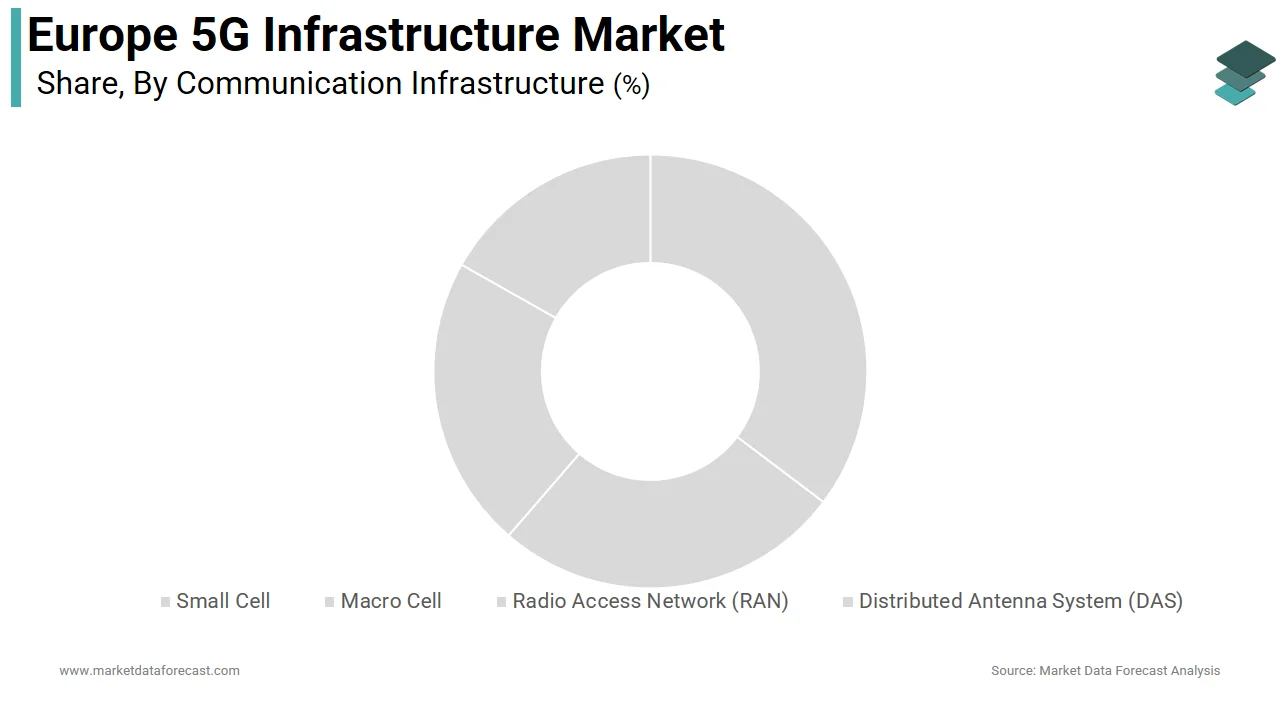
The small cells segment is projected to witness the fastest CAGR of 38.2% from 2025 to 2033, with the need for ultra-dense network topologies to support high-capacity urban microenvironments and indoor enterprise applications. In city centers like Paris and Stockholm, macro cell coverage alone cannot deliver the required throughput due to physical signal blockage and spectral congestion, necessitating small cell densification. The European Conference of Postal and Telecommunications Administrations noted that small cell deployments in major EU cities increased. Another key driver is the European Union’s allocation few billion Euros, under the Digital Europe Programme, specifically for small cell integration in public buildings, transport hubs, and university campuses.
By Network Technology Insights
The software-defined networking, combined with the Network Function Virtualization segment, was the largest by capturing 38.2% of the Europe 5G infrastructure market share in 2024, with the need to decouple hardware from software to enable flexible, scalable, and cost-efficient 5G core networks. European telecom operators, such as Deutsche Telekom and Orange, have virtualized their core network functions using NFV by reducing capital expenditure. The European Commission’s 5G Action Plan explicitly endorses SDN NFV adoption to support network slicing for vertical industries, a requirement for delivering differentiated service level agreements. In 2024, Ericsson and Vodafone jointly demonstrated a fully virtualized 5G core in Spain that supported over 50 simultaneous network slices for utilities, logistics, and public safety. Additionally, the European Telecommunications Standards Institute has certified more SDN NFV-based interoperability profiles, ensuring multi-vendor compatibility. These technological, economic, and policy-aligned factors position SDN NFV as the operational engine of Europe’s 5G transformation.
The mobile edge computing segment is anticipated to witness the fastest CAGR of 41.7% from 2026 to 2034, owing to the demand for real-time data processing in latency-sensitive applications, such as autonomous mobile robots, remote surgery, and immersive retail experiences. The deployment of edge data centers across the EU by mid 2024 more than double the count in 2022 reflects this momentum, according to the European Data Centre Association. In the healthcare sector, the Karolinska University Hospital in Sweden uses 5G-connected edge computing to analyze intraoperative imaging with under ten millisecond latency, improving surgical accuracy, as documented by the Swedish eHealth Agency. Similarly, retail chains like Carrefour are piloting edge-based computer vision for cashierless checkout in French stores by reducing transaction time.
By End Use Insights
The automotive sector accounted in holding 29.3% of the Europe 5G infrastructure market share in 2024, with Europe’s strategic focus on connected and automated mobility as a pillar of transport decarbonization and road safety. EU roadways have been designated as 5G corridors under the Connecting Europe Facility by enabling continuous vehicle-to-infrastructure communication. The German Federal Ministry of Transport reported that more new passenger vehicles sold in Germany in 2024 included embedded 5G modems for real-time traffic updates and over-the-air software upgrades. Major automakers like Stellantis and BMW have partnered with telecom providers to deploy private 5G networks in their R&D centers for testing autonomous driving algorithms under ultra-reliable low-latency conditions. The European Commission’s revised General Safety Regulation mandates that all new vehicles from 2025 support advanced driver assistance systems that rely on 5G-enabled cooperative awareness messages.
The healthcare segment is swiftly emerging at an anticipated CAGR of 43.5% throughout the forecast period, owing to the aging demographics, digital health policy reforms, and clinical demand for real-time remote diagnostics. The European Union’s 2023 Digital Health Action Plan has allocated many euros to modernize hospital connectivity, with funding earmarked for 5G private networks. In 2024, the UK’s National Health Service launched a 5G-enabled remote ultrasound program across 16 hospitals by reducing diagnostic wait times, as reported by NHS Digital. Similarly, Finland’s HUCH hospital system uses 5G to stream resolution intraoperative videos to specialists in real time, improving surgical decision-making. The European Medicines Agency has also begun accepting clinical trial data transmitted via secure 5G links, streamlining regulatory submissions.
COUNTRY-LEVEL ANALYSIS
Germany 5G Infrastructure Market Analysis
Germany was the top performer of the Europe 5G infrastructure market by capturing 18.2% of the share in 2024, with its industrial base, with over forty% of 5G private network deployments in Europe concentrated in German manufacturing facilities. The government’s “5G in Factories” initiative has funded, including Siemens’ fully automated Amberg plant that operates on a standalone 5G network. Deutsche Telekom and Vodafone have jointly invested in RAN densification by activating more than 15,000 new sites since 2022. The Federal Ministry for Economic Affairs and Climate Action estimates that 5G-enabled Industry 4.0 will add to Germany’s annual GDP by 2030.
United Kingdom 5G Infrastructure Market Analysis
The United Kingdom 5G infrastructure market growth is likely to grow at the fastest CAGR during the forecast period. The UK has maintained alignment with EU technical standards, while accelerating spectrum release. The government’s 5G Supply Chain Diversification Fund has committed to reducing reliance on single vendors, fostering a competitive ecosystem. The major UK population now has access to 5G services, with London achieving a small cell density of one node per three hundred meters in commercial districts. Additionally, the UK’s automotive 5G Testbed in Coventry supports an autonomous vehicle trials route with guaranteed network slicing. Ofcom projects that enterprise 5G revenue will surpass consumer revenue by 2027, reflecting the UK’s strategic pivot toward vertical industry enablement.
France 5G Infrastructure Market Analysis
The France 5G infrastructure market growth is attributed to having significant growth opportunities during the forecast period. The country’s 5G rollout is distinguished by strong public-private coordination under the “France Relance” recovery plan, which allocated 1.8 billion euros to digital infrastructure. Orange and SFR have deployed macro and small cell sites nationwide, with full 5G coverage achieved in all prefectures by 2024. A defining feature is France’s emphasis on sovereign cloud and network security, leading to the development of GaiaX-compliant 5G platforms in partnership with Thales and Atos. The French Ministry of Ecological Transition also mandates 5G-enabled smart metering for all new utility installations, driving utility sector adoption. These strategic industrial and regulatory initiatives position France as a model of integrated 5G governance.
Italy 5G Infrastructure Market Analysis
Italy 5G infrastructure market growth is likely to be driven by the National Recovery and Resilience Plan, which dedicated 5G infrastructure under Mission 1 Component 3. A standout application is precision agriculture in Emilia Romagna and Lombardy, which uses 5G drones and soil sensors to optimize irrigation and fertilization, increasing yields, according to the Italian Agricultural Network. Italy also leads Europe in 5G-enabled cultural heritage preservation, with real-time holographic tours of the Colosseum and Pompeii powered by edge computing nodes. The Ministry of Enterprises and Made in Italy has certified over three hundred “5G Ready” factories, emphasizing manufacturing digitization.
Sweden 5G Infrastructure Market Analysis
Sweden 5G infrastructure market growth is likely to be driven by the legacy of telecom innovation, home to Ericsson, to pioneer advanced 5G implementations. A hallmark of Sweden’s strategy is its integration of 5G with green technology. Volvo’s Gothenburg plant uses a private 5G network to coordinate battery electric vehicle production with renewable energy usage. In healthcare, the Karolinska Institute deploys 5G for remote robotic rehabilitation therapy.
COMPETITIVE LANDSCAPE
Competition in the Europe 5G infrastructure market is characterized by a dynamic interplay between technological innovation, regulatory alignment, and strategic localization. European champions like Ericsson and Nokia leverage their regional expertise to offer secure and sustainable network solutions while adapting to stringent cybersecurity and environmental standards. Global vendors operate under heightened scrutiny, requiring transparency measures and a limited scope in sensitive deployments. The competitive landscape is further shaped by the European Union’s push for supply chain diversification, which encourages multi-vendor procurement and Open RAN adoption. Operators increasingly demand vertically integrated solutions combining radio access, edge computing, and network slicing capabilities. This has intensified collaboration between infrastructure providers, cloud platforms, and industry integrators. Differentiation now hinges on energy efficiency deployment, agility support for industrial use cases, and compliance with evolving EU digital policy frameworks rather than hardware pricing alone.
KEY MARKET PLAYERS
The leading companies operating in the Europe 5G infrastructure market include:
- ZTE Corporation
- ALE International
- Nokia Corporation
- Nippon Telegraph and Telephone Corporation (NTT)
- Vodafone
- Samsung Electronics Co. Ltd.
- Orange
- Siemens AG
- Fujitsu Limited
- NEC Corporation
- InterDigital, Inc.
- Cisco Systems, Inc.
- Ericsson
- International Business Machines Corporation (IBM)
- Intel Corporation
- Huawei Technologies Co., Ltd.
- Atos SE
- Qualcomm Technologies, Inc.
- Orion Innovations PC
TOP PLAYERS IN THE MARKET
- Ericsson is a pivotal contributor to the global 5G infrastructure landscape with deep involvement across European markets. The company supplies end-to-end 5G radio access and core network solutions to major European telecom operators. In recent actions, Ericsson has expanded its R&D center in Poland to accelerate Open RAN development and launched a private 5G network platform tailored for European manufacturing and logistics sectors. It has also partnered with Dutch railway operator ProRail to deploy mission-critical 5G along freight corridors, underscoring its commitment to transport digitization. These initiatives reinforce Ericsson’s role as a technology enabler aligned with Europe’s industrial and connectivity priorities.
- Nokia maintains a strong footprint in the Europe 5G infrastructure market through its comprehensive portfolio spanning radio access, transport, and cloud native core networks. The company actively supports European digital sovereignty by localizing software development and hardware assembly in Finland and Germany. Recently, Nokia activated a private 5G network at BMW’s Leipzig plant and collaborated with Orange on energy-efficient base stations that reduce power consumption by up to thirty%. It also joined the European Semiconductor Pilot Line to enhance supply chain resilience. These steps demonstrate Nokia’s strategic focus on sustainability, vertical integration, and industrial 5G innovation.
- Huawei has played a significant role in global 5G deployment, though its European presence has evolved under heightened regulatory scrutiny. Despite restrictions in several EU countries, Huawei continues to support network modernization in markets like Hungary and Greece through radio upgrades and technical services. The company recently opened a cybersecurity verification center in Brussels to enhance transparency and compliance with EU standards. It also increased investments in European research collaborations focusing on antenna efficiency and network automation. While its infrastructure role has narrowed, Huawei remains engaged through innovation partnerships and localized compliance frameworks reflecting adaptation to Europe’s security-driven policy environment.
TOP STRATEGIES USED BY THE KEY MARKET PARTICIPANTS
Key players in the Europe 5G infrastructure market employ several core strategies to reinforce their positions. They prioritize strategic partnerships with national telecom operators to co-develop customized network solutions for industrial and public sector clients. Investment in research and development focuses on energy-efficient base stations, Open RAN compatibility, and private network architectures. Companies are localizing supply chains and software engineering to align with EU digital sovereignty goals. They also actively participate in EU-funded initiatives such as Horizon Europe and the Important Project of Common European Interest to secure public-private collaboration. Additionally, vendors are expanding private 5G offerings targeting automotive manufacturing and healthcare to diversify beyond consumer mobile services and capture high-value enterprise revenue streams.
MARKET SEGMENTATION
This research report on the Europe 5G infrastructure market has been segmented and sub-segmented into the following categories.
By Communication Infrastructure
- Small Cell
- Macro Cell
- Radio Access Network (RAN)
- Distributed Antenna System (DAS)
By Network Technology
- Software-Defined Networking (SDN) & Network Functions Virtualization (NFV)
- Mobile Edge Computing
- Fog Computing
- Self-Organizing Network
By Chipset Type
- ASIC
- RFIC
- Millimeter Wave Technology Chips
- FPGA
By End Use
- Automotive
- Energy & Utilities
- Healthcare
- Retail
- Others
By Country
- United Kingdom
- France
- Spain
- Germany
- Italy
- Russia
- Sweden
- Denmark
- Switzerland
- Netherlands
- Rest of Europe