- Product Description Description
- Table of Contents TOC
- List of Table & Figure LOT
- Get Free Sample PDF Sample PDF
Market Size, 2025
$1.63 BnMarket Estimate, 2026
$1.74 BnMarket Forecast, 2034
$2.87 BnCAGR, 2026–2034
6.5%Executive Summary: Europe eSIM Market
- Market Scope: Comprehensive European eSIM industry analysis covering solution types (connectivity services, hardware), application segments (consumer electronics, M2M), regional leadership frameworks, strategic corporate developments, and competitive landscapes.
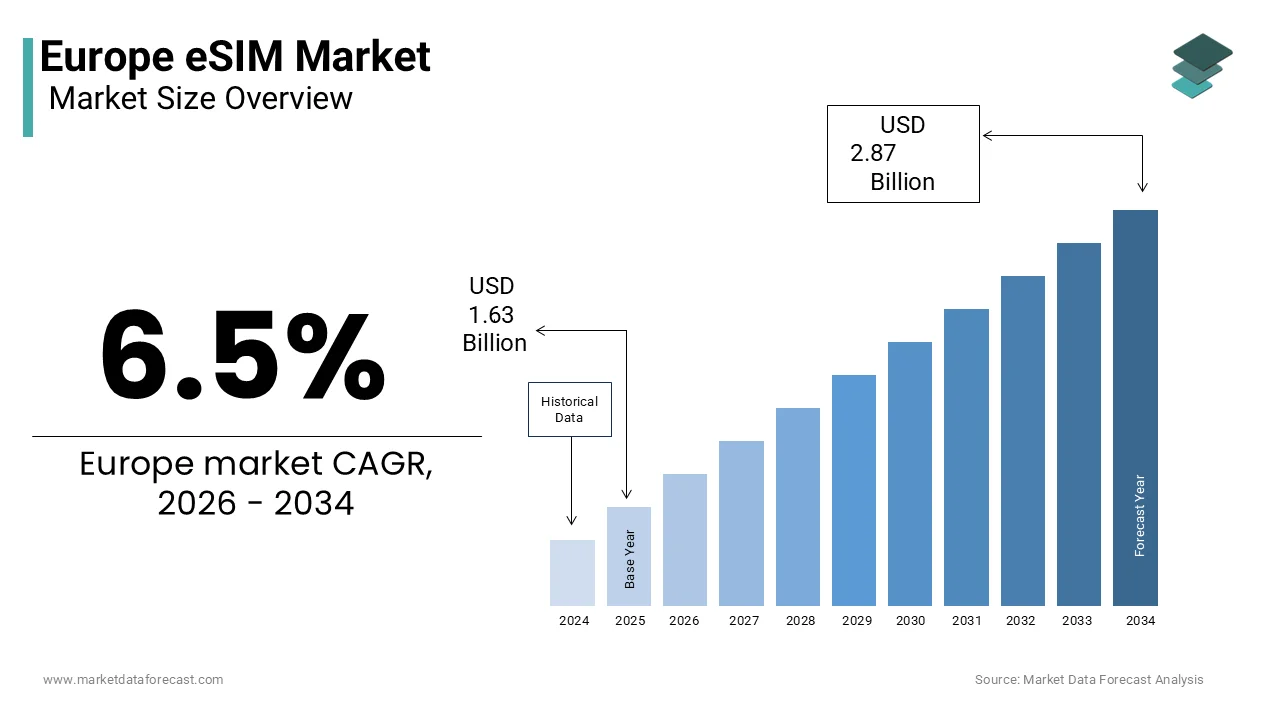
- Market Valuation: Valued at USD 1.63 billion (2025), estimated at USD 1.74 billion (2026), and projected to reach USD 2.87 billion by 2034, registering a steady CAGR of 6.5% (2026–2034).
- Primary Growth Drivers: EU Radio Equipment Directive device interoperability mandates, eSIM-only smartphone adoption, connected vehicle telematics, and smart utility IoT deployments. Restraints include fragmented cross-border roaming agreements, inconsistent operator support, and consumer activation confusion.
Key Market Segment Metrics (2026–2034)
| Category | Leading Segment / Region (Position) | Fastest-Growing Segment |
|---|---|---|
| By Solution & Application | Connectivity services (dominated solution segment with 64.2% share in 2025) & Consumer electronics (led applications via smartphone and wearable adoption) | Hardware (witnessing highest CAGR of 28.4% from 2025 to 2033 via laptops, wearables, and automotive systems) |
| By Connectivity Integration | Smartphone SIM tray removal initiatives and automotive telematics systems | Machine-to-Machine (M2M) accelerated growth supported by smart meter rollouts and industrial IoT |
| By Region / Country | United Kingdom (outperformed regionally with 19.5% share in 2025) & Germany (driven by automotive leadership and data sovereignty) | France (benefiting from government-backed digital identity-linked activation platforms) |
Major Market Players & Market Structure
Market Structure: Highly collaborative European telecommunications and digital security ecosystem driven by GSMA Remote SIM Provisioning standards, multi-IMSI enterprise switching, and physical SIM tray removal by major device makers.
Key Companies: IDEMIA, Giesecke+Devrient, Thales Group, Vodafone Group, BT Group, Deutsche Telekom, Telefónica, Orange S.A., Kigen, Swisscom AG, STMicroelectronics N.V., NXP Semiconductors N.V., Arm Holdings plc, Truphone Ltd., Telit Communications PLC, and Apple Inc.
Europe eSIM Market Size
The Europe eSIM market was valued at USD 1.63 billion in 2025, is estimated to reach USD 1.74 billion in 2026, and is projected to reach USD 2.87 billion by 2034, growing at a CAGR of 6.5% from 2026 to 2034.
E-SIM refers to the embedded Subscriber Identity Module technology across consumer electronics, connected vehicles, and industrial IoT devices within the European region. Unlike traditional removable SIM cards, eSIMs are soldered directly onto device circuit boards and enable remote provisioning of mobile network profiles, allowing users to switch carriers or activate plans without physical intervention. This technology aligns with Europe’s broader digital transformation agenda and regulatory push for device interoperability and consumer flexibility. According to studies, a notable share of new smartphones shipped in the European Union in 2023 were eSIM capable, which reflects rapid hardware integration. The European Commission’s Radio Equipment Directive (RED) was updated to include cybersecurity requirements for radio equipment, which will be mandatory from August 2025. Number portability is a well-established right in the EU, and multi-operator connectivity is enabled by technologies like eSIM. Furthermore, as per research, a portion of EU households had access to high-speed mobile broadband in 2023, creating a conducive environment for connecteeSIM-enabled devices. This convergence of regulatory policy, manufacturer strategy, and network readiness defines the current trajectory of the Europe eSIM market.
MARKET DRIVERS
Mandatory Regulatory Support for Device Interoperability
The European Union’s regulatory framework has become a primary driver for the growth of the Europe eSIM market. The proliferation of eSIM is achieved by mandating technical standards that favor embedded connectivity. The European Commission’s Delegated Regulation (EU) 2022/30, which implements the Radio Equipment Directive, explicitly requires that from August 1, 2025, all internet-connected wireless devices, including smartphones, tablets, and laptops, placed on the EU market must comply with new essential cybersecurity requirements. According to sources, this measure aims to reduce electronic waste and enhance consumer choice by enabling seamless carrier switching. The regulation effectively institutionalizes eSIM as the default connectivity solution for new devices. Also, the harmonization eliminates previous legal ambiguities that hinder multi-country eSIM use. Thus, regulatory foresight is not merely encouraging but actively enforcing eSIM integration across the digital ecosystem.
Rising Penetration of Dual eSIM and eSIM Only Smartphones
Consumer electronics manufacturers are rapidly transitioning to eSIM only or dual eSIM configurations in response to both regulatory signals and user demand for flexibility, which in turn propels the expansion of the Europe eSIM market. According to studies, a portion of smartphones sold in Western Europe in 2023 featured dual eSIM capability or a single embedded module with no physical SIM tray. Major device manufacturers like Apple, Google, and Samsung offer eSIM support on their premium smartphones sold in Europe, typically alongside a physical SIM tray. The hardware evolution is driven by consumer behavior. The use of eSIMs is particularly appealing for travelers, who can use local data plans to avoid costly roaming fees. eSIMs provide cost-saving potential and greater flexibility than traditional roaming packages. Network operators have responded by expanding eSIM onboarding portals. The convergence of device design, consumer preference, and operator readiness has created a self-reinforcing cycle that accelerates eSIM adoption beyond early adopters into mainstream usage.
MARKET RESTRAINTS
Incomplete eSIM Support Among Smaller Mobile Operators
The inconsistent support from smaller and regional mobile network operators remains a key barrier to the Europe eSIM market. According to research, only a share of mobile operators in the EU had fully functional remote SIM provisioning systems. In some countries, many smaller and regional carriers globally still operate with outdated or a mix of legacy systems, facing challenges in a costly, full-scale digital transformation. This fragmentation forces consumers in rural or less urbanized areas to either forgo eSIM functionality or switch to larger national providers, thereby limiting competition and consumer choice. Consequently, many delay implementation or offer only partial support, such as eSIM for prepaid but not postpaid plans. This technological gap contradicts the European Commission’s goal of a fully interoperable digital single market and creates a two-tier connectivity landscape where eSIM benefits are accessible primarily in metropolitan centers served by major carriers.
Persistent Consumer Confusion and Activation Friction
Widespread consumer unfamiliarity with activation procedures and perceived complexity of managing digital profiles further obstructs the growth of the Europe eSIM market. Even among younger demographics, a percentage cited confusion over whether their device or carrier supported eSIM as a primary deterrent. This knowledge gap is exacerbated by inconsistent user interfaces across manufacturers; while Apple uses a standardized QR scanning process, Samsung and Google implement varying menu paths for profile management, leading to user errors. Furthermore, unlike physical SIMs, which provide tangible confirmation of service, eSIMs lack visual feedback, increasing anxiety about successful provisioning. Without coordinated industry efforts to standardize onboarding education and error recovery, the full potential of eSIM convenience remains unrealized for a substantial portion of the European population.
MARKET OPPORTUNITIES
Expansion of eSIM in Connected Automotive and Telematics
The integration of eSIM technology into the automotive sector gives a new opportunity for the growth of the Europe eSIM market. This is because European vehicle manufacturers always embed connected capabilities for safety, infotainment, and over-the-air updates. According to studies, every new passenger car sold in the EU must include an eCall emergency system, which relies on embedded cellular connectivity. By 20,23, eSIM adoption in the automotive sector will increase. There is general growth and mandatory connectivity for eCall. In addition, the EU's General Safety Regulation (GSR) required all new types of vehicles to support a range of Advanced Driver Assistance Systems (ADAS) starting in July 2022. From July 2025, this requirement was extended to all new vehicles sold in the EU, including existing vehicle types. Apart from these, connected car services such as real-time traffic navigation and predictive maintenance are generating recurring revenue streams, with customer satisfaction with connected service being high among BMW and Audi owners, according to research. This regulatory and commercial synergy positions automotive eSIMs as a durable growth vector beyond consumer devices.
Growth of IoT Deployments in Smart Utilities and Logistics
Industrial and enterprise IoT applications are opening fresh opportunities for the expansion of the Europe eSIM market. This includes the eSIM adoption pathways across Europe’s utility and logistics sectors, where device longevity and remote management are paramount. According to Eurostat, millions of smart electricity meters were deployed across the EU in 20,23, with countries like Italy achieving notable coverage. These meters increasingly utilize eSIMs to enable two-way communication with grid operators, allowing dynamic pricing and outage detection. In logistics, some players have rolled out eSIM-enabled cargo trackers across their European networks with real-time temperature and location monitoring for pharmaceutical and perishable shipments. Unlike consumer devices, these industrial applications require several-year connectivity lifespans, which makes physical SIM replacement impractical. eSIM’s ability to remotely switch networks ensures service continuity even if a carrier exits a market, a critical resilience factor for mission-critical infrastructure.
MARKET CHALLENGES
Fragmented Cross-Border eSIM Roaming Agreements
The absence of standardized cross-border roaming frameworks for embedded profiles, despite the EU’s “Roam Like at Home” policy, hinders the growth of the Europe eSIM market. Also, the legal ambiguity has led to inconsistent implementation; while operators honor eSIM roaming under the same terms as physical SIMs, others impose additional fees or block activation of foreign eSIM profiles altogether. As per sources, a share of travelers using UK-issued eSIM encountered service denial when attempting to use it in Southern Europe. This undermines the core promise of eSIM convenience and creates consumer distrust. The European Commission has acknowledged this gap. Embedded SIM users will not have a complete single market for mobile connectivity until harmonization happens.
Security and Identity Verification Vulnerabilities
The remote nature of eSIM provisioning introduces unique cybersecurity and identity fraud risks that challenge consumer and regulatory confidence, and this hampers the expansion of the Europe eSIM market. Unlike physical SIMs, which require in-person verification at retail stores, eSIM activation often occurs through digital channels with varying levels of authentication. Mandatory and enforced security measures are required for telecommunication providers by national and EU-level regulations, like the NIS 2 Directive, a contrast to the GSMA's voluntary Security Accreditation Scheme (SAS). Enforcement of these mandatory regulations is still maturing and can vary across different EU member states. Furthermore, the lack of a centralized eSIM identity registry means stolen or cloned profiles cannot be reliably tracked across networks. The convenience of eSIMs will be undermined by a persistent trust deficit among privacy-conscious users until robust and uniform security protocols are mandated.
REPORT COVERAGE
| REPORT METRIC | DETAILS |
| Market Size Available | 2025 to 2034 |
| Base Year | 2025 |
| Forecast Period | 2026 to 2034 |
| Segments Covered | By Solution, Application, and Region. |
| Various Analyses Covered | Global, Regional, and Country-Level Analysis, Segment-Level Analysis, Drivers, Restraints, Opportunities, Challenges; PESTLE Analysis; Porter’s Five Forces Analysis, Competitive Landscape, Analyst Overview of Investment Opportunities |
| Countries Covered | UK, France, Spain, Germany, Italy, Russia, Sweden, Denmark, Switzerland, Netherlands, Turkey, Czech Republic, and the Rest of Europe |
| Market Leaders Profiled | IDEMIA, Giesecke+Devrient, Thales Group, Vodafone Group, BT Group, Deutsche Telekom AG, Telefónica S.A., Orange S.A., Kigen, Swisscom AG, STMicroelectronics N.V., NXP Semiconductors N.V., Arm Holdings plc, Truphone Ltd., Telit Communications PLC |
SEGMENTAL ANALYSIS
By Solution Insights
The connectivity services segment dominated the Europe eSIM market and accounted for 64.2% share in 2025. The growth of the connectivity services segment is mainly driven by the recurring revenue model and the essential role of mobile network provisioning in enabling eSIM functionality. Unlike one-time hardware sales, connectivity services generate sustained income through data plans, roaming bundles, and IoT subscriptions. According to research, millions of active eSIM profiles were in use across the EU in 202,3, with a notable portion linked to monthly or annual service contracts. Major operators such as Vodafone, Orange, and Deutsche Telekom have shifted their business strategies toward digital service ecosystems where eSIM activation serves as the entry point for broader digital offerings, including cloud storage, age cybersecu, and entertainment packages. Furthermore, the European Commission’s push for digital sovereignty has encouraged national operators to develop localized eSIM platforms, reducing dependency on global tech intermediaries. This strategic pivot toward service monetization rather than device dependency ensures that connectivity remains the economic core of the eSIM value chain.
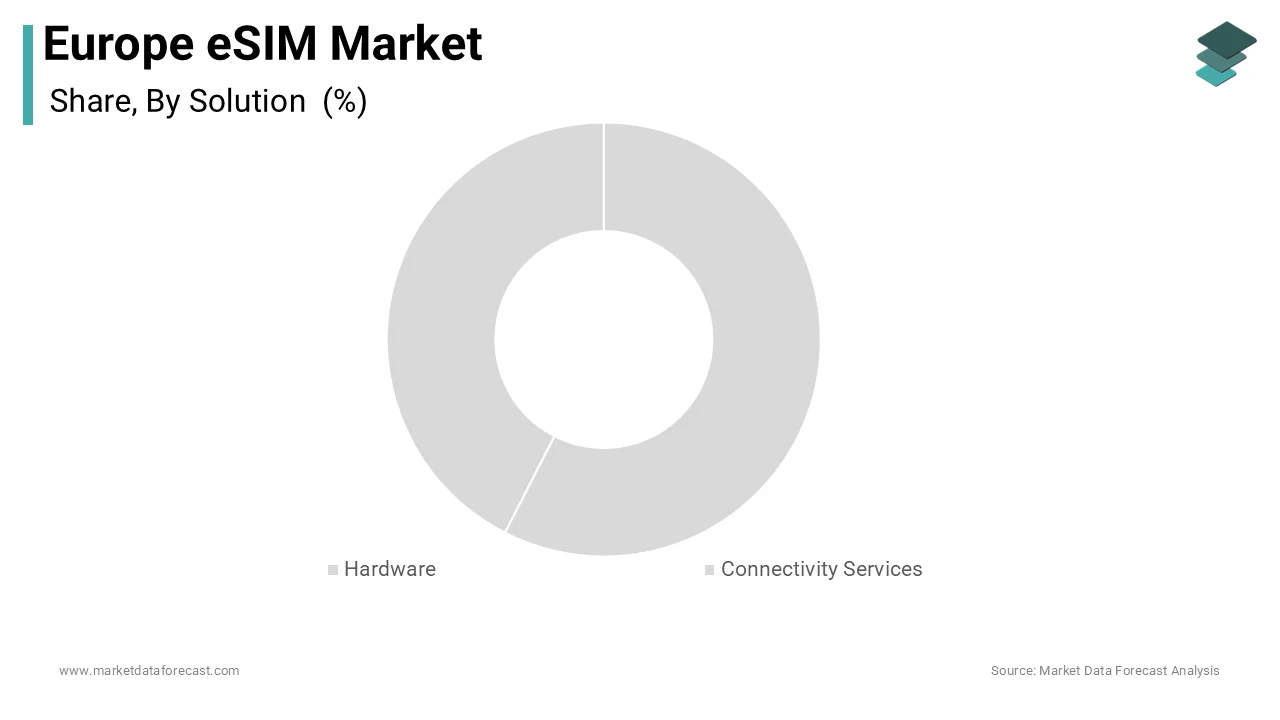
The hardware segment is predicted to witness the highest CAGR of 28.4% from 2025 to 2033 and is fuelled by the mandatory integration of eSIM chips into an ever-widening array of connected devices beyond smartphones. According to sources, a portion of new laptops shipped in Europe in 2023 included embedded eSIM modules, a sharp increase from previous years. This surge is propelled by regulatory mandates. Automotive is another key driver. Semiconductor suppliers such as Infineon and STMicroelectronics have ramped up eSIM chip production to meet automotive and industrial demand. Besides, the rise of smart wearables, Apple Watch and Samsung Galaxy Watch models sold in Europe are exclusively eSIM-enabled, adding millions of new hardware units annually. This regulatory and device diversification trend ensures hardware will outpace connectivity services in growth despite its smaller current share.
By Application Insights
The consumer electronics segment led the Europe eSIM market and captured a substantial share in 2025. The dominance of the consumer electronics segment is because of mass adoption in smartphones, wearables, and tablets, driven by both manufacturer strategy and user demand for travel and dual SIM convenience. According to research, millionseSIM-enabledbled smartphones were sold in Europe in 2023, accounting for a portion of all premium smartphone shipments. Apple’s decision to eliminate physical SIM trays in all iPhone models sold in Europe since 2022 has been pivotal, with millions of iPhone 14 and 15 units activated via eSIM in the region, as per studies. Wearables further amplify this dominance. Consumer behavior reinforces this trend. Network operators have responded by simplifying onboarding with QR code-based activation available. This synergy of device design, user economics, and service accessibility cements consumer electronics as the primary application pillar.
The machine-to-machine segment is estimated to register the fastest CAGR of 31.2% from 2025 to 2033 due to regulatory mandates and industrial digitization across utilities, transportation, and healthcare. Driven by evolving EU energy directives since 2009, many member states are progressively rolling out smart electricity and gas meters with remote communication capabilities, including cellular technologies enabled by eSIMs, according to research. Logistics is another high-growth domain. Unlike consumer devices, M2M applications require several-year service lifespans, which makes physical SIM replacement impractical. This structural shift toward embedded connectivity in critical infrastructure underpins M2M’s accelerated growth trajectory.
COUNTRY LEVEL ANALYSIS
United Kingdom eSIM Market Analysis
The United Kingdom outperformed other regions in the Europe eSIM market and occupied a 19.5% share in 2025. The domination of the United Kingdom is primarily driven by early regulatory adoption, high smartphone penetration,n and strong consumer awareness. According to studies, a substantial share of UK adults owned a smartphone in 20,23, with a notable portion of new devices sold featuring eSIM capability. The UK was among the key European countries to fully implement GSMA eSIM standards with all four major mobile operators—EE, Vodafone, O2, and Three—offering instant digital activation since 2021. As per sources, a portion of travelers used eSIMs for international trips, citing ease of setup and cost savings as primary motivators. The departure from the EU has not diminished momentum. Instead, UK regulators have maintained alignment with European connectivity standards to ensure device interoperability. Apple’s exclusive eSIM-only iPhone models have been available in the UK since 2022, accelerating hardware adoption. Furthermore, the UK’s robust IoT ecosystem with millions of connected utility meters using eSIMs, as per sources, supports multi-sector demand. This combination of consumer readiness, regulatory clarity, and infrastructure maturity sustains the UK’s market dominance.
Germany eSIM Market Analysis
Germany is the next prominent region in the Europe eSIM market and is driven by its advanced industrial base, stringent data sovereignty requirements, and high smartphone replacement rates. The country’s automotive sector is a major driver. Deutsche Telekom has led operator readiness offering eSIM profiles in multiple languages and supporting multi-IMSISI switching for cross-border drivers. Consumer adoption is further supported by strict data privacy laws, which favor eSIMs due to their secure element architecture certified under the German Federal Office for Information Security standards. This blend of industrial digitization, regulatory rigor, and anprivacy-consciousus design solidifies Germany’s strong market position.
France eSIM Market Analysis
France is expected to be the most lucrative region in the Europe eSIM market and is propelled by government-backed digital inclusion initiatives and a highly concentrated telecom sector. Orange SFR and Bouygues Telecom have integrated eSIM provisioning into their national digital identity platforms, allowing citizens to activate lines using FranceConnect, the government’s secure authentication service. Apple and Samsung’s eSIM-only device launches were rolled out simultaneously in France, aligning with local regulatory timelines. This coordinated ecosystem involving government operators and manufacturers creates a seamless adoption environment that sustains France’s robust eSIM uptake.
Italy eSIM Market Analysis
Italy is growing steadily in the Europe eSIM market owing to high mobile data consumption, tourism demand, nd and regulatory modernization. Italy’s status as Europe’s top tourist destination, receiving millions of international visitors in 2023 as per sources, has driven demand for temporary local eSIM plans with TIM Vodafone Italy and Wind Tre offering instant activation via airport kiosks and mobile apps. Automotive adoption is also rising. Stellantis is equipping all Fiat and Alfa Romeo models sold domestically with embedded connectivity. This confluent tourism-driven consumer behavior and state-led digital infrastructure investment underpins Italy’s growing influence in the regional eSIM landscape.
Spain eSIM Market Analysis
Spain is anticipated to expand in the Europe eSIM market during the forecast period due to its high mobile broadband penetration, strong tourism economy, and progressive telecom regulation. According to research, a notable share of new mobile devices sold in 2023 were eSIM compatible with all major operators, Movista,r Oran, and Vodafone Spain, and providing QR-based activation within minutes. Spain welcomed millions of international tourists in 2023, as per studies, which makes it the second most visited country in the world, creating massive demand for short-term eSIM data plans. The government has accelerated IoT deployment with millions of smart utility meters using eSIMs for remote reading, as confirmed by Red Eléctrica de España. Furthermore, Spanish automotive manufacturers, including SEAT, have integrated eSIMs into all new models for connected services. This unique blend of inbound tourism digital policy and industrial adoption ensures Spain remains a key growth engine in the European eSIM ecosystem.
COMPETITIVE LANDSCAPE
The Europe eSIM market features intense competition shaped by the convergence of device manufacturers, mobile operators, standards bodies, and semiconductor firms. Unlike the traditional telecommunication market, where operators dominated the value chain, eSIM has redistributed influence toward ecosystem orchestrators like Apple, G, and SMA, who control user experience and technical standards. Major European telecom groups such as Deutsche Telekom, Orange, and Vodafone are competing not only on price but on the sophistication of their digital provisioning platforms and cross-border service continuity. Simultaneously, non-traditional players, including automotive OEMs and utility companies, are emerging as significant eSIM adopters, driving demand for industrial-grade solutions. The regulatory environment adds another layer of complexity with the European Commission actively shaping the market through mandates on device interoperability and data sovereignty. This multi-dimensional rivalry fosters rapid innovation in security user interface and service bundling, but also creates fragmentation risks where smaller operators struggle to keep pace with infrastructure upgrades. The result is a dynamic landscape where prominence is determined by ecosystem integration rather than network coverage alone.
KEY MARKET PLAYERS
Some of the companies that are playing a dominating role in the European eSIM market include
- IDEMIA
- Giesecke+Devrient
- Thales Group
- Vodafone Group
- BT Group
- Deutsche Telekom AG
- Telefónica S.A.
- Orange S.A.
- Kigen
- Swisscom AG
- STMicroelectronics N.V.
- NXP Semiconductors N.V.
- Arm Holdings plc
- Truphone Ltd.
- Telit Communications PLC
TOP LEADING PLAYERS IN THE MARKET
- Apple Inc. has been a transformative force in the Europe eSIM market by pioneering the removal of physical SIM trays in its iPhone lineup sold across the region. The company’s decision to launch SIM-only models in Europe accelerated consumer and carrier readiness for embedded connectivity. This hardware-led strategy has not only reshaped device design standards but also pressured competitors and regulators to align with a fully digital SIM future, reinforcing Apple’s influence on global eSIM adoption trends.
- Deutsche Telekom AG is a cornerstone of eSIM enablement in Europe through its comprehensive network infrastructure and cross-border service integration. The company offers eSIM provisioning across all its European subsidiaries, including T Mobile in Germany, Telekom in Hungary, and OTE in Greece, ensuring a consistent user experience. It also integrated eSIM activation into national digital identity systems in Germany and the Netherlands, enhancing security and accessibility. The company actively participates in GSMA standardization efforts and has deployed eSIM solutions for automotive and IoT clients, including Volkswagen and Siemens. These initiatives position Deutsche Telekom as a critical enabler of both consumer and industrial eSIM ecosystems across the continent.
- The GSMA plays a foundational role in the European eSIM market by establishing and maintaining the global technical standards that ensure interoperability and security. Headquartered in London, the association developed the Remote SIM Provisioning specification, which is universally adopted by European operators, device makers,r nd chipset suppliers. It also facilitated the EU-wide harmonization of eSIM roaming policies through dialogue with the Body of European Regulators for Electronic Communications. Beyond standards, the GSMA publishes implementation guidelines, supports regulatory consultations,n and hosts interoperability testing events in Brussels and Berlin. Its neutral stewardship ensures that the European eSIM ecosystem remains open, secure, and scalable across consumer and industrial domains.
TOP STRATEGIES USED BY THE KEY MARKET PARTICIPANTS
Key players in the Europe eSIM market are pursuing multi-pronged strategies to consolidate their positions. They are investing in end-to-end digital onboarding platforms that integrate eSIM activation with national eID systems for secure and instant provisioning. Strategic partnerships with device manufacturers, automotive OEMs, O EMssand IoT solution providers are being forged to embed eSIM connectivity at the design stage. Operators are launching multi-IMSISI eSIM profiles that automatically select the best local network when roaming across EU countries, enhancing user convenience. Compliance with evolving EU regulations, such as the Radio Equipment Directive and upcoming eSIM roaming rules, is being prioritized to ensure legal readiness. Apart from these, companies are expanding eSIM offerings beyond smartphones to include laptops, wearables, e-smart met, and connectevehicleshes creating diversified revenue streams. These coordinated efforts aim to transform eSIM from a connectivity feature into a foundational layer of Europe’s digital infrastructure.
MARKET SEGMENTATION
This research report on the europe eSIM market is segmented and sub-segmented into the following categories.
By Solution
- Hardware
- Connectivity Services
By Application
- Consumer Electronics
- Machine-to-Machine (M2M)
By Country
- United Kingdom
- Germany
- France
- Italy
- Spain
- Rest of Europe