- Product Description Description
- Table of Contents TOC
- List of Table & Figure LOT
- Get Free Sample PDF Sample PDF
Market Size, 2025
$2.49 BnMarket Estimate, 2026
$2.58 BnMarket Forecast, 2034
$3.42 BnCAGR, 2026–2034
3.60%Global Feed Flavors and Sweeteners Market Size, Share, Trends & Forecast (2026–2034)
- Market Scope: Comprehensive global feed flavors and sweeteners market analysis covering product types, additive forms, livestock categories, regional leadership frameworks, and growth dynamics.
- Market Valuation: Valued at USD 2.49 billion (2025), estimated at USD 2.58 billion (2026), and projected to reach USD 3.42 billion by 2034, registering a robust CAGR of 3.60% (2026–2034).
- Primary Growth Drivers: Extensive research and continuous innovations in the animal feed sector leading to cost-effective artificial and natural additives, rising need to mask bitter tastes of vitamins and medicines, and increasing livestock palatability demands.
Key Global Feed Flavors and Sweeteners Segment Metrics (2026–2034)
| Category | Leading Segment (2025 Position) | Fastest-Growing Segment |
|---|---|---|
| By Type | Feed flavors (dominant segment for improving overall feed palatability and intake) | Sweeteners (expanding through natural alternatives and targeted palatability solutions) |
| By Livestock | Cattle and Ruminants (major consumers of flavor and sweetener-enhanced diets) | Swine and Poultry (driven by intensive meat production and early-stage weaning feeds) |
| By Region | Asia-Pacific (largest market share among all global regions) | Asia-Pacific (fastest-growing regional market globally) |
Major Market Players, Structure & Strategic Landscape
Market Structure: Highly competitive global feed additive industry featuring prominent life science and agro-industrial enterprises focusing on advanced palatability enhancers, natural flavor compounds, and cost-efficient sweetener formulations.
Key Companies: Biomin GMBH, E. I. Dupont, Eli Lilly and Company, Ferrer Internacional S.A, Industrial Técnica Pecuaria, Jefo Nutrition Inc, Kerry Group PLC, Phytobiotics, Prinova, and Tanke International Group.
Global Feed Flavors and Sweeteners Market Size
The global feed flavors and sweeteners market size was valued at USD 2.49 billion in 2025 and is anticipated to reach USD 2.58 billion in 2026 to reach USD 3.42 billion by 2034, growing at a CAGR of 3.60% during the forecast period from 2026 to 2034.
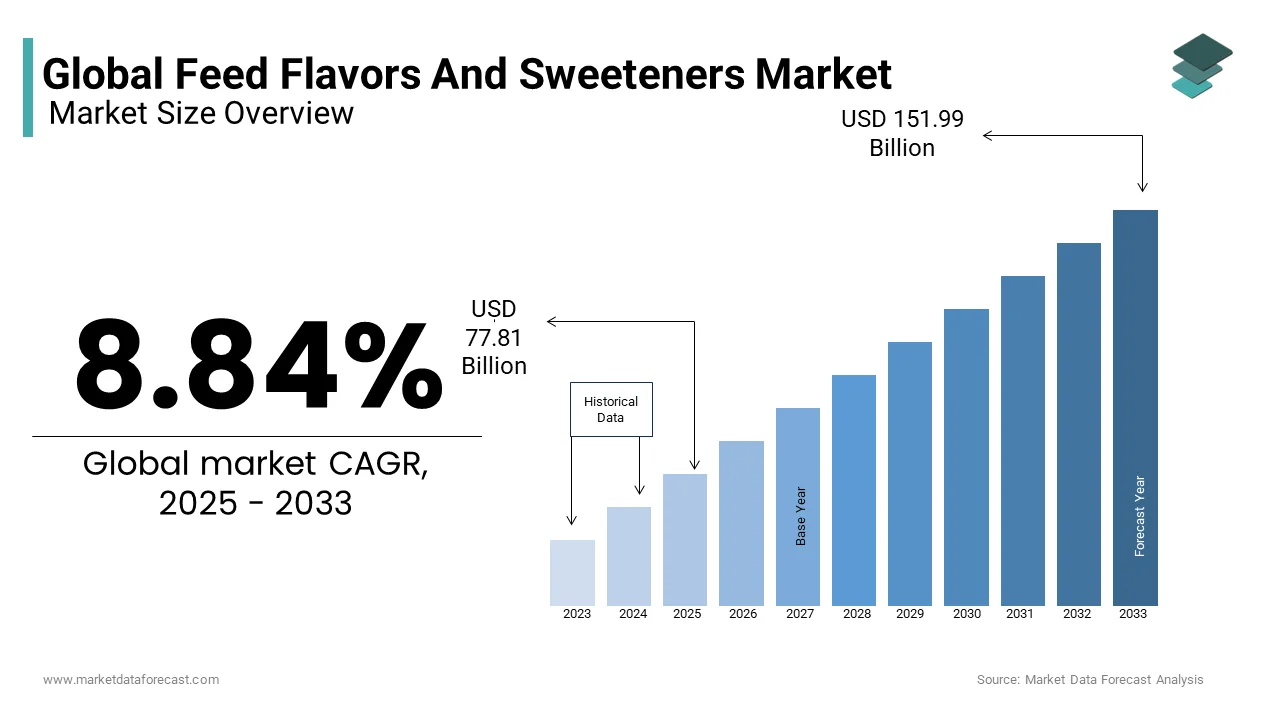
The market is showcasing great potential in the mentioned forecasting period. Feed additives are the edible substances added to animal food in order to make it tastier or enhance its appearance. A sweetener is a substance used as a substitute for sugar. It is mostly helpful for people suffering from sugar problems or diseases like diabetes,s in which the intake of sugar is asked to be very low.
People have been keeping livestock in the form of cattle for a long time for their own benefit, such as milk and wool from sheep. In order to keep these livestock healthy, they need to provide better food to them, which was provided back then in the form of natural feed additives & sweeteners mixed with the regular feed for the livestock. It wasn’t until the second half of the twentieth century that R&D started increasing in this sector, and many more food additives started coming into the market, of both natural and artificial origin. The same is in the case of sweeteners, which come from both natural sources and are also manufactured artificially.
MARKET DRIVERS
An enormous amount of research and innovations in the food sector, which started in the late 20th century and is still going on, have led to the development of a lot of artificial feed flavors and sweeteners. These developments have helped this market a lot because, with innovations in this market, cheaper and cheaper products are coming into the market, and people are being encouraged to use them. The main purpose of using Feed Flavors & sweeteners in animal feed is to remove the bitter taste of minerals, vitamins, and other medicines to increase the intake of animals. On the other hand, the unawareness of what people spend on their livestock is challenging this market.
REPORT COVERAGE
| REPORT METRIC | DETAILS |
| Market Size Available | 2025 to 2034 |
| Base Year | 2025 |
| Forecast Period | 2026 to 2034 |
| CAGR | 3.60% |
| Segments Covered | By Type, Livestock and Region |
| Various Analyses Covered | Global, Regional & Country Level Analysis, Segment-Level Analysis, DROC, PESTLE Analysis, Porter’s Five Forces Analysis, Competitive Landscape, Analyst Overview of Investment Opportunities |
| Regions Covered | North America, Europe, APAC, Latin America, Middle East & Africa |
| Market Leaders Profiled | Biomin GMBH, E. I. Dupont, Eli Lilly and Company, Ferrer Internacional S.A, Industrial Técnica Pecuaria, Jefo, Nutrition Inc, Kerry Group PLCPhytobiotics, Prinova, Tanke, International Group,p and Others. |
REGIONAL ANALYSIS
The global market for feed flavors and sweeteners is segmented into Asia-Pacific, North America, the Middle East, Africa, Latin America, and Europe. Asia-Pacific has the largest market share among all the segmented regions. It is also the fastest-growing region in the world.
KEY MARKET PLAYERS
Some of the market players dominate the global feed flavors of sweeteners market.
- Biomin GMBH
- E. I. Dupont
- Eli Lilly and Company
- Ferrer Internacional S.A
- Industrial Técnica Pecuaria
- Jefo Nutrition Inc
- Kerry Group PLC
- Phytobiotics
- Prinova
- Tanke International Group
MARKET SEGMENTATION
This research report on the global feed flavors and sweeteners market is segmented and sub-segmented based on type, livestock, and Region.
By Type Insights
- Natural Artificial
- Feed Flavors
- Sweeteners
By Livestock Insights
- Cattle
- Swine
- Poultry
- Aquaculture
By Regional
- North America
- Europe
- Asia Pacific
- Latin America
- Middle East and Africa
- Rest of the World