- Product Description Description
- Table of Contents TOC
- List of Table & Figure LOT
- Get Free Sample PDF Sample PDF
Market Size, 2025
$10.07 BnMarket Estimate, 2026
$10.61 BnMarket Forecast, 2034
$16.16 BnCAGR, 2026–2034
5.40%Global Dairy Processing Equipment Market Size
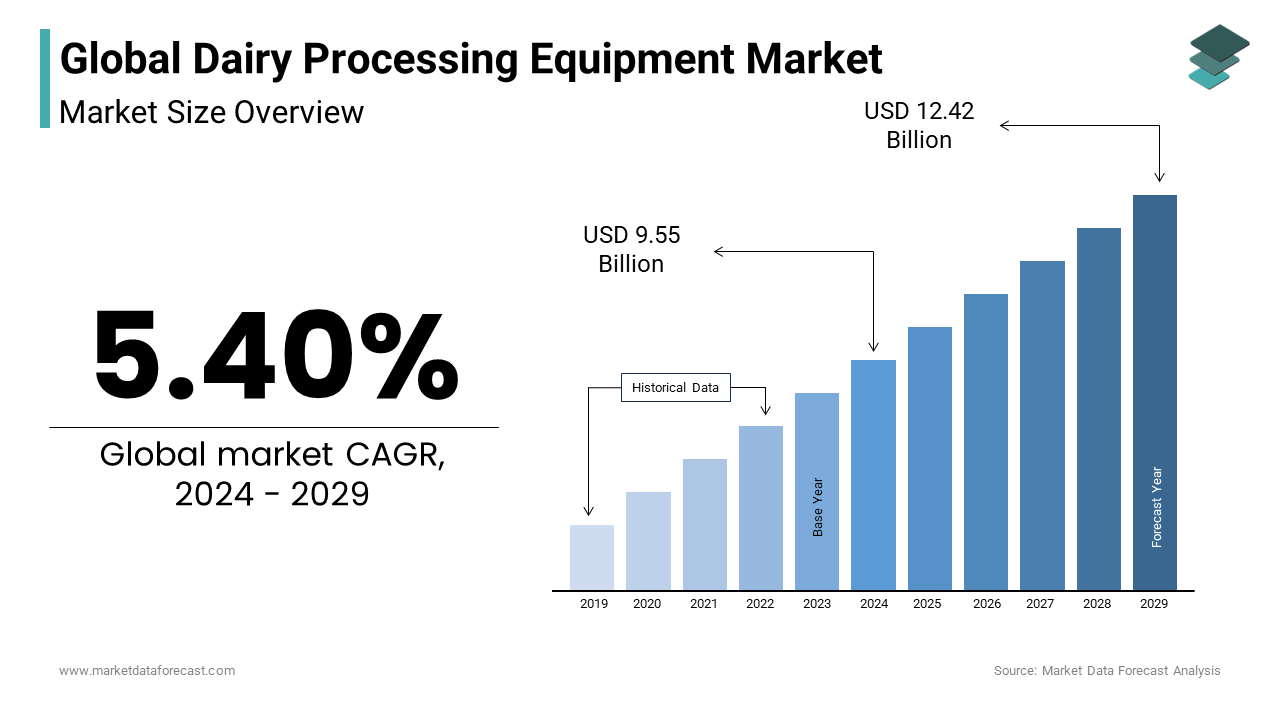
The size of the global dairy processing equipment market was expected to be worth USD 10.07 billion in 2025 and is anticipated to be worth USD 16.16 billion by 2034, up from USD 10.61 billion in 2026, growing at a CAGR of 5.40% during the forecast period.
Dairy processing equipment refers to the specialized machinery and systems used to collect, treat, store, and transform raw milk into safe, consumable dairy products like pasteurized milk, cheese, butter, yogurt, and ice cream. This sector is fundamentally defined by the technological bridge between biological variability in raw milk production and the stringent consistency required for international food safety and trade. According to the Food and Agriculture Organization of the United Nations (FAO), global milk production reached approximately 979 million tonnes in 2024, driving infrastructure investments that span from automated continuous-flow facilities in mature economies to modular batch units across smallholder supply channels. As per regional census data aggregated by the International Farm Comparison Network (IFCN), the average dairy herd size ranges from roughly 440 cows in New Zealand to fewer than 3 animals in East Africa, necessitating a dual-track equipment framework tailored to varying levels of supply chain fragmentation. The definition of this market extends beyond hardware sales to encompass the integration of sanitary design standards, energy recovery systems, and digital traceability technologies mandated by Codex Alimentarius and national food safety authorities. Consequently, the global landscape operates at the intersection of mature industrial engineering, emerging market modernization, and cross-border regulatory harmonization, functioning as the critical enabler of dairy’s role in global nutrition security and trade.
MARKET DRIVERS
Global Trade Harmonization and Export Grade Compliance Requirements
International dairy trade expansion is driving substantial procurement of export-compliant processing equipment, which accelerates the growth of the global dairy processing equipment market. Producing nations are upgrading facilities to meet destination market sanitary and compositional standards. According to the Food and Agriculture Organization of the United Nations (FAO), global trade in dairy products reached approximately 85.3 million tonnes in 2024, driving widespread investments in automated, continuous-flow machinery to satisfy cross-border sanitary and trade requirements. As per international export regulatory frameworks published by the Food and Drug Administration (FDA), processing establishments undergo rigorous compliance updates, including automated cleaning-in-place (CIP) and pasteurization validation to conform with European and Chinese import standards. This regulatory-driven demand creates non-discretionary procurement cycles independent of domestic consumption trends because non-compliance results in market exclusion rather than competitive disadvantage. According to sources, major exporting countries channel capital expenditures directly into industrial fluid milk pasteurization, sterilization, and processing facility modernizations to maintain robust cross-border trade margins. Equipment manufacturers benefit from standardized international specifications embedded in Codex Alimentarius guidelines, enabling volume production of globally compliant systems. Furthermore, bilateral trade agreements increasingly include mutual recognition provisions for equipment certification, reducing duplicate testing costs and accelerating cross-border technology transfer, thereby amplifying procurement volumes beyond what domestic markets alone would justify.
Urbanization and Retail Modernization in Emerging Economies
Rapid urban population growth and supermarket channel expansion across developing regions further propel the global dairy processing equipment market. These developments are compelling investment in ambient-stable processing and aseptic packaging technologies to overcome cold chain deficiencies and serve newly accessible consumer bases. According to data published in the United Nations World Urbanization Prospects, cities and urban agglomerations hold 45 per cent of the global population, sparking rapid shifts in supply infrastructure away from traditional, highly fragmented informal distribution loops. As per the World Bank, the continuous growth of urban consumer bases stimulates modern grocery investments, accelerating regional deployment of closed-loop aseptic filling systems for shelf-stable dairy formats. This structural shift transforms dairy from a perishable local commodity into a nationally distributed branded product, necessitating integrated processing lines capable of extended shelf-life production. According to the Food and Agriculture Organization (FAO), rising consumer incomes in middle-income and emerging regions trigger substantial manufacturing capacity shifts toward localized ultra-high-temperature (UHT) milk production lines. Government urban food security programs in India, Indonesia, and Egypt further subsidize processing infrastructure to reduce post-harvest losses and stabilize urban supply, creating public-private demand synergies that accelerate equipment adoption beyond pure commercial ROI calculations.
MARKET RESTRAINTS
Capital Intensity Mismatch with Smallholder-Dominant Supply Chains
The prohibitive cost of industrial-scale processing machinery relative to the financial capacity of smallholder-dominated dairy sectors severely constrains equipment adoption across vast segments of the global dairy processing equipment market. This trend is particularly visible in Africa, South Asia, and parts of Latin America. According to the Food and Agriculture Organization of the United Nations (FAO), smallholder dairy operations in developing countries confront severe financial barriers due to structural capital intensity gaps, making mid-scale pasteurization machinery inaccessible without cooperative aggregation frameworks. As per the International Fund for Agricultural Development (IFAD), smallholder dairy infrastructure projects routinely encounter stringent commercial credit restrictions, elevating the importance of public-private blended climate funds. The economic mismatch creates a persistent technology gap where informal processing methods continue dominating despite known food safety risks and efficiency losses. Equipment manufacturers face limited addressable markets in these regions because pricing strategies aligned with Western or large-scale Asian processor economics exclude the numerically dominant smallholder segment. According to the World Bank, bureaucratic implementation bottlenecks and localized institutional constraints delay capital absorption rates for rural processing equipment subsidy deployments.
Energy Infrastructure Deficits and Operational Cost Volatility in Developing Regions
Unstable electricity supply and rising industrial energy tariffs across developing economies restrict the growth of the global dairy processing equipment market. This undermines operational viability, deters investment, and forces reliance on inefficient alternatives or informal processing. According to global electricity reports from the International Energy Agency (IEA), severe grid vulnerabilities and accelerating tariff inflation strain regional manufacturing margins, necessitating independent off-grid generation backup units for perishable product handling. As per the Food and Agriculture Organization (FAO), thermal and electrical energy expenses constitute a highly volatile share of total operational overhead for small-scale milk pasteurization and cooling lines. Backup generator requirements add to capital expenditure while diesel fuel costs introduce additional operational unpredictability. Equipment designed for stable grid conditions in Europe or North America often performs suboptimally under voltage fluctuations common across developing regions, increasing maintenance frequency and premature failure rates. Manufacturers must either redesign products for harsh electrical environments, adding cost, or accept higher warranty claims and customer dissatisfaction, creating a hidden tax on modernization that disproportionately affects smaller operators lacking resources for comprehensive power conditioning solutions.
MARKET OPPORTUNITIES
Precision Fermentation Infrastructure for Alternative Dairy Proteins
The emerging precision fermentation sector is creating animal-identical dairy proteins without livestock, which offers a significant greenfield equipment opportunity in the global dairy processing equipment market. Bioreactors and downstream processing infrastructure are building out globally across traditional and non-traditional dairy regions to support this growth. According to the Good Food Institute (GFI), expanding global capacity constraints have driven the commissioning of new facilities to scale up alternative protein infrastructure for milk and dairy ingredient substitutes. As per the Good Food Institute (GFI), achieving commercial cost competitiveness for animal-free milk proteins requires highly specialized, capital-intensive large-scale fermentation bioreactors and high-throughput separation downstream machinery. According to sources, emerging food-tech companies scale localized pilot and commercial infrastructure to process non-animal dairy protein hydrolysates via specialized microbial cell lines. Traditional dairy equipment suppliers leveraging existing hygienic design expertise and customer relationships are well positioned to capture this adjacent market by adapting product portfolios to bioprocessing requirements. Government incentives including USDA Biobased Manufacturing Grants, EU Horizon Europe funding, and Singapore A*STAR grants covering a notable portion of qualifying equipment costs further de-risk early-stage deployments. This opportunity represents structural diversification beyond conventional dairy cycles, creating new revenue streams correlated with alternative protein adoption trajectories globally.
Circular Economy Integration Through Whey Valorization and Water Recovery
Accelerating sustainability mandates and commodity price volatility create substantial retrofit and greenfield opportunities for whey valorization, water recycling, and energy recovery technologies that fuel the expansion of the global dairy processing equipment market. This transforms waste streams into revenue-generating assets across global dairy processing infrastructure. According to the Food and Agriculture Organization (FAO), global cheese and dairy processing centers generate vast streams of fluid whey, expanding the commercial installation of multi-stage ultrafiltration and nanofiltration equipment for high-value ingredient extraction. As per the Office of Energy Efficiency at Natural Resources Canada, large-scale food plants integrate mechanical vapor recompression and advanced thermal optimization systems to achieve substantial utility savings and reduce plant energy overhead. According to the European Dairy Platform, major industrial cooperatives expand their deployment of closed-loop ultrafiltration and zero-waste whey valorisation processes to produce clinical and infant nutrition fractions. Utility rebate programs in California, Ontario, Germany, and Australia covering a portion of qualifying efficiency equipment costs improve project economics, according to sources. Equipment manufacturers offering integrated circular economy solutions combining whey fractionation, water reuse, and energy recovery can differentiate offerings in increasingly ESG-driven procurement processes while addressing operational cost concerns simultaneously. This convergence of environmental regulation, commodity economics, and corporate commitment creates durable demand independent of new capacity expansion cycles.
MARKET CHALLENGES
Regulatory Fragmentation and Certification Redundancy Across Jurisdictions
Divergent food safety standards, equipment certification requirements, and sanitary design protocols across global jurisdictions create compliance complexity and redundant testing burdens that challenge the growth of the global dairy processing equipment market. This inflates costs and delays market entry for equipment manufacturers and processors alike. According to the World Trade Organization (WTO), the continuous proliferation of distinct national sanitary and phytosanitary technical measures drives the need for international standard alignment across complex agri-food machinery pipelines. As per the International Dairy Foods Association (IDFA), export-oriented dairy manufacturing operations face significant structural compliance overheads when navigating non-scientific or non-harmonized equipment certification criteria across divergent global territories. Small and medium-sized equipment suppliers lacking dedicated regulatory affairs teams face disproportionate barriers. According to the United Nations Industrial Development Organization (UNIDO), small-scale manufacturing suppliers optimize localized manufacturing capabilities and enhance product standards to meet strict international market entry criteria and mitigate trade barriers. Even when standards are technically equivalent, differing interpretation and enforcement practices create uncertainty. Until deeper harmonization occurs through binding agreements rather than voluntary guidelines, market participants must maintain geographically dispersed inventory. These redundant testing capabilities erode efficiency gains theoretically available through global platform standardization.
Technical Skills Gap Limiting Advanced Equipment Utilization Worldwide
A chronic shortage of qualified technicians constrains effective technology deployment, which in turn impedes the expansion of the global dairy processing equipment market. This shortage reduces realized return on investment for automated dairy systems in both developed and developing regions. According to the International Labour Organization (ILO), rapid industrial automation trends and advanced machinery architectures prompt continuous adjustments in labor force mechatronics skill training requirements. As per studies, industrial food and dairy processing facilities rely heavily on structured preventative maintenance workflows to eliminate human-induced operational errors and maximize throughput. Vocational training programs struggle to keep pace with technological evolution. Immigration policy constraints in developed markets and brain drain in developing regions further exacerbate shortages. Human capital constraints will remain a binding limitation on technology value realization, regardless of equipment availability or sophistication. This will persist until education infrastructure aligns with industry needs through accelerated credentialing, employer partnerships, and cross-border skills mobility frameworks.
REPORT COVERAGE
| REPORT METRIC | DETAILS |
| Market Size Available | 2025 to 2034 |
| Base Year | 2025 |
| Forecast Period | 2026 to 2034 |
| CAGR | 5.40% |
| Segments Covered | By Type, Application, Distribution Channel and Region |
| Various Analyses Covered | Global, Regional and Country Level Analysis; Segment-Level Analysis; DROC; PESTLE Analysis; Porter’s Five Forces Analysis; Competitive Landscape; Analyst Overview of Investment Opportunities |
| Regions Covered | North America, Europe, APAC, Latin America, Middle East & Africa |
| Market Leaders Profiled | GEA Group, SP Pvt Limited, Alfa Laval Corporate AB, Inoxpa SA, A&B Process Systems, IDMC Limited, Feldmeier Equipment, Inc, Gemak Ltd, Sealtech Engineers, Van den Heuvel Dairy & Food Equipment B.V |
SEGMENTAL ANALYSIS
By Application Insights
In 2025, the processed milk segment held a 42.3% majority share of the global dairy processing equipment market, primarily because of mandatory thermal treatment regulations enforced across virtually all commercial dairy markets worldwide. According to the Codex Alimentarius Commission, uniform global codes of hygienic practice establish rigorous thermal validation guidelines to protect public health and manage microbiological hazards in raw milk processing. As per the Food and Agriculture Organization (FAO), dairy micro-enterprises and localized processors prioritize baseline food safety components and structured pasteurization setups to avoid critical bacterial contamination and secure supply chain access. This regulatory foundation ensures processed milk segment stability through compliance-driven procurement cycles insulated from premiumization or diversification trends affecting other categories. Equipment manufacturers benefit from standardized international specifications embedded in Codex guidelines, enabling volume production of globally compliant systems with reduced customization costs compared to specialized segments.
The prominence of this segment is further reinforced by widespread cold chain deficiency across developing regions, making UHT processing and aseptic packaging essential for market access beyond urban centers and serving newly accessible rural and peri-urban consumers. According to the United Nations, severe cold-chain infrastructure bottlenecks across emerging retail grids stimulate the adoption of room-temperature stable, aseptic milk processing and filling installations. As per sources, the deployment of continuous ultra-high-temperature (UHT) lines directly addresses ambient distribution realities rather than consumer lifestyle variations alone. According to the International Dairy Federation (IDF), dairy-exporting nations rely extensively on sterile aseptic processing machinery to fulfill cross-border logistics orders going to regions with long transit times. Until cold chain infrastructure achieves comprehensive coverage globally, UHT processing will remain the dominant application, driving sustained equipment demand insulated from premiumization trends affecting developed markets.
The protein segment is anticipated to witness the fastest CAGR of 11.5% from 2026 to 2034, due to explosive demand for sports nutrition, clinical dietary supplements, and medical foods across both developed and emerging global demographics. According to studies, rising global demand for protein-fortified foods accelerates domestic construction of specialized separation, evaporation, and powder processing lines across mature and emerging economies. As per the European Society for Clinical Nutrition and Metabolism (ESPEN), specific muscle-wasting conditions such as sarcopenia prompt increased research into protein-rich dietary supplements and medical nutrition components. Technical requirements for pharmaceutical-grade protein concentrates exceed food-grade standards, necessitating specialized chromatography, ultrafiltration, and spray drying equipment with enhanced hygiene validation protocols, increasing capital intensity per unit of output. This growth driver reflects structural demographic shifts toward preventive health and active aging rather than transient fitness fads, ensuring sustained expansion globally.
The swift expansion of this segment gains further momentum from the strategic reshoring of infant formula base powder manufacturing across major consuming regions, following supply chain disruptions during the pandemic period, highlighting the national security implications of import dependency. According to research, domestic infant nutrition manufacturing facilities scale up production lines to minimize regional supply risk and ensure stable consumer access to essential baseline formulas. As per food standard updates managed by the European Food Safety Authority (EFSA), specific product composition mandates require advanced dairy ingredient fraction balancing and cross-flow membrane system adaptations. The technical complexity of infant formula base powders requires multi-stage membrane filtration, precise mineral standardization, and low-temperature drying systems representing the highest-value equipment applications in the dairy processing sector. This strategic reshoring creates durable equipment demand correlated with national food security priorities rather than consumer discretionary spending, ensuring structural growth independent of economic cycles.
By Type Insights
The pasteurizers segment dominated the global dairy processing equipment market and accounted for a 36.1% share in 2025. This dominance of the segment was driven by its status as mandatory baseline equipment required by food safety regulations in every commercial dairy market globally. According to the International Dairy Federation, global commercial dairy processors are increasing investments in automated pasteurization safety controls to maintain regulatory compliance and optimize thermal efficiency. As per the International Dairy Federation, mandatory food safety infrastructure and automated pasteurization validation represent a primary priority in global dairy plant capital allocations to secure market access. This regulatory foundation ensures pasteurizer segment dominance through compliance-driven procurement cycles that are non-discretionary and recession-resistant. Equipment manufacturers benefit from decades of standardization under Codex Alimentarius and regional harmonization frameworks, enabling high-volume production with minimal customization, reducing unit costs and improving margins compared to specialized equipment segments.
Fueling this segment's ongoing lead is their irreplaceable role as the critical control point in every dairy product manufacturing process, from fluid milk to cheese, yogurt, and powder, making them indispensable regardless of end product mix or facility scale. According to sources, dairy processors are increasingly adopting advanced automation and digital solutions in thermal processing units to maximize throughput and achieve greater energy efficiency. As per the Cornell University College of Agriculture and Life Sciences, pasteurization systems serve as the core critical control point in fluid milk processing, meaning any unscheduled downtime directly halts downstream value-added bottling and packaging lines. Even artisanal and farmstead producers must install code-compliant pasteurizers, maintaining baseline equipment presence across all market tiers globally. This operational centrality ensures pasteurizer segment stability through diversification across application categories, insulating against downturns in any single product segment.
The membrane filtration equipment segment is on the rise and is expected to be the fastest-growing segment in the market, witnessing a CAGR of 10.2% during the forecast period, owing to escalating global demand for protein standardization in Greek yogurt, cottage cheese, and specialized protein ingredient manufacturing. According to research, global consumer demand for functional, high-protein dairy products is driving dairy processors to invest heavily in multi-stage membrane filtration systems for precise protein standardization. As per the Center for Dairy Research at the University of Wisconsin-Madison, ultrafiltration and microfiltration technologies allow yogurt manufacturers to optimize total solids recovery while significantly lowering raw environmental management and byproduct disposal costs. According to Danone, multinational dairy corporations are continuously expanding their production lines with specialized membrane filtration equipment to cater to changing health and wellness consumer preferences. Unlike commodity equipment driven by regulatory compliance, membrane filtration adoption correlates with premium product innovation cycles, creating a growth trajectory linked to consumer spending power and health consciousness rather than basic food safety mandates.
Growth in this segment is propelled by surging global demand for extended-shelf-life (ESL) milk and lactose-free dairy products, requiring microfiltration and nanofiltration capabilities absent in conventional thermal processing systems. According to studies, retail sales of specialty lactose-free products are showing positive growth momentum globally, supported by processing advancements like membrane filtration that optimize taste and production profiles. As per the U.S. Food and Drug Administration, dairy processors must adhere to precise residual sugar and formulation testing thresholds to legally validate and market products under official "lactose-free" claims. According to the International Dairy Foods Association, commercial dairy contract manufacturers are experiencing heightened B2B order volumes for extended shelf life (ESL) and value-added fluid milks. This demographic and clean label-driven demand ensures structural growth correlated with aging population trajectories and wellness trends rather than transient fads.
By Distribution Channel Insights
The supermarkets and hypermarkets segment was the largest in the global dairy processing equipment market and occupied a 58.2% share in 2025. This market share forces processors to prioritize investments in high-throughput, standardized equipment tailored to retailer requirements. According to the International Dairy Foods Association, major grocery retailers are increasing strict quality assurance and track-and-trace requirements for private label dairy suppliers, forcing contract manufacturers to upgrade their digital compliance infrastructure. As per the EuroCommerce association, the market share of private label dairy across European supermarkets has experienced consistent growth, driving third-party processing plants to invest heavily in automated production line technologies to maintain competitive margin agreements. This channel concentration enables equipment manufacturers to develop standardized solutions meeting common retailer requirements, achieving volume economies that fragmented foodservice or specialty channels cannot support. According to Walmart Inc., global supermarket chains are actively consolidating their supplier environmental criteria to prioritize energy-efficient packaging and processing machinery.
The foremost factor securing this segment's leading position is retailer-driven standardization of shelf life expectations and packaging formats that dictate processing technology selection and equipment configuration across global supply chains. According to the Food Industry Association (FMI), grocers enforce strict cold chain compliance metrics at distribution center arrival to optimize inventory shelf life and limit product spoilage. As per the Flexible Packaging Association, commercial high-speed filling lines are increasingly being configured by processors to handle lightweight, uniform container geometries favored by grocery distributors. This format standardization drives procurement toward continuous flow high-capacity equipment optimized for long production runs rather than versatile batch systems. Retailer sustainability commitments, including plastic reduction and recyclability targets, further influence equipment selection. According to the Ellen MacArthur Foundation, global grocery retailers and consumer goods brands are transitioning toward fully reusable, recyclable, or compostable packaging formats to meet localized packaging regulations. Equipment manufacturers responding with integrated forming, filling, and sealing systems compatible with mono-material and paper-based substrates capture preferential supplier status. This channel-driven standardization creates predictable equipment demand corridors aligned with retail calendar and planogram cycles rather than volatile foodservice or export market fluctuations.
The online stores segment is likely to experience the fastest CAGR of 18.5% between 2026 and 2034. This propels demand for flexible, small-batch processing and packaging equipment suited to direct-to-consumer fulfillment models. According to the International Dairy Foods Association, the online expansion of specialized, direct-to-consumer dairy formats is shifting production demands toward highly adaptive filler configurations. As per the Food Industry Association (FMI), the rapid rise of digital grocery ordering has forced regional fulfillment hubs to purchase modular sorting and material handling systems to execute low-SKU transactions profitably. This channel fragmentation drives procurement toward modular skid-mounted systems with quick-disconnect fittings and recipe-driven automation, enabling economical production of dozens of SKU variants versus single-format high-volume lines. According to Chobani Inc., direct-to-consumer and boutique dairy brands are setting up pilot plant production lines to test short-run or highly localized product concepts. Equipment manufacturers offering scalable modular platforms with digital ordering integration capture this emerging segment.
This segment's expansion is heavily fueled by consumer demand for personalized nutrition and custom formulation, enabled by digital platforms requiring processing equipment with real-time parameter adjustment and batch traceability capabilities absent in traditional systems. According to the International Dairy Foods Association, growing consumer interest in tailored nutrition plans is accelerating the commercial installation of variable dosage and automated inline formulation modules. As per the International Dairy Foods Association, specialized nutrition brands are integrating inline monitoring arrays and precision dosing software to change fluid formulations on the fly without halting main automated lines. This personalization trend drives procurement toward Industry 4.0-enabled equipment with MES integration and digital twin simulation capabilities, enabling virtual recipe validation before physical production, reducing waste and changeover time. Equipment manufacturers embedding IoT connectivity and cloud-based recipe management differentiate offerings in this emerging segment. This convergence of consumer personalization demand and digital technology maturity creates structural equipment growth correlated with e-commerce penetration trajectories.
REGIONAL ANALYSIS
North America Dairy Processing Equipment Analysis
North America led the global dairy processing equipment market and captured a 32.6% share in 2025. It functions as both the largest equipment consumer and the primary innovation hub for automation and digital integration technologies. According to the United States Department of Agriculture (USDA) National Agricultural Statistics Service, annual US milk production reached a record 231.5 billion pounds in 2025, stimulating infrastructure expansions across domestic processing and fluid distribution networks. As per the International Dairy Foods Association (IDFA), commercial consolidation among major dairy processors structures large-scale capital investments and tech demonstrations across corporate supply pipelines. According to state agricultural program updates, regional innovation grants and provincial capital allocations subsidize automated machinery procurement to improve energy conservation metrics across local food processing channels. Domestic equipment manufacturers, including SPX FLOW Alfa Laval North America and Matrix Technologies, maintain significant manufacturing and engineering presence supporting rapid service response and localized adaptation. Challenges persist in labor availability. As per structural employment metrics from the U.S. Bureau of Labor Statistics (BLS), expanding production vacancies within food manufacturing fields accelerate the adoption of automated handling lines and closed-loop process infrastructure. Despite workforce constraints, the sheer scale of consolidation and export-oriented capacity expansion ensures sustained regional leadership through volume-driven procurement cycles unmatched by other regions.
Europe Dairy Processing Equipment Analysis
Europe was the next prominent region in the global dairy processing equipment market and held a 28.4% share in 2025. However, its disproportionate influence on sanitary design standards and sustainability technology shapes global equipment specifications. According to regional industrial assessments compiled by Eurostat, dairy processing centers execute multi-million euro capital expenditures to overhaul outdated thermal equipment and meet regional climate goals. As per sustainability benchmarks tracked by the European Dairy Association (EDA), processing plants throughout Western Europe accelerate equipment retrofits to optimize energy use intensity and curb greenhouse gas releases. Regulatory leadership through EFSA and national food safety authorities establishes global benchmark standards for hygienic design validation and traceability. According to commercial equipment validation guidelines from the European Hygienic Engineering & Design Group (EHEDG), complex machinery configurations holding verified sanitary certifications command estimated 20 to 30% price premiums among global buyers. Domestic equipment manufacturers maintain technological leadership in membrane filtration, aseptic processing, and automation. Challenges include fragmented national regulations despite EU harmonization efforts. However, regulatory credibility and sustainability leadership create a defensible market position, enabling European suppliers to shape global technology trajectories through standard setting and knowledge export.
Asia Pacific Dairy Processing Equipment Analysis
Asia Pacific is another key player in the global dairy processing equipment market. It functions as a primary volume growth engine through dual-track development, combining advanced technology adoption in developed markets with basic mechanization across emerging economies. According to the Food and Agriculture Organization (FAO), India alone dominates global fluid milk volumes by generating 32 per cent of the world's total output, accelerating the deployment of specialized high-throughput pasteurization and processing lines across South Asia. As per the Asian Development Bank (ADB), public and private sector dairy modernization initiatives channel financial allocations into village chilling units and cold-chain infrastructure to enhance food security margins. Developed markets including China, Japan, and South Korea lead regional adoption of membrane filtration, protein fractionation, and automation technologies. According to agricultural banking reports from Rabobank, rapid urbanization and expanding middle-class demographics in major Asian markets accelerate commercial capital deployment toward ultra-high-temperature (UHT) milk processing networks. Domestic manufacturers in China, India, and Thailand increasingly capture mid-tier market share through cost competitiveness and localized adaptation, reducing import dependency. However, their sheer scale of production growth and government modernization commitment ensures sustained regional expansion through both volume and value drivers.
Latin America Dairy Processing Equipment Analysis
Latin America is experiencing accelerated growth in the global dairy processing equipment market, as export market access expansion and regional trade integration create demand for equipment upgrades. According to the Inter-American Development Bank (IDB), South American agricultural exporters upgrade local milk handling infrastructure to adhere strictly to sanitary and phytosanitary import barriers in major destination markets. As per sources, leading domestic dairy enterprises invest in multi-stage membrane separation lines and continuous-flow thermal components to capture premium export trade allocations. According to economic integration reports from the United Nations Economic Commission for Latin America and the Caribbean (ECLAC), cross-border trade agreements stimulate fluid processing equipment flows by harmonizing capital machinery tariff matrices across member countries. As per the Food and Agriculture Organization (FAO), expanding local retail demand for shelf-stable liquid dairy products prompts capacity extensions across urban processing clusters in Mexico and Colombia. Government programs, including Brazil's Plano Safra and Argentina's ProLeche, providing subsidized financing for dairy equipment, further stimulate demand according to agriculture ministry disclosures. Challenges include currency volatility and political uncertainty affecting investment planning. However, export opportunities and regional integration create a sustainable growth trajectory, positioning Latin America as a complementary capacity node within the global dairy ecosystem.
Middle East and Africa Dairy Processing Equipment Analysis
The Middle East and Africa region is expected to grow notably in the global dairy processing equipment market during the forecast period. It is an emerging frontier with significant untapped potential and nascent processing development supported by food security initiatives and international development assistance. According to sources, Africa's aggregate milk production reached approximately 53.2 million tonnes, prompting widespread strategic investments in modular cooling and pasteurization lines to combat the continent's large net dairy import deficit. As per studies, sovereign capital deployments fund large-scale integrated dairy farming and automated packaging lines to secure domestic supply buffers. According to the International Fund for Agricultural Development (IFAD), multilateral development institutions channel targeted blended financing into cooperative-led milk accumulation hubs and decentralized chilling equipment networks. As per regional demographic summaries compiled by the United Nations, rapid urban expansion and shifts in middle-class food purchases expand localized retail demand for commercially packaged liquid milk. Workforce training gaps require multinational suppliers to establish local technical academies, ensuring proper equipment utilization. Despite infrastructural constraints, food security priorities and urbanization create a sustainable growth trajectory, positioning MEA as an emerging capacity node within the global dairy ecosystem.
COMPETITION OVERVIEW
Competition within the global dairy processing equipment market exhibits pronounced stratification between multinational technology leaders dominating premium and high-capacity segments and specialized regional manufacturers capturing mid-tier volume through local expertise and cost competitiveness. Global players leverage technological superiority, comprehensive service ecosystems, and international certification portfolios to maintain leadership in advanced membrane filtration, aseptic processing, and automation-intensive applications where validation requirements and switching costs create defensible positions. Regional suppliers in Asia, Latin America, and Eastern Europe compete effectively in standard pasteurization, homogenization, and basic packaging segments through faster delivery, lower price points, and familiarity with local regulatory inspection protocols. Competitive intensity varies significantly by geography and application tier, with developed markets favoring integrated global solutions while emerging economies prioritize affordability, adaptability, and service proximity. Geographic fragmentation prevents winner-take-all dynamics, enabling multiple viable business models from full-line global integrators to specialized component suppliers and niche technology innovators. Emerging competition from precision fermentation and alternative protein equipment suppliers introduces adjacent market complexity as traditional dairy companies diversify portfolios, requiring hybrid processing capabilities. Digital service capabilities increasingly differentiate competitors as hardware commoditization accelerates, making software-enabled operational value creation critical for sustaining margins and customer loyalty across diverse global market segments and varying infrastructure maturity levels.
KEY PLAYERS IN THE GLOBAL DAIRY PROCESSING EQUIPMENT MARKET
Some of the key players in the Global Dairy Processing Equipment market include
- GEA Group
- SP Pvt Limited
- Alfa Laval Corporate AB
- Inoxpa SA
- A&B Process Systems
- IDMC Limited
- Feldmeier Equipment, Inc
- Gemak Ltd
- Sealtech Engineers
- Van den Heuvel
- Dairy & Food Equipment B.V
Top Strategies Used by Key Market Participants
Key participants in the global dairy processing equipment market prioritize geographic localization through the establishment of regional manufacturing and assembly facilities to reduce lead times, mitigate tariff exposure, and demonstrate commitment to long term market presence beyond transactional export relationships. Companies develop region-specific product variants adapted to local sanitary standards, regulatory requirements, and infrastructure constraints, distinguishing offerings from standardized global catalogs designed for Western operating environments. Another prevalent strategy involves digital service platform deployment, connecting installed equipment bases to remote monitoring centers, enabling predictive maintenance and performance optimization, creating recurring revenue streams while improving customer retention through measurable operational value delivery. Strategic partnerships with local engineering firms, distributors, and system integrators extend market reach into secondary regions where direct sales presence remains economically unviable, leveraging partner relationships and code expertise. Talent development investments through regional training academies and vocational institution collaborations address chronic skilled technician shortages, building brand loyalty and ensuring proper equipment utilization, reducing warranty costs. Finally, sustainability positioning through energy-efficient, water-saving, and circular-economy technology portfolios aligns with international ESG frameworks, government incentive programs, and corporate net zero commitments, creating preferential procurement advantages in increasingly environmentally conscious tender processes across public and private sector buyers throughout diverse global markets.
Leading Players in the Global Dairy Processing Equipment Market
- Tetra Pak International SA maintains extensive involvement in the global dairy processing equipment market through integrated processing and packaging solutions deployed across over 160 countries serving both developed and emerging markets. The company contributes to global supply stability by operating manufacturing facilities on five continents, enabling localized production and rapid technical support response times aligned with regional regulatory standards. Additionally, Tetra Pak expanded digital service platforms connecting over two thousand processing lines worldwide to remote monitoring centers, providing predictive maintenance alerts and reducing unplanned downtime significantly according to internal performance metrics. These investments reinforce operational reliability and differentiate offerings through technology-enabled service partnerships rather than standalone hardware sales in increasingly competitive global markets where sustainability and labor optimization drive procurement decisions.
- GEA Group Aktiengesellschaft serves as a leading supplier of advanced thermal separation membrane filtration and drying technologies tailored for large-scale cheese powder and protein concentrate manufacturing across global markets. The company contributes technical expertise through dedicated application centers in Germany, the United States, New Zealand, and China, staffed with process engineers supporting customer product development and international regulatory compliance documentation. Furthermore, GEA launched enhanced digital twin simulation tools at its German and US innovation hubs, enabling virtual commissioning and process optimization before physical installation, reducing project timelines considerably according to client case studies. These targeted investments enhance service differentiation beyond equipment specifications, allowing sustained relationships with quality-sensitive buyers prioritizing technical partnership and operational excellence over lowest-cost procurement strategies in premium segments globally.
- SPX FLOW Inc operates as a specialized provider of hygienic processing components, pumps, valves, and heat exchangers, serving small, medium, and large-scale dairy processors across global markets where modular and scalable solutions align with diverse supply chain structures. The company contributes to global market development through extensive distributor networks covering over 100 countries, ensuring component availability and technical support accessibility beyond major urban centers. Additionally, SPX FLOW established regional training academies in Wisconsin, Bangkok,kok Jakarta, and São Paulo, certifying over eight hundred local technicians annually on hygienic equipment maintenance, improving field service quality and reducing warranty claims. These initiatives reinforce market penetration through appropriate technology design and human capital development aligned with regional capability levels and infrastructure constraints worldwide.
DETAILED SEGMENTATION OF THE GLOBAL DAIRY PROCESSING EQUIPMENT MARKET INCLUDED IN THIS REPORT
This research report on the global dairy processing equipment market has been segmented and sub-segmented based on type, application, distribution channel, and region.
By Type
- Homogenizers
- Pasteurizers
- Separators
- Evaporators
- Membrane Filtration
By Application
- Cheese
- Yogurt
- Processed Milk
- Mild Powder
- Proteins
By Distribution Channel
- Supermarkets/Hypermarkets
- Convenience stores
- Online stores
By Region
- North America
- Europe
- Asia-Pacific
- Latin America
- Middle East And Africa