- Product Description Description
- Table of Contents TOC
- List of Table & Figure LOT
- Get Free Sample PDF Sample PDF
Market Size, 2025
$23.33 BnMarket Estimate, 2026
$24.86 BnMarket Forecast, 2034
$41.33 BnCAGR, 2026–2034
6.56%Executive Summary: Global Dialysis Equipment Market
- Market Scope: Comprehensive global market evaluation of the dialysis equipment sector covering equipment types, clinical end-users, and regional distribution frameworks.
- Market Valuation: Valued at USD 23.33 billion in 2025, estimated at USD 24.86 billion in 2026, and projected to reach USD 41.33 billion by 2034, registering a solid CAGR of 6.56% from 2026 to 2034.
- Primary Growth Drivers: Rising global prevalence of diabetes and hypertension leading to end-stage renal disease (ESRD), growing geriatric population susceptible to renal impairment, and expansion of home-based decentralized care models.
Key Market Segment Metrics (2026–2034)
| Category | Leading Segment (2025 Position) | Fastest-Growing / Preferred Segment |
|---|---|---|
| By Type | Hemodialysis Equipment (captured 62.6% of total value in 2025 due to widespread hospital and dialysis center adoption) | Home Care Dialysis / Peritoneal Dialysis Equipment (projected at the fastest CAGR of 11.4%) |
| By End-User | In-Center Dialysis (led the market via concentrated specialized clinical infrastructure and supervision) | Home Care Dialysis (expanding rapidly at a CAGR of 12.2% driven by patient flexibility and cost-efficiency) |
| By Region | North America (led with a 33.1% market share in 2025 backed by robust reimbursement and advanced infrastructure) | Asia-Pacific & Middle East & Africa (rapid growth driven by rising chronic kidney disease prevalence and healthcare access expansion) |
Major Market Players & Market Structure
Market Structure: Highly integrated global renal care landscape featuring multinational corporations combining devices, consumables, and clinical services with regional innovators focusing on compact and energy-efficient designs.
Key Companies: Fresenius Medical Care AG & Co., Gambro AB, Baxter International Inc., Nipro Inc., ALL-MED Medical GmbH, Asahi Kasei Corporation, and Nikkiso Co., Ltd.
Global Dialysis Equipment Market Size
The global dialysis equipment market size was valued at USD 23.33 billion in 2025 and is anticipated to reach USD 24.86 billion in 2026 from USD 41.33 billion by 2034, growing at a CAGR of 6.56% during the forecast period from 2026 to 2034.
Dialysis Equipment are medical devices designed to perform renal replacement therapy for patients suffering from acute or chronic kidney failure, primarily through hemodialysis and peritoneal dialysis systems. These technologies replicate critical kidney functions such as toxin filtration, fluid balance, and electrolyte regulation. Over 2.6 million people globally received dialysis in 2023, a figure projected to rise due to aging populations and increasing prevalence of diabetes and hypertension. As per the World Health Organization, chronic kidney disease (CKD) ranks among the top 20 causes of death worldwide, with low- and middle-income countries experiencing the fastest growth in CKD burden. This escalating clinical demand has intensified the need for reliable, scalable, and technologically advanced dialysis equipment across hospital, clinic, and home-based care settings.
MARKET DRIVERS
The rising global prevalence of diabetes, a leading cause of end-stage renal disease (ESRD) is a primary driver of the Dialysis Equipment Market. As per the International Diabetes Federation, approximately 537 million adults were living with diabetes in 2021, a number expected to reach 783 million by 2045. In the United States, the Centers for Disease Control and Prevention states that diabetes accounts for nearly 44% of new dialysis cases annually. The condition induces glomerular hyperfiltration and progressive nephropathy, ultimately necessitating renal replacement therapy. This direct pathophysiological link ensures sustained demand for dialysis machines, particularly in regions undergoing rapid epidemiological transition.
The growing geriatric population, which exhibits a significantly higher susceptibility to renal impairment, is another critical driver. According to the United Nations Department of Economic and Social Affairs, the number of people aged 65 and over is projected to double from 761 million in 2021 to 1.6 billion by 2050. Age-related decline in glomerular filtration rate (GFR), compounded by comorbidities such as hypertension and cardiovascular disease, increases ESRD incidence. Also, in Italy, dialysis prevalence among those aged 75 and above exceeds 4,000 per million population, as per the European Renal Association. This demographic shift is amplifying demand for both in-center and home dialysis equipment across developed nations
MARKET RESTRAINTS
The high capital and operational cost associated with hemodialysis machines and infrastructure is one major restraint in the Dialysis Equipment Market. A single hemodialysis unit can cost between $30,000 and $50,000, with additional expenses for water purification systems, maintenance, and trained personnel. In sub-Saharan Africa, the International Society of Nephrology estimates that fewer than 10% of patients requiring dialysis receive it due to financial and logistical barriers.
The shortage of trained nephrology professionals and dialysis technicians, particularly in rural and underserved regions, is another significant restraint. This deficit compromises patient safety and treatment efficacy, discouraging investment in equipment deployment. As per the American Society of Nephrology, improper machine operation can lead to bloodstream infections or inadequate dialysis, further deterring healthcare providers from expanding dialysis services despite rising patient demand.
MARKET OPPORTUNITIES
The advancement of home-based dialysis technologies, which offer improved patient outcomes and reduced healthcare system burden, is a pivotal opportunity. In the US, home dialysis utilization increased between 2019 and 2023, driven by patient preference for flexibility and lower infection risk. Companies like Baxter International and Fresenius Medical Care have introduced compact, user-friendly peritoneal dialysis cyclers with remote monitoring capabilities. The integration of IoT-enabled devices allows real-time data transmission to clinicians, enhancing adherence and early intervention, positioning home dialysis as a sustainable model for long-term renal care expansion.
The development of portable and wearable dialysis devices aimed at improving mobility and quality of life is another emerging opportunity. The Wearable Artificial Kidney (WAK) project, supported by the Kidney Research Institute at the University of Washington, has demonstrated prototype viability in ambulatory settings, enabling continuous filtration without fixed machines. In 2023, the U.S. Food and Drug Administration granted breakthrough device designation to several wearable dialysis candidates, accelerating regulatory pathways. These innovations promise to transform patient autonomy, particularly for younger and working-age individuals, creating a new segment within the dialysis equipment landscape.
MARKET CHALLENGES
The variability in treatment adherence and clinical outcomes due to inadequate patient education and support systems is a primary challenge facing the Dialysis Equipment Market. This undermines the effectiveness of even the most advanced equipment. Without robust training programs and telehealth support, the full potential of dialysis technology remains unrealized, particularly in decentralized care models.
The environmental impact of dialysis operations, particularly water consumption and medical waste generation, is another pressing challenge. According to a 2022 study by the University of Michigan, a single hemodialysis session consumes between 120 and 150 liters of purified water, placing strain on local resources in water-scarce regions. Additionally, each session generates approximately 6 kilograms of plastic and biomedical waste, as reported by the International Society of Nephrology. As healthcare systems face increasing pressure to adopt sustainable practices, manufacturers and providers must innovate to minimize the ecological footprint of dialysis equipment and consumables.
REPORT COVERAGE
| REPORT METRIC | DETAILS |
| Market Size Available | 2025 to 2034 |
| Base Year | 2025 |
| Forecast Period | 2026 to 2034 |
| Segments Covered | By Type, End-User, and Region |
| Various Analyses Covered | Global, Regional & Country Level Analysis, Segment-Level Analysis; DROC, PESTLE Analysis, Porter's Five Forces Analysis, Competitive Landscape, Analyst Overview of Investment Opportunities |
| Regions Covered | North America, Europe, APAC, Latin America, Middle East & Africa |
| Market Leader Profiled | Fresenius Medical, Care AG & Co, Gambro AB, Baxter International Inc, Nipro Inc, ALL-MED Medical GmbH, and Asahi Kasei Corporation. |
SEGMENTAL ANALYSIS
By Type Insights
The Hemodialysis Equipment segment dominated the global dialysis equipment market by capturing a 62.6% of total value in 2025. This dominance is primarily driven by its widespread adoption in hospital and dialysis center settings for treating end-stage renal disease (ESRD). In the United States, over 90% of dialysis patients initiate treatment with hemodialysis, according to the United States Renal Data System, due to its established infrastructure and clinical familiarity. The modality’s compatibility with centralized care models allows efficient management of large patient volumes. Besides, technological advancements such as online hemodiafiltration and integrated blood volume monitoring have enhanced treatment efficacy, further entrenching hemodialysis as the cornerstone of renal replacement therapy in both developed and emerging healthcare systems.
The Home Care Dialysis Equipment segment, particularly Peritoneal Dialysis (PD) Equipment, is projected to grow at the fastest CAGR of 11.4% from 2026 to 2034. This surge is fueled by increasing patient preference for decentralized, flexible treatment options that improve quality of life. The integration of automated PD cyclers with remote monitoring capabilities, such as Baxter’s HomeChoice Claria system, has improved adherence and reduced peritonitis risk. As per the European Renal Association, home dialysis reduces hospitalization rates by up to 30%, lowering overall healthcare costs and easing facility burdens, making it a strategic priority in sustainable renal care planning.
By End-User Insights
The In-Center Dialysis segment led the market by accounting for a substantial share of global dialysis treatments in 2025. This dominance is sustained by the concentration of specialized infrastructure, trained personnel, and regulatory oversight within clinical environments. In Japan, where dialysis prevalence is the highest globally, over 95% of patients receive treatment in certified clinics, according to the Japanese Society for Dialysis Therapy, due to stringent safety protocols and insurance reimbursement structures. In India, the expansion of corporate dialysis chains such as NephroPlus and Dialysis Care India has increased access to standardized in-center care, with over 1,200 centers operational by 2023, as per the Indian Society of Nephrology. The reliability and immediate clinical supervision offered by in-center settings remain critical for elderly and high-comorbidity patients.
The Home Care Dialysis segment is expanding at a CAGR of 12.2%. It is outpacing in-center modalities due to its alignment with patient-centric care models and cost-efficiency. . In Sweden, national guidelines mandate that all eligible ESRD patients be offered home-based options, resulting in 45% of dialysis being performed at home, as per the Swedish Renal Registry. The U.S. Centers for Medicare & Medicaid Services introduced the ESRD Treatment Choices (ETC) payment model in 2021, financially rewarding providers who increase home dialysis utilization. Compact, user-friendly devices and remote monitoring platforms have reduced technical barriers, enabling broader adoption among younger and tech-savvy patient cohorts.
REGIONAL ANALYSIS
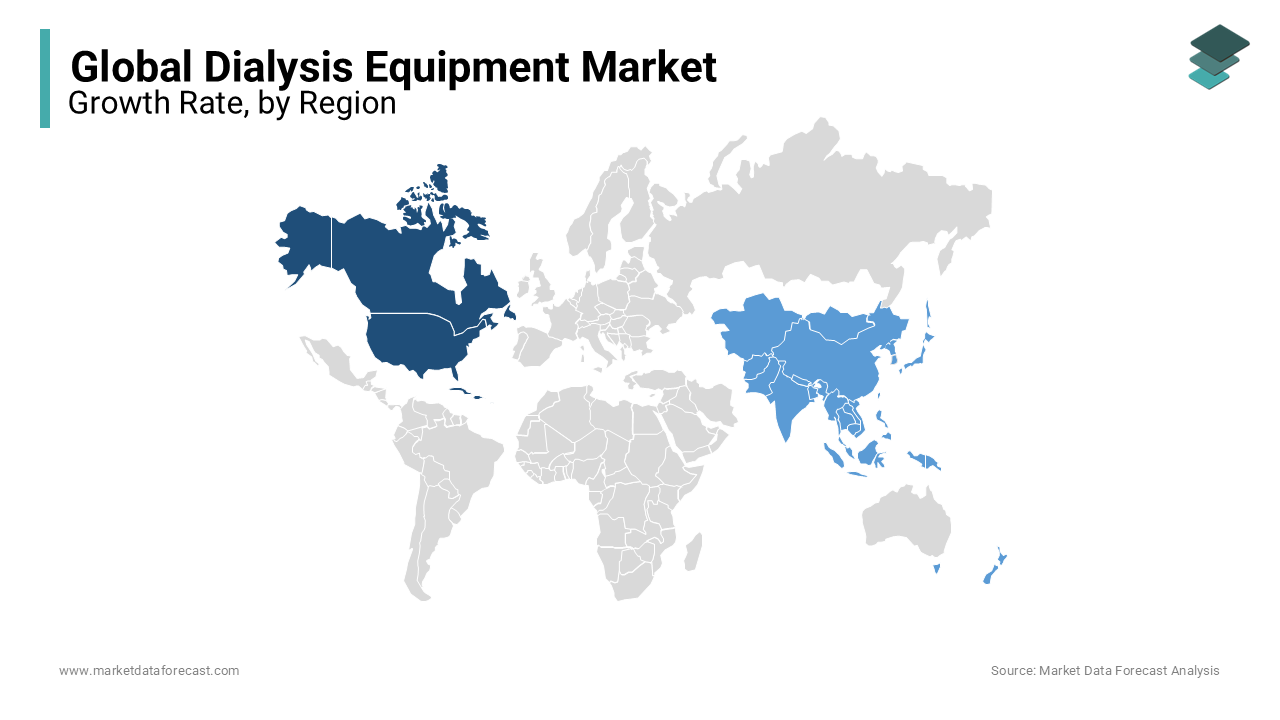
North America led the global dialysis equipment market with a 33.1% share in 2025. The region’s lead position is due to its advanced healthcare infrastructure, high prevalence of diabetes and hypertension, and robust reimbursement mechanisms. In the United States, over 800,000 individuals suffer from ESRD, with approximately 500,000 undergoing dialysis, according to the National Kidney Foundation. Medicare covers 92% of dialysis costs under the End-Stage Renal Disease Program, ensuring widespread access. Canada has also expanded home dialysis programs, with provinces like Ontario investing in remote monitoring networks. The presence of major manufacturers such as Fresenius Medical Care and DaVita, coupled with strong clinical research in nephrology, solidifies North America’s position as a hub of innovation and high-volume dialysis service delivery.
Europe is characterized by a mature dialysis ecosystem and increasing emphasis on home-based therapies. Germany and France operate some of the most technologically advanced dialysis centers in the world, with over 70% of facilities equipped with online hemodiafiltration systems, as per the European Renal Association. Regulatory harmonization under the EU Medical Devices Regulation (MDR) ensures high equipment safety standards, fostering patient trust and sustained investment in next-generation dialysis technologies.
Asia Pacific accounts for a significant share of the market, with rapid growth fueled by rising CKD prevalence and expanding healthcare access. In India, the number of dialysis centers grew from 1,200 to over 2,500 during the same period, according to the Indian Society of Nephrology. Japan, with the world’s highest life expectancy, maintains a highly standardized dialysis system, treating over 330,000 patients annually, as per the Japanese Society for Dialysis Medicine, setting benchmarks for clinical outcomes and equipment utilization.
Latin America represents a notable share of the global market, with Brazil and Mexico driving regional demand. Brazil operates over 1,800 dialysis clinics, serving more than 150,000 patients, as per the Brazilian Society of Nephrology. The Unified Health System (SUS) provides free dialysis, ensuring broad access despite economic constraints. Public-private partnerships are emerging to expand infrastructure, but inconsistent reimbursement and supply chain limitations continue to challenge equitable service delivery across the region.
Middle East and Africa collectively exhibit divergent dynamics. Gulf Cooperation Council (GCC) countries like Saudi Arabia and the UAE have highly developed dialysis networks, with Saudi Arabia operating over 300 centers and achieving near-universal ESRD coverage, as per the Saudi Center for Organ Transplantation. The UAE mandates health insurance for all residents, facilitating access to advanced equipment. In contrast, Sub-Saharan Africa faces severe shortages, according to the African Association of Nephrology, fewer than 15% of those needing dialysis receive it. Donor-funded initiatives and mobile dialysis units are being piloted to bridge gaps, but systemic underinvestment remains a critical barrier to growth.
COMPETITIVE LANDSCAPE
The competition in the dialysis equipment market is shaped by a convergence of technological innovation, regulatory compliance, and patient-centered care models. Multinational corporations dominate with integrated offerings that combine devices, consumables, and clinical services, while regional players differentiate through cost-effective, locally adapted solutions. In the Asia Pacific, competition is intensifying as local manufacturers improve quality to challenge established brands. Differentiation increasingly hinges on digital capabilities, such as remote monitoring and AI-driven treatment optimization, rather than hardware alone. Service reliability, training support, and after-sales maintenance play decisive roles in procurement decisions. With rising pressure to reduce healthcare costs, providers favor companies that deliver long-term value through improved patient outcomes and operational efficiency, making sustainability and clinical integration critical competitive levers.
KEY MARKET PLAYERS
Companies leading the global dialysis equipment market profiled in the report are
- Fresenius Medical
- Care AG & Co
- Gambro AB
- Baxter International Inc
- Nipro Inc
- ALL-MED Medical GmbH
- Asahi Kasei Corporation.
Top Players in the Dialysis Equipment Market
Baxter International Inc., a leading US-based healthcare company, announced that it had received FDA approval for its prospective multicenter clinical trials in January 2020 to test the on-demand PD generation system that facilitates the patient experience through home use. The test will assess the safety and effectiveness of the latest technology that uses a small water filtration device. It helps convert tap water into a dialysis solution to complement the patient's therapy session.
Fresenius Medical Care has established a dominant presence in the Asia Pacific by delivering integrated dialysis solutions encompassing hemodialysis machines, dialyzers, and chronic care management. The company operates over 500 dialysis centers across China, India, and Southeast Asia, providing both equipment and clinical services. It also partnered with local hospitals in Thailand and Indonesia to upgrade water treatment infrastructure, ensuring compatibility with its 5008 and 6008 dialysis machines. Through training programs for nephrologists and technicians, the company is enhancing clinical standards and building long-term trust within healthcare ecosystems, positioning itself as a comprehensive renal care enabler.
Baxter International Inc. plays a pivotal role in advancing peritoneal dialysis (PD) adoption across the Asia Pacific, where its automated PD cyclers and dual-chamber dialysate systems are widely used. The company has localized its product portfolio to meet regional preferences, such as introducing low-glucose degradation product (GDP) solutions in Japan and Korea to preserve peritoneal membrane integrity. It also collaborated with public health authorities in the Philippines and Vietnam to integrate home dialysis into national kidney disease programs. Through digital platforms like the HomeChoice Connect remote monitoring system, Baxter is improving patient adherence and clinical oversight, reinforcing its leadership in home-based renal therapies.
Nikkiso Co., Ltd. has emerged as a key regional innovator by designing hemodialysis equipment specifically for the Japanese and broader Asian markets, emphasizing compact design, energy efficiency, and ease of maintenance. The company’s HemoQueen series is installed in over 70% of dialysis clinics in Japan, as reported by the Japanese Society for Dialysis Therapy, due to its precision fluid control and low water consumption. It also entered a strategic collaboration with Indian dialysis providers to co-develop cost-optimized systems for tier-2 and tier-3 cities. By combining domestic market strength with targeted international expansion, Nikkiso is strengthening its reputation as a technologically advanced, regionally attuned player in the dialysis equipment landscape.
Top Strategies Used by the Key Market Participants
Key players in the dialysis equipment market deploy multifaceted strategies to consolidate their global and regional influence. Major approaches include product innovation focused on compact, intelligent, and user-friendly devices that support both in-center and home-based care. Companies are investing heavily in digital health integration, incorporating remote monitoring, predictive maintenance, and real-time patient data analytics into their systems. Strategic partnerships with hospitals, governments, and insurance providers ensure broader reimbursement coverage and clinical adoption. Expansion into emerging markets is achieved through localized manufacturing, training programs, and public-private collaborations. Additionally, sustainability initiatives—such as reducing water consumption and plastic waste—are becoming integral to product design. Mergers and acquisitions are leveraged to enhance technological portfolios and extend service networks, ensuring end-to-end renal care solution.
RECENT MARKET HAPPENINGS
- In October 2022, during this critical time in healthcare delivery, Fresenius Renal Care, the nation's top supplier of kidney care services, commends the dedication of its staff to its core principles of cooperation, proactiveness, dependability, and excellence in care. Those who excel in the five clinical pillars—quality and safety, growth, clinical leadership, clinical excellence, and patient experience—will receive Fresenius Kidney Care's Caring About Renal Excellence (CARE) Award.
- In September 2022, As Hurricane Ian approaches Florida's west coast, Fresenius Medical Care North America (FMCNA), the top dialysis provider in the country, has activated its national emergency response team to support personnel and maintain continuity of care for patients.
- Call Fresenius Kidney Care's 24-hour Emergency Hotline at 1-800-626-1297 if you require life-sustaining dialysis or have any questions about where to find care before, during, or after the storm. No matter their caregiver, any dialysis patient in the affected areas is eligible for this treatment. According to Bill Valle, CEO of Fresenius Medical Care North America and interim president of Fresenius Kidney Care, "Our priority is the health and safety of our patients and colleagues."
- In September 2022, To refocus after making its largest-ever acquisition last year, Baxter International Inc. is reportedly considering selling two subsidiaries inside its flagship renal-care business. In addition, according to the sources, the Deerfield, Illinois-based medical device company is collaborating with advisors on possible sales of its hemodialysis and renal care operations, who asked to remain anonymous because the material is private. According to the people, the units are anticipated to be worth well under $1 billion and could draw attention from private equity groups.
- In July 2020, Baxter announced its partnership with Ayogo Health Inc. to assist the requirements of patients with kidney-related problems through digital health solutions. This partnership helps bring renal care by building mobile apps and digital solutions, bringing personalized, applicable, and timely assistance to patients with kidney failure.
MARKET SEGMENTATION
This research report on the global dialysis equipment market has been segmented and sub-segmented based on type, end-user, and region.
By Type
- Hemodialysis Equipment
- Hemodialysis Machines
- Dialyzers
- Blood Access Device Dialysate
- Peritoneal Dialysis Equipment
- Continuous Cycling Peritoneal Dialysis
- Continuous Ambulatory Peritoneal Dialysis
- Intermittent Peritoneal Dialysis
- Continuous Renal Replacement Therapy Systems
- Dialysis Accessories
By End-User
- In-Center Dialysis
- Home Care Dialysis
By Region
- North America
- Europe
- Asia-Pacific
- Latin America
- Middle East
- Africa