- Product Description Description
- Table of Contents TOC
- List of Table & Figure LOT
- Get Free Sample PDF Sample PDF
Market Size, 2025
$1.09 BnMarket Estimate, 2026
$1.16 BnMarket Forecast, 2034
$1.92 BnCAGR, 2026–2034
6.50%Global Gum Arabic Market Size
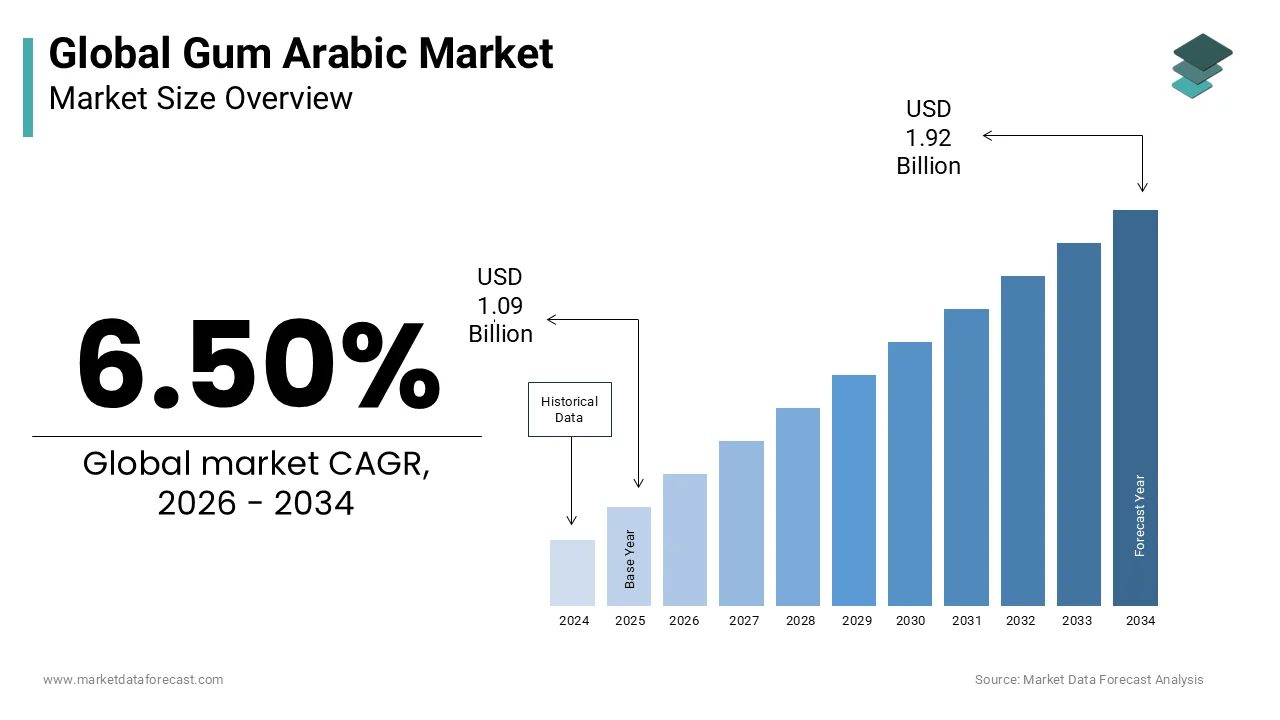
The global gum arabic market size was valued at USD 1.09 billion in 2025, and the global market size is expected to reach USD 1.92 billion by 2034 from USD 1.16 billion in 2026. The market is growing at a CAGR of 6.50% during the forecast period.
Gum arabic, often known as Indian gum, Senegal gum, acacia, gum acacia, Arabic gum, as well as other names, is a natural gum made from two acacia tree species, Vachellia Seyal and Acacia Senegal. Nigeria, Chad, Sudan, and Africa are the primary producers. It's employed in a variety of industries as a thickening, binding, and stabilising agent, including food and drinks, pharmaceuticals, and care products and cosmetics. Gum arabic is a complex polymer that both animals and humans cannot digest. Furthermore, the Food and Drug Administration (FDA) has regarded it as a safe dietary fibre since the 1970s. Acacia gum is high in water-soluble dietary fibres, which are not only healthy for your diet but also assist to control blood sugar levels and lower cholesterol levels. As a result, it's widely employed in the food and beverage, as well as medicinal industries.
MARKET DRIVERS
The increased knowledge of gum arabic's multi-functionality and associated therapeutic benefits is fueling the gum arabic market. Gum arabic's varied functions in enhancing the quality of food products have led to its widespread use in a variety of applications around the world. Gum arabic also has some medical properties, such as the elimination of dental plaque and wound healing, which are promoting its use in the pharmaceutical industry and driving the global market for gum arabic forward.
MARKET RESTRAINTS
The change in climatic conditions has adversely affected the trees which in turn has affected the volume of gum Arabic produced. A few more reasons can be attributed to the constant political struggle that the East African belt faces. Also, overexploitation of the acacia trees can also be a factor responsible. The development of synthetic flavours although lower in quality gives corporations a cheaper alternative, this is yet another factor which is likely to restrain the Gum Arabic market. An advantage that synthetic flavours have over natural gum Arabic is that production can be done as per the demand and climate changes don’t affect the production because of which the price remains low.
REPORT COVERAGE
| REPORT METRIC | DETAILS |
| Market Size Available | 2025 to 2034 |
| Base Year | 2025 |
| Forecast Period | 2026 to 2034 |
| CAGR | 6.50% |
| Segments Covered | By Type, Application, and Region |
| Various Analyses Covered | Global, Regional and Country Level Analysis; Segment-Level Analysis; DROC; PESTLE Analysis; Porter’s Five Forces Analysis; Competitive Landscape; Analyst Overview of Investment Opportunities |
| Regions Covered | North America, Europe, APAC, Latin America, Middle East & Africa |
| Market Leaders Profiled | Nexira International, AEP Colloids Inc, KERRY GROUP PUBLIC LIMITED COMPANY, Tic Gums Inc, POLYGAL AG, ALLAND ET ROBERT S.A, CARAGUM International S.A, IMPORTERS SERVICE CORP, C.E. Roeper GmbH, Mountain Rose Herbs, Inc. |
SEGMENTAL ANALYSIS
By Application Insights
Food & Beverage, Pharmaceutical, Personal Care, and Others are the application types of the Gum Arabic Market. During the projected period 2022-2027, food and beverage are expected to be the fastest expanding application, with a CAGR of 6.12 percent. This is due to the increasing use of Gum Arabic as a food additive in beverages, milkshakes, fruit-flavored water and beverages, and various carbonated beverages by food and beverage manufacturers and makers of edible flavors, syrups, and concentrates, which is driving up demand for the product. The causes for continued expansion throughout the predicted period 2025 to 2033, are thriving e-commerce platforms and an expanding number of domestic merchants.
By Type Insights
The Acacia Senegal and Acacia Seyal gum Arabic markets are divided by kind. Acacia Senegal dominated the Gum Arabic market in 2021 and is expected to continue to grow between 2022 and 2027. Regardless of climate conditions or soil texture, Acacia Senegal trees produce in all seasons. They are drought-tolerant, making them appropriate for cultivation in arid climates. When these trees are ill, they produce the most exceptional quality gum acacia. In various parts of the world, this type of gum is used for medicine and essential oils, as well as timber and firewood, as a soil fertilizer, for cropping systems, and as a decorative tree.
REGIONAL ANALYSIS
- Asia Pacific is expected to be the leading market. Gum arabic is very popular in North America, where it is mostly employed in the food and beverage industries. During the predicted period, Latin America and Europe are expected to expand slowly as these countries are focused on imports and don’t manufacture a lot in this product type.
- The Gum Arabic Market, during the forecast period 2022-2027, North America dominated the market with a 39.3 % share. This is due to the enormous customer base, particularly in the areas of beverages, confectioneries, and pharmaceuticals. During the prediction period 2022-2027, Asia Pacific will be the fastest expanding segment. This is due to an increase in dairy product sales, particularly in Japan, China, Australia, and India. Leading candy makers expanding their geographical presence across nations in South Asia is another element boosting regional market expansion.
KEY PLAYERS IN THE GUM ARABIC MARKET
Key Players in Gum Arabic Market are Nexira International, AEP Colloids Inc, KERRY GROUP PUBLIC LIMITED COMPANY, Tic Gums Inc, POLYGAL AG, ALLAND ET ROBERT S.A, CARAGUM International S.A, IMPORTERS SERVICE CORP, C.E. Roeper GmbH, Mountain Rose Herbs, Inc.
RECENT HAPPENINGS IN THE MARKET
- For the first time, the South Sudanese government began exporting Gum Arabic, popularly known as Acacia Gum, to the international market.
- A recent publication from Alland & Robert discusses acacia gum and its significance in lowering sugar consumption. The article discusses the body's reaction to acacia as well as how to incorporate it into a product.
- CaraGum has released CaraGum EM CG 108-2, a low-cost Arabic gum emulsifier. Because of its high concentration, it is less expensive than traditional gum.
MARKET SEGMENTATION
This research report on the Gum Arabic Market has been segmented and sub-segmented based on Application, Type, & region.
By Application
- Food & Beverage
- Pharmaceutical
- Personal care
- Others
By Type
- Senegalia Senegal Gum (Acacia Senegal)
- Vachellia Seyal Gum (Acacia Seyal)
By Region
- Europe
- North America
- Middle East
- Latin America
- Asia Pacific